Financial and Business News

“By the End of 2010, Every Second Person in Cape Town Was Trading,” FMAS:25 Leaders Roundtable

Wednesday, 09/07/2025 | 06:20 GMT by Jared Kirui
  • The panelists agreed that while access to trading platforms has increased in Africa, the key to long-term adoption lies in financial education.
  • Additionally, the region’s diversity in languages, regulations, and digital maturity makes a one-size-fits-all strategy ineffective.
FMAS:25

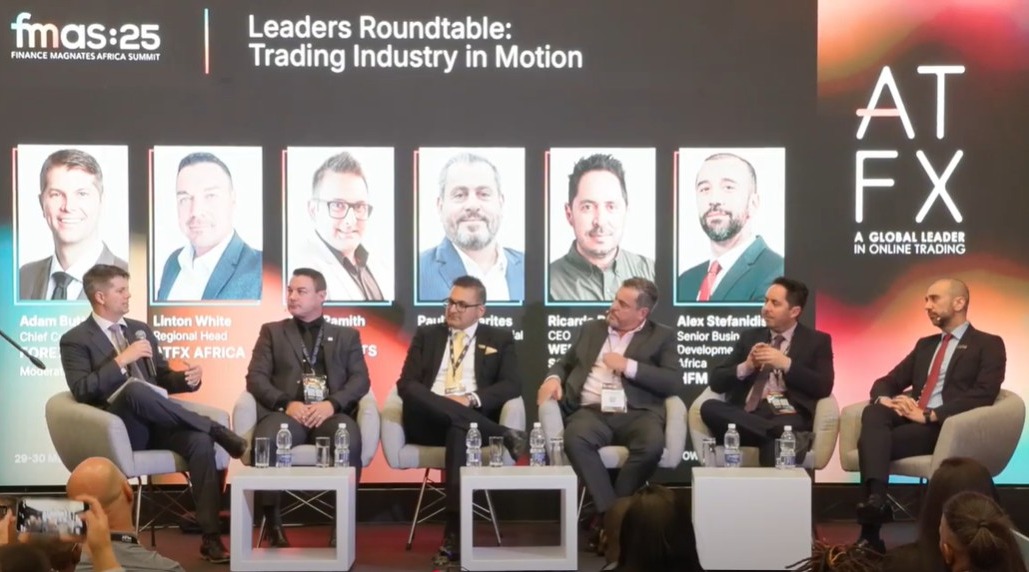
At the Finance Magnates Africa Summit 2025 in Cape Town, a panel discussion titled "Leaders Roundtable: Trading Industry in Motion" focused on the continent’s growing appetite for retail trading .

Leading executives from five major brokerages explained why Africa’s next trading chapter will be built not just on access but also on education and trust. The panel, moderated by ForexLive’s Chief Currency Analyst Adam Button, brought together executives from Exness, TD Markets, WeBull, HFM, and ATFX.

Education About the Industry

One key point of discussion was how Africa's trading business has expanded over the years. “By the end of 2010, every second person in Cape Town was trading,” said Paul Margarites, the Regional Commercial Director at Exness, recalling his days as a London-based trader visiting South Africa. “We’ve seen massive growth, not just in users but in knowledge.”

“There's been a massive sort of shift and education around the industry at large, and the fact that all these companies here and ourselves included have made it accessible to people not only in South Africa.”

Yet despite the exponential uptake in platforms and products, panelists were unanimous: education is the defining challenge and opportunity in the region.

“You could literally have a gold bar that you’re selling for half price,” said Amar of TD Markets. “But if your audience doesn’t understand what it is, they’ll walk away. That’s the difference between offering access and achieving adoption.”

And besides education, localization also emerged as another key differentiator. Africa’s diversity in languages, regulations, and digital maturity means brokers must abandon one-size-fits-all approaches.

Misconception About the Continent

The African market is often treated like a single country, a misconception the panelists agreed should change. According to the panelist, companies have recognized this and are seeking to change their approach to business in the region.

“ African countries are fragmented at the end of the day, and quite often, there's one approach to every country in Africa,” opined Ricardo Da Silva, the CEO at Webull Securities South Africa.

“I think you have to take a prudent approach, look at each individual country and its unique aspects and requirements, and cater your product to those countries.”

The other point that came up in the discussion was sifting through the noise. With over a thousand financial services providers active on the continent, clients need a way to sift through the noise. Proper education, not just sales, builds trust. And when it comes to growth, Africa is growing.

“In 2020, there were 450 financial services companies throughout the African continent, Linton White, the Regional Head of ATFX Africa, mentioned. “And at the beginning of 2024, we were looking at over 1,300. So, at this stage, we're probably sitting at what 1,500, 1,600 financial services providers.”

Regulations for the Financial Industry

The conversation also touched on the role of post-COVID financial stress and proactive regulation in driving demand for financial literacy. Amar Ramith, the CEO of TD Markets, noted that even crypto-focused traders are now seeking deeper understanding and more responsible decision-making.

“The beauty of the African market is that everybody is really education-hungry. We're seeing it super enthusiastically. Right now, the crypto market, which is now starting to sprout up quite largely, has a very proactive regulation for it, which is why we're actually launching a straight-up crypto exchange division. But it's because the FX market is now demanding more for the growth that's occurring in the fintech space.”

More from FMAS:25: “Even Five Good Trades in a Row Can Be Dangerous”: Inside FMAS:25’s Trading Success Panel

Beyond Online Engagement

When asked where the industry should invest, Alex Stefanidis, the Senior Business Development Executive for Africa at HFM, candidly explained the broker’s ongoing investment in offline engagement across the continent despite the industry being largely online.

"The answer is simply, no, it's not about the money, it's about getting out of our chamber, it's about listening to our clients. Someone will say it's an online industry, so why can't you listen online? Everything happens online, people are living online these days."

While the industry is predominantly online, Stefanidis made it clear that in-person interaction remains invaluable. “Online, you get biased opinions, you hear the influencers, you hear the key opinion leaders. I am more interested in the person behind the screen than the person inside the screen because he is my market; he's the one I want to listen to.”

He explained that the focus is not on short-term returns but on long-term understanding. He pushed back against the assumption that online channels provide adequate feedback.

At the Finance Magnates Africa Summit 2025 in Cape Town, a panel discussion titled "Leaders Roundtable: Trading Industry in Motion" focused on the continent’s growing appetite for retail trading .

Leading executives from five major brokerages explained why Africa’s next trading chapter will be built not just on access but also on education and trust. The panel, moderated by ForexLive’s Chief Currency Analyst Adam Button, brought together executives from Exness, TD Markets, WeBull, HFM, and ATFX.

Education About the Industry

One key point of discussion was how Africa's trading business has expanded over the years. “By the end of 2010, every second person in Cape Town was trading,” said Paul Margarites, the Regional Commercial Director at Exness, recalling his days as a London-based trader visiting South Africa. “We’ve seen massive growth, not just in users but in knowledge.”

“There's been a massive sort of shift and education around the industry at large, and the fact that all these companies here and ourselves included have made it accessible to people not only in South Africa.”

Yet despite the exponential uptake in platforms and products, panelists were unanimous: education is the defining challenge and opportunity in the region.

“You could literally have a gold bar that you’re selling for half price,” said Amar of TD Markets. “But if your audience doesn’t understand what it is, they’ll walk away. That’s the difference between offering access and achieving adoption.”

And besides education, localization also emerged as another key differentiator. Africa’s diversity in languages, regulations, and digital maturity means brokers must abandon one-size-fits-all approaches.

Misconception About the Continent

The African market is often treated like a single country, a misconception the panelists agreed should change. According to the panelist, companies have recognized this and are seeking to change their approach to business in the region.

“ African countries are fragmented at the end of the day, and quite often, there's one approach to every country in Africa,” opined Ricardo Da Silva, the CEO at Webull Securities South Africa.

“I think you have to take a prudent approach, look at each individual country and its unique aspects and requirements, and cater your product to those countries.”

The other point that came up in the discussion was sifting through the noise. With over a thousand financial services providers active on the continent, clients need a way to sift through the noise. Proper education, not just sales, builds trust. And when it comes to growth, Africa is growing.

“In 2020, there were 450 financial services companies throughout the African continent, Linton White, the Regional Head of ATFX Africa, mentioned. “And at the beginning of 2024, we were looking at over 1,300. So, at this stage, we're probably sitting at what 1,500, 1,600 financial services providers.”

Regulations for the Financial Industry

The conversation also touched on the role of post-COVID financial stress and proactive regulation in driving demand for financial literacy. Amar Ramith, the CEO of TD Markets, noted that even crypto-focused traders are now seeking deeper understanding and more responsible decision-making.

“The beauty of the African market is that everybody is really education-hungry. We're seeing it super enthusiastically. Right now, the crypto market, which is now starting to sprout up quite largely, has a very proactive regulation for it, which is why we're actually launching a straight-up crypto exchange division. But it's because the FX market is now demanding more for the growth that's occurring in the fintech space.”

More from FMAS:25: “Even Five Good Trades in a Row Can Be Dangerous”: Inside FMAS:25’s Trading Success Panel

Beyond Online Engagement

When asked where the industry should invest, Alex Stefanidis, the Senior Business Development Executive for Africa at HFM, candidly explained the broker’s ongoing investment in offline engagement across the continent despite the industry being largely online.

"The answer is simply, no, it's not about the money, it's about getting out of our chamber, it's about listening to our clients. Someone will say it's an online industry, so why can't you listen online? Everything happens online, people are living online these days."

While the industry is predominantly online, Stefanidis made it clear that in-person interaction remains invaluable. “Online, you get biased opinions, you hear the influencers, you hear the key opinion leaders. I am more interested in the person behind the screen than the person inside the screen because he is my market; he's the one I want to listen to.”

He explained that the focus is not on short-term returns but on long-term understanding. He pushed back against the assumption that online channels provide adequate feedback.

About the Author: Jared Kirui
Jared Kirui
  • 2449 Articles
  • 50 Followers
Jared is an experienced financial journalist passionate about all things forex and CFDs.

More from the Author

Retail FX