MONEX Group Releases Full Financial Results For Q1 Of Financial Year: Strong Performance In Japan & US
Wednesday,31/07/2013|04:50GMTby
Andrew Saks McLeod
Japanese company MONEX has announced its full financial results for the first quarter of this financial year showing a net revenue increase of 118%. Whilst continuing its strong performance on the domestic market, overseas presence continues to grow.
Japanese FX and Online Trading firm MONEX Group has today announced its corporate results for the first quarter of the fiscal year ending March 31, 2014.
US Retail Business Bucks The Trend
MONEX Group categorizes each of its business units according to importance and current status, citing TradeStation, the company's North American operations, as the largest retail investor market. This is an unusual conclusion, as volumes continue to decline in the US retail FX sector and companies find the cost of keeping their organizations in line with very strict regulations increasingly affecting the viability of their business.
To substantiate this finding, MONEX confirmed today that its TradeStation platform hosted 1.2 times the active traders as that of rival firm E*TRADE.
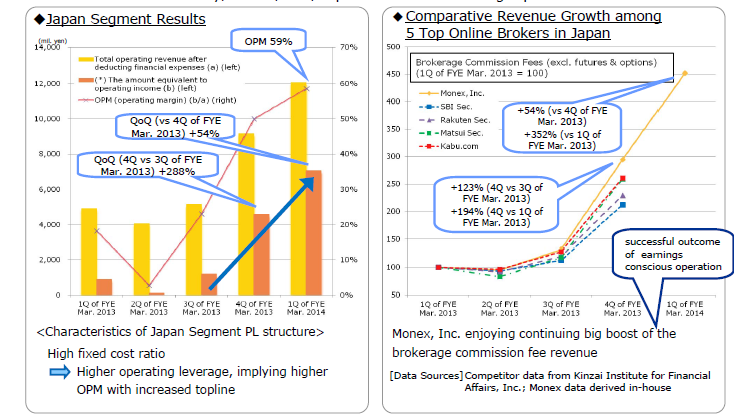
MONEX's Japanese operations continue to be the current revenue driver for the firm, with an operating income comparable to that of its contemporaries as follows: 80% of that of SBI Securities, 1.1 times that of Matsui Securities and double the income of Kabu.com
As is likely expected, China and Hong Kong are important growth markets for MONEX Group. BOOM, MONEX's subsidiary in that region has adopted a strategic plan to tap into the market in mainland China, and offers access to over 15 equity markets in the Asia-Pacific region.
Worldwide View
Japan, being home to the largest retail FX market in the world by a considerable margin, is by its very nature very much a country with a domestically orientated FX market, where most Japanese customers operate with Japanese companies, and the FX firms do not have such a need to seek business overseas as their home market is so established, however MONEX Group does consider the international market of importance.
The company's IBFX division has a global customer base and is responsible for continuing to expand this on an ongoing basis, whilst IBFX also expands the white label business to penetrate Asian and Middle Eastern markets.
Business Highlights For Q1
Business Highlights (Comparison with the previous quarter)
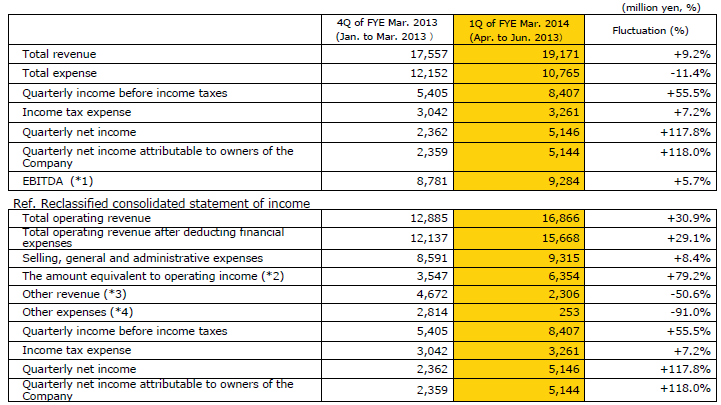
Significant QoQ increase; topline being x1.3, bottom line being x2.2
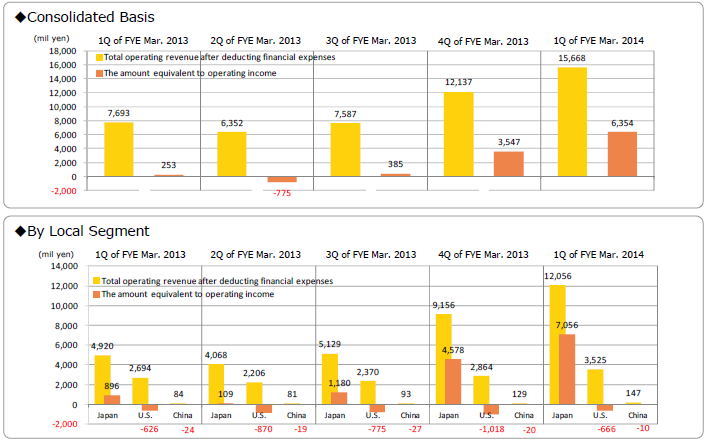
Total operating revenue after deducting financial expenses: JPY 15,668 million (+ 29%)
Quarterly net income attributable to owners of the Company: JPY 5,144 million (+118%)
Japan Segment
Capitalized on the booming market since December last year. Customer activity levels reached all-time highs this quarter.
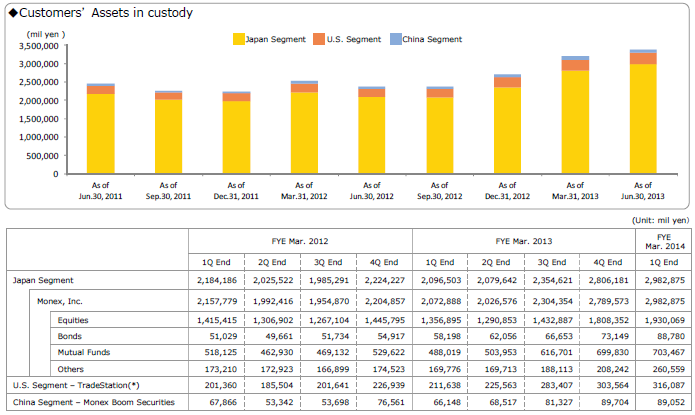
End-of-month customer assets increased to over JPY 3 trillion in April and May 2013
Monthly customer equity trading value reached all-time record of JPY 3.758 trillion in May 2013
Incurred a gain on the sale of shares of Lifenet Insurance Company of JPY 2,288 million
U.S. Segment
EBITDA for the quarter nearly reached the break-even point (USGAAP)
Shareholder Commitment
As a publicly listed firm, MONEX declared that its shareholders will receive an increased dividend payout ratio from 30% to 50% which is applicable from FYE March 2014 and to be announced in June 2013, and a completed share buyback amounting to approximately 4% of outstanding shares, or 120,000 shares, and retired all shares which were repurchased in May 2013.
Financial Results In Detail
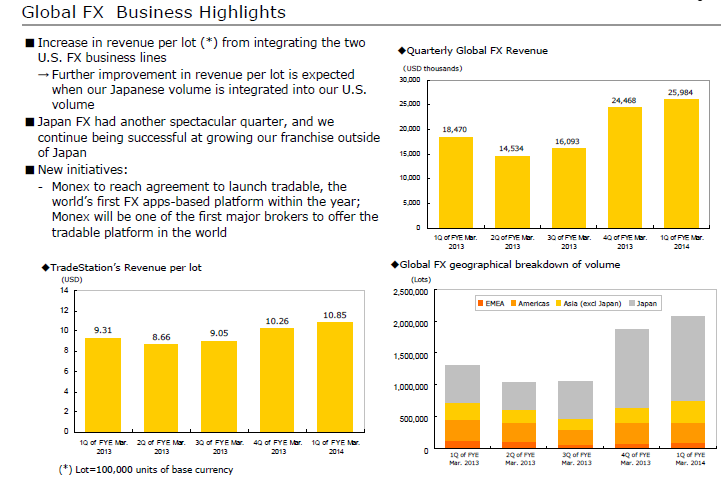
In this quarter, as depicted below, the Group intends to launch the tradable platform for the international market, and has experienced a continued growth in Japanese trading volume.
Note: Statements In This Chart Attributable to MONEX Group
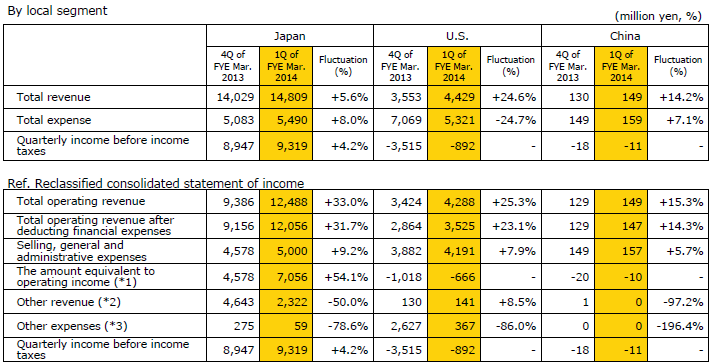
Compared to each quarterly period of the previous year, the entire business has, in line with the industry as a whole, improved in all markets including the US. The largest increase has been in the company's home market of Japan.
Operating Revenue Classified On Consolidated And Local Segment Results
Total Income By Local Segment
Overall, the company experienced a strong first quarter during this fiscal year, and has defined a steady growth strategy for the remainder of the period. In June this year, a clearer separation between operation & supervision of the company was agreed, and reinforcement of corporate governance, and ensuring optimum decision making environment at senior level were defined as priorities.
Two outside directors recently joined Monex: One of these appointments is a globally recognized business manager with a wide range of international business leadership expertise and the other is a qualified lawyer with law practice experiences in Japan & the United States, two crucial markets for MONEX Group.
Competition has increased domestically, but volumes continue to display healthy increases in Japan, attesting to a full recovery of what has been a strong FX industry in the nation for some years now.
Full Breakdown Of Financial Results Q1 Year Ending March 31, 2014
Japanese FX and Online Trading firm MONEX Group has today announced its corporate results for the first quarter of the fiscal year ending March 31, 2014.
US Retail Business Bucks The Trend
MONEX Group categorizes each of its business units according to importance and current status, citing TradeStation, the company's North American operations, as the largest retail investor market. This is an unusual conclusion, as volumes continue to decline in the US retail FX sector and companies find the cost of keeping their organizations in line with very strict regulations increasingly affecting the viability of their business.
To substantiate this finding, MONEX confirmed today that its TradeStation platform hosted 1.2 times the active traders as that of rival firm E*TRADE.
MONEX's Japanese operations continue to be the current revenue driver for the firm, with an operating income comparable to that of its contemporaries as follows: 80% of that of SBI Securities, 1.1 times that of Matsui Securities and double the income of Kabu.com
As is likely expected, China and Hong Kong are important growth markets for MONEX Group. BOOM, MONEX's subsidiary in that region has adopted a strategic plan to tap into the market in mainland China, and offers access to over 15 equity markets in the Asia-Pacific region.
Worldwide View
Japan, being home to the largest retail FX market in the world by a considerable margin, is by its very nature very much a country with a domestically orientated FX market, where most Japanese customers operate with Japanese companies, and the FX firms do not have such a need to seek business overseas as their home market is so established, however MONEX Group does consider the international market of importance.
The company's IBFX division has a global customer base and is responsible for continuing to expand this on an ongoing basis, whilst IBFX also expands the white label business to penetrate Asian and Middle Eastern markets.
Business Highlights For Q1
Business Highlights (Comparison with the previous quarter)
Significant QoQ increase; topline being x1.3, bottom line being x2.2
Total operating revenue after deducting financial expenses: JPY 15,668 million (+ 29%)
Quarterly net income attributable to owners of the Company: JPY 5,144 million (+118%)
Japan Segment
Capitalized on the booming market since December last year. Customer activity levels reached all-time highs this quarter.
End-of-month customer assets increased to over JPY 3 trillion in April and May 2013
Monthly customer equity trading value reached all-time record of JPY 3.758 trillion in May 2013
Incurred a gain on the sale of shares of Lifenet Insurance Company of JPY 2,288 million
U.S. Segment
EBITDA for the quarter nearly reached the break-even point (USGAAP)
Shareholder Commitment
As a publicly listed firm, MONEX declared that its shareholders will receive an increased dividend payout ratio from 30% to 50% which is applicable from FYE March 2014 and to be announced in June 2013, and a completed share buyback amounting to approximately 4% of outstanding shares, or 120,000 shares, and retired all shares which were repurchased in May 2013.
Financial Results In Detail
In this quarter, as depicted below, the Group intends to launch the tradable platform for the international market, and has experienced a continued growth in Japanese trading volume.
Note: Statements In This Chart Attributable to MONEX Group
Compared to each quarterly period of the previous year, the entire business has, in line with the industry as a whole, improved in all markets including the US. The largest increase has been in the company's home market of Japan.
Operating Revenue Classified On Consolidated And Local Segment Results
Total Income By Local Segment
Overall, the company experienced a strong first quarter during this fiscal year, and has defined a steady growth strategy for the remainder of the period. In June this year, a clearer separation between operation & supervision of the company was agreed, and reinforcement of corporate governance, and ensuring optimum decision making environment at senior level were defined as priorities.
Two outside directors recently joined Monex: One of these appointments is a globally recognized business manager with a wide range of international business leadership expertise and the other is a qualified lawyer with law practice experiences in Japan & the United States, two crucial markets for MONEX Group.
Competition has increased domestically, but volumes continue to display healthy increases in Japan, attesting to a full recovery of what has been a strong FX industry in the nation for some years now.
Full Breakdown Of Financial Results Q1 Year Ending March 31, 2014
Italy’s Consob Tightens Net on AI-Fueled Scams With Fresh Website Bans
FP Markets Winner Spotlight 🏆 | Global Broker of the Year 2025 #Trading #Broker #Innovation #Shorts
FP Markets Winner Spotlight 🏆 | Global Broker of the Year 2025 #Trading #Broker #Innovation #Shorts
FP Markets takes the spotlight as Global Broker of the Year 2025 at the Finance Magnates Awards.
Martin Stoilov, Head of Client Experience, shares that trust, innovation, and people played a key role in the company’s success, supported by a strong foundation of integrity and client-centricity.
Following this milestone, FP Markets continues to focus on growth, technology investment, and its core values of transparency and excellence.
👉 Be part of FM Awards 2026: https://awards.financemagnates.com/#nominate
FP Markets takes the spotlight as Global Broker of the Year 2025 at the Finance Magnates Awards.
Martin Stoilov, Head of Client Experience, shares that trust, innovation, and people played a key role in the company’s success, supported by a strong foundation of integrity and client-centricity.
Following this milestone, FP Markets continues to focus on growth, technology investment, and its core values of transparency and excellence.
👉 Be part of FM Awards 2026: https://awards.financemagnates.com/#nominate
In this video, we review @HolaPrimeMarketsOfficial, a multi-asset forex and CFDs broker offering different account types, trading platforms, and flexible trading conditions.
We cover the broker’s overall offering, including account options, trading environment, platforms like MT4 and MT5, and additional services such as managed accounts and fast withdrawals.
Watch the full video to see if Hola Prime Markets fits your trading needs.
📣 Stay up to date with the latest in finance and trading. Follow Finance Magnates for industry news, insights, and global event coverage.
Connect with us:
🔗 LinkedIn: /financemagnates
👍 Facebook: /financemagnates
📸 Instagram: https://www.instagram.com/financemagnates
🐦 X: https://x.com/financemagnates
🎥 TikTok: https://www.tiktok.com/tag/financemagnates
▶️ YouTube: /@financemagnates_official
#HolaPrime #ForexBroker #CFDTrading #FinanceMagnates #Trading #Forex #BrokerReview
In this video, we review @HolaPrimeMarketsOfficial, a multi-asset forex and CFDs broker offering different account types, trading platforms, and flexible trading conditions.
We cover the broker’s overall offering, including account options, trading environment, platforms like MT4 and MT5, and additional services such as managed accounts and fast withdrawals.
Watch the full video to see if Hola Prime Markets fits your trading needs.
📣 Stay up to date with the latest in finance and trading. Follow Finance Magnates for industry news, insights, and global event coverage.
Connect with us:
🔗 LinkedIn: /financemagnates
👍 Facebook: /financemagnates
📸 Instagram: https://www.instagram.com/financemagnates
🐦 X: https://x.com/financemagnates
🎥 TikTok: https://www.tiktok.com/tag/financemagnates
▶️ YouTube: /@financemagnates_official
#HolaPrime #ForexBroker #CFDTrading #FinanceMagnates #Trading #Forex #BrokerReview
Hola Prime Review: What You Need to Know | Full Breakdown by Finance Magnates
Hola Prime Review: What You Need to Know | Full Breakdown by Finance Magnates
In this video, we review @HolaPrime_Global, a proprietary trading firm offering evaluation programs and performance-based payouts in simulated market environments.
We cover how the challenge model works, including account types, profit splits (up to 95%), trading rules, and what it takes to reach a funded account. You’ll also learn about available platforms like MT4, MT5, cTrader, and more, along with insights into payouts, support, and trading conditions.
Watch the full video to see if Hola Prime fits your trading style.
📣 Stay up to date with the latest in finance and trading. Follow Finance Magnates for industry news, insights, and global event coverage.
Connect with us:
🔗 LinkedIn: /financemagnates
👍 Facebook: /financemagnates
📸 Instagram: https://www.instagram.com/financemagnates
🐦 X: https://x.com/financemagnates
🎥 TikTok: https://www.tiktok.com/tag/financemagnates
▶️ YouTube: /@financemagnates_official
#HolaPrime #PropFirm #Trading #FinanceMagnates #Forex #FuturesTrading #TradingReview #PropFirmReview
In this video, we review @HolaPrime_Global, a proprietary trading firm offering evaluation programs and performance-based payouts in simulated market environments.
We cover how the challenge model works, including account types, profit splits (up to 95%), trading rules, and what it takes to reach a funded account. You’ll also learn about available platforms like MT4, MT5, cTrader, and more, along with insights into payouts, support, and trading conditions.
Watch the full video to see if Hola Prime fits your trading style.
📣 Stay up to date with the latest in finance and trading. Follow Finance Magnates for industry news, insights, and global event coverage.
Connect with us:
🔗 LinkedIn: /financemagnates
👍 Facebook: /financemagnates
📸 Instagram: https://www.instagram.com/financemagnates
🐦 X: https://x.com/financemagnates
🎥 TikTok: https://www.tiktok.com/tag/financemagnates
▶️ YouTube: /@financemagnates_official
#HolaPrime #PropFirm #Trading #FinanceMagnates #Forex #FuturesTrading #TradingReview #PropFirmReview
Axi Winner Spotlight 🏆 | Global Most Innovative Broker 2025 #Innovation #Trading #Fintech #Broker
Axi Winner Spotlight 🏆 | Global Most Innovative Broker 2025 #Innovation #Trading #Fintech #Broker
Axi takes the spotlight at the Finance Magnates Awards, winning Global Most Innovative Broker 2025.
Olivia Xenofontos and Ivanna Openko share how the team will feel: proud, motivated, and ready to keep delivering.
They also describe the night as well-organized, focused, and enjoyable for all.
👉 Be part of FM Awards 2026.
Axi takes the spotlight at the Finance Magnates Awards, winning Global Most Innovative Broker 2025.
Olivia Xenofontos and Ivanna Openko share how the team will feel: proud, motivated, and ready to keep delivering.
They also describe the night as well-organized, focused, and enjoyable for all.
👉 Be part of FM Awards 2026.
Recognition that matters.
Built on transparency.
Driven by the industry.
The Finance Magnates Awards 2026.
Nominations are now open.
🔗 https://awards.financemagnates.com/?utm_source=SM&utm_medium=social&utm_campaign=recognition-matters
Recognition that matters.
Built on transparency.
Driven by the industry.
The Finance Magnates Awards 2026.
Nominations are now open.
🔗 https://awards.financemagnates.com/?utm_source=SM&utm_medium=social&utm_campaign=recognition-matters