>
GAIN Capital Publishes GFT's Three Year Financial Accounts: Steady Revenue Downturn
GAIN Capital Publishes GFT's Three Year Financial Accounts: Steady Revenue Downturn
Monday,18/11/2013|22:50GMTby
Andrew Saks McLeod
GAIN Capital has today published full financial details for GFT and its subsidiaries for three years including 2010, 2012 and 2013 in the 8-K form which the company submitted to the SEC on September 24.
The report contains a detailed overview of the financial position of GFT and subsidiaries as of December 31, 2012 and 2011, and the results of their operations and their cash flows for the three years in the period ended December 31, 2012 in accordance with accounting principles generally accepted in the United States of America.
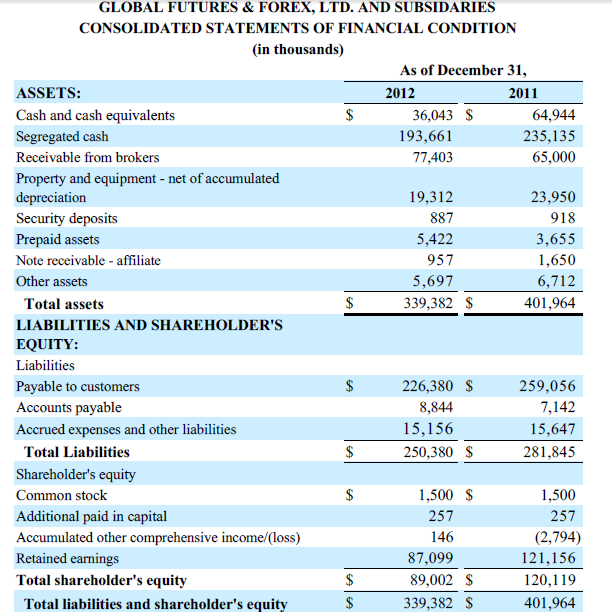
The filing asserts that GFT's cash and cash equivalent assets stood at $64,944,000 at the end of December 2011, and had reduced to $36,043,000 by December 2012, with segregated cash assets of $235,135,000 as of December 31, 2011, compared with $193,661,000 on December 31, 2012.
Total assets held by the company stood at $401,964,000 at the end of 2011, compared to $339,382,000 as of December 31, 2012.
With shareholder's equity standing at $120,119,000 as of December 31, 2011 and $89,002,000 one year later, the total liabilities and shareholder's equity equated to the exact same figures as the firm's assets.
Revenue Figures Over Three Years
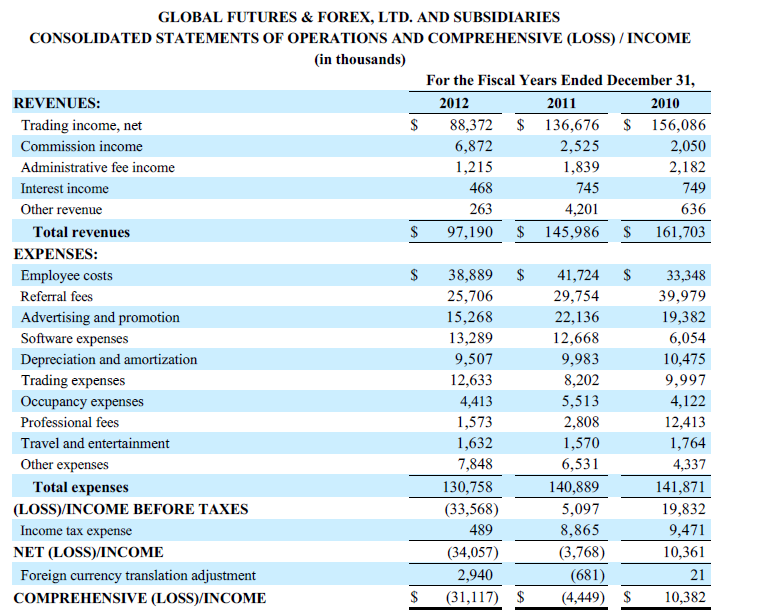
GFT has, along with many other retail FX firms in North America, experienced a sustained contraction in trading income, reporting $156,086,000 for the fiscal year ended December 31, 2010, compared with $136,676,000 on the last day of 2011, followed by $88,372,000 on December 31, 2012.
Total revenues including commission income, administrative fee income and interest income, amounted to $161,703,000 at the end of December 2010, followed by $145,986,000 on December 31, 2011, and $97,190,000 at the end of 2012.
Losses had been posted for the fiscal years of 2011 and 2012, of $4,449,000 and $31,117,000 respectively, depicting 2010 as the last profitable year for GFT during this reporting period, with a profit of $10,382,000 as of December 31, 2010.
Shareholder's equity had taken a dip over the three year reporting period , with 15,000 shares being worth $125,390,000 as of January 1, 2010, which had increased to $130,441,000 by December that year, subsequently declining to $120,118,000 by December 31, 2011, and falling further to $89,001,000 at the end of 2012.
Region Specific Segregated Funds
A downturn in segrated funds across GFT's regional divisions is apparent, with the company's UK division having gained an increase in segregated funds, or funds in seperate accounts by regulatory authorities.
The British arm of the firm had $142,930,000 in segregated funds as of December 31, 2011, compared with $174,685,000 one year later.
The Asia Pacific region showed lower figures with the branch in Japan having $66,047,000 in segregated funds on December 31, 2011 compared to just $11,120,000 on December 31, 2012.
Derivatives
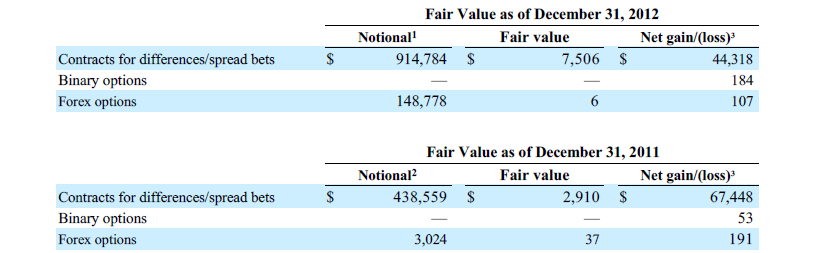
As of December 31, 2012, the company's derivatives stood at a notional value of $914,784,000 in CFDs and spread bets, with a fair value of $7,506,000, resulting in a net gain of $44,318,000, whereas its FX options figures were $148,778,00 in notional value, and $6,000 in fair vale.
One year previous, CFDs and spread bets were $438,559,000 in notional value and $2,910,000 in fair value, with a net gain of $67,448,000 and with FX options at $3,024 in notional value and $37,000 in fair value.
Contracts for differences/spread bets amount consists of $220.7 million and $694.1 million relating to amounts classified in receivable from brokers and payables to customers, respectively.
FX options amount consists $79.8 million and $69 million relating to amounts classified in receivable from brokers and payable to customers, respectively.
Contracts for differences/spread bets amount consists of $84.7 million and $353.8 million relating to amounts classified in receivable from brokers and payables to customers, respectively.
The FX options amount consists $2.1 million and $0.9 million relating to amounts classified in
receivable from brokers and payable to customers, respectively.
Recent Unaudited Six Monthly Figures
Total revenues for the unaudited period ending June 30, 2013 which comprises six months of operating were $63,196,000 compared to the same period last year's figure of $49,459,000 in trading income, which after adjustments for operational costs resulted in a loss of $13,769,000.
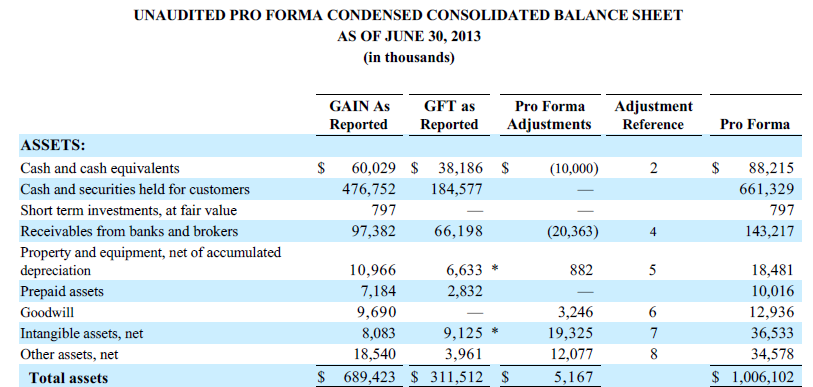
The company's 15,000 shares had a value of $74,072,000 as of June 30, 2013, and the segregated funds within the firm weighed in at $184,577,000 as of June 30 this year.
The report contains a detailed overview of the financial position of GFT and subsidiaries as of December 31, 2012 and 2011, and the results of their operations and their cash flows for the three years in the period ended December 31, 2012 in accordance with accounting principles generally accepted in the United States of America.
The filing asserts that GFT's cash and cash equivalent assets stood at $64,944,000 at the end of December 2011, and had reduced to $36,043,000 by December 2012, with segregated cash assets of $235,135,000 as of December 31, 2011, compared with $193,661,000 on December 31, 2012.
Total assets held by the company stood at $401,964,000 at the end of 2011, compared to $339,382,000 as of December 31, 2012.
With shareholder's equity standing at $120,119,000 as of December 31, 2011 and $89,002,000 one year later, the total liabilities and shareholder's equity equated to the exact same figures as the firm's assets.
Revenue Figures Over Three Years
GFT has, along with many other retail FX firms in North America, experienced a sustained contraction in trading income, reporting $156,086,000 for the fiscal year ended December 31, 2010, compared with $136,676,000 on the last day of 2011, followed by $88,372,000 on December 31, 2012.
Total revenues including commission income, administrative fee income and interest income, amounted to $161,703,000 at the end of December 2010, followed by $145,986,000 on December 31, 2011, and $97,190,000 at the end of 2012.
Losses had been posted for the fiscal years of 2011 and 2012, of $4,449,000 and $31,117,000 respectively, depicting 2010 as the last profitable year for GFT during this reporting period, with a profit of $10,382,000 as of December 31, 2010.
Shareholder's equity had taken a dip over the three year reporting period , with 15,000 shares being worth $125,390,000 as of January 1, 2010, which had increased to $130,441,000 by December that year, subsequently declining to $120,118,000 by December 31, 2011, and falling further to $89,001,000 at the end of 2012.
Region Specific Segregated Funds
A downturn in segrated funds across GFT's regional divisions is apparent, with the company's UK division having gained an increase in segregated funds, or funds in seperate accounts by regulatory authorities.
The British arm of the firm had $142,930,000 in segregated funds as of December 31, 2011, compared with $174,685,000 one year later.
The Asia Pacific region showed lower figures with the branch in Japan having $66,047,000 in segregated funds on December 31, 2011 compared to just $11,120,000 on December 31, 2012.
Derivatives
As of December 31, 2012, the company's derivatives stood at a notional value of $914,784,000 in CFDs and spread bets, with a fair value of $7,506,000, resulting in a net gain of $44,318,000, whereas its FX options figures were $148,778,00 in notional value, and $6,000 in fair vale.
One year previous, CFDs and spread bets were $438,559,000 in notional value and $2,910,000 in fair value, with a net gain of $67,448,000 and with FX options at $3,024 in notional value and $37,000 in fair value.
Contracts for differences/spread bets amount consists of $220.7 million and $694.1 million relating to amounts classified in receivable from brokers and payables to customers, respectively.
FX options amount consists $79.8 million and $69 million relating to amounts classified in receivable from brokers and payable to customers, respectively.
Contracts for differences/spread bets amount consists of $84.7 million and $353.8 million relating to amounts classified in receivable from brokers and payables to customers, respectively.
The FX options amount consists $2.1 million and $0.9 million relating to amounts classified in
receivable from brokers and payable to customers, respectively.
Recent Unaudited Six Monthly Figures
Total revenues for the unaudited period ending June 30, 2013 which comprises six months of operating were $63,196,000 compared to the same period last year's figure of $49,459,000 in trading income, which after adjustments for operational costs resulted in a loss of $13,769,000.
The company's 15,000 shares had a value of $74,072,000 as of June 30, 2013, and the segregated funds within the firm weighed in at $184,577,000 as of June 30 this year.
Interactive Brokers Adds Ether Staking with Fees Capped at 30% of Rewards
Featured Videos
FxPro Sells EU Clients to Capital.com; NAGA H1 Profit Revised
FxPro Sells EU Clients to Capital.com; NAGA H1 Profit Revised
FxPro Sells EU Clients to Capital.com; NAGA H1 Profit Revised
FxPro Sells EU Clients to Capital.com; NAGA H1 Profit Revised
Today’s financial news recap covers FxPro agrees to sell its European client book to Capital.com, NAGA raises its first-half profit estimate, Trade Republic prepares a fee-free pension account, and Interactive Brokers introduces Ether staking.
Finance Magnates Daily Recap brings you the latest news from forex and CFD brokers, fintech, payments, cryptocurrency, digital assets, trading platforms, financial regulation and global markets.
Get the key company news, executive moves, deals, regulatory updates and market developments of the day, in just a few minutes. New episodes published every weekday.
Read more: https://www.financemagnates.com
#FinanceMagnates #ForexNews #FintechNews
Today’s financial news recap covers FxPro agrees to sell its European client book to Capital.com, NAGA raises its first-half profit estimate, Trade Republic prepares a fee-free pension account, and Interactive Brokers introduces Ether staking.
Finance Magnates Daily Recap brings you the latest news from forex and CFD brokers, fintech, payments, cryptocurrency, digital assets, trading platforms, financial regulation and global markets.
Get the key company news, executive moves, deals, regulatory updates and market developments of the day, in just a few minutes. New episodes published every weekday.
Read more: https://www.financemagnates.com
#FinanceMagnates #ForexNews #FintechNews
Today’s financial news recap covers FxPro agrees to sell its European client book to Capital.com, NAGA raises its first-half profit estimate, Trade Republic prepares a fee-free pension account, and Interactive Brokers introduces Ether staking.
Finance Magnates Daily Recap brings you the latest news from forex and CFD brokers, fintech, payments, cryptocurrency, digital assets, trading platforms, financial regulation and global markets.
Get the key company news, executive moves, deals, regulatory updates and market developments of the day, in just a few minutes. New episodes published every weekday.
Read more: https://www.financemagnates.com
#FinanceMagnates #ForexNews #FintechNews
Today’s financial news recap covers FxPro agrees to sell its European client book to Capital.com, NAGA raises its first-half profit estimate, Trade Republic prepares a fee-free pension account, and Interactive Brokers introduces Ether staking.
Finance Magnates Daily Recap brings you the latest news from forex and CFD brokers, fintech, payments, cryptocurrency, digital assets, trading platforms, financial regulation and global markets.
Get the key company news, executive moves, deals, regulatory updates and market developments of the day, in just a few minutes. New episodes published every weekday.
Read more: https://www.financemagnates.com
#FinanceMagnates #ForexNews #FintechNews
Plus500 Plans US Super-App; Investec to Offer IG Platform
Plus500 Plans US Super-App; Investec to Offer IG Platform
Plus500 Plans US Super-App; Investec to Offer IG Platform
Plus500 Plans US Super-App; Investec to Offer IG Platform
Plus500 Plans US Super-App; Investec to Offer IG Platform
Plus500 Plans US Super-App; Investec to Offer IG Platform
Today’s financial news recap covers Plus500 plans a US trading super-app, Investec partners with IG, Trade Republic reports a sevenfold profit jump, and BingX adds thousands of US stocks.
Finance Magnates Daily Recap brings you the latest news from forex and CFD brokers, fintech, payments, cryptocurrency, digital assets, trading platforms, financial regulation and global markets.
Get the key company news, executive moves, deals, regulatory updates and market developments of the day, in just a few minutes. New episodes published every weekday.
Read more: https://www.financemagnates.com
#FinanceMagnates #ForexNews #FintechNews
Today’s financial news recap covers Plus500 plans a US trading super-app, Investec partners with IG, Trade Republic reports a sevenfold profit jump, and BingX adds thousands of US stocks.
Finance Magnates Daily Recap brings you the latest news from forex and CFD brokers, fintech, payments, cryptocurrency, digital assets, trading platforms, financial regulation and global markets.
Get the key company news, executive moves, deals, regulatory updates and market developments of the day, in just a few minutes. New episodes published every weekday.
Read more: https://www.financemagnates.com
#FinanceMagnates #ForexNews #FintechNews
Today’s financial news recap covers Plus500 plans a US trading super-app, Investec partners with IG, Trade Republic reports a sevenfold profit jump, and BingX adds thousands of US stocks.
Finance Magnates Daily Recap brings you the latest news from forex and CFD brokers, fintech, payments, cryptocurrency, digital assets, trading platforms, financial regulation and global markets.
Get the key company news, executive moves, deals, regulatory updates and market developments of the day, in just a few minutes. New episodes published every weekday.
Read more: https://www.financemagnates.com
#FinanceMagnates #ForexNews #FintechNews
Today’s financial news recap covers Plus500 plans a US trading super-app, Investec partners with IG, Trade Republic reports a sevenfold profit jump, and BingX adds thousands of US stocks.
Finance Magnates Daily Recap brings you the latest news from forex and CFD brokers, fintech, payments, cryptocurrency, digital assets, trading platforms, financial regulation and global markets.
Get the key company news, executive moves, deals, regulatory updates and market developments of the day, in just a few minutes. New episodes published every weekday.
Read more: https://www.financemagnates.com
#FinanceMagnates #ForexNews #FintechNews
Today’s financial news recap covers Plus500 plans a US trading super-app, Investec partners with IG, Trade Republic reports a sevenfold profit jump, and BingX adds thousands of US stocks.
Finance Magnates Daily Recap brings you the latest news from forex and CFD brokers, fintech, payments, cryptocurrency, digital assets, trading platforms, financial regulation and global markets.
Get the key company news, executive moves, deals, regulatory updates and market developments of the day, in just a few minutes. New episodes published every weekday.
Read more: https://www.financemagnates.com
#FinanceMagnates #ForexNews #FintechNews
Today’s financial news recap covers Plus500 plans a US trading super-app, Investec partners with IG, Trade Republic reports a sevenfold profit jump, and BingX adds thousands of US stocks.
Finance Magnates Daily Recap brings you the latest news from forex and CFD brokers, fintech, payments, cryptocurrency, digital assets, trading platforms, financial regulation and global markets.
Get the key company news, executive moves, deals, regulatory updates and market developments of the day, in just a few minutes. New episodes published every weekday.
Read more: https://www.financemagnates.com
#FinanceMagnates #ForexNews #FintechNews
FXCM UK Holds $110m in Client Money; IG CEO Questions Prediction Market Volumes
FXCM UK Holds $110m in Client Money; IG CEO Questions Prediction Market Volumes
FXCM UK Holds $110m in Client Money; IG CEO Questions Prediction Market Volumes
FXCM UK Holds $110m in Client Money; IG CEO Questions Prediction Market Volumes
FXCM UK Holds $110m in Client Money; IG CEO Questions Prediction Market Volumes
FXCM UK Holds $110m in Client Money; IG CEO Questions Prediction Market Volumes
Today’s financial news recap covers FXCM's UK arm holds $110 million in client money ahead of its sale to Trade Nation, Citadel Securities' UK profit falls 38 per cent, and Kraken secures its final Dubai crypto licence.
Finance Magnates Daily Recap brings you the latest news from forex and CFD brokers, fintech, payments, cryptocurrency, digital assets, trading platforms, financial regulation and global markets.
Get the key company news, executive moves, deals, regulatory updates and market developments of the day, in just a few minutes. New episodes published every weekday.
Read more: https://www.financemagnates.com
#FinanceMagnates #ForexNews #FintechNews
Today’s financial news recap covers FXCM's UK arm holds $110 million in client money ahead of its sale to Trade Nation, Citadel Securities' UK profit falls 38 per cent, and Kraken secures its final Dubai crypto licence.
Finance Magnates Daily Recap brings you the latest news from forex and CFD brokers, fintech, payments, cryptocurrency, digital assets, trading platforms, financial regulation and global markets.
Get the key company news, executive moves, deals, regulatory updates and market developments of the day, in just a few minutes. New episodes published every weekday.
Read more: https://www.financemagnates.com
#FinanceMagnates #ForexNews #FintechNews
Today’s financial news recap covers FXCM's UK arm holds $110 million in client money ahead of its sale to Trade Nation, Citadel Securities' UK profit falls 38 per cent, and Kraken secures its final Dubai crypto licence.
Finance Magnates Daily Recap brings you the latest news from forex and CFD brokers, fintech, payments, cryptocurrency, digital assets, trading platforms, financial regulation and global markets.
Get the key company news, executive moves, deals, regulatory updates and market developments of the day, in just a few minutes. New episodes published every weekday.
Read more: https://www.financemagnates.com
#FinanceMagnates #ForexNews #FintechNews
Today’s financial news recap covers FXCM's UK arm holds $110 million in client money ahead of its sale to Trade Nation, Citadel Securities' UK profit falls 38 per cent, and Kraken secures its final Dubai crypto licence.
Finance Magnates Daily Recap brings you the latest news from forex and CFD brokers, fintech, payments, cryptocurrency, digital assets, trading platforms, financial regulation and global markets.
Get the key company news, executive moves, deals, regulatory updates and market developments of the day, in just a few minutes. New episodes published every weekday.
Read more: https://www.financemagnates.com
#FinanceMagnates #ForexNews #FintechNews
Today’s financial news recap covers FXCM's UK arm holds $110 million in client money ahead of its sale to Trade Nation, Citadel Securities' UK profit falls 38 per cent, and Kraken secures its final Dubai crypto licence.
Finance Magnates Daily Recap brings you the latest news from forex and CFD brokers, fintech, payments, cryptocurrency, digital assets, trading platforms, financial regulation and global markets.
Get the key company news, executive moves, deals, regulatory updates and market developments of the day, in just a few minutes. New episodes published every weekday.
Read more: https://www.financemagnates.com
#FinanceMagnates #ForexNews #FintechNews
Today’s financial news recap covers FXCM's UK arm holds $110 million in client money ahead of its sale to Trade Nation, Citadel Securities' UK profit falls 38 per cent, and Kraken secures its final Dubai crypto licence.
Finance Magnates Daily Recap brings you the latest news from forex and CFD brokers, fintech, payments, cryptocurrency, digital assets, trading platforms, financial regulation and global markets.
Get the key company news, executive moves, deals, regulatory updates and market developments of the day, in just a few minutes. New episodes published every weekday.
Read more: https://www.financemagnates.com
#FinanceMagnates #ForexNews #FintechNews
AvaTrade to Acquire Most of FXCM; NAGA Raises $8M
AvaTrade to Acquire Most of FXCM; NAGA Raises $8M
AvaTrade to Acquire Most of FXCM; NAGA Raises $8M
AvaTrade to Acquire Most of FXCM; NAGA Raises $8M
AvaTrade to Acquire Most of FXCM; NAGA Raises $8M
AvaTrade to Acquire Most of FXCM; NAGA Raises $8M
Today’s financial news recap covers AvaTrade agrees to acquire most of FXCM, NAGA secures eight million dollars in new financing, and Wise seeks a tax settlement in the UK.
Finance Magnates Daily Recap brings you the latest news from forex and CFD brokers, fintech, payments, cryptocurrency, digital assets, trading platforms, financial regulation and global markets.
Get the key company news, executive moves, deals, regulatory updates and market developments of the day, in just a few minutes. New episodes published every weekday.
Read more: https://www.financemagnates.com
#FinanceMagnates #ForexNews #FintechNews
Today’s financial news recap covers AvaTrade agrees to acquire most of FXCM, NAGA secures eight million dollars in new financing, and Wise seeks a tax settlement in the UK.
Finance Magnates Daily Recap brings you the latest news from forex and CFD brokers, fintech, payments, cryptocurrency, digital assets, trading platforms, financial regulation and global markets.
Get the key company news, executive moves, deals, regulatory updates and market developments of the day, in just a few minutes. New episodes published every weekday.
Read more: https://www.financemagnates.com
#FinanceMagnates #ForexNews #FintechNews
Today’s financial news recap covers AvaTrade agrees to acquire most of FXCM, NAGA secures eight million dollars in new financing, and Wise seeks a tax settlement in the UK.
Finance Magnates Daily Recap brings you the latest news from forex and CFD brokers, fintech, payments, cryptocurrency, digital assets, trading platforms, financial regulation and global markets.
Get the key company news, executive moves, deals, regulatory updates and market developments of the day, in just a few minutes. New episodes published every weekday.
Read more: https://www.financemagnates.com
#FinanceMagnates #ForexNews #FintechNews
Today’s financial news recap covers AvaTrade agrees to acquire most of FXCM, NAGA secures eight million dollars in new financing, and Wise seeks a tax settlement in the UK.
Finance Magnates Daily Recap brings you the latest news from forex and CFD brokers, fintech, payments, cryptocurrency, digital assets, trading platforms, financial regulation and global markets.
Get the key company news, executive moves, deals, regulatory updates and market developments of the day, in just a few minutes. New episodes published every weekday.
Read more: https://www.financemagnates.com
#FinanceMagnates #ForexNews #FintechNews
Today’s financial news recap covers AvaTrade agrees to acquire most of FXCM, NAGA secures eight million dollars in new financing, and Wise seeks a tax settlement in the UK.
Finance Magnates Daily Recap brings you the latest news from forex and CFD brokers, fintech, payments, cryptocurrency, digital assets, trading platforms, financial regulation and global markets.
Get the key company news, executive moves, deals, regulatory updates and market developments of the day, in just a few minutes. New episodes published every weekday.
Read more: https://www.financemagnates.com
#FinanceMagnates #ForexNews #FintechNews
Today’s financial news recap covers AvaTrade agrees to acquire most of FXCM, NAGA secures eight million dollars in new financing, and Wise seeks a tax settlement in the UK.
Finance Magnates Daily Recap brings you the latest news from forex and CFD brokers, fintech, payments, cryptocurrency, digital assets, trading platforms, financial regulation and global markets.
Get the key company news, executive moves, deals, regulatory updates and market developments of the day, in just a few minutes. New episodes published every weekday.
Read more: https://www.financemagnates.com
#FinanceMagnates #ForexNews #FintechNews
XTB Adds Overnight US Stock Trading; Nasdaq Ventures Invests in One Trading
XTB Adds Overnight US Stock Trading; Nasdaq Ventures Invests in One Trading
XTB Adds Overnight US Stock Trading; Nasdaq Ventures Invests in One Trading
XTB Adds Overnight US Stock Trading; Nasdaq Ventures Invests in One Trading
XTB Adds Overnight US Stock Trading; Nasdaq Ventures Invests in One Trading
XTB Adds Overnight US Stock Trading; Nasdaq Ventures Invests in One Trading
Today’s financial news recap covers XTB expands overnight US stock trading, Fortrade reports higher revenue, Nasdaq backs One Trading, and Vest Labs raises 13 million dollars.
Finance Magnates Daily Recap brings you the latest news from forex and CFD brokers, fintech, payments, cryptocurrency, digital assets, trading platforms, financial regulation and global markets.
Get the key company news, executive moves, deals, regulatory updates and market developments of the day, in just a few minutes. New episodes published every weekday.
Read more: https://www.financemagnates.com
#FinanceMagnates #ForexNews #FintechNews
Today’s financial news recap covers XTB expands overnight US stock trading, Fortrade reports higher revenue, Nasdaq backs One Trading, and Vest Labs raises 13 million dollars.
Finance Magnates Daily Recap brings you the latest news from forex and CFD brokers, fintech, payments, cryptocurrency, digital assets, trading platforms, financial regulation and global markets.
Get the key company news, executive moves, deals, regulatory updates and market developments of the day, in just a few minutes. New episodes published every weekday.
Read more: https://www.financemagnates.com
#FinanceMagnates #ForexNews #FintechNews
Today’s financial news recap covers XTB expands overnight US stock trading, Fortrade reports higher revenue, Nasdaq backs One Trading, and Vest Labs raises 13 million dollars.
Finance Magnates Daily Recap brings you the latest news from forex and CFD brokers, fintech, payments, cryptocurrency, digital assets, trading platforms, financial regulation and global markets.
Get the key company news, executive moves, deals, regulatory updates and market developments of the day, in just a few minutes. New episodes published every weekday.
Read more: https://www.financemagnates.com
#FinanceMagnates #ForexNews #FintechNews
Today’s financial news recap covers XTB expands overnight US stock trading, Fortrade reports higher revenue, Nasdaq backs One Trading, and Vest Labs raises 13 million dollars.
Finance Magnates Daily Recap brings you the latest news from forex and CFD brokers, fintech, payments, cryptocurrency, digital assets, trading platforms, financial regulation and global markets.
Get the key company news, executive moves, deals, regulatory updates and market developments of the day, in just a few minutes. New episodes published every weekday.
Read more: https://www.financemagnates.com
#FinanceMagnates #ForexNews #FintechNews
Today’s financial news recap covers XTB expands overnight US stock trading, Fortrade reports higher revenue, Nasdaq backs One Trading, and Vest Labs raises 13 million dollars.
Finance Magnates Daily Recap brings you the latest news from forex and CFD brokers, fintech, payments, cryptocurrency, digital assets, trading platforms, financial regulation and global markets.
Get the key company news, executive moves, deals, regulatory updates and market developments of the day, in just a few minutes. New episodes published every weekday.
Read more: https://www.financemagnates.com
#FinanceMagnates #ForexNews #FintechNews
Today’s financial news recap covers XTB expands overnight US stock trading, Fortrade reports higher revenue, Nasdaq backs One Trading, and Vest Labs raises 13 million dollars.
Finance Magnates Daily Recap brings you the latest news from forex and CFD brokers, fintech, payments, cryptocurrency, digital assets, trading platforms, financial regulation and global markets.
Get the key company news, executive moves, deals, regulatory updates and market developments of the day, in just a few minutes. New episodes published every weekday.
Read more: https://www.financemagnates.com
#FinanceMagnates #ForexNews #FintechNews