The company’s CEO Drew Niv highlighted in the conference call after the FXCM Inc earnings report yesterday that the firm intended to repay its loan to Leucadia National by the end of 2015 primary through assets sales.
After FXCM Inc (NYSE:FXCM) reported its earnings and trading volumes figures yesterday, the company’s CEO Drew Niv and CFO Robert Lande have taken to the earnings call. FXCM’s senior management revealed crucial details about the company's future plans after the dramatic events of the 15th of January.
The main takeaway from the earnings call is that as expected, there will be a major restructuring of FXCM Inc's (NYSE:FXCM) business in the coming months. The company’s CEO Drew Niv outlined that aside from selling its institutional businesses, which was already clearly communicated by the firm, it intends to part with its FXCM Japan and FXCM Hong Kong subsidiaries.
In the aftermath of the Swiss National Bank’s decision to scrap the floor under the EUR/CHF, FXCM Inc (NYSE:FXCM) was forced to shore up its balance sheet. The company was forced to recapitalize, signing a $300 million loan agreement with Leucadia National with a starting interest rate of 10%, growing by 1.5% each quarter.
Revision of Losses from January 15th and Sale of FXCM Japan and Hong Kong
The company’s CEO, Drew Niv, highlighted during the earnings call that the firm intends to make significant reductions in its obligations to Leucadia National through the sale of non-core assets. The main surprise from this statement is in the details, as the CEO of FXCM Inc (NYSE:FXCM) stated that the firm decided to exit its business in Japan and Hong Kong.
Speaking during the earnings call, Mr. Niv said, “We have decided to exit the Japanese and Hong Kong retail markets selling our locally regulated subsidiary in each country. The sales will not only generate meaningful proceeds, but will also liberate over $50 million of cash which currently resides in these two entities.”
“We have multiple bids for each subsidiary and are seeing significant competition for these properties. We are in active discussions to select the best bid and move towards closing in the near future,” he explained.
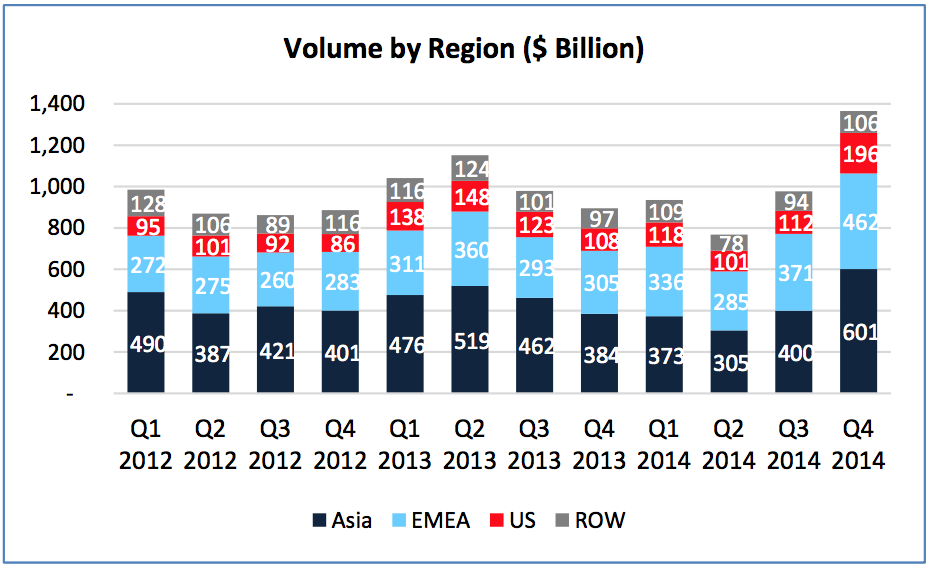
FXCM Trading Volume by Region, Source: FXCM
From the $50 million which Mr. Niv mentioned, $22 million in cash lie on the balance sheet of FXCM Japan, while the remaining $28 million are in the Hong Kong subsidiary of FXCM Inc.
The company's CEO Drew Niv stated, “We believe that the sale proceeds plus cash freed from the balance sheet of these entities could exceed $250 million, which would go a long way towards repaying if not fully repaying the Leucadia loan.”
Considering the lucrative Japanese market and the expansion appetite of many companies to acquire businesses in the region, the sale of this unit could net FXCM somewhere between $40 and $50 million.
The Hong Kong unit of the firm generated about $2.5 million in non-GAAP adjusted EBITDA in 2014. The jurisdiction and the lack of wide media coverage of the Swiss National Bank conundrum which FXCM faced, likely saved the value of the brand and clients continued to hold their accounts with the brokerage.
The main proceeds from potential sales will come from the non-core business of FXCM Inc (NYSE:FXCM). Back in 2012, FXCM acquired Lucid Markets for $176 million, with the estimated total costs of the investment totaling $192 million.
Considering the pressure under which FXCM is to sell its institutional business, and the outflow of institutional clients from FXCM, the company is not likely to recover its investment in this business.
The other big institutional business of FXCM, FastMatch, has experienced dwindling volumes in the aftermath of the Swiss National Bank debacle leading to decreased volumes.
FXCM owns 35% of FastMatch and the stake is on the sale list of the company alongside its high-frequency trading investment in V3. The company paid around $16 million for a 50.1 percent stake in V3, with the rest of the unit owned by Lucid Markets.
Retail Revenue per Million Drops to $69, Clients to Choose Dealing Desk or Not
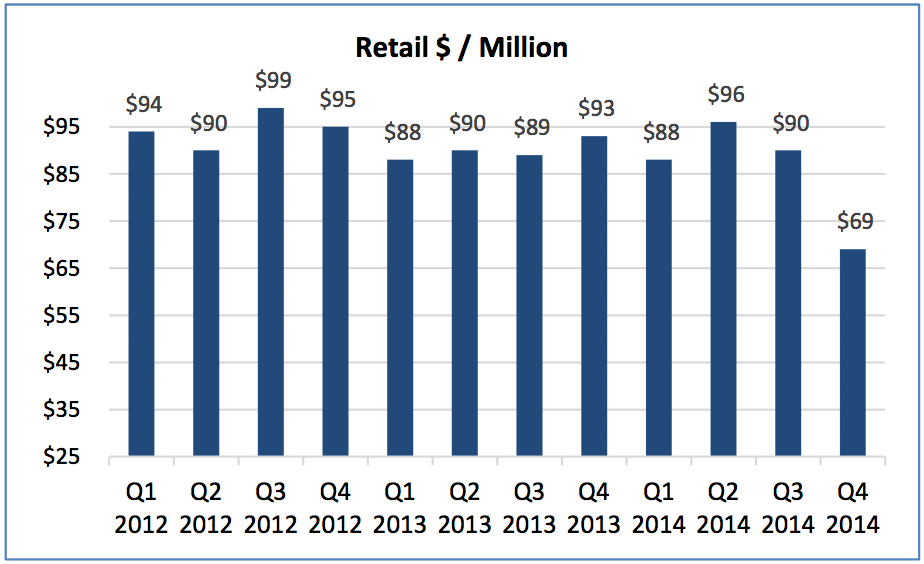
FXCM Retail Revenue per Million, Source: FXCM
The retail revenues per million (RPM) which FXCM reported for the fourth quarter of 2014 totaled $69. This is $1 below the estimate which the company made in its previous earnings report.
In order to optimize its RPM, FXCM Inc (NYSE:FXCM) has announced that it will be returning the dealing desk model for clients with equity below $20,000.
The company’s CEO Drew Niv said during the earnings call, “To accelerate growth in our core business we will launch a hybrid desk model for small retail FX accounts. These are accounts with less than $20,000 of deposits. While these accounts maybe large in number, they still represent much less than half of our trading volume.”
After FXCM Inc (NYSE:FXCM) reported its earnings and trading volumes figures yesterday, the company’s CEO Drew Niv and CFO Robert Lande have taken to the earnings call. FXCM’s senior management revealed crucial details about the company's future plans after the dramatic events of the 15th of January.
The main takeaway from the earnings call is that as expected, there will be a major restructuring of FXCM Inc's (NYSE:FXCM) business in the coming months. The company’s CEO Drew Niv outlined that aside from selling its institutional businesses, which was already clearly communicated by the firm, it intends to part with its FXCM Japan and FXCM Hong Kong subsidiaries.
In the aftermath of the Swiss National Bank’s decision to scrap the floor under the EUR/CHF, FXCM Inc (NYSE:FXCM) was forced to shore up its balance sheet. The company was forced to recapitalize, signing a $300 million loan agreement with Leucadia National with a starting interest rate of 10%, growing by 1.5% each quarter.
Revision of Losses from January 15th and Sale of FXCM Japan and Hong Kong
The company’s CEO, Drew Niv, highlighted during the earnings call that the firm intends to make significant reductions in its obligations to Leucadia National through the sale of non-core assets. The main surprise from this statement is in the details, as the CEO of FXCM Inc (NYSE:FXCM) stated that the firm decided to exit its business in Japan and Hong Kong.
Speaking during the earnings call, Mr. Niv said, “We have decided to exit the Japanese and Hong Kong retail markets selling our locally regulated subsidiary in each country. The sales will not only generate meaningful proceeds, but will also liberate over $50 million of cash which currently resides in these two entities.”
“We have multiple bids for each subsidiary and are seeing significant competition for these properties. We are in active discussions to select the best bid and move towards closing in the near future,” he explained.
FXCM Trading Volume by Region, Source: FXCM
From the $50 million which Mr. Niv mentioned, $22 million in cash lie on the balance sheet of FXCM Japan, while the remaining $28 million are in the Hong Kong subsidiary of FXCM Inc.
The company's CEO Drew Niv stated, “We believe that the sale proceeds plus cash freed from the balance sheet of these entities could exceed $250 million, which would go a long way towards repaying if not fully repaying the Leucadia loan.”
Considering the lucrative Japanese market and the expansion appetite of many companies to acquire businesses in the region, the sale of this unit could net FXCM somewhere between $40 and $50 million.
The Hong Kong unit of the firm generated about $2.5 million in non-GAAP adjusted EBITDA in 2014. The jurisdiction and the lack of wide media coverage of the Swiss National Bank conundrum which FXCM faced, likely saved the value of the brand and clients continued to hold their accounts with the brokerage.
The main proceeds from potential sales will come from the non-core business of FXCM Inc (NYSE:FXCM). Back in 2012, FXCM acquired Lucid Markets for $176 million, with the estimated total costs of the investment totaling $192 million.
Considering the pressure under which FXCM is to sell its institutional business, and the outflow of institutional clients from FXCM, the company is not likely to recover its investment in this business.
The other big institutional business of FXCM, FastMatch, has experienced dwindling volumes in the aftermath of the Swiss National Bank debacle leading to decreased volumes.
FXCM owns 35% of FastMatch and the stake is on the sale list of the company alongside its high-frequency trading investment in V3. The company paid around $16 million for a 50.1 percent stake in V3, with the rest of the unit owned by Lucid Markets.
Retail Revenue per Million Drops to $69, Clients to Choose Dealing Desk or Not
FXCM Retail Revenue per Million, Source: FXCM
The retail revenues per million (RPM) which FXCM reported for the fourth quarter of 2014 totaled $69. This is $1 below the estimate which the company made in its previous earnings report.
In order to optimize its RPM, FXCM Inc (NYSE:FXCM) has announced that it will be returning the dealing desk model for clients with equity below $20,000.
The company’s CEO Drew Niv said during the earnings call, “To accelerate growth in our core business we will launch a hybrid desk model for small retail FX accounts. These are accounts with less than $20,000 of deposits. While these accounts maybe large in number, they still represent much less than half of our trading volume.”
Italy’s Consob Tightens Net on AI-Fueled Scams With Fresh Website Bans
Featured Videos
FP Markets Winner Spotlight 🏆 | Global Broker of the Year 2025 #Trading #Broker #Innovation #Shorts
FP Markets Winner Spotlight 🏆 | Global Broker of the Year 2025 #Trading #Broker #Innovation #Shorts
FP Markets Winner Spotlight 🏆 | Global Broker of the Year 2025 #Trading #Broker #Innovation #Shorts
FP Markets Winner Spotlight 🏆 | Global Broker of the Year 2025 #Trading #Broker #Innovation #Shorts
FP Markets takes the spotlight as Global Broker of the Year 2025 at the Finance Magnates Awards.
Martin Stoilov, Head of Client Experience, shares that trust, innovation, and people played a key role in the company’s success, supported by a strong foundation of integrity and client-centricity.
Following this milestone, FP Markets continues to focus on growth, technology investment, and its core values of transparency and excellence.
👉 Be part of FM Awards 2026: https://awards.financemagnates.com/#nominate
FP Markets takes the spotlight as Global Broker of the Year 2025 at the Finance Magnates Awards.
Martin Stoilov, Head of Client Experience, shares that trust, innovation, and people played a key role in the company’s success, supported by a strong foundation of integrity and client-centricity.
Following this milestone, FP Markets continues to focus on growth, technology investment, and its core values of transparency and excellence.
👉 Be part of FM Awards 2026: https://awards.financemagnates.com/#nominate
FP Markets takes the spotlight as Global Broker of the Year 2025 at the Finance Magnates Awards.
Martin Stoilov, Head of Client Experience, shares that trust, innovation, and people played a key role in the company’s success, supported by a strong foundation of integrity and client-centricity.
Following this milestone, FP Markets continues to focus on growth, technology investment, and its core values of transparency and excellence.
👉 Be part of FM Awards 2026: https://awards.financemagnates.com/#nominate
FP Markets takes the spotlight as Global Broker of the Year 2025 at the Finance Magnates Awards.
Martin Stoilov, Head of Client Experience, shares that trust, innovation, and people played a key role in the company’s success, supported by a strong foundation of integrity and client-centricity.
Following this milestone, FP Markets continues to focus on growth, technology investment, and its core values of transparency and excellence.
👉 Be part of FM Awards 2026: https://awards.financemagnates.com/#nominate
In this video, we review @HolaPrimeMarketsOfficial, a multi-asset forex and CFDs broker offering different account types, trading platforms, and flexible trading conditions.
We cover the broker’s overall offering, including account options, trading environment, platforms like MT4 and MT5, and additional services such as managed accounts and fast withdrawals.
Watch the full video to see if Hola Prime Markets fits your trading needs.
📣 Stay up to date with the latest in finance and trading. Follow Finance Magnates for industry news, insights, and global event coverage.
Connect with us:
🔗 LinkedIn: /financemagnates
👍 Facebook: /financemagnates
📸 Instagram: https://www.instagram.com/financemagnates
🐦 X: https://x.com/financemagnates
🎥 TikTok: https://www.tiktok.com/tag/financemagnates
▶️ YouTube: /@financemagnates_official
#HolaPrime #ForexBroker #CFDTrading #FinanceMagnates #Trading #Forex #BrokerReview
In this video, we review @HolaPrimeMarketsOfficial, a multi-asset forex and CFDs broker offering different account types, trading platforms, and flexible trading conditions.
We cover the broker’s overall offering, including account options, trading environment, platforms like MT4 and MT5, and additional services such as managed accounts and fast withdrawals.
Watch the full video to see if Hola Prime Markets fits your trading needs.
📣 Stay up to date with the latest in finance and trading. Follow Finance Magnates for industry news, insights, and global event coverage.
Connect with us:
🔗 LinkedIn: /financemagnates
👍 Facebook: /financemagnates
📸 Instagram: https://www.instagram.com/financemagnates
🐦 X: https://x.com/financemagnates
🎥 TikTok: https://www.tiktok.com/tag/financemagnates
▶️ YouTube: /@financemagnates_official
#HolaPrime #ForexBroker #CFDTrading #FinanceMagnates #Trading #Forex #BrokerReview
In this video, we review @HolaPrimeMarketsOfficial, a multi-asset forex and CFDs broker offering different account types, trading platforms, and flexible trading conditions.
We cover the broker’s overall offering, including account options, trading environment, platforms like MT4 and MT5, and additional services such as managed accounts and fast withdrawals.
Watch the full video to see if Hola Prime Markets fits your trading needs.
📣 Stay up to date with the latest in finance and trading. Follow Finance Magnates for industry news, insights, and global event coverage.
Connect with us:
🔗 LinkedIn: /financemagnates
👍 Facebook: /financemagnates
📸 Instagram: https://www.instagram.com/financemagnates
🐦 X: https://x.com/financemagnates
🎥 TikTok: https://www.tiktok.com/tag/financemagnates
▶️ YouTube: /@financemagnates_official
#HolaPrime #ForexBroker #CFDTrading #FinanceMagnates #Trading #Forex #BrokerReview
In this video, we review @HolaPrimeMarketsOfficial, a multi-asset forex and CFDs broker offering different account types, trading platforms, and flexible trading conditions.
We cover the broker’s overall offering, including account options, trading environment, platforms like MT4 and MT5, and additional services such as managed accounts and fast withdrawals.
Watch the full video to see if Hola Prime Markets fits your trading needs.
📣 Stay up to date with the latest in finance and trading. Follow Finance Magnates for industry news, insights, and global event coverage.
Connect with us:
🔗 LinkedIn: /financemagnates
👍 Facebook: /financemagnates
📸 Instagram: https://www.instagram.com/financemagnates
🐦 X: https://x.com/financemagnates
🎥 TikTok: https://www.tiktok.com/tag/financemagnates
▶️ YouTube: /@financemagnates_official
#HolaPrime #ForexBroker #CFDTrading #FinanceMagnates #Trading #Forex #BrokerReview
In this video, we review @HolaPrimeMarketsOfficial, a multi-asset forex and CFDs broker offering different account types, trading platforms, and flexible trading conditions.
We cover the broker’s overall offering, including account options, trading environment, platforms like MT4 and MT5, and additional services such as managed accounts and fast withdrawals.
Watch the full video to see if Hola Prime Markets fits your trading needs.
📣 Stay up to date with the latest in finance and trading. Follow Finance Magnates for industry news, insights, and global event coverage.
Connect with us:
🔗 LinkedIn: /financemagnates
👍 Facebook: /financemagnates
📸 Instagram: https://www.instagram.com/financemagnates
🐦 X: https://x.com/financemagnates
🎥 TikTok: https://www.tiktok.com/tag/financemagnates
▶️ YouTube: /@financemagnates_official
#HolaPrime #ForexBroker #CFDTrading #FinanceMagnates #Trading #Forex #BrokerReview
In this video, we review @HolaPrimeMarketsOfficial, a multi-asset forex and CFDs broker offering different account types, trading platforms, and flexible trading conditions.
We cover the broker’s overall offering, including account options, trading environment, platforms like MT4 and MT5, and additional services such as managed accounts and fast withdrawals.
Watch the full video to see if Hola Prime Markets fits your trading needs.
📣 Stay up to date with the latest in finance and trading. Follow Finance Magnates for industry news, insights, and global event coverage.
Connect with us:
🔗 LinkedIn: /financemagnates
👍 Facebook: /financemagnates
📸 Instagram: https://www.instagram.com/financemagnates
🐦 X: https://x.com/financemagnates
🎥 TikTok: https://www.tiktok.com/tag/financemagnates
▶️ YouTube: /@financemagnates_official
#HolaPrime #ForexBroker #CFDTrading #FinanceMagnates #Trading #Forex #BrokerReview
Hola Prime Review: What You Need to Know | Full Breakdown by Finance Magnates
Hola Prime Review: What You Need to Know | Full Breakdown by Finance Magnates
Hola Prime Review: What You Need to Know | Full Breakdown by Finance Magnates
Hola Prime Review: What You Need to Know | Full Breakdown by Finance Magnates
Hola Prime Review: What You Need to Know | Full Breakdown by Finance Magnates
Hola Prime Review: What You Need to Know | Full Breakdown by Finance Magnates
In this video, we review @HolaPrime_Global, a proprietary trading firm offering evaluation programs and performance-based payouts in simulated market environments.
We cover how the challenge model works, including account types, profit splits (up to 95%), trading rules, and what it takes to reach a funded account. You’ll also learn about available platforms like MT4, MT5, cTrader, and more, along with insights into payouts, support, and trading conditions.
Watch the full video to see if Hola Prime fits your trading style.
📣 Stay up to date with the latest in finance and trading. Follow Finance Magnates for industry news, insights, and global event coverage.
Connect with us:
🔗 LinkedIn: /financemagnates
👍 Facebook: /financemagnates
📸 Instagram: https://www.instagram.com/financemagnates
🐦 X: https://x.com/financemagnates
🎥 TikTok: https://www.tiktok.com/tag/financemagnates
▶️ YouTube: /@financemagnates_official
#HolaPrime #PropFirm #Trading #FinanceMagnates #Forex #FuturesTrading #TradingReview #PropFirmReview
In this video, we review @HolaPrime_Global, a proprietary trading firm offering evaluation programs and performance-based payouts in simulated market environments.
We cover how the challenge model works, including account types, profit splits (up to 95%), trading rules, and what it takes to reach a funded account. You’ll also learn about available platforms like MT4, MT5, cTrader, and more, along with insights into payouts, support, and trading conditions.
Watch the full video to see if Hola Prime fits your trading style.
📣 Stay up to date with the latest in finance and trading. Follow Finance Magnates for industry news, insights, and global event coverage.
Connect with us:
🔗 LinkedIn: /financemagnates
👍 Facebook: /financemagnates
📸 Instagram: https://www.instagram.com/financemagnates
🐦 X: https://x.com/financemagnates
🎥 TikTok: https://www.tiktok.com/tag/financemagnates
▶️ YouTube: /@financemagnates_official
#HolaPrime #PropFirm #Trading #FinanceMagnates #Forex #FuturesTrading #TradingReview #PropFirmReview
In this video, we review @HolaPrime_Global, a proprietary trading firm offering evaluation programs and performance-based payouts in simulated market environments.
We cover how the challenge model works, including account types, profit splits (up to 95%), trading rules, and what it takes to reach a funded account. You’ll also learn about available platforms like MT4, MT5, cTrader, and more, along with insights into payouts, support, and trading conditions.
Watch the full video to see if Hola Prime fits your trading style.
📣 Stay up to date with the latest in finance and trading. Follow Finance Magnates for industry news, insights, and global event coverage.
Connect with us:
🔗 LinkedIn: /financemagnates
👍 Facebook: /financemagnates
📸 Instagram: https://www.instagram.com/financemagnates
🐦 X: https://x.com/financemagnates
🎥 TikTok: https://www.tiktok.com/tag/financemagnates
▶️ YouTube: /@financemagnates_official
#HolaPrime #PropFirm #Trading #FinanceMagnates #Forex #FuturesTrading #TradingReview #PropFirmReview
In this video, we review @HolaPrime_Global, a proprietary trading firm offering evaluation programs and performance-based payouts in simulated market environments.
We cover how the challenge model works, including account types, profit splits (up to 95%), trading rules, and what it takes to reach a funded account. You’ll also learn about available platforms like MT4, MT5, cTrader, and more, along with insights into payouts, support, and trading conditions.
Watch the full video to see if Hola Prime fits your trading style.
📣 Stay up to date with the latest in finance and trading. Follow Finance Magnates for industry news, insights, and global event coverage.
Connect with us:
🔗 LinkedIn: /financemagnates
👍 Facebook: /financemagnates
📸 Instagram: https://www.instagram.com/financemagnates
🐦 X: https://x.com/financemagnates
🎥 TikTok: https://www.tiktok.com/tag/financemagnates
▶️ YouTube: /@financemagnates_official
#HolaPrime #PropFirm #Trading #FinanceMagnates #Forex #FuturesTrading #TradingReview #PropFirmReview
In this video, we review @HolaPrime_Global, a proprietary trading firm offering evaluation programs and performance-based payouts in simulated market environments.
We cover how the challenge model works, including account types, profit splits (up to 95%), trading rules, and what it takes to reach a funded account. You’ll also learn about available platforms like MT4, MT5, cTrader, and more, along with insights into payouts, support, and trading conditions.
Watch the full video to see if Hola Prime fits your trading style.
📣 Stay up to date with the latest in finance and trading. Follow Finance Magnates for industry news, insights, and global event coverage.
Connect with us:
🔗 LinkedIn: /financemagnates
👍 Facebook: /financemagnates
📸 Instagram: https://www.instagram.com/financemagnates
🐦 X: https://x.com/financemagnates
🎥 TikTok: https://www.tiktok.com/tag/financemagnates
▶️ YouTube: /@financemagnates_official
#HolaPrime #PropFirm #Trading #FinanceMagnates #Forex #FuturesTrading #TradingReview #PropFirmReview
In this video, we review @HolaPrime_Global, a proprietary trading firm offering evaluation programs and performance-based payouts in simulated market environments.
We cover how the challenge model works, including account types, profit splits (up to 95%), trading rules, and what it takes to reach a funded account. You’ll also learn about available platforms like MT4, MT5, cTrader, and more, along with insights into payouts, support, and trading conditions.
Watch the full video to see if Hola Prime fits your trading style.
📣 Stay up to date with the latest in finance and trading. Follow Finance Magnates for industry news, insights, and global event coverage.
Connect with us:
🔗 LinkedIn: /financemagnates
👍 Facebook: /financemagnates
📸 Instagram: https://www.instagram.com/financemagnates
🐦 X: https://x.com/financemagnates
🎥 TikTok: https://www.tiktok.com/tag/financemagnates
▶️ YouTube: /@financemagnates_official
#HolaPrime #PropFirm #Trading #FinanceMagnates #Forex #FuturesTrading #TradingReview #PropFirmReview
Axi Winner Spotlight 🏆 | Global Most Innovative Broker 2025 #Innovation #Trading #Fintech #Broker
Axi Winner Spotlight 🏆 | Global Most Innovative Broker 2025 #Innovation #Trading #Fintech #Broker
Axi Winner Spotlight 🏆 | Global Most Innovative Broker 2025 #Innovation #Trading #Fintech #Broker
Axi Winner Spotlight 🏆 | Global Most Innovative Broker 2025 #Innovation #Trading #Fintech #Broker
Axi Winner Spotlight 🏆 | Global Most Innovative Broker 2025 #Innovation #Trading #Fintech #Broker
Axi Winner Spotlight 🏆 | Global Most Innovative Broker 2025 #Innovation #Trading #Fintech #Broker
Axi takes the spotlight at the Finance Magnates Awards, winning Global Most Innovative Broker 2025.
Olivia Xenofontos and Ivanna Openko share how the team will feel: proud, motivated, and ready to keep delivering.
They also describe the night as well-organized, focused, and enjoyable for all.
👉 Be part of FM Awards 2026.
Axi takes the spotlight at the Finance Magnates Awards, winning Global Most Innovative Broker 2025.
Olivia Xenofontos and Ivanna Openko share how the team will feel: proud, motivated, and ready to keep delivering.
They also describe the night as well-organized, focused, and enjoyable for all.
👉 Be part of FM Awards 2026.
Axi takes the spotlight at the Finance Magnates Awards, winning Global Most Innovative Broker 2025.
Olivia Xenofontos and Ivanna Openko share how the team will feel: proud, motivated, and ready to keep delivering.
They also describe the night as well-organized, focused, and enjoyable for all.
👉 Be part of FM Awards 2026.
Axi takes the spotlight at the Finance Magnates Awards, winning Global Most Innovative Broker 2025.
Olivia Xenofontos and Ivanna Openko share how the team will feel: proud, motivated, and ready to keep delivering.
They also describe the night as well-organized, focused, and enjoyable for all.
👉 Be part of FM Awards 2026.
Axi takes the spotlight at the Finance Magnates Awards, winning Global Most Innovative Broker 2025.
Olivia Xenofontos and Ivanna Openko share how the team will feel: proud, motivated, and ready to keep delivering.
They also describe the night as well-organized, focused, and enjoyable for all.
👉 Be part of FM Awards 2026.
Axi takes the spotlight at the Finance Magnates Awards, winning Global Most Innovative Broker 2025.
Olivia Xenofontos and Ivanna Openko share how the team will feel: proud, motivated, and ready to keep delivering.
They also describe the night as well-organized, focused, and enjoyable for all.
👉 Be part of FM Awards 2026.
Recognition that matters.
Built on transparency.
Driven by the industry.
The Finance Magnates Awards 2026.
Nominations are now open.
🔗 https://awards.financemagnates.com/?utm_source=SM&utm_medium=social&utm_campaign=recognition-matters
Recognition that matters.
Built on transparency.
Driven by the industry.
The Finance Magnates Awards 2026.
Nominations are now open.
🔗 https://awards.financemagnates.com/?utm_source=SM&utm_medium=social&utm_campaign=recognition-matters
Recognition that matters.
Built on transparency.
Driven by the industry.
The Finance Magnates Awards 2026.
Nominations are now open.
🔗 https://awards.financemagnates.com/?utm_source=SM&utm_medium=social&utm_campaign=recognition-matters
Recognition that matters.
Built on transparency.
Driven by the industry.
The Finance Magnates Awards 2026.
Nominations are now open.
🔗 https://awards.financemagnates.com/?utm_source=SM&utm_medium=social&utm_campaign=recognition-matters
Recognition that matters.
Built on transparency.
Driven by the industry.
The Finance Magnates Awards 2026.
Nominations are now open.
🔗 https://awards.financemagnates.com/?utm_source=SM&utm_medium=social&utm_campaign=recognition-matters
Recognition that matters.
Built on transparency.
Driven by the industry.
The Finance Magnates Awards 2026.
Nominations are now open.
🔗 https://awards.financemagnates.com/?utm_source=SM&utm_medium=social&utm_campaign=recognition-matters