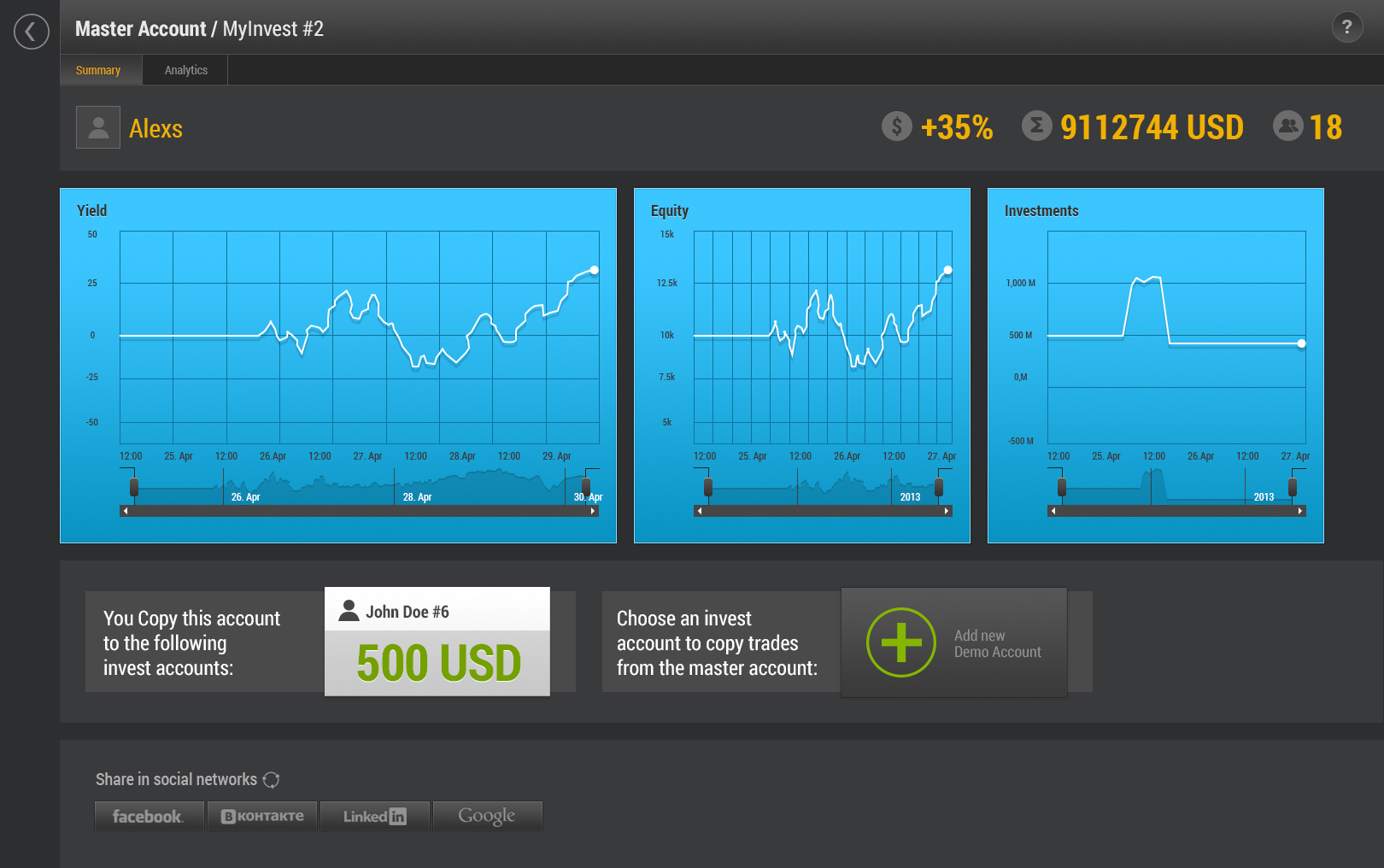
In the area of copy trading, MyInvest is a new venture that is currently hitting the market, with its roots in PAMM technology. MyInvest is a copy trader service that aims to combine benefits of managed accounts and social trading.
In the area of copy trading, MyInvest is a new venture that is currently hitting the market. Founded by Dmitry Orlov, who was the creator and the main ideologist of Alpari’s PAMM based product, MyInvest is a copy trader service that aims to combine benefits of managed accounts and social trading. The firm is currently pitching itself as a solution for brokers to offer their clients trade copying and is available as a fully branded integrated product. First to launch the product are GKFX and its Russian subsidiary, GKFX.Ru.
Learning more about the product and how it distinguishes itself from various other products that are in the market, Forex Magnates spoke to Alexey Semichastnov, Project Manager at MyInvest. Semichastnov explained that MyInvest targeted creating a product that met the needs of both brokers and clients. As a result, he added that there is a lot of flexibility in terms of how the product is able to be operated by brokers, as well focusing on execution quality. In singling out advantages, Semichastnov mentioned ‘quality of copying, money management, simplicity, and flexibility’.
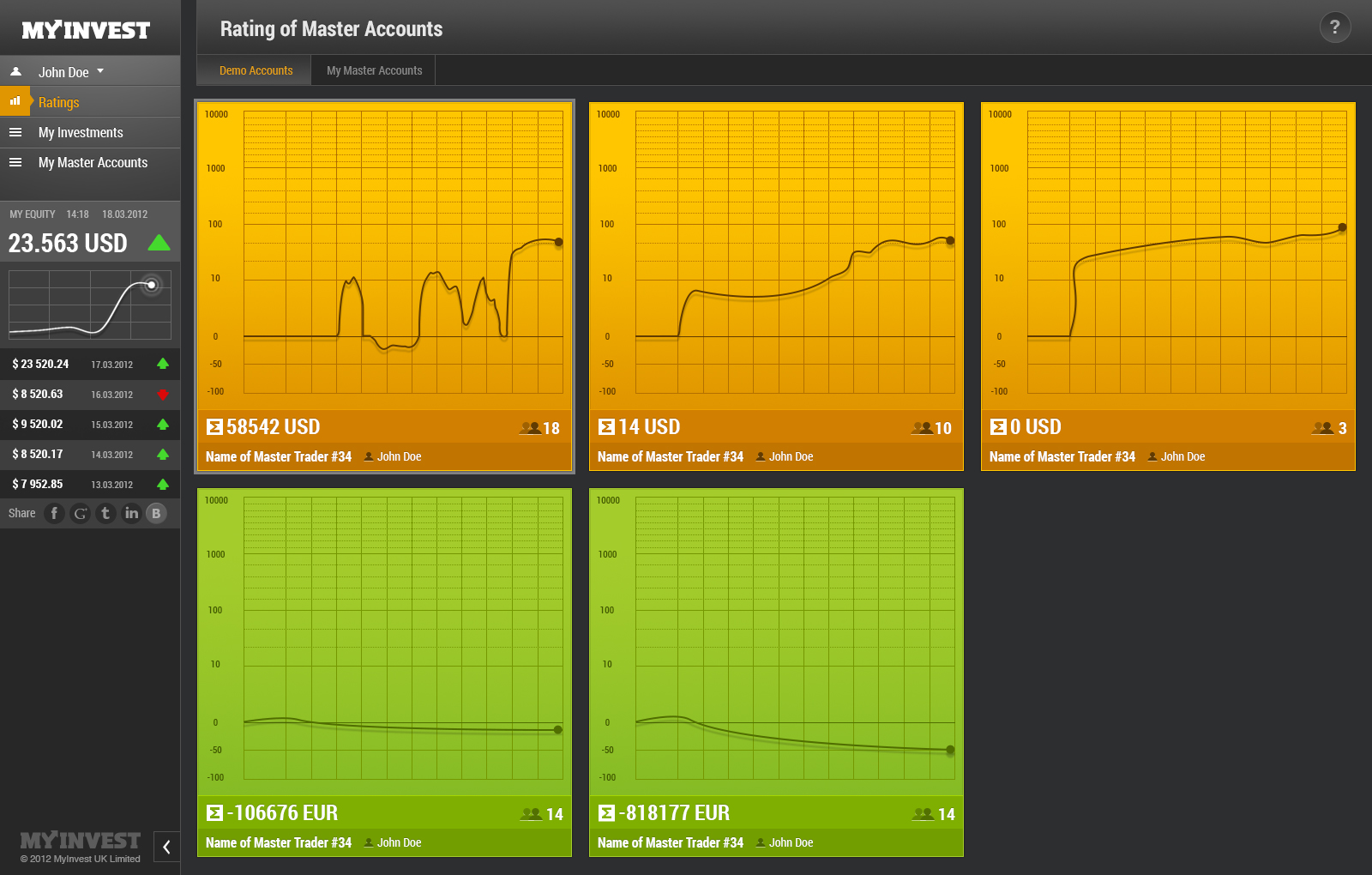
In terms of quality of copying, Semichastnov explained that the greatest impediment to successful copy trading, and an issue that exists in the market today are delays in executions, “from the moment a trader (leader) decides that it is a time for action till the moment this action is taken on an invest account (follower) 2-10 seconds pass, which means that the price that an investor gets is far away from what is expected by the trader and his strategy”. Addressing this, MyInvest is based on single server execution, with both leaders and followers having their trades filled on the same trading environment, with reported executions in milliseconds of each other. In addition, MyInvest supports aggregated fill types. With aggregated execution, brokers can elect to have leaders and followers filled simultaneously in one large order. The aggregated execution is similar to PAMM accounts, where money manager orders are scaled based on the amount of sub-accounts that are linked to the trader. However, Semichastnov added that the leader remains independent of the followers, and as a result “the trader doesn’t have to adjust positions when someone starts or stops copying his signals. Note that the trader doesn’t manage some pool account - he continues trading on his account as usual.”
In regards to flexibility, Semichastnov explained that the MyInvest platform can be branded and customized to their needs as he said “MyInvest provides a platform and each broker that deploys this platform can decide on how the service should look like for his clients. This covers all areas: from ability to smoothly embed all MyInvest functionality into the existing web site to decisions about core service functionality. For example how much fees signal providers get; whether the fees are turnover- or profit-based; whether investors are charged (by spread mark up or commission) for using the service or not and so on.”
In terms of other platforms, Semichastnov explained that similar to being an open-broker product, they are ready to support all trading platforms such as cTrader, MT5, and QUIK. He added that MyInvest is also equipped to offer services and plans for brokers offering non-forex products that include equities and derivatives trading.
Crowded but Growing Market
It will be interesting to see how MyInvest performs and its reception from traders. For brokers, the product provides firms the ability to offer a branded copy trading solution to clients. While the idea isn’t new, and there are several existing products on the market, there have been concerns among users in regards to product quality of current offerings. Nonetheless, several brokers have been quite positive about the existing products, specifically with the trio of Australian based forex brands, Go Markets, Vantage FX, and Enfinium leveraging their combined customer base with one auto trading solution.
Overall, due to the simplicity of copy versus discretionary trading, demand for auto trading products remains high among brokers. Since the beginning of the year we have several of the larger brokers who were later adopters launch branded offerings or partner with third party firms. As such, while MyInvest enters a crowded market, demand remains well paced which could boost the product’s chances of succeeding.
The article is part of Forex Magnates 'New Product Spotlight' posts. Previous writeups:
In the area of copy trading, MyInvest is a new venture that is currently hitting the market. Founded by Dmitry Orlov, who was the creator and the main ideologist of Alpari’s PAMM based product, MyInvest is a copy trader service that aims to combine benefits of managed accounts and social trading. The firm is currently pitching itself as a solution for brokers to offer their clients trade copying and is available as a fully branded integrated product. First to launch the product are GKFX and its Russian subsidiary, GKFX.Ru.
Learning more about the product and how it distinguishes itself from various other products that are in the market, Forex Magnates spoke to Alexey Semichastnov, Project Manager at MyInvest. Semichastnov explained that MyInvest targeted creating a product that met the needs of both brokers and clients. As a result, he added that there is a lot of flexibility in terms of how the product is able to be operated by brokers, as well focusing on execution quality. In singling out advantages, Semichastnov mentioned ‘quality of copying, money management, simplicity, and flexibility’.
In terms of quality of copying, Semichastnov explained that the greatest impediment to successful copy trading, and an issue that exists in the market today are delays in executions, “from the moment a trader (leader) decides that it is a time for action till the moment this action is taken on an invest account (follower) 2-10 seconds pass, which means that the price that an investor gets is far away from what is expected by the trader and his strategy”. Addressing this, MyInvest is based on single server execution, with both leaders and followers having their trades filled on the same trading environment, with reported executions in milliseconds of each other. In addition, MyInvest supports aggregated fill types. With aggregated execution, brokers can elect to have leaders and followers filled simultaneously in one large order. The aggregated execution is similar to PAMM accounts, where money manager orders are scaled based on the amount of sub-accounts that are linked to the trader. However, Semichastnov added that the leader remains independent of the followers, and as a result “the trader doesn’t have to adjust positions when someone starts or stops copying his signals. Note that the trader doesn’t manage some pool account - he continues trading on his account as usual.”
In regards to flexibility, Semichastnov explained that the MyInvest platform can be branded and customized to their needs as he said “MyInvest provides a platform and each broker that deploys this platform can decide on how the service should look like for his clients. This covers all areas: from ability to smoothly embed all MyInvest functionality into the existing web site to decisions about core service functionality. For example how much fees signal providers get; whether the fees are turnover- or profit-based; whether investors are charged (by spread mark up or commission) for using the service or not and so on.”
In terms of other platforms, Semichastnov explained that similar to being an open-broker product, they are ready to support all trading platforms such as cTrader, MT5, and QUIK. He added that MyInvest is also equipped to offer services and plans for brokers offering non-forex products that include equities and derivatives trading.
Crowded but Growing Market
It will be interesting to see how MyInvest performs and its reception from traders. For brokers, the product provides firms the ability to offer a branded copy trading solution to clients. While the idea isn’t new, and there are several existing products on the market, there have been concerns among users in regards to product quality of current offerings. Nonetheless, several brokers have been quite positive about the existing products, specifically with the trio of Australian based forex brands, Go Markets, Vantage FX, and Enfinium leveraging their combined customer base with one auto trading solution.
Overall, due to the simplicity of copy versus discretionary trading, demand for auto trading products remains high among brokers. Since the beginning of the year we have several of the larger brokers who were later adopters launch branded offerings or partner with third party firms. As such, while MyInvest enters a crowded market, demand remains well paced which could boost the product’s chances of succeeding.
The article is part of Forex Magnates 'New Product Spotlight' posts. Previous writeups:
Your Trading App Looks Like a Gambling Shop. Regulators Have Noticed.
Featured Videos
FM Daily Brief - 29 May 2026
Today is Friday, the 29th of May 2026, and these are our main stories: three global regulators are converging on trading platform design, and a Singapore prop firm launches a deferred-fee challenge model.
Today is Thursday, the 28th of May 2026, and these are our main stories: the chair of CySEC makes clear that prediction markets look like binary options to Brussels, Robinhood enters the age of AI agents, and a Google engineer faces insider trading charges over Polymarket activity.
Nick Strain, Country Manager Singapore at LMAX Digital, discusses the future of digital assets and shares his views on crypto markets, perpetuals, institutional adoption, tokenization, and why regulatory clarity remains the biggest driver in the space.
The discussion, hosted by Jonathan Fine, Content Strategist at Finance Magnates, covers:
Crypto market sentiment
Bitcoin and Ethereum's role as macro assets
The mechanics of perpetuals and funding rates
Institutional adoption beyond buying crypto
The opportunity in tokenization and programmable money
The critical role of regulation in market growth
Nick Strain, Country Manager Singapore at LMAX Digital, discusses the future of digital assets and shares his views on crypto markets, perpetuals, institutional adoption, tokenization, and why regulatory clarity remains the biggest driver in the space.
The discussion, hosted by Jonathan Fine, Content Strategist at Finance Magnates, covers:
Crypto market sentiment
Bitcoin and Ethereum's role as macro assets
The mechanics of perpetuals and funding rates
Institutional adoption beyond buying crypto
The opportunity in tokenization and programmable money
The critical role of regulation in market growth
Nick Strain, Country Manager Singapore at LMAX Digital, discusses the future of digital assets and shares his views on crypto markets, perpetuals, institutional adoption, tokenization, and why regulatory clarity remains the biggest driver in the space.
The discussion, hosted by Jonathan Fine, Content Strategist at Finance Magnates, covers:
Crypto market sentiment
Bitcoin and Ethereum's role as macro assets
The mechanics of perpetuals and funding rates
Institutional adoption beyond buying crypto
The opportunity in tokenization and programmable money
The critical role of regulation in market growth
Nick Strain, Country Manager Singapore at LMAX Digital, discusses the future of digital assets and shares his views on crypto markets, perpetuals, institutional adoption, tokenization, and why regulatory clarity remains the biggest driver in the space.
The discussion, hosted by Jonathan Fine, Content Strategist at Finance Magnates, covers:
Crypto market sentiment
Bitcoin and Ethereum's role as macro assets
The mechanics of perpetuals and funding rates
Institutional adoption beyond buying crypto
The opportunity in tokenization and programmable money
The critical role of regulation in market growth
Nick Strain, Country Manager Singapore at LMAX Digital, discusses the future of digital assets and shares his views on crypto markets, perpetuals, institutional adoption, tokenization, and why regulatory clarity remains the biggest driver in the space.
The discussion, hosted by Jonathan Fine, Content Strategist at Finance Magnates, covers:
Crypto market sentiment
Bitcoin and Ethereum's role as macro assets
The mechanics of perpetuals and funding rates
Institutional adoption beyond buying crypto
The opportunity in tokenization and programmable money
The critical role of regulation in market growth
Nick Strain, Country Manager Singapore at LMAX Digital, discusses the future of digital assets and shares his views on crypto markets, perpetuals, institutional adoption, tokenization, and why regulatory clarity remains the biggest driver in the space.
The discussion, hosted by Jonathan Fine, Content Strategist at Finance Magnates, covers:
Crypto market sentiment
Bitcoin and Ethereum's role as macro assets
The mechanics of perpetuals and funding rates
Institutional adoption beyond buying crypto
The opportunity in tokenization and programmable money
The critical role of regulation in market growth
FM Daily Brief - 27 May 2026
Today is Wednesday, the 27th of May 2026, and these are our main stories: questions are swirling around the futures of FXCM and Tradu, as owner Jefferies reportedly weighs a sale, an acquisition of a prop firm, and the demographics of prediction markets.
FYNXT CEO Samuel Aeby: Why Brokers Need Operating Systems, Not Just CRMs
Should brokers build their own technology, or buy existing solutions? And with AI changing how firms manage clients, retention, and risk, are traditional CRM systems still enough?
At the Finance Magnates Singapore Summit, Jonathan Fine, Content Strategist at Finance Magnates, spoke with Samuel Aeby, CEO & Founder of FYNXT, about the future of broker technology, AI, and why operational complexity may be holding firms back.
🎥 Watch the interview: What does Samuel Aeby think most brokers are getting wrong when it comes to technology?
Should brokers build their own technology, or buy existing solutions? And with AI changing how firms manage clients, retention, and risk, are traditional CRM systems still enough?
At the Finance Magnates Singapore Summit, Jonathan Fine, Content Strategist at Finance Magnates, spoke with Samuel Aeby, CEO & Founder of FYNXT, about the future of broker technology, AI, and why operational complexity may be holding firms back.
🎥 Watch the interview: What does Samuel Aeby think most brokers are getting wrong when it comes to technology?
Should brokers build their own technology, or buy existing solutions? And with AI changing how firms manage clients, retention, and risk, are traditional CRM systems still enough?
At the Finance Magnates Singapore Summit, Jonathan Fine, Content Strategist at Finance Magnates, spoke with Samuel Aeby, CEO & Founder of FYNXT, about the future of broker technology, AI, and why operational complexity may be holding firms back.
🎥 Watch the interview: What does Samuel Aeby think most brokers are getting wrong when it comes to technology?
Should brokers build their own technology, or buy existing solutions? And with AI changing how firms manage clients, retention, and risk, are traditional CRM systems still enough?
At the Finance Magnates Singapore Summit, Jonathan Fine, Content Strategist at Finance Magnates, spoke with Samuel Aeby, CEO & Founder of FYNXT, about the future of broker technology, AI, and why operational complexity may be holding firms back.
🎥 Watch the interview: What does Samuel Aeby think most brokers are getting wrong when it comes to technology?
Should brokers build their own technology, or buy existing solutions? And with AI changing how firms manage clients, retention, and risk, are traditional CRM systems still enough?
At the Finance Magnates Singapore Summit, Jonathan Fine, Content Strategist at Finance Magnates, spoke with Samuel Aeby, CEO & Founder of FYNXT, about the future of broker technology, AI, and why operational complexity may be holding firms back.
🎥 Watch the interview: What does Samuel Aeby think most brokers are getting wrong when it comes to technology?
Should brokers build their own technology, or buy existing solutions? And with AI changing how firms manage clients, retention, and risk, are traditional CRM systems still enough?
At the Finance Magnates Singapore Summit, Jonathan Fine, Content Strategist at Finance Magnates, spoke with Samuel Aeby, CEO & Founder of FYNXT, about the future of broker technology, AI, and why operational complexity may be holding firms back.
🎥 Watch the interview: What does Samuel Aeby think most brokers are getting wrong when it comes to technology?