>
Diversification On The Agenda - OANDA Purchases Social Trading Network Currensee
Diversification On The Agenda - OANDA Purchases Social Trading Network Currensee
Tuesday,24/09/2013|22:00GMTby
Andrew Saks McLeod
OANDA, one the handful of retail FX firms still operating in America, has today announced that it is to purchase Currensee, alluding to a potential need for diversification of service offering to stay in the market.
North America's retail FX industry has been experiencing an exodus of companies for some considerable time now, calling into question the viability of the current business model, and whether it may be heading toward obsolescence in America.
Today, Canadian FX company OANDA Corporation, which has the majority of its core business concentrated within the United States, announced that it is to acquire the social trading network, Currensee, thus further alluding to the willingness of America's remaining retail FX firms' propensity toward diversification into other areas via mergers and acquistions.
Expansion into the arena of social trading has become a great matter of importance for retail firms wishing to increase volumes of novice traders, and to use as a tool to acquire clients with little or no trading experience. The established social trading networks are now seeking further development opportunities, and have widened their scope of late.
Whereas the business model employed a year ago, centered on providing such services to MetaTrader 4 retail FX brokers, the entire sector is now broadening its horizons by fostering partnerships with new platforms and seeking distribution channels via institutional service providers, particularly, subsequent to MetaQuotes having issued a warning to brokers alleging that four social trading providers had contravened a MetaQuotes protocol.
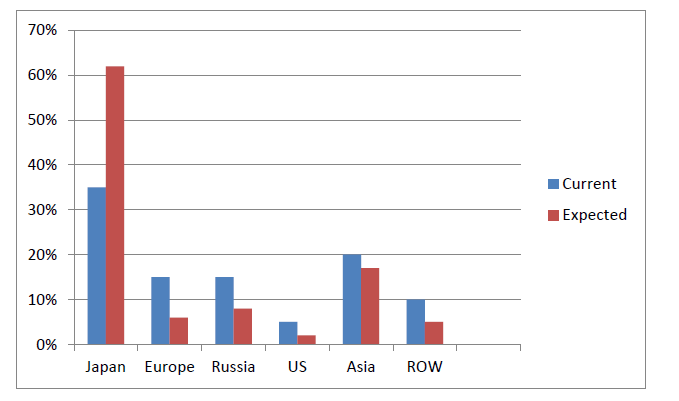
Over a five year period, 600,000 clients used social trading, and the largest markets are Japan, which accounts for 30% of the entire social trading market, followed by Europe and Russia representing 15% each, further showing the possible attraction of an existing social trading company to American retail FX firms, as a means of tapping into this activity overseas (the full research can be purchased separately).
Beyond America's Horizons
The United States government has been engaged in rolling out extensive and finely detailed market reform criteria post financial crisis, intended to completely restructure the method by which all financial products are sold, and critically, how FX firms provide OTC trading services to their clients, which not only has resulted in a depletion of retail FX trading in the domestic market, but has also stood social trading in a similarly stagnant position, as depicted by this graph.
Global Social Trading Market Share By Region
Diversification
In this case, with OANDA electing to purchase an external social trading network, which in the case of Currensee, has its clients based internationally, it could be that OANDA is looking to expand its service not only beyond America's horizons, but also beyond the borders of purely gaining revenue from the ever decreasing circles of the domestic FX market.
OANDA views copy trading, a method by which traders can mirror the trading behavior of experienced FX traders from around the world, referred to by Currensee as 'Trade Leaders', as an area which has realized tremendous growth in recent years. In addition, copy trading makes it possible for individual traders to share research data and collaborate with other traders.
A similar view could be taken with regard to FXCM's recent acquisition. Although, OANDA does not publish its results, FXCM's trading activity during the second quarter of 2013, consisted of multiple record months. The firm announced $140.1 million in revenues, an all-time high, and 53% above the same period last year, showing that for certain firms, there is still a good profit to be made on home territory. On the other hand, how long will this last as the authorities make it less viable to operate is uncertain, therefore, demonstrating that these profits are being channeled into diversifying the service offering via such acquisitions.
OANDA Corporation's CEO, K. Duker made a corporate statement today regarding the acquisition ,"From the collective experience of Currensee’s extensive community of traders," he said.
Mr. Duker continued by explaining what he considers to be the main virtues of the acquisition, "Like OANDA, Currensee has a strong business vision coupled with an expert engineering pedigree. We are committed to continue serving the needs of all Currensee customers, Trade Leaders and partners, and look forward to making OANDA’s competitive spreads and superior execution available to this new group of traders.”
Technical teams are scheduled to begin the work to make the Currensee platform available to OANDA clients, and a notice will be issued once this work is completed.
"We are excited to be a part of this larger venture, and believe that our customers will find dealing with an established broker like OANDA most beneficial," stated Dave Lemont, CEO of Currensee.
"Our clients can expect the continued excellence of our offering, and we look forward to introducing OANDA's established global customer base to our Trade Leaders' program."
With a flourishing institutional FX sector and world-leading trading technology and infrastructure, America continues to mark itself as a homestead for the large, business to business and interbank segments, as well as a leader in instigating modernized regulatory structures for world markets.
North America's retail FX industry has been experiencing an exodus of companies for some considerable time now, calling into question the viability of the current business model, and whether it may be heading toward obsolescence in America.
Today, Canadian FX company OANDA Corporation, which has the majority of its core business concentrated within the United States, announced that it is to acquire the social trading network, Currensee, thus further alluding to the willingness of America's remaining retail FX firms' propensity toward diversification into other areas via mergers and acquistions.
Expansion into the arena of social trading has become a great matter of importance for retail firms wishing to increase volumes of novice traders, and to use as a tool to acquire clients with little or no trading experience. The established social trading networks are now seeking further development opportunities, and have widened their scope of late.
Whereas the business model employed a year ago, centered on providing such services to MetaTrader 4 retail FX brokers, the entire sector is now broadening its horizons by fostering partnerships with new platforms and seeking distribution channels via institutional service providers, particularly, subsequent to MetaQuotes having issued a warning to brokers alleging that four social trading providers had contravened a MetaQuotes protocol.
Over a five year period, 600,000 clients used social trading, and the largest markets are Japan, which accounts for 30% of the entire social trading market, followed by Europe and Russia representing 15% each, further showing the possible attraction of an existing social trading company to American retail FX firms, as a means of tapping into this activity overseas (the full research can be purchased separately).
Beyond America's Horizons
The United States government has been engaged in rolling out extensive and finely detailed market reform criteria post financial crisis, intended to completely restructure the method by which all financial products are sold, and critically, how FX firms provide OTC trading services to their clients, which not only has resulted in a depletion of retail FX trading in the domestic market, but has also stood social trading in a similarly stagnant position, as depicted by this graph.
Global Social Trading Market Share By Region
Diversification
In this case, with OANDA electing to purchase an external social trading network, which in the case of Currensee, has its clients based internationally, it could be that OANDA is looking to expand its service not only beyond America's horizons, but also beyond the borders of purely gaining revenue from the ever decreasing circles of the domestic FX market.
OANDA views copy trading, a method by which traders can mirror the trading behavior of experienced FX traders from around the world, referred to by Currensee as 'Trade Leaders', as an area which has realized tremendous growth in recent years. In addition, copy trading makes it possible for individual traders to share research data and collaborate with other traders.
A similar view could be taken with regard to FXCM's recent acquisition. Although, OANDA does not publish its results, FXCM's trading activity during the second quarter of 2013, consisted of multiple record months. The firm announced $140.1 million in revenues, an all-time high, and 53% above the same period last year, showing that for certain firms, there is still a good profit to be made on home territory. On the other hand, how long will this last as the authorities make it less viable to operate is uncertain, therefore, demonstrating that these profits are being channeled into diversifying the service offering via such acquisitions.
OANDA Corporation's CEO, K. Duker made a corporate statement today regarding the acquisition ,"From the collective experience of Currensee’s extensive community of traders," he said.
Mr. Duker continued by explaining what he considers to be the main virtues of the acquisition, "Like OANDA, Currensee has a strong business vision coupled with an expert engineering pedigree. We are committed to continue serving the needs of all Currensee customers, Trade Leaders and partners, and look forward to making OANDA’s competitive spreads and superior execution available to this new group of traders.”
Technical teams are scheduled to begin the work to make the Currensee platform available to OANDA clients, and a notice will be issued once this work is completed.
"We are excited to be a part of this larger venture, and believe that our customers will find dealing with an established broker like OANDA most beneficial," stated Dave Lemont, CEO of Currensee.
"Our clients can expect the continued excellence of our offering, and we look forward to introducing OANDA's established global customer base to our Trade Leaders' program."
With a flourishing institutional FX sector and world-leading trading technology and infrastructure, America continues to mark itself as a homestead for the large, business to business and interbank segments, as well as a leader in instigating modernized regulatory structures for world markets.
Italy’s Consob Tightens Net on AI-Fueled Scams With Fresh Website Bans
Featured Videos
FP Markets Winner Spotlight 🏆 | Global Broker of the Year 2025 #Trading #Broker #Innovation #Shorts
FP Markets Winner Spotlight 🏆 | Global Broker of the Year 2025 #Trading #Broker #Innovation #Shorts
FP Markets Winner Spotlight 🏆 | Global Broker of the Year 2025 #Trading #Broker #Innovation #Shorts
FP Markets Winner Spotlight 🏆 | Global Broker of the Year 2025 #Trading #Broker #Innovation #Shorts
FP Markets takes the spotlight as Global Broker of the Year 2025 at the Finance Magnates Awards.
Martin Stoilov, Head of Client Experience, shares that trust, innovation, and people played a key role in the company’s success, supported by a strong foundation of integrity and client-centricity.
Following this milestone, FP Markets continues to focus on growth, technology investment, and its core values of transparency and excellence.
👉 Be part of FM Awards 2026: https://awards.financemagnates.com/#nominate
FP Markets takes the spotlight as Global Broker of the Year 2025 at the Finance Magnates Awards.
Martin Stoilov, Head of Client Experience, shares that trust, innovation, and people played a key role in the company’s success, supported by a strong foundation of integrity and client-centricity.
Following this milestone, FP Markets continues to focus on growth, technology investment, and its core values of transparency and excellence.
👉 Be part of FM Awards 2026: https://awards.financemagnates.com/#nominate
FP Markets takes the spotlight as Global Broker of the Year 2025 at the Finance Magnates Awards.
Martin Stoilov, Head of Client Experience, shares that trust, innovation, and people played a key role in the company’s success, supported by a strong foundation of integrity and client-centricity.
Following this milestone, FP Markets continues to focus on growth, technology investment, and its core values of transparency and excellence.
👉 Be part of FM Awards 2026: https://awards.financemagnates.com/#nominate
FP Markets takes the spotlight as Global Broker of the Year 2025 at the Finance Magnates Awards.
Martin Stoilov, Head of Client Experience, shares that trust, innovation, and people played a key role in the company’s success, supported by a strong foundation of integrity and client-centricity.
Following this milestone, FP Markets continues to focus on growth, technology investment, and its core values of transparency and excellence.
👉 Be part of FM Awards 2026: https://awards.financemagnates.com/#nominate
In this video, we review @HolaPrimeMarketsOfficial, a multi-asset forex and CFDs broker offering different account types, trading platforms, and flexible trading conditions.
We cover the broker’s overall offering, including account options, trading environment, platforms like MT4 and MT5, and additional services such as managed accounts and fast withdrawals.
Watch the full video to see if Hola Prime Markets fits your trading needs.
📣 Stay up to date with the latest in finance and trading. Follow Finance Magnates for industry news, insights, and global event coverage.
Connect with us:
🔗 LinkedIn: /financemagnates
👍 Facebook: /financemagnates
📸 Instagram: https://www.instagram.com/financemagnates
🐦 X: https://x.com/financemagnates
🎥 TikTok: https://www.tiktok.com/tag/financemagnates
▶️ YouTube: /@financemagnates_official
#HolaPrime #ForexBroker #CFDTrading #FinanceMagnates #Trading #Forex #BrokerReview
In this video, we review @HolaPrimeMarketsOfficial, a multi-asset forex and CFDs broker offering different account types, trading platforms, and flexible trading conditions.
We cover the broker’s overall offering, including account options, trading environment, platforms like MT4 and MT5, and additional services such as managed accounts and fast withdrawals.
Watch the full video to see if Hola Prime Markets fits your trading needs.
📣 Stay up to date with the latest in finance and trading. Follow Finance Magnates for industry news, insights, and global event coverage.
Connect with us:
🔗 LinkedIn: /financemagnates
👍 Facebook: /financemagnates
📸 Instagram: https://www.instagram.com/financemagnates
🐦 X: https://x.com/financemagnates
🎥 TikTok: https://www.tiktok.com/tag/financemagnates
▶️ YouTube: /@financemagnates_official
#HolaPrime #ForexBroker #CFDTrading #FinanceMagnates #Trading #Forex #BrokerReview
In this video, we review @HolaPrimeMarketsOfficial, a multi-asset forex and CFDs broker offering different account types, trading platforms, and flexible trading conditions.
We cover the broker’s overall offering, including account options, trading environment, platforms like MT4 and MT5, and additional services such as managed accounts and fast withdrawals.
Watch the full video to see if Hola Prime Markets fits your trading needs.
📣 Stay up to date with the latest in finance and trading. Follow Finance Magnates for industry news, insights, and global event coverage.
Connect with us:
🔗 LinkedIn: /financemagnates
👍 Facebook: /financemagnates
📸 Instagram: https://www.instagram.com/financemagnates
🐦 X: https://x.com/financemagnates
🎥 TikTok: https://www.tiktok.com/tag/financemagnates
▶️ YouTube: /@financemagnates_official
#HolaPrime #ForexBroker #CFDTrading #FinanceMagnates #Trading #Forex #BrokerReview
In this video, we review @HolaPrimeMarketsOfficial, a multi-asset forex and CFDs broker offering different account types, trading platforms, and flexible trading conditions.
We cover the broker’s overall offering, including account options, trading environment, platforms like MT4 and MT5, and additional services such as managed accounts and fast withdrawals.
Watch the full video to see if Hola Prime Markets fits your trading needs.
📣 Stay up to date with the latest in finance and trading. Follow Finance Magnates for industry news, insights, and global event coverage.
Connect with us:
🔗 LinkedIn: /financemagnates
👍 Facebook: /financemagnates
📸 Instagram: https://www.instagram.com/financemagnates
🐦 X: https://x.com/financemagnates
🎥 TikTok: https://www.tiktok.com/tag/financemagnates
▶️ YouTube: /@financemagnates_official
#HolaPrime #ForexBroker #CFDTrading #FinanceMagnates #Trading #Forex #BrokerReview
In this video, we review @HolaPrimeMarketsOfficial, a multi-asset forex and CFDs broker offering different account types, trading platforms, and flexible trading conditions.
We cover the broker’s overall offering, including account options, trading environment, platforms like MT4 and MT5, and additional services such as managed accounts and fast withdrawals.
Watch the full video to see if Hola Prime Markets fits your trading needs.
📣 Stay up to date with the latest in finance and trading. Follow Finance Magnates for industry news, insights, and global event coverage.
Connect with us:
🔗 LinkedIn: /financemagnates
👍 Facebook: /financemagnates
📸 Instagram: https://www.instagram.com/financemagnates
🐦 X: https://x.com/financemagnates
🎥 TikTok: https://www.tiktok.com/tag/financemagnates
▶️ YouTube: /@financemagnates_official
#HolaPrime #ForexBroker #CFDTrading #FinanceMagnates #Trading #Forex #BrokerReview
In this video, we review @HolaPrimeMarketsOfficial, a multi-asset forex and CFDs broker offering different account types, trading platforms, and flexible trading conditions.
We cover the broker’s overall offering, including account options, trading environment, platforms like MT4 and MT5, and additional services such as managed accounts and fast withdrawals.
Watch the full video to see if Hola Prime Markets fits your trading needs.
📣 Stay up to date with the latest in finance and trading. Follow Finance Magnates for industry news, insights, and global event coverage.
Connect with us:
🔗 LinkedIn: /financemagnates
👍 Facebook: /financemagnates
📸 Instagram: https://www.instagram.com/financemagnates
🐦 X: https://x.com/financemagnates
🎥 TikTok: https://www.tiktok.com/tag/financemagnates
▶️ YouTube: /@financemagnates_official
#HolaPrime #ForexBroker #CFDTrading #FinanceMagnates #Trading #Forex #BrokerReview
Hola Prime Review: What You Need to Know | Full Breakdown by Finance Magnates
Hola Prime Review: What You Need to Know | Full Breakdown by Finance Magnates
Hola Prime Review: What You Need to Know | Full Breakdown by Finance Magnates
Hola Prime Review: What You Need to Know | Full Breakdown by Finance Magnates
Hola Prime Review: What You Need to Know | Full Breakdown by Finance Magnates
Hola Prime Review: What You Need to Know | Full Breakdown by Finance Magnates
In this video, we review @HolaPrime_Global, a proprietary trading firm offering evaluation programs and performance-based payouts in simulated market environments.
We cover how the challenge model works, including account types, profit splits (up to 95%), trading rules, and what it takes to reach a funded account. You’ll also learn about available platforms like MT4, MT5, cTrader, and more, along with insights into payouts, support, and trading conditions.
Watch the full video to see if Hola Prime fits your trading style.
📣 Stay up to date with the latest in finance and trading. Follow Finance Magnates for industry news, insights, and global event coverage.
Connect with us:
🔗 LinkedIn: /financemagnates
👍 Facebook: /financemagnates
📸 Instagram: https://www.instagram.com/financemagnates
🐦 X: https://x.com/financemagnates
🎥 TikTok: https://www.tiktok.com/tag/financemagnates
▶️ YouTube: /@financemagnates_official
#HolaPrime #PropFirm #Trading #FinanceMagnates #Forex #FuturesTrading #TradingReview #PropFirmReview
In this video, we review @HolaPrime_Global, a proprietary trading firm offering evaluation programs and performance-based payouts in simulated market environments.
We cover how the challenge model works, including account types, profit splits (up to 95%), trading rules, and what it takes to reach a funded account. You’ll also learn about available platforms like MT4, MT5, cTrader, and more, along with insights into payouts, support, and trading conditions.
Watch the full video to see if Hola Prime fits your trading style.
📣 Stay up to date with the latest in finance and trading. Follow Finance Magnates for industry news, insights, and global event coverage.
Connect with us:
🔗 LinkedIn: /financemagnates
👍 Facebook: /financemagnates
📸 Instagram: https://www.instagram.com/financemagnates
🐦 X: https://x.com/financemagnates
🎥 TikTok: https://www.tiktok.com/tag/financemagnates
▶️ YouTube: /@financemagnates_official
#HolaPrime #PropFirm #Trading #FinanceMagnates #Forex #FuturesTrading #TradingReview #PropFirmReview
In this video, we review @HolaPrime_Global, a proprietary trading firm offering evaluation programs and performance-based payouts in simulated market environments.
We cover how the challenge model works, including account types, profit splits (up to 95%), trading rules, and what it takes to reach a funded account. You’ll also learn about available platforms like MT4, MT5, cTrader, and more, along with insights into payouts, support, and trading conditions.
Watch the full video to see if Hola Prime fits your trading style.
📣 Stay up to date with the latest in finance and trading. Follow Finance Magnates for industry news, insights, and global event coverage.
Connect with us:
🔗 LinkedIn: /financemagnates
👍 Facebook: /financemagnates
📸 Instagram: https://www.instagram.com/financemagnates
🐦 X: https://x.com/financemagnates
🎥 TikTok: https://www.tiktok.com/tag/financemagnates
▶️ YouTube: /@financemagnates_official
#HolaPrime #PropFirm #Trading #FinanceMagnates #Forex #FuturesTrading #TradingReview #PropFirmReview
In this video, we review @HolaPrime_Global, a proprietary trading firm offering evaluation programs and performance-based payouts in simulated market environments.
We cover how the challenge model works, including account types, profit splits (up to 95%), trading rules, and what it takes to reach a funded account. You’ll also learn about available platforms like MT4, MT5, cTrader, and more, along with insights into payouts, support, and trading conditions.
Watch the full video to see if Hola Prime fits your trading style.
📣 Stay up to date with the latest in finance and trading. Follow Finance Magnates for industry news, insights, and global event coverage.
Connect with us:
🔗 LinkedIn: /financemagnates
👍 Facebook: /financemagnates
📸 Instagram: https://www.instagram.com/financemagnates
🐦 X: https://x.com/financemagnates
🎥 TikTok: https://www.tiktok.com/tag/financemagnates
▶️ YouTube: /@financemagnates_official
#HolaPrime #PropFirm #Trading #FinanceMagnates #Forex #FuturesTrading #TradingReview #PropFirmReview
In this video, we review @HolaPrime_Global, a proprietary trading firm offering evaluation programs and performance-based payouts in simulated market environments.
We cover how the challenge model works, including account types, profit splits (up to 95%), trading rules, and what it takes to reach a funded account. You’ll also learn about available platforms like MT4, MT5, cTrader, and more, along with insights into payouts, support, and trading conditions.
Watch the full video to see if Hola Prime fits your trading style.
📣 Stay up to date with the latest in finance and trading. Follow Finance Magnates for industry news, insights, and global event coverage.
Connect with us:
🔗 LinkedIn: /financemagnates
👍 Facebook: /financemagnates
📸 Instagram: https://www.instagram.com/financemagnates
🐦 X: https://x.com/financemagnates
🎥 TikTok: https://www.tiktok.com/tag/financemagnates
▶️ YouTube: /@financemagnates_official
#HolaPrime #PropFirm #Trading #FinanceMagnates #Forex #FuturesTrading #TradingReview #PropFirmReview
In this video, we review @HolaPrime_Global, a proprietary trading firm offering evaluation programs and performance-based payouts in simulated market environments.
We cover how the challenge model works, including account types, profit splits (up to 95%), trading rules, and what it takes to reach a funded account. You’ll also learn about available platforms like MT4, MT5, cTrader, and more, along with insights into payouts, support, and trading conditions.
Watch the full video to see if Hola Prime fits your trading style.
📣 Stay up to date with the latest in finance and trading. Follow Finance Magnates for industry news, insights, and global event coverage.
Connect with us:
🔗 LinkedIn: /financemagnates
👍 Facebook: /financemagnates
📸 Instagram: https://www.instagram.com/financemagnates
🐦 X: https://x.com/financemagnates
🎥 TikTok: https://www.tiktok.com/tag/financemagnates
▶️ YouTube: /@financemagnates_official
#HolaPrime #PropFirm #Trading #FinanceMagnates #Forex #FuturesTrading #TradingReview #PropFirmReview
Axi Winner Spotlight 🏆 | Global Most Innovative Broker 2025 #Innovation #Trading #Fintech #Broker
Axi Winner Spotlight 🏆 | Global Most Innovative Broker 2025 #Innovation #Trading #Fintech #Broker
Axi Winner Spotlight 🏆 | Global Most Innovative Broker 2025 #Innovation #Trading #Fintech #Broker
Axi Winner Spotlight 🏆 | Global Most Innovative Broker 2025 #Innovation #Trading #Fintech #Broker
Axi Winner Spotlight 🏆 | Global Most Innovative Broker 2025 #Innovation #Trading #Fintech #Broker
Axi Winner Spotlight 🏆 | Global Most Innovative Broker 2025 #Innovation #Trading #Fintech #Broker
Axi takes the spotlight at the Finance Magnates Awards, winning Global Most Innovative Broker 2025.
Olivia Xenofontos and Ivanna Openko share how the team will feel: proud, motivated, and ready to keep delivering.
They also describe the night as well-organized, focused, and enjoyable for all.
👉 Be part of FM Awards 2026.
Axi takes the spotlight at the Finance Magnates Awards, winning Global Most Innovative Broker 2025.
Olivia Xenofontos and Ivanna Openko share how the team will feel: proud, motivated, and ready to keep delivering.
They also describe the night as well-organized, focused, and enjoyable for all.
👉 Be part of FM Awards 2026.
Axi takes the spotlight at the Finance Magnates Awards, winning Global Most Innovative Broker 2025.
Olivia Xenofontos and Ivanna Openko share how the team will feel: proud, motivated, and ready to keep delivering.
They also describe the night as well-organized, focused, and enjoyable for all.
👉 Be part of FM Awards 2026.
Axi takes the spotlight at the Finance Magnates Awards, winning Global Most Innovative Broker 2025.
Olivia Xenofontos and Ivanna Openko share how the team will feel: proud, motivated, and ready to keep delivering.
They also describe the night as well-organized, focused, and enjoyable for all.
👉 Be part of FM Awards 2026.
Axi takes the spotlight at the Finance Magnates Awards, winning Global Most Innovative Broker 2025.
Olivia Xenofontos and Ivanna Openko share how the team will feel: proud, motivated, and ready to keep delivering.
They also describe the night as well-organized, focused, and enjoyable for all.
👉 Be part of FM Awards 2026.
Axi takes the spotlight at the Finance Magnates Awards, winning Global Most Innovative Broker 2025.
Olivia Xenofontos and Ivanna Openko share how the team will feel: proud, motivated, and ready to keep delivering.
They also describe the night as well-organized, focused, and enjoyable for all.
👉 Be part of FM Awards 2026.
Recognition that matters.
Built on transparency.
Driven by the industry.
The Finance Magnates Awards 2026.
Nominations are now open.
🔗 https://awards.financemagnates.com/?utm_source=SM&utm_medium=social&utm_campaign=recognition-matters
Recognition that matters.
Built on transparency.
Driven by the industry.
The Finance Magnates Awards 2026.
Nominations are now open.
🔗 https://awards.financemagnates.com/?utm_source=SM&utm_medium=social&utm_campaign=recognition-matters
Recognition that matters.
Built on transparency.
Driven by the industry.
The Finance Magnates Awards 2026.
Nominations are now open.
🔗 https://awards.financemagnates.com/?utm_source=SM&utm_medium=social&utm_campaign=recognition-matters
Recognition that matters.
Built on transparency.
Driven by the industry.
The Finance Magnates Awards 2026.
Nominations are now open.
🔗 https://awards.financemagnates.com/?utm_source=SM&utm_medium=social&utm_campaign=recognition-matters
Recognition that matters.
Built on transparency.
Driven by the industry.
The Finance Magnates Awards 2026.
Nominations are now open.
🔗 https://awards.financemagnates.com/?utm_source=SM&utm_medium=social&utm_campaign=recognition-matters
Recognition that matters.
Built on transparency.
Driven by the industry.
The Finance Magnates Awards 2026.
Nominations are now open.
🔗 https://awards.financemagnates.com/?utm_source=SM&utm_medium=social&utm_campaign=recognition-matters