The WFE argues that it is best to start with 22/5 or 23/5 models rather than jumping straight into full continuous trading.
It also urges caution on "mimicked stock tokens" and says extended investing won't fit every market.
Equity
exchanges worldwide are grappling with mounting pressure to extend trading
hours as investors demand near-constant market access, according to a new
analysis from the World Federation of Exchanges (WFE).
The global
industry body released a comprehensive study examining the shift toward
extended trading hours, particularly the move to 22-hour or 23-hour trading
weeks that several major exchanges are considering.
The
analysis doesn't advocate for 24/7 trading but instead provides a roadmap for
exchanges considering the transition. Extended trading hours present
significant operational challenges that require careful coordination across the
entire financial ecosystem, the WFE warns.
Growing Investor Appetite
Drives Market Changes
Three main
factors are pushing exchanges toward longer trading sessions, according to the
WFE analysis. Local retail investors increasingly expect the same
around-the-clock access they get from digital services and cryptocurrency
markets. International retail traders, particularly in Asia, want to trade U.S.
stocks during their local business hours. Meanwhile, overseas institutional
investors seek continuous access to manage global portfolios and respond
quickly to market-moving events.
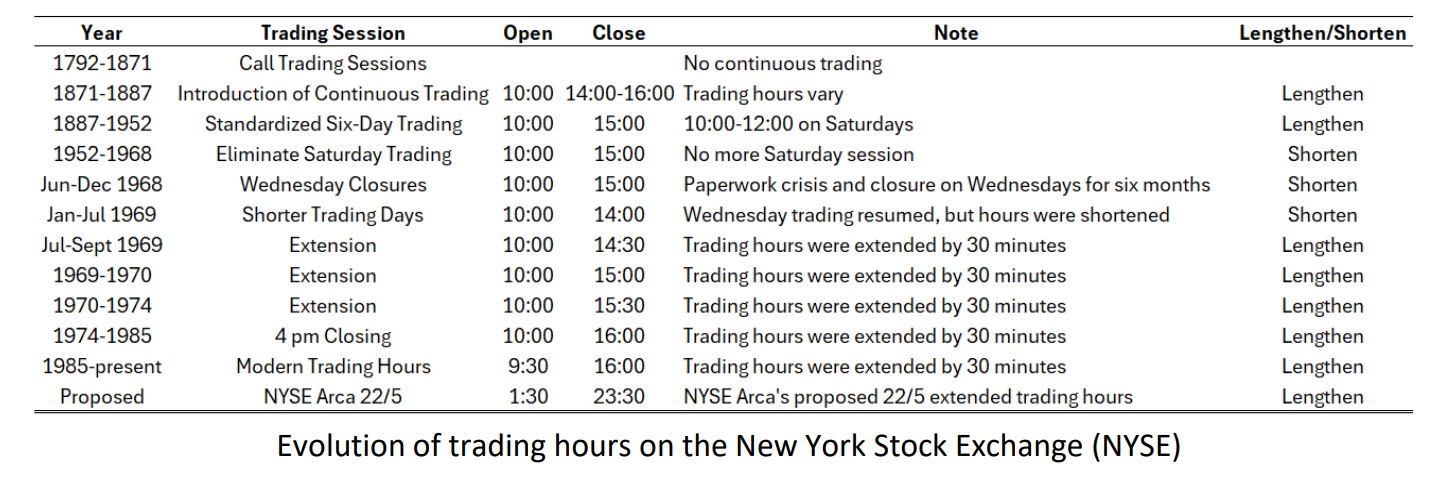
How the stock market hours were chaning. Source: WFE
Major U.S.
equity exchanges have announced plans to move toward continuous trading, while
the Depository Trust & Clearing Corporation plans to transition to 24/5
clearing by the second quarter of 2026. The moves follow similar developments
in derivatives markets, where CME's Globex platform already operates 23 hours a
day, five days a week.
Extended
trading hours create complex challenges that go far beyond keeping computer
systems running longer. Market participants will need to adapt risk management
systems, surveillance programs, and staffing models to handle round-the-clock
activity.
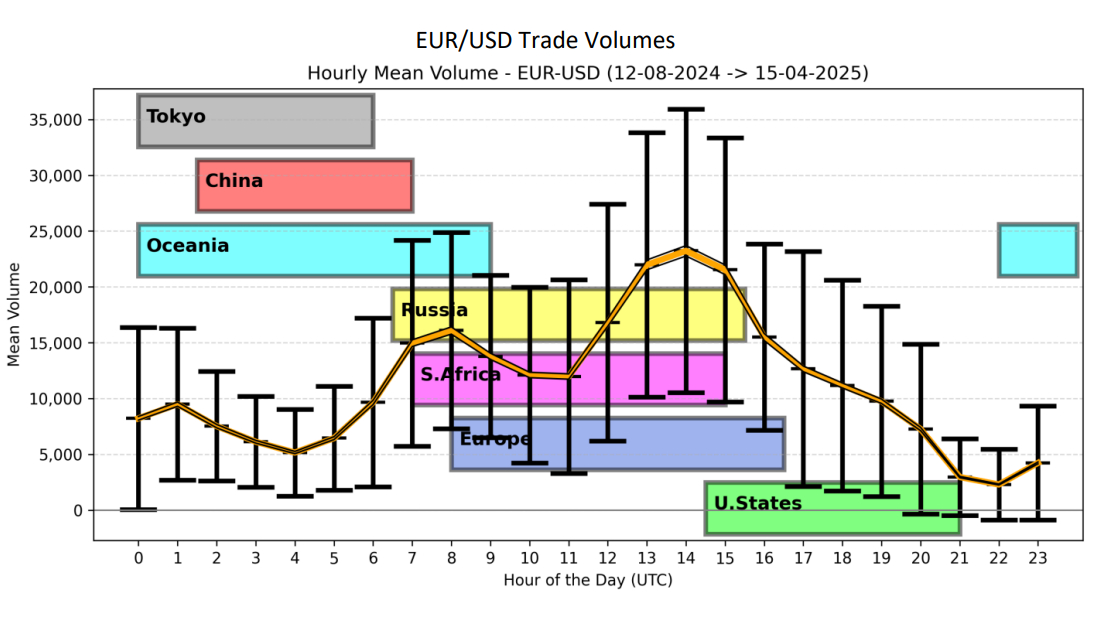
Liquidity
patterns observed in foreign exchange and cryptocurrency markets suggest
trading volumes won't remain constant throughout extended hours. Instead,
activity will likely peak during traditional business hours, with thinner
participation overnight potentially leading to wider bid-ask spreads and
increased volatility.
Liquidity remains one of the most important risk factor. Source: WFE
“Lower
participation at these times may lead to wider spreads, price slippage, and
volatility,” the WFE notes, adding that brokers should clearly disclose
these risks to retail investors who may be less familiar with overnight trading
dynamics.
Exchanges
will need to maintain circuit breakers and other risk controls during extended
hours, while ensuring proper surveillance to prevent market manipulation during
periods of thin liquidity. The infrastructure demands are substantial – systems
must achieve near-zero downtime and support continuous operation without
traditional maintenance windows.
Post-Trade Systems Face
Major Overhaul
The shift
to extended trading creates particular challenges for clearing and settlement
operations. Traditional clearing environments often align risk assessments with
business-day cycles, but extended hours require constant price formation and
real-time margin calculations.
One major
concern involves margin calls and funding requirements during periods when
banking and payment systems are offline. Some exchanges have addressed this by
requiring prefunded margin buffers or arranging with foreign banks to
facilitate after-hours margin movements.
Payment
system operators are responding to the demand. The Federal Reserve is
considering expanding Fedwire operating hours to 22 hours per day, seven days a
week by 2027. The European Central Bank is similarly consulting on extending
its payment system hours.
Markets
will also need to maintain designated closing prices for benchmarks, fund
valuations, and corporate actions. Potential solutions include “virtual
closes” or brief scheduled closures to handle these essential functions.
Regulatory Flexibility Key
to Market Evolution
The WFE
emphasizes that extended trading isn't suitable for all markets and shouldn't
be viewed as inevitable. Different exchanges will adopt different models based
on their participant base, liquidity profiles, and local market conditions.
WFE CEO Nandini Sukumar
“Extended
trading is not inevitable nor universally desirable,” WFE CEO Nandini
Sukumar said. “The shift to extended trading is technologically feasible
and already aligned with investor behaviour in other asset classes. The real
question is how markets evolve in a way that protects investors, supports
integrity, and strengthens global competitiveness.”
The WFE has
recently also highlighted
the growing popularity of tokenized stocks in retail trading. In an email
sent to FinanceMagnates.com, it explained that while it is not generally
opposed to tokenization, it has “called for a crackdown on mimicked tokens.”
The institution argues that the term “stock tokens” may mislead investors, as
these instruments often do not provide the same rights and protections as
traditional shares.
“What
Nasdaq is doing is best practice. If tokenized securities are to be traded,
this is how it should work,” Sukumar added. “The emergence of unregulated
platforms offering mimicked tokens raises serious concerns. These offerings
often bypass established safeguards, creating risks for investors, undermining
market integrity, and enabling regulatory arbitrage. In contrast, Nasdaq’s
approach ensures that tokenized securities are treated like traditional
securities, meaning investor rights remain protected.
The
organization warns that regulatory inaction could push trading activity toward
less transparent, unregulated venues. Several major exchanges have already
announced extended trading initiatives, joining a growing trend across global
markets.
The Biggest Players Wants
to Join the Trend
Richard Metcalfe, the WFE's head of regulatory affairs
Richard
Metcalfe, the WFE's head of regulatory affairs, emphasized that trading hours
should remain the responsibility of individual market operators rather than
being mandated by regulators.
“Flexibility
and diversity in trading models should be encouraged, with trading hours
remaining the responsibility of market infrastructures,” Metcalfe said.
“Regulators should focus on enabling innovation while maintaining the
fundamental principles of fairness, transparency, and systemic stability.”
The WFE
study suggests that 22/5 or 23/5 trading models offer a pragmatic stepping
stone toward eventual 24/7 markets, allowing exchanges to test operational
readiness while managing risks incrementally. True continuous trading would
require more extensive system-wide changes across the entire financial
ecosystem.
This story was updated on Sept. 14, 2025, at 20:15 CET to include comments from the WFE and to clarify the organization's position on extended trading hours and tokenization.
Equity
exchanges worldwide are grappling with mounting pressure to extend trading
hours as investors demand near-constant market access, according to a new
analysis from the World Federation of Exchanges (WFE).
The global
industry body released a comprehensive study examining the shift toward
extended trading hours, particularly the move to 22-hour or 23-hour trading
weeks that several major exchanges are considering.
The
analysis doesn't advocate for 24/7 trading but instead provides a roadmap for
exchanges considering the transition. Extended trading hours present
significant operational challenges that require careful coordination across the
entire financial ecosystem, the WFE warns.
Growing Investor Appetite
Drives Market Changes
Three main
factors are pushing exchanges toward longer trading sessions, according to the
WFE analysis. Local retail investors increasingly expect the same
around-the-clock access they get from digital services and cryptocurrency
markets. International retail traders, particularly in Asia, want to trade U.S.
stocks during their local business hours. Meanwhile, overseas institutional
investors seek continuous access to manage global portfolios and respond
quickly to market-moving events.
How the stock market hours were chaning. Source: WFE
Major U.S.
equity exchanges have announced plans to move toward continuous trading, while
the Depository Trust & Clearing Corporation plans to transition to 24/5
clearing by the second quarter of 2026. The moves follow similar developments
in derivatives markets, where CME's Globex platform already operates 23 hours a
day, five days a week.
Extended
trading hours create complex challenges that go far beyond keeping computer
systems running longer. Market participants will need to adapt risk management
systems, surveillance programs, and staffing models to handle round-the-clock
activity.
Liquidity
patterns observed in foreign exchange and cryptocurrency markets suggest
trading volumes won't remain constant throughout extended hours. Instead,
activity will likely peak during traditional business hours, with thinner
participation overnight potentially leading to wider bid-ask spreads and
increased volatility.
Liquidity remains one of the most important risk factor. Source: WFE
“Lower
participation at these times may lead to wider spreads, price slippage, and
volatility,” the WFE notes, adding that brokers should clearly disclose
these risks to retail investors who may be less familiar with overnight trading
dynamics.
Exchanges
will need to maintain circuit breakers and other risk controls during extended
hours, while ensuring proper surveillance to prevent market manipulation during
periods of thin liquidity. The infrastructure demands are substantial – systems
must achieve near-zero downtime and support continuous operation without
traditional maintenance windows.
Post-Trade Systems Face
Major Overhaul
The shift
to extended trading creates particular challenges for clearing and settlement
operations. Traditional clearing environments often align risk assessments with
business-day cycles, but extended hours require constant price formation and
real-time margin calculations.
One major
concern involves margin calls and funding requirements during periods when
banking and payment systems are offline. Some exchanges have addressed this by
requiring prefunded margin buffers or arranging with foreign banks to
facilitate after-hours margin movements.
Payment
system operators are responding to the demand. The Federal Reserve is
considering expanding Fedwire operating hours to 22 hours per day, seven days a
week by 2027. The European Central Bank is similarly consulting on extending
its payment system hours.
Markets
will also need to maintain designated closing prices for benchmarks, fund
valuations, and corporate actions. Potential solutions include “virtual
closes” or brief scheduled closures to handle these essential functions.
Regulatory Flexibility Key
to Market Evolution
The WFE
emphasizes that extended trading isn't suitable for all markets and shouldn't
be viewed as inevitable. Different exchanges will adopt different models based
on their participant base, liquidity profiles, and local market conditions.
WFE CEO Nandini Sukumar
“Extended
trading is not inevitable nor universally desirable,” WFE CEO Nandini
Sukumar said. “The shift to extended trading is technologically feasible
and already aligned with investor behaviour in other asset classes. The real
question is how markets evolve in a way that protects investors, supports
integrity, and strengthens global competitiveness.”
The WFE has
recently also highlighted
the growing popularity of tokenized stocks in retail trading. In an email
sent to FinanceMagnates.com, it explained that while it is not generally
opposed to tokenization, it has “called for a crackdown on mimicked tokens.”
The institution argues that the term “stock tokens” may mislead investors, as
these instruments often do not provide the same rights and protections as
traditional shares.
“What
Nasdaq is doing is best practice. If tokenized securities are to be traded,
this is how it should work,” Sukumar added. “The emergence of unregulated
platforms offering mimicked tokens raises serious concerns. These offerings
often bypass established safeguards, creating risks for investors, undermining
market integrity, and enabling regulatory arbitrage. In contrast, Nasdaq’s
approach ensures that tokenized securities are treated like traditional
securities, meaning investor rights remain protected.
The
organization warns that regulatory inaction could push trading activity toward
less transparent, unregulated venues. Several major exchanges have already
announced extended trading initiatives, joining a growing trend across global
markets.
The Biggest Players Wants
to Join the Trend
Richard Metcalfe, the WFE's head of regulatory affairs
Richard
Metcalfe, the WFE's head of regulatory affairs, emphasized that trading hours
should remain the responsibility of individual market operators rather than
being mandated by regulators.
“Flexibility
and diversity in trading models should be encouraged, with trading hours
remaining the responsibility of market infrastructures,” Metcalfe said.
“Regulators should focus on enabling innovation while maintaining the
fundamental principles of fairness, transparency, and systemic stability.”
The WFE
study suggests that 22/5 or 23/5 trading models offer a pragmatic stepping
stone toward eventual 24/7 markets, allowing exchanges to test operational
readiness while managing risks incrementally. True continuous trading would
require more extensive system-wide changes across the entire financial
ecosystem.
This story was updated on Sept. 14, 2025, at 20:15 CET to include comments from the WFE and to clarify the organization's position on extended trading hours and tokenization.
Damian Chmiel is a Senior Analyst & Editor at Finance Magnates with more than 15 years of experience in the CFD and online trading industry. Active as both a trader and journalist since 2010, he focuses on broker coverage, fintech innovation, and regulatory developments across Europe, the Middle East, and Asia.
His work includes interviews with C-level leaders at major brokerages and fintech platforms, as well as co-authoring Finance Magnates’ quarterly industry benchmarking reports. Damian’s reporting is data-driven, market-aware, and grounded in direct industry engagement. His analysis and commentary have also been cited by external media outlets, including Investing.com, Binance, The Asset, Stockhead, and Dispatch.
Education:
MA in Finance and Accounting, Cracow University of Economics
Retail Traders Can Now Access Prediction Markets Through Binance Wallet
FP Markets Winner Spotlight 🏆 | Global Broker of the Year 2025 #Trading #Broker #Innovation #Shorts
FP Markets Winner Spotlight 🏆 | Global Broker of the Year 2025 #Trading #Broker #Innovation #Shorts
FP Markets takes the spotlight as Global Broker of the Year 2025 at the Finance Magnates Awards.
Martin Stoilov, Head of Client Experience, shares that trust, innovation, and people played a key role in the company’s success, supported by a strong foundation of integrity and client-centricity.
Following this milestone, FP Markets continues to focus on growth, technology investment, and its core values of transparency and excellence.
👉 Be part of FM Awards 2026: https://awards.financemagnates.com/#nominate
FP Markets takes the spotlight as Global Broker of the Year 2025 at the Finance Magnates Awards.
Martin Stoilov, Head of Client Experience, shares that trust, innovation, and people played a key role in the company’s success, supported by a strong foundation of integrity and client-centricity.
Following this milestone, FP Markets continues to focus on growth, technology investment, and its core values of transparency and excellence.
👉 Be part of FM Awards 2026: https://awards.financemagnates.com/#nominate
In this video, we review @HolaPrimeMarketsOfficial, a multi-asset forex and CFDs broker offering different account types, trading platforms, and flexible trading conditions.
We cover the broker’s overall offering, including account options, trading environment, platforms like MT4 and MT5, and additional services such as managed accounts and fast withdrawals.
Watch the full video to see if Hola Prime Markets fits your trading needs.
📣 Stay up to date with the latest in finance and trading. Follow Finance Magnates for industry news, insights, and global event coverage.
Connect with us:
🔗 LinkedIn: /financemagnates
👍 Facebook: /financemagnates
📸 Instagram: https://www.instagram.com/financemagnates
🐦 X: https://x.com/financemagnates
🎥 TikTok: https://www.tiktok.com/tag/financemagnates
▶️ YouTube: /@financemagnates_official
#HolaPrime #ForexBroker #CFDTrading #FinanceMagnates #Trading #Forex #BrokerReview
In this video, we review @HolaPrimeMarketsOfficial, a multi-asset forex and CFDs broker offering different account types, trading platforms, and flexible trading conditions.
We cover the broker’s overall offering, including account options, trading environment, platforms like MT4 and MT5, and additional services such as managed accounts and fast withdrawals.
Watch the full video to see if Hola Prime Markets fits your trading needs.
📣 Stay up to date with the latest in finance and trading. Follow Finance Magnates for industry news, insights, and global event coverage.
Connect with us:
🔗 LinkedIn: /financemagnates
👍 Facebook: /financemagnates
📸 Instagram: https://www.instagram.com/financemagnates
🐦 X: https://x.com/financemagnates
🎥 TikTok: https://www.tiktok.com/tag/financemagnates
▶️ YouTube: /@financemagnates_official
#HolaPrime #ForexBroker #CFDTrading #FinanceMagnates #Trading #Forex #BrokerReview
Hola Prime Review: What You Need to Know | Full Breakdown by Finance Magnates
Hola Prime Review: What You Need to Know | Full Breakdown by Finance Magnates
In this video, we review @HolaPrime_Global, a proprietary trading firm offering evaluation programs and performance-based payouts in simulated market environments.
We cover how the challenge model works, including account types, profit splits (up to 95%), trading rules, and what it takes to reach a funded account. You’ll also learn about available platforms like MT4, MT5, cTrader, and more, along with insights into payouts, support, and trading conditions.
Watch the full video to see if Hola Prime fits your trading style.
📣 Stay up to date with the latest in finance and trading. Follow Finance Magnates for industry news, insights, and global event coverage.
Connect with us:
🔗 LinkedIn: /financemagnates
👍 Facebook: /financemagnates
📸 Instagram: https://www.instagram.com/financemagnates
🐦 X: https://x.com/financemagnates
🎥 TikTok: https://www.tiktok.com/tag/financemagnates
▶️ YouTube: /@financemagnates_official
#HolaPrime #PropFirm #Trading #FinanceMagnates #Forex #FuturesTrading #TradingReview #PropFirmReview
In this video, we review @HolaPrime_Global, a proprietary trading firm offering evaluation programs and performance-based payouts in simulated market environments.
We cover how the challenge model works, including account types, profit splits (up to 95%), trading rules, and what it takes to reach a funded account. You’ll also learn about available platforms like MT4, MT5, cTrader, and more, along with insights into payouts, support, and trading conditions.
Watch the full video to see if Hola Prime fits your trading style.
📣 Stay up to date with the latest in finance and trading. Follow Finance Magnates for industry news, insights, and global event coverage.
Connect with us:
🔗 LinkedIn: /financemagnates
👍 Facebook: /financemagnates
📸 Instagram: https://www.instagram.com/financemagnates
🐦 X: https://x.com/financemagnates
🎥 TikTok: https://www.tiktok.com/tag/financemagnates
▶️ YouTube: /@financemagnates_official
#HolaPrime #PropFirm #Trading #FinanceMagnates #Forex #FuturesTrading #TradingReview #PropFirmReview
Axi Winner Spotlight 🏆 | Global Most Innovative Broker 2025 #Innovation #Trading #Fintech #Broker
Axi Winner Spotlight 🏆 | Global Most Innovative Broker 2025 #Innovation #Trading #Fintech #Broker
Axi takes the spotlight at the Finance Magnates Awards, winning Global Most Innovative Broker 2025.
Olivia Xenofontos and Ivanna Openko share how the team will feel: proud, motivated, and ready to keep delivering.
They also describe the night as well-organized, focused, and enjoyable for all.
👉 Be part of FM Awards 2026.
Axi takes the spotlight at the Finance Magnates Awards, winning Global Most Innovative Broker 2025.
Olivia Xenofontos and Ivanna Openko share how the team will feel: proud, motivated, and ready to keep delivering.
They also describe the night as well-organized, focused, and enjoyable for all.
👉 Be part of FM Awards 2026.
Recognition that matters.
Built on transparency.
Driven by the industry.
The Finance Magnates Awards 2026.
Nominations are now open.
🔗 https://awards.financemagnates.com/?utm_source=SM&utm_medium=social&utm_campaign=recognition-matters
Recognition that matters.
Built on transparency.
Driven by the industry.
The Finance Magnates Awards 2026.
Nominations are now open.
🔗 https://awards.financemagnates.com/?utm_source=SM&utm_medium=social&utm_campaign=recognition-matters