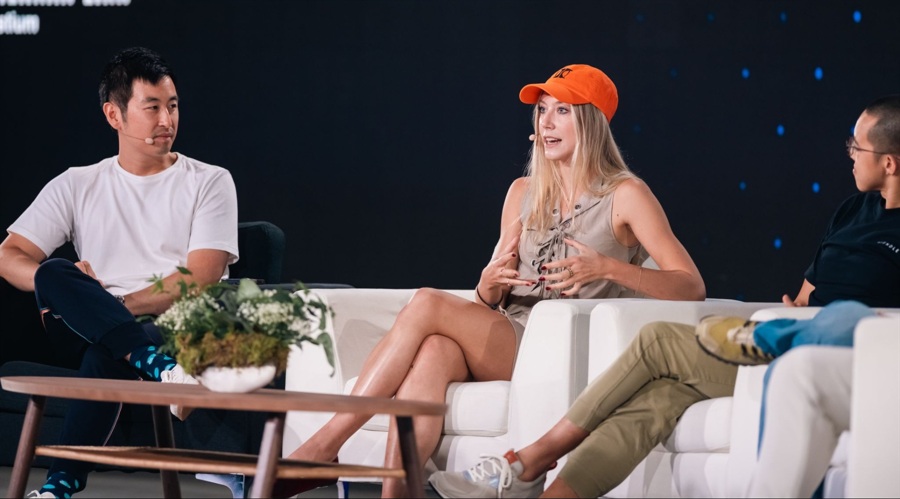
Kaledora
Fontana Kiernan-Lin is putting a timeline on her bold prediction: the global
contract-for-difference (CFD) broker market faces major disruption from
decentralized finance within five years.
The
co-founder and CEO of Ostium, a blockchain-based perpetual swaps platform,
recently secured $20 million in Series A funding from General
Catalyst and Jump Crypto to back that thesis.
In an interview
with FinanceMagnates.com, Kiernan-Lin laid out why she believes retail foreign
exchange
Exchange
An exchange is known as a marketplace that supports the trading of derivatives, commodities, securities, and other financial instruments.Generally, an exchange is accessible through a digital platform or sometimes at a tangible address where investors organize to perform trading. Among the chief responsibilities of an exchange would be to uphold honest and fair-trading practices. These are instrumental in making sure that the distribution of supported security rates on that exchange are effectiv
An exchange is known as a marketplace that supports the trading of derivatives, commodities, securities, and other financial instruments.Generally, an exchange is accessible through a digital platform or sometimes at a tangible address where investors organize to perform trading. Among the chief responsibilities of an exchange would be to uphold honest and fair-trading practices. These are instrumental in making sure that the distribution of supported security rates on that exchange are effectiv
Read this Term and commodities traders will abandon traditional CFD brokers for
on-chain alternatives that offer transparent pricing and self-custody of funds.
"The
'perpification' of markets – where every asset becomes a liquid, tradeable
perpetual swap – is the inevitable end state," Kiernan-Lin said. She
expects retail FX and commodities to crack first, calling them "markets
where users are currently paying exorbitant costs for opacity".
Whether
that vision materializes on her timeline remains an open question.
Decentralized finance platforms face their own set of challenges, including
smart contract vulnerabilities, liquidation risks from high leverage, and a
lack of comprehensive regulatory frameworks that have plagued the crypto
derivatives sector.
Crypto Exchanges Already
Moving Into TradFi
Ostium
isn't alone in targeting traditional assets. Major crypto exchanges have been
racing to capture TradFi trading volume, particularly during the recent metals
rally.
Binance
launched round-the-clock perpetual contracts on silver in early January as silver
prices surged 150% year-over-year, with rival Bitget rolling out similar
offerings focused on gold, forex, and global macro assets.
BingX reported
that record gold prices drove half of its $1 billion TradFi trading surge, with gold futures contracts alone
generating over $500 million in daily volume.
The trend
extends beyond perpetual swaps: Coinbase and
Crypto.com have acquired CFD licenses, signaling that well-funded fintech players
with large user bases are eyeing the retail derivatives market.
These moves
suggest Kiernan-Lin's thesis about TradFi asset demand isn't purely
aspirational. But they also highlight the competitive dynamics at play, with
established crypto exchanges leveraging existing liquidity and brand
recognition to capture the same offshore trading cohort Ostium is targeting.
Record Volumes Signal
Early Traction
Ostium's
recent performance appears to validate at least part of that vision. The
platform hit a record $711 million in single-day trading volume on January 30 as
metals prices surged, with silver and gold trading accounting for roughly
half that total. Over 95% of Ostium's open interest now sits in traditional
markets rather than crypto assets, an unusual profile for a blockchain
Blockchain
Blockchain comprises a digital network of blocks with a comprehensive ledger of transactions made in a cryptocurrency such as Bitcoin or other altcoins.One of the signature features of blockchain is that it is maintained across more than one computer. The ledger can be public or private (permissioned). In this sense, blockchain is immune to the manipulation of data, making it not only open but verifiable. Because a blockchain is stored across a network of computers, it is very difficult to tamp
Blockchain comprises a digital network of blocks with a comprehensive ledger of transactions made in a cryptocurrency such as Bitcoin or other altcoins.One of the signature features of blockchain is that it is maintained across more than one computer. The ledger can be public or private (permissioned). In this sense, blockchain is immune to the manipulation of data, making it not only open but verifiable. Because a blockchain is stored across a network of computers, it is very difficult to tamp
Read this Term-based
exchange.
Cumulative
trading volume has topped $33 billion since launch, including more than $5
billion in metals alone. The surge aligns with precious metals rallies that
saw silver hit a
record $120 per ounce in
late January and gold push past $5,600.
fourth day in a row of ostium hitting fresh ATHs:
> $2.5B L7D volume
> $711m in 24h volume
> $250m of that in silver alone
> another $250m across copper + gold
> crossed 4,000 WAUs
> $339m in open interest
> 100% uptime during highest vol day for metals ever
> single-shot trades… pic.twitter.com/3nnb2hDdjt
— kaledora (@kaledora) January 31, 2026
Traders on
the platform netted $5.8 million in profits on January 30, the highest
single-day gain in Ostium's history, reversing earlier cumulative losses. Just
two days earlier, the same cohort had logged $2.7 million in losses.
Eliminating the
Broker-as-Counterparty Problem
Kiernan-Lin's
pitch centers on a structural critique of the CFD model. When retail traders
lose money on traditional platforms, which
happens to 76-82% of them, according to regulatory disclosures, the broker
often profits directly by taking the other side of those trades. UK regulators
have repeatedly flagged this conflict of interest.
Ostium,
however, claims it architecture routes trades through institutional liquidity
venues and executes them on-chain via smart contracts built on Arbitrum, an
Ethereum Layer 2 network.
"When
you trade Oil on Ostium, the quote is derived from institutional liquidity and
anchored by our oracle infrastructure, then executed onchain," Kiernan-Lin
explained. "Once a position is open, the protocol can't arbitrarily widen
spreads, change financing terms, freeze accounts, or introduce new
constraints."
🥇🥈🥉
Thanks to our liquidity system at @OstiumLabs we are the only place you can trade the underlying market’s spot price for metals with no exchange-specific orderbook surprises.
We are also the only place on chain that has kept metals rolling fees in the single digit range… pic.twitter.com/zOOdXeWeaX
— marcoantonio.eth (@contrarianmarco) January 29, 2026
She argues
the real advantage isn't just about who sits on the other side of a trade, but
that pricing, funding, and execution follow transparent, programmatic rules
rather than discretionary broker decisions.
Legacy
brokers retain broad power to adjust spreads, modify financing costs, or
restrict accounts during volatile periods, actions that are theoretically
impossible on Ostium's smart contract infrastructure.
Still,
smart contracts introduce their own risks. The Financial Stability Board (FSB) has
warned that decentralized finance platforms face
vulnerabilities related to faulty code, market manipulation through
governance token voting, and concentration risks among third-party
infrastructure providers.
Offshore Markets and
Regulatory Gray Zones
Ostium is
explicitly targeting offshore CFD traders, particularly non-US investors
seeking exposure to American equities and commodities. Kiernan-Lin describes
the pain point as access: traders in Vietnam or the Philippines typically
navigate offshore entities "with questionable solvency, high withdrawal
friction, and the real risk of unexpected account freezing".
The
platform operates as a non-custodial technology provider, meaning Ostium itself
doesn't hold client funds, the smart contracts do.
“We respect
local laws; our primary focus is replacing the trading infrastructure with one
that doesn't require a user to trust a centralized entity in a jurisdiction
they can't sue," Kiernan-Lin said.
The
strategy mirrors how offshore CFD brokers have historically operated in
regulatory gray zones, raising questions about whether decentralized
infrastructure truly solves investor protection issues or simply relocates them
to a different layer of the technology stack.
Self-Custody as a Feature,
Not a Bug
The CEO
reframes self-custody, often seen as a technical barrier for retail traders, as
the platform's killer feature.
"Nobody
can freeze your funds," she said, arguing that's more compelling than
traditional brokers' ease of fiat deposits once traders experience the
difference.
Ostium has
designed its onboarding so "connect wallet" replaces traditional
login credentials. There's no three-day wire transfer wait, and the platform is
exploring account abstraction technology to make the wallet experience
"invisible for those who want it".
Kiernan-Lin
believes once traders realize holding their own margin means never waiting for
a broker to approve a withdrawal, the perceived barrier becomes a preference.
The flip
side is that self-custody also means self-responsibility.
Cost Structure and
Competitive Positioning
When
pressed on fees, Kiernan-Lin acknowledged Ostium may not win "a headline
comparison on advertised execution costs alone" against large incumbents
like IG or Pepperstone. Entry spreads at traditional brokers can look cheaper
at first glance.
Where
Ostium claims to differentiate is cost predictability. Gas fees on Arbitrum are
minimal and visible upfront. Execution fees and funding rates are explicit and
known before opening a position.
"There
are no hidden spread markups, surprise swap charges, or discretionary account
actions that change the economics of a position after it's opened,"
Kiernan-Lin said.
Traditional
"zero commission" pricing often masks variable spreads, opaque
financing, and operational risk, she argued. However, perpetual swaps carry
their own cost structure that can erode profitability.
Derivatives Over Tokenized
Equity
Kiernan-Lin
sees limited
trading appeal in true tokenized equity ownership compared to derivatives.
"It's
capital efficiency," she said. Traders betting on earnings calls or macro
events don't want to lock up 100% of capital to buy shares when they can
express the same view with a fraction of that capital via derivatives.
"The
FX market trades $7.5 trillion a day, not because people want to own Euros, but
because they are hedging or speculating on price," she noted.
A opposite view is held by Vlad Tenev, the chief
executive of Robinhood, who sees tokenization as “the
biggest innovation in capital markets.”
She also has
a different viewon prediction markets like Polymarket and Kalshi,
calling them "highly complementary" rather than competitive.
The 2030 Vision
By December
2030, Kiernan-Lin expects the term "Real World Asset" to be retired
because all assets will exist on-chain. Ostium won't be labeled a "crypto
platform" but rather backend infrastructure for a chunk of global macro
trading.
some thoughts on weekend liquidation hunting...
- 24/7 RWA perp markets are very cool in theory! but the downsides of their illiquidity over the weekends - continuous trading without a real, liquid spot price - outweigh the benefits. these drawbacks are greater the larger you…
— kaledora (@kaledora) January 21, 2026
"Decentralized
protocols won't simply disrupt a subset of the market; they'll supercharge the
growth of the market itself," Kiernan-Lin added, drawing
a parallel to how Uber expanded the taxi market by orders of magnitude
while upending the industry. She positions Ostium as the "standard-bearer
for that shift".
That
timeline assumes several things go right: regulatory frameworks evolve to
accommodate decentralized platforms without crushing them, smart contract
security matures to prevent the kinds of exploits that have plagued DeFi, and
retail traders prove willing to trade traditional protections for transparency.
Meanwhile,
traditional CFD brokers aren't standing still. Some
80% of European CFD firms are plotting a pivot to listed derivatives amid
regulatory pressure, suggesting the industry itself is adapting to survive.
Kaledora
Fontana Kiernan-Lin is putting a timeline on her bold prediction: the global
contract-for-difference (CFD) broker market faces major disruption from
decentralized finance within five years.
The
co-founder and CEO of Ostium, a blockchain-based perpetual swaps platform,
recently secured $20 million in Series A funding from General
Catalyst and Jump Crypto to back that thesis.
In an interview
with FinanceMagnates.com, Kiernan-Lin laid out why she believes retail foreign
exchange
Exchange
An exchange is known as a marketplace that supports the trading of derivatives, commodities, securities, and other financial instruments.Generally, an exchange is accessible through a digital platform or sometimes at a tangible address where investors organize to perform trading. Among the chief responsibilities of an exchange would be to uphold honest and fair-trading practices. These are instrumental in making sure that the distribution of supported security rates on that exchange are effectiv
An exchange is known as a marketplace that supports the trading of derivatives, commodities, securities, and other financial instruments.Generally, an exchange is accessible through a digital platform or sometimes at a tangible address where investors organize to perform trading. Among the chief responsibilities of an exchange would be to uphold honest and fair-trading practices. These are instrumental in making sure that the distribution of supported security rates on that exchange are effectiv
Read this Term and commodities traders will abandon traditional CFD brokers for
on-chain alternatives that offer transparent pricing and self-custody of funds.
"The
'perpification' of markets – where every asset becomes a liquid, tradeable
perpetual swap – is the inevitable end state," Kiernan-Lin said. She
expects retail FX and commodities to crack first, calling them "markets
where users are currently paying exorbitant costs for opacity".
Whether
that vision materializes on her timeline remains an open question.
Decentralized finance platforms face their own set of challenges, including
smart contract vulnerabilities, liquidation risks from high leverage, and a
lack of comprehensive regulatory frameworks that have plagued the crypto
derivatives sector.
Crypto Exchanges Already
Moving Into TradFi
Ostium
isn't alone in targeting traditional assets. Major crypto exchanges have been
racing to capture TradFi trading volume, particularly during the recent metals
rally.
Binance
launched round-the-clock perpetual contracts on silver in early January as silver
prices surged 150% year-over-year, with rival Bitget rolling out similar
offerings focused on gold, forex, and global macro assets.
BingX reported
that record gold prices drove half of its $1 billion TradFi trading surge, with gold futures contracts alone
generating over $500 million in daily volume.
The trend
extends beyond perpetual swaps: Coinbase and
Crypto.com have acquired CFD licenses, signaling that well-funded fintech players
with large user bases are eyeing the retail derivatives market.
These moves
suggest Kiernan-Lin's thesis about TradFi asset demand isn't purely
aspirational. But they also highlight the competitive dynamics at play, with
established crypto exchanges leveraging existing liquidity and brand
recognition to capture the same offshore trading cohort Ostium is targeting.
Record Volumes Signal
Early Traction
Ostium's
recent performance appears to validate at least part of that vision. The
platform hit a record $711 million in single-day trading volume on January 30 as
metals prices surged, with silver and gold trading accounting for roughly
half that total. Over 95% of Ostium's open interest now sits in traditional
markets rather than crypto assets, an unusual profile for a blockchain
Blockchain
Blockchain comprises a digital network of blocks with a comprehensive ledger of transactions made in a cryptocurrency such as Bitcoin or other altcoins.One of the signature features of blockchain is that it is maintained across more than one computer. The ledger can be public or private (permissioned). In this sense, blockchain is immune to the manipulation of data, making it not only open but verifiable. Because a blockchain is stored across a network of computers, it is very difficult to tamp
Blockchain comprises a digital network of blocks with a comprehensive ledger of transactions made in a cryptocurrency such as Bitcoin or other altcoins.One of the signature features of blockchain is that it is maintained across more than one computer. The ledger can be public or private (permissioned). In this sense, blockchain is immune to the manipulation of data, making it not only open but verifiable. Because a blockchain is stored across a network of computers, it is very difficult to tamp
Read this Term-based
exchange.
Cumulative
trading volume has topped $33 billion since launch, including more than $5
billion in metals alone. The surge aligns with precious metals rallies that
saw silver hit a
record $120 per ounce in
late January and gold push past $5,600.
fourth day in a row of ostium hitting fresh ATHs:
> $2.5B L7D volume
> $711m in 24h volume
> $250m of that in silver alone
> another $250m across copper + gold
> crossed 4,000 WAUs
> $339m in open interest
> 100% uptime during highest vol day for metals ever
> single-shot trades… pic.twitter.com/3nnb2hDdjt
— kaledora (@kaledora) January 31, 2026
Traders on
the platform netted $5.8 million in profits on January 30, the highest
single-day gain in Ostium's history, reversing earlier cumulative losses. Just
two days earlier, the same cohort had logged $2.7 million in losses.
Eliminating the
Broker-as-Counterparty Problem
Kiernan-Lin's
pitch centers on a structural critique of the CFD model. When retail traders
lose money on traditional platforms, which
happens to 76-82% of them, according to regulatory disclosures, the broker
often profits directly by taking the other side of those trades. UK regulators
have repeatedly flagged this conflict of interest.
Ostium,
however, claims it architecture routes trades through institutional liquidity
venues and executes them on-chain via smart contracts built on Arbitrum, an
Ethereum Layer 2 network.
"When
you trade Oil on Ostium, the quote is derived from institutional liquidity and
anchored by our oracle infrastructure, then executed onchain," Kiernan-Lin
explained. "Once a position is open, the protocol can't arbitrarily widen
spreads, change financing terms, freeze accounts, or introduce new
constraints."
🥇🥈🥉
Thanks to our liquidity system at @OstiumLabs we are the only place you can trade the underlying market’s spot price for metals with no exchange-specific orderbook surprises.
We are also the only place on chain that has kept metals rolling fees in the single digit range… pic.twitter.com/zOOdXeWeaX
— marcoantonio.eth (@contrarianmarco) January 29, 2026
She argues
the real advantage isn't just about who sits on the other side of a trade, but
that pricing, funding, and execution follow transparent, programmatic rules
rather than discretionary broker decisions.
Legacy
brokers retain broad power to adjust spreads, modify financing costs, or
restrict accounts during volatile periods, actions that are theoretically
impossible on Ostium's smart contract infrastructure.
Still,
smart contracts introduce their own risks. The Financial Stability Board (FSB) has
warned that decentralized finance platforms face
vulnerabilities related to faulty code, market manipulation through
governance token voting, and concentration risks among third-party
infrastructure providers.
Offshore Markets and
Regulatory Gray Zones
Ostium is
explicitly targeting offshore CFD traders, particularly non-US investors
seeking exposure to American equities and commodities. Kiernan-Lin describes
the pain point as access: traders in Vietnam or the Philippines typically
navigate offshore entities "with questionable solvency, high withdrawal
friction, and the real risk of unexpected account freezing".
The
platform operates as a non-custodial technology provider, meaning Ostium itself
doesn't hold client funds, the smart contracts do.
“We respect
local laws; our primary focus is replacing the trading infrastructure with one
that doesn't require a user to trust a centralized entity in a jurisdiction
they can't sue," Kiernan-Lin said.
The
strategy mirrors how offshore CFD brokers have historically operated in
regulatory gray zones, raising questions about whether decentralized
infrastructure truly solves investor protection issues or simply relocates them
to a different layer of the technology stack.
Self-Custody as a Feature,
Not a Bug
The CEO
reframes self-custody, often seen as a technical barrier for retail traders, as
the platform's killer feature.
"Nobody
can freeze your funds," she said, arguing that's more compelling than
traditional brokers' ease of fiat deposits once traders experience the
difference.
Ostium has
designed its onboarding so "connect wallet" replaces traditional
login credentials. There's no three-day wire transfer wait, and the platform is
exploring account abstraction technology to make the wallet experience
"invisible for those who want it".
Kiernan-Lin
believes once traders realize holding their own margin means never waiting for
a broker to approve a withdrawal, the perceived barrier becomes a preference.
The flip
side is that self-custody also means self-responsibility.
Cost Structure and
Competitive Positioning
When
pressed on fees, Kiernan-Lin acknowledged Ostium may not win "a headline
comparison on advertised execution costs alone" against large incumbents
like IG or Pepperstone. Entry spreads at traditional brokers can look cheaper
at first glance.
Where
Ostium claims to differentiate is cost predictability. Gas fees on Arbitrum are
minimal and visible upfront. Execution fees and funding rates are explicit and
known before opening a position.
"There
are no hidden spread markups, surprise swap charges, or discretionary account
actions that change the economics of a position after it's opened,"
Kiernan-Lin said.
Traditional
"zero commission" pricing often masks variable spreads, opaque
financing, and operational risk, she argued. However, perpetual swaps carry
their own cost structure that can erode profitability.
Derivatives Over Tokenized
Equity
Kiernan-Lin
sees limited
trading appeal in true tokenized equity ownership compared to derivatives.
"It's
capital efficiency," she said. Traders betting on earnings calls or macro
events don't want to lock up 100% of capital to buy shares when they can
express the same view with a fraction of that capital via derivatives.
"The
FX market trades $7.5 trillion a day, not because people want to own Euros, but
because they are hedging or speculating on price," she noted.
A opposite view is held by Vlad Tenev, the chief
executive of Robinhood, who sees tokenization as “the
biggest innovation in capital markets.”
She also has
a different viewon prediction markets like Polymarket and Kalshi,
calling them "highly complementary" rather than competitive.
The 2030 Vision
By December
2030, Kiernan-Lin expects the term "Real World Asset" to be retired
because all assets will exist on-chain. Ostium won't be labeled a "crypto
platform" but rather backend infrastructure for a chunk of global macro
trading.
some thoughts on weekend liquidation hunting...
- 24/7 RWA perp markets are very cool in theory! but the downsides of their illiquidity over the weekends - continuous trading without a real, liquid spot price - outweigh the benefits. these drawbacks are greater the larger you…
— kaledora (@kaledora) January 21, 2026
"Decentralized
protocols won't simply disrupt a subset of the market; they'll supercharge the
growth of the market itself," Kiernan-Lin added, drawing
a parallel to how Uber expanded the taxi market by orders of magnitude
while upending the industry. She positions Ostium as the "standard-bearer
for that shift".
That
timeline assumes several things go right: regulatory frameworks evolve to
accommodate decentralized platforms without crushing them, smart contract
security matures to prevent the kinds of exploits that have plagued DeFi, and
retail traders prove willing to trade traditional protections for transparency.
Meanwhile,
traditional CFD brokers aren't standing still. Some
80% of European CFD firms are plotting a pivot to listed derivatives amid
regulatory pressure, suggesting the industry itself is adapting to survive.