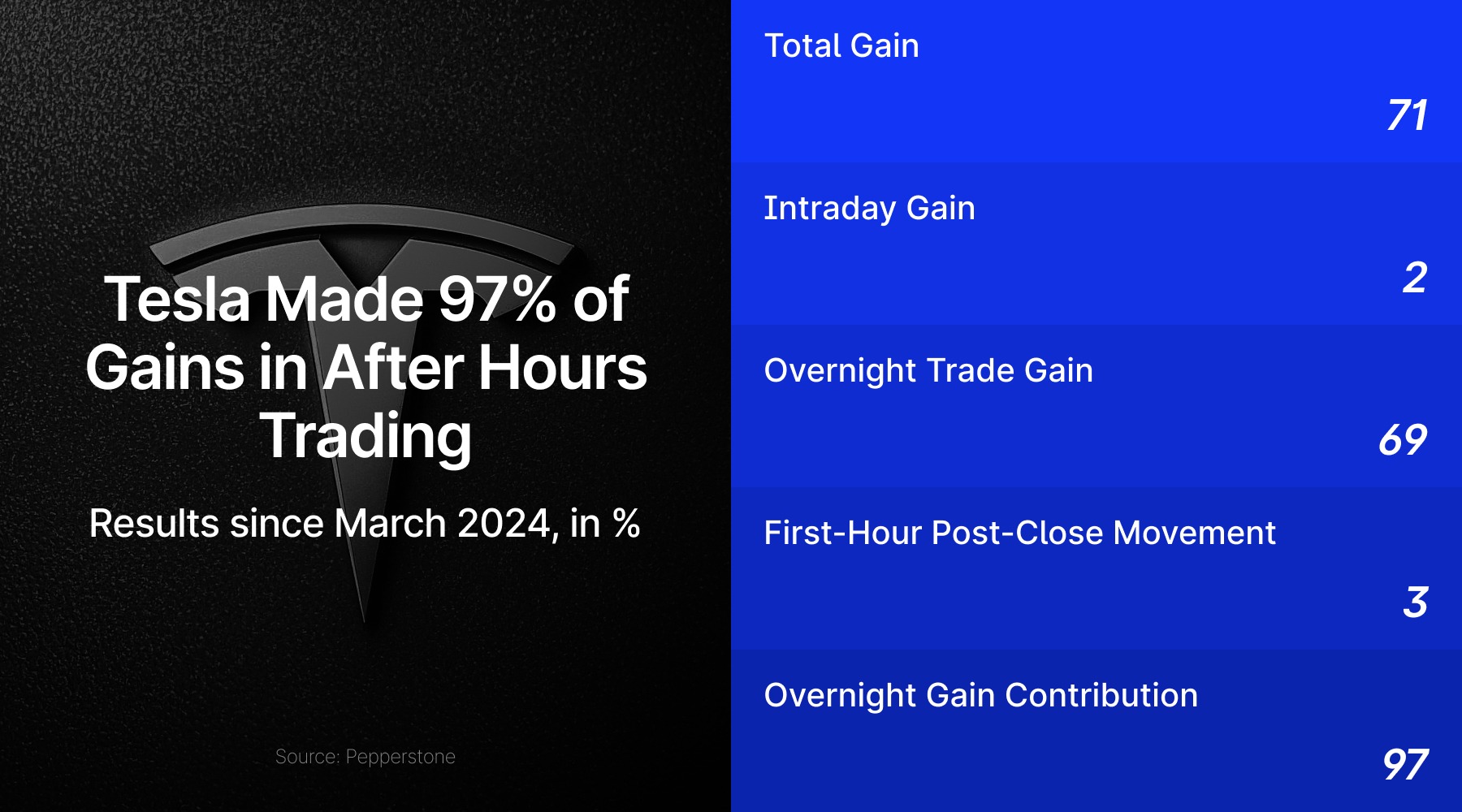
New data reveals that the bulk of share price increases for tech leaders occurred outside regular trading hours since March 2024.
It drove Pepperstone to expand its 24-hour stock offerings, adding additional 79 US share CFDs.
Nearly all
price gains in major technology stocks on Wall Street have occurred outside
regular trading hours over the past year, according to new market data released
today (Monday). It prompted CFD broker Pepperstone to more than triple its
after-hours trading offerings to over 100 U.S. stocks.
Tech Giants Made Nearly
All Gains After Hours, New Data Shows
Analysis of
trading patterns shows that Tesla recorded 97% of its price appreciation during
after-hours trading since March 2024, while Alphabet saw 91% of its gains
outside regular market hours. Nvidia, currently the market's third-most
valuable company, generated 82% of its returns when traditional exchanges were
closed.
These statistics
emerge as institutional investors and algorithmic trading systems increasingly
react to market-moving events such as earnings releases and global developments
during overnight hours, leaving traditional day traders potentially missing the
market's biggest moves.
Chris Weston, Head of Research at Pepperstone; Photo: LinkedIn
“The
data trends we’ve observed suggest that, for traders whose strategy holds the edge
in periods of trend and heightened movement, it’s the overnight session that
has generated the best returns for the NAS100 and many of the marquee US equity
plays,” said Chris Weston, Head of Research at Pepperstone.
The
findings highlight a fundamental shift in global market dynamics, where Asian
trading hours and pre-market responses to earnings releases can drive
significant price movements before U.S. exchanges open. This trend has
accelerated with the rise of 24-hour cryptocurrency markets and increased
retail trading participation across time zones.
Pepperstone Expands
24-Hour Stock CFDs as After-Hours Trading Surges
In response
to these patterns, trading platforms are racing to provide round-the-clock
access. Pepperstone is one of them, expanding its 24-hour trading service to
include an additional 79 US share CFDs, bringing its total offering to more
than 100 continuously traded instruments.
The
expansion follows the broker's initial
launch of 24-hour US share CFD trading in March 2024. The new offering
encompasses technology companies such as ASML and Palantir, transportation
service provider Uber, entertainment company Netflix, and financial services
firms Mastercard and Visa.
This
development enables traders to respond to market-moving events such as earnings
announcements and economic data releases that occur outside standard trading
hours.
“Aside from
the complete ability to react at a time of the trader's choosing, this relative
performance is perhaps another reason why 24-hour US equity pricing may be the
default position for equity traders in the future. One to watch with Nvidia’s
earnings report coming up,” added Weston.
Pepperstone
is not the only one that has expanded its clients' access to round-the-clock
trading. A similar move was made this month by Charles
Schwab and Firstrade, although the latter offers 20/5
trading.
Overnight Trading Drives
US Equity Gains
Pepperstone
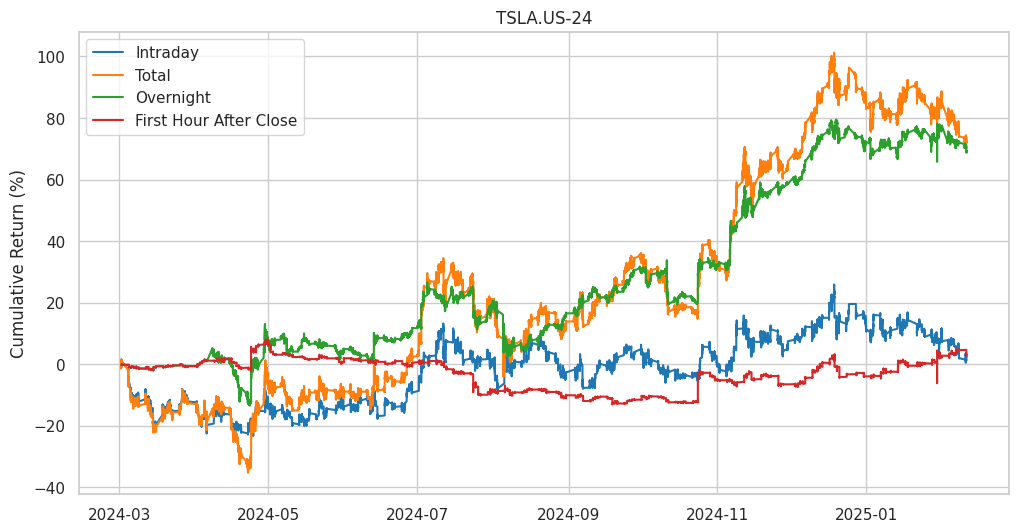
examined price movements for US 24-hour share CFDs since March 2024, when
the company introduced the offering. The analysis divided the trading day into
two key periods: US cash equity trade (09:30 to 16:00 EST) and the ‘overnight’
session (16:01 to 09:29 EST). The team assessed cumulative percentage changes
in various assets, including the NAS100 index and several prominent individual
stocks.
The study
also investigated performance within the first hour after the US stock market
closed, a period known for heightened activity due to corporate earnings
releases and other key developments.
Key Findings: NAS100 Index
Gains from Overnight Trading
Since March
2024, the NAS100 index has registered a 20.1% total gain. However, a detailed
breakdown of performance reveals a striking contrast:
If a trader
had engaged in intraday trading only—buying at market open and selling at
close—they would have recorded a cumulative 1% loss.
In
contrast, executing trades in the ‘overnight’ session—buying after the US close
and selling just before the next market open—would have resulted in a
cumulative 21.1% gain.
This
discrepancy suggests that market-moving events and momentum are favoring
extended-hour sessions, a trend that also holds for individual equities.
Applying
the same methodology to select high-profile stocks, the analysis showed that
overnight trading accounted for the majority of gains in some of the most
actively traded US equities.
Stock
Total Gain
(%)
Intraday
Trade Gain (%)
Overnight
Trade Gain (%)
First-Hour Post-Close Movement (%)
Overnight
Gain Contribution (%)
Nvidia (NVDA)
64.8
11.7
53.1
0.9
82.0
Tesla (TSLA)
70.7
1.6
69.1
3.2
97.0
Alphabet
(GOOGL)
34.9
3.1
31.8
-6.2
91.1
These
results indicate that traders focusing only on regular market hours might be
missing significant profit opportunities.
Source: Pepperstone
One
contributing factor to overnight outperformance is the release of earnings
reports, which often occur shortly after market close. The analysis highlighted
that in the past eight quarterly earnings reports, major stocks experienced
significant one-day price movements:
Nvidia: 9.2%
Microsoft: 4%
Meta: 7.9%
Amazon: 6%
Alphabet: 6%
Tesla: 11.3%
While
earnings-driven moves play a role, the data suggests that overnight trading
extends beyond just post-earnings volatility. For traders with strategies
favoring trending markets and higher volatility, extended-hour trading provides
additional opportunities to capture meaningful price shifts.
Nearly all
price gains in major technology stocks on Wall Street have occurred outside
regular trading hours over the past year, according to new market data released
today (Monday). It prompted CFD broker Pepperstone to more than triple its
after-hours trading offerings to over 100 U.S. stocks.
Tech Giants Made Nearly
All Gains After Hours, New Data Shows
Analysis of
trading patterns shows that Tesla recorded 97% of its price appreciation during
after-hours trading since March 2024, while Alphabet saw 91% of its gains
outside regular market hours. Nvidia, currently the market's third-most
valuable company, generated 82% of its returns when traditional exchanges were
closed.
These statistics
emerge as institutional investors and algorithmic trading systems increasingly
react to market-moving events such as earnings releases and global developments
during overnight hours, leaving traditional day traders potentially missing the
market's biggest moves.
Chris Weston, Head of Research at Pepperstone; Photo: LinkedIn
“The
data trends we’ve observed suggest that, for traders whose strategy holds the edge
in periods of trend and heightened movement, it’s the overnight session that
has generated the best returns for the NAS100 and many of the marquee US equity
plays,” said Chris Weston, Head of Research at Pepperstone.
The
findings highlight a fundamental shift in global market dynamics, where Asian
trading hours and pre-market responses to earnings releases can drive
significant price movements before U.S. exchanges open. This trend has
accelerated with the rise of 24-hour cryptocurrency markets and increased
retail trading participation across time zones.
Pepperstone Expands
24-Hour Stock CFDs as After-Hours Trading Surges
In response
to these patterns, trading platforms are racing to provide round-the-clock
access. Pepperstone is one of them, expanding its 24-hour trading service to
include an additional 79 US share CFDs, bringing its total offering to more
than 100 continuously traded instruments.
The
expansion follows the broker's initial
launch of 24-hour US share CFD trading in March 2024. The new offering
encompasses technology companies such as ASML and Palantir, transportation
service provider Uber, entertainment company Netflix, and financial services
firms Mastercard and Visa.
This
development enables traders to respond to market-moving events such as earnings
announcements and economic data releases that occur outside standard trading
hours.
“Aside from
the complete ability to react at a time of the trader's choosing, this relative
performance is perhaps another reason why 24-hour US equity pricing may be the
default position for equity traders in the future. One to watch with Nvidia’s
earnings report coming up,” added Weston.
Pepperstone
is not the only one that has expanded its clients' access to round-the-clock
trading. A similar move was made this month by Charles
Schwab and Firstrade, although the latter offers 20/5
trading.
Overnight Trading Drives
US Equity Gains
Pepperstone
examined price movements for US 24-hour share CFDs since March 2024, when
the company introduced the offering. The analysis divided the trading day into
two key periods: US cash equity trade (09:30 to 16:00 EST) and the ‘overnight’
session (16:01 to 09:29 EST). The team assessed cumulative percentage changes
in various assets, including the NAS100 index and several prominent individual
stocks.
The study
also investigated performance within the first hour after the US stock market
closed, a period known for heightened activity due to corporate earnings
releases and other key developments.
Key Findings: NAS100 Index
Gains from Overnight Trading
Since March
2024, the NAS100 index has registered a 20.1% total gain. However, a detailed
breakdown of performance reveals a striking contrast:
If a trader
had engaged in intraday trading only—buying at market open and selling at
close—they would have recorded a cumulative 1% loss.
In
contrast, executing trades in the ‘overnight’ session—buying after the US close
and selling just before the next market open—would have resulted in a
cumulative 21.1% gain.
This
discrepancy suggests that market-moving events and momentum are favoring
extended-hour sessions, a trend that also holds for individual equities.
Applying
the same methodology to select high-profile stocks, the analysis showed that
overnight trading accounted for the majority of gains in some of the most
actively traded US equities.
Stock
Total Gain
(%)
Intraday
Trade Gain (%)
Overnight
Trade Gain (%)
First-Hour Post-Close Movement (%)
Overnight
Gain Contribution (%)
Nvidia (NVDA)
64.8
11.7
53.1
0.9
82.0
Tesla (TSLA)
70.7
1.6
69.1
3.2
97.0
Alphabet
(GOOGL)
34.9
3.1
31.8
-6.2
91.1
These
results indicate that traders focusing only on regular market hours might be
missing significant profit opportunities.
Source: Pepperstone
One
contributing factor to overnight outperformance is the release of earnings
reports, which often occur shortly after market close. The analysis highlighted
that in the past eight quarterly earnings reports, major stocks experienced
significant one-day price movements:
Nvidia: 9.2%
Microsoft: 4%
Meta: 7.9%
Amazon: 6%
Alphabet: 6%
Tesla: 11.3%
While
earnings-driven moves play a role, the data suggests that overnight trading
extends beyond just post-earnings volatility. For traders with strategies
favoring trending markets and higher volatility, extended-hour trading provides
additional opportunities to capture meaningful price shifts.
Damian Chmiel is a Senior Analyst & Editor at Finance Magnates with more than 15 years of experience in the CFD and online trading industry. Active as both a trader and journalist since 2010, he focuses on broker coverage, fintech innovation, and regulatory developments across Europe, the Middle East, and Asia.
His work includes interviews with C-level leaders at major brokerages and fintech platforms, as well as co-authoring Finance Magnates’ quarterly industry benchmarking reports. Damian’s reporting is data-driven, market-aware, and grounded in direct industry engagement. His analysis and commentary have also been cited by external media outlets, including Investing.com, Binance, The Asset, Stockhead, and Dispatch.
Education:
MA in Finance and Accounting, Cracow University of Economics
Italy’s Consob Tightens Net on AI-Fueled Scams With Fresh Website Bans
FP Markets Winner Spotlight 🏆 | Global Broker of the Year 2025 #Trading #Broker #Innovation #Shorts
FP Markets Winner Spotlight 🏆 | Global Broker of the Year 2025 #Trading #Broker #Innovation #Shorts
FP Markets takes the spotlight as Global Broker of the Year 2025 at the Finance Magnates Awards.
Martin Stoilov, Head of Client Experience, shares that trust, innovation, and people played a key role in the company’s success, supported by a strong foundation of integrity and client-centricity.
Following this milestone, FP Markets continues to focus on growth, technology investment, and its core values of transparency and excellence.
👉 Be part of FM Awards 2026: https://awards.financemagnates.com/#nominate
FP Markets takes the spotlight as Global Broker of the Year 2025 at the Finance Magnates Awards.
Martin Stoilov, Head of Client Experience, shares that trust, innovation, and people played a key role in the company’s success, supported by a strong foundation of integrity and client-centricity.
Following this milestone, FP Markets continues to focus on growth, technology investment, and its core values of transparency and excellence.
👉 Be part of FM Awards 2026: https://awards.financemagnates.com/#nominate
In this video, we review @HolaPrimeMarketsOfficial, a multi-asset forex and CFDs broker offering different account types, trading platforms, and flexible trading conditions.
We cover the broker’s overall offering, including account options, trading environment, platforms like MT4 and MT5, and additional services such as managed accounts and fast withdrawals.
Watch the full video to see if Hola Prime Markets fits your trading needs.
📣 Stay up to date with the latest in finance and trading. Follow Finance Magnates for industry news, insights, and global event coverage.
Connect with us:
🔗 LinkedIn: /financemagnates
👍 Facebook: /financemagnates
📸 Instagram: https://www.instagram.com/financemagnates
🐦 X: https://x.com/financemagnates
🎥 TikTok: https://www.tiktok.com/tag/financemagnates
▶️ YouTube: /@financemagnates_official
#HolaPrime #ForexBroker #CFDTrading #FinanceMagnates #Trading #Forex #BrokerReview
In this video, we review @HolaPrimeMarketsOfficial, a multi-asset forex and CFDs broker offering different account types, trading platforms, and flexible trading conditions.
We cover the broker’s overall offering, including account options, trading environment, platforms like MT4 and MT5, and additional services such as managed accounts and fast withdrawals.
Watch the full video to see if Hola Prime Markets fits your trading needs.
📣 Stay up to date with the latest in finance and trading. Follow Finance Magnates for industry news, insights, and global event coverage.
Connect with us:
🔗 LinkedIn: /financemagnates
👍 Facebook: /financemagnates
📸 Instagram: https://www.instagram.com/financemagnates
🐦 X: https://x.com/financemagnates
🎥 TikTok: https://www.tiktok.com/tag/financemagnates
▶️ YouTube: /@financemagnates_official
#HolaPrime #ForexBroker #CFDTrading #FinanceMagnates #Trading #Forex #BrokerReview
Hola Prime Review: What You Need to Know | Full Breakdown by Finance Magnates
Hola Prime Review: What You Need to Know | Full Breakdown by Finance Magnates
In this video, we review @HolaPrime_Global, a proprietary trading firm offering evaluation programs and performance-based payouts in simulated market environments.
We cover how the challenge model works, including account types, profit splits (up to 95%), trading rules, and what it takes to reach a funded account. You’ll also learn about available platforms like MT4, MT5, cTrader, and more, along with insights into payouts, support, and trading conditions.
Watch the full video to see if Hola Prime fits your trading style.
📣 Stay up to date with the latest in finance and trading. Follow Finance Magnates for industry news, insights, and global event coverage.
Connect with us:
🔗 LinkedIn: /financemagnates
👍 Facebook: /financemagnates
📸 Instagram: https://www.instagram.com/financemagnates
🐦 X: https://x.com/financemagnates
🎥 TikTok: https://www.tiktok.com/tag/financemagnates
▶️ YouTube: /@financemagnates_official
#HolaPrime #PropFirm #Trading #FinanceMagnates #Forex #FuturesTrading #TradingReview #PropFirmReview
In this video, we review @HolaPrime_Global, a proprietary trading firm offering evaluation programs and performance-based payouts in simulated market environments.
We cover how the challenge model works, including account types, profit splits (up to 95%), trading rules, and what it takes to reach a funded account. You’ll also learn about available platforms like MT4, MT5, cTrader, and more, along with insights into payouts, support, and trading conditions.
Watch the full video to see if Hola Prime fits your trading style.
📣 Stay up to date with the latest in finance and trading. Follow Finance Magnates for industry news, insights, and global event coverage.
Connect with us:
🔗 LinkedIn: /financemagnates
👍 Facebook: /financemagnates
📸 Instagram: https://www.instagram.com/financemagnates
🐦 X: https://x.com/financemagnates
🎥 TikTok: https://www.tiktok.com/tag/financemagnates
▶️ YouTube: /@financemagnates_official
#HolaPrime #PropFirm #Trading #FinanceMagnates #Forex #FuturesTrading #TradingReview #PropFirmReview
Axi Winner Spotlight 🏆 | Global Most Innovative Broker 2025 #Innovation #Trading #Fintech #Broker
Axi Winner Spotlight 🏆 | Global Most Innovative Broker 2025 #Innovation #Trading #Fintech #Broker
Axi takes the spotlight at the Finance Magnates Awards, winning Global Most Innovative Broker 2025.
Olivia Xenofontos and Ivanna Openko share how the team will feel: proud, motivated, and ready to keep delivering.
They also describe the night as well-organized, focused, and enjoyable for all.
👉 Be part of FM Awards 2026.
Axi takes the spotlight at the Finance Magnates Awards, winning Global Most Innovative Broker 2025.
Olivia Xenofontos and Ivanna Openko share how the team will feel: proud, motivated, and ready to keep delivering.
They also describe the night as well-organized, focused, and enjoyable for all.
👉 Be part of FM Awards 2026.
Recognition that matters.
Built on transparency.
Driven by the industry.
The Finance Magnates Awards 2026.
Nominations are now open.
🔗 https://awards.financemagnates.com/?utm_source=SM&utm_medium=social&utm_campaign=recognition-matters
Recognition that matters.
Built on transparency.
Driven by the industry.
The Finance Magnates Awards 2026.
Nominations are now open.
🔗 https://awards.financemagnates.com/?utm_source=SM&utm_medium=social&utm_campaign=recognition-matters