During the past 12 months, the forex sector has had a lot of changes. The most notable, of course, was in Europe with the European Securities and Markets Authority (ESMA) implementing a suite of regulatory changes. However, trade war tensions, financial crises, low market volatility, and the ever-growing cryptocurrency space has changed the industry globally.
As a result, all of these changes have had an impact on FX trading. So what patterns have emerged over the past four quarters (Q4 2017 - Q3 2018)? Based on data sourced by Finance Magnates Intelligence, which has accumulated trading volumes from brokers worldwide, there are a few patterns that emerge.
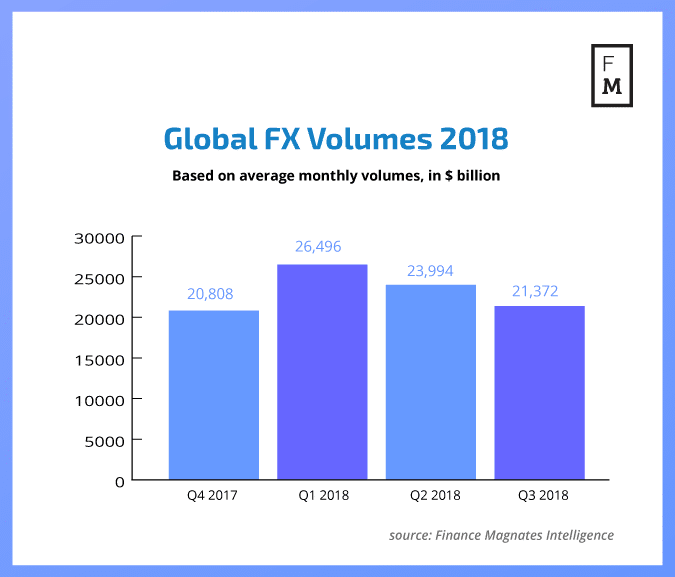
Taking a global view, we can see that the weakest quarter overall for the past four quarters, is in fact, the final quarter of 2017. During Q4 of last year, total forex trading volume came in at $20.81 trillion. This is around 21.47 percent less than that achieved in the first quarter of 2018, which was $26.5 trillion.
ESMA hurts EU brokers
Unsurprisingly, the second weakest period was the third quarter of this year. For the forex industry, the three months from July until September, are typically plagued with lower volatility thanks in large part to the summer season.
However, during this quarter trade tensions between the United States and China were heating up, which drove traders away from forex trading, and ESMA hurt brokers in the European Union by imposing trading restrictions, which impacted leverage levels and marketing practices.
To see how this impacted the trading volumes of some of the top brokers in the forex industry, you can read our previous analysis here. Specifically, we saw some of the top EU and UK brokers record a sharp fall in FX volumes during the third quarter, whereas Australian brokers actually managed to achieve an uptick in trading activity.
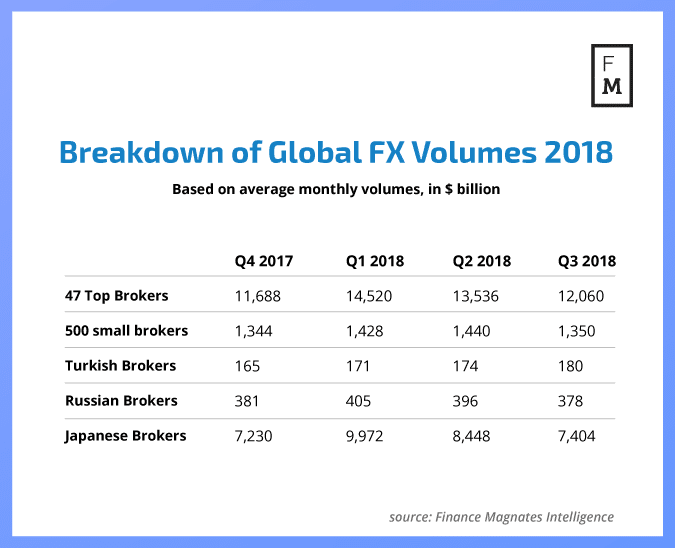
As part of our analysis, we compiled data from some of the top brokers in the industry, ranging from the UK, Australia, Europe, Asia and more. In addition, we also compiled data from brokers in Russia, Turkey, Japan, and some smaller brokers. You can see a breakdown in the graph below.
Turkey bucks the trend
As can be seen, one country, in particular, recorded figures that go against the global trend. That country is Turkey. For those who have kept up to date with financial news, it probably comes as no surprise that Turkey is an outlier here.
2018 has been a difficult year for Turkey, with the country facing a financial crisis and its currency, the Turkish lira (TRY) fell to historically low levels, losing 45 percent of its value against the US dollar by mid-August since the start of the year.
As a result of the falling TRY, numerous forex brokers suspended trading in the currency. As Finance Magnates reported, one such broker was Alpari, who cited “economic instability” in Turkey as the reason behind its decision. However, swings in TRY have calmed down after the country’s central bank hiked interest rates to combat rapidly-rising inflation.
Russia also went against the trend, with the third quarter of this year being its lowest in terms of FX trading volume, coming in at $126 billion. However, this is only 0.8 percent less than Q4 of 2017.
Japan, which has a large FX trading industry, is home to giant brokerages such as Nomura Securities, Mitsubishi UFJ, Mizuho Securities and Daiwa Securities. As is the same with global volumes, the country’s first quarter ($3.32 trillion) far outperformed the other three quarters and had a trading volume which was 27.5 percent higher than Q4 2017, and 25.8 per cent stronger than Q3 2018.
During the past 12 months, the forex sector has had a lot of changes. The most notable, of course, was in Europe with the European Securities and Markets Authority (ESMA) implementing a suite of regulatory changes. However, trade war tensions, financial crises, low market volatility, and the ever-growing cryptocurrency space has changed the industry globally.
As a result, all of these changes have had an impact on FX trading. So what patterns have emerged over the past four quarters (Q4 2017 - Q3 2018)? Based on data sourced by Finance Magnates Intelligence, which has accumulated trading volumes from brokers worldwide, there are a few patterns that emerge.
Taking a global view, we can see that the weakest quarter overall for the past four quarters, is in fact, the final quarter of 2017. During Q4 of last year, total forex trading volume came in at $20.81 trillion. This is around 21.47 percent less than that achieved in the first quarter of 2018, which was $26.5 trillion.
ESMA hurts EU brokers
Unsurprisingly, the second weakest period was the third quarter of this year. For the forex industry, the three months from July until September, are typically plagued with lower volatility thanks in large part to the summer season.
However, during this quarter trade tensions between the United States and China were heating up, which drove traders away from forex trading, and ESMA hurt brokers in the European Union by imposing trading restrictions, which impacted leverage levels and marketing practices.
To see how this impacted the trading volumes of some of the top brokers in the forex industry, you can read our previous analysis here. Specifically, we saw some of the top EU and UK brokers record a sharp fall in FX volumes during the third quarter, whereas Australian brokers actually managed to achieve an uptick in trading activity.
As part of our analysis, we compiled data from some of the top brokers in the industry, ranging from the UK, Australia, Europe, Asia and more. In addition, we also compiled data from brokers in Russia, Turkey, Japan, and some smaller brokers. You can see a breakdown in the graph below.
Turkey bucks the trend
As can be seen, one country, in particular, recorded figures that go against the global trend. That country is Turkey. For those who have kept up to date with financial news, it probably comes as no surprise that Turkey is an outlier here.
2018 has been a difficult year for Turkey, with the country facing a financial crisis and its currency, the Turkish lira (TRY) fell to historically low levels, losing 45 percent of its value against the US dollar by mid-August since the start of the year.
As a result of the falling TRY, numerous forex brokers suspended trading in the currency. As Finance Magnates reported, one such broker was Alpari, who cited “economic instability” in Turkey as the reason behind its decision. However, swings in TRY have calmed down after the country’s central bank hiked interest rates to combat rapidly-rising inflation.
Russia also went against the trend, with the third quarter of this year being its lowest in terms of FX trading volume, coming in at $126 billion. However, this is only 0.8 percent less than Q4 of 2017.
Japan, which has a large FX trading industry, is home to giant brokerages such as Nomura Securities, Mitsubishi UFJ, Mizuho Securities and Daiwa Securities. As is the same with global volumes, the country’s first quarter ($3.32 trillion) far outperformed the other three quarters and had a trading volume which was 27.5 percent higher than Q4 2017, and 25.8 per cent stronger than Q3 2018.
CySEC Withdraws TTCM Traders Trust Capital Markets Licence as CFD Broker Exits Voluntarily
Featured Videos
FM Daily Brief – 9 June 2026
Today’s Tuesday, the 9th of June 2026, and these are our main stories: eToro’s customer assets climbed back above $20 billion, Prop trading model in prediction markets, and Leverate launched a new AI assistant for brokers and traders.
War Stories: Lessons from 20 Years in Markets (the pain, the pitfalls and the profits)
The trades that taught me the most aren't the ones that worked. They're the ones that didn't — or the ones I almost caught and didn't have the nerve to ride. In this session, I'll tell you about the Brexit miss, the SNB shocker that nearly handed me a 5400% return, the BoJ surprise that punched me in the gut, and a few wins along the way. Each story carries a lesson, but the lessons aren't the point. Everyone who trades long enough collects a portfolio of moments like these; what separates the people who stay in the game is what they do with them.
The Engine and the Fuel: How AI & Data Drives African Future
If AI is the engine, data is the fuel. Without quality, accessible data, AI cannot work well; and without the right mindset, data remains just numbers instead of insight. In this session, leading experts will explore how AI and data are democratizing opportunities for businesses and personal growth. Discover practical ways to make AI accessible today, anticipate its transformative impact on African markets, and learn actionable steps to prepare for what's next. Let's talk about:
-How AI and data drive business efficiency and innovation in trading and fintech
-AI tools to elevate trading or business strategies
-How to access and maximise the power of data and AI
-Emerging AI and data trends in Africa and their economic ripple effects
If AI is the engine, data is the fuel. Without quality, accessible data, AI cannot work well; and without the right mindset, data remains just numbers instead of insight. In this session, leading experts will explore how AI and data are democratizing opportunities for businesses and personal growth. Discover practical ways to make AI accessible today, anticipate its transformative impact on African markets, and learn actionable steps to prepare for what's next. Let's talk about:
-How AI and data drive business efficiency and innovation in trading and fintech
-AI tools to elevate trading or business strategies
-How to access and maximise the power of data and AI
-Emerging AI and data trends in Africa and their economic ripple effects
If AI is the engine, data is the fuel. Without quality, accessible data, AI cannot work well; and without the right mindset, data remains just numbers instead of insight. In this session, leading experts will explore how AI and data are democratizing opportunities for businesses and personal growth. Discover practical ways to make AI accessible today, anticipate its transformative impact on African markets, and learn actionable steps to prepare for what's next. Let's talk about:
-How AI and data drive business efficiency and innovation in trading and fintech
-AI tools to elevate trading or business strategies
-How to access and maximise the power of data and AI
-Emerging AI and data trends in Africa and their economic ripple effects
If AI is the engine, data is the fuel. Without quality, accessible data, AI cannot work well; and without the right mindset, data remains just numbers instead of insight. In this session, leading experts will explore how AI and data are democratizing opportunities for businesses and personal growth. Discover practical ways to make AI accessible today, anticipate its transformative impact on African markets, and learn actionable steps to prepare for what's next. Let's talk about:
-How AI and data drive business efficiency and innovation in trading and fintech
-AI tools to elevate trading or business strategies
-How to access and maximise the power of data and AI
-Emerging AI and data trends in Africa and their economic ripple effects
If AI is the engine, data is the fuel. Without quality, accessible data, AI cannot work well; and without the right mindset, data remains just numbers instead of insight. In this session, leading experts will explore how AI and data are democratizing opportunities for businesses and personal growth. Discover practical ways to make AI accessible today, anticipate its transformative impact on African markets, and learn actionable steps to prepare for what's next. Let's talk about:
-How AI and data drive business efficiency and innovation in trading and fintech
-AI tools to elevate trading or business strategies
-How to access and maximise the power of data and AI
-Emerging AI and data trends in Africa and their economic ripple effects
If AI is the engine, data is the fuel. Without quality, accessible data, AI cannot work well; and without the right mindset, data remains just numbers instead of insight. In this session, leading experts will explore how AI and data are democratizing opportunities for businesses and personal growth. Discover practical ways to make AI accessible today, anticipate its transformative impact on African markets, and learn actionable steps to prepare for what's next. Let's talk about:
-How AI and data drive business efficiency and innovation in trading and fintech
-AI tools to elevate trading or business strategies
-How to access and maximise the power of data and AI
-Emerging AI and data trends in Africa and their economic ripple effects
Inside My Best Trade with Jimmy Moyaha
Most market post-mortems describe what happened to prices. Few describe what happened in the trading room while the position was open: the entry conviction, the moments that tested it, and the exit decision that closed the book.
This session brings one seasoned trader to the stage for an unfiltered account of the position that still defines how they think about markets.
Attendees will walk away with:
-A first-hand account of how a conviction trade is built, from thesis and entry through position management and exit
-Understanding of what turns a market observation into a live position, and what holds it when conditions shift
-Insight into how timing, execution quality, and market structure shaped the final result
-Perspective on what the trade revealed about edge, risk tolerance, and when to hold through a position moving against you
-Clarity on what separates a well-built trade from a well-timed one
Most market post-mortems describe what happened to prices. Few describe what happened in the trading room while the position was open: the entry conviction, the moments that tested it, and the exit decision that closed the book.
This session brings one seasoned trader to the stage for an unfiltered account of the position that still defines how they think about markets.
Attendees will walk away with:
-A first-hand account of how a conviction trade is built, from thesis and entry through position management and exit
-Understanding of what turns a market observation into a live position, and what holds it when conditions shift
-Insight into how timing, execution quality, and market structure shaped the final result
-Perspective on what the trade revealed about edge, risk tolerance, and when to hold through a position moving against you
-Clarity on what separates a well-built trade from a well-timed one
Most market post-mortems describe what happened to prices. Few describe what happened in the trading room while the position was open: the entry conviction, the moments that tested it, and the exit decision that closed the book.
This session brings one seasoned trader to the stage for an unfiltered account of the position that still defines how they think about markets.
Attendees will walk away with:
-A first-hand account of how a conviction trade is built, from thesis and entry through position management and exit
-Understanding of what turns a market observation into a live position, and what holds it when conditions shift
-Insight into how timing, execution quality, and market structure shaped the final result
-Perspective on what the trade revealed about edge, risk tolerance, and when to hold through a position moving against you
-Clarity on what separates a well-built trade from a well-timed one
Most market post-mortems describe what happened to prices. Few describe what happened in the trading room while the position was open: the entry conviction, the moments that tested it, and the exit decision that closed the book.
This session brings one seasoned trader to the stage for an unfiltered account of the position that still defines how they think about markets.
Attendees will walk away with:
-A first-hand account of how a conviction trade is built, from thesis and entry through position management and exit
-Understanding of what turns a market observation into a live position, and what holds it when conditions shift
-Insight into how timing, execution quality, and market structure shaped the final result
-Perspective on what the trade revealed about edge, risk tolerance, and when to hold through a position moving against you
-Clarity on what separates a well-built trade from a well-timed one
Most market post-mortems describe what happened to prices. Few describe what happened in the trading room while the position was open: the entry conviction, the moments that tested it, and the exit decision that closed the book.
This session brings one seasoned trader to the stage for an unfiltered account of the position that still defines how they think about markets.
Attendees will walk away with:
-A first-hand account of how a conviction trade is built, from thesis and entry through position management and exit
-Understanding of what turns a market observation into a live position, and what holds it when conditions shift
-Insight into how timing, execution quality, and market structure shaped the final result
-Perspective on what the trade revealed about edge, risk tolerance, and when to hold through a position moving against you
-Clarity on what separates a well-built trade from a well-timed one
Most market post-mortems describe what happened to prices. Few describe what happened in the trading room while the position was open: the entry conviction, the moments that tested it, and the exit decision that closed the book.
This session brings one seasoned trader to the stage for an unfiltered account of the position that still defines how they think about markets.
Attendees will walk away with:
-A first-hand account of how a conviction trade is built, from thesis and entry through position management and exit
-Understanding of what turns a market observation into a live position, and what holds it when conditions shift
-Insight into how timing, execution quality, and market structure shaped the final result
-Perspective on what the trade revealed about edge, risk tolerance, and when to hold through a position moving against you
-Clarity on what separates a well-built trade from a well-timed one
Agentic Inequality: Democratizing Financial Access Through AI & Blockchain
As crypto and CFD trading continue to expand across Africa, access to advanced tools and market insights remains uneven. This session explores how AI and blockchain can bridge that gap by empowering informal traders and underserved communities to participate more effectively in digital financial markets. The discussion will focus on practical applications of technology to improve accessibility, education, and investment outcomes in both formal and informal sectors.
In this discussion, we will explore:
-The role of AI in democratizing access to trading tools, insights, and strategy development
-How crypto and blockchain can enable broader participation beyond traditional financial systems
-Addressing access barriers: infrastructure, education, and affordability in underserved communities
-Opportunities for brokers and platforms to tap into the informal trading economy
As crypto and CFD trading continue to expand across Africa, access to advanced tools and market insights remains uneven. This session explores how AI and blockchain can bridge that gap by empowering informal traders and underserved communities to participate more effectively in digital financial markets. The discussion will focus on practical applications of technology to improve accessibility, education, and investment outcomes in both formal and informal sectors.
In this discussion, we will explore:
-The role of AI in democratizing access to trading tools, insights, and strategy development
-How crypto and blockchain can enable broader participation beyond traditional financial systems
-Addressing access barriers: infrastructure, education, and affordability in underserved communities
-Opportunities for brokers and platforms to tap into the informal trading economy
As crypto and CFD trading continue to expand across Africa, access to advanced tools and market insights remains uneven. This session explores how AI and blockchain can bridge that gap by empowering informal traders and underserved communities to participate more effectively in digital financial markets. The discussion will focus on practical applications of technology to improve accessibility, education, and investment outcomes in both formal and informal sectors.
In this discussion, we will explore:
-The role of AI in democratizing access to trading tools, insights, and strategy development
-How crypto and blockchain can enable broader participation beyond traditional financial systems
-Addressing access barriers: infrastructure, education, and affordability in underserved communities
-Opportunities for brokers and platforms to tap into the informal trading economy
As crypto and CFD trading continue to expand across Africa, access to advanced tools and market insights remains uneven. This session explores how AI and blockchain can bridge that gap by empowering informal traders and underserved communities to participate more effectively in digital financial markets. The discussion will focus on practical applications of technology to improve accessibility, education, and investment outcomes in both formal and informal sectors.
In this discussion, we will explore:
-The role of AI in democratizing access to trading tools, insights, and strategy development
-How crypto and blockchain can enable broader participation beyond traditional financial systems
-Addressing access barriers: infrastructure, education, and affordability in underserved communities
-Opportunities for brokers and platforms to tap into the informal trading economy
As crypto and CFD trading continue to expand across Africa, access to advanced tools and market insights remains uneven. This session explores how AI and blockchain can bridge that gap by empowering informal traders and underserved communities to participate more effectively in digital financial markets. The discussion will focus on practical applications of technology to improve accessibility, education, and investment outcomes in both formal and informal sectors.
In this discussion, we will explore:
-The role of AI in democratizing access to trading tools, insights, and strategy development
-How crypto and blockchain can enable broader participation beyond traditional financial systems
-Addressing access barriers: infrastructure, education, and affordability in underserved communities
-Opportunities for brokers and platforms to tap into the informal trading economy
As crypto and CFD trading continue to expand across Africa, access to advanced tools and market insights remains uneven. This session explores how AI and blockchain can bridge that gap by empowering informal traders and underserved communities to participate more effectively in digital financial markets. The discussion will focus on practical applications of technology to improve accessibility, education, and investment outcomes in both formal and informal sectors.
In this discussion, we will explore:
-The role of AI in democratizing access to trading tools, insights, and strategy development
-How crypto and blockchain can enable broader participation beyond traditional financial systems
-Addressing access barriers: infrastructure, education, and affordability in underserved communities
-Opportunities for brokers and platforms to tap into the informal trading economy