Prediction markets boomed in 2025 as retail trading giant Robinhood added them to its platform.
Although the CFTC approved their issuance a few years ago, the agency is now questioning whether it made the right decision.
Will
Bitcoin reach $150,000? When will GTA 6 be released? How many gold cards will
Donald Trump sell in 2025? Who will become the NBA champion? While these
questions might seem unrelated at first glance, they share a common
denominator: event-based contracts, a regulated yet controversial financial
instrument offered by companies like Robinhood (NASDAQ: HOOD) and Interactive Brokers (NASDAQ: IBKR).
This
explosive mixture—resembling a blend of once-popular binary options, sports
betting, and coin flipping—is hailed by enthusiasts as the next revolution in
retail trading. Regulators, however, fear it's just a backdoor to gambling.
Who's
right? I decided to go straight to the source to find answers to this
intriguing question.
What Are
Event Contracts?
“Event
contracts are an asset class that give investors the ability to trade directly
on their opinions about a specific yes-or-no question,” states Kalshi,
currently one of the main providers of such instruments, on its official
website.
For
example, betting on a contract like “Powell out as Chair this year?”
could earn you $395 from a $100 investment if you answer “Yes,” while
the same amount bet on “No” would yield only $128. Everything depends
on the probability of the event occurring, which changes dynamically based on
how users vote on the platform.
Source: Kalshi.com
You can bet
on virtually anything: politics, sports, cryptocurrencies, culture, climate
change, company results, technological discoveries, and major world events.
“Event contracts have generated high demand because they provide a maximally direct way to get
exposure to events that affect businesses, people, and the economy, and they
provide the most accurate signal on what the likelihood of future events
are,” commented Jack Such from Kalshi, responsible for Business &
Media Development, to FinanceMagnates.com.
Jack Such from Kalshi
All this
comes with the “blessing” of the CFTC, which Kalshi received in 2020,
enabling the launch of the first regulated event contracts exchange over three
years ago. The problem, however, is that regulators are no longer looking so
favorably on the growing popularity of these instruments, and the bone of
contention remains whether some of them are investments or already
“gaming.”
A
Trillion Dollar Asset Class
Despite the
regulatory controversies surrounding event contracts, Such remains optimistic
and claims that in 2024, Kalshi's prediction markets showed an
“astronomical rate of growth.”
“We
are confident that prediction markets will become a trillion dollar asset
class,” he added.
His words
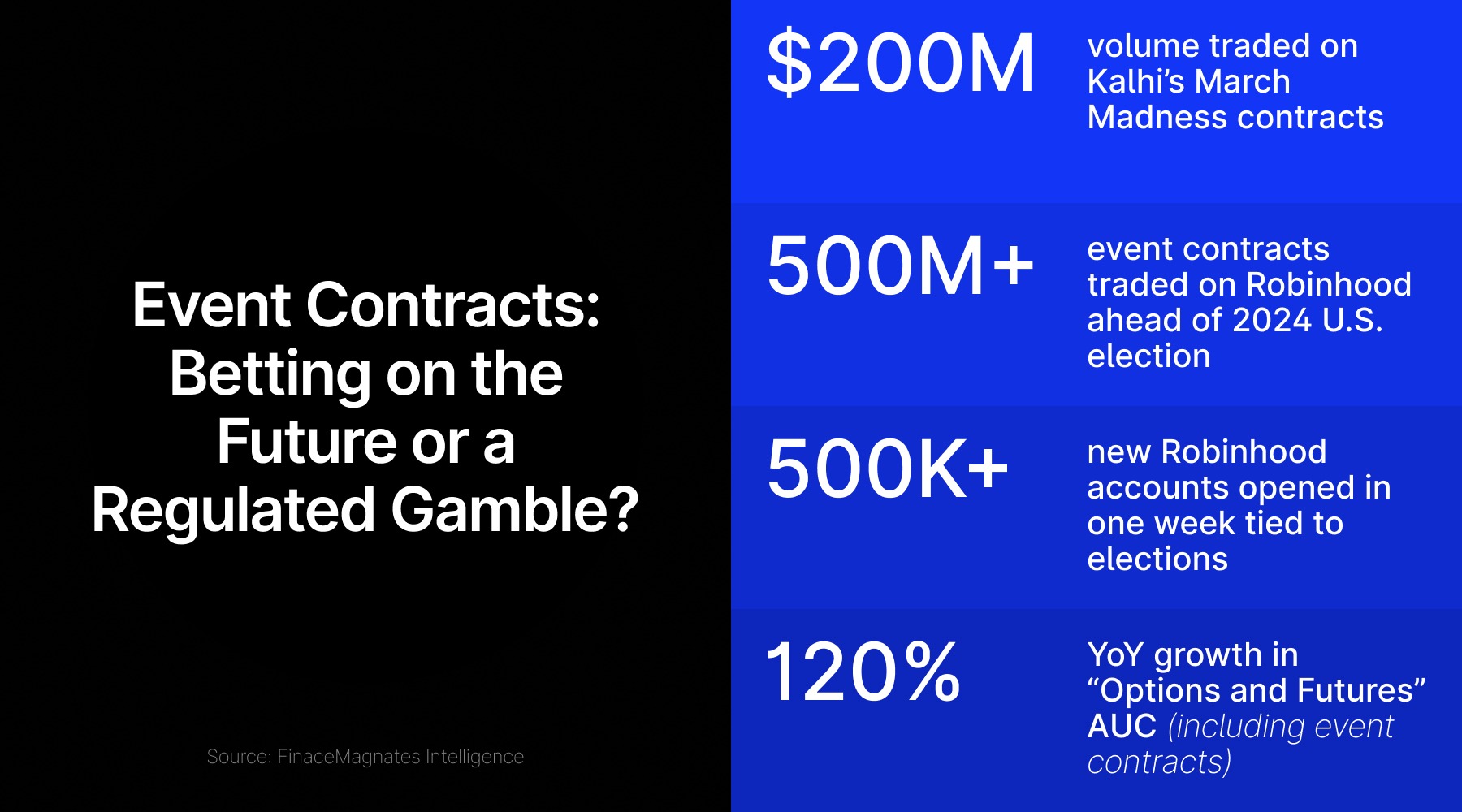
are also confirmed by Robinhood, which offered its first event contracts in 2024, before the US presidential election. “Our Presidential Election
Market was very popular,” Robinhood commented.
“In
roughly a week leading up to the election, over half a million people opened a
Robinhood account and more than half a billion contracts were traded,” the
company added.
How much money is actually in this market? Looking at
the largest contracts in terms of volume, they typically attract investments of
several tens of millions of dollars. The contract for “Bitcoin price today
at 5pm EDT?” is the only one exceeding $150 million. Others, also focused
on Bitcoin price, S&P 500, Nasdaq, or Fed decisions, have attracted between
$30 and $70 million in trading volume.
Source: Kalshi
It is
difficult to obtain more comprehensive data. A year ago, the platform reported
a five-fold increase in active users and volume growth of 50%, without
providing specific figures.
However, in
March, the NCAA “March Madness” basketball tournaments attracted a
record $200 million in volume, representing approximately 10% of the total
legal betting handle estimated for the NCAA tournaments.
As for
Robinhood, although HOOD is a publicly traded company, it doesn't publish
separate data for event contracts, which it launched during Q4 2024. From the
latest report summarizing 2024, we can see that the “options and
futures” assets under custody (AUC) category, which includes event contracts, grew by 120%
compared to 2023, from $0.6 billion to $1.8 billion. However, this category
encompasses futures, options on futures and swaps, as well as the
aforementioned contracts.
However, looking at the popularity of Polymarket—a blockchain-based, unregulated prediction market—it is reasonable to estimate that this industry is either already large or has significant growth potential. Polymarket’s trading volume grew in 2024 from just $50 million to an average of $1 billion per month, peaking at a record $2.6 billion in November during the U.S. election cycle. Over the course of 2024, the total trading volume reached approximately $9 billion, with more than 314,000 active users.
CFTC's
Legal Battle with Kalshi Over Political Contracts
The
regulation of event contracts in the US dates back to the late 19th and early
20th centuries when “bucket shops” allowed individuals to bet on
stock prices without owning shares. Currently, CFTC established clear
prohibitions on certain types of event contracts. Specifically, CFTC Regulation
40.11 prohibits contracts that involve or reference terrorism, assassination,
war, and gaming activities.
In May
2024, the CFTC issued proposed amendments to further clarify what constitutes
“gaming” activities and other prohibited event contracts. The
proposed definition of “gaming” would include staking or risking
something of value upon specific outcomes or occurrences.
Political
event contracts have been particularly controversial. The CFTC has been engaged
in a prolonged legal battle with Kalshi regarding this type of instrument. In
January, the United States Court of Appeals for the District of Columbia
Circuit heard oral arguments in a case centered on Kalshi's ability to list
political event contracts for trading.
The dispute
began in June 2023 when Kalshi self-certified that its planned Congressional
Control Contracts (which allow users to predict which political party would
control each chamber of Congress) complied with federal requirements.
Kalshi
challenged the CFTC's decision, arguing the regulator exceeded its statutory
authority. In September 2024, a district court ruled in Kalshi's favor, finding
that the political event contracts did not “involve” either gaming or
unlawful activity. The CFTC appealed this decision, leading to the January 2025
oral arguments where the D.C. Circuit expressed “particular discomfort
with the CFTC's expansive view of its authority.”
Sports
Contracts Also Face Regulatory Pushback
In February, Robinhood and Kalshi were forced to pull their Super Bowl event contracts
at the request of the CFTC, just days after announcing their offering. The
“Pro Football Championship” event contract would have allowed users
to bet on the outcome of the Super Bowl. Despite Kalshi having submitted a
request for approval to introduce sports event prediction contracts in January, the CFTC pushed for the contracts to be withdrawn.
When I
asked Robinhood about event contracts and the controversies they raise, I was
referred to their Policy Paper on prediction markets, published in March.
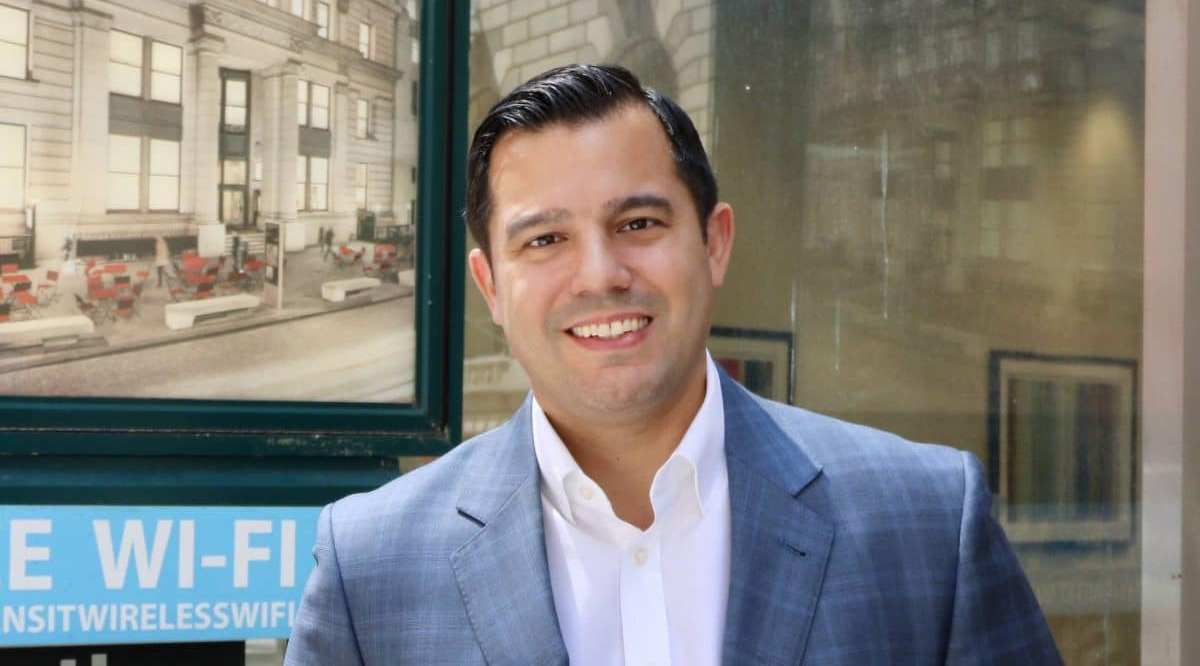
Oliver McIntosh, Senior Product Communications Manager at Robinhood.
“Prediction
markets can be particularly valuable in fields such as finance, politics, and
technology, among others, where decision-makers seek the best possible insights
to navigate an unpredictable future,” commented Oliver McIntosh, Senior Product
Communications Manager at Robinhood.
At the same
time, Crypto.com also withdrew from offering these instruments. Although the
company wants to continue offering them in the future and in February its press
office commented that “We firmly believe in the legality of our events
contracts and believe the CFTC is the appropriate regulator,” they
declined to provide FinanceMagnates.com with a more detailed comment on the
matter.
Interestingly,
just a week after Robinhood and Crypto.com withdrew their Super Bowl contracts,
Webull decided to enter this market. Even more curiously, in announcing this
decision, they even used the term “binary” event contracts. Can't get
much closer to binary options, right?
However, it seems that these firms are confident in their compliance with regulations governing such instruments. Webull, which only recently made its stock market debut, would likely be keen to avoid any unnecessary complications and regulatory hurdles.
Robinhood
Carries On Undeterred
In
mid-March, Robinhood announced that it was expanding its offering with new
prediction markets, allowing speculation on decisions the Federal Reserve might
make regarding interest rates or the outcomes of college basketball games. At
least initially, with the possibility of expanding the offering over time.
The company
confirmed that it is in close discussions with the CFTC and intends to maintain
compliance with regulations while expanding the range of instruments offered.
“We
have been in close contact with the CFTC over the past several weeks and look
forward to continuing to work with them to promote innovation in the futures,
derivatives and crypto markets,” commented McIntosh.
And
although everyone around claims that everything is in perfect order, the market
watchdog sees the matter somewhat differently.
CFTC Has
“Serious Concerns”
“The
CFTC has serious concerns about FCMs offering access to their customers to any
contract that may not be permissible under the law and will exercise its
oversight authority to the fullest extent as appropriate,” told CFTC spokeperson.
“FCMs
have strict duties and obligations pursuant to the CFTC's customer protection
rules and are held to the highest standards to safeguard the public,” the
CFTC added, as quoted by Reuters.
State
regulators have also gotten involved. As FinanceMagnates.com reported in late March, Nevada,
America's gambling capital that earns fortunes from Las Vegas, is also having
problems with Kalshi contracts.
“Some
Event Contracts Are Structured as Binary Options”
Although
event contract providers claim they have nothing to do with binary options,
which were banned many years ago in Europe due to their gambling nature, Kalshi
confirmed to FinanceMagnates.com that some of them “are structured as
binary options.”
However,
they can also take a different structure, depending on the type of event the
underlying market is based on, “such as events where multiple options can
resolve YES.”
“The
accuracy and flexibility of these markets makes them a critical tool for
managing risk, making the world a smarter and more stable place,” explains
Kalshi, defending itself against accusations of offering binary options in a
new guise.
Feature
Binary
Options
Event
Contracts
Basic
Structure
Fixed payout based on yes/no
outcome
Fixed payout based on yes/no
outcome
Regulatory
Status
Banned in many jurisdictions
(including Europe)
Regulated in the US by the CFTC
Provider
Examples
Previously offered by unregulated
brokers
Kalshi,
Robinhood, Webull
Market
Positioning
Marketed as
investment products
Positioned as prediction
markets/investment tools
Underlying
Assets
Typically financial instruments
(stocks, forex, commodities)
Apparently, regulators view a contract based on the EUR/USD exchange rate differently than one based on the outcome of a sporting event.
For comparison, the blockchain-based Polymarket can offer a wide range of contracts, including those related to gambling, war, or “anything deemed not in the public interest.” Kalshi is
“limited” here by the regulator. The question remains, however:
wouldn't this regulated instrument still be closer to gambling and binary options than to real
investing?
Will
Bitcoin reach $150,000? When will GTA 6 be released? How many gold cards will
Donald Trump sell in 2025? Who will become the NBA champion? While these
questions might seem unrelated at first glance, they share a common
denominator: event-based contracts, a regulated yet controversial financial
instrument offered by companies like Robinhood (NASDAQ: HOOD) and Interactive Brokers (NASDAQ: IBKR).
This
explosive mixture—resembling a blend of once-popular binary options, sports
betting, and coin flipping—is hailed by enthusiasts as the next revolution in
retail trading. Regulators, however, fear it's just a backdoor to gambling.
Who's
right? I decided to go straight to the source to find answers to this
intriguing question.
What Are
Event Contracts?
“Event
contracts are an asset class that give investors the ability to trade directly
on their opinions about a specific yes-or-no question,” states Kalshi,
currently one of the main providers of such instruments, on its official
website.
For
example, betting on a contract like “Powell out as Chair this year?”
could earn you $395 from a $100 investment if you answer “Yes,” while
the same amount bet on “No” would yield only $128. Everything depends
on the probability of the event occurring, which changes dynamically based on
how users vote on the platform.
Source: Kalshi.com
You can bet
on virtually anything: politics, sports, cryptocurrencies, culture, climate
change, company results, technological discoveries, and major world events.
“Event contracts have generated high demand because they provide a maximally direct way to get
exposure to events that affect businesses, people, and the economy, and they
provide the most accurate signal on what the likelihood of future events
are,” commented Jack Such from Kalshi, responsible for Business &
Media Development, to FinanceMagnates.com.
Jack Such from Kalshi
All this
comes with the “blessing” of the CFTC, which Kalshi received in 2020,
enabling the launch of the first regulated event contracts exchange over three
years ago. The problem, however, is that regulators are no longer looking so
favorably on the growing popularity of these instruments, and the bone of
contention remains whether some of them are investments or already
“gaming.”
A
Trillion Dollar Asset Class
Despite the
regulatory controversies surrounding event contracts, Such remains optimistic
and claims that in 2024, Kalshi's prediction markets showed an
“astronomical rate of growth.”
“We
are confident that prediction markets will become a trillion dollar asset
class,” he added.
His words
are also confirmed by Robinhood, which offered its first event contracts in 2024, before the US presidential election. “Our Presidential Election
Market was very popular,” Robinhood commented.
“In
roughly a week leading up to the election, over half a million people opened a
Robinhood account and more than half a billion contracts were traded,” the
company added.
How much money is actually in this market? Looking at
the largest contracts in terms of volume, they typically attract investments of
several tens of millions of dollars. The contract for “Bitcoin price today
at 5pm EDT?” is the only one exceeding $150 million. Others, also focused
on Bitcoin price, S&P 500, Nasdaq, or Fed decisions, have attracted between
$30 and $70 million in trading volume.
Source: Kalshi
It is
difficult to obtain more comprehensive data. A year ago, the platform reported
a five-fold increase in active users and volume growth of 50%, without
providing specific figures.
However, in
March, the NCAA “March Madness” basketball tournaments attracted a
record $200 million in volume, representing approximately 10% of the total
legal betting handle estimated for the NCAA tournaments.
As for
Robinhood, although HOOD is a publicly traded company, it doesn't publish
separate data for event contracts, which it launched during Q4 2024. From the
latest report summarizing 2024, we can see that the “options and
futures” assets under custody (AUC) category, which includes event contracts, grew by 120%
compared to 2023, from $0.6 billion to $1.8 billion. However, this category
encompasses futures, options on futures and swaps, as well as the
aforementioned contracts.
However, looking at the popularity of Polymarket—a blockchain-based, unregulated prediction market—it is reasonable to estimate that this industry is either already large or has significant growth potential. Polymarket’s trading volume grew in 2024 from just $50 million to an average of $1 billion per month, peaking at a record $2.6 billion in November during the U.S. election cycle. Over the course of 2024, the total trading volume reached approximately $9 billion, with more than 314,000 active users.
CFTC's
Legal Battle with Kalshi Over Political Contracts
The
regulation of event contracts in the US dates back to the late 19th and early
20th centuries when “bucket shops” allowed individuals to bet on
stock prices without owning shares. Currently, CFTC established clear
prohibitions on certain types of event contracts. Specifically, CFTC Regulation
40.11 prohibits contracts that involve or reference terrorism, assassination,
war, and gaming activities.
In May
2024, the CFTC issued proposed amendments to further clarify what constitutes
“gaming” activities and other prohibited event contracts. The
proposed definition of “gaming” would include staking or risking
something of value upon specific outcomes or occurrences.
Political
event contracts have been particularly controversial. The CFTC has been engaged
in a prolonged legal battle with Kalshi regarding this type of instrument. In
January, the United States Court of Appeals for the District of Columbia
Circuit heard oral arguments in a case centered on Kalshi's ability to list
political event contracts for trading.
The dispute
began in June 2023 when Kalshi self-certified that its planned Congressional
Control Contracts (which allow users to predict which political party would
control each chamber of Congress) complied with federal requirements.
Kalshi
challenged the CFTC's decision, arguing the regulator exceeded its statutory
authority. In September 2024, a district court ruled in Kalshi's favor, finding
that the political event contracts did not “involve” either gaming or
unlawful activity. The CFTC appealed this decision, leading to the January 2025
oral arguments where the D.C. Circuit expressed “particular discomfort
with the CFTC's expansive view of its authority.”
Sports
Contracts Also Face Regulatory Pushback
In February, Robinhood and Kalshi were forced to pull their Super Bowl event contracts
at the request of the CFTC, just days after announcing their offering. The
“Pro Football Championship” event contract would have allowed users
to bet on the outcome of the Super Bowl. Despite Kalshi having submitted a
request for approval to introduce sports event prediction contracts in January, the CFTC pushed for the contracts to be withdrawn.
When I
asked Robinhood about event contracts and the controversies they raise, I was
referred to their Policy Paper on prediction markets, published in March.
Oliver McIntosh, Senior Product Communications Manager at Robinhood.
“Prediction
markets can be particularly valuable in fields such as finance, politics, and
technology, among others, where decision-makers seek the best possible insights
to navigate an unpredictable future,” commented Oliver McIntosh, Senior Product
Communications Manager at Robinhood.
At the same
time, Crypto.com also withdrew from offering these instruments. Although the
company wants to continue offering them in the future and in February its press
office commented that “We firmly believe in the legality of our events
contracts and believe the CFTC is the appropriate regulator,” they
declined to provide FinanceMagnates.com with a more detailed comment on the
matter.
Interestingly,
just a week after Robinhood and Crypto.com withdrew their Super Bowl contracts,
Webull decided to enter this market. Even more curiously, in announcing this
decision, they even used the term “binary” event contracts. Can't get
much closer to binary options, right?
However, it seems that these firms are confident in their compliance with regulations governing such instruments. Webull, which only recently made its stock market debut, would likely be keen to avoid any unnecessary complications and regulatory hurdles.
Robinhood
Carries On Undeterred
In
mid-March, Robinhood announced that it was expanding its offering with new
prediction markets, allowing speculation on decisions the Federal Reserve might
make regarding interest rates or the outcomes of college basketball games. At
least initially, with the possibility of expanding the offering over time.
The company
confirmed that it is in close discussions with the CFTC and intends to maintain
compliance with regulations while expanding the range of instruments offered.
“We
have been in close contact with the CFTC over the past several weeks and look
forward to continuing to work with them to promote innovation in the futures,
derivatives and crypto markets,” commented McIntosh.
And
although everyone around claims that everything is in perfect order, the market
watchdog sees the matter somewhat differently.
CFTC Has
“Serious Concerns”
“The
CFTC has serious concerns about FCMs offering access to their customers to any
contract that may not be permissible under the law and will exercise its
oversight authority to the fullest extent as appropriate,” told CFTC spokeperson.
“FCMs
have strict duties and obligations pursuant to the CFTC's customer protection
rules and are held to the highest standards to safeguard the public,” the
CFTC added, as quoted by Reuters.
State
regulators have also gotten involved. As FinanceMagnates.com reported in late March, Nevada,
America's gambling capital that earns fortunes from Las Vegas, is also having
problems with Kalshi contracts.
“Some
Event Contracts Are Structured as Binary Options”
Although
event contract providers claim they have nothing to do with binary options,
which were banned many years ago in Europe due to their gambling nature, Kalshi
confirmed to FinanceMagnates.com that some of them “are structured as
binary options.”
However,
they can also take a different structure, depending on the type of event the
underlying market is based on, “such as events where multiple options can
resolve YES.”
“The
accuracy and flexibility of these markets makes them a critical tool for
managing risk, making the world a smarter and more stable place,” explains
Kalshi, defending itself against accusations of offering binary options in a
new guise.
Feature
Binary
Options
Event
Contracts
Basic
Structure
Fixed payout based on yes/no
outcome
Fixed payout based on yes/no
outcome
Regulatory
Status
Banned in many jurisdictions
(including Europe)
Regulated in the US by the CFTC
Provider
Examples
Previously offered by unregulated
brokers
Kalshi,
Robinhood, Webull
Market
Positioning
Marketed as
investment products
Positioned as prediction
markets/investment tools
Underlying
Assets
Typically financial instruments
(stocks, forex, commodities)
Apparently, regulators view a contract based on the EUR/USD exchange rate differently than one based on the outcome of a sporting event.
For comparison, the blockchain-based Polymarket can offer a wide range of contracts, including those related to gambling, war, or “anything deemed not in the public interest.” Kalshi is
“limited” here by the regulator. The question remains, however:
wouldn't this regulated instrument still be closer to gambling and binary options than to real
investing?
Damian Chmiel is a Senior Analyst & Editor at Finance Magnates with more than 15 years of experience in the CFD and online trading industry. Active as both a trader and journalist since 2010, he focuses on broker coverage, fintech innovation, and regulatory developments across Europe, the Middle East, and Asia.
His work includes interviews with C-level leaders at major brokerages and fintech platforms, as well as co-authoring Finance Magnates’ quarterly industry benchmarking reports. Damian’s reporting is data-driven, market-aware, and grounded in direct industry engagement. His analysis and commentary have also been cited by external media outlets, including Investing.com, Binance, The Asset, Stockhead, and Dispatch.
Education:
MA in Finance and Accounting, Cracow University of Economics
Italy’s Consob Tightens Net on AI-Fueled Scams With Fresh Website Bans
FP Markets Winner Spotlight 🏆 | Global Broker of the Year 2025 #Trading #Broker #Innovation #Shorts
FP Markets Winner Spotlight 🏆 | Global Broker of the Year 2025 #Trading #Broker #Innovation #Shorts
FP Markets takes the spotlight as Global Broker of the Year 2025 at the Finance Magnates Awards.
Martin Stoilov, Head of Client Experience, shares that trust, innovation, and people played a key role in the company’s success, supported by a strong foundation of integrity and client-centricity.
Following this milestone, FP Markets continues to focus on growth, technology investment, and its core values of transparency and excellence.
👉 Be part of FM Awards 2026: https://awards.financemagnates.com/#nominate
FP Markets takes the spotlight as Global Broker of the Year 2025 at the Finance Magnates Awards.
Martin Stoilov, Head of Client Experience, shares that trust, innovation, and people played a key role in the company’s success, supported by a strong foundation of integrity and client-centricity.
Following this milestone, FP Markets continues to focus on growth, technology investment, and its core values of transparency and excellence.
👉 Be part of FM Awards 2026: https://awards.financemagnates.com/#nominate
In this video, we review @HolaPrimeMarketsOfficial, a multi-asset forex and CFDs broker offering different account types, trading platforms, and flexible trading conditions.
We cover the broker’s overall offering, including account options, trading environment, platforms like MT4 and MT5, and additional services such as managed accounts and fast withdrawals.
Watch the full video to see if Hola Prime Markets fits your trading needs.
📣 Stay up to date with the latest in finance and trading. Follow Finance Magnates for industry news, insights, and global event coverage.
Connect with us:
🔗 LinkedIn: /financemagnates
👍 Facebook: /financemagnates
📸 Instagram: https://www.instagram.com/financemagnates
🐦 X: https://x.com/financemagnates
🎥 TikTok: https://www.tiktok.com/tag/financemagnates
▶️ YouTube: /@financemagnates_official
#HolaPrime #ForexBroker #CFDTrading #FinanceMagnates #Trading #Forex #BrokerReview
In this video, we review @HolaPrimeMarketsOfficial, a multi-asset forex and CFDs broker offering different account types, trading platforms, and flexible trading conditions.
We cover the broker’s overall offering, including account options, trading environment, platforms like MT4 and MT5, and additional services such as managed accounts and fast withdrawals.
Watch the full video to see if Hola Prime Markets fits your trading needs.
📣 Stay up to date with the latest in finance and trading. Follow Finance Magnates for industry news, insights, and global event coverage.
Connect with us:
🔗 LinkedIn: /financemagnates
👍 Facebook: /financemagnates
📸 Instagram: https://www.instagram.com/financemagnates
🐦 X: https://x.com/financemagnates
🎥 TikTok: https://www.tiktok.com/tag/financemagnates
▶️ YouTube: /@financemagnates_official
#HolaPrime #ForexBroker #CFDTrading #FinanceMagnates #Trading #Forex #BrokerReview
Hola Prime Review: What You Need to Know | Full Breakdown by Finance Magnates
Hola Prime Review: What You Need to Know | Full Breakdown by Finance Magnates
In this video, we review @HolaPrime_Global, a proprietary trading firm offering evaluation programs and performance-based payouts in simulated market environments.
We cover how the challenge model works, including account types, profit splits (up to 95%), trading rules, and what it takes to reach a funded account. You’ll also learn about available platforms like MT4, MT5, cTrader, and more, along with insights into payouts, support, and trading conditions.
Watch the full video to see if Hola Prime fits your trading style.
📣 Stay up to date with the latest in finance and trading. Follow Finance Magnates for industry news, insights, and global event coverage.
Connect with us:
🔗 LinkedIn: /financemagnates
👍 Facebook: /financemagnates
📸 Instagram: https://www.instagram.com/financemagnates
🐦 X: https://x.com/financemagnates
🎥 TikTok: https://www.tiktok.com/tag/financemagnates
▶️ YouTube: /@financemagnates_official
#HolaPrime #PropFirm #Trading #FinanceMagnates #Forex #FuturesTrading #TradingReview #PropFirmReview
In this video, we review @HolaPrime_Global, a proprietary trading firm offering evaluation programs and performance-based payouts in simulated market environments.
We cover how the challenge model works, including account types, profit splits (up to 95%), trading rules, and what it takes to reach a funded account. You’ll also learn about available platforms like MT4, MT5, cTrader, and more, along with insights into payouts, support, and trading conditions.
Watch the full video to see if Hola Prime fits your trading style.
📣 Stay up to date with the latest in finance and trading. Follow Finance Magnates for industry news, insights, and global event coverage.
Connect with us:
🔗 LinkedIn: /financemagnates
👍 Facebook: /financemagnates
📸 Instagram: https://www.instagram.com/financemagnates
🐦 X: https://x.com/financemagnates
🎥 TikTok: https://www.tiktok.com/tag/financemagnates
▶️ YouTube: /@financemagnates_official
#HolaPrime #PropFirm #Trading #FinanceMagnates #Forex #FuturesTrading #TradingReview #PropFirmReview
Axi Winner Spotlight 🏆 | Global Most Innovative Broker 2025 #Innovation #Trading #Fintech #Broker
Axi Winner Spotlight 🏆 | Global Most Innovative Broker 2025 #Innovation #Trading #Fintech #Broker
Axi takes the spotlight at the Finance Magnates Awards, winning Global Most Innovative Broker 2025.
Olivia Xenofontos and Ivanna Openko share how the team will feel: proud, motivated, and ready to keep delivering.
They also describe the night as well-organized, focused, and enjoyable for all.
👉 Be part of FM Awards 2026.
Axi takes the spotlight at the Finance Magnates Awards, winning Global Most Innovative Broker 2025.
Olivia Xenofontos and Ivanna Openko share how the team will feel: proud, motivated, and ready to keep delivering.
They also describe the night as well-organized, focused, and enjoyable for all.
👉 Be part of FM Awards 2026.
Recognition that matters.
Built on transparency.
Driven by the industry.
The Finance Magnates Awards 2026.
Nominations are now open.
🔗 https://awards.financemagnates.com/?utm_source=SM&utm_medium=social&utm_campaign=recognition-matters
Recognition that matters.
Built on transparency.
Driven by the industry.
The Finance Magnates Awards 2026.
Nominations are now open.
🔗 https://awards.financemagnates.com/?utm_source=SM&utm_medium=social&utm_campaign=recognition-matters