British consumers are keeping hundreds of billions of pounds out of stocks and other investments largely because they fear falling victim to online scams, according to new research from Capital.com.
Scam Concerns Keep £610 Billion in UK Savings Accounts
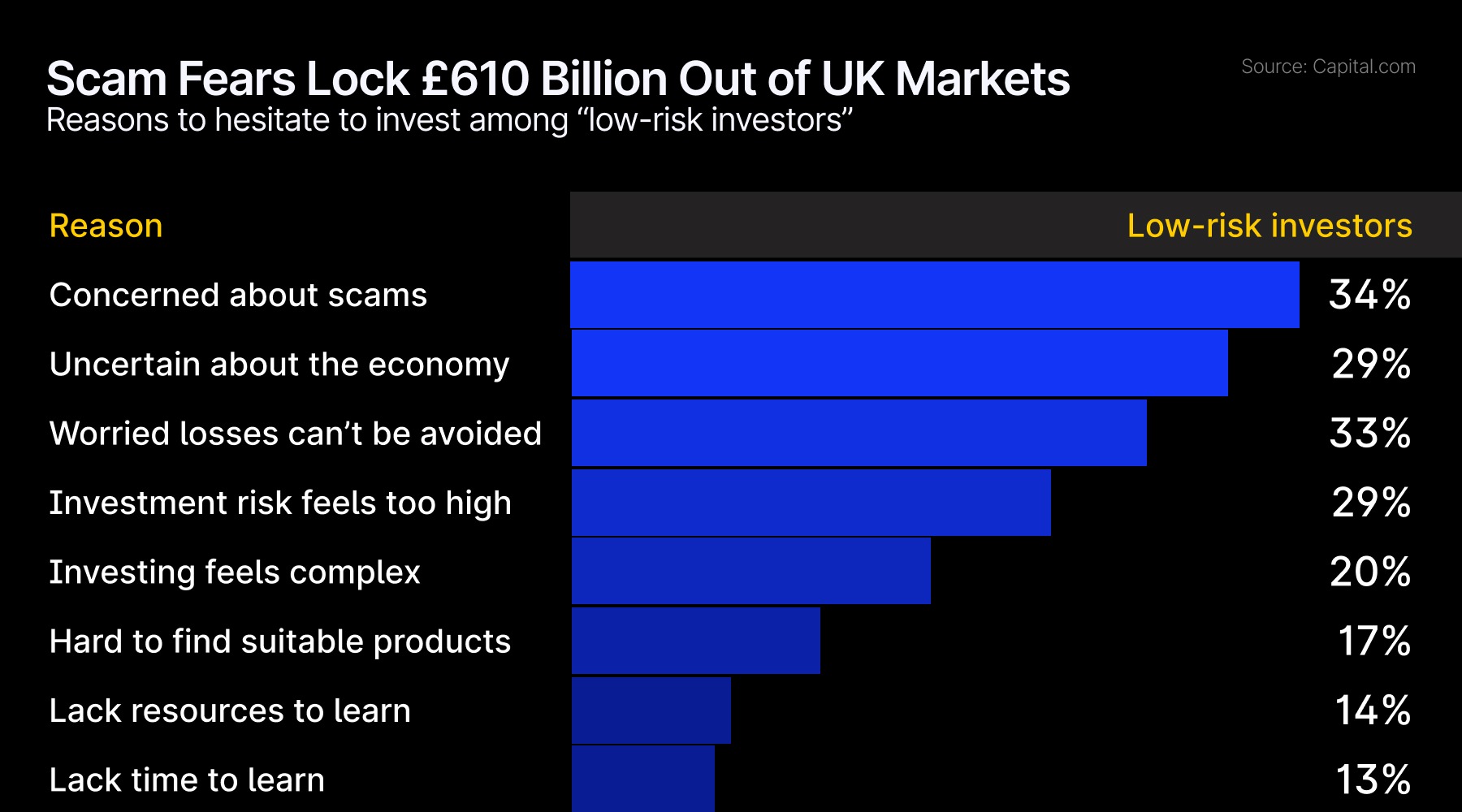
The survey of 1,004 UK adults found that 34% of conservative investors cited worries about potential fraud as the primary reason they avoid investing beyond basic savings accounts. That figure topped concerns about market volatility , economic uncertainty, and product complexity, marking a shift in how consumers evaluate financial risk.
About eight in 10 British adults feel too nervous to invest, with the research showing that confusion and misinformation create bigger obstacles than actual product performance or market conditions. Only 13% of people who limit themselves to traditional savings products like Individual Savings Accounts and pensions feel confident about their investment knowledge.
The fear is not unfounded. According to data from industry body UK Finance, Britons lost £1.17 billion to financial fraud and scams in 2024, with 2.6 million savers falling victim, a 22% increase from the previous year.
This is another study of the British market conducted by Capital.com, following the September report that found UK traders use stop-losses 60% more often than others, which in turn helps them achieve profits more frequently.
Security Concerns Trump Market Risk
The research suggests that fraud anxiety now plays a more decisive role than conventional investment worries in keeping people on the sidelines.
- Capital.com UK’s 2024 Profit Jumps 215% Despite Higher Expenses
- Exclusive: Capital.com Plans to Enter Turkey, Seeking Local Licence
Conservative savers express roughly equal concern about online scams and actual investment losses, a pattern that doesn't hold for more experienced investors who view scams as just one risk among many.

Another significant issue is the lack of education. Capital.com CEO Rupert Osborne said the findings point to a fundamental knowledge problem rather than pure risk appetite.
“When nearly nine in 10 can't tell the difference between the risk of investing in FTSE-listed companies and speculative crypto assets, it's clear the education gap is costing the economy,” he said.
The research comes as regulators and policymakers push to unlock what the Financial Conduct Authority (FCA) and Barclays recently quantified as £610 billion sitting in excess cash savings held by roughly 15 million UK adults.
Last month, Chancellor Rachel Reeves backed a new advertising campaign to encourage investment in stocks and shares, while the government released its Financial Inclusion Strategy 2025, which calls for mandatory financial literacy teaching in English schools by 2028.
Confidence Gaps Widen With Complexity
Familiarity with financial products drops sharply as complexity increases. While 88% of conservative investors feel very familiar with standard savings accounts, that figure falls to under 10% for stocks, exchange -traded funds, and other investment vehicles.
The survey found that 92% of low-risk investors view cryptocurrencies and alternative assets as extremely high risk, with 87% placing publicly traded stocks in the same category. This lumping together of vastly different asset classes suggests confusion rather than sophisticated risk assessment.
Investment Asset | Low-Risk Investor | Mid-Level Investor |
Cryptocurrencies and other alternative assets | 88% | 92% |
Stocks and shares | 85% | 87% |
Commodities | 69% | 61% |
Venture Capital Trusts (VCTs) | 67% | 67% |
Investment funds (Unit Trusts, OEICs, ETFs, Investment Trusts) | 63% | 71% |
Enterprise Investment Schemes (EIS) and Seed Enterprise Investment Schemes (SEIS) | 63% | 65% |
Mid-level investors who already hold some investments beyond pensions and ISAs show notably different patterns. While 45% of conservative savers say investing feels too complex or difficult to navigate, only 22% of mid-level investors share that view. The gap extends to understanding inflation's impact on cash savings – a concept that mid-level investors grasp intuitively but that conservative savers only recognize when explicitly explained.
The research, titled “Fear or Fortune?”, was conducted between December 2024 and February 2025 using focus groups and a nationally representative online survey. It covered both conservative investors limited to traditional savings products and mid-level investors with exposure to stocks, bonds, or other assets beyond basic accounts.