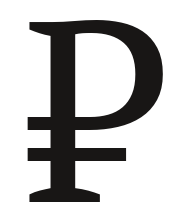
A month after the official abandonment of the trading corridor which was acting as a backstop against excessive moves on the forex market, the Russian central bank is facing an endless volatility conundrum.
This morning the Russian finance ministry announced that the “ruble is highly undervalued” and committed to selling residual foreign exchange from its accounts. The finance ministry clarified that it is prepared to sell close to $7 billion worth of foreign currency to the open market.
The currency rallied more than 10% on the announcement from its opening level around 66.33. However, it subsequently lost all of the gains made from the intervention chatter and proceeded to trade lower by 2% around 68. As of the time of publication, intervention operations are obvious on the FX market. However, the amount of bids in USD/RUB seems endless.
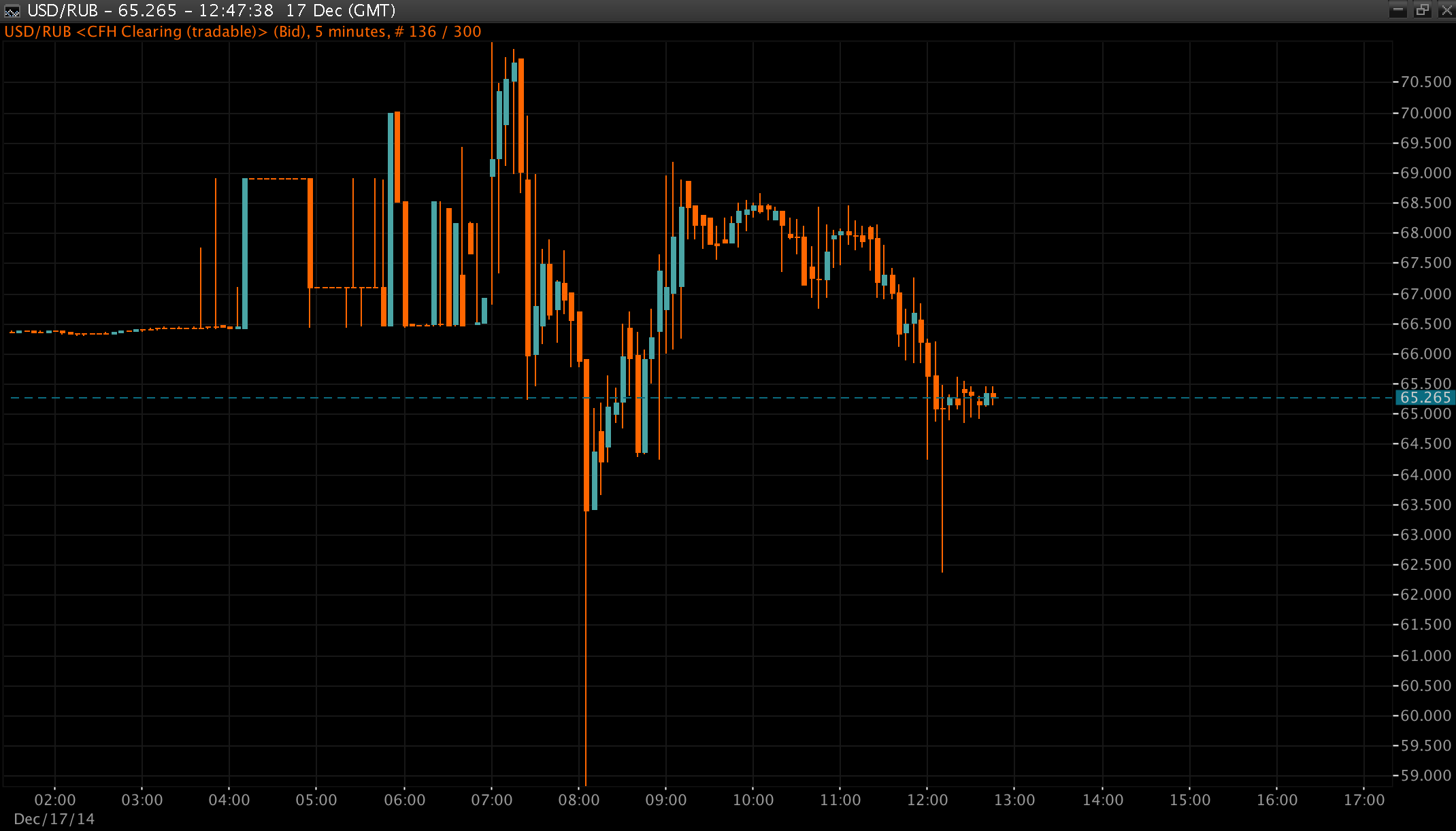
Russian Ruble trading, 17th of December, Source: NetDania
Speculation about capital and currency controls are rampant while Russian authorities are pondering what to do. The move of the Russian central bank clearly came too late. The Russian monetary authorities should have been way more proactive around the time of floating the ruble, but instead were bound to political pressure.
Apple has officially announced that its online store in the country would cease operations due to the volatile conditions on the foreign exchange market until further notice.
A Lesson in How NOT to Intervene in Currency Markets
If Russian officials continue with the policy of announcing what they are aiming, willing and prepared to do, the market is likely to react the same way that it did this morning - by shrugging and continuing to sell all rubles at hand.
With the amount of currency committed to intervention known beforehand and a decisive one time action still missing from the market, the central bank’s reserves are simply going to bleed out slowly without having any effect on the ruble exchange rate.
Well, Mr. Shvetsov, the currency market is not a roulette as you have referred to it in your statements related to regulating the Russian retail forex market. It is responding to the rapidly deteriorating fundamentals of the Russian oil economy.
Earlier this autumn, the Bank of Russia assumed a worse case scenario of $60 dollars per barrel in order to devise a crisis-response path in the case that the situation might demand decisive action.
Looks like central bank officials haven't really designed anything, because it took the oil market only a couple of months to get there and the response came only when the situation on the currency market became beyond critical.
The first deputy of the Russian central bank is treating the ruble exchange rate with the same approach - let the roulette spin. But let’s be fair to the central bankers, its the politicians who have been pressuring the central bank from making a decisive move on interest rates which could have stemmed the decline of the Russian currency much earlier.
Russian Stock Market Capitalization Ties With Google
German journalist from Die Welt newspaper Holger Zschaepitz has brought to the attention of his Twitter followers a chart which shows that the current market cap of Google is surpassing the whole wide Russian stock market.
There is only one question which remains on investors’ and the Russian population’s minds - can it get any worse? Recent moves by US and EU governing bodies are contemplating additional sanctions. We risk disappointing some of our Russian readers, but let's borrow a phrase from US president Barack Obama - “Yes, it can!”
This morning the Russian finance ministry announced that the “ruble is highly undervalued” and committed to selling residual foreign exchange from its accounts. The finance ministry clarified that it is prepared to sell close to $7 billion worth of foreign currency to the open market.
The currency rallied more than 10% on the announcement from its opening level around 66.33. However, it subsequently lost all of the gains made from the intervention chatter and proceeded to trade lower by 2% around 68. As of the time of publication, intervention operations are obvious on the FX market. However, the amount of bids in USD/RUB seems endless.
Russian Ruble trading, 17th of December, Source: NetDania
Speculation about capital and currency controls are rampant while Russian authorities are pondering what to do. The move of the Russian central bank clearly came too late. The Russian monetary authorities should have been way more proactive around the time of floating the ruble, but instead were bound to political pressure.
Apple has officially announced that its online store in the country would cease operations due to the volatile conditions on the foreign exchange market until further notice.
A Lesson in How NOT to Intervene in Currency Markets
If Russian officials continue with the policy of announcing what they are aiming, willing and prepared to do, the market is likely to react the same way that it did this morning - by shrugging and continuing to sell all rubles at hand.
With the amount of currency committed to intervention known beforehand and a decisive one time action still missing from the market, the central bank’s reserves are simply going to bleed out slowly without having any effect on the ruble exchange rate.
Well, Mr. Shvetsov, the currency market is not a roulette as you have referred to it in your statements related to regulating the Russian retail forex market. It is responding to the rapidly deteriorating fundamentals of the Russian oil economy.
Earlier this autumn, the Bank of Russia assumed a worse case scenario of $60 dollars per barrel in order to devise a crisis-response path in the case that the situation might demand decisive action.
Looks like central bank officials haven't really designed anything, because it took the oil market only a couple of months to get there and the response came only when the situation on the currency market became beyond critical.
The first deputy of the Russian central bank is treating the ruble exchange rate with the same approach - let the roulette spin. But let’s be fair to the central bankers, its the politicians who have been pressuring the central bank from making a decisive move on interest rates which could have stemmed the decline of the Russian currency much earlier.
Russian Stock Market Capitalization Ties With Google
German journalist from Die Welt newspaper Holger Zschaepitz has brought to the attention of his Twitter followers a chart which shows that the current market cap of Google is surpassing the whole wide Russian stock market.
There is only one question which remains on investors’ and the Russian population’s minds - can it get any worse? Recent moves by US and EU governing bodies are contemplating additional sanctions. We risk disappointing some of our Russian readers, but let's borrow a phrase from US president Barack Obama - “Yes, it can!”
Tiger Brokers Parent Swings to Loss as China Penalty Wipes Out Its Profit
Featured Videos
FM Daily Brief - 2 June 2026
Today is Tuesday, the second of May 2026, and these are our main stories: Why Revolut may be the most serious competitive threat the CFD brokers have ever faced, Binance adds seven thousand US stocks, and CME kills the weekend gap for crypto derivatives.
Today is Monday, the 1st of June 2026, and these are our main stories:
The US just opened a regulated door for crypto perpetual futures, ThinkMarkets joins the MCP server bandwagon, and XM obtains a MiCA license.
Today is Monday, the 1st of June 2026, and these are our main stories:
The US just opened a regulated door for crypto perpetual futures, ThinkMarkets joins the MCP server bandwagon, and XM obtains a MiCA license.
Today is Monday, the 1st of June 2026, and these are our main stories:
The US just opened a regulated door for crypto perpetual futures, ThinkMarkets joins the MCP server bandwagon, and XM obtains a MiCA license.
Today is Monday, the 1st of June 2026, and these are our main stories:
The US just opened a regulated door for crypto perpetual futures, ThinkMarkets joins the MCP server bandwagon, and XM obtains a MiCA license.
Today is Monday, the 1st of June 2026, and these are our main stories:
The US just opened a regulated door for crypto perpetual futures, ThinkMarkets joins the MCP server bandwagon, and XM obtains a MiCA license.
Today is Monday, the 1st of June 2026, and these are our main stories:
The US just opened a regulated door for crypto perpetual futures, ThinkMarkets joins the MCP server bandwagon, and XM obtains a MiCA license.
FM Daily Brief - 29 May 2026
Today is Friday, the 29th of May 2026, and these are our main stories: three global regulators are converging on trading platform design, and a Singapore prop firm launches a deferred-fee challenge model.
FM Daily Brief - 28 May 2026
Today is Thursday, the 28th of May 2026, and these are our main stories: the chair of CySEC makes clear that prediction markets look like binary options to Brussels, Robinhood enters the age of AI agents, and a Google engineer faces insider trading charges over Polymarket activity.
Nick Strain, Country Manager Singapore at LMAX Digital, discusses the future of digital assets and shares his views on crypto markets, perpetuals, institutional adoption, tokenization, and why regulatory clarity remains the biggest driver in the space.
The discussion, hosted by Jonathan Fine, Content Strategist at Finance Magnates, covers:
Crypto market sentiment
Bitcoin and Ethereum's role as macro assets
The mechanics of perpetuals and funding rates
Institutional adoption beyond buying crypto
The opportunity in tokenization and programmable money
The critical role of regulation in market growth
Nick Strain, Country Manager Singapore at LMAX Digital, discusses the future of digital assets and shares his views on crypto markets, perpetuals, institutional adoption, tokenization, and why regulatory clarity remains the biggest driver in the space.
The discussion, hosted by Jonathan Fine, Content Strategist at Finance Magnates, covers:
Crypto market sentiment
Bitcoin and Ethereum's role as macro assets
The mechanics of perpetuals and funding rates
Institutional adoption beyond buying crypto
The opportunity in tokenization and programmable money
The critical role of regulation in market growth
Nick Strain, Country Manager Singapore at LMAX Digital, discusses the future of digital assets and shares his views on crypto markets, perpetuals, institutional adoption, tokenization, and why regulatory clarity remains the biggest driver in the space.
The discussion, hosted by Jonathan Fine, Content Strategist at Finance Magnates, covers:
Crypto market sentiment
Bitcoin and Ethereum's role as macro assets
The mechanics of perpetuals and funding rates
Institutional adoption beyond buying crypto
The opportunity in tokenization and programmable money
The critical role of regulation in market growth
Nick Strain, Country Manager Singapore at LMAX Digital, discusses the future of digital assets and shares his views on crypto markets, perpetuals, institutional adoption, tokenization, and why regulatory clarity remains the biggest driver in the space.
The discussion, hosted by Jonathan Fine, Content Strategist at Finance Magnates, covers:
Crypto market sentiment
Bitcoin and Ethereum's role as macro assets
The mechanics of perpetuals and funding rates
Institutional adoption beyond buying crypto
The opportunity in tokenization and programmable money
The critical role of regulation in market growth
Nick Strain, Country Manager Singapore at LMAX Digital, discusses the future of digital assets and shares his views on crypto markets, perpetuals, institutional adoption, tokenization, and why regulatory clarity remains the biggest driver in the space.
The discussion, hosted by Jonathan Fine, Content Strategist at Finance Magnates, covers:
Crypto market sentiment
Bitcoin and Ethereum's role as macro assets
The mechanics of perpetuals and funding rates
Institutional adoption beyond buying crypto
The opportunity in tokenization and programmable money
The critical role of regulation in market growth
Nick Strain, Country Manager Singapore at LMAX Digital, discusses the future of digital assets and shares his views on crypto markets, perpetuals, institutional adoption, tokenization, and why regulatory clarity remains the biggest driver in the space.
The discussion, hosted by Jonathan Fine, Content Strategist at Finance Magnates, covers:
Crypto market sentiment
Bitcoin and Ethereum's role as macro assets
The mechanics of perpetuals and funding rates
Institutional adoption beyond buying crypto
The opportunity in tokenization and programmable money
The critical role of regulation in market growth