Resistance is Futile - CME to Close Nearly All Floor Trading for Futures
Thursday,05/02/2015|09:53GMTby
Kenny Mariasin
Open outcry futures volumes have declined to just one percent of daily futures volumes. Floor trader numbers have also dwindled in recent years.
Another nail in the coffin was hammered in Wednesday for open outcry trading. CME Group Inc. announced it is shuttering most of its futures trading pits in Chicago and New York, as Borg-like electronic trading has all but assimilated trading floors.
The move will be completed by July 2, 2015, marking the end of an era of floor traders clamoring and climbing over each other in a mountain of buys, sells and haggling—an era lasting close to 150 years.
CME will keep some pits open, such as the S&P 500 futures market and the market for options on futures, the latter remaining active on both the floor and screen due to the complexity inherent in constructing contracts with multiple options. In Chicago, all options pits will be located on a single floor in the company’s Financial Room by September.
Otherwise, trading floors have been reduced to little more than novelty in the past few years as electronic markets have made trading faster, cheaper and more traceable. ICE (Intercontinental Exchange Inc.) keeps its Manhattan-based NYSE Group stocks and options trading floor open, for its part, but largely because issuing companies love ringing the bell over the trading pit—surely reveling in their ability to grab the attention, albeit ceremoniously, of a boisterous and otherwise unwieldy market.
Palms Out
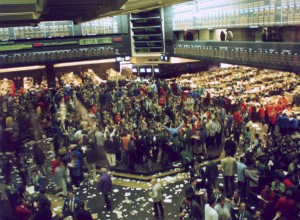
Trading Floor - Chicago Board of Trade, 1993
CME was born when the Chicago Mercantile Exchange merged with rival Chicago Board of Trade in 2007. Chicago Board of Trade’s pioneering octagonal pit, opened in 1870, became a world-leading agricultural commodities trading venue throughout the 20th century. Later it also became a Hub for currency, interest rate and stock index contracts.
But open outcry futures volumes have declined to just one percent of daily futures volumes. Last year CME traded 31 million futures on its floors in Chicago and New York, compared with 2.66 billion futures on its electronic platform, Globex. Floor personnel numbers have likewise dwindled in recent years to about 1,200 in Chicago, from a peak of over 10,000 personnel in the 90s.
In floor-trader language, palms in mean “buying” and palms out mean “selling.” Price is indicated with outstretched arms and quantity with hands close to the face. But soon this unique hand-signal language invented in Chicago will join the dead languages, and floor traders will pack up their bags, head home, and log on to their computers.
Another nail in the coffin was hammered in Wednesday for open outcry trading. CME Group Inc. announced it is shuttering most of its futures trading pits in Chicago and New York, as Borg-like electronic trading has all but assimilated trading floors.
The move will be completed by July 2, 2015, marking the end of an era of floor traders clamoring and climbing over each other in a mountain of buys, sells and haggling—an era lasting close to 150 years.
CME will keep some pits open, such as the S&P 500 futures market and the market for options on futures, the latter remaining active on both the floor and screen due to the complexity inherent in constructing contracts with multiple options. In Chicago, all options pits will be located on a single floor in the company’s Financial Room by September.
Otherwise, trading floors have been reduced to little more than novelty in the past few years as electronic markets have made trading faster, cheaper and more traceable. ICE (Intercontinental Exchange Inc.) keeps its Manhattan-based NYSE Group stocks and options trading floor open, for its part, but largely because issuing companies love ringing the bell over the trading pit—surely reveling in their ability to grab the attention, albeit ceremoniously, of a boisterous and otherwise unwieldy market.
Palms Out
Trading Floor - Chicago Board of Trade, 1993
CME was born when the Chicago Mercantile Exchange merged with rival Chicago Board of Trade in 2007. Chicago Board of Trade’s pioneering octagonal pit, opened in 1870, became a world-leading agricultural commodities trading venue throughout the 20th century. Later it also became a Hub for currency, interest rate and stock index contracts.
But open outcry futures volumes have declined to just one percent of daily futures volumes. Last year CME traded 31 million futures on its floors in Chicago and New York, compared with 2.66 billion futures on its electronic platform, Globex. Floor personnel numbers have likewise dwindled in recent years to about 1,200 in Chicago, from a peak of over 10,000 personnel in the 90s.
In floor-trader language, palms in mean “buying” and palms out mean “selling.” Price is indicated with outstretched arms and quantity with hands close to the face. But soon this unique hand-signal language invented in Chicago will join the dead languages, and floor traders will pack up their bags, head home, and log on to their computers.
Italy’s Consob Tightens Net on AI-Fueled Scams With Fresh Website Bans
FP Markets Winner Spotlight 🏆 | Global Broker of the Year 2025 #Trading #Broker #Innovation #Shorts
FP Markets Winner Spotlight 🏆 | Global Broker of the Year 2025 #Trading #Broker #Innovation #Shorts
FP Markets takes the spotlight as Global Broker of the Year 2025 at the Finance Magnates Awards.
Martin Stoilov, Head of Client Experience, shares that trust, innovation, and people played a key role in the company’s success, supported by a strong foundation of integrity and client-centricity.
Following this milestone, FP Markets continues to focus on growth, technology investment, and its core values of transparency and excellence.
👉 Be part of FM Awards 2026: https://awards.financemagnates.com/#nominate
FP Markets takes the spotlight as Global Broker of the Year 2025 at the Finance Magnates Awards.
Martin Stoilov, Head of Client Experience, shares that trust, innovation, and people played a key role in the company’s success, supported by a strong foundation of integrity and client-centricity.
Following this milestone, FP Markets continues to focus on growth, technology investment, and its core values of transparency and excellence.
👉 Be part of FM Awards 2026: https://awards.financemagnates.com/#nominate
In this video, we review @HolaPrimeMarketsOfficial, a multi-asset forex and CFDs broker offering different account types, trading platforms, and flexible trading conditions.
We cover the broker’s overall offering, including account options, trading environment, platforms like MT4 and MT5, and additional services such as managed accounts and fast withdrawals.
Watch the full video to see if Hola Prime Markets fits your trading needs.
📣 Stay up to date with the latest in finance and trading. Follow Finance Magnates for industry news, insights, and global event coverage.
Connect with us:
🔗 LinkedIn: /financemagnates
👍 Facebook: /financemagnates
📸 Instagram: https://www.instagram.com/financemagnates
🐦 X: https://x.com/financemagnates
🎥 TikTok: https://www.tiktok.com/tag/financemagnates
▶️ YouTube: /@financemagnates_official
#HolaPrime #ForexBroker #CFDTrading #FinanceMagnates #Trading #Forex #BrokerReview
In this video, we review @HolaPrimeMarketsOfficial, a multi-asset forex and CFDs broker offering different account types, trading platforms, and flexible trading conditions.
We cover the broker’s overall offering, including account options, trading environment, platforms like MT4 and MT5, and additional services such as managed accounts and fast withdrawals.
Watch the full video to see if Hola Prime Markets fits your trading needs.
📣 Stay up to date with the latest in finance and trading. Follow Finance Magnates for industry news, insights, and global event coverage.
Connect with us:
🔗 LinkedIn: /financemagnates
👍 Facebook: /financemagnates
📸 Instagram: https://www.instagram.com/financemagnates
🐦 X: https://x.com/financemagnates
🎥 TikTok: https://www.tiktok.com/tag/financemagnates
▶️ YouTube: /@financemagnates_official
#HolaPrime #ForexBroker #CFDTrading #FinanceMagnates #Trading #Forex #BrokerReview
Hola Prime Review: What You Need to Know | Full Breakdown by Finance Magnates
Hola Prime Review: What You Need to Know | Full Breakdown by Finance Magnates
In this video, we review @HolaPrime_Global, a proprietary trading firm offering evaluation programs and performance-based payouts in simulated market environments.
We cover how the challenge model works, including account types, profit splits (up to 95%), trading rules, and what it takes to reach a funded account. You’ll also learn about available platforms like MT4, MT5, cTrader, and more, along with insights into payouts, support, and trading conditions.
Watch the full video to see if Hola Prime fits your trading style.
📣 Stay up to date with the latest in finance and trading. Follow Finance Magnates for industry news, insights, and global event coverage.
Connect with us:
🔗 LinkedIn: /financemagnates
👍 Facebook: /financemagnates
📸 Instagram: https://www.instagram.com/financemagnates
🐦 X: https://x.com/financemagnates
🎥 TikTok: https://www.tiktok.com/tag/financemagnates
▶️ YouTube: /@financemagnates_official
#HolaPrime #PropFirm #Trading #FinanceMagnates #Forex #FuturesTrading #TradingReview #PropFirmReview
In this video, we review @HolaPrime_Global, a proprietary trading firm offering evaluation programs and performance-based payouts in simulated market environments.
We cover how the challenge model works, including account types, profit splits (up to 95%), trading rules, and what it takes to reach a funded account. You’ll also learn about available platforms like MT4, MT5, cTrader, and more, along with insights into payouts, support, and trading conditions.
Watch the full video to see if Hola Prime fits your trading style.
📣 Stay up to date with the latest in finance and trading. Follow Finance Magnates for industry news, insights, and global event coverage.
Connect with us:
🔗 LinkedIn: /financemagnates
👍 Facebook: /financemagnates
📸 Instagram: https://www.instagram.com/financemagnates
🐦 X: https://x.com/financemagnates
🎥 TikTok: https://www.tiktok.com/tag/financemagnates
▶️ YouTube: /@financemagnates_official
#HolaPrime #PropFirm #Trading #FinanceMagnates #Forex #FuturesTrading #TradingReview #PropFirmReview
Axi Winner Spotlight 🏆 | Global Most Innovative Broker 2025 #Innovation #Trading #Fintech #Broker
Axi Winner Spotlight 🏆 | Global Most Innovative Broker 2025 #Innovation #Trading #Fintech #Broker
Axi takes the spotlight at the Finance Magnates Awards, winning Global Most Innovative Broker 2025.
Olivia Xenofontos and Ivanna Openko share how the team will feel: proud, motivated, and ready to keep delivering.
They also describe the night as well-organized, focused, and enjoyable for all.
👉 Be part of FM Awards 2026.
Axi takes the spotlight at the Finance Magnates Awards, winning Global Most Innovative Broker 2025.
Olivia Xenofontos and Ivanna Openko share how the team will feel: proud, motivated, and ready to keep delivering.
They also describe the night as well-organized, focused, and enjoyable for all.
👉 Be part of FM Awards 2026.
Recognition that matters.
Built on transparency.
Driven by the industry.
The Finance Magnates Awards 2026.
Nominations are now open.
🔗 https://awards.financemagnates.com/?utm_source=SM&utm_medium=social&utm_campaign=recognition-matters
Recognition that matters.
Built on transparency.
Driven by the industry.
The Finance Magnates Awards 2026.
Nominations are now open.
🔗 https://awards.financemagnates.com/?utm_source=SM&utm_medium=social&utm_campaign=recognition-matters