OECD Cuts Global Growth Forecast and Urges ECB to Begin Unsterilised Bond Purchases
Monday,15/09/2014|12:08GMTby
George Tchetvertakov
The OECD is expecting economic growth rates to slow across the developed world although the ECB and BoJ are encouraged to extend their QE policies due to their proximity to deflation.
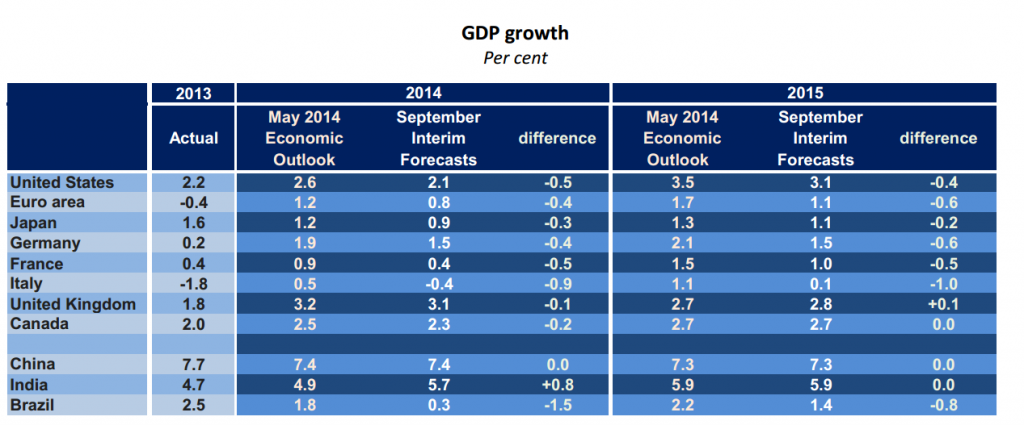
The Organization for Economic Cooperation and Development (OECD) gave an interim update to its bi-annual forecasts covering the world’s major economies. The underlying point from the latest update is that the OECD foresees lower growth rates in almost all of the world’s seven major economies.
Source: OECD
The OECD's projected growth in the Eurozone is to reach a maximum of 0.8% in 2014 and 1.1% in 2015. Their previous estimates for the region published in May 2014, forecast a growth rate of 1.2% in 2014 and 1.7% in 2015. The ECB recently cut the cost of borrowing to near zero and plans to implement a banking union over the next two years. The OECD supports these measures and recommends that the ECB goes further in their monetary policy stance.
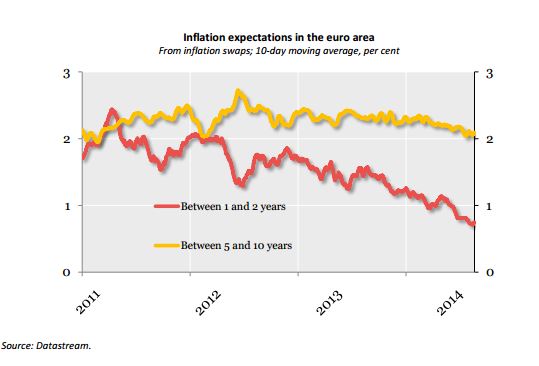
The OECD said that Eurozone inflation is at a 5-year low of 0.4% and should strengthen as demand recovers, although price inflation remains at low levels close to zero putting the trading bloc at risk of deflation. "Given the low-growth outlook and the risk that demand could be further sapped if inflation remains near zero, or even turns negative, the OECD recommends more monetary support for the euro area," the organization said in a statement published alongside the interim forecast.
The largest recalibration was for Italy. The OECD expects Italy’s economy to contract by 0.4% in 2014, having estimated it would grow by 0.5% in May.
"The global recovery from the crisis has been inadequate in several ways," the OECD said. "Economic slack has persisted, potential growth has slowed, and inequality has risen. Meanwhile, external imbalances and threats to financial stability have remained."
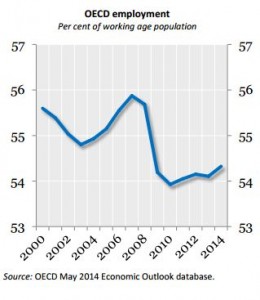
As previously postulated by Forex Magnates, the OECD believes monetary policies in the major economies are set to diverge, with the Fed and the Bank of England (BoE) ending their easing policies at a time when the European Central Bank (ECB) may have to provide even more stimulus. A large component and causal factor for the divergence is changing employment conditions. Despite corporate resilience and stock market strength, employment conditions remain anaemic across most developed countries and are struggling to recover at a rapid pace. This is worrying central bankers and legislators alike.
The OECD supports greater policy accommodation across the board and has publicly given support for outright bond purchases in similar vein to the Fed, BoE, SNB and BoJ in the Eurozone. "Recent ECB action is welcome but further measures, including quantitative easing, are warranted," said Rintaro Tamaki, the OECD's Chief Economist.
The OECD sees dovish monetary policy as most suitable in Japan too, saying that additional stimulus will be required when a second planned increase in sales tax occurs in 2015.
With Scotland’s independence vote grabbing attention and headlines around the world, the OECD also weighed in with their stance saying it would prefer the 307-year old union to be maintained. "We clearly believe that better together is the way to go," said OECD Secretary General Ángel Gurria. "The U.K. is an important member of the OECD, and we would like to see it remain together, we think that would be best for all its component parts,” he added.
The Organization for Economic Cooperation and Development (OECD) gave an interim update to its bi-annual forecasts covering the world’s major economies. The underlying point from the latest update is that the OECD foresees lower growth rates in almost all of the world’s seven major economies.
Source: OECD
The OECD's projected growth in the Eurozone is to reach a maximum of 0.8% in 2014 and 1.1% in 2015. Their previous estimates for the region published in May 2014, forecast a growth rate of 1.2% in 2014 and 1.7% in 2015. The ECB recently cut the cost of borrowing to near zero and plans to implement a banking union over the next two years. The OECD supports these measures and recommends that the ECB goes further in their monetary policy stance.
The OECD said that Eurozone inflation is at a 5-year low of 0.4% and should strengthen as demand recovers, although price inflation remains at low levels close to zero putting the trading bloc at risk of deflation. "Given the low-growth outlook and the risk that demand could be further sapped if inflation remains near zero, or even turns negative, the OECD recommends more monetary support for the euro area," the organization said in a statement published alongside the interim forecast.
The largest recalibration was for Italy. The OECD expects Italy’s economy to contract by 0.4% in 2014, having estimated it would grow by 0.5% in May.
"The global recovery from the crisis has been inadequate in several ways," the OECD said. "Economic slack has persisted, potential growth has slowed, and inequality has risen. Meanwhile, external imbalances and threats to financial stability have remained."
As previously postulated by Forex Magnates, the OECD believes monetary policies in the major economies are set to diverge, with the Fed and the Bank of England (BoE) ending their easing policies at a time when the European Central Bank (ECB) may have to provide even more stimulus. A large component and causal factor for the divergence is changing employment conditions. Despite corporate resilience and stock market strength, employment conditions remain anaemic across most developed countries and are struggling to recover at a rapid pace. This is worrying central bankers and legislators alike.
The OECD supports greater policy accommodation across the board and has publicly given support for outright bond purchases in similar vein to the Fed, BoE, SNB and BoJ in the Eurozone. "Recent ECB action is welcome but further measures, including quantitative easing, are warranted," said Rintaro Tamaki, the OECD's Chief Economist.
The OECD sees dovish monetary policy as most suitable in Japan too, saying that additional stimulus will be required when a second planned increase in sales tax occurs in 2015.
With Scotland’s independence vote grabbing attention and headlines around the world, the OECD also weighed in with their stance saying it would prefer the 307-year old union to be maintained. "We clearly believe that better together is the way to go," said OECD Secretary General Ángel Gurria. "The U.K. is an important member of the OECD, and we would like to see it remain together, we think that would be best for all its component parts,” he added.
Tradition Posts Record CHF 1.2 Billion Revenue as UAE Business Rises 55%
CMC Markets’ Artur Delijergijevs on Metals Demand, Volatility, & Stable Execution
CMC Markets’ Artur Delijergijevs on Metals Demand, Volatility, & Stable Execution
In this exclusive Executive Interview, Finance Magnates speaks with Artur Delijergijevs, Head of Systematic Market Making at CMC Markets, about the current state of metals demand and market volatility.
Delijergijevs offers a desk-level view on:
- Metals Demand: Why metals are seeing the strongest demand from both retail and institutional clients right now.
- The Safe-Haven Debate: Questioning whether gold still fits the classic safe-haven definition given large daily price movements.
- Volatile Market Prep: How a market-making desk prepares its systems and pricing for stressed market conditions and high-impact economic events.
- Hybrid Execution: Why the best execution model combines electronic speed with human relationship support, especially during volatility.
- AI in Workflow: Where CMC Markets is integrating machine learning for risk management and pricing, and the limitations of AI during stressed markets.
- Dubai's Role: The strategic importance of Dubai’s location for covering global trading sessions across Asia, Europe, and the US.
Watch to understand how CMC Markets maintains stable pricing and reliable execution quality in high-volatility environments.
#CMCmarkets #forex #metals #gold #trading #volatility #MarketMaking #iFXDubai #FinanceMagnates #Finance #Fintech #Execution #AlgorithmicTrading #RiskManagement
In this exclusive Executive Interview, Finance Magnates speaks with Artur Delijergijevs, Head of Systematic Market Making at CMC Markets, about the current state of metals demand and market volatility.
Delijergijevs offers a desk-level view on:
- Metals Demand: Why metals are seeing the strongest demand from both retail and institutional clients right now.
- The Safe-Haven Debate: Questioning whether gold still fits the classic safe-haven definition given large daily price movements.
- Volatile Market Prep: How a market-making desk prepares its systems and pricing for stressed market conditions and high-impact economic events.
- Hybrid Execution: Why the best execution model combines electronic speed with human relationship support, especially during volatility.
- AI in Workflow: Where CMC Markets is integrating machine learning for risk management and pricing, and the limitations of AI during stressed markets.
- Dubai's Role: The strategic importance of Dubai’s location for covering global trading sessions across Asia, Europe, and the US.
Watch to understand how CMC Markets maintains stable pricing and reliable execution quality in high-volatility environments.
#CMCmarkets #forex #metals #gold #trading #volatility #MarketMaking #iFXDubai #FinanceMagnates #Finance #Fintech #Execution #AlgorithmicTrading #RiskManagement
Finance Magnates Awards 2026 – Nominations Now Open
Finance Magnates Awards 2026 – Nominations Now Open
The Finance Magnates Awards 2026 nominations are now open. 🏆
From fintech innovators to leading brokers, this is where the finance industry celebrates its biggest achievements.
Winners will be announced at the Cyprus Gala Dinner on November 6, 2026.
Nominate your brand now.
https://awards.financemagnates.com/?utm_source=linkedin&utm_medium=video&utm_campaign=nominations-open
#FMAwards #FinanceMagnates #FintechAwards #Fintech #FinanceIndustry
The Finance Magnates Awards 2026 nominations are now open. 🏆
From fintech innovators to leading brokers, this is where the finance industry celebrates its biggest achievements.
Winners will be announced at the Cyprus Gala Dinner on November 6, 2026.
Nominate your brand now.
https://awards.financemagnates.com/?utm_source=linkedin&utm_medium=video&utm_campaign=nominations-open
#FMAwards #FinanceMagnates #FintechAwards #Fintech #FinanceIndustry
Finance Magnates Awards 2026 | Nominations Now Open 🏆#Fintech #FMAwards #TradingIndustry
Finance Magnates Awards 2026 | Nominations Now Open 🏆#Fintech #FMAwards #TradingIndustry
Lights on. Cameras ready. 🎬
Finance Magnates Awards 2026 nominations are now open. 🏆
#FMAwards #FinanceMagnates #FintechAwards #Fintech
Lights on. Cameras ready. 🎬
Finance Magnates Awards 2026 nominations are now open. 🏆
#FMAwards #FinanceMagnates #FintechAwards #Fintech
Exness sees trust as the key theme for growth in MENA Trading Growth for 2026
Exness sees trust as the key theme for growth in MENA Trading Growth for 2026
Mohammad Amer, Regional Commercial Director at Exness, sits down to discuss the booming MENA financial trading market. Find out why Dubai is key to the company's growth strategy, how a mobile-first generation is changing expectations, and why trust will be the defining theme for traders in 2026.
In this interview, you'll learn:
* Why Dubai and the MENA region are critical growth markets for fintech and online trading.
* How Exness is addressing the demands of mobile-first, younger traders through engineering, platform stability, and transparent conditions.
* The essential role local talent plays in providing a culturally relevant and compliant user experience.
* Mohammad Amer's outlook on the future of the online trading industry and why stronger controls and systems are necessary.
* Why "trust" isn't just a brand value, but has commercial value—and why he predicts 2026 will be the "Year of Trust."
Key Takeaways:
➡️ The MENA region is rapidly shaping global financial markets.
➡️ New traders expect stability, precise execution, and transparency.
➡️ Local expertise is key to regulatory compliance and user experience.
➡️ Future success belongs to firms capable of meeting rising standards across regulation and platform consistency.
Read the full article at: https://www.financemagnates.com/thought-leadership/exness-sees-trust-as-the-key-theme-for-growth-in-mena-trading-growth-for-2026/
#Exness #MENA #Trading #FinTech #Dubai #OnlineTrading #FinanceMagnates #MohammadAmer #Trust #MobileTrading
Mohammad Amer, Regional Commercial Director at Exness, sits down to discuss the booming MENA financial trading market. Find out why Dubai is key to the company's growth strategy, how a mobile-first generation is changing expectations, and why trust will be the defining theme for traders in 2026.
In this interview, you'll learn:
* Why Dubai and the MENA region are critical growth markets for fintech and online trading.
* How Exness is addressing the demands of mobile-first, younger traders through engineering, platform stability, and transparent conditions.
* The essential role local talent plays in providing a culturally relevant and compliant user experience.
* Mohammad Amer's outlook on the future of the online trading industry and why stronger controls and systems are necessary.
* Why "trust" isn't just a brand value, but has commercial value—and why he predicts 2026 will be the "Year of Trust."
Key Takeaways:
➡️ The MENA region is rapidly shaping global financial markets.
➡️ New traders expect stability, precise execution, and transparency.
➡️ Local expertise is key to regulatory compliance and user experience.
➡️ Future success belongs to firms capable of meeting rising standards across regulation and platform consistency.
Read the full article at: https://www.financemagnates.com/thought-leadership/exness-sees-trust-as-the-key-theme-for-growth-in-mena-trading-growth-for-2026/
#Exness #MENA #Trading #FinTech #Dubai #OnlineTrading #FinanceMagnates #MohammadAmer #Trust #MobileTrading
Paytiko CEO Razi Salih on Why Payment Orchestration is a MUST-HAVE for Brokers in 2026
Paytiko CEO Razi Salih on Why Payment Orchestration is a MUST-HAVE for Brokers in 2026
At iFX Expo Dubai, Finance Magnates spoke with Razi Salih, CEO at Paytiko, about the evolution of the payments ecosystem and why payment orchestration has shifted from an option to a necessity for brokers, prop firms, and exchanges.
Mr. Salih explains how global expansion, the need for deep localisation, and the sheer number of new payment methods, from instant banking to stablecoins, are driving this critical infrastructure shift.
#PaymentOrchestration #Fintech #Brokerage #TradingPayments #RaziSalih #Paytiko #iFXExpoDubai #Stablecoins #AIinFintech
At iFX Expo Dubai, Finance Magnates spoke with Razi Salih, CEO at Paytiko, about the evolution of the payments ecosystem and why payment orchestration has shifted from an option to a necessity for brokers, prop firms, and exchanges.
Mr. Salih explains how global expansion, the need for deep localisation, and the sheer number of new payment methods, from instant banking to stablecoins, are driving this critical infrastructure shift.
#PaymentOrchestration #Fintech #Brokerage #TradingPayments #RaziSalih #Paytiko #iFXExpoDubai #Stablecoins #AIinFintech