The Chainstory's analysis of nearly 3,000 crypto press releases reveals 62 percent originated from high-risk or fraudulent projects.
Pay-to-play distribution platforms transform unverified promotional content into manufactured legitimacy.
“If
you stumble upon a crypto press release on a news site, odds are better than
50/50 that the project behind it is of low credibility or worse,” Tal
Shmuel Harel, co-founder of Chainstory, told FinanceMagnates.com.
His warning
comes as Chainstory’s new research exposes how the crypto press release
industry has evolved into a distribution channel for market manipulation, with
dubious projects exploiting pay-to-play platforms to bypass editorial scrutiny
and manufacture credibility.
“Better Than 50/50 the
Project Is Low Credibility”
An analysis
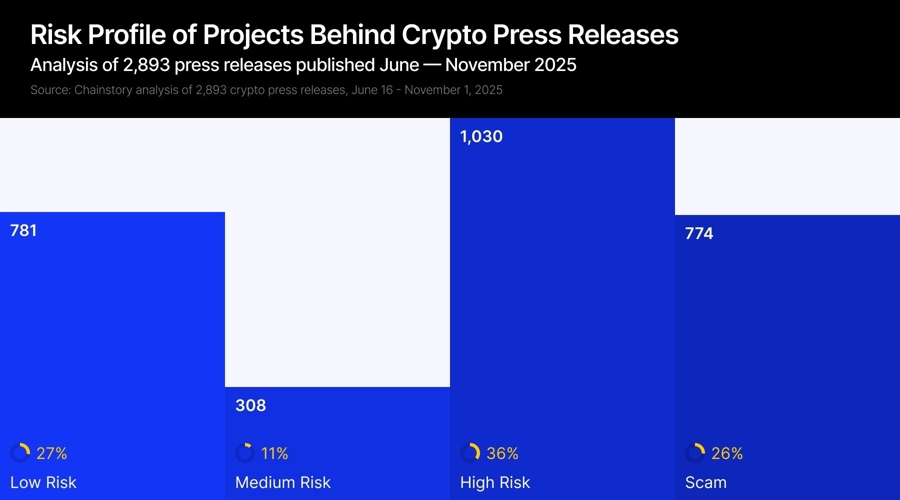
of 2,893 press releases published between June and November 2025 found that 62
percent came from projects flagged as high-risk or outright scams. In the cloud
mining sector specifically, 90 percent of issuers fell into those categories.
More than
half of all releases covered routine events that traditional newsrooms would
dismiss, including product tweaks, exchange listings, or token sales. Only 58
releases, roughly 2 percent, related to substantive developments like funding
rounds, mergers, or research reports.
The tone
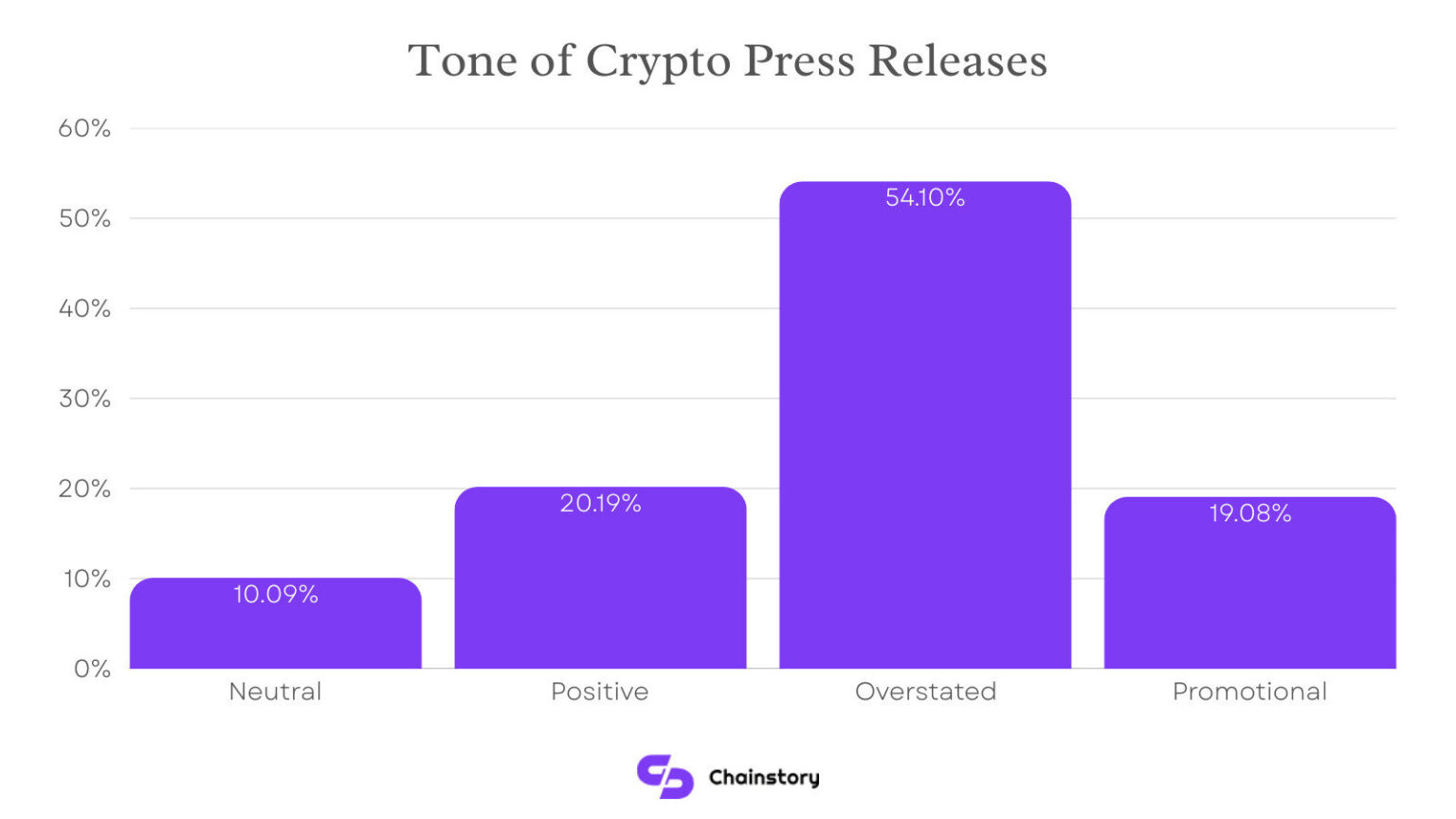
skewed heavily promotional. Roughly 54 percent were tagged as
“overstated” and another 19 percent as “promotional.” Only
10 percent used neutral, factual language.
“If a
fake press release could dupe even Reuters and CNN, it's easy to imagine how
everyday retail crypto investors, who see press releases on aggregator sites or
social media, might be misled by the steady stream of paid announcements that
look like real news,” Chainstory notes in its report.
Distribution
services claim to perform compliance vetting, but by their own admission, it's
impossible to rigorously fact-check thousands of daily releases. The onus falls
on clients to be truthful, creating what the report calls a “fox guarding
the henhouse” scenario.
Projects Buy Credibility
Through Guaranteed Placement
Crypto-specific
distribution platforms operate differently from traditional services like
Business Wire or PR Newswire. Instead of syndicating announcements to
journalists for review, crypto wires sell guaranteed placement across partner
websites, bypassing editorial filters entirely.
Projects
with a few thousand dollars can secure publication on dozens of sites,
including some that auto-post releases in sections labeled “Press
Release” rather than “Sponsored Content.” This creates what the
report describes as a “false hierarchy” where paid announcements shed
the stigma of advertising.
Harel
explained that distribution platforms have exclusive contracts with crypto
websites and are motivated to push high volumes of releases.
“A few
years back, the service was called ‘article placements’ or ‘link building
brokerage,’ where everything was handled manually,” he said. “This
model is a bit more sophisticated since there's software in place, which is
integrated in third-party websites and acts as a ‘bridge’ to publication,
designed to place advertorial content at scale and high volumes.”
Exchange Listings Create
Illusion of Activity
Major
exchanges flood press release channels with listing announcements to signal
constant activity, even for obscure tokens that mainstream outlets would
ignore. The practice serves multiple purposes: satisfying token projects that
expect promotional support, generating permanent web pages for search
optimization, and creating the appearance of dynamic growth.
The SEO
strategy largely fails due to duplicate content filters. When identical text
appears across dozens of domains, search engines typically index only the
original source while hiding remaining placements. Clients pay for guaranteed
placement on 100-plus websites believing they've bought visibility, but most
links remain hidden from average users.
Buzzword Bombing Targets
Retail Investors
Press
releases frequently deploy trending terminology – AI, NFT, DeFi, Web3, Layer-2,
Metaverse – regardless of actual relevance to the project. Titles read like
clickbait designed to trigger FOMO: “Project X Blazes Into Web3 with
Unprecedented Growth,” “Startup Y Tops Global Charts in
Security.”
“This
keyword bombing approach is a hallmark of promotional writing aimed at
investors and not genuine tech announcements,” according to the analysis.
Any
seasoned editor would recognize such language as a rejection flag, which is
precisely why these projects bypass editorial channels entirely.
Research
shows automated trading algorithms compound the effect. Some bots scrape news
feeds for keywords like “partnership” or “launch” to
execute trades. A press release crossing the wire with the right buzzwords can
trigger algorithmic buys before anyone realizes the source was just paid
placement with no external validation.
“In
fast-moving markets, regulators typically target the ‘obvious’ fraud after
investors cry foul, which is the projects themselves, while the 'enablers' (the
distribution platforms) remain under the radar,” he said.
The SEC has
prosecuted stock promoters for issuing misleading press releases to pump
prices, with data from 2002–2015 showing press releases appeared in 73 percent
of 150 pump-and-dump cases targeting penny stocks.
“Distribution
platforms shield themselves with Terms and Conditions that dump all
accountability onto the issuers, claiming it's ‘impossible’ to fact-check every
claim,” Harel said.
Information Quality Crisis
Threatens Market Integrity
The
proliferation of unvetted promotional content disguised as news creates an
alternate reality where every project appears best, biggest, safest, and
revolutionary according to its own paid output.
Harel warns
that investors cannot rely on single sources of information. “In an
environment where even Tier-1 outlets can be manipulated or rush to report
inaccuracies, relying solely on unvetted press release distribution platforms
is a recipe for disaster,” he concluded.
“If
you stumble upon a crypto press release on a news site, odds are better than
50/50 that the project behind it is of low credibility or worse,” Tal
Shmuel Harel, co-founder of Chainstory, told FinanceMagnates.com.
His warning
comes as Chainstory’s new research exposes how the crypto press release
industry has evolved into a distribution channel for market manipulation, with
dubious projects exploiting pay-to-play platforms to bypass editorial scrutiny
and manufacture credibility.
“Better Than 50/50 the
Project Is Low Credibility”
An analysis
of 2,893 press releases published between June and November 2025 found that 62
percent came from projects flagged as high-risk or outright scams. In the cloud
mining sector specifically, 90 percent of issuers fell into those categories.
More than
half of all releases covered routine events that traditional newsrooms would
dismiss, including product tweaks, exchange listings, or token sales. Only 58
releases, roughly 2 percent, related to substantive developments like funding
rounds, mergers, or research reports.
The tone
skewed heavily promotional. Roughly 54 percent were tagged as
“overstated” and another 19 percent as “promotional.” Only
10 percent used neutral, factual language.
“If a
fake press release could dupe even Reuters and CNN, it's easy to imagine how
everyday retail crypto investors, who see press releases on aggregator sites or
social media, might be misled by the steady stream of paid announcements that
look like real news,” Chainstory notes in its report.
Distribution
services claim to perform compliance vetting, but by their own admission, it's
impossible to rigorously fact-check thousands of daily releases. The onus falls
on clients to be truthful, creating what the report calls a “fox guarding
the henhouse” scenario.
Projects Buy Credibility
Through Guaranteed Placement
Crypto-specific
distribution platforms operate differently from traditional services like
Business Wire or PR Newswire. Instead of syndicating announcements to
journalists for review, crypto wires sell guaranteed placement across partner
websites, bypassing editorial filters entirely.
Projects
with a few thousand dollars can secure publication on dozens of sites,
including some that auto-post releases in sections labeled “Press
Release” rather than “Sponsored Content.” This creates what the
report describes as a “false hierarchy” where paid announcements shed
the stigma of advertising.
Harel
explained that distribution platforms have exclusive contracts with crypto
websites and are motivated to push high volumes of releases.
“A few
years back, the service was called ‘article placements’ or ‘link building
brokerage,’ where everything was handled manually,” he said. “This
model is a bit more sophisticated since there's software in place, which is
integrated in third-party websites and acts as a ‘bridge’ to publication,
designed to place advertorial content at scale and high volumes.”
Exchange Listings Create
Illusion of Activity
Major
exchanges flood press release channels with listing announcements to signal
constant activity, even for obscure tokens that mainstream outlets would
ignore. The practice serves multiple purposes: satisfying token projects that
expect promotional support, generating permanent web pages for search
optimization, and creating the appearance of dynamic growth.
The SEO
strategy largely fails due to duplicate content filters. When identical text
appears across dozens of domains, search engines typically index only the
original source while hiding remaining placements. Clients pay for guaranteed
placement on 100-plus websites believing they've bought visibility, but most
links remain hidden from average users.
Buzzword Bombing Targets
Retail Investors
Press
releases frequently deploy trending terminology – AI, NFT, DeFi, Web3, Layer-2,
Metaverse – regardless of actual relevance to the project. Titles read like
clickbait designed to trigger FOMO: “Project X Blazes Into Web3 with
Unprecedented Growth,” “Startup Y Tops Global Charts in
Security.”
“This
keyword bombing approach is a hallmark of promotional writing aimed at
investors and not genuine tech announcements,” according to the analysis.
Any
seasoned editor would recognize such language as a rejection flag, which is
precisely why these projects bypass editorial channels entirely.
Research
shows automated trading algorithms compound the effect. Some bots scrape news
feeds for keywords like “partnership” or “launch” to
execute trades. A press release crossing the wire with the right buzzwords can
trigger algorithmic buys before anyone realizes the source was just paid
placement with no external validation.
“In
fast-moving markets, regulators typically target the ‘obvious’ fraud after
investors cry foul, which is the projects themselves, while the 'enablers' (the
distribution platforms) remain under the radar,” he said.
The SEC has
prosecuted stock promoters for issuing misleading press releases to pump
prices, with data from 2002–2015 showing press releases appeared in 73 percent
of 150 pump-and-dump cases targeting penny stocks.
“Distribution
platforms shield themselves with Terms and Conditions that dump all
accountability onto the issuers, claiming it's ‘impossible’ to fact-check every
claim,” Harel said.
Information Quality Crisis
Threatens Market Integrity
The
proliferation of unvetted promotional content disguised as news creates an
alternate reality where every project appears best, biggest, safest, and
revolutionary according to its own paid output.
Harel warns
that investors cannot rely on single sources of information. “In an
environment where even Tier-1 outlets can be manipulated or rush to report
inaccuracies, relying solely on unvetted press release distribution platforms
is a recipe for disaster,” he concluded.
Damian Chmiel is a Senior Analyst & Editor at Finance Magnates with more than 15 years of experience in the CFD and online trading industry. Active as both a trader and journalist since 2010, he focuses on broker coverage, fintech innovation, and regulatory developments across Europe, the Middle East, and Asia.
His work includes interviews with C-level leaders at major brokerages and fintech platforms, as well as co-authoring Finance Magnates’ quarterly industry benchmarking reports. Damian’s reporting is data-driven, market-aware, and grounded in direct industry engagement. His analysis and commentary have also been cited by external media outlets, including Investing.com, Binance, The Asset, Stockhead, and Dispatch.
Education:
MA in Finance and Accounting, Cracow University of Economics
"Death by a Thousand Cuts": Are Tech Issues Burning Out Traders?
Featured Videos
Hola Prime Review: What You Need to Know | Full Breakdown by Finance Magnates
Hola Prime Review: What You Need to Know | Full Breakdown by Finance Magnates
Hola Prime Review: What You Need to Know | Full Breakdown by Finance Magnates
Hola Prime Review: What You Need to Know | Full Breakdown by Finance Magnates
In this video, we review @HolaPrime_Global, a proprietary trading firm offering evaluation programs and performance-based payouts in simulated market environments.
We cover how the challenge model works, including account types, profit splits (up to 95%), trading rules, and what it takes to reach a funded account. You’ll also learn about available platforms like MT4, MT5, cTrader, and more, along with insights into payouts, support, and trading conditions.
Watch the full video to see if Hola Prime fits your trading style.
📣 Stay up to date with the latest in finance and trading. Follow Finance Magnates for industry news, insights, and global event coverage.
Connect with us:
🔗 LinkedIn: /financemagnates
👍 Facebook: /financemagnates
📸 Instagram: https://www.instagram.com/financemagnates
🐦 X: https://x.com/financemagnates
🎥 TikTok: https://www.tiktok.com/tag/financemagnates
▶️ YouTube: /@financemagnates_official
#HolaPrime #PropFirm #Trading #FinanceMagnates #Forex #FuturesTrading #TradingReview #PropFirmReview
In this video, we review @HolaPrime_Global, a proprietary trading firm offering evaluation programs and performance-based payouts in simulated market environments.
We cover how the challenge model works, including account types, profit splits (up to 95%), trading rules, and what it takes to reach a funded account. You’ll also learn about available platforms like MT4, MT5, cTrader, and more, along with insights into payouts, support, and trading conditions.
Watch the full video to see if Hola Prime fits your trading style.
📣 Stay up to date with the latest in finance and trading. Follow Finance Magnates for industry news, insights, and global event coverage.
Connect with us:
🔗 LinkedIn: /financemagnates
👍 Facebook: /financemagnates
📸 Instagram: https://www.instagram.com/financemagnates
🐦 X: https://x.com/financemagnates
🎥 TikTok: https://www.tiktok.com/tag/financemagnates
▶️ YouTube: /@financemagnates_official
#HolaPrime #PropFirm #Trading #FinanceMagnates #Forex #FuturesTrading #TradingReview #PropFirmReview
In this video, we review @HolaPrime_Global, a proprietary trading firm offering evaluation programs and performance-based payouts in simulated market environments.
We cover how the challenge model works, including account types, profit splits (up to 95%), trading rules, and what it takes to reach a funded account. You’ll also learn about available platforms like MT4, MT5, cTrader, and more, along with insights into payouts, support, and trading conditions.
Watch the full video to see if Hola Prime fits your trading style.
📣 Stay up to date with the latest in finance and trading. Follow Finance Magnates for industry news, insights, and global event coverage.
Connect with us:
🔗 LinkedIn: /financemagnates
👍 Facebook: /financemagnates
📸 Instagram: https://www.instagram.com/financemagnates
🐦 X: https://x.com/financemagnates
🎥 TikTok: https://www.tiktok.com/tag/financemagnates
▶️ YouTube: /@financemagnates_official
#HolaPrime #PropFirm #Trading #FinanceMagnates #Forex #FuturesTrading #TradingReview #PropFirmReview
In this video, we review @HolaPrime_Global, a proprietary trading firm offering evaluation programs and performance-based payouts in simulated market environments.
We cover how the challenge model works, including account types, profit splits (up to 95%), trading rules, and what it takes to reach a funded account. You’ll also learn about available platforms like MT4, MT5, cTrader, and more, along with insights into payouts, support, and trading conditions.
Watch the full video to see if Hola Prime fits your trading style.
📣 Stay up to date with the latest in finance and trading. Follow Finance Magnates for industry news, insights, and global event coverage.
Connect with us:
🔗 LinkedIn: /financemagnates
👍 Facebook: /financemagnates
📸 Instagram: https://www.instagram.com/financemagnates
🐦 X: https://x.com/financemagnates
🎥 TikTok: https://www.tiktok.com/tag/financemagnates
▶️ YouTube: /@financemagnates_official
#HolaPrime #PropFirm #Trading #FinanceMagnates #Forex #FuturesTrading #TradingReview #PropFirmReview
Axi Winner Spotlight 🏆 | Global Most Innovative Broker 2025 #Innovation #Trading #Fintech #Broker
Axi Winner Spotlight 🏆 | Global Most Innovative Broker 2025 #Innovation #Trading #Fintech #Broker
Axi Winner Spotlight 🏆 | Global Most Innovative Broker 2025 #Innovation #Trading #Fintech #Broker
Axi Winner Spotlight 🏆 | Global Most Innovative Broker 2025 #Innovation #Trading #Fintech #Broker
Axi Winner Spotlight 🏆 | Global Most Innovative Broker 2025 #Innovation #Trading #Fintech #Broker
Axi Winner Spotlight 🏆 | Global Most Innovative Broker 2025 #Innovation #Trading #Fintech #Broker
Axi takes the spotlight at the Finance Magnates Awards, winning Global Most Innovative Broker 2025.
Olivia Xenofontos and Ivanna Openko share how the team will feel: proud, motivated, and ready to keep delivering.
They also describe the night as well-organized, focused, and enjoyable for all.
👉 Be part of FM Awards 2026.
Axi takes the spotlight at the Finance Magnates Awards, winning Global Most Innovative Broker 2025.
Olivia Xenofontos and Ivanna Openko share how the team will feel: proud, motivated, and ready to keep delivering.
They also describe the night as well-organized, focused, and enjoyable for all.
👉 Be part of FM Awards 2026.
Axi takes the spotlight at the Finance Magnates Awards, winning Global Most Innovative Broker 2025.
Olivia Xenofontos and Ivanna Openko share how the team will feel: proud, motivated, and ready to keep delivering.
They also describe the night as well-organized, focused, and enjoyable for all.
👉 Be part of FM Awards 2026.
Axi takes the spotlight at the Finance Magnates Awards, winning Global Most Innovative Broker 2025.
Olivia Xenofontos and Ivanna Openko share how the team will feel: proud, motivated, and ready to keep delivering.
They also describe the night as well-organized, focused, and enjoyable for all.
👉 Be part of FM Awards 2026.
Axi takes the spotlight at the Finance Magnates Awards, winning Global Most Innovative Broker 2025.
Olivia Xenofontos and Ivanna Openko share how the team will feel: proud, motivated, and ready to keep delivering.
They also describe the night as well-organized, focused, and enjoyable for all.
👉 Be part of FM Awards 2026.
Axi takes the spotlight at the Finance Magnates Awards, winning Global Most Innovative Broker 2025.
Olivia Xenofontos and Ivanna Openko share how the team will feel: proud, motivated, and ready to keep delivering.
They also describe the night as well-organized, focused, and enjoyable for all.
👉 Be part of FM Awards 2026.
Recognition that matters.
Built on transparency.
Driven by the industry.
The Finance Magnates Awards 2026.
Nominations are now open.
🔗 https://awards.financemagnates.com/?utm_source=SM&utm_medium=social&utm_campaign=recognition-matters
Recognition that matters.
Built on transparency.
Driven by the industry.
The Finance Magnates Awards 2026.
Nominations are now open.
🔗 https://awards.financemagnates.com/?utm_source=SM&utm_medium=social&utm_campaign=recognition-matters
Recognition that matters.
Built on transparency.
Driven by the industry.
The Finance Magnates Awards 2026.
Nominations are now open.
🔗 https://awards.financemagnates.com/?utm_source=SM&utm_medium=social&utm_campaign=recognition-matters
Recognition that matters.
Built on transparency.
Driven by the industry.
The Finance Magnates Awards 2026.
Nominations are now open.
🔗 https://awards.financemagnates.com/?utm_source=SM&utm_medium=social&utm_campaign=recognition-matters
Recognition that matters.
Built on transparency.
Driven by the industry.
The Finance Magnates Awards 2026.
Nominations are now open.
🔗 https://awards.financemagnates.com/?utm_source=SM&utm_medium=social&utm_campaign=recognition-matters
Recognition that matters.
Built on transparency.
Driven by the industry.
The Finance Magnates Awards 2026.
Nominations are now open.
🔗 https://awards.financemagnates.com/?utm_source=SM&utm_medium=social&utm_campaign=recognition-matters
Tickmill Winner Spotlight | Broker of the Year 2025 (LATAM) 🏆 | Finance Magnates Awards #Trading
Tickmill Winner Spotlight | Broker of the Year 2025 (LATAM) 🏆 | Finance Magnates Awards #Trading
Tickmill Winner Spotlight | Broker of the Year 2025 (LATAM) 🏆 | Finance Magnates Awards #Trading
Tickmill Winner Spotlight | Broker of the Year 2025 (LATAM) 🏆 | Finance Magnates Awards #Trading
Tickmill Winner Spotlight | Broker of the Year 2025 (LATAM) 🏆 | Finance Magnates Awards #Trading
Tickmill Winner Spotlight | Broker of the Year 2025 (LATAM) 🏆 | Finance Magnates Awards #Trading
What helped Tickmill stand out this year?
In this Winner Spotlight, Johnny Khalil, Executive Director at Tickmill Europe, shares how listening closely to clients and delivering strong trading conditions made the difference.
A big thank you to the community whose support continues to drive progress every day.
👉 Think your brand has what it takes? Nominate for the 2026 Finance Magnates Awards: https://awards.financemagnates.com/#nominate
What helped Tickmill stand out this year?
In this Winner Spotlight, Johnny Khalil, Executive Director at Tickmill Europe, shares how listening closely to clients and delivering strong trading conditions made the difference.
A big thank you to the community whose support continues to drive progress every day.
👉 Think your brand has what it takes? Nominate for the 2026 Finance Magnates Awards: https://awards.financemagnates.com/#nominate
What helped Tickmill stand out this year?
In this Winner Spotlight, Johnny Khalil, Executive Director at Tickmill Europe, shares how listening closely to clients and delivering strong trading conditions made the difference.
A big thank you to the community whose support continues to drive progress every day.
👉 Think your brand has what it takes? Nominate for the 2026 Finance Magnates Awards: https://awards.financemagnates.com/#nominate
What helped Tickmill stand out this year?
In this Winner Spotlight, Johnny Khalil, Executive Director at Tickmill Europe, shares how listening closely to clients and delivering strong trading conditions made the difference.
A big thank you to the community whose support continues to drive progress every day.
👉 Think your brand has what it takes? Nominate for the 2026 Finance Magnates Awards: https://awards.financemagnates.com/#nominate
What helped Tickmill stand out this year?
In this Winner Spotlight, Johnny Khalil, Executive Director at Tickmill Europe, shares how listening closely to clients and delivering strong trading conditions made the difference.
A big thank you to the community whose support continues to drive progress every day.
👉 Think your brand has what it takes? Nominate for the 2026 Finance Magnates Awards: https://awards.financemagnates.com/#nominate
What helped Tickmill stand out this year?
In this Winner Spotlight, Johnny Khalil, Executive Director at Tickmill Europe, shares how listening closely to clients and delivering strong trading conditions made the difference.
A big thank you to the community whose support continues to drive progress every day.
👉 Think your brand has what it takes? Nominate for the 2026 Finance Magnates Awards: https://awards.financemagnates.com/#nominate
CMC Markets’ Artur Delijergijevs on Metals Demand, Volatility, & Stable Execution
CMC Markets’ Artur Delijergijevs on Metals Demand, Volatility, & Stable Execution
CMC Markets’ Artur Delijergijevs on Metals Demand, Volatility, & Stable Execution
CMC Markets’ Artur Delijergijevs on Metals Demand, Volatility, & Stable Execution
CMC Markets’ Artur Delijergijevs on Metals Demand, Volatility, & Stable Execution
CMC Markets’ Artur Delijergijevs on Metals Demand, Volatility, & Stable Execution
In this exclusive Executive Interview, Finance Magnates speaks with Artur Delijergijevs, Head of Systematic Market Making at CMC Markets, about the current state of metals demand and market volatility.
Delijergijevs offers a desk-level view on:
- Metals Demand: Why metals are seeing the strongest demand from both retail and institutional clients right now.
- The Safe-Haven Debate: Questioning whether gold still fits the classic safe-haven definition given large daily price movements.
- Volatile Market Prep: How a market-making desk prepares its systems and pricing for stressed market conditions and high-impact economic events.
- Hybrid Execution: Why the best execution model combines electronic speed with human relationship support, especially during volatility.
- AI in Workflow: Where CMC Markets is integrating machine learning for risk management and pricing, and the limitations of AI during stressed markets.
- Dubai's Role: The strategic importance of Dubai’s location for covering global trading sessions across Asia, Europe, and the US.
Watch to understand how CMC Markets maintains stable pricing and reliable execution quality in high-volatility environments.
#CMCmarkets #forex #metals #gold #trading #volatility #MarketMaking #iFXDubai #FinanceMagnates #Finance #Fintech #Execution #AlgorithmicTrading #RiskManagement
In this exclusive Executive Interview, Finance Magnates speaks with Artur Delijergijevs, Head of Systematic Market Making at CMC Markets, about the current state of metals demand and market volatility.
Delijergijevs offers a desk-level view on:
- Metals Demand: Why metals are seeing the strongest demand from both retail and institutional clients right now.
- The Safe-Haven Debate: Questioning whether gold still fits the classic safe-haven definition given large daily price movements.
- Volatile Market Prep: How a market-making desk prepares its systems and pricing for stressed market conditions and high-impact economic events.
- Hybrid Execution: Why the best execution model combines electronic speed with human relationship support, especially during volatility.
- AI in Workflow: Where CMC Markets is integrating machine learning for risk management and pricing, and the limitations of AI during stressed markets.
- Dubai's Role: The strategic importance of Dubai’s location for covering global trading sessions across Asia, Europe, and the US.
Watch to understand how CMC Markets maintains stable pricing and reliable execution quality in high-volatility environments.
#CMCmarkets #forex #metals #gold #trading #volatility #MarketMaking #iFXDubai #FinanceMagnates #Finance #Fintech #Execution #AlgorithmicTrading #RiskManagement
In this exclusive Executive Interview, Finance Magnates speaks with Artur Delijergijevs, Head of Systematic Market Making at CMC Markets, about the current state of metals demand and market volatility.
Delijergijevs offers a desk-level view on:
- Metals Demand: Why metals are seeing the strongest demand from both retail and institutional clients right now.
- The Safe-Haven Debate: Questioning whether gold still fits the classic safe-haven definition given large daily price movements.
- Volatile Market Prep: How a market-making desk prepares its systems and pricing for stressed market conditions and high-impact economic events.
- Hybrid Execution: Why the best execution model combines electronic speed with human relationship support, especially during volatility.
- AI in Workflow: Where CMC Markets is integrating machine learning for risk management and pricing, and the limitations of AI during stressed markets.
- Dubai's Role: The strategic importance of Dubai’s location for covering global trading sessions across Asia, Europe, and the US.
Watch to understand how CMC Markets maintains stable pricing and reliable execution quality in high-volatility environments.
#CMCmarkets #forex #metals #gold #trading #volatility #MarketMaking #iFXDubai #FinanceMagnates #Finance #Fintech #Execution #AlgorithmicTrading #RiskManagement
In this exclusive Executive Interview, Finance Magnates speaks with Artur Delijergijevs, Head of Systematic Market Making at CMC Markets, about the current state of metals demand and market volatility.
Delijergijevs offers a desk-level view on:
- Metals Demand: Why metals are seeing the strongest demand from both retail and institutional clients right now.
- The Safe-Haven Debate: Questioning whether gold still fits the classic safe-haven definition given large daily price movements.
- Volatile Market Prep: How a market-making desk prepares its systems and pricing for stressed market conditions and high-impact economic events.
- Hybrid Execution: Why the best execution model combines electronic speed with human relationship support, especially during volatility.
- AI in Workflow: Where CMC Markets is integrating machine learning for risk management and pricing, and the limitations of AI during stressed markets.
- Dubai's Role: The strategic importance of Dubai’s location for covering global trading sessions across Asia, Europe, and the US.
Watch to understand how CMC Markets maintains stable pricing and reliable execution quality in high-volatility environments.
#CMCmarkets #forex #metals #gold #trading #volatility #MarketMaking #iFXDubai #FinanceMagnates #Finance #Fintech #Execution #AlgorithmicTrading #RiskManagement
In this exclusive Executive Interview, Finance Magnates speaks with Artur Delijergijevs, Head of Systematic Market Making at CMC Markets, about the current state of metals demand and market volatility.
Delijergijevs offers a desk-level view on:
- Metals Demand: Why metals are seeing the strongest demand from both retail and institutional clients right now.
- The Safe-Haven Debate: Questioning whether gold still fits the classic safe-haven definition given large daily price movements.
- Volatile Market Prep: How a market-making desk prepares its systems and pricing for stressed market conditions and high-impact economic events.
- Hybrid Execution: Why the best execution model combines electronic speed with human relationship support, especially during volatility.
- AI in Workflow: Where CMC Markets is integrating machine learning for risk management and pricing, and the limitations of AI during stressed markets.
- Dubai's Role: The strategic importance of Dubai’s location for covering global trading sessions across Asia, Europe, and the US.
Watch to understand how CMC Markets maintains stable pricing and reliable execution quality in high-volatility environments.
#CMCmarkets #forex #metals #gold #trading #volatility #MarketMaking #iFXDubai #FinanceMagnates #Finance #Fintech #Execution #AlgorithmicTrading #RiskManagement
In this exclusive Executive Interview, Finance Magnates speaks with Artur Delijergijevs, Head of Systematic Market Making at CMC Markets, about the current state of metals demand and market volatility.
Delijergijevs offers a desk-level view on:
- Metals Demand: Why metals are seeing the strongest demand from both retail and institutional clients right now.
- The Safe-Haven Debate: Questioning whether gold still fits the classic safe-haven definition given large daily price movements.
- Volatile Market Prep: How a market-making desk prepares its systems and pricing for stressed market conditions and high-impact economic events.
- Hybrid Execution: Why the best execution model combines electronic speed with human relationship support, especially during volatility.
- AI in Workflow: Where CMC Markets is integrating machine learning for risk management and pricing, and the limitations of AI during stressed markets.
- Dubai's Role: The strategic importance of Dubai’s location for covering global trading sessions across Asia, Europe, and the US.
Watch to understand how CMC Markets maintains stable pricing and reliable execution quality in high-volatility environments.
#CMCmarkets #forex #metals #gold #trading #volatility #MarketMaking #iFXDubai #FinanceMagnates #Finance #Fintech #Execution #AlgorithmicTrading #RiskManagement