Financial and Business News

Hola Prime Brings In Deloitte to Audit Payouts as Trust Gap Widens Across Prop Firms

Monday, 27/04/2026 | 10:25 GMT by Damian Chmiel
  • The Big Four firm reviewed five months of withdrawals and found 98% processed within an hour and zero denied.
  • Most prop firms still verify payouts through self-reported dashboards or on-chain crypto transfers, neither of which gives traders a reliable picture.
Deloitte office space in Sofia

Hola Prime hired Deloitte to conduct an independent review of its payout processing between October 15, 2025 and March 15, 2026. The audit found the prop trading firm cleared 98.35% of withdrawal requests within its one-hour target and rejected none, according to documents exclusively seen by FinanceMagnates.com.

Singapore Summit: Meet the largest APAC brokers you know (and those you still don't!)

A commissioned Big Four review is unusual in a sector where most payout claims still rest on internal dashboards, company-run disclosure pages, or blockchain trackers that openly admit they cannot always separate trader payouts from operational spending.

It lands as part of a growing competition for transparency amid persistent claims of payout issues elsewhere in the industry.

The Hong Kong-registered firm, which runs its brokerage under a Mauritius Financial Services Commission license, says it has distributed about $3.2 million to funded traders to date, with roughly $2 million of that processed in the first quarter of 2026 alone.

Hola Prime Founder and Chief Executive Officer Somesh Kapuria told FinanceMagnates.com that the firm's approach is built around stripping ambiguity out of the process well before a withdrawal is requested.

What the Deloitte Review Covered

Deloitte looked at all payout transactions processed during the five-month window. The review found that 98.35% of payouts were processed within one hour, 1.65% exceeded that timeline, and zero payouts were denied across the period.
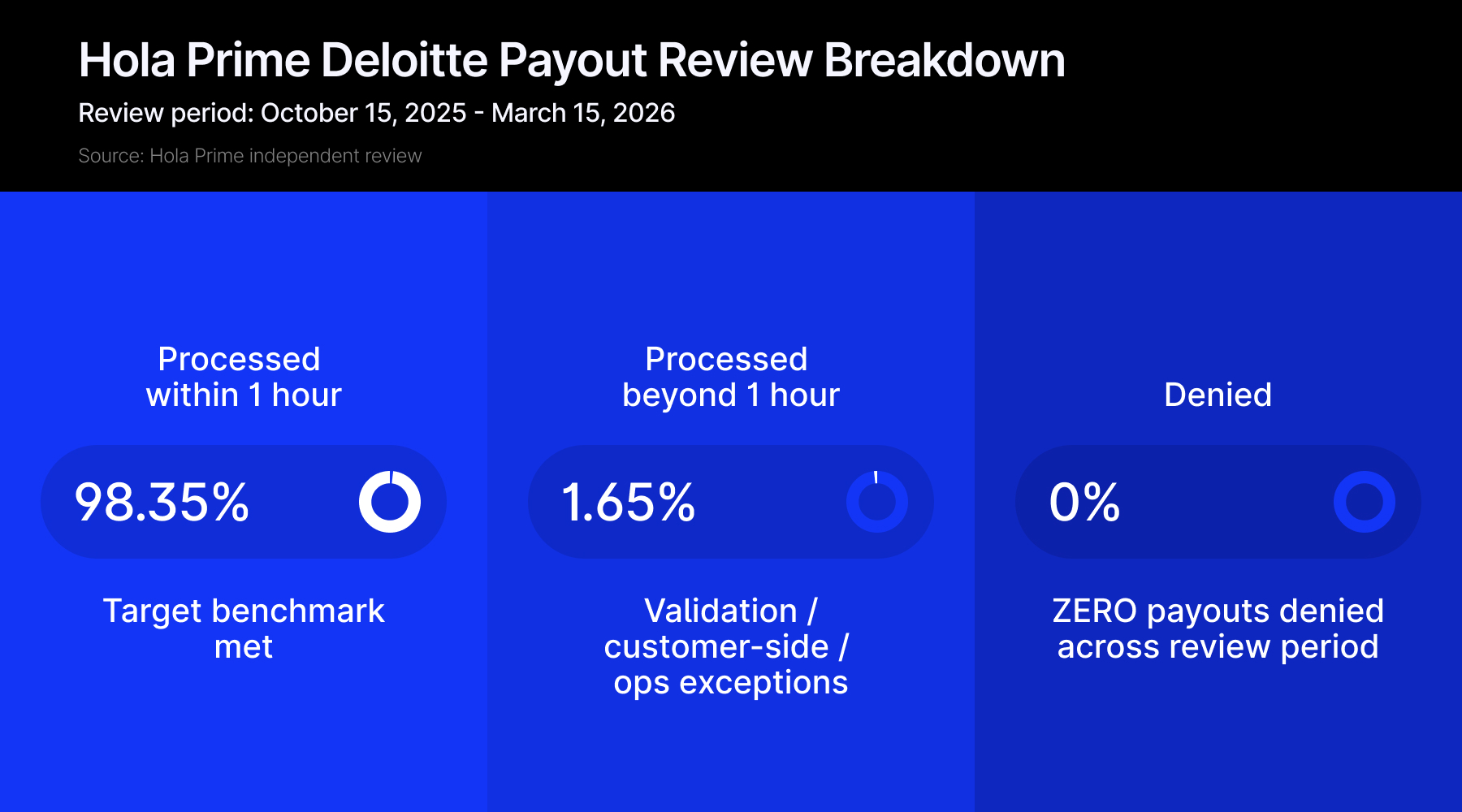
The cases that ran past an hour were tied to additional validation checks, customer-side delays such as incomplete information, and operational exceptions, according to the report.

Most prop firms do not commission reviews of this kind. When they do disclose payout figures, the data generally comes from internal systems or from on-chain observers with their own blind spots, which leaves traders and competitors relying on statements that are hard to audit.

Somesh Kapuria, the CEO of Hola Prime

"Our goal is to eliminate surprises," Kapuria said. "By the time a trader reaches a payout request, their trading activity has already been aligned with our rules."

The firm separates hard-rule breaches, such as exceeding daily or maximum loss limits, from behavioral patterns flagged through real-time monitoring, with traders notified and guided before reaching a withdrawal request.

"That's why we operate with a Zero Payout Denial Policy... if a trader reaches the payout stage, they can expect to be paid."

Why the Industry Is Rebranding Faster Than It Is Reforming

Prop trading has spent much of the past three years trying to stay just ahead of its regulators. After the US Commodity Futures Trading Commission's 2023 lawsuit against Traders Global Group, better known as My Forex Funds, firms across the sector quietly rewrote their websites to swap "capital" for "simulated capital" and "trading" for "virtual trading," building a case that they sat outside broker rules.

The CFTC's case was dismissed in May 2025 after a special master found the regulator had taken, in the court's language, "deliberate steps down a path of obfuscation and avoidance."

The linguistic drift has continued. Dallas-based E8 Markets now describes itself as a SaaS educational simulation platform for financial markets, a label that lets it steer clear of the regulated-broker perimeter while marketing to retail traders. Italy's Consob has gone the other direction, describing the category as something closer to a finance video game aimed at passing skill tests and making a profit.

A separate cohort of firms has gone offshore for almost the opposite reason. After MetaQuotes shut off MT5 access to grey-labeled prop firms in early 2024, Wall Street Funded incorporated in Saint Lucia to secure its own MetaTrader agreement, and Blue Guardian and Maven Prop Trading followed within weeks.

Saint Lucia does not run a CFD regulatory regime at all, which did not prevent MetaQuotes from accepting the paperwork.

The Credibility Gap on Payout Claims

Claims like "we paid $1 million to traders last week" have become a standard marketing line in prop trading, but there is rarely a clean way to check them. Many firms lump vendor costs, affiliate commissions and salary payments into the same crypto wallets they use for trader payouts, which makes the headline number easy to inflate.

On-chain trackers such as Payout Junction monitor Rise transactions and publish aggregate figures, but they note in their own footnotes that firms may route non-trader spending through the same addresses.

That gap shows up in the data. FundedNext said it disbursed $15.19 million to 8,340 traders in February 2026, while Payout Junction tracked roughly $13 million over the same period, about $2.2 million below the firm's own figure.

The wider market is still growing, though the pace has stalled. FM Intelligence put tracked crypto payouts across the top 10 prop firms at $115.1 million in the first quarter of 2026, double the level a year earlier but nearly flat against the fourth quarter of 2025.

The figure also excludes prominent names such as FTMO and The5ers, which do not use Rise.

Hola Prime's Numbers by the Book

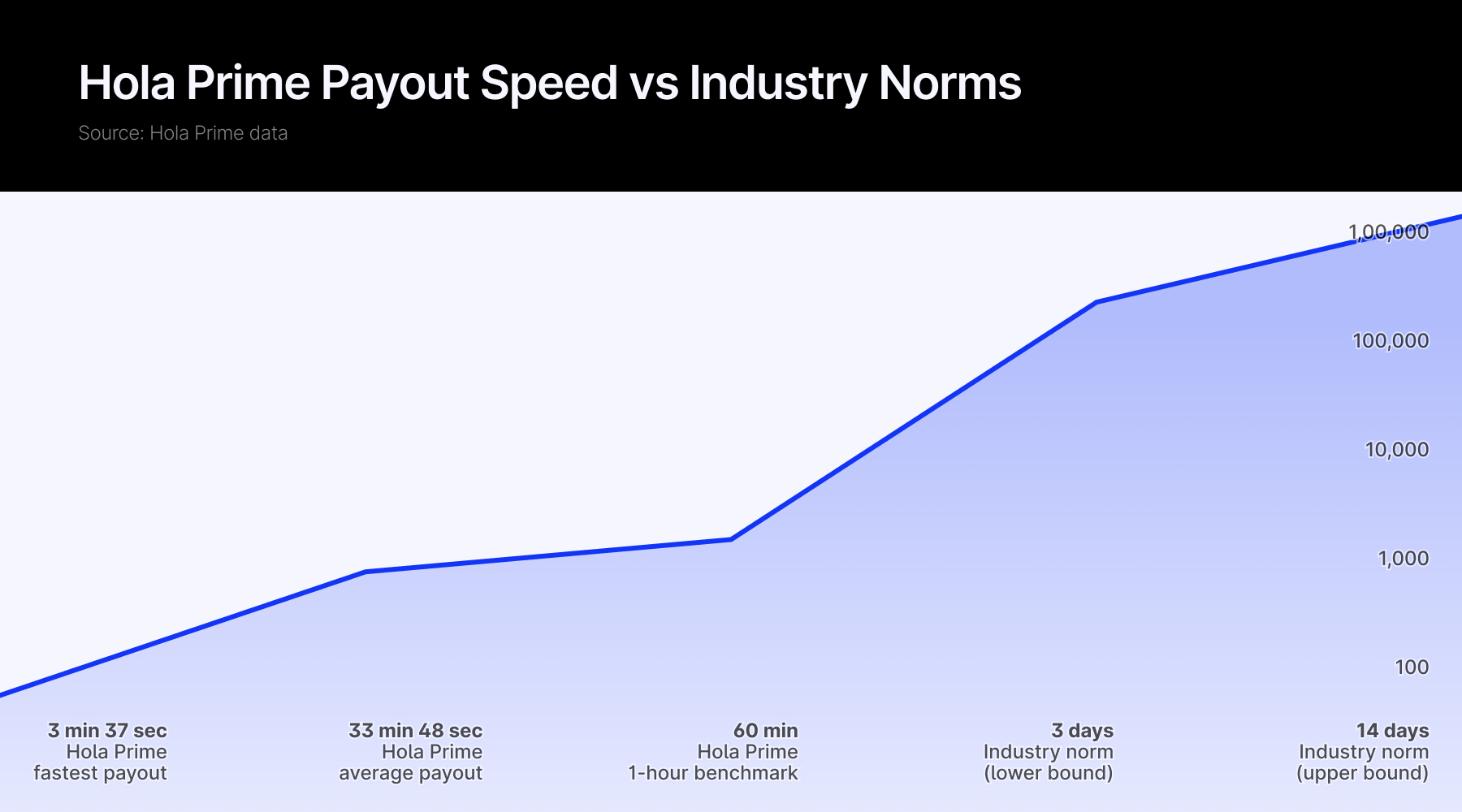
The Deloitte-reviewed figures sit alongside operational data the firm has been publishing for months. Hola Prime says its average profit-split payout clears in 33 minutes and 48 seconds, with the fastest on record at 3 minutes and 37 seconds, and an average payout size of roughly $4,500.

It is worth noting, however, that the figures refer only to traders who have completed the evaluation (challenge) and been pre-approved for a payout, rather than the firm's entire trader base. Hola Prime told FinanceMagnates.com that compliance checks are conducted on a rolling basis to ensure all activity aligns with the rules, and that payouts are processed on fixed dates, enabling rapid execution.
The firm reports an evaluation-to-funded pass rate of about 15%, with traders averaging 3.5 attempts before clearing a challenge. For comparison, FPFX Tech data puts the share of prop participants who turn a profit at roughly 7%, with average earnings of just 4% of allocated capital.

Kapuria said just under 5,000 traders joined Hola Prime in 2025, with another 10,000 added in the first quarter of 2026.

"The growth reflects increasing trust from traders, especially around transparency and payout reliability," he said.

He also pushed back on the idea that prop trading and CFD broking sit on the same risk plane.

"Yes, prop trading can be a safer format for retail participants compared to CFDs, primarily because the capital at risk is limited to the evaluation fee, rather than the trader's full personal capital," Kapuria said, while acknowledging that overall outcomes still depend on the individual.

The firm's pitch leans on two of the sector's stock reassurances. It publishes a Price Transparency Report that benchmarks its feed against external market data, which Kapuria said addresses trader concerns about simulated environments being tilted against them, and runs a Payout Transparency Report offering date-by-date visibility into processing times.

Since launching a futures offering backed by a Mauritius-licensed parent in October 2025, Hola Prime has leaned harder on the audit-and-publish approach as a way to distance itself from firms still waiting for regulators to draw a line.

Until now, the firm had relied on industry-standard methods, publishing its own reports. A portion of that data has now been independently verified by Deloitte.

Whether Voluntary Audits Will Catch On

Hola Prime is not the only firm chasing voluntary disclosure, but bringing in Deloitte raises the bar from the firm-published reports that have become standard.

The Funded Trader, which still has more than a thousand clients waiting on payouts dating back to March 2024, has leaned on Rise-tracked transactions to rebuild its public numbers.

FTMO closed its $250 million acquisition of OANDA in December 2025, bringing a CFTC-regulated US entity into its group structure.

For Hola Prime, the bet is that paying a Big Four firm to inspect its books, rather than rebadging as a simulation platform or flying a Saint Lucia flag, is what separates a firm that can absorb regulatory scrutiny from one that cannot.

"The industry is still in an evolving phase, so you're seeing a range of positioning," Kapuria said, pointing to the split between SaaS-style simulation models and broker-linked structures. "Over time, clearer regulation will benefit the entire industry."

Whether traders agree is a separate question. A Swiset study of nearly 10,000 prop traders placed the global failure rate at around 80%.

Against that backdrop, the most interesting number in the Deloitte report may not be the 98.35% on-time rate. It may be the zero payout denial.


Hola Prime hired Deloitte to conduct an independent review of its payout processing between October 15, 2025 and March 15, 2026. The audit found the prop trading firm cleared 98.35% of withdrawal requests within its one-hour target and rejected none, according to documents exclusively seen by FinanceMagnates.com.

Singapore Summit: Meet the largest APAC brokers you know (and those you still don't!)

A commissioned Big Four review is unusual in a sector where most payout claims still rest on internal dashboards, company-run disclosure pages, or blockchain trackers that openly admit they cannot always separate trader payouts from operational spending.

It lands as part of a growing competition for transparency amid persistent claims of payout issues elsewhere in the industry.

The Hong Kong-registered firm, which runs its brokerage under a Mauritius Financial Services Commission license, says it has distributed about $3.2 million to funded traders to date, with roughly $2 million of that processed in the first quarter of 2026 alone.

Hola Prime Founder and Chief Executive Officer Somesh Kapuria told FinanceMagnates.com that the firm's approach is built around stripping ambiguity out of the process well before a withdrawal is requested.

What the Deloitte Review Covered

Deloitte looked at all payout transactions processed during the five-month window. The review found that 98.35% of payouts were processed within one hour, 1.65% exceeded that timeline, and zero payouts were denied across the period.

The cases that ran past an hour were tied to additional validation checks, customer-side delays such as incomplete information, and operational exceptions, according to the report.

Most prop firms do not commission reviews of this kind. When they do disclose payout figures, the data generally comes from internal systems or from on-chain observers with their own blind spots, which leaves traders and competitors relying on statements that are hard to audit.

Somesh Kapuria, the CEO of Hola Prime

"Our goal is to eliminate surprises," Kapuria said. "By the time a trader reaches a payout request, their trading activity has already been aligned with our rules."

The firm separates hard-rule breaches, such as exceeding daily or maximum loss limits, from behavioral patterns flagged through real-time monitoring, with traders notified and guided before reaching a withdrawal request.

"That's why we operate with a Zero Payout Denial Policy... if a trader reaches the payout stage, they can expect to be paid."

Why the Industry Is Rebranding Faster Than It Is Reforming

Prop trading has spent much of the past three years trying to stay just ahead of its regulators. After the US Commodity Futures Trading Commission's 2023 lawsuit against Traders Global Group, better known as My Forex Funds, firms across the sector quietly rewrote their websites to swap "capital" for "simulated capital" and "trading" for "virtual trading," building a case that they sat outside broker rules.

The CFTC's case was dismissed in May 2025 after a special master found the regulator had taken, in the court's language, "deliberate steps down a path of obfuscation and avoidance."

The linguistic drift has continued. Dallas-based E8 Markets now describes itself as a SaaS educational simulation platform for financial markets, a label that lets it steer clear of the regulated-broker perimeter while marketing to retail traders. Italy's Consob has gone the other direction, describing the category as something closer to a finance video game aimed at passing skill tests and making a profit.

A separate cohort of firms has gone offshore for almost the opposite reason. After MetaQuotes shut off MT5 access to grey-labeled prop firms in early 2024, Wall Street Funded incorporated in Saint Lucia to secure its own MetaTrader agreement, and Blue Guardian and Maven Prop Trading followed within weeks.

Saint Lucia does not run a CFD regulatory regime at all, which did not prevent MetaQuotes from accepting the paperwork.

The Credibility Gap on Payout Claims

Claims like "we paid $1 million to traders last week" have become a standard marketing line in prop trading, but there is rarely a clean way to check them. Many firms lump vendor costs, affiliate commissions and salary payments into the same crypto wallets they use for trader payouts, which makes the headline number easy to inflate.

On-chain trackers such as Payout Junction monitor Rise transactions and publish aggregate figures, but they note in their own footnotes that firms may route non-trader spending through the same addresses.

That gap shows up in the data. FundedNext said it disbursed $15.19 million to 8,340 traders in February 2026, while Payout Junction tracked roughly $13 million over the same period, about $2.2 million below the firm's own figure.

The wider market is still growing, though the pace has stalled. FM Intelligence put tracked crypto payouts across the top 10 prop firms at $115.1 million in the first quarter of 2026, double the level a year earlier but nearly flat against the fourth quarter of 2025.

The figure also excludes prominent names such as FTMO and The5ers, which do not use Rise.

Hola Prime's Numbers by the Book

The Deloitte-reviewed figures sit alongside operational data the firm has been publishing for months. Hola Prime says its average profit-split payout clears in 33 minutes and 48 seconds, with the fastest on record at 3 minutes and 37 seconds, and an average payout size of roughly $4,500.

It is worth noting, however, that the figures refer only to traders who have completed the evaluation (challenge) and been pre-approved for a payout, rather than the firm's entire trader base. Hola Prime told FinanceMagnates.com that compliance checks are conducted on a rolling basis to ensure all activity aligns with the rules, and that payouts are processed on fixed dates, enabling rapid execution.

The firm reports an evaluation-to-funded pass rate of about 15%, with traders averaging 3.5 attempts before clearing a challenge. For comparison, FPFX Tech data puts the share of prop participants who turn a profit at roughly 7%, with average earnings of just 4% of allocated capital.

Kapuria said just under 5,000 traders joined Hola Prime in 2025, with another 10,000 added in the first quarter of 2026.

"The growth reflects increasing trust from traders, especially around transparency and payout reliability," he said.

He also pushed back on the idea that prop trading and CFD broking sit on the same risk plane.

"Yes, prop trading can be a safer format for retail participants compared to CFDs, primarily because the capital at risk is limited to the evaluation fee, rather than the trader's full personal capital," Kapuria said, while acknowledging that overall outcomes still depend on the individual.

The firm's pitch leans on two of the sector's stock reassurances. It publishes a Price Transparency Report that benchmarks its feed against external market data, which Kapuria said addresses trader concerns about simulated environments being tilted against them, and runs a Payout Transparency Report offering date-by-date visibility into processing times.

Since launching a futures offering backed by a Mauritius-licensed parent in October 2025, Hola Prime has leaned harder on the audit-and-publish approach as a way to distance itself from firms still waiting for regulators to draw a line.

Until now, the firm had relied on industry-standard methods, publishing its own reports. A portion of that data has now been independently verified by Deloitte.

Whether Voluntary Audits Will Catch On

Hola Prime is not the only firm chasing voluntary disclosure, but bringing in Deloitte raises the bar from the firm-published reports that have become standard.

The Funded Trader, which still has more than a thousand clients waiting on payouts dating back to March 2024, has leaned on Rise-tracked transactions to rebuild its public numbers.

FTMO closed its $250 million acquisition of OANDA in December 2025, bringing a CFTC-regulated US entity into its group structure.

For Hola Prime, the bet is that paying a Big Four firm to inspect its books, rather than rebadging as a simulation platform or flying a Saint Lucia flag, is what separates a firm that can absorb regulatory scrutiny from one that cannot.

"The industry is still in an evolving phase, so you're seeing a range of positioning," Kapuria said, pointing to the split between SaaS-style simulation models and broker-linked structures. "Over time, clearer regulation will benefit the entire industry."

Whether traders agree is a separate question. A Swiset study of nearly 10,000 prop traders placed the global failure rate at around 80%.

Against that backdrop, the most interesting number in the Deloitte report may not be the 98.35% on-time rate. It may be the zero payout denial.

About the Author: Damian Chmiel
Damian Chmiel
  • 3481 Articles
  • 109 Followers
Damian Chmiel is a Senior Analyst & Editor at Finance Magnates with more than 15 years of experience in the CFD and online trading industry. Active as both a trader and journalist since 2010, he focuses on broker coverage, fintech innovation, and regulatory developments across Europe, the Middle East, and Asia. His work includes interviews with C-level leaders at major brokerages and fintech platforms, as well as co-authoring Finance Magnates’ quarterly industry benchmarking reports. Damian’s reporting is data-driven, market-aware, and grounded in direct industry engagement. His analysis and commentary have also been cited by external media outlets, including Investing.com, Binance, The Asset, Stockhead, and Dispatch. Education: MA in Finance and Accounting, Cracow University of Economics

More from the Author

Retail FX