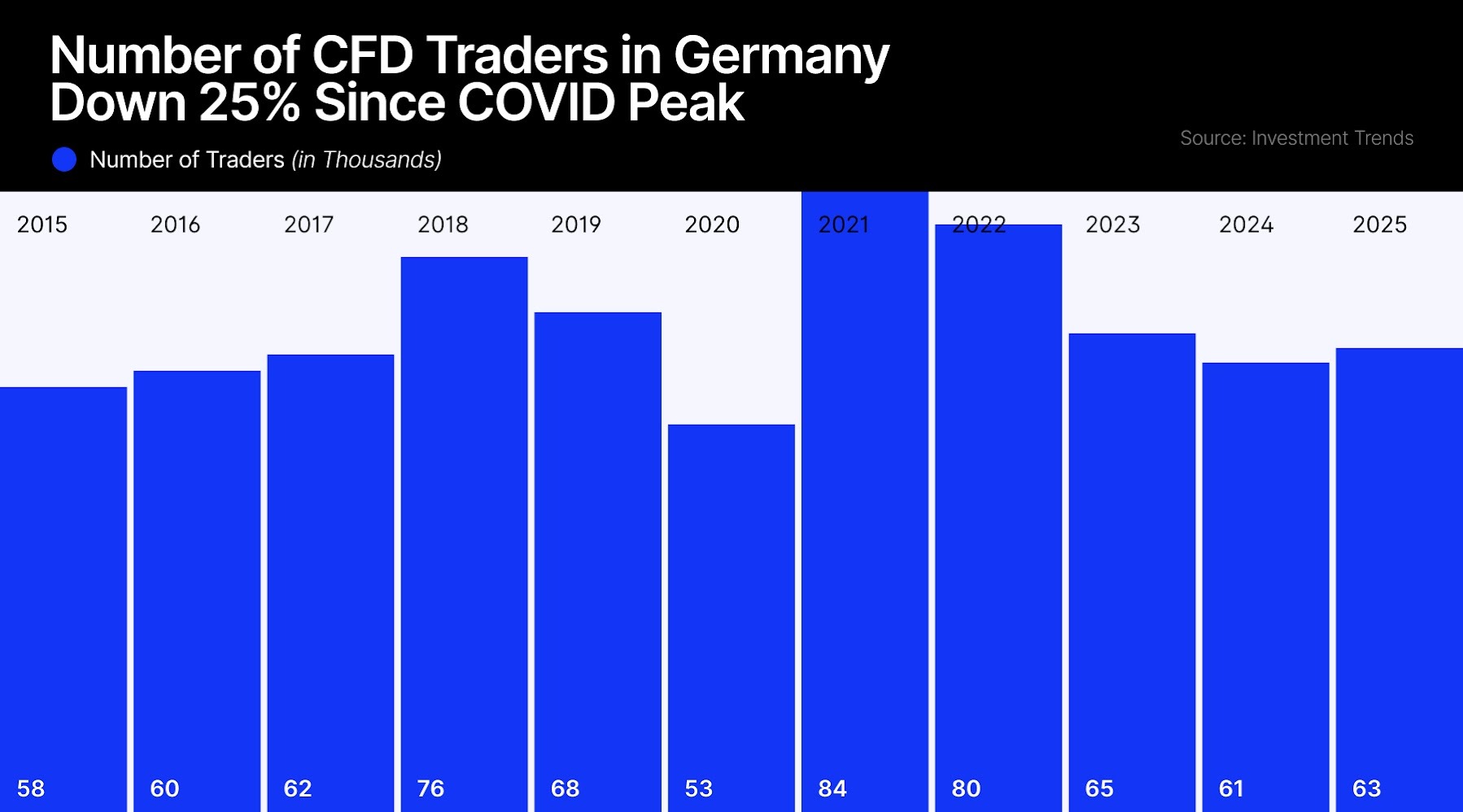
Germany's CFD/FX market has grown by 3% to 63,000 active traders, marking the first positive turn after three years of decline.
However, the numbers remain 25% below the COVID-era peak of 84,000 reached in 2021.
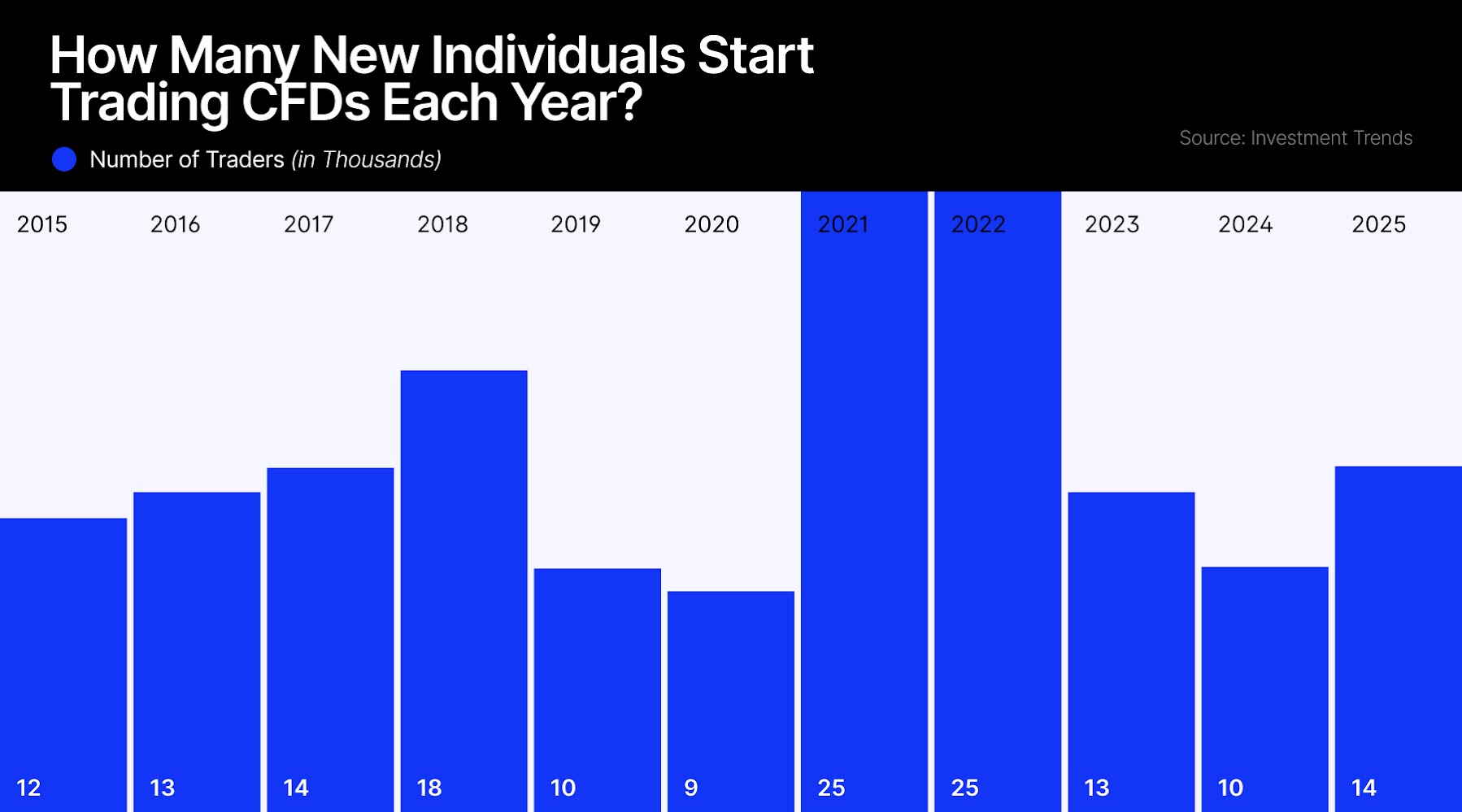
The evolving trader profile shows more entrants now coming to CFDs from derivatives and cryptocurrency backgrounds.
Germany's
leveraged trading market has reversed course, growing 3% to reach 63,000 active
CFD and forex traders in the 12 months to February 2025, according to a new
report from market research firm Investment Trends.
The
increase marks the first positive growth after three consecutive years of
contraction following the pandemic-driven peak in 2021.
German CFD/FX Trading
Market Grows for First Time in Three Years
The number
of traders in Germany's CFD/FX market remains 25% below the COVID-era high of
84,000 recorded in March 2021, but the latest figures suggest the market may
finally be stabilizing after a prolonged adjustment period.
Lorenzo Vignati, Associate Research Director at Investment Trends
“This
marks an important turning point for Germany's CFD/FX market,” said
Lorenzo Vignati, Associate Research Director at Investment Trends.
“The market has weathered a difficult period of contraction, but we're now
seeing signs of sustainable recovery.”
However,
63,000 is still a relatively small number compared to
the 1.8 million active online investors in Germany, according to a separate
report by Investment Trends published in early April. The report also showed
that as many as 16% of respondents had changed or were in the process of
changing their broker.
The rebound
in the FX/CFDs client base has been driven by a combination of factors, including
the reactivation of dormant traders and improved retention rates. The report,
based on a survey of 11,680 investors conducted between January and February
2025, revealed changing dynamics in how new participants enter the leveraged
trading market.
From ETFs to CFDs
While
shares and ETFs remain the primary gateway to trading for most Germans (72%),
the pathways are diversifying. Among new entrants to CFD/FX trading, 33% now
come with experience in listed derivatives and 27% arrive from cryptocurrency
markets—signaling an evolution in trader profiles and expectations.
“The
profile of the new leveraged trader in Germany is evolving,” Vignati
noted. “They're arriving more informed, more product-aware, and with
different expectations of what a trading platform should deliver.”
The German
market's recovery comes after a period of significant volatility. After
reaching a pandemic-driven peak of 84,000 traders in March 2021, the market
experienced three consecutive years of decline, with dormancy rates fluctuating
between 37% and 39%. This year's positive growth suggests the market may have
found its footing after the extended correction period.
“Cross-Sell Appetite in
Germany Is Strong”
The report
also highlighted the significant untapped potential for brokers to cross-sell
products. Despite 84% of German CFD/FX traders expressing openness to using
additional services from their main provider, only 26% of multi-asset traders
currently consolidate their trading and investing on a single platform.
This
disconnect points to a substantial opportunity for trading platforms that can
create more seamless experiences.
“Cross-sell
appetite in Germany is strong, but the experience gap is real,” said
Vignati. “To unlock value, providers need to build platforms that
genuinely integrate trading and investing.”
Moreover,
the German leveraged trading market has demonstrated resilience over the long
term, growing from 51,000 traders in April 2012 to the current 63,000—representing 23.5% growth over 13 years despite significant fluctuations along
the way.
Germany's
leveraged trading market has reversed course, growing 3% to reach 63,000 active
CFD and forex traders in the 12 months to February 2025, according to a new
report from market research firm Investment Trends.
The
increase marks the first positive growth after three consecutive years of
contraction following the pandemic-driven peak in 2021.
German CFD/FX Trading
Market Grows for First Time in Three Years
The number
of traders in Germany's CFD/FX market remains 25% below the COVID-era high of
84,000 recorded in March 2021, but the latest figures suggest the market may
finally be stabilizing after a prolonged adjustment period.
Lorenzo Vignati, Associate Research Director at Investment Trends
“This
marks an important turning point for Germany's CFD/FX market,” said
Lorenzo Vignati, Associate Research Director at Investment Trends.
“The market has weathered a difficult period of contraction, but we're now
seeing signs of sustainable recovery.”
However,
63,000 is still a relatively small number compared to
the 1.8 million active online investors in Germany, according to a separate
report by Investment Trends published in early April. The report also showed
that as many as 16% of respondents had changed or were in the process of
changing their broker.
The rebound
in the FX/CFDs client base has been driven by a combination of factors, including
the reactivation of dormant traders and improved retention rates. The report,
based on a survey of 11,680 investors conducted between January and February
2025, revealed changing dynamics in how new participants enter the leveraged
trading market.
From ETFs to CFDs
While
shares and ETFs remain the primary gateway to trading for most Germans (72%),
the pathways are diversifying. Among new entrants to CFD/FX trading, 33% now
come with experience in listed derivatives and 27% arrive from cryptocurrency
markets—signaling an evolution in trader profiles and expectations.
“The
profile of the new leveraged trader in Germany is evolving,” Vignati
noted. “They're arriving more informed, more product-aware, and with
different expectations of what a trading platform should deliver.”
The German
market's recovery comes after a period of significant volatility. After
reaching a pandemic-driven peak of 84,000 traders in March 2021, the market
experienced three consecutive years of decline, with dormancy rates fluctuating
between 37% and 39%. This year's positive growth suggests the market may have
found its footing after the extended correction period.
“Cross-Sell Appetite in
Germany Is Strong”
The report
also highlighted the significant untapped potential for brokers to cross-sell
products. Despite 84% of German CFD/FX traders expressing openness to using
additional services from their main provider, only 26% of multi-asset traders
currently consolidate their trading and investing on a single platform.
This
disconnect points to a substantial opportunity for trading platforms that can
create more seamless experiences.
“Cross-sell
appetite in Germany is strong, but the experience gap is real,” said
Vignati. “To unlock value, providers need to build platforms that
genuinely integrate trading and investing.”
Moreover,
the German leveraged trading market has demonstrated resilience over the long
term, growing from 51,000 traders in April 2012 to the current 63,000—representing 23.5% growth over 13 years despite significant fluctuations along
the way.
Damian Chmiel is a Senior Analyst & Editor at Finance Magnates with more than 15 years of experience in the CFD and online trading industry. Active as both a trader and journalist since 2010, he focuses on broker coverage, fintech innovation, and regulatory developments across Europe, the Middle East, and Asia.
His work includes interviews with C-level leaders at major brokerages and fintech platforms, as well as co-authoring Finance Magnates’ quarterly industry benchmarking reports. Damian’s reporting is data-driven, market-aware, and grounded in direct industry engagement. His analysis and commentary have also been cited by external media outlets, including Investing.com, Binance, The Asset, Stockhead, and Dispatch.
Education:
MA in Finance and Accounting, Cracow University of Economics
Italy’s Consob Tightens Net on AI-Fueled Scams With Fresh Website Bans
FP Markets Winner Spotlight 🏆 | Global Broker of the Year 2025 #Trading #Broker #Innovation #Shorts
FP Markets Winner Spotlight 🏆 | Global Broker of the Year 2025 #Trading #Broker #Innovation #Shorts
FP Markets takes the spotlight as Global Broker of the Year 2025 at the Finance Magnates Awards.
Martin Stoilov, Head of Client Experience, shares that trust, innovation, and people played a key role in the company’s success, supported by a strong foundation of integrity and client-centricity.
Following this milestone, FP Markets continues to focus on growth, technology investment, and its core values of transparency and excellence.
👉 Be part of FM Awards 2026: https://awards.financemagnates.com/#nominate
FP Markets takes the spotlight as Global Broker of the Year 2025 at the Finance Magnates Awards.
Martin Stoilov, Head of Client Experience, shares that trust, innovation, and people played a key role in the company’s success, supported by a strong foundation of integrity and client-centricity.
Following this milestone, FP Markets continues to focus on growth, technology investment, and its core values of transparency and excellence.
👉 Be part of FM Awards 2026: https://awards.financemagnates.com/#nominate
In this video, we review @HolaPrimeMarketsOfficial, a multi-asset forex and CFDs broker offering different account types, trading platforms, and flexible trading conditions.
We cover the broker’s overall offering, including account options, trading environment, platforms like MT4 and MT5, and additional services such as managed accounts and fast withdrawals.
Watch the full video to see if Hola Prime Markets fits your trading needs.
📣 Stay up to date with the latest in finance and trading. Follow Finance Magnates for industry news, insights, and global event coverage.
Connect with us:
🔗 LinkedIn: /financemagnates
👍 Facebook: /financemagnates
📸 Instagram: https://www.instagram.com/financemagnates
🐦 X: https://x.com/financemagnates
🎥 TikTok: https://www.tiktok.com/tag/financemagnates
▶️ YouTube: /@financemagnates_official
#HolaPrime #ForexBroker #CFDTrading #FinanceMagnates #Trading #Forex #BrokerReview
In this video, we review @HolaPrimeMarketsOfficial, a multi-asset forex and CFDs broker offering different account types, trading platforms, and flexible trading conditions.
We cover the broker’s overall offering, including account options, trading environment, platforms like MT4 and MT5, and additional services such as managed accounts and fast withdrawals.
Watch the full video to see if Hola Prime Markets fits your trading needs.
📣 Stay up to date with the latest in finance and trading. Follow Finance Magnates for industry news, insights, and global event coverage.
Connect with us:
🔗 LinkedIn: /financemagnates
👍 Facebook: /financemagnates
📸 Instagram: https://www.instagram.com/financemagnates
🐦 X: https://x.com/financemagnates
🎥 TikTok: https://www.tiktok.com/tag/financemagnates
▶️ YouTube: /@financemagnates_official
#HolaPrime #ForexBroker #CFDTrading #FinanceMagnates #Trading #Forex #BrokerReview
Hola Prime Review: What You Need to Know | Full Breakdown by Finance Magnates
Hola Prime Review: What You Need to Know | Full Breakdown by Finance Magnates
In this video, we review @HolaPrime_Global, a proprietary trading firm offering evaluation programs and performance-based payouts in simulated market environments.
We cover how the challenge model works, including account types, profit splits (up to 95%), trading rules, and what it takes to reach a funded account. You’ll also learn about available platforms like MT4, MT5, cTrader, and more, along with insights into payouts, support, and trading conditions.
Watch the full video to see if Hola Prime fits your trading style.
📣 Stay up to date with the latest in finance and trading. Follow Finance Magnates for industry news, insights, and global event coverage.
Connect with us:
🔗 LinkedIn: /financemagnates
👍 Facebook: /financemagnates
📸 Instagram: https://www.instagram.com/financemagnates
🐦 X: https://x.com/financemagnates
🎥 TikTok: https://www.tiktok.com/tag/financemagnates
▶️ YouTube: /@financemagnates_official
#HolaPrime #PropFirm #Trading #FinanceMagnates #Forex #FuturesTrading #TradingReview #PropFirmReview
In this video, we review @HolaPrime_Global, a proprietary trading firm offering evaluation programs and performance-based payouts in simulated market environments.
We cover how the challenge model works, including account types, profit splits (up to 95%), trading rules, and what it takes to reach a funded account. You’ll also learn about available platforms like MT4, MT5, cTrader, and more, along with insights into payouts, support, and trading conditions.
Watch the full video to see if Hola Prime fits your trading style.
📣 Stay up to date with the latest in finance and trading. Follow Finance Magnates for industry news, insights, and global event coverage.
Connect with us:
🔗 LinkedIn: /financemagnates
👍 Facebook: /financemagnates
📸 Instagram: https://www.instagram.com/financemagnates
🐦 X: https://x.com/financemagnates
🎥 TikTok: https://www.tiktok.com/tag/financemagnates
▶️ YouTube: /@financemagnates_official
#HolaPrime #PropFirm #Trading #FinanceMagnates #Forex #FuturesTrading #TradingReview #PropFirmReview
Axi Winner Spotlight 🏆 | Global Most Innovative Broker 2025 #Innovation #Trading #Fintech #Broker
Axi Winner Spotlight 🏆 | Global Most Innovative Broker 2025 #Innovation #Trading #Fintech #Broker
Axi takes the spotlight at the Finance Magnates Awards, winning Global Most Innovative Broker 2025.
Olivia Xenofontos and Ivanna Openko share how the team will feel: proud, motivated, and ready to keep delivering.
They also describe the night as well-organized, focused, and enjoyable for all.
👉 Be part of FM Awards 2026.
Axi takes the spotlight at the Finance Magnates Awards, winning Global Most Innovative Broker 2025.
Olivia Xenofontos and Ivanna Openko share how the team will feel: proud, motivated, and ready to keep delivering.
They also describe the night as well-organized, focused, and enjoyable for all.
👉 Be part of FM Awards 2026.
Recognition that matters.
Built on transparency.
Driven by the industry.
The Finance Magnates Awards 2026.
Nominations are now open.
🔗 https://awards.financemagnates.com/?utm_source=SM&utm_medium=social&utm_campaign=recognition-matters
Recognition that matters.
Built on transparency.
Driven by the industry.
The Finance Magnates Awards 2026.
Nominations are now open.
🔗 https://awards.financemagnates.com/?utm_source=SM&utm_medium=social&utm_campaign=recognition-matters