When questioned about the drop per/million markup, Jaclyn Klein, Vice President of Corporate Communications at FXCM referred us to FXCM’s conference call where the broker said “that our customer mix in the quarter shifted towards the larger clients with discounted pricing, which brought down our $$/MM.”
FXCM re-launches Dealing Desk offering in Australia and plans to offer it worldwide
In its company description, FXCM added these comments:
“The Company intends to launch an offering to its smaller retail clients to trade with a dealing desk, or principal model. In the principal model offering, the Company will earn revenue from: (i) the difference between the retail bid/offer spread and wholesale bid/offer spread for trades the Company has chosen to hedge, (ii) the entire retail bid/offer spread in trades where the Company’s customers’ trades have naturally offset each other, and (iii) net gains or losses, if any, where the Company has not hedged the customer trade”
These quotes appeared to indicate that FXCM was preparing to offer a Dealing Desk model to smaller size accounts. We asked FXCM for specifics as to how the new dealing desk offering would work and whether it would be offered worldwide. Jaclyn Klein clarified for us that the broker would now also offer a dealing desk option, and that it would be offered worldwide in the coming weeks. Mrs. Klein felt it important to point out that FXCM will NEVER switch any clients forex execution type from No Dealing Desk to dealing desk without prior consent.
Jaclyn added that the dealing desk option is already being marketed on the company’s Australian website www.forextrading.com.au. Klein also added that “FXCM always has, and still does, believe that a No Dealing Desk execution is the right execution for the best overall trading experience. However, FXCM also believes in quality customer service and a fully customizable trading experience. FXCM is committed to offering as many options as possible, and the new Dealing Desk execution offering will be another option for clients to take advantage of and use to tailor their trading strategies.” (In the Australian website, FXCM details as to how a dealing desk works and comparisons to its NDD model)
FXCM’s rational behind the dealing desk product is to offer clients a tighter spread offering. According to details that exist on the Australian website, trades will continue to be executed at market, with no re-quotes. Interestingly though, FXCM makes it clear on their website that clients found trying to abuse the dealing desk prices (IE arbitrage) will be switched to NDD execution.
In its July Metrics Slideshow (see below), FXCM added that narrowed spreads “dominates new client acquisition.” As such, they stated that “We believe that by introducing a narrow spread, principal model offering our competitive advantages in brand, scale, financial strength, platform and customer service will enable us to capture a significant portion of these small accounts.”
Decreases in referral broker fees by 13.7% when compared to Q2 2011
In addition to the 10Q, FXCM also released its July Metrics slideshow analysis for its recent quarter. The figures showed that DARTs fell for the 3rd quarter in a row, after peaking in Q3 2011.
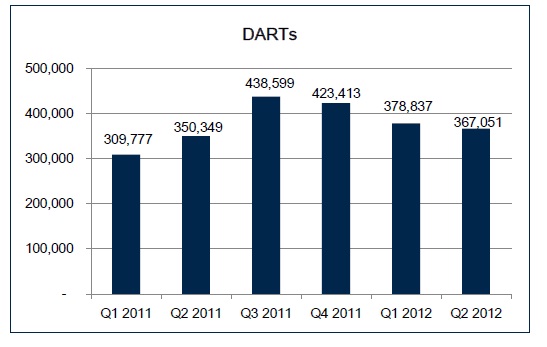
This trend is continuing as July figures are below Q2’s. Also, although total active accounts and customer cash balances are steadily increasing, it hasn’t been followed by an increase in retail trading volumes.
On the positive side, FXCM’s institutional business segment has been steadily versus last year’s figures. Also, July’s figure of $60 billion in volume puts the division well in place to shatter its previous quarterly high of $143 billion in Q4 2011.
FXCM also added that second quarter purchase Lucid Markets added $3.9 million in revenues for the quarter. Lucid would have added $24.0 million in revenues and $4.2 million ($0.06/share) net income if it had been part of FXCM for the entire quarter.
FXCM also added that it was continuing to pursue M&A deals and growing its institutional market business.
Scanning through FXCM’s Q2 2012 report, here are some important notes we found.
Retail revenues from markup are shrinking due to larger clients discounted pricing
FXCM re-launches Dealing Desk offering in Australia and plans to offer it worldwide
Decreases in referral broker fees by 13.7% when compared to Q2 2011
Retail revenues from markup are shrinking due to larger clients discounted pricing
When questioned about the drop per/million markup, Jaclyn Klein, Vice President of Corporate Communications at FXCM referred us to FXCM’s conference call where the broker said “that our customer mix in the quarter shifted towards the larger clients with discounted pricing, which brought down our $$/MM.”
FXCM re-launches Dealing Desk offering in Australia and plans to offer it worldwide
In its company description, FXCM added these comments:
“The Company intends to launch an offering to its smaller retail clients to trade with a dealing desk, or principal model. In the principal model offering, the Company will earn revenue from: (i) the difference between the retail bid/offer spread and wholesale bid/offer spread for trades the Company has chosen to hedge, (ii) the entire retail bid/offer spread in trades where the Company’s customers’ trades have naturally offset each other, and (iii) net gains or losses, if any, where the Company has not hedged the customer trade”
These quotes appeared to indicate that FXCM was preparing to offer a Dealing Desk model to smaller size accounts. We asked FXCM for specifics as to how the new dealing desk offering would work and whether it would be offered worldwide. Jaclyn Klein clarified for us that the broker would now also offer a dealing desk option, and that it would be offered worldwide in the coming weeks. Mrs. Klein felt it important to point out that FXCM will NEVER switch any clients forex execution type from No Dealing Desk to dealing desk without prior consent.
Jaclyn added that the dealing desk option is already being marketed on the company’s Australian website www.forextrading.com.au. Klein also added that “FXCM always has, and still does, believe that a No Dealing Desk execution is the right execution for the best overall trading experience. However, FXCM also believes in quality customer service and a fully customizable trading experience. FXCM is committed to offering as many options as possible, and the new Dealing Desk execution offering will be another option for clients to take advantage of and use to tailor their trading strategies.” (In the Australian website, FXCM details as to how a dealing desk works and comparisons to its NDD model)
FXCM’s rational behind the dealing desk product is to offer clients a tighter spread offering. According to details that exist on the Australian website, trades will continue to be executed at market, with no re-quotes. Interestingly though, FXCM makes it clear on their website that clients found trying to abuse the dealing desk prices (IE arbitrage) will be switched to NDD execution.
In its July Metrics Slideshow (see below), FXCM added that narrowed spreads “dominates new client acquisition.” As such, they stated that “We believe that by introducing a narrow spread, principal model offering our competitive advantages in brand, scale, financial strength, platform and customer service will enable us to capture a significant portion of these small accounts.”
Decreases in referral broker fees by 13.7% when compared to Q2 2011
In addition to the 10Q, FXCM also released its July Metrics slideshow analysis for its recent quarter. The figures showed that DARTs fell for the 3rd quarter in a row, after peaking in Q3 2011.
This trend is continuing as July figures are below Q2’s. Also, although total active accounts and customer cash balances are steadily increasing, it hasn’t been followed by an increase in retail trading volumes.
On the positive side, FXCM’s institutional business segment has been steadily versus last year’s figures. Also, July’s figure of $60 billion in volume puts the division well in place to shatter its previous quarterly high of $143 billion in Q4 2011.
FXCM also added that second quarter purchase Lucid Markets added $3.9 million in revenues for the quarter. Lucid would have added $24.0 million in revenues and $4.2 million ($0.06/share) net income if it had been part of FXCM for the entire quarter.
FXCM also added that it was continuing to pursue M&A deals and growing its institutional market business.
FXBO Adds IDWise KYC And AML Tools To Broker CRM Stack
Featured Videos
Precious Insights: APAC's Bullion Market amid Record Volatility
The precious metals rally has challenged how brokers and LPs think about hedging, pricing, and physical delivery. But with regional banks eyeing physical gold retail and bullion brokers across Southeast Asia harnessing new tech, volatility is not only in 'safe havens'.
This session gathers practitioners from across the bullion ecosystem to unpack what the rally means on the ground in APAC.
Attendees will walk away with:
Insight into the physical market dynamics driving retail demand across Southeast Asia, from central bank buying to store-of-value purchases
Understanding of Singapore's distinct role as APAC's bullion gateway, and competition near and far
Perspective on operational challenges unique to APAC: kilogram pricing, local delivery, and bridging CFD and physical bullion infrastructure
The precious metals rally has challenged how brokers and LPs think about hedging, pricing, and physical delivery. But with regional banks eyeing physical gold retail and bullion brokers across Southeast Asia harnessing new tech, volatility is not only in 'safe havens'.
This session gathers practitioners from across the bullion ecosystem to unpack what the rally means on the ground in APAC.
Attendees will walk away with:
Insight into the physical market dynamics driving retail demand across Southeast Asia, from central bank buying to store-of-value purchases
Understanding of Singapore's distinct role as APAC's bullion gateway, and competition near and far
Perspective on operational challenges unique to APAC: kilogram pricing, local delivery, and bridging CFD and physical bullion infrastructure
The precious metals rally has challenged how brokers and LPs think about hedging, pricing, and physical delivery. But with regional banks eyeing physical gold retail and bullion brokers across Southeast Asia harnessing new tech, volatility is not only in 'safe havens'.
This session gathers practitioners from across the bullion ecosystem to unpack what the rally means on the ground in APAC.
Attendees will walk away with:
Insight into the physical market dynamics driving retail demand across Southeast Asia, from central bank buying to store-of-value purchases
Understanding of Singapore's distinct role as APAC's bullion gateway, and competition near and far
Perspective on operational challenges unique to APAC: kilogram pricing, local delivery, and bridging CFD and physical bullion infrastructure
The precious metals rally has challenged how brokers and LPs think about hedging, pricing, and physical delivery. But with regional banks eyeing physical gold retail and bullion brokers across Southeast Asia harnessing new tech, volatility is not only in 'safe havens'.
This session gathers practitioners from across the bullion ecosystem to unpack what the rally means on the ground in APAC.
Attendees will walk away with:
Insight into the physical market dynamics driving retail demand across Southeast Asia, from central bank buying to store-of-value purchases
Understanding of Singapore's distinct role as APAC's bullion gateway, and competition near and far
Perspective on operational challenges unique to APAC: kilogram pricing, local delivery, and bridging CFD and physical bullion infrastructure
License to Fill: Market Liquidity amid Global Turmoil
Asian markets bear unique characteristics, from connectivity to asset preference. The Singapore Summit will connect global executives and local experts across the liquidity chain to discuss volatility fluctuations, diversification vs over-reliance on single assets, and the role of trust and liquidity relationships in an increasingly automated sphere.
Regional Focus: Thailand, Vietnam
Bangkok is consolidating as Southeast Asia's broker hub for CLMV access, while Vietnam's trading volumes have made it harder to ignore from any regional headquarters. Most brokers know both exist. Fewer have tested what operating there actually requires.
This session gathers practitioners with on-the-ground experience in both markets to examine what it takes to build and run operations in Thailand and Vietnam.
Attendees will walk away with:
A clear view of setup requirements in both markets: entity structures, timelines, and what first-time operators tend to get wrong
Understanding of the offshore broker model and how compliant operators work within domestic restrictions in each jurisdiction
Insight into talent acquisition, client onboarding, and distribution in markets where language, culture, and acquisition channels don't follow standard APAC assumptions
Perspective on adjacent Southeast Asian markets worth monitoring for the next regional move
Bangkok is consolidating as Southeast Asia's broker hub for CLMV access, while Vietnam's trading volumes have made it harder to ignore from any regional headquarters. Most brokers know both exist. Fewer have tested what operating there actually requires.
This session gathers practitioners with on-the-ground experience in both markets to examine what it takes to build and run operations in Thailand and Vietnam.
Attendees will walk away with:
A clear view of setup requirements in both markets: entity structures, timelines, and what first-time operators tend to get wrong
Understanding of the offshore broker model and how compliant operators work within domestic restrictions in each jurisdiction
Insight into talent acquisition, client onboarding, and distribution in markets where language, culture, and acquisition channels don't follow standard APAC assumptions
Perspective on adjacent Southeast Asian markets worth monitoring for the next regional move
Bangkok is consolidating as Southeast Asia's broker hub for CLMV access, while Vietnam's trading volumes have made it harder to ignore from any regional headquarters. Most brokers know both exist. Fewer have tested what operating there actually requires.
This session gathers practitioners with on-the-ground experience in both markets to examine what it takes to build and run operations in Thailand and Vietnam.
Attendees will walk away with:
A clear view of setup requirements in both markets: entity structures, timelines, and what first-time operators tend to get wrong
Understanding of the offshore broker model and how compliant operators work within domestic restrictions in each jurisdiction
Insight into talent acquisition, client onboarding, and distribution in markets where language, culture, and acquisition channels don't follow standard APAC assumptions
Perspective on adjacent Southeast Asian markets worth monitoring for the next regional move
Bangkok is consolidating as Southeast Asia's broker hub for CLMV access, while Vietnam's trading volumes have made it harder to ignore from any regional headquarters. Most brokers know both exist. Fewer have tested what operating there actually requires.
This session gathers practitioners with on-the-ground experience in both markets to examine what it takes to build and run operations in Thailand and Vietnam.
Attendees will walk away with:
A clear view of setup requirements in both markets: entity structures, timelines, and what first-time operators tend to get wrong
Understanding of the offshore broker model and how compliant operators work within domestic restrictions in each jurisdiction
Insight into talent acquisition, client onboarding, and distribution in markets where language, culture, and acquisition channels don't follow standard APAC assumptions
Perspective on adjacent Southeast Asian markets worth monitoring for the next regional move
Bangkok is consolidating as Southeast Asia's broker hub for CLMV access, while Vietnam's trading volumes have made it harder to ignore from any regional headquarters. Most brokers know both exist. Fewer have tested what operating there actually requires.
This session gathers practitioners with on-the-ground experience in both markets to examine what it takes to build and run operations in Thailand and Vietnam.
Attendees will walk away with:
A clear view of setup requirements in both markets: entity structures, timelines, and what first-time operators tend to get wrong
Understanding of the offshore broker model and how compliant operators work within domestic restrictions in each jurisdiction
Insight into talent acquisition, client onboarding, and distribution in markets where language, culture, and acquisition channels don't follow standard APAC assumptions
Perspective on adjacent Southeast Asian markets worth monitoring for the next regional move
Bangkok is consolidating as Southeast Asia's broker hub for CLMV access, while Vietnam's trading volumes have made it harder to ignore from any regional headquarters. Most brokers know both exist. Fewer have tested what operating there actually requires.
This session gathers practitioners with on-the-ground experience in both markets to examine what it takes to build and run operations in Thailand and Vietnam.
Attendees will walk away with:
A clear view of setup requirements in both markets: entity structures, timelines, and what first-time operators tend to get wrong
Understanding of the offshore broker model and how compliant operators work within domestic restrictions in each jurisdiction
Insight into talent acquisition, client onboarding, and distribution in markets where language, culture, and acquisition channels don't follow standard APAC assumptions
Perspective on adjacent Southeast Asian markets worth monitoring for the next regional move
Join The Club: What Premium Clients Want
High-net-worth traders account for an outsized portion of revenues for various retail brokers.
This session will gather heads of premium, acquisition, and product experts to reveal how they build their client base in Asia.
Attendees will walk away with:
Understanding of how brokers view premium clients (beyond deposit size).
Insight into which services, products, and benefits increase trust and LTV.
Examples of offerings that scale without inflating cost or operational burden.
Lessons from leading brokers on growing premium segments and what’s next.
High-net-worth traders account for an outsized portion of revenues for various retail brokers.
This session will gather heads of premium, acquisition, and product experts to reveal how they build their client base in Asia.
Attendees will walk away with:
Understanding of how brokers view premium clients (beyond deposit size).
Insight into which services, products, and benefits increase trust and LTV.
Examples of offerings that scale without inflating cost or operational burden.
Lessons from leading brokers on growing premium segments and what’s next.
High-net-worth traders account for an outsized portion of revenues for various retail brokers.
This session will gather heads of premium, acquisition, and product experts to reveal how they build their client base in Asia.
Attendees will walk away with:
Understanding of how brokers view premium clients (beyond deposit size).
Insight into which services, products, and benefits increase trust and LTV.
Examples of offerings that scale without inflating cost or operational burden.
Lessons from leading brokers on growing premium segments and what’s next.
High-net-worth traders account for an outsized portion of revenues for various retail brokers.
This session will gather heads of premium, acquisition, and product experts to reveal how they build their client base in Asia.
Attendees will walk away with:
Understanding of how brokers view premium clients (beyond deposit size).
Insight into which services, products, and benefits increase trust and LTV.
Examples of offerings that scale without inflating cost or operational burden.
Lessons from leading brokers on growing premium segments and what’s next.
High-net-worth traders account for an outsized portion of revenues for various retail brokers.
This session will gather heads of premium, acquisition, and product experts to reveal how they build their client base in Asia.
Attendees will walk away with:
Understanding of how brokers view premium clients (beyond deposit size).
Insight into which services, products, and benefits increase trust and LTV.
Examples of offerings that scale without inflating cost or operational burden.
Lessons from leading brokers on growing premium segments and what’s next.
High-net-worth traders account for an outsized portion of revenues for various retail brokers.
This session will gather heads of premium, acquisition, and product experts to reveal how they build their client base in Asia.
Attendees will walk away with:
Understanding of how brokers view premium clients (beyond deposit size).
Insight into which services, products, and benefits increase trust and LTV.
Examples of offerings that scale without inflating cost or operational burden.
Lessons from leading brokers on growing premium segments and what’s next.
Buying The Deep: Digital Asset Adoption in APAC and Beyond
The persisting price drops test the industry's commitment to crypto adoption. While on-chain innovation is making headway across market mechanics, from stablecoins to tokenization, investors remains cautious.
This session brings together market structure experts and institutional investors to explore how a prolonged bear market affects their long-term strategy, and where the opportunities lie ahead of the next cycle.
Attendees will walk away with:
First-hand account of the bear market's impact on various industry players
Understanding of what custody, connectivity, and settlement gaps still hamper growth in APAC
Insight into how client mandates and operational readiness are shaping who moves and who waits
Perspective on what institutional investors need to move toward actual digital asset capital deployment
The persisting price drops test the industry's commitment to crypto adoption. While on-chain innovation is making headway across market mechanics, from stablecoins to tokenization, investors remains cautious.
This session brings together market structure experts and institutional investors to explore how a prolonged bear market affects their long-term strategy, and where the opportunities lie ahead of the next cycle.
Attendees will walk away with:
First-hand account of the bear market's impact on various industry players
Understanding of what custody, connectivity, and settlement gaps still hamper growth in APAC
Insight into how client mandates and operational readiness are shaping who moves and who waits
Perspective on what institutional investors need to move toward actual digital asset capital deployment
The persisting price drops test the industry's commitment to crypto adoption. While on-chain innovation is making headway across market mechanics, from stablecoins to tokenization, investors remains cautious.
This session brings together market structure experts and institutional investors to explore how a prolonged bear market affects their long-term strategy, and where the opportunities lie ahead of the next cycle.
Attendees will walk away with:
First-hand account of the bear market's impact on various industry players
Understanding of what custody, connectivity, and settlement gaps still hamper growth in APAC
Insight into how client mandates and operational readiness are shaping who moves and who waits
Perspective on what institutional investors need to move toward actual digital asset capital deployment
The persisting price drops test the industry's commitment to crypto adoption. While on-chain innovation is making headway across market mechanics, from stablecoins to tokenization, investors remains cautious.
This session brings together market structure experts and institutional investors to explore how a prolonged bear market affects their long-term strategy, and where the opportunities lie ahead of the next cycle.
Attendees will walk away with:
First-hand account of the bear market's impact on various industry players
Understanding of what custody, connectivity, and settlement gaps still hamper growth in APAC
Insight into how client mandates and operational readiness are shaping who moves and who waits
Perspective on what institutional investors need to move toward actual digital asset capital deployment
The persisting price drops test the industry's commitment to crypto adoption. While on-chain innovation is making headway across market mechanics, from stablecoins to tokenization, investors remains cautious.
This session brings together market structure experts and institutional investors to explore how a prolonged bear market affects their long-term strategy, and where the opportunities lie ahead of the next cycle.
Attendees will walk away with:
First-hand account of the bear market's impact on various industry players
Understanding of what custody, connectivity, and settlement gaps still hamper growth in APAC
Insight into how client mandates and operational readiness are shaping who moves and who waits
Perspective on what institutional investors need to move toward actual digital asset capital deployment
The persisting price drops test the industry's commitment to crypto adoption. While on-chain innovation is making headway across market mechanics, from stablecoins to tokenization, investors remains cautious.
This session brings together market structure experts and institutional investors to explore how a prolonged bear market affects their long-term strategy, and where the opportunities lie ahead of the next cycle.
Attendees will walk away with:
First-hand account of the bear market's impact on various industry players
Understanding of what custody, connectivity, and settlement gaps still hamper growth in APAC
Insight into how client mandates and operational readiness are shaping who moves and who waits
Perspective on what institutional investors need to move toward actual digital asset capital deployment