While 73,000 investors are still interested in CFDs, only half stayed active in 2024.
The market evolution is marked by prop firms, transparency, and lower costs.
The number of active FX/CFD traders in Singapore is falling
Singapore's
leverage trading market continues to contract toward pre-pandemic levels, yet
maintains a significant market presence with 73,000 potential investors still
showing interest in CFD trading, according to a new industry report by
Investment Trends released today (Wednesday).
What is
more, 60% of active investors expressed interest in the offerings of
proprietary trading firms, confirming the growing importance of this sector in
retail trading.
Singapore CFD Market Holds
Ground but Retail Trading Base Shrinks
The latest
research from Investment Trends reveals that while retail leveraged trader
numbers are trending toward pre-pandemic levels, a substantial pool of online cash
equities investors maintains an active interest in CFDs.
This
transition marks a significant shift in trading motivations, with 47% of
traders now primarily focused on profiting from specific market events, while
leverage remains a crucial factor for 41% of participants.
Lorenzo Vignati, Associate Research Director at Investment Trends
“The
data highlights an evolving dynamic in Singapore’s leverage trading market,”
said Lorenzo Vignati, Associate Research Director at Investment Trends.
“While active trader numbers have declined, the interest in CFDs remains
significant, driven by sharp pricing and effective decision-support tools. This
shift reflects changing trader priorities and signals an opportunity for the
market to better meet evolving investor needs.”
Although
Investment Trends reports that there are over 70,000 investors in Singapore interested
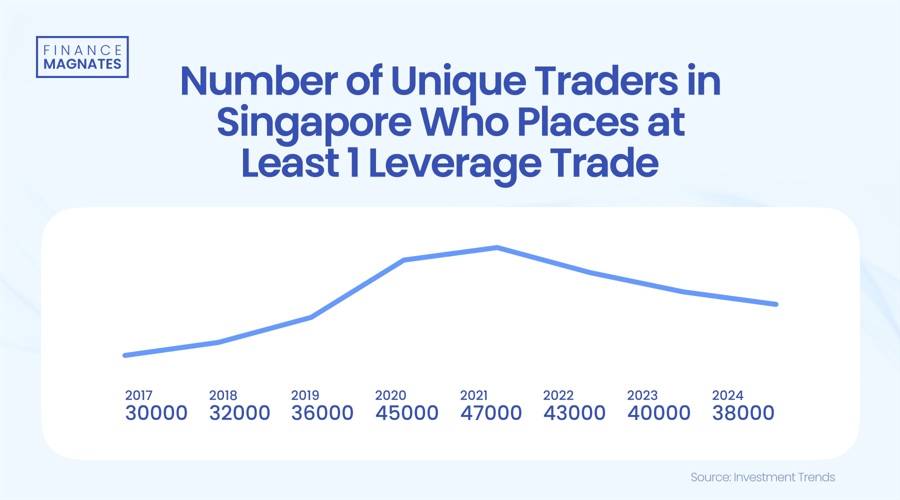
in CFDs, the actual number of “active” participants is significantly
lower (check the infographic above). In the report, activity is defined as
investors who have opened at least one leveraged position in the past 12
months.
According
to 2024 data, this group comprises 38,000 individuals, the lowest since 2019
and nearly 10,000 fewer than the 2021 peak, when
the figure reached 47,000. The number of consistently active clients,
however, has not changed as drastically. Three years ago, it stood at over
30,000, compared to the current figure of 26,000.
The
landscape is witnessing a notable surge in portfolio diversification, with
traders actively incorporating CFDs alongside other investment products.
Technological adoption is accelerating, with three in five traders either
already engaged in or showing interest in prop trading.
Local
regulations, however, may pose challenges for proprietary trading firms. Two
months ago, Singapore-based
MPFunds ceased operations, citing “regulatory decisions and strict
enforcement within the local landscape” as the reasons for its closure.
Moreover,
the integration of artificial intelligence in trading strategies has gained
significant traction, with two-thirds of traders either utilizing or expressing
openness to AI-assisted trading tools.
“The
diversification of investment products and the integration of global
innovations like AI-assisted trading reflect a more sophisticated trader base,”
Vignati added. “The data clearly shows Singaporean traders are increasingly
seeking cutting-edge tools and insights to enhance both trading opportunities
and efficiency.”
Transparency and Cost
Efficiency
The report also
highlights a steady increase in switching intentions among traders over the
past five years. Cost consciousness and execution quality have emerged as
primary drivers for broker changes, with traders increasingly demanding
transparency in their trading relationships. This trend suggests a maturing
market where sophisticated traders are actively seeking partners that align
with their evolving needs.
“Transparency
is an increasingly vital factor for traders,” Vignati emphasized. “Those
looking to switch are demanding not only lower costs but also more reliable and
efficient trading experiences. Brokers who can deliver on these fronts will be
well-positioned to win over this discerning segment.”
Singapore
has become an important market for brokers, as highlighted in IG
Group's fiscal year 2024 financial report. It was the only jurisdiction to
report revenue growth last year, with larger clients driving a 6% increase in
income through heightened trading activity. IG attributed the stronger trading
revenue in Singapore to higher trading volumes from its largest clients.
Singapore's
leverage trading market continues to contract toward pre-pandemic levels, yet
maintains a significant market presence with 73,000 potential investors still
showing interest in CFD trading, according to a new industry report by
Investment Trends released today (Wednesday).
What is
more, 60% of active investors expressed interest in the offerings of
proprietary trading firms, confirming the growing importance of this sector in
retail trading.
Singapore CFD Market Holds
Ground but Retail Trading Base Shrinks
The latest
research from Investment Trends reveals that while retail leveraged trader
numbers are trending toward pre-pandemic levels, a substantial pool of online cash
equities investors maintains an active interest in CFDs.
This
transition marks a significant shift in trading motivations, with 47% of
traders now primarily focused on profiting from specific market events, while
leverage remains a crucial factor for 41% of participants.
Lorenzo Vignati, Associate Research Director at Investment Trends
“The
data highlights an evolving dynamic in Singapore’s leverage trading market,”
said Lorenzo Vignati, Associate Research Director at Investment Trends.
“While active trader numbers have declined, the interest in CFDs remains
significant, driven by sharp pricing and effective decision-support tools. This
shift reflects changing trader priorities and signals an opportunity for the
market to better meet evolving investor needs.”
Although
Investment Trends reports that there are over 70,000 investors in Singapore interested
in CFDs, the actual number of “active” participants is significantly
lower (check the infographic above). In the report, activity is defined as
investors who have opened at least one leveraged position in the past 12
months.
According
to 2024 data, this group comprises 38,000 individuals, the lowest since 2019
and nearly 10,000 fewer than the 2021 peak, when
the figure reached 47,000. The number of consistently active clients,
however, has not changed as drastically. Three years ago, it stood at over
30,000, compared to the current figure of 26,000.
The
landscape is witnessing a notable surge in portfolio diversification, with
traders actively incorporating CFDs alongside other investment products.
Technological adoption is accelerating, with three in five traders either
already engaged in or showing interest in prop trading.
Local
regulations, however, may pose challenges for proprietary trading firms. Two
months ago, Singapore-based
MPFunds ceased operations, citing “regulatory decisions and strict
enforcement within the local landscape” as the reasons for its closure.
Moreover,
the integration of artificial intelligence in trading strategies has gained
significant traction, with two-thirds of traders either utilizing or expressing
openness to AI-assisted trading tools.
“The
diversification of investment products and the integration of global
innovations like AI-assisted trading reflect a more sophisticated trader base,”
Vignati added. “The data clearly shows Singaporean traders are increasingly
seeking cutting-edge tools and insights to enhance both trading opportunities
and efficiency.”
Transparency and Cost
Efficiency
The report also
highlights a steady increase in switching intentions among traders over the
past five years. Cost consciousness and execution quality have emerged as
primary drivers for broker changes, with traders increasingly demanding
transparency in their trading relationships. This trend suggests a maturing
market where sophisticated traders are actively seeking partners that align
with their evolving needs.
“Transparency
is an increasingly vital factor for traders,” Vignati emphasized. “Those
looking to switch are demanding not only lower costs but also more reliable and
efficient trading experiences. Brokers who can deliver on these fronts will be
well-positioned to win over this discerning segment.”
Singapore
has become an important market for brokers, as highlighted in IG
Group's fiscal year 2024 financial report. It was the only jurisdiction to
report revenue growth last year, with larger clients driving a 6% increase in
income through heightened trading activity. IG attributed the stronger trading
revenue in Singapore to higher trading volumes from its largest clients.
Damian's adventure with financial markets began at the Cracow University of Economics, where he obtained his MA in finance and accounting. Starting from the retail trader perspective, he collaborated with brokerage houses and financial portals in Poland as an independent editor and content manager. His adventure with Finance Magnates began in 2016, where he is working as a business intelligence analyst.
iFOREX Adds Saudi and South Korean Equity CFDs as IPO Is Delayed
Featured Videos
Executive Interview | Charlotte Bullock | Chief Product Officer, Bank of London | FMLS:25
In this interview, we sat down with Charlotte Bullock, Head of Product at The Bank of London, previously at SAP and now shaping product at one of the sector’s most ambitious new banking players.
Charlotte reflects on the Summit so far and talks about the culture inside fintech banks today. We look at the pressures that come with scaling, and how firms can hold onto the nimble approach that made them stand out early on.
We also cover the state of payments ahead of her appearance on the payments roundtable: the blockages financial firms face, the areas that still need fixing, and what a realistic solution looks like in 2026.
In this interview, we sat down with Charlotte Bullock, Head of Product at The Bank of London, previously at SAP and now shaping product at one of the sector’s most ambitious new banking players.
Charlotte reflects on the Summit so far and talks about the culture inside fintech banks today. We look at the pressures that come with scaling, and how firms can hold onto the nimble approach that made them stand out early on.
We also cover the state of payments ahead of her appearance on the payments roundtable: the blockages financial firms face, the areas that still need fixing, and what a realistic solution looks like in 2026.
In this interview, we sat down with Charlotte Bullock, Head of Product at The Bank of London, previously at SAP and now shaping product at one of the sector’s most ambitious new banking players.
Charlotte reflects on the Summit so far and talks about the culture inside fintech banks today. We look at the pressures that come with scaling, and how firms can hold onto the nimble approach that made them stand out early on.
We also cover the state of payments ahead of her appearance on the payments roundtable: the blockages financial firms face, the areas that still need fixing, and what a realistic solution looks like in 2026.
In this interview, we sat down with Charlotte Bullock, Head of Product at The Bank of London, previously at SAP and now shaping product at one of the sector’s most ambitious new banking players.
Charlotte reflects on the Summit so far and talks about the culture inside fintech banks today. We look at the pressures that come with scaling, and how firms can hold onto the nimble approach that made them stand out early on.
We also cover the state of payments ahead of her appearance on the payments roundtable: the blockages financial firms face, the areas that still need fixing, and what a realistic solution looks like in 2026.
In this conversation, we sit down with Drew Niv, CSO at ATFX Connect and one of the most influential figures in modern FX.
We speak about market structure, the institutional view on liquidity, and the sharp rise of prop trading, a sector Drew has been commenting on in recent months. Drew explains why he once dismissed prop trading, why his view changed, and what he now thinks the model means for brokers, clients and risk managers.
We explore subscription-fee dependency, the high reneging rate, and the long-term challenge: how brokers can build a more stable and honest version of the model. Drew also talks about the traffic advantage standalone prop firms have built and why brokers may still win in the long run if they take the right approach.
In this conversation, we sit down with Drew Niv, CSO at ATFX Connect and one of the most influential figures in modern FX.
We speak about market structure, the institutional view on liquidity, and the sharp rise of prop trading, a sector Drew has been commenting on in recent months. Drew explains why he once dismissed prop trading, why his view changed, and what he now thinks the model means for brokers, clients and risk managers.
We explore subscription-fee dependency, the high reneging rate, and the long-term challenge: how brokers can build a more stable and honest version of the model. Drew also talks about the traffic advantage standalone prop firms have built and why brokers may still win in the long run if they take the right approach.
In this conversation, we sit down with Drew Niv, CSO at ATFX Connect and one of the most influential figures in modern FX.
We speak about market structure, the institutional view on liquidity, and the sharp rise of prop trading, a sector Drew has been commenting on in recent months. Drew explains why he once dismissed prop trading, why his view changed, and what he now thinks the model means for brokers, clients and risk managers.
We explore subscription-fee dependency, the high reneging rate, and the long-term challenge: how brokers can build a more stable and honest version of the model. Drew also talks about the traffic advantage standalone prop firms have built and why brokers may still win in the long run if they take the right approach.
In this conversation, we sit down with Drew Niv, CSO at ATFX Connect and one of the most influential figures in modern FX.
We speak about market structure, the institutional view on liquidity, and the sharp rise of prop trading, a sector Drew has been commenting on in recent months. Drew explains why he once dismissed prop trading, why his view changed, and what he now thinks the model means for brokers, clients and risk managers.
We explore subscription-fee dependency, the high reneging rate, and the long-term challenge: how brokers can build a more stable and honest version of the model. Drew also talks about the traffic advantage standalone prop firms have built and why brokers may still win in the long run if they take the right approach.
In this conversation, we sit down with Drew Niv, CSO at ATFX Connect and one of the most influential figures in modern FX.
We speak about market structure, the institutional view on liquidity, and the sharp rise of prop trading, a sector Drew has been commenting on in recent months. Drew explains why he once dismissed prop trading, why his view changed, and what he now thinks the model means for brokers, clients and risk managers.
We explore subscription-fee dependency, the high reneging rate, and the long-term challenge: how brokers can build a more stable and honest version of the model. Drew also talks about the traffic advantage standalone prop firms have built and why brokers may still win in the long run if they take the right approach.
In this conversation, we sit down with Drew Niv, CSO at ATFX Connect and one of the most influential figures in modern FX.
We speak about market structure, the institutional view on liquidity, and the sharp rise of prop trading, a sector Drew has been commenting on in recent months. Drew explains why he once dismissed prop trading, why his view changed, and what he now thinks the model means for brokers, clients and risk managers.
We explore subscription-fee dependency, the high reneging rate, and the long-term challenge: how brokers can build a more stable and honest version of the model. Drew also talks about the traffic advantage standalone prop firms have built and why brokers may still win in the long run if they take the right approach.
Executive Interview | Remonda Z. Kirketerp Møller| CEO & Founder Muinmos | FMLS:25
In this interview, Remonda Z. Kirketerp Møller, founder of Muinmos, breaks down the state of AI in regtech and what responsible adoption really looks like for brokers. We talk about rising fragmentation, the pressures around compliance accuracy, and why most firms are still in the early stages of AI maturity.
Ramanda also shares insights on regulator sandboxes, shifting expectations around accountability, and the current reality of MiCA licensing and passporting in Europe.
A concise look at where compliance, onboarding, and AI-driven processes are heading next.
In this interview, Remonda Z. Kirketerp Møller, founder of Muinmos, breaks down the state of AI in regtech and what responsible adoption really looks like for brokers. We talk about rising fragmentation, the pressures around compliance accuracy, and why most firms are still in the early stages of AI maturity.
Ramanda also shares insights on regulator sandboxes, shifting expectations around accountability, and the current reality of MiCA licensing and passporting in Europe.
A concise look at where compliance, onboarding, and AI-driven processes are heading next.
In this interview, Remonda Z. Kirketerp Møller, founder of Muinmos, breaks down the state of AI in regtech and what responsible adoption really looks like for brokers. We talk about rising fragmentation, the pressures around compliance accuracy, and why most firms are still in the early stages of AI maturity.
Ramanda also shares insights on regulator sandboxes, shifting expectations around accountability, and the current reality of MiCA licensing and passporting in Europe.
A concise look at where compliance, onboarding, and AI-driven processes are heading next.
In this interview, Remonda Z. Kirketerp Møller, founder of Muinmos, breaks down the state of AI in regtech and what responsible adoption really looks like for brokers. We talk about rising fragmentation, the pressures around compliance accuracy, and why most firms are still in the early stages of AI maturity.
Ramanda also shares insights on regulator sandboxes, shifting expectations around accountability, and the current reality of MiCA licensing and passporting in Europe.
A concise look at where compliance, onboarding, and AI-driven processes are heading next.
In this interview, Remonda Z. Kirketerp Møller, founder of Muinmos, breaks down the state of AI in regtech and what responsible adoption really looks like for brokers. We talk about rising fragmentation, the pressures around compliance accuracy, and why most firms are still in the early stages of AI maturity.
Ramanda also shares insights on regulator sandboxes, shifting expectations around accountability, and the current reality of MiCA licensing and passporting in Europe.
A concise look at where compliance, onboarding, and AI-driven processes are heading next.
In this interview, Remonda Z. Kirketerp Møller, founder of Muinmos, breaks down the state of AI in regtech and what responsible adoption really looks like for brokers. We talk about rising fragmentation, the pressures around compliance accuracy, and why most firms are still in the early stages of AI maturity.
Ramanda also shares insights on regulator sandboxes, shifting expectations around accountability, and the current reality of MiCA licensing and passporting in Europe.
A concise look at where compliance, onboarding, and AI-driven processes are heading next.
In this conversation, we speak with Aydin Bonabi, CEO and co-founder of Surveill, a firm focused on fraud detection and AI-driven compliance tools for financial institutions.
We start with Aydin’s view of the Summit and the challenges brokers face as fraud tactics grow more complex. He explains how firms can stay ahead through real-time signals, data patterns, and early-stage detection.
We also talk about AI training and why compliance teams often struggle to keep models accurate, fair, and aligned with regulatory expectations. Aydin breaks down what “good” AI training looks like inside a financial environment, including the importance of clean data, domain expertise, and human oversight.
He closes with a clear message: fraud is scaling, and so must the tools that stop it.
In this conversation, we speak with Aydin Bonabi, CEO and co-founder of Surveill, a firm focused on fraud detection and AI-driven compliance tools for financial institutions.
We start with Aydin’s view of the Summit and the challenges brokers face as fraud tactics grow more complex. He explains how firms can stay ahead through real-time signals, data patterns, and early-stage detection.
We also talk about AI training and why compliance teams often struggle to keep models accurate, fair, and aligned with regulatory expectations. Aydin breaks down what “good” AI training looks like inside a financial environment, including the importance of clean data, domain expertise, and human oversight.
He closes with a clear message: fraud is scaling, and so must the tools that stop it.
In this conversation, we speak with Aydin Bonabi, CEO and co-founder of Surveill, a firm focused on fraud detection and AI-driven compliance tools for financial institutions.
We start with Aydin’s view of the Summit and the challenges brokers face as fraud tactics grow more complex. He explains how firms can stay ahead through real-time signals, data patterns, and early-stage detection.
We also talk about AI training and why compliance teams often struggle to keep models accurate, fair, and aligned with regulatory expectations. Aydin breaks down what “good” AI training looks like inside a financial environment, including the importance of clean data, domain expertise, and human oversight.
He closes with a clear message: fraud is scaling, and so must the tools that stop it.
In this conversation, we speak with Aydin Bonabi, CEO and co-founder of Surveill, a firm focused on fraud detection and AI-driven compliance tools for financial institutions.
We start with Aydin’s view of the Summit and the challenges brokers face as fraud tactics grow more complex. He explains how firms can stay ahead through real-time signals, data patterns, and early-stage detection.
We also talk about AI training and why compliance teams often struggle to keep models accurate, fair, and aligned with regulatory expectations. Aydin breaks down what “good” AI training looks like inside a financial environment, including the importance of clean data, domain expertise, and human oversight.
He closes with a clear message: fraud is scaling, and so must the tools that stop it.
In this conversation, we speak with Aydin Bonabi, CEO and co-founder of Surveill, a firm focused on fraud detection and AI-driven compliance tools for financial institutions.
We start with Aydin’s view of the Summit and the challenges brokers face as fraud tactics grow more complex. He explains how firms can stay ahead through real-time signals, data patterns, and early-stage detection.
We also talk about AI training and why compliance teams often struggle to keep models accurate, fair, and aligned with regulatory expectations. Aydin breaks down what “good” AI training looks like inside a financial environment, including the importance of clean data, domain expertise, and human oversight.
He closes with a clear message: fraud is scaling, and so must the tools that stop it.
In this conversation, we speak with Aydin Bonabi, CEO and co-founder of Surveill, a firm focused on fraud detection and AI-driven compliance tools for financial institutions.
We start with Aydin’s view of the Summit and the challenges brokers face as fraud tactics grow more complex. He explains how firms can stay ahead through real-time signals, data patterns, and early-stage detection.
We also talk about AI training and why compliance teams often struggle to keep models accurate, fair, and aligned with regulatory expectations. Aydin breaks down what “good” AI training looks like inside a financial environment, including the importance of clean data, domain expertise, and human oversight.
He closes with a clear message: fraud is scaling, and so must the tools that stop it.
Exness expands its presence in Africa: Inside our interview with Paul Margarites in Cape Town
Finance Magnates met with Paul Margarites, Exness regional commercial director for Sub-Saharan Africa, during a visit to the firm’s office opening in Cape Town. In this talk, led by Andrea Badiola Mateos, Co-CEO at Finance Magnates, Paul shares views on the South African trading space, local user behavior, mobile trends, regulation, team growth, and how Exness plans to grow in more markets across the region. @Exness
Read the article at: https://www.financemagnates.com/thought-leadership/exness-expands-its-presence-in-africa-inside-our-interview-with-paul-margarites/
#exness #financemagnates #exnesstrading #CFDtrading #tradeonline #africanews #capetown
Finance Magnates met with Paul Margarites, Exness regional commercial director for Sub-Saharan Africa, during a visit to the firm’s office opening in Cape Town. In this talk, led by Andrea Badiola Mateos, Co-CEO at Finance Magnates, Paul shares views on the South African trading space, local user behavior, mobile trends, regulation, team growth, and how Exness plans to grow in more markets across the region. @Exness
Read the article at: https://www.financemagnates.com/thought-leadership/exness-expands-its-presence-in-africa-inside-our-interview-with-paul-margarites/
#exness #financemagnates #exnesstrading #CFDtrading #tradeonline #africanews #capetown
Finance Magnates met with Paul Margarites, Exness regional commercial director for Sub-Saharan Africa, during a visit to the firm’s office opening in Cape Town. In this talk, led by Andrea Badiola Mateos, Co-CEO at Finance Magnates, Paul shares views on the South African trading space, local user behavior, mobile trends, regulation, team growth, and how Exness plans to grow in more markets across the region. @Exness
Read the article at: https://www.financemagnates.com/thought-leadership/exness-expands-its-presence-in-africa-inside-our-interview-with-paul-margarites/
#exness #financemagnates #exnesstrading #CFDtrading #tradeonline #africanews #capetown
Finance Magnates met with Paul Margarites, Exness regional commercial director for Sub-Saharan Africa, during a visit to the firm’s office opening in Cape Town. In this talk, led by Andrea Badiola Mateos, Co-CEO at Finance Magnates, Paul shares views on the South African trading space, local user behavior, mobile trends, regulation, team growth, and how Exness plans to grow in more markets across the region. @Exness
Read the article at: https://www.financemagnates.com/thought-leadership/exness-expands-its-presence-in-africa-inside-our-interview-with-paul-margarites/
#exness #financemagnates #exnesstrading #CFDtrading #tradeonline #africanews #capetown
Finance Magnates met with Paul Margarites, Exness regional commercial director for Sub-Saharan Africa, during a visit to the firm’s office opening in Cape Town. In this talk, led by Andrea Badiola Mateos, Co-CEO at Finance Magnates, Paul shares views on the South African trading space, local user behavior, mobile trends, regulation, team growth, and how Exness plans to grow in more markets across the region. @Exness
Read the article at: https://www.financemagnates.com/thought-leadership/exness-expands-its-presence-in-africa-inside-our-interview-with-paul-margarites/
#exness #financemagnates #exnesstrading #CFDtrading #tradeonline #africanews #capetown
Finance Magnates met with Paul Margarites, Exness regional commercial director for Sub-Saharan Africa, during a visit to the firm’s office opening in Cape Town. In this talk, led by Andrea Badiola Mateos, Co-CEO at Finance Magnates, Paul shares views on the South African trading space, local user behavior, mobile trends, regulation, team growth, and how Exness plans to grow in more markets across the region. @Exness
Read the article at: https://www.financemagnates.com/thought-leadership/exness-expands-its-presence-in-africa-inside-our-interview-with-paul-margarites/
#exness #financemagnates #exnesstrading #CFDtrading #tradeonline #africanews #capetown