Revolut is hiring 100+ staff as it mobilizes for its UK banking license.
The fintech aims to become a primary banking partner, not just a disruptor.
Regulatory hurdles persist, but Revolut is pushing forward undeterred.
Is Revolut about to become a fully-licensed bank?
As Revolut gears up to become a fully licensed UK bank, it's on a
hiring spree, aiming to transition from a disruptor to your primary banking
partner.
Revolut's Recruitment Rampage: Staffing Up for Banking Glory
Revolut, the fintech darling that made traditional banks sweat with its
sleek, app-first approach, is now playing an even bigger game. After years of
shaking up global finance, the company has set its sights on full-fledged UK
banking status. But becoming a bank isn’t just about slapping a new title on
the door—it requires a massive operational upgrade. Enter Revolut’s latest
power move: a full-blown hiring spree.
Revolut UK hiring a hundred new bank staff, from regulatory reporting analysts to financial risk controllers, as it prepares to exit the bank mobilization phase in July. CEO Francesca Carlesi told Bloomberg that the bank went from 35 to over 100 staff members through hires and… pic.twitter.com/G43ULLoaR8
The company is recruiting more than 100 new employees to bolster its
banking operations in the UK, a clear signal that it's gearing up for the final
stages of securing a full banking license, according
to Bloomberg. Revolut has already made banking plays in Europe, holding a license
in Lithuania that allows it to operate across the European Economic Area (EEA).
But the UK, one of the world’s most tightly regulated financial markets, has
been a harder nut to crack.
According to Bloomberg, the company is hiring 100 new employees across roles such as regulatory reporting analysts and financial risk controllers as it moves past operational restrictions imposed by the UK central bank.
Since obtaining a restricted banking license last summer, the London-based fintech has grown its UK banking division from 35 to over 100 employees through both new hires and internal transfers, according to Francesca Carlesi, Revolut’s UK CEO.
Carlesi added that the UK banking unit is expected to reach around 200 staff members by the end of the year. The digital challenger bank recently secured its long-awaited UK banking license.
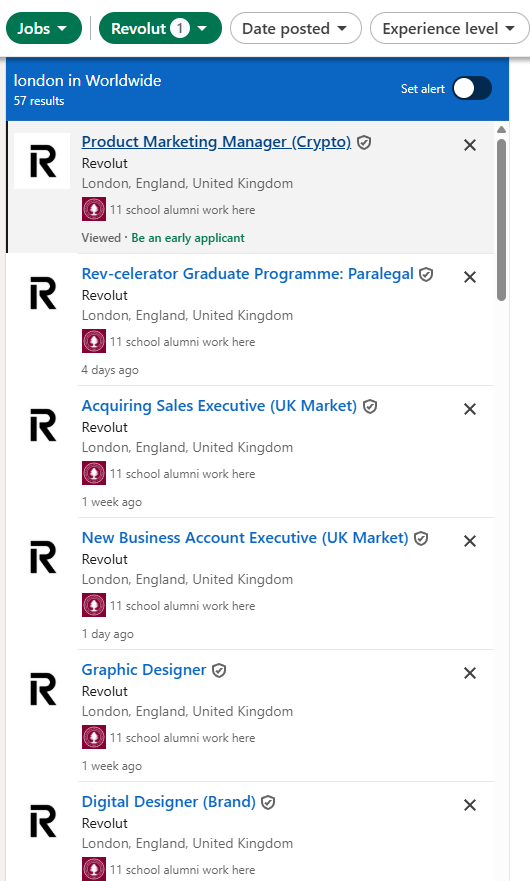
Revolut is currently hiring for a wide range of positions in London (LinkedIn screenshot).
At the time of writing, there were 57 open jobs at Revout
listed on LinkedIn, filtered by location, London. The positions included Product
Owner, Credit Analytics Manager, Group Head of Sanctions (Risk), Acquiring
Sales Executive (Enterprise), FinCrime Risk Manager (KYB), Legal Counsel
(Private Bank), Regulatory Strategy Lead and more. While it’s impossible to
confirm that these hires are (all) related to the company’s UK moves, it certainly
seems as if things are happening in London.
Francesca Carlesi, Revolut’s UK CEO, recently shed light on the
company’s ambitions at the MoneyLive Summit in London. Her message? Revolut
isn’t content with being a flashy alternative bank—it wants to be the bank for
millions of Brits.
Francesca Carlesi, Revolut’s UK CEO (LinkedIn).
“We want to move from being a disruptor to being a primary banking
partner,” Carlesi declared, emphasizing that the fintech’s long-term goal is to
become the go-to institution for everyday banking needs. “It’s about deepening
the relationship with our customers, it’s about not just having a Revolut card
in your wallet when you travel but making sure Revolut comes top of mind for
any financial needs,” she
said.
Revolut has long been the bank you use when you travel or the app you
keep for managing different currencies. But Carlesi’s comments make it clear
that the company is positioning itself as a viable alternative to high-street
banking, capable of handling salaries, savings, mortgages, and business
banking—all under one digital-first roof.
But to do that, it needs a full banking license. And that’s where
things get complicated.
The Regulatory Rumble: Revolut vs. The Establishment
The UK’s financial regulators have never been ones to roll out the red
carpet for disruptors, and Revolut has had its fair share of run-ins with the
powers that be.
One of the biggest hurdles? Compliance concerns. The Bank of England
has scrutinized Revolut’s ability to meet the rigorous oversight and reporting
standards required of traditional banks. There have been whispers of concerns
over financial controls, risk management, and even accounting practices—issues
that have delayed the licensing process.
Fintech News 🚨: @RevolutApp and @Visa Challenge UK Proposal to Cap Interchange Fees
Revolut and Visa reportedly filed legal challenges against the U.K.’s Payment Systems Regulator (PSR), seeking to overturn the regulator’s proposed cap on interchange fees on cross-border… pic.twitter.com/vSNvMbt9ZP
Yet, despite these challenges, Revolut remains undeterred. It has
worked extensively with regulators to tighten compliance measures and
strengthen governance frameworks. The current hiring spree is part of that
effort, ensuring that the company has the right personnel in place to navigate
the increasingly complex world of UK banking regulations.
“We have been in constant and open dialogue with our regulators, to
ensure our mobilization meets the highest standards,” Carlesi said. “We’re
in no rush, as getting this right matters more, so once everyone is ready,
we’ll launch the UK bank and begin to operate as one of the UK’s newest banks.”
Mobilization Mode: The Final Countdown
Right now, Revolut is—in its own words, “mobilizing”, where it’s built
out its banking infrastructure while working closely with a limited number of
customers to test its systems before going fully live. Think of it as the final
dress rehearsal before stepping onto the big stage. If all goes to plan,
Revolut expects to complete this phase by July of next year.
Once mobilization wraps up, Revolut will shift its millions of UK
customers onto its new, fully licensed banking entity. This will bring a host
of benefits, including access to FSCS-protected deposits and a wider range of
financial services.
Of course, all of this hinges on regulators giving Revolut the green
light. But with the hiring spree in full effect and operational upgrades
underway, the fintech appears more prepared than ever to take on the UK’s
banking elite.
The Big Picture: A Fintech Force to Be Reckoned With
Revolut isn’t going away. With over 50 million customers worldwide and more
than 10 million in the UK, the company has already built an empire that
most challenger banks can only dream of.
Its aggressive expansion strategy, coupled with its commitment to
innovation, positions it as a serious threat to traditional banks. Whether
regulators approve its full banking license or throw more hurdles in its path,
one thing is clear—Revolut is on the up.
And if it gets that final stamp of approval? The UK’s banking landscape
may never look the same again.
For more stories around the world’s most impactful fintech firms,
visit our fintech section.
As Revolut gears up to become a fully licensed UK bank, it's on a
hiring spree, aiming to transition from a disruptor to your primary banking
partner.
Revolut's Recruitment Rampage: Staffing Up for Banking Glory
Revolut, the fintech darling that made traditional banks sweat with its
sleek, app-first approach, is now playing an even bigger game. After years of
shaking up global finance, the company has set its sights on full-fledged UK
banking status. But becoming a bank isn’t just about slapping a new title on
the door—it requires a massive operational upgrade. Enter Revolut’s latest
power move: a full-blown hiring spree.
Revolut UK hiring a hundred new bank staff, from regulatory reporting analysts to financial risk controllers, as it prepares to exit the bank mobilization phase in July. CEO Francesca Carlesi told Bloomberg that the bank went from 35 to over 100 staff members through hires and… pic.twitter.com/G43ULLoaR8
The company is recruiting more than 100 new employees to bolster its
banking operations in the UK, a clear signal that it's gearing up for the final
stages of securing a full banking license, according
to Bloomberg. Revolut has already made banking plays in Europe, holding a license
in Lithuania that allows it to operate across the European Economic Area (EEA).
But the UK, one of the world’s most tightly regulated financial markets, has
been a harder nut to crack.
According to Bloomberg, the company is hiring 100 new employees across roles such as regulatory reporting analysts and financial risk controllers as it moves past operational restrictions imposed by the UK central bank.
Since obtaining a restricted banking license last summer, the London-based fintech has grown its UK banking division from 35 to over 100 employees through both new hires and internal transfers, according to Francesca Carlesi, Revolut’s UK CEO.
Carlesi added that the UK banking unit is expected to reach around 200 staff members by the end of the year. The digital challenger bank recently secured its long-awaited UK banking license.
Revolut is currently hiring for a wide range of positions in London (LinkedIn screenshot).
At the time of writing, there were 57 open jobs at Revout
listed on LinkedIn, filtered by location, London. The positions included Product
Owner, Credit Analytics Manager, Group Head of Sanctions (Risk), Acquiring
Sales Executive (Enterprise), FinCrime Risk Manager (KYB), Legal Counsel
(Private Bank), Regulatory Strategy Lead and more. While it’s impossible to
confirm that these hires are (all) related to the company’s UK moves, it certainly
seems as if things are happening in London.
Francesca Carlesi, Revolut’s UK CEO, recently shed light on the
company’s ambitions at the MoneyLive Summit in London. Her message? Revolut
isn’t content with being a flashy alternative bank—it wants to be the bank for
millions of Brits.
Francesca Carlesi, Revolut’s UK CEO (LinkedIn).
“We want to move from being a disruptor to being a primary banking
partner,” Carlesi declared, emphasizing that the fintech’s long-term goal is to
become the go-to institution for everyday banking needs. “It’s about deepening
the relationship with our customers, it’s about not just having a Revolut card
in your wallet when you travel but making sure Revolut comes top of mind for
any financial needs,” she
said.
Revolut has long been the bank you use when you travel or the app you
keep for managing different currencies. But Carlesi’s comments make it clear
that the company is positioning itself as a viable alternative to high-street
banking, capable of handling salaries, savings, mortgages, and business
banking—all under one digital-first roof.
But to do that, it needs a full banking license. And that’s where
things get complicated.
The Regulatory Rumble: Revolut vs. The Establishment
The UK’s financial regulators have never been ones to roll out the red
carpet for disruptors, and Revolut has had its fair share of run-ins with the
powers that be.
One of the biggest hurdles? Compliance concerns. The Bank of England
has scrutinized Revolut’s ability to meet the rigorous oversight and reporting
standards required of traditional banks. There have been whispers of concerns
over financial controls, risk management, and even accounting practices—issues
that have delayed the licensing process.
Fintech News 🚨: @RevolutApp and @Visa Challenge UK Proposal to Cap Interchange Fees
Revolut and Visa reportedly filed legal challenges against the U.K.’s Payment Systems Regulator (PSR), seeking to overturn the regulator’s proposed cap on interchange fees on cross-border… pic.twitter.com/vSNvMbt9ZP
Yet, despite these challenges, Revolut remains undeterred. It has
worked extensively with regulators to tighten compliance measures and
strengthen governance frameworks. The current hiring spree is part of that
effort, ensuring that the company has the right personnel in place to navigate
the increasingly complex world of UK banking regulations.
“We have been in constant and open dialogue with our regulators, to
ensure our mobilization meets the highest standards,” Carlesi said. “We’re
in no rush, as getting this right matters more, so once everyone is ready,
we’ll launch the UK bank and begin to operate as one of the UK’s newest banks.”
Mobilization Mode: The Final Countdown
Right now, Revolut is—in its own words, “mobilizing”, where it’s built
out its banking infrastructure while working closely with a limited number of
customers to test its systems before going fully live. Think of it as the final
dress rehearsal before stepping onto the big stage. If all goes to plan,
Revolut expects to complete this phase by July of next year.
Once mobilization wraps up, Revolut will shift its millions of UK
customers onto its new, fully licensed banking entity. This will bring a host
of benefits, including access to FSCS-protected deposits and a wider range of
financial services.
Of course, all of this hinges on regulators giving Revolut the green
light. But with the hiring spree in full effect and operational upgrades
underway, the fintech appears more prepared than ever to take on the UK’s
banking elite.
The Big Picture: A Fintech Force to Be Reckoned With
Revolut isn’t going away. With over 50 million customers worldwide and more
than 10 million in the UK, the company has already built an empire that
most challenger banks can only dream of.
Its aggressive expansion strategy, coupled with its commitment to
innovation, positions it as a serious threat to traditional banks. Whether
regulators approve its full banking license or throw more hurdles in its path,
one thing is clear—Revolut is on the up.
And if it gets that final stamp of approval? The UK’s banking landscape
may never look the same again.
For more stories around the world’s most impactful fintech firms,
visit our fintech section.
Louis Parks has lived and worked in and around the Middle East for much of his professional career. He writes about the meeting of the tech and finance worlds.
Polymarket Replaces Bridged USDC Aiming for a U.S. Relaunch
Featured Videos
FP Markets Winner Spotlight 🏆 | Global Broker of the Year 2025 #Trading #Broker #Innovation #Shorts
FP Markets Winner Spotlight 🏆 | Global Broker of the Year 2025 #Trading #Broker #Innovation #Shorts
FP Markets Winner Spotlight 🏆 | Global Broker of the Year 2025 #Trading #Broker #Innovation #Shorts
FP Markets Winner Spotlight 🏆 | Global Broker of the Year 2025 #Trading #Broker #Innovation #Shorts
FP Markets takes the spotlight as Global Broker of the Year 2025 at the Finance Magnates Awards.
Martin Stoilov, Head of Client Experience, shares that trust, innovation, and people played a key role in the company’s success, supported by a strong foundation of integrity and client-centricity.
Following this milestone, FP Markets continues to focus on growth, technology investment, and its core values of transparency and excellence.
👉 Be part of FM Awards 2026: https://awards.financemagnates.com/#nominate
FP Markets takes the spotlight as Global Broker of the Year 2025 at the Finance Magnates Awards.
Martin Stoilov, Head of Client Experience, shares that trust, innovation, and people played a key role in the company’s success, supported by a strong foundation of integrity and client-centricity.
Following this milestone, FP Markets continues to focus on growth, technology investment, and its core values of transparency and excellence.
👉 Be part of FM Awards 2026: https://awards.financemagnates.com/#nominate
FP Markets takes the spotlight as Global Broker of the Year 2025 at the Finance Magnates Awards.
Martin Stoilov, Head of Client Experience, shares that trust, innovation, and people played a key role in the company’s success, supported by a strong foundation of integrity and client-centricity.
Following this milestone, FP Markets continues to focus on growth, technology investment, and its core values of transparency and excellence.
👉 Be part of FM Awards 2026: https://awards.financemagnates.com/#nominate
FP Markets takes the spotlight as Global Broker of the Year 2025 at the Finance Magnates Awards.
Martin Stoilov, Head of Client Experience, shares that trust, innovation, and people played a key role in the company’s success, supported by a strong foundation of integrity and client-centricity.
Following this milestone, FP Markets continues to focus on growth, technology investment, and its core values of transparency and excellence.
👉 Be part of FM Awards 2026: https://awards.financemagnates.com/#nominate
In this video, we review @HolaPrimeMarketsOfficial, a multi-asset forex and CFDs broker offering different account types, trading platforms, and flexible trading conditions.
We cover the broker’s overall offering, including account options, trading environment, platforms like MT4 and MT5, and additional services such as managed accounts and fast withdrawals.
Watch the full video to see if Hola Prime Markets fits your trading needs.
📣 Stay up to date with the latest in finance and trading. Follow Finance Magnates for industry news, insights, and global event coverage.
Connect with us:
🔗 LinkedIn: /financemagnates
👍 Facebook: /financemagnates
📸 Instagram: https://www.instagram.com/financemagnates
🐦 X: https://x.com/financemagnates
🎥 TikTok: https://www.tiktok.com/tag/financemagnates
▶️ YouTube: /@financemagnates_official
#HolaPrime #ForexBroker #CFDTrading #FinanceMagnates #Trading #Forex #BrokerReview
In this video, we review @HolaPrimeMarketsOfficial, a multi-asset forex and CFDs broker offering different account types, trading platforms, and flexible trading conditions.
We cover the broker’s overall offering, including account options, trading environment, platforms like MT4 and MT5, and additional services such as managed accounts and fast withdrawals.
Watch the full video to see if Hola Prime Markets fits your trading needs.
📣 Stay up to date with the latest in finance and trading. Follow Finance Magnates for industry news, insights, and global event coverage.
Connect with us:
🔗 LinkedIn: /financemagnates
👍 Facebook: /financemagnates
📸 Instagram: https://www.instagram.com/financemagnates
🐦 X: https://x.com/financemagnates
🎥 TikTok: https://www.tiktok.com/tag/financemagnates
▶️ YouTube: /@financemagnates_official
#HolaPrime #ForexBroker #CFDTrading #FinanceMagnates #Trading #Forex #BrokerReview
In this video, we review @HolaPrimeMarketsOfficial, a multi-asset forex and CFDs broker offering different account types, trading platforms, and flexible trading conditions.
We cover the broker’s overall offering, including account options, trading environment, platforms like MT4 and MT5, and additional services such as managed accounts and fast withdrawals.
Watch the full video to see if Hola Prime Markets fits your trading needs.
📣 Stay up to date with the latest in finance and trading. Follow Finance Magnates for industry news, insights, and global event coverage.
Connect with us:
🔗 LinkedIn: /financemagnates
👍 Facebook: /financemagnates
📸 Instagram: https://www.instagram.com/financemagnates
🐦 X: https://x.com/financemagnates
🎥 TikTok: https://www.tiktok.com/tag/financemagnates
▶️ YouTube: /@financemagnates_official
#HolaPrime #ForexBroker #CFDTrading #FinanceMagnates #Trading #Forex #BrokerReview
In this video, we review @HolaPrimeMarketsOfficial, a multi-asset forex and CFDs broker offering different account types, trading platforms, and flexible trading conditions.
We cover the broker’s overall offering, including account options, trading environment, platforms like MT4 and MT5, and additional services such as managed accounts and fast withdrawals.
Watch the full video to see if Hola Prime Markets fits your trading needs.
📣 Stay up to date with the latest in finance and trading. Follow Finance Magnates for industry news, insights, and global event coverage.
Connect with us:
🔗 LinkedIn: /financemagnates
👍 Facebook: /financemagnates
📸 Instagram: https://www.instagram.com/financemagnates
🐦 X: https://x.com/financemagnates
🎥 TikTok: https://www.tiktok.com/tag/financemagnates
▶️ YouTube: /@financemagnates_official
#HolaPrime #ForexBroker #CFDTrading #FinanceMagnates #Trading #Forex #BrokerReview
In this video, we review @HolaPrimeMarketsOfficial, a multi-asset forex and CFDs broker offering different account types, trading platforms, and flexible trading conditions.
We cover the broker’s overall offering, including account options, trading environment, platforms like MT4 and MT5, and additional services such as managed accounts and fast withdrawals.
Watch the full video to see if Hola Prime Markets fits your trading needs.
📣 Stay up to date with the latest in finance and trading. Follow Finance Magnates for industry news, insights, and global event coverage.
Connect with us:
🔗 LinkedIn: /financemagnates
👍 Facebook: /financemagnates
📸 Instagram: https://www.instagram.com/financemagnates
🐦 X: https://x.com/financemagnates
🎥 TikTok: https://www.tiktok.com/tag/financemagnates
▶️ YouTube: /@financemagnates_official
#HolaPrime #ForexBroker #CFDTrading #FinanceMagnates #Trading #Forex #BrokerReview
In this video, we review @HolaPrimeMarketsOfficial, a multi-asset forex and CFDs broker offering different account types, trading platforms, and flexible trading conditions.
We cover the broker’s overall offering, including account options, trading environment, platforms like MT4 and MT5, and additional services such as managed accounts and fast withdrawals.
Watch the full video to see if Hola Prime Markets fits your trading needs.
📣 Stay up to date with the latest in finance and trading. Follow Finance Magnates for industry news, insights, and global event coverage.
Connect with us:
🔗 LinkedIn: /financemagnates
👍 Facebook: /financemagnates
📸 Instagram: https://www.instagram.com/financemagnates
🐦 X: https://x.com/financemagnates
🎥 TikTok: https://www.tiktok.com/tag/financemagnates
▶️ YouTube: /@financemagnates_official
#HolaPrime #ForexBroker #CFDTrading #FinanceMagnates #Trading #Forex #BrokerReview
Hola Prime Review: What You Need to Know | Full Breakdown by Finance Magnates
Hola Prime Review: What You Need to Know | Full Breakdown by Finance Magnates
Hola Prime Review: What You Need to Know | Full Breakdown by Finance Magnates
Hola Prime Review: What You Need to Know | Full Breakdown by Finance Magnates
Hola Prime Review: What You Need to Know | Full Breakdown by Finance Magnates
Hola Prime Review: What You Need to Know | Full Breakdown by Finance Magnates
In this video, we review @HolaPrime_Global, a proprietary trading firm offering evaluation programs and performance-based payouts in simulated market environments.
We cover how the challenge model works, including account types, profit splits (up to 95%), trading rules, and what it takes to reach a funded account. You’ll also learn about available platforms like MT4, MT5, cTrader, and more, along with insights into payouts, support, and trading conditions.
Watch the full video to see if Hola Prime fits your trading style.
📣 Stay up to date with the latest in finance and trading. Follow Finance Magnates for industry news, insights, and global event coverage.
Connect with us:
🔗 LinkedIn: /financemagnates
👍 Facebook: /financemagnates
📸 Instagram: https://www.instagram.com/financemagnates
🐦 X: https://x.com/financemagnates
🎥 TikTok: https://www.tiktok.com/tag/financemagnates
▶️ YouTube: /@financemagnates_official
#HolaPrime #PropFirm #Trading #FinanceMagnates #Forex #FuturesTrading #TradingReview #PropFirmReview
In this video, we review @HolaPrime_Global, a proprietary trading firm offering evaluation programs and performance-based payouts in simulated market environments.
We cover how the challenge model works, including account types, profit splits (up to 95%), trading rules, and what it takes to reach a funded account. You’ll also learn about available platforms like MT4, MT5, cTrader, and more, along with insights into payouts, support, and trading conditions.
Watch the full video to see if Hola Prime fits your trading style.
📣 Stay up to date with the latest in finance and trading. Follow Finance Magnates for industry news, insights, and global event coverage.
Connect with us:
🔗 LinkedIn: /financemagnates
👍 Facebook: /financemagnates
📸 Instagram: https://www.instagram.com/financemagnates
🐦 X: https://x.com/financemagnates
🎥 TikTok: https://www.tiktok.com/tag/financemagnates
▶️ YouTube: /@financemagnates_official
#HolaPrime #PropFirm #Trading #FinanceMagnates #Forex #FuturesTrading #TradingReview #PropFirmReview
In this video, we review @HolaPrime_Global, a proprietary trading firm offering evaluation programs and performance-based payouts in simulated market environments.
We cover how the challenge model works, including account types, profit splits (up to 95%), trading rules, and what it takes to reach a funded account. You’ll also learn about available platforms like MT4, MT5, cTrader, and more, along with insights into payouts, support, and trading conditions.
Watch the full video to see if Hola Prime fits your trading style.
📣 Stay up to date with the latest in finance and trading. Follow Finance Magnates for industry news, insights, and global event coverage.
Connect with us:
🔗 LinkedIn: /financemagnates
👍 Facebook: /financemagnates
📸 Instagram: https://www.instagram.com/financemagnates
🐦 X: https://x.com/financemagnates
🎥 TikTok: https://www.tiktok.com/tag/financemagnates
▶️ YouTube: /@financemagnates_official
#HolaPrime #PropFirm #Trading #FinanceMagnates #Forex #FuturesTrading #TradingReview #PropFirmReview
In this video, we review @HolaPrime_Global, a proprietary trading firm offering evaluation programs and performance-based payouts in simulated market environments.
We cover how the challenge model works, including account types, profit splits (up to 95%), trading rules, and what it takes to reach a funded account. You’ll also learn about available platforms like MT4, MT5, cTrader, and more, along with insights into payouts, support, and trading conditions.
Watch the full video to see if Hola Prime fits your trading style.
📣 Stay up to date with the latest in finance and trading. Follow Finance Magnates for industry news, insights, and global event coverage.
Connect with us:
🔗 LinkedIn: /financemagnates
👍 Facebook: /financemagnates
📸 Instagram: https://www.instagram.com/financemagnates
🐦 X: https://x.com/financemagnates
🎥 TikTok: https://www.tiktok.com/tag/financemagnates
▶️ YouTube: /@financemagnates_official
#HolaPrime #PropFirm #Trading #FinanceMagnates #Forex #FuturesTrading #TradingReview #PropFirmReview
In this video, we review @HolaPrime_Global, a proprietary trading firm offering evaluation programs and performance-based payouts in simulated market environments.
We cover how the challenge model works, including account types, profit splits (up to 95%), trading rules, and what it takes to reach a funded account. You’ll also learn about available platforms like MT4, MT5, cTrader, and more, along with insights into payouts, support, and trading conditions.
Watch the full video to see if Hola Prime fits your trading style.
📣 Stay up to date with the latest in finance and trading. Follow Finance Magnates for industry news, insights, and global event coverage.
Connect with us:
🔗 LinkedIn: /financemagnates
👍 Facebook: /financemagnates
📸 Instagram: https://www.instagram.com/financemagnates
🐦 X: https://x.com/financemagnates
🎥 TikTok: https://www.tiktok.com/tag/financemagnates
▶️ YouTube: /@financemagnates_official
#HolaPrime #PropFirm #Trading #FinanceMagnates #Forex #FuturesTrading #TradingReview #PropFirmReview
In this video, we review @HolaPrime_Global, a proprietary trading firm offering evaluation programs and performance-based payouts in simulated market environments.
We cover how the challenge model works, including account types, profit splits (up to 95%), trading rules, and what it takes to reach a funded account. You’ll also learn about available platforms like MT4, MT5, cTrader, and more, along with insights into payouts, support, and trading conditions.
Watch the full video to see if Hola Prime fits your trading style.
📣 Stay up to date with the latest in finance and trading. Follow Finance Magnates for industry news, insights, and global event coverage.
Connect with us:
🔗 LinkedIn: /financemagnates
👍 Facebook: /financemagnates
📸 Instagram: https://www.instagram.com/financemagnates
🐦 X: https://x.com/financemagnates
🎥 TikTok: https://www.tiktok.com/tag/financemagnates
▶️ YouTube: /@financemagnates_official
#HolaPrime #PropFirm #Trading #FinanceMagnates #Forex #FuturesTrading #TradingReview #PropFirmReview
Axi Winner Spotlight 🏆 | Global Most Innovative Broker 2025 #Innovation #Trading #Fintech #Broker
Axi Winner Spotlight 🏆 | Global Most Innovative Broker 2025 #Innovation #Trading #Fintech #Broker
Axi Winner Spotlight 🏆 | Global Most Innovative Broker 2025 #Innovation #Trading #Fintech #Broker
Axi Winner Spotlight 🏆 | Global Most Innovative Broker 2025 #Innovation #Trading #Fintech #Broker
Axi Winner Spotlight 🏆 | Global Most Innovative Broker 2025 #Innovation #Trading #Fintech #Broker
Axi Winner Spotlight 🏆 | Global Most Innovative Broker 2025 #Innovation #Trading #Fintech #Broker
Axi takes the spotlight at the Finance Magnates Awards, winning Global Most Innovative Broker 2025.
Olivia Xenofontos and Ivanna Openko share how the team will feel: proud, motivated, and ready to keep delivering.
They also describe the night as well-organized, focused, and enjoyable for all.
👉 Be part of FM Awards 2026.
Axi takes the spotlight at the Finance Magnates Awards, winning Global Most Innovative Broker 2025.
Olivia Xenofontos and Ivanna Openko share how the team will feel: proud, motivated, and ready to keep delivering.
They also describe the night as well-organized, focused, and enjoyable for all.
👉 Be part of FM Awards 2026.
Axi takes the spotlight at the Finance Magnates Awards, winning Global Most Innovative Broker 2025.
Olivia Xenofontos and Ivanna Openko share how the team will feel: proud, motivated, and ready to keep delivering.
They also describe the night as well-organized, focused, and enjoyable for all.
👉 Be part of FM Awards 2026.
Axi takes the spotlight at the Finance Magnates Awards, winning Global Most Innovative Broker 2025.
Olivia Xenofontos and Ivanna Openko share how the team will feel: proud, motivated, and ready to keep delivering.
They also describe the night as well-organized, focused, and enjoyable for all.
👉 Be part of FM Awards 2026.
Axi takes the spotlight at the Finance Magnates Awards, winning Global Most Innovative Broker 2025.
Olivia Xenofontos and Ivanna Openko share how the team will feel: proud, motivated, and ready to keep delivering.
They also describe the night as well-organized, focused, and enjoyable for all.
👉 Be part of FM Awards 2026.
Axi takes the spotlight at the Finance Magnates Awards, winning Global Most Innovative Broker 2025.
Olivia Xenofontos and Ivanna Openko share how the team will feel: proud, motivated, and ready to keep delivering.
They also describe the night as well-organized, focused, and enjoyable for all.
👉 Be part of FM Awards 2026.
Recognition that matters.
Built on transparency.
Driven by the industry.
The Finance Magnates Awards 2026.
Nominations are now open.
🔗 https://awards.financemagnates.com/?utm_source=SM&utm_medium=social&utm_campaign=recognition-matters
Recognition that matters.
Built on transparency.
Driven by the industry.
The Finance Magnates Awards 2026.
Nominations are now open.
🔗 https://awards.financemagnates.com/?utm_source=SM&utm_medium=social&utm_campaign=recognition-matters
Recognition that matters.
Built on transparency.
Driven by the industry.
The Finance Magnates Awards 2026.
Nominations are now open.
🔗 https://awards.financemagnates.com/?utm_source=SM&utm_medium=social&utm_campaign=recognition-matters
Recognition that matters.
Built on transparency.
Driven by the industry.
The Finance Magnates Awards 2026.
Nominations are now open.
🔗 https://awards.financemagnates.com/?utm_source=SM&utm_medium=social&utm_campaign=recognition-matters
Recognition that matters.
Built on transparency.
Driven by the industry.
The Finance Magnates Awards 2026.
Nominations are now open.
🔗 https://awards.financemagnates.com/?utm_source=SM&utm_medium=social&utm_campaign=recognition-matters
Recognition that matters.
Built on transparency.
Driven by the industry.
The Finance Magnates Awards 2026.
Nominations are now open.
🔗 https://awards.financemagnates.com/?utm_source=SM&utm_medium=social&utm_campaign=recognition-matters