Those regulations, known as ‘open banking’ in the UK, meant banks were forced to provide third-party companies with access to their clients’ banking information via an application programming interface.
In the UK, there are now close to 100 companies regulated as either Account Information Service Providers (AISPs) or Payment Initiation Service Providers (PISPs).
AISPs have read-only access to your banking information, meaning they are likely to provide budgeting or lending services. PISPs, on the other hand, can - as their name implies - initiate payments from your account.
Changing the process
This may not sound like a big deal, but it could drastically reshape the online payments sector.
When you buy something on Amazon or iTunes, the payment will usually go through in a couple of seconds. But in that short period of time, a lot of stuff is happening.
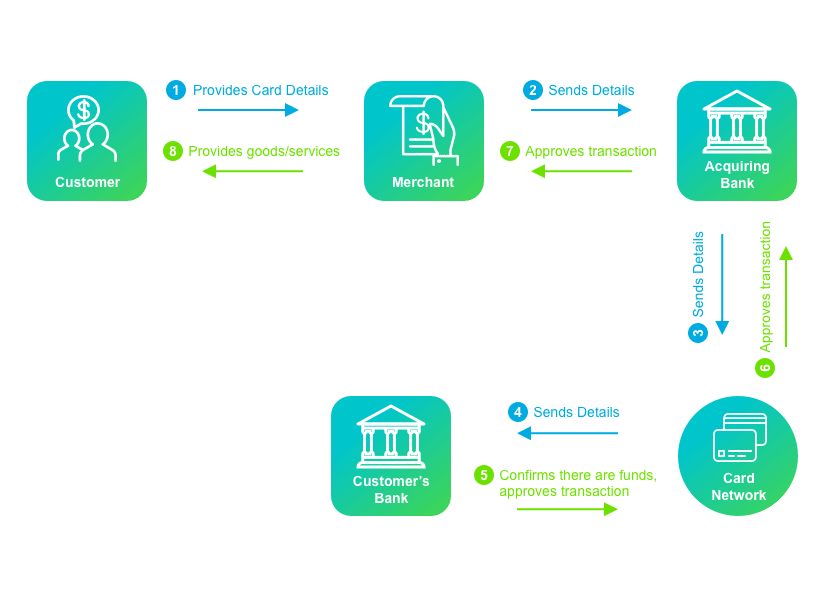
In simple terms, your payment will be transmitted to the online store or ‘merchant.’ In turn, the merchant will send the details to their acquiring bank - the institution responsible for processing their payments.
How a 'Traditional' card payment works
The acquiring bank will then send your payment information to your card network, most likely Visa or Mastercard, who will then have to contact your bank to greenlight the transaction.
Assuming your bank approves the transaction, it will send an authorization code back, through the card network, to the acquiring bank. The acquiring bank will then send that information to the merchant, who will - at last - provide you with your product or service.
Simple, right?
Except this isn’t the end of the process. You may have your service or product, but the merchant will have to wait for a lengthy batching, clearing and funding process to be completed, something which can take over a week before your funds are actually deposited into their bank account.
Bank to bank
PISPs are able to change this process entirely.
Let’s say I buy a book on Amazon using a PISP application on my phone.
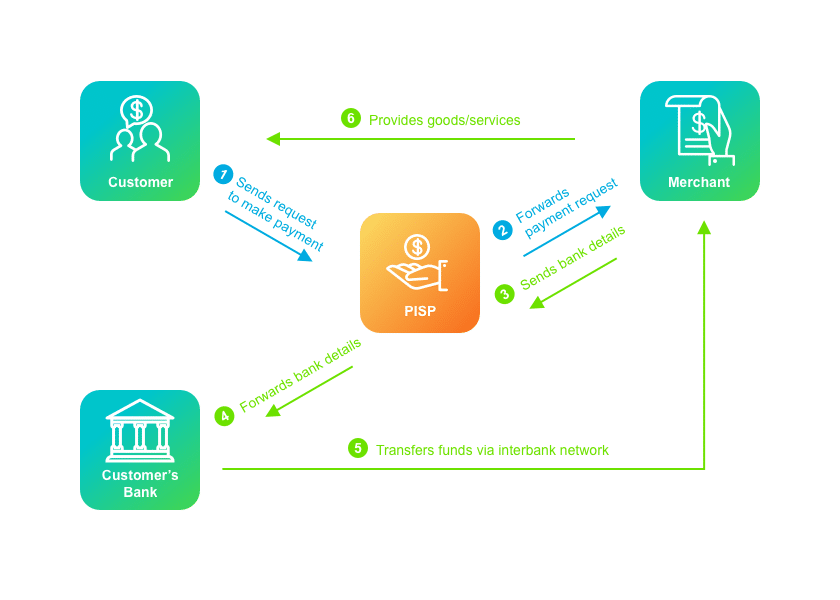
After I click ‘buy,’ Amazon will send a request for funds back through the PISP. The PISP then initiates a payment from my bank account and sends the money - via the interbank payment network - directly to Amazon’s business account.
This makes things faster and cheaper for businesses. Faster because they get paid instantly and don’t have to wait for their acquiring bank to go through an end-of-day clearing process. Cheaper because it reduces the number of intermediaries that have to be paid.
A PISP Payment
For consumers, there is also an added security benefit. At the moment, online payments require a user to provide a business with their card details - something that has resulted in huge numbers of bank details being stolen by hackers.
Conversely, a PISP-based payment means it would be the merchant, not the buyer, that has to reveal their bank details.
“Traditional systems work on a ‘pull’ authentication where you authorize the payment processor to reach into your account and pull
Brad Goodall, CEO and Founder, Banked
money out by giving them your bank details, via a 16 digit card number,” said Brad Goodall, the CEO of Banked - an FCA regulated PISP.
“Our system works on ‘push’ authentication – the merchant says please pay me for ‘X,’ and you push the payment from your account by authorizing the sending of funds. Critically, you aren’t sharing your financial details – the merchant is. [The Banked] system essentially works in reverse [to traditional payments], with the customer in control.”
The scramble for PISPs
Goodall’s firm, which was launched last year and is based in London, is one of many start-ups attempting to capture some of the market share in this nascent payments industry.
A large number of these financial technology companies, most of which were founded in the past couple of years, were set up by ex-bankers or tech workers. Goodall, for instance, helped co-found cloud software provider 10x Banking with Antony Jenkins, the former CEO of Barclays, before he launched Banked.
Frank Zhou, the founder of payments and investing application Zeux, has a slightly different background. An ex-derivatives trader, Zhou had stints at Lloyds, Merrill Lynch, and Societe Generale before launching Zeux last year.
“My previous jobs have always required a lot of risk-taking and the ability to handle the pressure that comes with it,” Zhou told Finance Magnates. “So since I’d already signed myself up for a career taking risks - which I thoroughly enjoy - I thought I might as well take an even bigger risk in something that I truly believe in.
Big players coming for open banking
Of course, it’s not only start-ups that are trying to jump onto the open banking bandwagon. Several big players in the payments space have already received PISP licenses from the FCA or other European regulators.
American Express, for example, has set up a new service called Pay with Bank. As the name implies, this service allows you to pay
Frank Zhou, CEO and Founder, Zeux
directly from your bank to an online merchant’s account. Adyen, Skrill, and several banks have also received open banking licenses.
Given that this is the case, one could be forgiven for thinking that, in this new industry, there is already a surplus of providers. But for Jakub Zmuda, chief product officer at payments technology company Modulr, there’s a lot of business to go around.
“Modulr will be building in payment initiation services into our core offering, enhancing our existing products through which we help business and partners already move billions of pounds. This means that our offering will be enhanced by [PISP licensing], but we do not see ourselves in direct competition with pure-play PISPs.”
"Seamless treasury function"
As Zmuda’s comments suggest, it’s not just retail customers and e-commerce stores that PISPs can help grow - any businesses can likely benefit from the new offerings being made available to them.
A company could, for example, use a PISP to visualize ten different bank accounts in one application, as opposed to having to log on to ten different proprietary banking application accounts and then trying to make sure all the numbers match up.
Aside from making life easier for accountants, this could allow businesses to move cash between their different bank accounts much more easily.
“Payment initiation could ultimately be utilized by businesses to move funds between accounts, optimizing cash flow and easily using new providers to lower cost of payment fulfillment,” added Zmuda.
“Today, this would need to be done manually, moving between different accounts using different logins and platforms. Tomorrow, businesses could use an [AISP] for aggregation and a PISP to create a seamless treasury function.”
No more overdraft
It might not just be businesses that can optimize their payment flows. There are also plenty of applications looking to provide similar services to retail customers via mobile applications.
A PISP could allow a user to move money between different bank accounts so that they don’t go into overdraft. Some app developers have even hinted that they are developing features that would allow users to automate this process.
Others are looking at providing investment options to their clients. Zeux, for example, provides users with access to a range of investment products, ranging from P2P lending to fixed-rate interest on cryptocurrency deposits.
The start-up has also introduced a range of features that enable its users to make online payments directly to a merchant’s bank account or in-store via a number of different methods.
“As we have a PISP license, our users can make payments directly from their bank accounts,” said Zhou. “But we are trying to make our service as convenient and flexible as possible. So our users can make mobile payments with Apple Pay or Samsung Pay, perform quick bank transfers, or do instant customer to customer payments.”
The card payments process may be the most immediately affected by developments in the open banking space. But ultimately, the regulatory changes implemented in January of last year will allow for a plethora of technological developments that will change the way we save, pay, and bank in the long run.
Whether it’s the average Joe being better able to manage his money and make faster payments to friends or a massive business that can optimize cash flows and receive money from its customers instantly, open banking regulations are going to change the way we make payments significantly.
Those regulations, known as ‘open banking’ in the UK, meant banks were forced to provide third-party companies with access to their clients’ banking information via an application programming interface.
In the UK, there are now close to 100 companies regulated as either Account Information Service Providers (AISPs) or Payment Initiation Service Providers (PISPs).
AISPs have read-only access to your banking information, meaning they are likely to provide budgeting or lending services. PISPs, on the other hand, can - as their name implies - initiate payments from your account.
Changing the process
This may not sound like a big deal, but it could drastically reshape the online payments sector.
When you buy something on Amazon or iTunes, the payment will usually go through in a couple of seconds. But in that short period of time, a lot of stuff is happening.
In simple terms, your payment will be transmitted to the online store or ‘merchant.’ In turn, the merchant will send the details to their acquiring bank - the institution responsible for processing their payments.
How a 'Traditional' card payment works
The acquiring bank will then send your payment information to your card network, most likely Visa or Mastercard, who will then have to contact your bank to greenlight the transaction.
Assuming your bank approves the transaction, it will send an authorization code back, through the card network, to the acquiring bank. The acquiring bank will then send that information to the merchant, who will - at last - provide you with your product or service.
Simple, right?
Except this isn’t the end of the process. You may have your service or product, but the merchant will have to wait for a lengthy batching, clearing and funding process to be completed, something which can take over a week before your funds are actually deposited into their bank account.
Bank to bank
PISPs are able to change this process entirely.
Let’s say I buy a book on Amazon using a PISP application on my phone.
After I click ‘buy,’ Amazon will send a request for funds back through the PISP. The PISP then initiates a payment from my bank account and sends the money - via the interbank payment network - directly to Amazon’s business account.
This makes things faster and cheaper for businesses. Faster because they get paid instantly and don’t have to wait for their acquiring bank to go through an end-of-day clearing process. Cheaper because it reduces the number of intermediaries that have to be paid.
A PISP Payment
For consumers, there is also an added security benefit. At the moment, online payments require a user to provide a business with their card details - something that has resulted in huge numbers of bank details being stolen by hackers.
Conversely, a PISP-based payment means it would be the merchant, not the buyer, that has to reveal their bank details.
“Traditional systems work on a ‘pull’ authentication where you authorize the payment processor to reach into your account and pull
Brad Goodall, CEO and Founder, Banked
money out by giving them your bank details, via a 16 digit card number,” said Brad Goodall, the CEO of Banked - an FCA regulated PISP.
“Our system works on ‘push’ authentication – the merchant says please pay me for ‘X,’ and you push the payment from your account by authorizing the sending of funds. Critically, you aren’t sharing your financial details – the merchant is. [The Banked] system essentially works in reverse [to traditional payments], with the customer in control.”
The scramble for PISPs
Goodall’s firm, which was launched last year and is based in London, is one of many start-ups attempting to capture some of the market share in this nascent payments industry.
A large number of these financial technology companies, most of which were founded in the past couple of years, were set up by ex-bankers or tech workers. Goodall, for instance, helped co-found cloud software provider 10x Banking with Antony Jenkins, the former CEO of Barclays, before he launched Banked.
Frank Zhou, the founder of payments and investing application Zeux, has a slightly different background. An ex-derivatives trader, Zhou had stints at Lloyds, Merrill Lynch, and Societe Generale before launching Zeux last year.
“My previous jobs have always required a lot of risk-taking and the ability to handle the pressure that comes with it,” Zhou told Finance Magnates. “So since I’d already signed myself up for a career taking risks - which I thoroughly enjoy - I thought I might as well take an even bigger risk in something that I truly believe in.
Big players coming for open banking
Of course, it’s not only start-ups that are trying to jump onto the open banking bandwagon. Several big players in the payments space have already received PISP licenses from the FCA or other European regulators.
American Express, for example, has set up a new service called Pay with Bank. As the name implies, this service allows you to pay
Frank Zhou, CEO and Founder, Zeux
directly from your bank to an online merchant’s account. Adyen, Skrill, and several banks have also received open banking licenses.
Given that this is the case, one could be forgiven for thinking that, in this new industry, there is already a surplus of providers. But for Jakub Zmuda, chief product officer at payments technology company Modulr, there’s a lot of business to go around.
“Modulr will be building in payment initiation services into our core offering, enhancing our existing products through which we help business and partners already move billions of pounds. This means that our offering will be enhanced by [PISP licensing], but we do not see ourselves in direct competition with pure-play PISPs.”
"Seamless treasury function"
As Zmuda’s comments suggest, it’s not just retail customers and e-commerce stores that PISPs can help grow - any businesses can likely benefit from the new offerings being made available to them.
A company could, for example, use a PISP to visualize ten different bank accounts in one application, as opposed to having to log on to ten different proprietary banking application accounts and then trying to make sure all the numbers match up.
Aside from making life easier for accountants, this could allow businesses to move cash between their different bank accounts much more easily.
“Payment initiation could ultimately be utilized by businesses to move funds between accounts, optimizing cash flow and easily using new providers to lower cost of payment fulfillment,” added Zmuda.
“Today, this would need to be done manually, moving between different accounts using different logins and platforms. Tomorrow, businesses could use an [AISP] for aggregation and a PISP to create a seamless treasury function.”
No more overdraft
It might not just be businesses that can optimize their payment flows. There are also plenty of applications looking to provide similar services to retail customers via mobile applications.
A PISP could allow a user to move money between different bank accounts so that they don’t go into overdraft. Some app developers have even hinted that they are developing features that would allow users to automate this process.
Others are looking at providing investment options to their clients. Zeux, for example, provides users with access to a range of investment products, ranging from P2P lending to fixed-rate interest on cryptocurrency deposits.
The start-up has also introduced a range of features that enable its users to make online payments directly to a merchant’s bank account or in-store via a number of different methods.
“As we have a PISP license, our users can make payments directly from their bank accounts,” said Zhou. “But we are trying to make our service as convenient and flexible as possible. So our users can make mobile payments with Apple Pay or Samsung Pay, perform quick bank transfers, or do instant customer to customer payments.”
The card payments process may be the most immediately affected by developments in the open banking space. But ultimately, the regulatory changes implemented in January of last year will allow for a plethora of technological developments that will change the way we save, pay, and bank in the long run.
Whether it’s the average Joe being better able to manage his money and make faster payments to friends or a massive business that can optimize cash flows and receive money from its customers instantly, open banking regulations are going to change the way we make payments significantly.
Polymarket Replaces Bridged USDC Aiming for a U.S. Relaunch
Featured Videos
FP Markets Winner Spotlight 🏆 | Global Broker of the Year 2025 #Trading #Broker #Innovation #Shorts
FP Markets Winner Spotlight 🏆 | Global Broker of the Year 2025 #Trading #Broker #Innovation #Shorts
FP Markets Winner Spotlight 🏆 | Global Broker of the Year 2025 #Trading #Broker #Innovation #Shorts
FP Markets Winner Spotlight 🏆 | Global Broker of the Year 2025 #Trading #Broker #Innovation #Shorts
FP Markets takes the spotlight as Global Broker of the Year 2025 at the Finance Magnates Awards.
Martin Stoilov, Head of Client Experience, shares that trust, innovation, and people played a key role in the company’s success, supported by a strong foundation of integrity and client-centricity.
Following this milestone, FP Markets continues to focus on growth, technology investment, and its core values of transparency and excellence.
👉 Be part of FM Awards 2026: https://awards.financemagnates.com/#nominate
FP Markets takes the spotlight as Global Broker of the Year 2025 at the Finance Magnates Awards.
Martin Stoilov, Head of Client Experience, shares that trust, innovation, and people played a key role in the company’s success, supported by a strong foundation of integrity and client-centricity.
Following this milestone, FP Markets continues to focus on growth, technology investment, and its core values of transparency and excellence.
👉 Be part of FM Awards 2026: https://awards.financemagnates.com/#nominate
FP Markets takes the spotlight as Global Broker of the Year 2025 at the Finance Magnates Awards.
Martin Stoilov, Head of Client Experience, shares that trust, innovation, and people played a key role in the company’s success, supported by a strong foundation of integrity and client-centricity.
Following this milestone, FP Markets continues to focus on growth, technology investment, and its core values of transparency and excellence.
👉 Be part of FM Awards 2026: https://awards.financemagnates.com/#nominate
FP Markets takes the spotlight as Global Broker of the Year 2025 at the Finance Magnates Awards.
Martin Stoilov, Head of Client Experience, shares that trust, innovation, and people played a key role in the company’s success, supported by a strong foundation of integrity and client-centricity.
Following this milestone, FP Markets continues to focus on growth, technology investment, and its core values of transparency and excellence.
👉 Be part of FM Awards 2026: https://awards.financemagnates.com/#nominate
In this video, we review @HolaPrimeMarketsOfficial, a multi-asset forex and CFDs broker offering different account types, trading platforms, and flexible trading conditions.
We cover the broker’s overall offering, including account options, trading environment, platforms like MT4 and MT5, and additional services such as managed accounts and fast withdrawals.
Watch the full video to see if Hola Prime Markets fits your trading needs.
📣 Stay up to date with the latest in finance and trading. Follow Finance Magnates for industry news, insights, and global event coverage.
Connect with us:
🔗 LinkedIn: /financemagnates
👍 Facebook: /financemagnates
📸 Instagram: https://www.instagram.com/financemagnates
🐦 X: https://x.com/financemagnates
🎥 TikTok: https://www.tiktok.com/tag/financemagnates
▶️ YouTube: /@financemagnates_official
#HolaPrime #ForexBroker #CFDTrading #FinanceMagnates #Trading #Forex #BrokerReview
In this video, we review @HolaPrimeMarketsOfficial, a multi-asset forex and CFDs broker offering different account types, trading platforms, and flexible trading conditions.
We cover the broker’s overall offering, including account options, trading environment, platforms like MT4 and MT5, and additional services such as managed accounts and fast withdrawals.
Watch the full video to see if Hola Prime Markets fits your trading needs.
📣 Stay up to date with the latest in finance and trading. Follow Finance Magnates for industry news, insights, and global event coverage.
Connect with us:
🔗 LinkedIn: /financemagnates
👍 Facebook: /financemagnates
📸 Instagram: https://www.instagram.com/financemagnates
🐦 X: https://x.com/financemagnates
🎥 TikTok: https://www.tiktok.com/tag/financemagnates
▶️ YouTube: /@financemagnates_official
#HolaPrime #ForexBroker #CFDTrading #FinanceMagnates #Trading #Forex #BrokerReview
In this video, we review @HolaPrimeMarketsOfficial, a multi-asset forex and CFDs broker offering different account types, trading platforms, and flexible trading conditions.
We cover the broker’s overall offering, including account options, trading environment, platforms like MT4 and MT5, and additional services such as managed accounts and fast withdrawals.
Watch the full video to see if Hola Prime Markets fits your trading needs.
📣 Stay up to date with the latest in finance and trading. Follow Finance Magnates for industry news, insights, and global event coverage.
Connect with us:
🔗 LinkedIn: /financemagnates
👍 Facebook: /financemagnates
📸 Instagram: https://www.instagram.com/financemagnates
🐦 X: https://x.com/financemagnates
🎥 TikTok: https://www.tiktok.com/tag/financemagnates
▶️ YouTube: /@financemagnates_official
#HolaPrime #ForexBroker #CFDTrading #FinanceMagnates #Trading #Forex #BrokerReview
In this video, we review @HolaPrimeMarketsOfficial, a multi-asset forex and CFDs broker offering different account types, trading platforms, and flexible trading conditions.
We cover the broker’s overall offering, including account options, trading environment, platforms like MT4 and MT5, and additional services such as managed accounts and fast withdrawals.
Watch the full video to see if Hola Prime Markets fits your trading needs.
📣 Stay up to date with the latest in finance and trading. Follow Finance Magnates for industry news, insights, and global event coverage.
Connect with us:
🔗 LinkedIn: /financemagnates
👍 Facebook: /financemagnates
📸 Instagram: https://www.instagram.com/financemagnates
🐦 X: https://x.com/financemagnates
🎥 TikTok: https://www.tiktok.com/tag/financemagnates
▶️ YouTube: /@financemagnates_official
#HolaPrime #ForexBroker #CFDTrading #FinanceMagnates #Trading #Forex #BrokerReview
In this video, we review @HolaPrimeMarketsOfficial, a multi-asset forex and CFDs broker offering different account types, trading platforms, and flexible trading conditions.
We cover the broker’s overall offering, including account options, trading environment, platforms like MT4 and MT5, and additional services such as managed accounts and fast withdrawals.
Watch the full video to see if Hola Prime Markets fits your trading needs.
📣 Stay up to date with the latest in finance and trading. Follow Finance Magnates for industry news, insights, and global event coverage.
Connect with us:
🔗 LinkedIn: /financemagnates
👍 Facebook: /financemagnates
📸 Instagram: https://www.instagram.com/financemagnates
🐦 X: https://x.com/financemagnates
🎥 TikTok: https://www.tiktok.com/tag/financemagnates
▶️ YouTube: /@financemagnates_official
#HolaPrime #ForexBroker #CFDTrading #FinanceMagnates #Trading #Forex #BrokerReview
In this video, we review @HolaPrimeMarketsOfficial, a multi-asset forex and CFDs broker offering different account types, trading platforms, and flexible trading conditions.
We cover the broker’s overall offering, including account options, trading environment, platforms like MT4 and MT5, and additional services such as managed accounts and fast withdrawals.
Watch the full video to see if Hola Prime Markets fits your trading needs.
📣 Stay up to date with the latest in finance and trading. Follow Finance Magnates for industry news, insights, and global event coverage.
Connect with us:
🔗 LinkedIn: /financemagnates
👍 Facebook: /financemagnates
📸 Instagram: https://www.instagram.com/financemagnates
🐦 X: https://x.com/financemagnates
🎥 TikTok: https://www.tiktok.com/tag/financemagnates
▶️ YouTube: /@financemagnates_official
#HolaPrime #ForexBroker #CFDTrading #FinanceMagnates #Trading #Forex #BrokerReview
Hola Prime Review: What You Need to Know | Full Breakdown by Finance Magnates
Hola Prime Review: What You Need to Know | Full Breakdown by Finance Magnates
Hola Prime Review: What You Need to Know | Full Breakdown by Finance Magnates
Hola Prime Review: What You Need to Know | Full Breakdown by Finance Magnates
Hola Prime Review: What You Need to Know | Full Breakdown by Finance Magnates
Hola Prime Review: What You Need to Know | Full Breakdown by Finance Magnates
In this video, we review @HolaPrime_Global, a proprietary trading firm offering evaluation programs and performance-based payouts in simulated market environments.
We cover how the challenge model works, including account types, profit splits (up to 95%), trading rules, and what it takes to reach a funded account. You’ll also learn about available platforms like MT4, MT5, cTrader, and more, along with insights into payouts, support, and trading conditions.
Watch the full video to see if Hola Prime fits your trading style.
📣 Stay up to date with the latest in finance and trading. Follow Finance Magnates for industry news, insights, and global event coverage.
Connect with us:
🔗 LinkedIn: /financemagnates
👍 Facebook: /financemagnates
📸 Instagram: https://www.instagram.com/financemagnates
🐦 X: https://x.com/financemagnates
🎥 TikTok: https://www.tiktok.com/tag/financemagnates
▶️ YouTube: /@financemagnates_official
#HolaPrime #PropFirm #Trading #FinanceMagnates #Forex #FuturesTrading #TradingReview #PropFirmReview
In this video, we review @HolaPrime_Global, a proprietary trading firm offering evaluation programs and performance-based payouts in simulated market environments.
We cover how the challenge model works, including account types, profit splits (up to 95%), trading rules, and what it takes to reach a funded account. You’ll also learn about available platforms like MT4, MT5, cTrader, and more, along with insights into payouts, support, and trading conditions.
Watch the full video to see if Hola Prime fits your trading style.
📣 Stay up to date with the latest in finance and trading. Follow Finance Magnates for industry news, insights, and global event coverage.
Connect with us:
🔗 LinkedIn: /financemagnates
👍 Facebook: /financemagnates
📸 Instagram: https://www.instagram.com/financemagnates
🐦 X: https://x.com/financemagnates
🎥 TikTok: https://www.tiktok.com/tag/financemagnates
▶️ YouTube: /@financemagnates_official
#HolaPrime #PropFirm #Trading #FinanceMagnates #Forex #FuturesTrading #TradingReview #PropFirmReview
In this video, we review @HolaPrime_Global, a proprietary trading firm offering evaluation programs and performance-based payouts in simulated market environments.
We cover how the challenge model works, including account types, profit splits (up to 95%), trading rules, and what it takes to reach a funded account. You’ll also learn about available platforms like MT4, MT5, cTrader, and more, along with insights into payouts, support, and trading conditions.
Watch the full video to see if Hola Prime fits your trading style.
📣 Stay up to date with the latest in finance and trading. Follow Finance Magnates for industry news, insights, and global event coverage.
Connect with us:
🔗 LinkedIn: /financemagnates
👍 Facebook: /financemagnates
📸 Instagram: https://www.instagram.com/financemagnates
🐦 X: https://x.com/financemagnates
🎥 TikTok: https://www.tiktok.com/tag/financemagnates
▶️ YouTube: /@financemagnates_official
#HolaPrime #PropFirm #Trading #FinanceMagnates #Forex #FuturesTrading #TradingReview #PropFirmReview
In this video, we review @HolaPrime_Global, a proprietary trading firm offering evaluation programs and performance-based payouts in simulated market environments.
We cover how the challenge model works, including account types, profit splits (up to 95%), trading rules, and what it takes to reach a funded account. You’ll also learn about available platforms like MT4, MT5, cTrader, and more, along with insights into payouts, support, and trading conditions.
Watch the full video to see if Hola Prime fits your trading style.
📣 Stay up to date with the latest in finance and trading. Follow Finance Magnates for industry news, insights, and global event coverage.
Connect with us:
🔗 LinkedIn: /financemagnates
👍 Facebook: /financemagnates
📸 Instagram: https://www.instagram.com/financemagnates
🐦 X: https://x.com/financemagnates
🎥 TikTok: https://www.tiktok.com/tag/financemagnates
▶️ YouTube: /@financemagnates_official
#HolaPrime #PropFirm #Trading #FinanceMagnates #Forex #FuturesTrading #TradingReview #PropFirmReview
In this video, we review @HolaPrime_Global, a proprietary trading firm offering evaluation programs and performance-based payouts in simulated market environments.
We cover how the challenge model works, including account types, profit splits (up to 95%), trading rules, and what it takes to reach a funded account. You’ll also learn about available platforms like MT4, MT5, cTrader, and more, along with insights into payouts, support, and trading conditions.
Watch the full video to see if Hola Prime fits your trading style.
📣 Stay up to date with the latest in finance and trading. Follow Finance Magnates for industry news, insights, and global event coverage.
Connect with us:
🔗 LinkedIn: /financemagnates
👍 Facebook: /financemagnates
📸 Instagram: https://www.instagram.com/financemagnates
🐦 X: https://x.com/financemagnates
🎥 TikTok: https://www.tiktok.com/tag/financemagnates
▶️ YouTube: /@financemagnates_official
#HolaPrime #PropFirm #Trading #FinanceMagnates #Forex #FuturesTrading #TradingReview #PropFirmReview
In this video, we review @HolaPrime_Global, a proprietary trading firm offering evaluation programs and performance-based payouts in simulated market environments.
We cover how the challenge model works, including account types, profit splits (up to 95%), trading rules, and what it takes to reach a funded account. You’ll also learn about available platforms like MT4, MT5, cTrader, and more, along with insights into payouts, support, and trading conditions.
Watch the full video to see if Hola Prime fits your trading style.
📣 Stay up to date with the latest in finance and trading. Follow Finance Magnates for industry news, insights, and global event coverage.
Connect with us:
🔗 LinkedIn: /financemagnates
👍 Facebook: /financemagnates
📸 Instagram: https://www.instagram.com/financemagnates
🐦 X: https://x.com/financemagnates
🎥 TikTok: https://www.tiktok.com/tag/financemagnates
▶️ YouTube: /@financemagnates_official
#HolaPrime #PropFirm #Trading #FinanceMagnates #Forex #FuturesTrading #TradingReview #PropFirmReview
Axi Winner Spotlight 🏆 | Global Most Innovative Broker 2025 #Innovation #Trading #Fintech #Broker
Axi Winner Spotlight 🏆 | Global Most Innovative Broker 2025 #Innovation #Trading #Fintech #Broker
Axi Winner Spotlight 🏆 | Global Most Innovative Broker 2025 #Innovation #Trading #Fintech #Broker
Axi Winner Spotlight 🏆 | Global Most Innovative Broker 2025 #Innovation #Trading #Fintech #Broker
Axi Winner Spotlight 🏆 | Global Most Innovative Broker 2025 #Innovation #Trading #Fintech #Broker
Axi Winner Spotlight 🏆 | Global Most Innovative Broker 2025 #Innovation #Trading #Fintech #Broker
Axi takes the spotlight at the Finance Magnates Awards, winning Global Most Innovative Broker 2025.
Olivia Xenofontos and Ivanna Openko share how the team will feel: proud, motivated, and ready to keep delivering.
They also describe the night as well-organized, focused, and enjoyable for all.
👉 Be part of FM Awards 2026.
Axi takes the spotlight at the Finance Magnates Awards, winning Global Most Innovative Broker 2025.
Olivia Xenofontos and Ivanna Openko share how the team will feel: proud, motivated, and ready to keep delivering.
They also describe the night as well-organized, focused, and enjoyable for all.
👉 Be part of FM Awards 2026.
Axi takes the spotlight at the Finance Magnates Awards, winning Global Most Innovative Broker 2025.
Olivia Xenofontos and Ivanna Openko share how the team will feel: proud, motivated, and ready to keep delivering.
They also describe the night as well-organized, focused, and enjoyable for all.
👉 Be part of FM Awards 2026.
Axi takes the spotlight at the Finance Magnates Awards, winning Global Most Innovative Broker 2025.
Olivia Xenofontos and Ivanna Openko share how the team will feel: proud, motivated, and ready to keep delivering.
They also describe the night as well-organized, focused, and enjoyable for all.
👉 Be part of FM Awards 2026.
Axi takes the spotlight at the Finance Magnates Awards, winning Global Most Innovative Broker 2025.
Olivia Xenofontos and Ivanna Openko share how the team will feel: proud, motivated, and ready to keep delivering.
They also describe the night as well-organized, focused, and enjoyable for all.
👉 Be part of FM Awards 2026.
Axi takes the spotlight at the Finance Magnates Awards, winning Global Most Innovative Broker 2025.
Olivia Xenofontos and Ivanna Openko share how the team will feel: proud, motivated, and ready to keep delivering.
They also describe the night as well-organized, focused, and enjoyable for all.
👉 Be part of FM Awards 2026.
Recognition that matters.
Built on transparency.
Driven by the industry.
The Finance Magnates Awards 2026.
Nominations are now open.
🔗 https://awards.financemagnates.com/?utm_source=SM&utm_medium=social&utm_campaign=recognition-matters
Recognition that matters.
Built on transparency.
Driven by the industry.
The Finance Magnates Awards 2026.
Nominations are now open.
🔗 https://awards.financemagnates.com/?utm_source=SM&utm_medium=social&utm_campaign=recognition-matters
Recognition that matters.
Built on transparency.
Driven by the industry.
The Finance Magnates Awards 2026.
Nominations are now open.
🔗 https://awards.financemagnates.com/?utm_source=SM&utm_medium=social&utm_campaign=recognition-matters
Recognition that matters.
Built on transparency.
Driven by the industry.
The Finance Magnates Awards 2026.
Nominations are now open.
🔗 https://awards.financemagnates.com/?utm_source=SM&utm_medium=social&utm_campaign=recognition-matters
Recognition that matters.
Built on transparency.
Driven by the industry.
The Finance Magnates Awards 2026.
Nominations are now open.
🔗 https://awards.financemagnates.com/?utm_source=SM&utm_medium=social&utm_campaign=recognition-matters
Recognition that matters.
Built on transparency.
Driven by the industry.
The Finance Magnates Awards 2026.
Nominations are now open.
🔗 https://awards.financemagnates.com/?utm_source=SM&utm_medium=social&utm_campaign=recognition-matters