

The long-running tension between fintech agility and banking caution is entering a new phase—one shaped not just by regulation and capital discipline, but by the disruptive force of artificial intelligence.
That was the underlying message from a senior panel at the Finance Magnates London Summit 2025, where executives from banks, fintechs and technology firms debated how fast is “too fast” when innovation now moves at machine speed.
The session, titled “Move Fast & Fix Things? Corporate Culture in Fintechs vs Banks,” brought together Tiama Hanson-Drury, Chief Product and Technology Officer at legal-tech firm Opus 2; Charlotte Bullock, Chief Product Officer at the Bank of London; Elena Novokreshchenova, Board Director at Virgin Money and former Remitly executive; and Ezechi Britton, co-founder of innovation accelerator Collectively Better.
From Headcount to Value Creation
Where growth once meant rapid hiring, the panel argued that fintech and banking cultures are now converging around leaner, outcome-driven models. Novokreshchenova, who helped scale Remitly from a three-person operation, said today’s environment demands discipline on both sides of the regulatory divide.
- “If You Are a CFD Broker, You’re Still Limited,” FMLS:25 Panel on Neo Bank Expansion
- Chart Focused Traders Can Now Act Without Leaving eToro’s Desktop Charts
- SWIFT’s ISO 20022 Cutover Approaches as Blockchain Connections Point to Next Phase
“Capital is expensive now,” she said. “Investors are looking very carefully at profitability per head. You have to be mindful of how much you bulk up your team versus what you actually produce.”
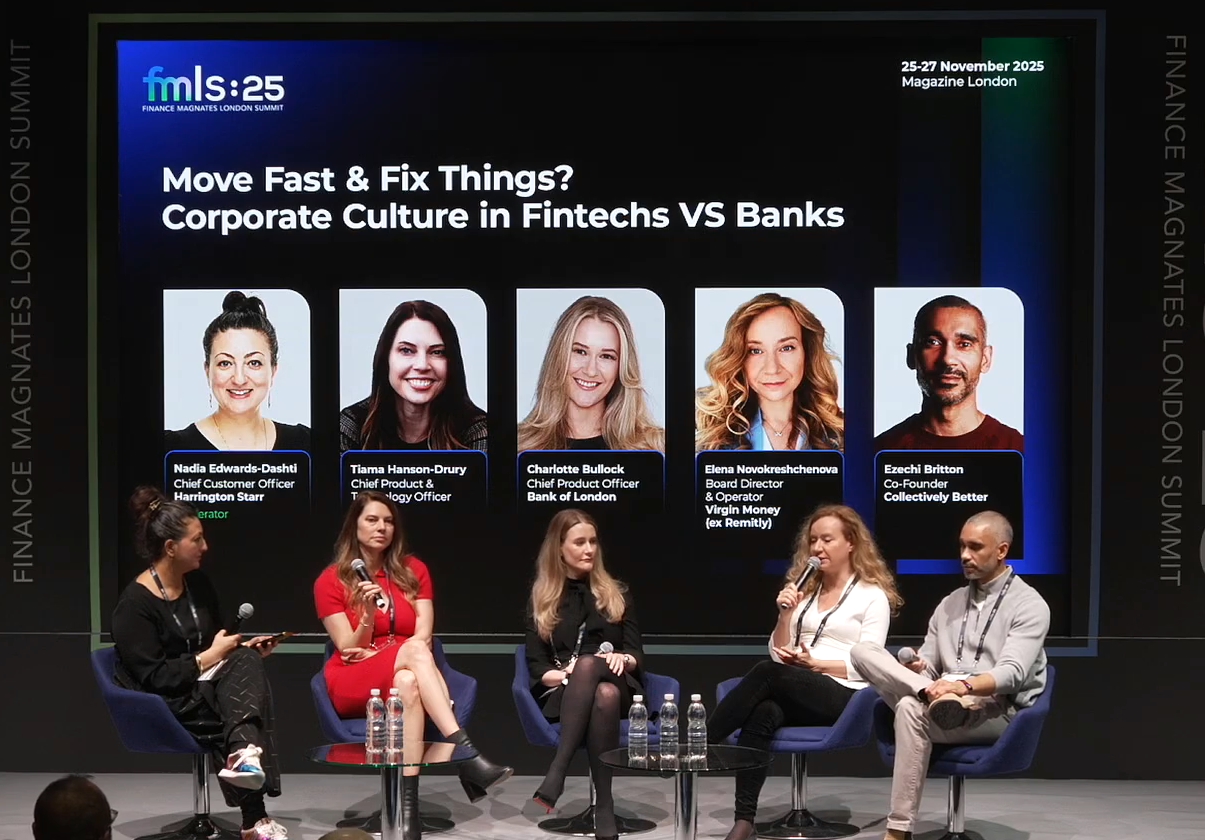
Britton said the industry has moved beyond what he called “team empire building” toward a sharper focus on revenue and execution. “The question now is not how many people you have, but are you generating revenue, are you profitable, and are you growing?”
Hanson-Drury agreed, warning that early-stage companies often mistake hiring for progress. At one former employer, she said, no role could be approved unless someone had already performed the work for three months—an approach designed to prevent premature expansion. Britton admitted he had learned the lesson the hard way: “Six months later you’re going, ‘Oh dear, I’ve got a problem right now.’”
Agile, but Not Aimless
If startups move quickly, banks move deliberately—and both models carry risk. Bullock, who has worked in global corporates and early-stage firms, described the extremes. In large institutions, lengthy approval chains can outlast the relevance of the technology under review. In startups, strategy can veer sharply with each new opportunity.
“I sometimes describe it as kids playing football,” she said. “One person kicks, everyone follows. It creates change debt—an MVP goes live, but when you try to scale it, the cracks show.”
Novokreshchenova added that the cultural divide is also geographic, with US firms historically more tolerant of failure than their European peers. Yet even banks are trying to adapt, she said, though regulators inevitably slow the pace. “By default, they are slower in terms of change,” she said. “But the appetite to improve is clearly there.”
McKinsey warned that banks could lose up to $170 billion in global profits, about 9%, as AI agents begin helping consumers automatically move money into higher-yield a/c
— Wall St Engine (@wallstengine) October 24, 2025
"Agentic AI” could erode margins by removing the inertia that keeps $23T of deposits stuck in near-0-rate… pic.twitter.com/aXLzZcks6O
AI: Competitive Weapon and Existential Risk
Where the panel showed both excitement and anxiety was artificial intelligence. Hanson-Drury warned that the competitive moat once created by professional judgment in fields such as banking and law is eroding fast.
“We’re now in a place where AI is being applied to multi-step processes—reason and judgment,” she said. “What used to be a competitive advantage is no longer one. If legacy players don’t harness this, fintechs will take market share.”
But Bullock cautioned against “AI for the sake of AI,” arguing that many use cases are disconnected from real strategy. Novokreshchenova added that implementation—not invention—will define the next phase of disruption. “It’s not plug-and-play,” she said, pointing to the difficulty of embedding new models into fragile legacy data infrastructures.
Governance emerged as the sharpest fault line. Bullock offered a stark warning about security risks. “With AI, copying an entire CRM platform could take minutes,” she said. “That’s terrifying.”
Britton framed the dilemma bluntly: “Revolut can move fast in a very different way from Barclays. The risk of making a mistake in production is not the same. In banking, the moment you break things for customers, you have a real issue.”
AI just went from making viral videos to moving millions of dollars.
— AI Frontliner (@AIFrontliner) December 9, 2025
This fintech is building AI agents to automate finance workflows
Here's the complete breakdown🧵 pic.twitter.com/aSToxkVEdM
The Talent Question
As automation accelerates, the panel warned of an unintended consequence: the hollowing out of junior roles. Bullock said entry-level positions are already disappearing. “Who needs an analyst when you have AI at your fingertips?” she asked. “But those people are also our future buyers.”
Hanson-Drury said future hires must combine curiosity with humility. “If you’re too fixed on how you used to build products, you’ll be out of date very quickly,” she said, describing how her teams now prototype ideas with AI tools before they ever reach formal approval.
Britton, however, urged caution against blind reliance on machine output. Without skepticism, he warned, “you’re going to get a generation of young coders vibe-coding their way into production with no understanding of what the code is doing.”
Novokreshchenova added a sobering ethical dimension, citing concerns around AI in debt collection and vulnerable consumers. “Innovation is exciting until there is an accident on the other side,” she said. Her advice to both startups and banks: “Don’t hire yourself. Balance speed with experience.”
Strategy Before Speed
As the discussion closed, a common thread emerged: technology may be accelerating, but strategy and people remain the decisive variables. Hanson-Drury urged firms to ensure every employee understands the basic economics of the business. “We can build faster than ever,” she said, “but that doesn’t mean it’s the right thing to launch.”
Britton offered a final warning against rushing into AI transformations without foundations in place. “Solve your people first,” he said. “Then your process. Then your technology.”
The panel ended where it began—on the uneasy balance between velocity and responsibility. In a world where systems can now move at machine speed, the true challenge for banks and fintechs alike is not how fast they can go, but how carefully they choose where to go next.


