

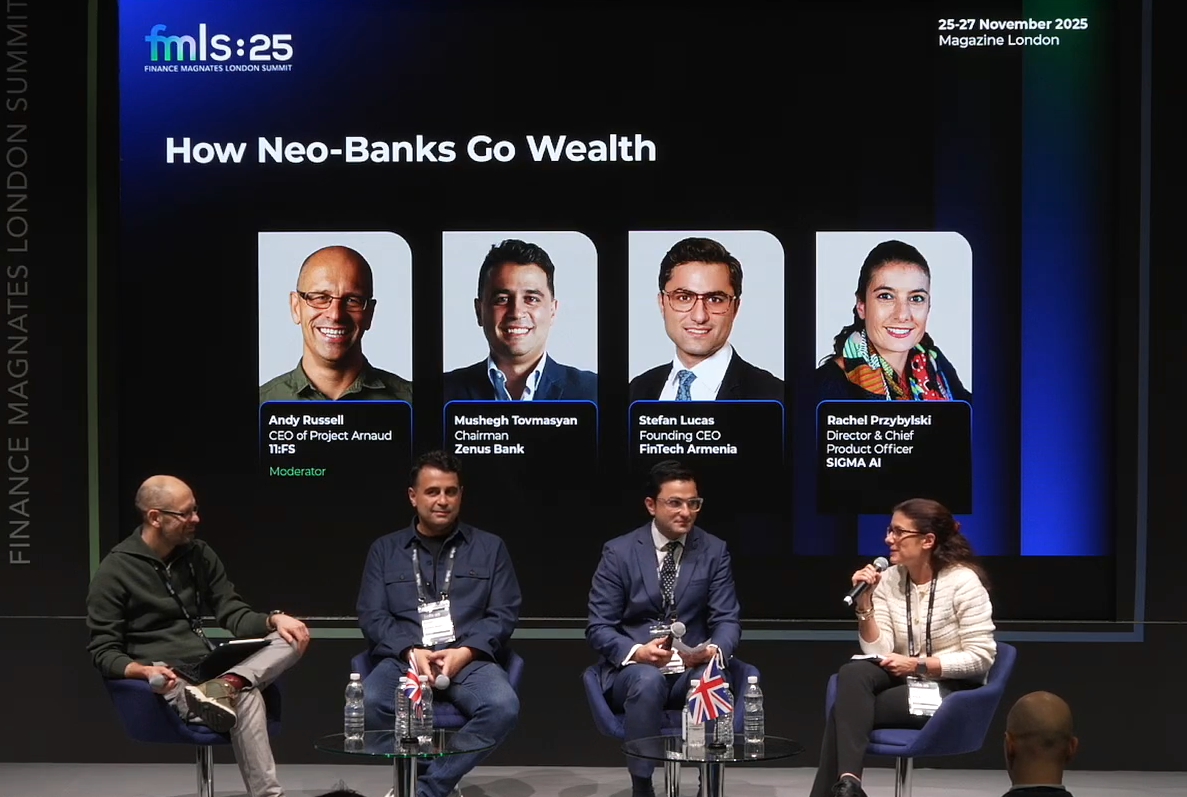
At the Finance Magnates London Summit 2025, a panel titled “How Neo Banks Go Wealth” explored the role of digital challengers in wealth management. The discussion highlighted how Europe’s £30 trillion wealth market is shifting from traditional advice to digital platforms, creating opportunities for neo banks to expand their presence in savings, investment, and asset management.
The session was moderated by Andy Russell, CEO of Project Arnaud at 11:FS, and featured Mushegh Tovmasyan, Chairman of Zenus Bank; Stefan Lucas, Founding CEO of FinTech Armenia; and Rachel Przybylski, Chief Product Officer at SIGMA AI. The panel examined how neo banks, fintech hubs, and AI-driven platforms are reshaping the industry.
Market Opportunity
The moderator framed the opportunity in stark terms: Europe’s wealth market is expanding at roughly five percent annually, while the gap widens between digitally engaged younger investors and high-net-worth clients relying on traditional advice.
- Chart Focused Traders Can Now Act Without Leaving eToro’s Desktop Charts
- SWIFT’s ISO 20022 Cutover Approaches as Blockchain Connections Point to Next Phase
- Brokers Clash Over UK Savings: eToro Launches Cash ISA, but IG Pushes Restrictions
At the same time, a significant intergenerational transfer of assets is underway, prompting the industry to rethink how wealth is delivered. Neo banks view this transition as a natural extension of their existing payments business.
Neo Banks as Infrastructure Front-Ends
Tovmasyan described neo banks as the “front end of financial services,” built on infrastructure that quietly manages payments, custody, and investment behind the scenes. “Stablecoins and crypto are a big trend, especially under the new US administration,” he said, pointing to faster cross-border settlement, decentralised finance, and new yield models as drivers of change.
Zenus, he added, now powers money movement for digital brands that want to add wealth without building full banking stacks themselves.
Strategic Expansion and Growth
From a market strategy perspective, Lucas said the push into wealth is driven by both regulatory and strategic considerations, with firms increasingly focused on profit growth and the accumulation of assets under management.
He pointed to forecasts that place the neo banking market at about two trillion dollars by the end of the decade, while wealth management represents a three-trillion-dollar opportunity with far larger projected AUM overall. By contrast, he said: “a CFD, spread-betting or forex broker —or a neo bank operating only in payments across a handful of countries—remains structurally limited in its growth.”
Expanding into wealth, he added, reflects the broader convergence now under way, with “traditional banks going digital, digital banks moving into traditional markets,” and crypto wallets increasingly intersecting with both.
Client Expectations and AI
Przybylski focused on client behaviour rather than balance sheets. Younger investors, she said, expect personalised, data-driven, and fast investment tools. “They want to make their own investment decisions and want the data to support that,” she told the audience. Firms with AI-native platforms, she added, will hold a structural advantage as competition accelerates.
What is a “neobank”?
— Noel Moldvai (@noelregrets) December 5, 2025
Good question. 😁
It’s basically a fintech company that only offers services online. (No physical locations)
Example: Revolut (and Chime, Mercury, SoFi)
Revolut has a banking license for the EU and the UK, but the US will be a critical market for for… pic.twitter.com/mcBIHfVyIV
Super-App Competition
The panel agreed that the industry is entering what Tovmasyan called a “super-app arms race,” as payments firms add investments, crypto platforms seek banking licences, and brokers move into payments. The strategic value, he argued, is shifting away from proprietary technology toward audience access and speed to market.
Yet the fragmentation of today’s wealth landscape may not last. Russell warned that while entry-level investing has already become an add-on feature across apps, deeper disruption is likely to strike the private banking middle, where efficiency and consolidation pressures are rising.
Regulatory Landscape
Regulation remains a moving target. Przybylski said most existing frameworks already cover much of today’s activity, but governance around artificial intelligence will be critical. Lucas pointed to a resurgence of regulatory sandboxes, including stablecoin trials under the UK’s Financial Conduct Authority and controlled fintech experimentation in Armenia.
Crypto and Generational Change
The sharpest generational divide surfaced during questions on crypto and custody. Tovmasyan said some younger wealthy clients now reject paper contracts altogether. “They just connect a wallet and trade,” he said, adding that regulators are increasingly focused on controlling fiat on-ramps and off-ramps through KYC and AML. “Once funds are on-chain, control becomes much harder. The change is already here.”
Long-Term Outlook
Despite the risks, the panel’s long-term outlook was broadly optimistic. Neo banks, Lucas argued, already have trust, data, and scale among middle-aged users. As products mature and older assets gradually change hands, wealth could become their most significant frontier yet.


