
An unbundled solution at a fraction of price of the Bloomberg product allures traders to Money.net.
FM
“Bloomberg Killer” - Google the words and you will find many companies trying to dethrone the popular and immensely profitable financial trading portal. In most cases the Bloomberg alternatives market themselves as being vastly cheaper with nearly all of the global giant's functionality.
Among the wannabe Bloomberg killers is Money.net. Unlike other rivals, Money.net was founded by a former Bloomberg employee with knowledge of its product and customer type.
With a monthly price of $150, Money.net costs a fraction of the price of Bloomberg Terminal’s $2000 per month fee. But can it really operate as an alternative to a Bloomberg Terminal? The answer is - it depends on what you are looking for.
Along with Money.net, the theory among the many Bloomberg killers is that they can compete by offering an unbundled solution. This model allows users to purchase the parts they want at significantly lower costs.
Nuts and bolts
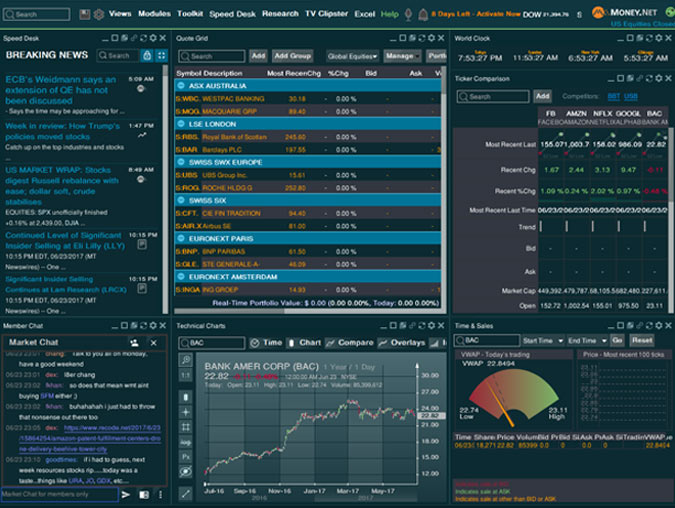
At the heart of Money.net is a market data platform with real time pricing, charting and research. To expand functionality, Money.net has partnered with other firms to add features allowing the platform to mimic Bloomberg.
Market data: Like Bloomberg, users can build trading screens with lists of stock symbols, indexes and other traded asset classes. As well as query charts and time and sales grids of any symbol.
Trading: While not used by all Bloomberg users, a core feature of the Terminal is the ability to place trades directly from the platform. This allows traders to use the same interface for both their analysis and order management. To mimic this, Money.net has partnered with multiple brokers such as E*Trade, OptionsCity, Interactive Brokers and TD Waterhouse. Through the partnerships, broker customers of Money.net’s partners can access and trade their accounts on a GUI that is integrated directly on the market data platform.
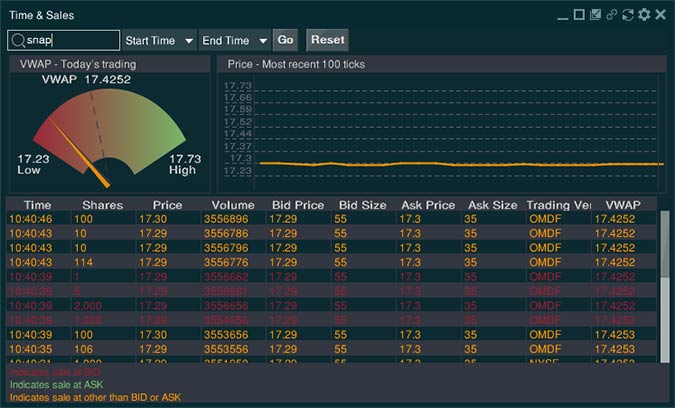
Time & Sales
Chat: Arguably the biggest pushback in the market for leaving Bloomberg is its ‘chat’ feature. Often cited as the Facebook for millionaires, the Terminal’s chat allows users to message each other as well as create groups between themselves. Due to the advantages of being connected to other influential traders and analysts, there are many Terminal users paying the high monthly fees only to access the chat. To compete, Money.net includes its own inter-chat functionality between its users. Offered as a public forum, users can pitch real time ideas and gain feedback from the Money.net community. In addition, following with the ‘unbundling’ theme, Money.net is integrated with Symphony.
Also touted as a Bloomberg killer, Symphony is a bank backed messaging platform that was created to provide a lower cost alternative for financial professionals that only want an industry chat network without the high cost of a Terminal. Symphony also touts end to end encryption which is advanced to the Bloomberg chat.
Analytics: Arguably, Money.net’s most distinguishing feature is its Excel analytics plugin. With the plugin, users can connect data to Excel sheets containing their analytic calculations. The Excel connectivity is bolstered by the ability to use pretty much any data point for calculations such as company fundamentals and economic reports. As such, a user could create a query to compare in real time Crude Inventory results to Oil Stock prices to find laggards and strong performers to trade.
Bloomberg also provides a wide ranging list of variables available for analytic calculations, and is therefore used widely by securities analysts and traders. With Money.net’s Excel integration, many Bloomberg users should be able to cover their analytic needs with the platform.
News and research: Probably its weakest link when compared with Bloomberg and other expensive terminals such as Thomson Reuters Eikon and CapitalIQ is the available news and research on Money.net.
For real time news, Money.net aggregates data from numerous sources such as The Fly on the Wall, Seeking Alpha and Twitter. However, as those outlets predominately repost information from news tickers like Bloomberg and Dow Jones, traders used to accessing news from primary sources as it happens might be disappointed with Money.net.
Also, Wall Street analyst recommendations and commentary is lacking on Money.net compared to that of the high-end terminals.

Newsticker with Twitter news tweet
UI/UX: On a graphical level, Money.net has a lot going for it. It looks modern and users can unlock individual modules such as charts or time and sales screens to operate in their own windows.
On the downside, while looking slick, the available charting experience felt a bit clunky when compared to modern systems based on HTML5. Also, some of the fancy features such as a tick chart and VWAP scale on the time and sales window took a lot of room and weren’t adding much value.
Support:To compete against the big boys, Money.net has had to cater to customers and focus on great support. Even as they’ve grown quickly, the customer focus has continued with the company available to help individual users answer their questions and demo features.
Competition
Money.net spends a lot of time on its site comparing itself to Bloomberg. There are definite tradeoffs with the lower price. There is no question that the vast majority of Bloomberg users don’t need most of its features and can be equally productive paying for systems at a fraction of the cost.
In this regard, there are other platforms and products in Money.net’s price range competing for private individual traders and for cost conscious banks and brokers.
E-Signal: One of the oldest in the game, E-Signal has been providing traders real time trading data and charting at an affordable price for years. The system also allows users to export data to power their own analytic solutions.
TipRanks: On the surface, TipRanks may be an odd choice to be listed as a Money.net competitor. However, TipRanks focuses exclusively on providing and ranking Wall Street research. As such, they also compete for available dollars from professional traders with many of their customers happy to run TipRanks alongside their broker’s complementary trading platforms.
NetDania: Not as well known in the US, Denmark-based NetDania has been providing unbundled trading tools to financial institutions since the 1990’s. Specifically they have carved out a niche in Europe with their FX related products. For many trading desks, these solutions provide a cost effective alternative to the bundled and costly terminals.
TradingView: No one will confuse TradingView for a high end trading platform. But, there is no questioning that TradingView provides some of the best charting tools in the market. They’ve also built a massive community on their platform. It’s not Bloomberg’s chat network, but for private traders that are charting aficionados, the TradingView community covers this niche sector with Pro prices that are well below that of Money.net.
Conclusion
Is Money.net a Bloomberg killer? There is no doubt that it's vastly cheaper. But if you are making money using the Bloomberg Terminal, than cost isn’t the only factor.
Where you have to give Money.net credit though, is that they have succeeded in integrating both internal and external trading tools together. This provides a semblance of the bundled all-in-one environment that is behind the high cost terminals and why their users are such big fans.
“Bloomberg Killer” - Google the words and you will find many companies trying to dethrone the popular and immensely profitable financial trading portal. In most cases the Bloomberg alternatives market themselves as being vastly cheaper with nearly all of the global giant's functionality.
Among the wannabe Bloomberg killers is Money.net. Unlike other rivals, Money.net was founded by a former Bloomberg employee with knowledge of its product and customer type.
With a monthly price of $150, Money.net costs a fraction of the price of Bloomberg Terminal’s $2000 per month fee. But can it really operate as an alternative to a Bloomberg Terminal? The answer is - it depends on what you are looking for.
Along with Money.net, the theory among the many Bloomberg killers is that they can compete by offering an unbundled solution. This model allows users to purchase the parts they want at significantly lower costs.
Nuts and bolts
At the heart of Money.net is a market data platform with real time pricing, charting and research. To expand functionality, Money.net has partnered with other firms to add features allowing the platform to mimic Bloomberg.
Market data: Like Bloomberg, users can build trading screens with lists of stock symbols, indexes and other traded asset classes. As well as query charts and time and sales grids of any symbol.
Trading: While not used by all Bloomberg users, a core feature of the Terminal is the ability to place trades directly from the platform. This allows traders to use the same interface for both their analysis and order management. To mimic this, Money.net has partnered with multiple brokers such as E*Trade, OptionsCity, Interactive Brokers and TD Waterhouse. Through the partnerships, broker customers of Money.net’s partners can access and trade their accounts on a GUI that is integrated directly on the market data platform.
Time & Sales
Chat: Arguably the biggest pushback in the market for leaving Bloomberg is its ‘chat’ feature. Often cited as the Facebook for millionaires, the Terminal’s chat allows users to message each other as well as create groups between themselves. Due to the advantages of being connected to other influential traders and analysts, there are many Terminal users paying the high monthly fees only to access the chat. To compete, Money.net includes its own inter-chat functionality between its users. Offered as a public forum, users can pitch real time ideas and gain feedback from the Money.net community. In addition, following with the ‘unbundling’ theme, Money.net is integrated with Symphony.
Also touted as a Bloomberg killer, Symphony is a bank backed messaging platform that was created to provide a lower cost alternative for financial professionals that only want an industry chat network without the high cost of a Terminal. Symphony also touts end to end encryption which is advanced to the Bloomberg chat.
Analytics: Arguably, Money.net’s most distinguishing feature is its Excel analytics plugin. With the plugin, users can connect data to Excel sheets containing their analytic calculations. The Excel connectivity is bolstered by the ability to use pretty much any data point for calculations such as company fundamentals and economic reports. As such, a user could create a query to compare in real time Crude Inventory results to Oil Stock prices to find laggards and strong performers to trade.
Bloomberg also provides a wide ranging list of variables available for analytic calculations, and is therefore used widely by securities analysts and traders. With Money.net’s Excel integration, many Bloomberg users should be able to cover their analytic needs with the platform.
News and research: Probably its weakest link when compared with Bloomberg and other expensive terminals such as Thomson Reuters Eikon and CapitalIQ is the available news and research on Money.net.
For real time news, Money.net aggregates data from numerous sources such as The Fly on the Wall, Seeking Alpha and Twitter. However, as those outlets predominately repost information from news tickers like Bloomberg and Dow Jones, traders used to accessing news from primary sources as it happens might be disappointed with Money.net.
Also, Wall Street analyst recommendations and commentary is lacking on Money.net compared to that of the high-end terminals.
Newsticker with Twitter news tweet
UI/UX: On a graphical level, Money.net has a lot going for it. It looks modern and users can unlock individual modules such as charts or time and sales screens to operate in their own windows.
On the downside, while looking slick, the available charting experience felt a bit clunky when compared to modern systems based on HTML5. Also, some of the fancy features such as a tick chart and VWAP scale on the time and sales window took a lot of room and weren’t adding much value.
Support:To compete against the big boys, Money.net has had to cater to customers and focus on great support. Even as they’ve grown quickly, the customer focus has continued with the company available to help individual users answer their questions and demo features.
Competition
Money.net spends a lot of time on its site comparing itself to Bloomberg. There are definite tradeoffs with the lower price. There is no question that the vast majority of Bloomberg users don’t need most of its features and can be equally productive paying for systems at a fraction of the cost.
In this regard, there are other platforms and products in Money.net’s price range competing for private individual traders and for cost conscious banks and brokers.
E-Signal: One of the oldest in the game, E-Signal has been providing traders real time trading data and charting at an affordable price for years. The system also allows users to export data to power their own analytic solutions.
TipRanks: On the surface, TipRanks may be an odd choice to be listed as a Money.net competitor. However, TipRanks focuses exclusively on providing and ranking Wall Street research. As such, they also compete for available dollars from professional traders with many of their customers happy to run TipRanks alongside their broker’s complementary trading platforms.
NetDania: Not as well known in the US, Denmark-based NetDania has been providing unbundled trading tools to financial institutions since the 1990’s. Specifically they have carved out a niche in Europe with their FX related products. For many trading desks, these solutions provide a cost effective alternative to the bundled and costly terminals.
TradingView: No one will confuse TradingView for a high end trading platform. But, there is no questioning that TradingView provides some of the best charting tools in the market. They’ve also built a massive community on their platform. It’s not Bloomberg’s chat network, but for private traders that are charting aficionados, the TradingView community covers this niche sector with Pro prices that are well below that of Money.net.
Conclusion
Is Money.net a Bloomberg killer? There is no doubt that it's vastly cheaper. But if you are making money using the Bloomberg Terminal, than cost isn’t the only factor.
Where you have to give Money.net credit though, is that they have succeeded in integrating both internal and external trading tools together. This provides a semblance of the bundled all-in-one environment that is behind the high cost terminals and why their users are such big fans.
In this conversation, we sit down with Drew Niv, CSO at ATFX Connect and one of the most influential figures in modern FX.
We speak about market structure, the institutional view on liquidity, and the sharp rise of prop trading, a sector Drew has been commenting on in recent months. Drew explains why he once dismissed prop trading, why his view changed, and what he now thinks the model means for brokers, clients and risk managers.
We explore subscription-fee dependency, the high reneging rate, and the long-term challenge: how brokers can build a more stable and honest version of the model. Drew also talks about the traffic advantage standalone prop firms have built and why brokers may still win in the long run if they take the right approach.
In this conversation, we sit down with Drew Niv, CSO at ATFX Connect and one of the most influential figures in modern FX.
We speak about market structure, the institutional view on liquidity, and the sharp rise of prop trading, a sector Drew has been commenting on in recent months. Drew explains why he once dismissed prop trading, why his view changed, and what he now thinks the model means for brokers, clients and risk managers.
We explore subscription-fee dependency, the high reneging rate, and the long-term challenge: how brokers can build a more stable and honest version of the model. Drew also talks about the traffic advantage standalone prop firms have built and why brokers may still win in the long run if they take the right approach.
In this conversation, we sit down with Drew Niv, CSO at ATFX Connect and one of the most influential figures in modern FX.
We speak about market structure, the institutional view on liquidity, and the sharp rise of prop trading, a sector Drew has been commenting on in recent months. Drew explains why he once dismissed prop trading, why his view changed, and what he now thinks the model means for brokers, clients and risk managers.
We explore subscription-fee dependency, the high reneging rate, and the long-term challenge: how brokers can build a more stable and honest version of the model. Drew also talks about the traffic advantage standalone prop firms have built and why brokers may still win in the long run if they take the right approach.
In this conversation, we sit down with Drew Niv, CSO at ATFX Connect and one of the most influential figures in modern FX.
We speak about market structure, the institutional view on liquidity, and the sharp rise of prop trading, a sector Drew has been commenting on in recent months. Drew explains why he once dismissed prop trading, why his view changed, and what he now thinks the model means for brokers, clients and risk managers.
We explore subscription-fee dependency, the high reneging rate, and the long-term challenge: how brokers can build a more stable and honest version of the model. Drew also talks about the traffic advantage standalone prop firms have built and why brokers may still win in the long run if they take the right approach.
Executive Interview | Remonda Z. Kirketerp Møller| CEO & Founder Muinmos | FMLS:25
In this interview, Remonda Z. Kirketerp Møller, founder of Muinmos, breaks down the state of AI in regtech and what responsible adoption really looks like for brokers. We talk about rising fragmentation, the pressures around compliance accuracy, and why most firms are still in the early stages of AI maturity.
Ramanda also shares insights on regulator sandboxes, shifting expectations around accountability, and the current reality of MiCA licensing and passporting in Europe.
A concise look at where compliance, onboarding, and AI-driven processes are heading next.
In this interview, Remonda Z. Kirketerp Møller, founder of Muinmos, breaks down the state of AI in regtech and what responsible adoption really looks like for brokers. We talk about rising fragmentation, the pressures around compliance accuracy, and why most firms are still in the early stages of AI maturity.
Ramanda also shares insights on regulator sandboxes, shifting expectations around accountability, and the current reality of MiCA licensing and passporting in Europe.
A concise look at where compliance, onboarding, and AI-driven processes are heading next.
In this interview, Remonda Z. Kirketerp Møller, founder of Muinmos, breaks down the state of AI in regtech and what responsible adoption really looks like for brokers. We talk about rising fragmentation, the pressures around compliance accuracy, and why most firms are still in the early stages of AI maturity.
Ramanda also shares insights on regulator sandboxes, shifting expectations around accountability, and the current reality of MiCA licensing and passporting in Europe.
A concise look at where compliance, onboarding, and AI-driven processes are heading next.
In this interview, Remonda Z. Kirketerp Møller, founder of Muinmos, breaks down the state of AI in regtech and what responsible adoption really looks like for brokers. We talk about rising fragmentation, the pressures around compliance accuracy, and why most firms are still in the early stages of AI maturity.
Ramanda also shares insights on regulator sandboxes, shifting expectations around accountability, and the current reality of MiCA licensing and passporting in Europe.
A concise look at where compliance, onboarding, and AI-driven processes are heading next.
In this interview, Remonda Z. Kirketerp Møller, founder of Muinmos, breaks down the state of AI in regtech and what responsible adoption really looks like for brokers. We talk about rising fragmentation, the pressures around compliance accuracy, and why most firms are still in the early stages of AI maturity.
Ramanda also shares insights on regulator sandboxes, shifting expectations around accountability, and the current reality of MiCA licensing and passporting in Europe.
A concise look at where compliance, onboarding, and AI-driven processes are heading next.
In this interview, Remonda Z. Kirketerp Møller, founder of Muinmos, breaks down the state of AI in regtech and what responsible adoption really looks like for brokers. We talk about rising fragmentation, the pressures around compliance accuracy, and why most firms are still in the early stages of AI maturity.
Ramanda also shares insights on regulator sandboxes, shifting expectations around accountability, and the current reality of MiCA licensing and passporting in Europe.
A concise look at where compliance, onboarding, and AI-driven processes are heading next.
In this conversation, we speak with Aydin Bonabi, CEO and co-founder of Surveill, a firm focused on fraud detection and AI-driven compliance tools for financial institutions.
We start with Aydin’s view of the Summit and the challenges brokers face as fraud tactics grow more complex. He explains how firms can stay ahead through real-time signals, data patterns, and early-stage detection.
We also talk about AI training and why compliance teams often struggle to keep models accurate, fair, and aligned with regulatory expectations. Aydin breaks down what “good” AI training looks like inside a financial environment, including the importance of clean data, domain expertise, and human oversight.
He closes with a clear message: fraud is scaling, and so must the tools that stop it.
In this conversation, we speak with Aydin Bonabi, CEO and co-founder of Surveill, a firm focused on fraud detection and AI-driven compliance tools for financial institutions.
We start with Aydin’s view of the Summit and the challenges brokers face as fraud tactics grow more complex. He explains how firms can stay ahead through real-time signals, data patterns, and early-stage detection.
We also talk about AI training and why compliance teams often struggle to keep models accurate, fair, and aligned with regulatory expectations. Aydin breaks down what “good” AI training looks like inside a financial environment, including the importance of clean data, domain expertise, and human oversight.
He closes with a clear message: fraud is scaling, and so must the tools that stop it.
In this conversation, we speak with Aydin Bonabi, CEO and co-founder of Surveill, a firm focused on fraud detection and AI-driven compliance tools for financial institutions.
We start with Aydin’s view of the Summit and the challenges brokers face as fraud tactics grow more complex. He explains how firms can stay ahead through real-time signals, data patterns, and early-stage detection.
We also talk about AI training and why compliance teams often struggle to keep models accurate, fair, and aligned with regulatory expectations. Aydin breaks down what “good” AI training looks like inside a financial environment, including the importance of clean data, domain expertise, and human oversight.
He closes with a clear message: fraud is scaling, and so must the tools that stop it.
In this conversation, we speak with Aydin Bonabi, CEO and co-founder of Surveill, a firm focused on fraud detection and AI-driven compliance tools for financial institutions.
We start with Aydin’s view of the Summit and the challenges brokers face as fraud tactics grow more complex. He explains how firms can stay ahead through real-time signals, data patterns, and early-stage detection.
We also talk about AI training and why compliance teams often struggle to keep models accurate, fair, and aligned with regulatory expectations. Aydin breaks down what “good” AI training looks like inside a financial environment, including the importance of clean data, domain expertise, and human oversight.
He closes with a clear message: fraud is scaling, and so must the tools that stop it.
In this conversation, we speak with Aydin Bonabi, CEO and co-founder of Surveill, a firm focused on fraud detection and AI-driven compliance tools for financial institutions.
We start with Aydin’s view of the Summit and the challenges brokers face as fraud tactics grow more complex. He explains how firms can stay ahead through real-time signals, data patterns, and early-stage detection.
We also talk about AI training and why compliance teams often struggle to keep models accurate, fair, and aligned with regulatory expectations. Aydin breaks down what “good” AI training looks like inside a financial environment, including the importance of clean data, domain expertise, and human oversight.
He closes with a clear message: fraud is scaling, and so must the tools that stop it.
In this conversation, we speak with Aydin Bonabi, CEO and co-founder of Surveill, a firm focused on fraud detection and AI-driven compliance tools for financial institutions.
We start with Aydin’s view of the Summit and the challenges brokers face as fraud tactics grow more complex. He explains how firms can stay ahead through real-time signals, data patterns, and early-stage detection.
We also talk about AI training and why compliance teams often struggle to keep models accurate, fair, and aligned with regulatory expectations. Aydin breaks down what “good” AI training looks like inside a financial environment, including the importance of clean data, domain expertise, and human oversight.
He closes with a clear message: fraud is scaling, and so must the tools that stop it.
Exness expands its presence in Africa: Inside our interview with Paul Margarites in Cape Town
Finance Magnates met with Paul Margarites, Exness regional commercial director for Sub-Saharan Africa, during a visit to the firm’s office opening in Cape Town. In this talk, led by Andrea Badiola Mateos, Co-CEO at Finance Magnates, Paul shares views on the South African trading space, local user behavior, mobile trends, regulation, team growth, and how Exness plans to grow in more markets across the region. @Exness
Read the article at: https://www.financemagnates.com/thought-leadership/exness-expands-its-presence-in-africa-inside-our-interview-with-paul-margarites/
#exness #financemagnates #exnesstrading #CFDtrading #tradeonline #africanews #capetown
Finance Magnates met with Paul Margarites, Exness regional commercial director for Sub-Saharan Africa, during a visit to the firm’s office opening in Cape Town. In this talk, led by Andrea Badiola Mateos, Co-CEO at Finance Magnates, Paul shares views on the South African trading space, local user behavior, mobile trends, regulation, team growth, and how Exness plans to grow in more markets across the region. @Exness
Read the article at: https://www.financemagnates.com/thought-leadership/exness-expands-its-presence-in-africa-inside-our-interview-with-paul-margarites/
#exness #financemagnates #exnesstrading #CFDtrading #tradeonline #africanews #capetown
Finance Magnates met with Paul Margarites, Exness regional commercial director for Sub-Saharan Africa, during a visit to the firm’s office opening in Cape Town. In this talk, led by Andrea Badiola Mateos, Co-CEO at Finance Magnates, Paul shares views on the South African trading space, local user behavior, mobile trends, regulation, team growth, and how Exness plans to grow in more markets across the region. @Exness
Read the article at: https://www.financemagnates.com/thought-leadership/exness-expands-its-presence-in-africa-inside-our-interview-with-paul-margarites/
#exness #financemagnates #exnesstrading #CFDtrading #tradeonline #africanews #capetown
Finance Magnates met with Paul Margarites, Exness regional commercial director for Sub-Saharan Africa, during a visit to the firm’s office opening in Cape Town. In this talk, led by Andrea Badiola Mateos, Co-CEO at Finance Magnates, Paul shares views on the South African trading space, local user behavior, mobile trends, regulation, team growth, and how Exness plans to grow in more markets across the region. @Exness
Read the article at: https://www.financemagnates.com/thought-leadership/exness-expands-its-presence-in-africa-inside-our-interview-with-paul-margarites/
#exness #financemagnates #exnesstrading #CFDtrading #tradeonline #africanews #capetown
Finance Magnates met with Paul Margarites, Exness regional commercial director for Sub-Saharan Africa, during a visit to the firm’s office opening in Cape Town. In this talk, led by Andrea Badiola Mateos, Co-CEO at Finance Magnates, Paul shares views on the South African trading space, local user behavior, mobile trends, regulation, team growth, and how Exness plans to grow in more markets across the region. @Exness
Read the article at: https://www.financemagnates.com/thought-leadership/exness-expands-its-presence-in-africa-inside-our-interview-with-paul-margarites/
#exness #financemagnates #exnesstrading #CFDtrading #tradeonline #africanews #capetown
Finance Magnates met with Paul Margarites, Exness regional commercial director for Sub-Saharan Africa, during a visit to the firm’s office opening in Cape Town. In this talk, led by Andrea Badiola Mateos, Co-CEO at Finance Magnates, Paul shares views on the South African trading space, local user behavior, mobile trends, regulation, team growth, and how Exness plans to grow in more markets across the region. @Exness
Read the article at: https://www.financemagnates.com/thought-leadership/exness-expands-its-presence-in-africa-inside-our-interview-with-paul-margarites/
#exness #financemagnates #exnesstrading #CFDtrading #tradeonline #africanews #capetown
Executive Interview | Jas Shah | FMLS:25
Interview with Jas Shah
Builder | Adviser | Fintech Writer | Product Strategist
In this episode, Jonathan Fine sat down with Jas Shah, one of the most thoughtful voices in global fintech. Known for his work across advisory, product, stablecoins, and his widely read writing, Jas brings a rare combination of industry insight and plain-spoken clarity.
We talk about his first impression of the Summit, the projects that keep him busy today, and how they connect to the stablecoin panel he joined. Jas shares his view on the link between fintech, wealthtech and retail brokers, especially as firms like Revolut, eToro and Trading212 blur long-standing lines in the market.
We also explore what stablecoin adoption might look like for retail investment platforms, including a few product and UX angles that are not obvious at first glance.
To close, Jas explains how he thinks about writing, and how he approaches “shipping” pieces that spark debate across the industry.
Interview with Jas Shah
Builder | Adviser | Fintech Writer | Product Strategist
In this episode, Jonathan Fine sat down with Jas Shah, one of the most thoughtful voices in global fintech. Known for his work across advisory, product, stablecoins, and his widely read writing, Jas brings a rare combination of industry insight and plain-spoken clarity.
We talk about his first impression of the Summit, the projects that keep him busy today, and how they connect to the stablecoin panel he joined. Jas shares his view on the link between fintech, wealthtech and retail brokers, especially as firms like Revolut, eToro and Trading212 blur long-standing lines in the market.
We also explore what stablecoin adoption might look like for retail investment platforms, including a few product and UX angles that are not obvious at first glance.
To close, Jas explains how he thinks about writing, and how he approaches “shipping” pieces that spark debate across the industry.
Interview with Jas Shah
Builder | Adviser | Fintech Writer | Product Strategist
In this episode, Jonathan Fine sat down with Jas Shah, one of the most thoughtful voices in global fintech. Known for his work across advisory, product, stablecoins, and his widely read writing, Jas brings a rare combination of industry insight and plain-spoken clarity.
We talk about his first impression of the Summit, the projects that keep him busy today, and how they connect to the stablecoin panel he joined. Jas shares his view on the link between fintech, wealthtech and retail brokers, especially as firms like Revolut, eToro and Trading212 blur long-standing lines in the market.
We also explore what stablecoin adoption might look like for retail investment platforms, including a few product and UX angles that are not obvious at first glance.
To close, Jas explains how he thinks about writing, and how he approaches “shipping” pieces that spark debate across the industry.
Interview with Jas Shah
Builder | Adviser | Fintech Writer | Product Strategist
In this episode, Jonathan Fine sat down with Jas Shah, one of the most thoughtful voices in global fintech. Known for his work across advisory, product, stablecoins, and his widely read writing, Jas brings a rare combination of industry insight and plain-spoken clarity.
We talk about his first impression of the Summit, the projects that keep him busy today, and how they connect to the stablecoin panel he joined. Jas shares his view on the link between fintech, wealthtech and retail brokers, especially as firms like Revolut, eToro and Trading212 blur long-standing lines in the market.
We also explore what stablecoin adoption might look like for retail investment platforms, including a few product and UX angles that are not obvious at first glance.
To close, Jas explains how he thinks about writing, and how he approaches “shipping” pieces that spark debate across the industry.
Interview with Jas Shah
Builder | Adviser | Fintech Writer | Product Strategist
In this episode, Jonathan Fine sat down with Jas Shah, one of the most thoughtful voices in global fintech. Known for his work across advisory, product, stablecoins, and his widely read writing, Jas brings a rare combination of industry insight and plain-spoken clarity.
We talk about his first impression of the Summit, the projects that keep him busy today, and how they connect to the stablecoin panel he joined. Jas shares his view on the link between fintech, wealthtech and retail brokers, especially as firms like Revolut, eToro and Trading212 blur long-standing lines in the market.
We also explore what stablecoin adoption might look like for retail investment platforms, including a few product and UX angles that are not obvious at first glance.
To close, Jas explains how he thinks about writing, and how he approaches “shipping” pieces that spark debate across the industry.
Interview with Jas Shah
Builder | Adviser | Fintech Writer | Product Strategist
In this episode, Jonathan Fine sat down with Jas Shah, one of the most thoughtful voices in global fintech. Known for his work across advisory, product, stablecoins, and his widely read writing, Jas brings a rare combination of industry insight and plain-spoken clarity.
We talk about his first impression of the Summit, the projects that keep him busy today, and how they connect to the stablecoin panel he joined. Jas shares his view on the link between fintech, wealthtech and retail brokers, especially as firms like Revolut, eToro and Trading212 blur long-standing lines in the market.
We also explore what stablecoin adoption might look like for retail investment platforms, including a few product and UX angles that are not obvious at first glance.
To close, Jas explains how he thinks about writing, and how he approaches “shipping” pieces that spark debate across the industry.