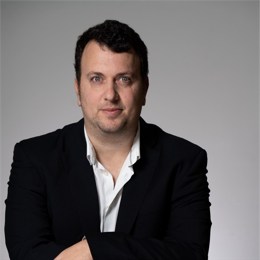
Bridgewise’s CEO, Gaby Diamant, spoke with Finance Magnates after raising $21 million in funding elaborating on its use of AI for stock analysis reports.
"TipRanks is aggregating a lot of data from analysts, while Bridgewise is creating opinions."
“The stock research market is broken and highly concentrated,” Bridgewise’s CEO, Gaby Diamant, pointed out while speaking to Finance Magnates recently after raising $21 million, adding: “Only 20 percent of global companies are covered by analysts. While the situation is slightly better in the US, it is dire in Europe, Latin America, and Asia.”
Bridgewise is addressing this gap by generating stock analysis reports in over 22 languages across 15 countries. Founded in 2019, the Israeli company employs proprietary generative artificial intelligence (AI) models to produce analyses and reports.
Addressing the language gap in stock reports, Bridgewise’s CEO described it as an “amazing advantage” for the company.
While English remains dominant due to its reach, other top languages in demand are Portuguese and Hebrew, based on Bridgewise’s user data. The platform’s popularity in Brazil has led to increased usage of Portuguese. Interestingly, the company generates all reports directly in local languages and receives approximately 120 million API calls yearly.
“In Brazil, we have a significant market share, but I believe it will begin shifting towards Japan, where we see emerging interest. We are also targeting investors in Singapore and Hong Kong,” Bridgewise’s CEO said.
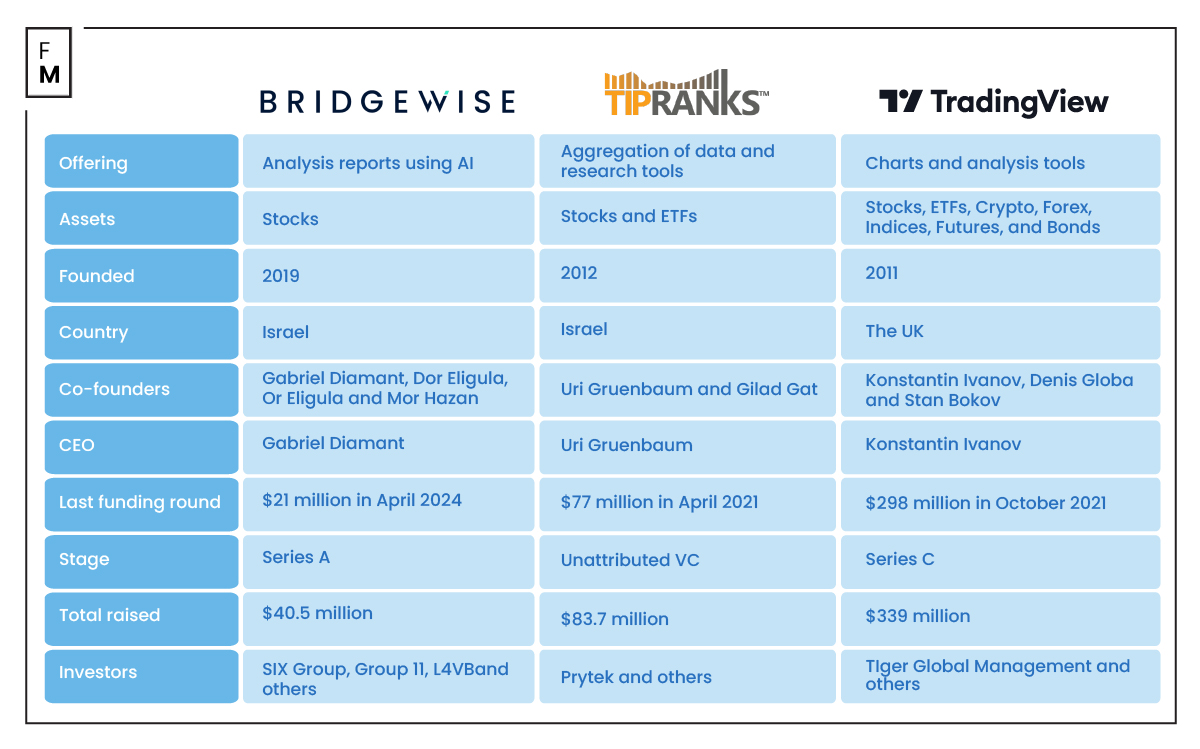
However, Bridgewise is not the only company offering stock research with AI. Its closest competitor is TipRanks, another Israeli company, uses natural language processing to analyze the performance of professional analysts for its services.
"The two companies are doing exactly the same thing, but the difference is an aggregation and opinion," Diamant elaborated. "TipRanks is aggregating a lot of data from analysts, while Bridgewise is creating opinions. We are actually acting as an analyst."
“Not for the Money”
Israel-headquartered Bridgewise, with offices in New York, London, Sao Paulo, Singapore, and Tokyo, recently secured $21 million in funding. Officially, the company stated it will use the funds “to accelerate market penetration and growth.”
However, Diamant revealed that money was not the primary motive for raising the funds.
“The main reason we pursued this funding round was not for the money,” Diamant said. “I know it sounds obnoxious,” he added, “What we did was bring global players. In this round, we attracted institutions from four different continents, including the United Emirates, the US, and Switzerland.”
Indeed, Switzerland’s SIX Group led Bridgewise’s latest funding round, with participation from Group11, L4 Venture Builder, and other global financial institutions.
“We Made Our Analysts Write Our Training Data”
One of the challenges AI companies face is copyright infringement with the training data. OpenAI, which revolutionized the AI industry by introducing ChatGPT, has been sued by a group of US newspapers over the allegations of misusing reporters' work to train their generative AI models.
Regarding niche companies like Bridgewise, such copyright infringement issues are minimal.
“We are highly focused on the reports we generate, resulting in less work when training AI models. Moreover, we made the strategic decision to have our analysts write our entire training data for the report,” Diamant said.
“Developing a micro language model with connected training data and putting it into practice provided us with a significant advantage over the rest of the market.”
In addition to reports, Bridgewise’s AI model scores individual stocks and predicts their future performance.
“One of our initial challenges was to establish a standardized approach because we did not want reports similar to those offered by other companies. Thus, we chose a different path,” Diamant explained.
“Our emphasis is on sector-specific features. For instance, we focus on marginal profit and interest in the banking industry. On the technological side, we place greater emphasis on revenues, which vary across different segments.”
Bridgewise’s CEO further disclosed that the company relies on “22 algorithms that segment the world region based on market cap and sectors,” rather than a single algorithm. The company is also generating all the reports in local languages rather then translating them from another language.
"We are not translating anything. We are building the report in the local language," Diamant said. "This makes the reports so much better, well. You can see that there is zero quality loss between the reports in English and the ones in other local languages."
“The Trust Rate Is Not as High as You Imagine”
Generative AI has made significant strides in the financial sector, among others. Discussing AI’s use in finance, Diamant said: “AI excels at summarizing information, but it struggles with generating new ideas. This poses a challenge when the data is inaccurate.”
“We are already in discussions with industry giants like Goldman Sachs, Barclays, and Citibank. They recognise that AI is adept at summarizing data but should be used cautiously for generating ideas. The rest falls somewhere in between.”
“Currently, financial institutions trust and employ large summarization models. They use them to make data more engaging and create conversational gateways into their data sources, similar to what we are doing.”
However, there are other challenges, as he continued: “I think that the first thing financial institutions will do is to use AI-based services internally before releasing them to the public. This is because the trust rate is not as high as you imagine. I think there are a lot of things that need to be resolved right now regarding trust and responsibility.”
“The stock research market is broken and highly concentrated,” Bridgewise’s CEO, Gaby Diamant, pointed out while speaking to Finance Magnates recently after raising $21 million, adding: “Only 20 percent of global companies are covered by analysts. While the situation is slightly better in the US, it is dire in Europe, Latin America, and Asia.”
Bridgewise is addressing this gap by generating stock analysis reports in over 22 languages across 15 countries. Founded in 2019, the Israeli company employs proprietary generative artificial intelligence (AI) models to produce analyses and reports.
Addressing the language gap in stock reports, Bridgewise’s CEO described it as an “amazing advantage” for the company.
While English remains dominant due to its reach, other top languages in demand are Portuguese and Hebrew, based on Bridgewise’s user data. The platform’s popularity in Brazil has led to increased usage of Portuguese. Interestingly, the company generates all reports directly in local languages and receives approximately 120 million API calls yearly.
“In Brazil, we have a significant market share, but I believe it will begin shifting towards Japan, where we see emerging interest. We are also targeting investors in Singapore and Hong Kong,” Bridgewise’s CEO said.
However, Bridgewise is not the only company offering stock research with AI. Its closest competitor is TipRanks, another Israeli company, uses natural language processing to analyze the performance of professional analysts for its services.
"The two companies are doing exactly the same thing, but the difference is an aggregation and opinion," Diamant elaborated. "TipRanks is aggregating a lot of data from analysts, while Bridgewise is creating opinions. We are actually acting as an analyst."
“Not for the Money”
Israel-headquartered Bridgewise, with offices in New York, London, Sao Paulo, Singapore, and Tokyo, recently secured $21 million in funding. Officially, the company stated it will use the funds “to accelerate market penetration and growth.”
However, Diamant revealed that money was not the primary motive for raising the funds.
“The main reason we pursued this funding round was not for the money,” Diamant said. “I know it sounds obnoxious,” he added, “What we did was bring global players. In this round, we attracted institutions from four different continents, including the United Emirates, the US, and Switzerland.”
Indeed, Switzerland’s SIX Group led Bridgewise’s latest funding round, with participation from Group11, L4 Venture Builder, and other global financial institutions.
“We Made Our Analysts Write Our Training Data”
One of the challenges AI companies face is copyright infringement with the training data. OpenAI, which revolutionized the AI industry by introducing ChatGPT, has been sued by a group of US newspapers over the allegations of misusing reporters' work to train their generative AI models.
Regarding niche companies like Bridgewise, such copyright infringement issues are minimal.
“We are highly focused on the reports we generate, resulting in less work when training AI models. Moreover, we made the strategic decision to have our analysts write our entire training data for the report,” Diamant said.
“Developing a micro language model with connected training data and putting it into practice provided us with a significant advantage over the rest of the market.”
In addition to reports, Bridgewise’s AI model scores individual stocks and predicts their future performance.
“One of our initial challenges was to establish a standardized approach because we did not want reports similar to those offered by other companies. Thus, we chose a different path,” Diamant explained.
“Our emphasis is on sector-specific features. For instance, we focus on marginal profit and interest in the banking industry. On the technological side, we place greater emphasis on revenues, which vary across different segments.”
Bridgewise’s CEO further disclosed that the company relies on “22 algorithms that segment the world region based on market cap and sectors,” rather than a single algorithm. The company is also generating all the reports in local languages rather then translating them from another language.
"We are not translating anything. We are building the report in the local language," Diamant said. "This makes the reports so much better, well. You can see that there is zero quality loss between the reports in English and the ones in other local languages."
“The Trust Rate Is Not as High as You Imagine”
Generative AI has made significant strides in the financial sector, among others. Discussing AI’s use in finance, Diamant said: “AI excels at summarizing information, but it struggles with generating new ideas. This poses a challenge when the data is inaccurate.”
“We are already in discussions with industry giants like Goldman Sachs, Barclays, and Citibank. They recognise that AI is adept at summarizing data but should be used cautiously for generating ideas. The rest falls somewhere in between.”
“Currently, financial institutions trust and employ large summarization models. They use them to make data more engaging and create conversational gateways into their data sources, similar to what we are doing.”
However, there are other challenges, as he continued: “I think that the first thing financial institutions will do is to use AI-based services internally before releasing them to the public. This is because the trust rate is not as high as you imagine. I think there are a lot of things that need to be resolved right now regarding trust and responsibility.”
Arnab Shome is an electronics engineer-turned-financial editor. He holds a Bachelor of Technology from the National Institute of Technology, Agartala. He entered the retail trading industry about a decade ago, covering the cryptocurrency market for Finance Magnates, and later expanded his coverage to include forex and CFDs as well.
His work at Finance Magnates includes C-level interviews, data-driven analysis, opinion pieces, and scoops of industry exclusives. He also contributes to Finance Magnates’ quarterly industry report.
Area of coverage:
1. CFD broker-related news
2. Industry-related Regulatory updates and developments
3. New retail trading trends
4. Prop trading industry updates
5. Executive interviews
Education:
Bachelor of Technology - National Institute of Technology, Agartala (India)
BMLL Appoints Futures Veteran to US Derivatives Role
FP Markets Winner Spotlight 🏆 | Global Broker of the Year 2025 #Trading #Broker #Innovation #Shorts
FP Markets Winner Spotlight 🏆 | Global Broker of the Year 2025 #Trading #Broker #Innovation #Shorts
FP Markets takes the spotlight as Global Broker of the Year 2025 at the Finance Magnates Awards.
Martin Stoilov, Head of Client Experience, shares that trust, innovation, and people played a key role in the company’s success, supported by a strong foundation of integrity and client-centricity.
Following this milestone, FP Markets continues to focus on growth, technology investment, and its core values of transparency and excellence.
👉 Be part of FM Awards 2026: https://awards.financemagnates.com/#nominate
FP Markets takes the spotlight as Global Broker of the Year 2025 at the Finance Magnates Awards.
Martin Stoilov, Head of Client Experience, shares that trust, innovation, and people played a key role in the company’s success, supported by a strong foundation of integrity and client-centricity.
Following this milestone, FP Markets continues to focus on growth, technology investment, and its core values of transparency and excellence.
👉 Be part of FM Awards 2026: https://awards.financemagnates.com/#nominate
In this video, we review @HolaPrimeMarketsOfficial, a multi-asset forex and CFDs broker offering different account types, trading platforms, and flexible trading conditions.
We cover the broker’s overall offering, including account options, trading environment, platforms like MT4 and MT5, and additional services such as managed accounts and fast withdrawals.
Watch the full video to see if Hola Prime Markets fits your trading needs.
📣 Stay up to date with the latest in finance and trading. Follow Finance Magnates for industry news, insights, and global event coverage.
Connect with us:
🔗 LinkedIn: /financemagnates
👍 Facebook: /financemagnates
📸 Instagram: https://www.instagram.com/financemagnates
🐦 X: https://x.com/financemagnates
🎥 TikTok: https://www.tiktok.com/tag/financemagnates
▶️ YouTube: /@financemagnates_official
#HolaPrime #ForexBroker #CFDTrading #FinanceMagnates #Trading #Forex #BrokerReview
In this video, we review @HolaPrimeMarketsOfficial, a multi-asset forex and CFDs broker offering different account types, trading platforms, and flexible trading conditions.
We cover the broker’s overall offering, including account options, trading environment, platforms like MT4 and MT5, and additional services such as managed accounts and fast withdrawals.
Watch the full video to see if Hola Prime Markets fits your trading needs.
📣 Stay up to date with the latest in finance and trading. Follow Finance Magnates for industry news, insights, and global event coverage.
Connect with us:
🔗 LinkedIn: /financemagnates
👍 Facebook: /financemagnates
📸 Instagram: https://www.instagram.com/financemagnates
🐦 X: https://x.com/financemagnates
🎥 TikTok: https://www.tiktok.com/tag/financemagnates
▶️ YouTube: /@financemagnates_official
#HolaPrime #ForexBroker #CFDTrading #FinanceMagnates #Trading #Forex #BrokerReview
Hola Prime Review: What You Need to Know | Full Breakdown by Finance Magnates
Hola Prime Review: What You Need to Know | Full Breakdown by Finance Magnates
In this video, we review @HolaPrime_Global, a proprietary trading firm offering evaluation programs and performance-based payouts in simulated market environments.
We cover how the challenge model works, including account types, profit splits (up to 95%), trading rules, and what it takes to reach a funded account. You’ll also learn about available platforms like MT4, MT5, cTrader, and more, along with insights into payouts, support, and trading conditions.
Watch the full video to see if Hola Prime fits your trading style.
📣 Stay up to date with the latest in finance and trading. Follow Finance Magnates for industry news, insights, and global event coverage.
Connect with us:
🔗 LinkedIn: /financemagnates
👍 Facebook: /financemagnates
📸 Instagram: https://www.instagram.com/financemagnates
🐦 X: https://x.com/financemagnates
🎥 TikTok: https://www.tiktok.com/tag/financemagnates
▶️ YouTube: /@financemagnates_official
#HolaPrime #PropFirm #Trading #FinanceMagnates #Forex #FuturesTrading #TradingReview #PropFirmReview
In this video, we review @HolaPrime_Global, a proprietary trading firm offering evaluation programs and performance-based payouts in simulated market environments.
We cover how the challenge model works, including account types, profit splits (up to 95%), trading rules, and what it takes to reach a funded account. You’ll also learn about available platforms like MT4, MT5, cTrader, and more, along with insights into payouts, support, and trading conditions.
Watch the full video to see if Hola Prime fits your trading style.
📣 Stay up to date with the latest in finance and trading. Follow Finance Magnates for industry news, insights, and global event coverage.
Connect with us:
🔗 LinkedIn: /financemagnates
👍 Facebook: /financemagnates
📸 Instagram: https://www.instagram.com/financemagnates
🐦 X: https://x.com/financemagnates
🎥 TikTok: https://www.tiktok.com/tag/financemagnates
▶️ YouTube: /@financemagnates_official
#HolaPrime #PropFirm #Trading #FinanceMagnates #Forex #FuturesTrading #TradingReview #PropFirmReview
Axi Winner Spotlight 🏆 | Global Most Innovative Broker 2025 #Innovation #Trading #Fintech #Broker
Axi Winner Spotlight 🏆 | Global Most Innovative Broker 2025 #Innovation #Trading #Fintech #Broker
Axi takes the spotlight at the Finance Magnates Awards, winning Global Most Innovative Broker 2025.
Olivia Xenofontos and Ivanna Openko share how the team will feel: proud, motivated, and ready to keep delivering.
They also describe the night as well-organized, focused, and enjoyable for all.
👉 Be part of FM Awards 2026.
Axi takes the spotlight at the Finance Magnates Awards, winning Global Most Innovative Broker 2025.
Olivia Xenofontos and Ivanna Openko share how the team will feel: proud, motivated, and ready to keep delivering.
They also describe the night as well-organized, focused, and enjoyable for all.
👉 Be part of FM Awards 2026.
Recognition that matters.
Built on transparency.
Driven by the industry.
The Finance Magnates Awards 2026.
Nominations are now open.
🔗 https://awards.financemagnates.com/?utm_source=SM&utm_medium=social&utm_campaign=recognition-matters
Recognition that matters.
Built on transparency.
Driven by the industry.
The Finance Magnates Awards 2026.
Nominations are now open.
🔗 https://awards.financemagnates.com/?utm_source=SM&utm_medium=social&utm_campaign=recognition-matters