Bitcoin, Ethereum, and XRP crash as Fed's hawkish stance triggers $3.3T crypto market sell-off.
Crypto liquidations hit $300M as BTC drops below $94K, ETH falls to $3.3K amid Fed policy impact.
Major altcoins face steep declines: XRP tests $2.20 support, DOGE plunges 21% to $0.31 level.
Why is crypto and Bitcoin price down today?
The crypto market experienced a significant sell-off today,
with Bitcoin (BTC) dropping notably below $94,000. Along with BTC, major
altcoin prices are also declining, and the total cryptocurrency market
capitalization has fallen to $3.3T, marking the lowest level in almost a month.
This sell-off stems from last week's Federal Reserve's (Fed’s)
monetary policy announcement, with
Bitcoin falling below $100,000. Market participants witnessed a sharp decline
across cryptocurrencies, triggering substantial liquidations and affecting the
total market capitalization.
The cryptocurrency market has had a challenging period over
the past day and week. Both Bitcoin and major altcoins, including Ethereum,
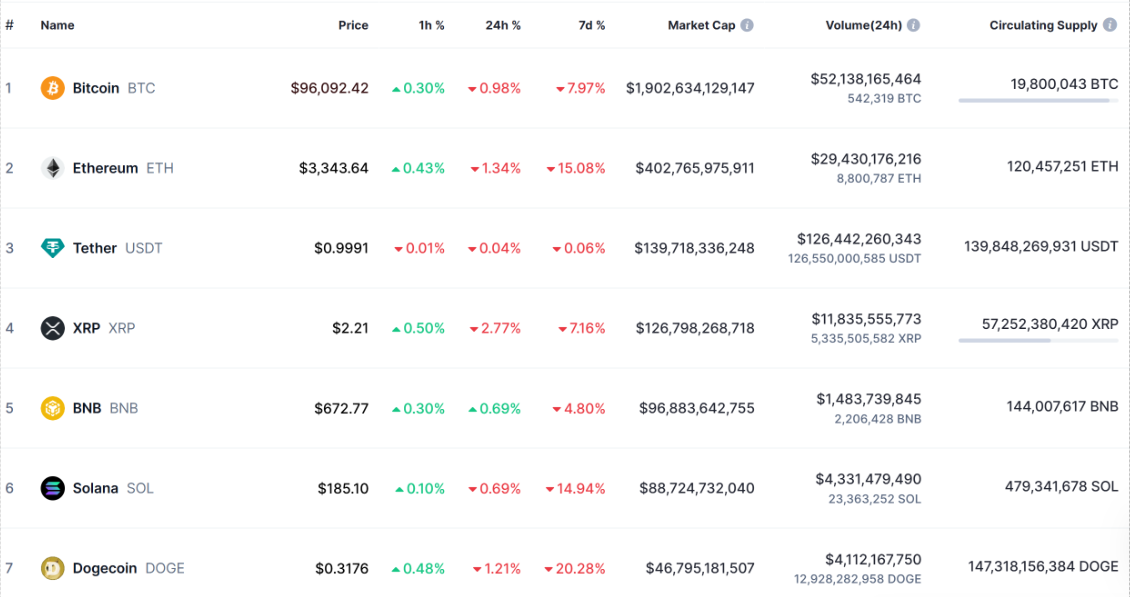
XRP, and Dogecoin, have experienced significant losses. During Monday's
session, Bitcoin's price briefly dipped below $94,000. While it has since
recovered somewhat to $95,800, it still shows an 8.5% decline over the past
week.
Ethereum has seen even steeper losses, dropping nearly 16%
during the same period, with its current price hovering around $3,300. XRP has
declined by 8% and now trades at $2.20. Meanwhile, the meme-inspired Dogecoin,
which ranks as the seventh-largest cryptocurrency by market capitalization, has
shed 21% of its value, currently trading at $0.31.
Major cryptocurrencies, including Bitcoin, are down today. Source: CoinMarketCap.com
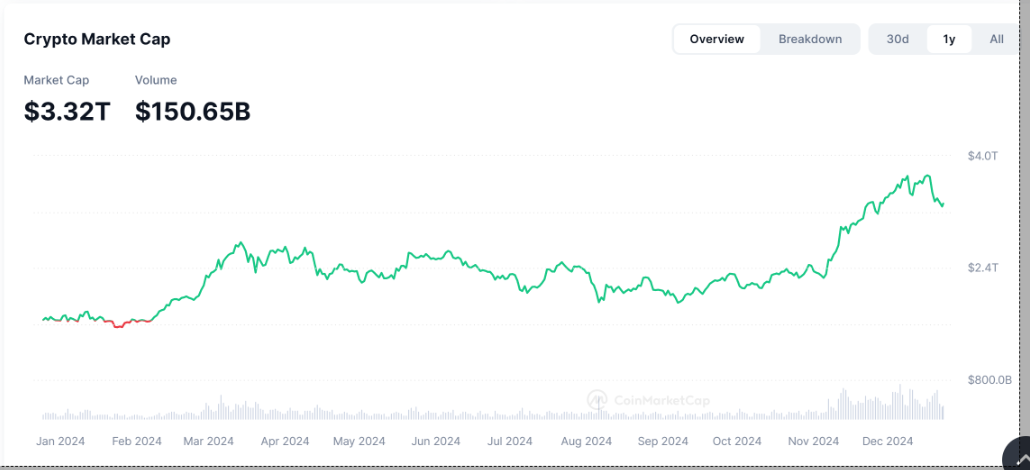
These declines in major cryptocurrencies have negatively
impacted the total market capitalization, which now stands at just over $3.3
trillion—the lowest level in a month.
The Fear and Greed Index for cryptocurrencies, which had
consistently remained at extremely high greed levels, has now moved closer to
50, indicating a neutral market sentiment. This suggests investors are
currently in a wait-and-see mode, neither panicking about dramatic drops nor
eagerly buying the dip.
Total market cap test at the lowest levels since November. Source: CoinMarketCap.com
Liquidations: Almost $300M in Crypto Leveraged Positions Gone
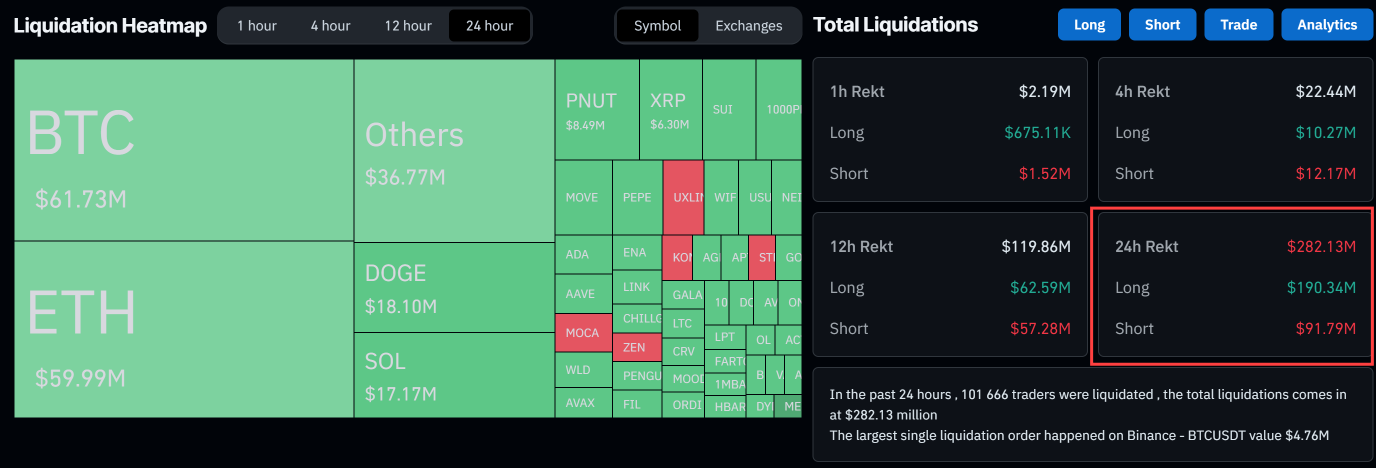
Despite the market downturn, there hasn't been a significant
surge in leveraged position liquidations over the past 24 hours. According to
Coinglass data, $283 million in leveraged positions were liquidated, with $191
million in long positions and $92 million in short positions.
Current crypto liquidations. Source: Coinglass.com
Federal Reserve Factor, Why Is Crypto Down Today?
The Federal Reserve's recent monetary policy stance has
significantly impacted the market. While the Fed cut rates by 0.25%, Fed Chair
Powell's cautious statements about future rate cuts and emphasis on maintaining
restrictive policy to control inflation spooked investors. The Fed's projection
of only two rate cuts in 2025 was less aggressive than markets had hoped.
The Fed's decision had a significant impact on the
cryptocurrency market. When it was announced last Wednesday, Bitcoin slid from
near its historic highs, losing almost 6% in a single day. The current monthly
lows continue to be a direct consequence of Powell's announcements.
Federal Reserve Chair Jerome Powell says the Fed is "not allowed to own Bitcoin"
They weren't allowed to own Corporate Bonds before Covid either.
Global liquidity conditions are tightening, with central
banks reducing their balance sheets and rising bond market volatility making
conditions unfavorable for risk assets. This has particularly affected Bitcoin
and other cryptocurrencies, which are sensitive to liquidity changes.
Crypto Technical Analysis: Bitcoin, Ethereum, Dogecoin and XRP
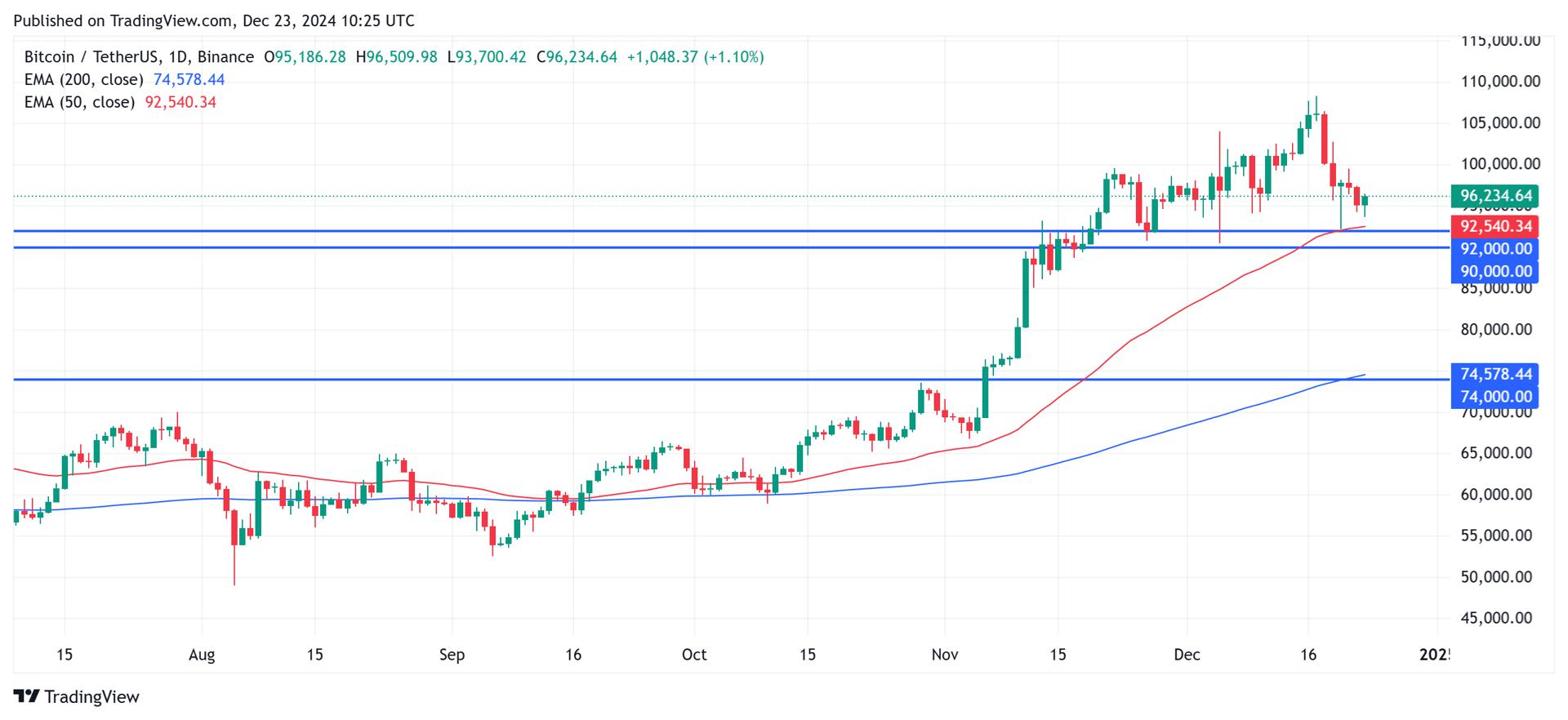
From a technical analysis perspective, Bitcoin's long-term
outlook remains relatively stable. BTC is retesting local support just below
$93,500, a level that has been regularly tested since late November.
This support coincides with the local peaks established on
November 13, when this level marked a new record high. Currently, Bitcoin faces
crucial technical support, reinforced by the round number of $92,000 and the
50-day exponential moving average. The psychological barrier of $90,000 lies
just below, which bulls are likely to defend strongly.
In my opinion, buyers should only become concerned about
Bitcoin's future if the price drops below $74,000, where the 200-day
exponential moving average intersects with support levels from October 29. Key
resistance levels are at $100,000 (psychological), $104,000 (October 5 highs),
and $108,000 (current all-time high from December 16–17).
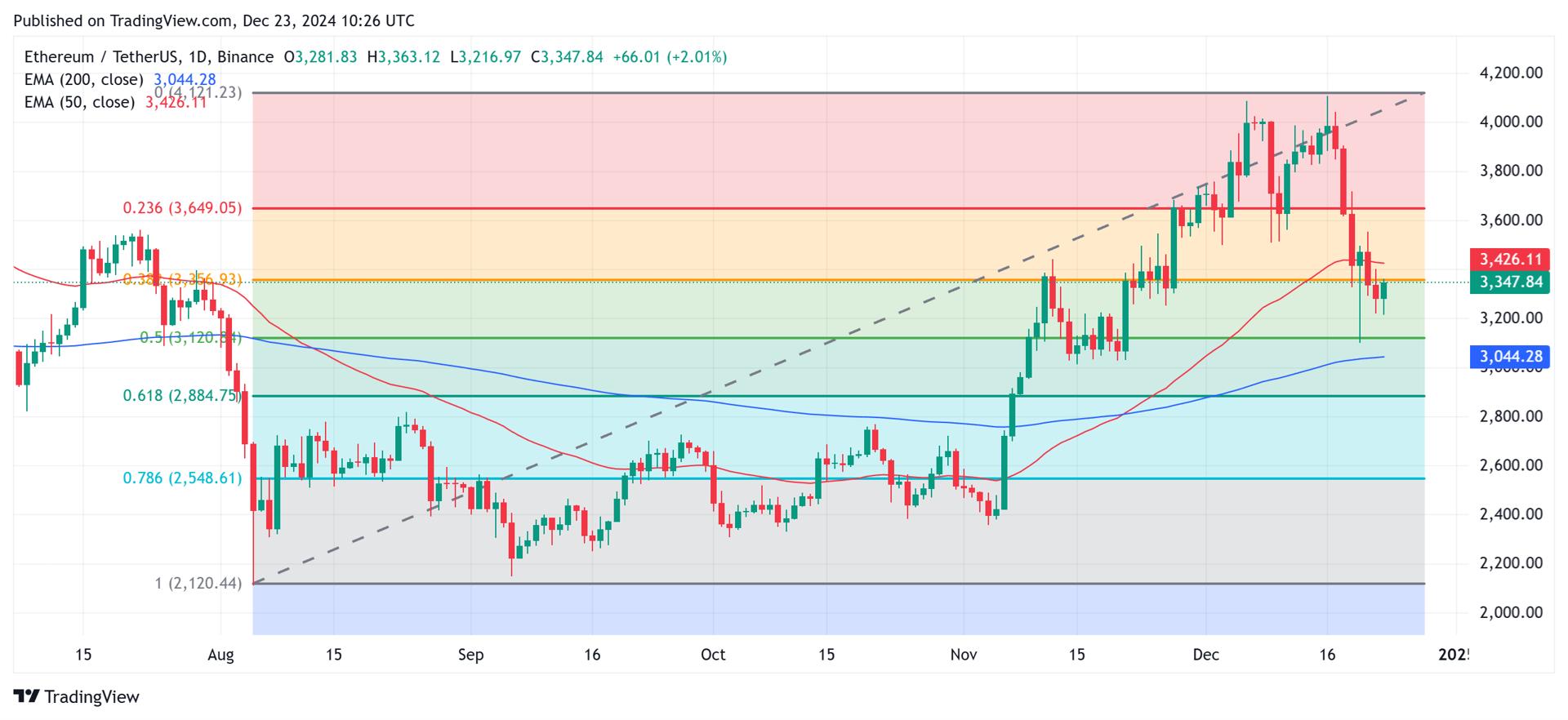
Ethereum is currently testing support at the 61.8% Fibonacci
retracement level, coinciding with month-old lows. Below this lies the more
significant support at $3,000, reinforced by the 200-day moving average and 50%
Fibonacci retracement.
Ethereum tests the Fibonacci retracement level. Source: Tradingview.com
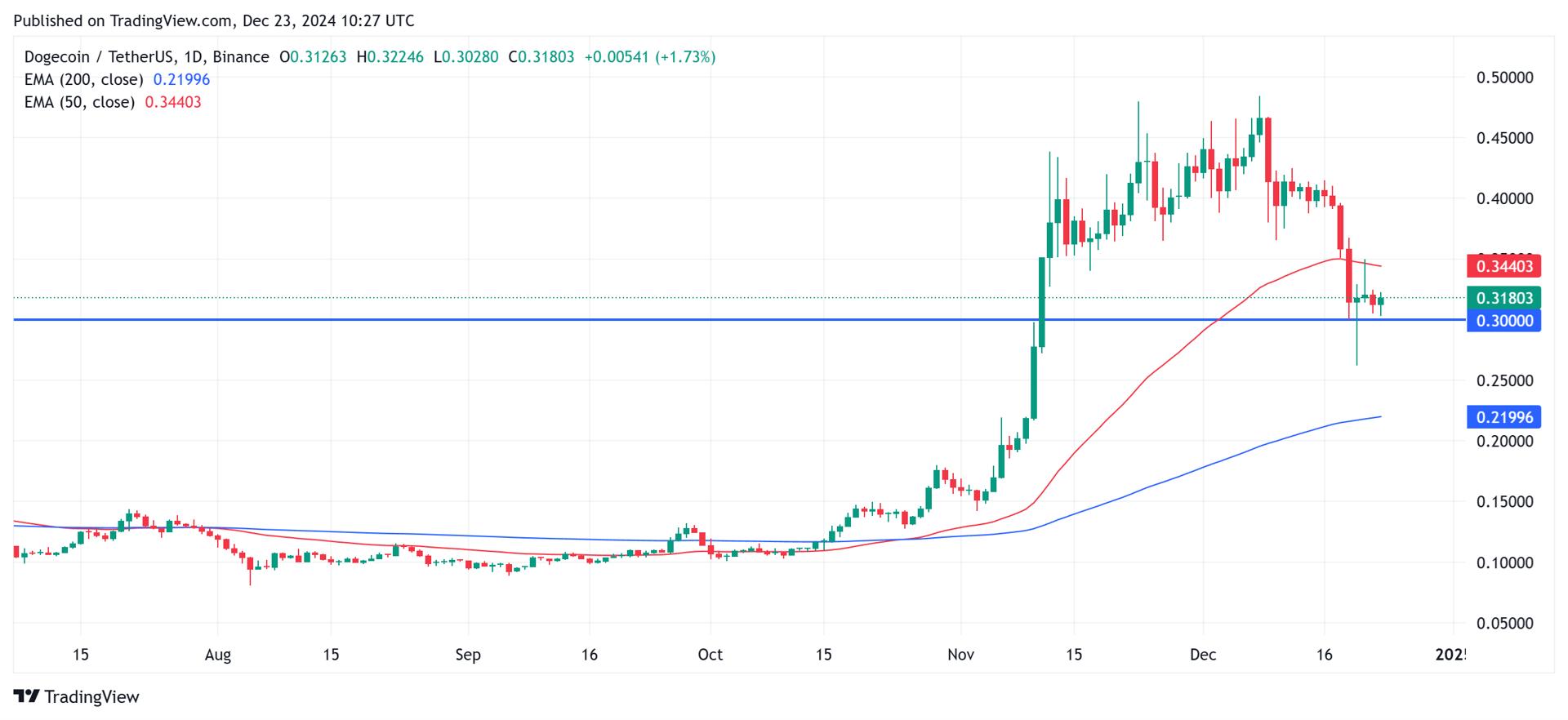
Dogecoin has been forming support around $0.30 for nearly a
week, matching month-old lows. If this level fails to hold, we might see a
decline toward the 200-day EMA near $0.22.
Last month I was trying to find an answer to another important question: “Will Dogecoin Reach $1?”
Why is Dogecoin down? Source: Tradingview.com
Finally, XRP has been maintaining local support at $2.20
since mid-November. Even if this level breaks, the psychological support at
$2.00 lies just below, and only a drop below this level might cause genuine
concern among Ripple token investors.
The crypto market is experiencing a significant decline
primarily due to the Federal Reserve's recent monetary policy announcement.
Despite a 0.25% rate cut, Fed Chair Powell's hawkish stance and indication of
fewer rate cuts in 2025 have dampened investor sentiment. Additionally,
tightening global liquidity conditions and rising bond market volatility have
created unfavorable conditions for risk assets.
Will crypto ever go up again?
Historical patterns and market fundamentals suggest recovery
potential, as evidenced by Bitcoin's quick rebounds above $100,000 after recent
dips. The 2024 market has shown resilience through increased institutional
investment and favorable political developments, though current market
conditions remain volatile.
What has happened to crypto today?
Bitcoin has fallen below $94,000, while Ethereum dropped to
around $3,350. The total market capitalization has decreased to $3.3 trillion,
marking the lowest level in nearly a month. This decline triggered
approximately $1.5 billion in liquidations across the crypto market.
Why is Bitcoin dropping now?
Bitcoin's decline is attributed to multiple factors: the
Federal Reserve's hawkish stance on interest rates, fears of a
slower-than-expected rate cut cycle in 2025, and pre-holiday low liquidity
conditions. Market structure weaknesses and high leverage have also contributed
to the downward pressure.
Why is XRP crashing?
XRP's decline aligns with the broader market downturn
following the Federal Reserve's policy announcement. Like other
cryptocurrencies, XRP is responding to macroeconomic factors and the general
risk-off sentiment in the market.
Why is Dogecoin falling?
Dogecoin's decline is attributed to multiple factors: the
Federal Reserve's policy impact, decreasing transaction volume, and reduced
daily active addresses. Additionally, a recent network vulnerability that
resulted in 69% of Dogecoin nodes crashing has contributed to negative market
sentiment.
The crypto market experienced a significant sell-off today,
with Bitcoin (BTC) dropping notably below $94,000. Along with BTC, major
altcoin prices are also declining, and the total cryptocurrency market
capitalization has fallen to $3.3T, marking the lowest level in almost a month.
This sell-off stems from last week's Federal Reserve's (Fed’s)
monetary policy announcement, with
Bitcoin falling below $100,000. Market participants witnessed a sharp decline
across cryptocurrencies, triggering substantial liquidations and affecting the
total market capitalization.
The cryptocurrency market has had a challenging period over
the past day and week. Both Bitcoin and major altcoins, including Ethereum,
XRP, and Dogecoin, have experienced significant losses. During Monday's
session, Bitcoin's price briefly dipped below $94,000. While it has since
recovered somewhat to $95,800, it still shows an 8.5% decline over the past
week.
Ethereum has seen even steeper losses, dropping nearly 16%
during the same period, with its current price hovering around $3,300. XRP has
declined by 8% and now trades at $2.20. Meanwhile, the meme-inspired Dogecoin,
which ranks as the seventh-largest cryptocurrency by market capitalization, has
shed 21% of its value, currently trading at $0.31.
Major cryptocurrencies, including Bitcoin, are down today. Source: CoinMarketCap.com
These declines in major cryptocurrencies have negatively
impacted the total market capitalization, which now stands at just over $3.3
trillion—the lowest level in a month.
The Fear and Greed Index for cryptocurrencies, which had
consistently remained at extremely high greed levels, has now moved closer to
50, indicating a neutral market sentiment. This suggests investors are
currently in a wait-and-see mode, neither panicking about dramatic drops nor
eagerly buying the dip.
Total market cap test at the lowest levels since November. Source: CoinMarketCap.com
Liquidations: Almost $300M in Crypto Leveraged Positions Gone
Despite the market downturn, there hasn't been a significant
surge in leveraged position liquidations over the past 24 hours. According to
Coinglass data, $283 million in leveraged positions were liquidated, with $191
million in long positions and $92 million in short positions.
Current crypto liquidations. Source: Coinglass.com
Federal Reserve Factor, Why Is Crypto Down Today?
The Federal Reserve's recent monetary policy stance has
significantly impacted the market. While the Fed cut rates by 0.25%, Fed Chair
Powell's cautious statements about future rate cuts and emphasis on maintaining
restrictive policy to control inflation spooked investors. The Fed's projection
of only two rate cuts in 2025 was less aggressive than markets had hoped.
The Fed's decision had a significant impact on the
cryptocurrency market. When it was announced last Wednesday, Bitcoin slid from
near its historic highs, losing almost 6% in a single day. The current monthly
lows continue to be a direct consequence of Powell's announcements.
Federal Reserve Chair Jerome Powell says the Fed is "not allowed to own Bitcoin"
They weren't allowed to own Corporate Bonds before Covid either.
Global liquidity conditions are tightening, with central
banks reducing their balance sheets and rising bond market volatility making
conditions unfavorable for risk assets. This has particularly affected Bitcoin
and other cryptocurrencies, which are sensitive to liquidity changes.
Crypto Technical Analysis: Bitcoin, Ethereum, Dogecoin and XRP
From a technical analysis perspective, Bitcoin's long-term
outlook remains relatively stable. BTC is retesting local support just below
$93,500, a level that has been regularly tested since late November.
This support coincides with the local peaks established on
November 13, when this level marked a new record high. Currently, Bitcoin faces
crucial technical support, reinforced by the round number of $92,000 and the
50-day exponential moving average. The psychological barrier of $90,000 lies
just below, which bulls are likely to defend strongly.
In my opinion, buyers should only become concerned about
Bitcoin's future if the price drops below $74,000, where the 200-day
exponential moving average intersects with support levels from October 29. Key
resistance levels are at $100,000 (psychological), $104,000 (October 5 highs),
and $108,000 (current all-time high from December 16–17).
Ethereum is currently testing support at the 61.8% Fibonacci
retracement level, coinciding with month-old lows. Below this lies the more
significant support at $3,000, reinforced by the 200-day moving average and 50%
Fibonacci retracement.
Ethereum tests the Fibonacci retracement level. Source: Tradingview.com
Dogecoin has been forming support around $0.30 for nearly a
week, matching month-old lows. If this level fails to hold, we might see a
decline toward the 200-day EMA near $0.22.
Last month I was trying to find an answer to another important question: “Will Dogecoin Reach $1?”
Why is Dogecoin down? Source: Tradingview.com
Finally, XRP has been maintaining local support at $2.20
since mid-November. Even if this level breaks, the psychological support at
$2.00 lies just below, and only a drop below this level might cause genuine
concern among Ripple token investors.
The crypto market is experiencing a significant decline
primarily due to the Federal Reserve's recent monetary policy announcement.
Despite a 0.25% rate cut, Fed Chair Powell's hawkish stance and indication of
fewer rate cuts in 2025 have dampened investor sentiment. Additionally,
tightening global liquidity conditions and rising bond market volatility have
created unfavorable conditions for risk assets.
Will crypto ever go up again?
Historical patterns and market fundamentals suggest recovery
potential, as evidenced by Bitcoin's quick rebounds above $100,000 after recent
dips. The 2024 market has shown resilience through increased institutional
investment and favorable political developments, though current market
conditions remain volatile.
What has happened to crypto today?
Bitcoin has fallen below $94,000, while Ethereum dropped to
around $3,350. The total market capitalization has decreased to $3.3 trillion,
marking the lowest level in nearly a month. This decline triggered
approximately $1.5 billion in liquidations across the crypto market.
Why is Bitcoin dropping now?
Bitcoin's decline is attributed to multiple factors: the
Federal Reserve's hawkish stance on interest rates, fears of a
slower-than-expected rate cut cycle in 2025, and pre-holiday low liquidity
conditions. Market structure weaknesses and high leverage have also contributed
to the downward pressure.
Why is XRP crashing?
XRP's decline aligns with the broader market downturn
following the Federal Reserve's policy announcement. Like other
cryptocurrencies, XRP is responding to macroeconomic factors and the general
risk-off sentiment in the market.
Why is Dogecoin falling?
Dogecoin's decline is attributed to multiple factors: the
Federal Reserve's policy impact, decreasing transaction volume, and reduced
daily active addresses. Additionally, a recent network vulnerability that
resulted in 69% of Dogecoin nodes crashing has contributed to negative market
sentiment.
Damian Chmiel is a Senior Analyst & Editor at Finance Magnates with more than 15 years of experience in the CFD and online trading industry. Active as both a trader and journalist since 2010, he focuses on broker coverage, fintech innovation, and regulatory developments across Europe, the Middle East, and Asia.
His work includes interviews with C-level leaders at major brokerages and fintech platforms, as well as co-authoring Finance Magnates’ quarterly industry benchmarking reports. Damian’s reporting is data-driven, market-aware, and grounded in direct industry engagement. His analysis and commentary have also been cited by external media outlets, including Investing.com, Binance, The Asset, Stockhead, and Dispatch.
Education:
MA in Finance and Accounting, Cracow University of Economics
Kraken Steps Up Speed Race with New Equinix Colocation Service for Crypto Traders
Featured Videos
FP Markets Winner Spotlight 🏆 | Global Broker of the Year 2025 #Trading #Broker #Innovation #Shorts
FP Markets Winner Spotlight 🏆 | Global Broker of the Year 2025 #Trading #Broker #Innovation #Shorts
FP Markets Winner Spotlight 🏆 | Global Broker of the Year 2025 #Trading #Broker #Innovation #Shorts
FP Markets Winner Spotlight 🏆 | Global Broker of the Year 2025 #Trading #Broker #Innovation #Shorts
FP Markets takes the spotlight as Global Broker of the Year 2025 at the Finance Magnates Awards.
Martin Stoilov, Head of Client Experience, shares that trust, innovation, and people played a key role in the company’s success, supported by a strong foundation of integrity and client-centricity.
Following this milestone, FP Markets continues to focus on growth, technology investment, and its core values of transparency and excellence.
👉 Be part of FM Awards 2026: https://awards.financemagnates.com/#nominate
FP Markets takes the spotlight as Global Broker of the Year 2025 at the Finance Magnates Awards.
Martin Stoilov, Head of Client Experience, shares that trust, innovation, and people played a key role in the company’s success, supported by a strong foundation of integrity and client-centricity.
Following this milestone, FP Markets continues to focus on growth, technology investment, and its core values of transparency and excellence.
👉 Be part of FM Awards 2026: https://awards.financemagnates.com/#nominate
FP Markets takes the spotlight as Global Broker of the Year 2025 at the Finance Magnates Awards.
Martin Stoilov, Head of Client Experience, shares that trust, innovation, and people played a key role in the company’s success, supported by a strong foundation of integrity and client-centricity.
Following this milestone, FP Markets continues to focus on growth, technology investment, and its core values of transparency and excellence.
👉 Be part of FM Awards 2026: https://awards.financemagnates.com/#nominate
FP Markets takes the spotlight as Global Broker of the Year 2025 at the Finance Magnates Awards.
Martin Stoilov, Head of Client Experience, shares that trust, innovation, and people played a key role in the company’s success, supported by a strong foundation of integrity and client-centricity.
Following this milestone, FP Markets continues to focus on growth, technology investment, and its core values of transparency and excellence.
👉 Be part of FM Awards 2026: https://awards.financemagnates.com/#nominate
In this video, we review @HolaPrimeMarketsOfficial, a multi-asset forex and CFDs broker offering different account types, trading platforms, and flexible trading conditions.
We cover the broker’s overall offering, including account options, trading environment, platforms like MT4 and MT5, and additional services such as managed accounts and fast withdrawals.
Watch the full video to see if Hola Prime Markets fits your trading needs.
📣 Stay up to date with the latest in finance and trading. Follow Finance Magnates for industry news, insights, and global event coverage.
Connect with us:
🔗 LinkedIn: /financemagnates
👍 Facebook: /financemagnates
📸 Instagram: https://www.instagram.com/financemagnates
🐦 X: https://x.com/financemagnates
🎥 TikTok: https://www.tiktok.com/tag/financemagnates
▶️ YouTube: /@financemagnates_official
#HolaPrime #ForexBroker #CFDTrading #FinanceMagnates #Trading #Forex #BrokerReview
In this video, we review @HolaPrimeMarketsOfficial, a multi-asset forex and CFDs broker offering different account types, trading platforms, and flexible trading conditions.
We cover the broker’s overall offering, including account options, trading environment, platforms like MT4 and MT5, and additional services such as managed accounts and fast withdrawals.
Watch the full video to see if Hola Prime Markets fits your trading needs.
📣 Stay up to date with the latest in finance and trading. Follow Finance Magnates for industry news, insights, and global event coverage.
Connect with us:
🔗 LinkedIn: /financemagnates
👍 Facebook: /financemagnates
📸 Instagram: https://www.instagram.com/financemagnates
🐦 X: https://x.com/financemagnates
🎥 TikTok: https://www.tiktok.com/tag/financemagnates
▶️ YouTube: /@financemagnates_official
#HolaPrime #ForexBroker #CFDTrading #FinanceMagnates #Trading #Forex #BrokerReview
In this video, we review @HolaPrimeMarketsOfficial, a multi-asset forex and CFDs broker offering different account types, trading platforms, and flexible trading conditions.
We cover the broker’s overall offering, including account options, trading environment, platforms like MT4 and MT5, and additional services such as managed accounts and fast withdrawals.
Watch the full video to see if Hola Prime Markets fits your trading needs.
📣 Stay up to date with the latest in finance and trading. Follow Finance Magnates for industry news, insights, and global event coverage.
Connect with us:
🔗 LinkedIn: /financemagnates
👍 Facebook: /financemagnates
📸 Instagram: https://www.instagram.com/financemagnates
🐦 X: https://x.com/financemagnates
🎥 TikTok: https://www.tiktok.com/tag/financemagnates
▶️ YouTube: /@financemagnates_official
#HolaPrime #ForexBroker #CFDTrading #FinanceMagnates #Trading #Forex #BrokerReview
In this video, we review @HolaPrimeMarketsOfficial, a multi-asset forex and CFDs broker offering different account types, trading platforms, and flexible trading conditions.
We cover the broker’s overall offering, including account options, trading environment, platforms like MT4 and MT5, and additional services such as managed accounts and fast withdrawals.
Watch the full video to see if Hola Prime Markets fits your trading needs.
📣 Stay up to date with the latest in finance and trading. Follow Finance Magnates for industry news, insights, and global event coverage.
Connect with us:
🔗 LinkedIn: /financemagnates
👍 Facebook: /financemagnates
📸 Instagram: https://www.instagram.com/financemagnates
🐦 X: https://x.com/financemagnates
🎥 TikTok: https://www.tiktok.com/tag/financemagnates
▶️ YouTube: /@financemagnates_official
#HolaPrime #ForexBroker #CFDTrading #FinanceMagnates #Trading #Forex #BrokerReview
In this video, we review @HolaPrimeMarketsOfficial, a multi-asset forex and CFDs broker offering different account types, trading platforms, and flexible trading conditions.
We cover the broker’s overall offering, including account options, trading environment, platforms like MT4 and MT5, and additional services such as managed accounts and fast withdrawals.
Watch the full video to see if Hola Prime Markets fits your trading needs.
📣 Stay up to date with the latest in finance and trading. Follow Finance Magnates for industry news, insights, and global event coverage.
Connect with us:
🔗 LinkedIn: /financemagnates
👍 Facebook: /financemagnates
📸 Instagram: https://www.instagram.com/financemagnates
🐦 X: https://x.com/financemagnates
🎥 TikTok: https://www.tiktok.com/tag/financemagnates
▶️ YouTube: /@financemagnates_official
#HolaPrime #ForexBroker #CFDTrading #FinanceMagnates #Trading #Forex #BrokerReview
In this video, we review @HolaPrimeMarketsOfficial, a multi-asset forex and CFDs broker offering different account types, trading platforms, and flexible trading conditions.
We cover the broker’s overall offering, including account options, trading environment, platforms like MT4 and MT5, and additional services such as managed accounts and fast withdrawals.
Watch the full video to see if Hola Prime Markets fits your trading needs.
📣 Stay up to date with the latest in finance and trading. Follow Finance Magnates for industry news, insights, and global event coverage.
Connect with us:
🔗 LinkedIn: /financemagnates
👍 Facebook: /financemagnates
📸 Instagram: https://www.instagram.com/financemagnates
🐦 X: https://x.com/financemagnates
🎥 TikTok: https://www.tiktok.com/tag/financemagnates
▶️ YouTube: /@financemagnates_official
#HolaPrime #ForexBroker #CFDTrading #FinanceMagnates #Trading #Forex #BrokerReview
Hola Prime Review: What You Need to Know | Full Breakdown by Finance Magnates
Hola Prime Review: What You Need to Know | Full Breakdown by Finance Magnates
Hola Prime Review: What You Need to Know | Full Breakdown by Finance Magnates
Hola Prime Review: What You Need to Know | Full Breakdown by Finance Magnates
Hola Prime Review: What You Need to Know | Full Breakdown by Finance Magnates
Hola Prime Review: What You Need to Know | Full Breakdown by Finance Magnates
In this video, we review @HolaPrime_Global, a proprietary trading firm offering evaluation programs and performance-based payouts in simulated market environments.
We cover how the challenge model works, including account types, profit splits (up to 95%), trading rules, and what it takes to reach a funded account. You’ll also learn about available platforms like MT4, MT5, cTrader, and more, along with insights into payouts, support, and trading conditions.
Watch the full video to see if Hola Prime fits your trading style.
📣 Stay up to date with the latest in finance and trading. Follow Finance Magnates for industry news, insights, and global event coverage.
Connect with us:
🔗 LinkedIn: /financemagnates
👍 Facebook: /financemagnates
📸 Instagram: https://www.instagram.com/financemagnates
🐦 X: https://x.com/financemagnates
🎥 TikTok: https://www.tiktok.com/tag/financemagnates
▶️ YouTube: /@financemagnates_official
#HolaPrime #PropFirm #Trading #FinanceMagnates #Forex #FuturesTrading #TradingReview #PropFirmReview
In this video, we review @HolaPrime_Global, a proprietary trading firm offering evaluation programs and performance-based payouts in simulated market environments.
We cover how the challenge model works, including account types, profit splits (up to 95%), trading rules, and what it takes to reach a funded account. You’ll also learn about available platforms like MT4, MT5, cTrader, and more, along with insights into payouts, support, and trading conditions.
Watch the full video to see if Hola Prime fits your trading style.
📣 Stay up to date with the latest in finance and trading. Follow Finance Magnates for industry news, insights, and global event coverage.
Connect with us:
🔗 LinkedIn: /financemagnates
👍 Facebook: /financemagnates
📸 Instagram: https://www.instagram.com/financemagnates
🐦 X: https://x.com/financemagnates
🎥 TikTok: https://www.tiktok.com/tag/financemagnates
▶️ YouTube: /@financemagnates_official
#HolaPrime #PropFirm #Trading #FinanceMagnates #Forex #FuturesTrading #TradingReview #PropFirmReview
In this video, we review @HolaPrime_Global, a proprietary trading firm offering evaluation programs and performance-based payouts in simulated market environments.
We cover how the challenge model works, including account types, profit splits (up to 95%), trading rules, and what it takes to reach a funded account. You’ll also learn about available platforms like MT4, MT5, cTrader, and more, along with insights into payouts, support, and trading conditions.
Watch the full video to see if Hola Prime fits your trading style.
📣 Stay up to date with the latest in finance and trading. Follow Finance Magnates for industry news, insights, and global event coverage.
Connect with us:
🔗 LinkedIn: /financemagnates
👍 Facebook: /financemagnates
📸 Instagram: https://www.instagram.com/financemagnates
🐦 X: https://x.com/financemagnates
🎥 TikTok: https://www.tiktok.com/tag/financemagnates
▶️ YouTube: /@financemagnates_official
#HolaPrime #PropFirm #Trading #FinanceMagnates #Forex #FuturesTrading #TradingReview #PropFirmReview
In this video, we review @HolaPrime_Global, a proprietary trading firm offering evaluation programs and performance-based payouts in simulated market environments.
We cover how the challenge model works, including account types, profit splits (up to 95%), trading rules, and what it takes to reach a funded account. You’ll also learn about available platforms like MT4, MT5, cTrader, and more, along with insights into payouts, support, and trading conditions.
Watch the full video to see if Hola Prime fits your trading style.
📣 Stay up to date with the latest in finance and trading. Follow Finance Magnates for industry news, insights, and global event coverage.
Connect with us:
🔗 LinkedIn: /financemagnates
👍 Facebook: /financemagnates
📸 Instagram: https://www.instagram.com/financemagnates
🐦 X: https://x.com/financemagnates
🎥 TikTok: https://www.tiktok.com/tag/financemagnates
▶️ YouTube: /@financemagnates_official
#HolaPrime #PropFirm #Trading #FinanceMagnates #Forex #FuturesTrading #TradingReview #PropFirmReview
In this video, we review @HolaPrime_Global, a proprietary trading firm offering evaluation programs and performance-based payouts in simulated market environments.
We cover how the challenge model works, including account types, profit splits (up to 95%), trading rules, and what it takes to reach a funded account. You’ll also learn about available platforms like MT4, MT5, cTrader, and more, along with insights into payouts, support, and trading conditions.
Watch the full video to see if Hola Prime fits your trading style.
📣 Stay up to date with the latest in finance and trading. Follow Finance Magnates for industry news, insights, and global event coverage.
Connect with us:
🔗 LinkedIn: /financemagnates
👍 Facebook: /financemagnates
📸 Instagram: https://www.instagram.com/financemagnates
🐦 X: https://x.com/financemagnates
🎥 TikTok: https://www.tiktok.com/tag/financemagnates
▶️ YouTube: /@financemagnates_official
#HolaPrime #PropFirm #Trading #FinanceMagnates #Forex #FuturesTrading #TradingReview #PropFirmReview
In this video, we review @HolaPrime_Global, a proprietary trading firm offering evaluation programs and performance-based payouts in simulated market environments.
We cover how the challenge model works, including account types, profit splits (up to 95%), trading rules, and what it takes to reach a funded account. You’ll also learn about available platforms like MT4, MT5, cTrader, and more, along with insights into payouts, support, and trading conditions.
Watch the full video to see if Hola Prime fits your trading style.
📣 Stay up to date with the latest in finance and trading. Follow Finance Magnates for industry news, insights, and global event coverage.
Connect with us:
🔗 LinkedIn: /financemagnates
👍 Facebook: /financemagnates
📸 Instagram: https://www.instagram.com/financemagnates
🐦 X: https://x.com/financemagnates
🎥 TikTok: https://www.tiktok.com/tag/financemagnates
▶️ YouTube: /@financemagnates_official
#HolaPrime #PropFirm #Trading #FinanceMagnates #Forex #FuturesTrading #TradingReview #PropFirmReview
Axi Winner Spotlight 🏆 | Global Most Innovative Broker 2025 #Innovation #Trading #Fintech #Broker
Axi Winner Spotlight 🏆 | Global Most Innovative Broker 2025 #Innovation #Trading #Fintech #Broker
Axi Winner Spotlight 🏆 | Global Most Innovative Broker 2025 #Innovation #Trading #Fintech #Broker
Axi Winner Spotlight 🏆 | Global Most Innovative Broker 2025 #Innovation #Trading #Fintech #Broker
Axi Winner Spotlight 🏆 | Global Most Innovative Broker 2025 #Innovation #Trading #Fintech #Broker
Axi Winner Spotlight 🏆 | Global Most Innovative Broker 2025 #Innovation #Trading #Fintech #Broker
Axi takes the spotlight at the Finance Magnates Awards, winning Global Most Innovative Broker 2025.
Olivia Xenofontos and Ivanna Openko share how the team will feel: proud, motivated, and ready to keep delivering.
They also describe the night as well-organized, focused, and enjoyable for all.
👉 Be part of FM Awards 2026.
Axi takes the spotlight at the Finance Magnates Awards, winning Global Most Innovative Broker 2025.
Olivia Xenofontos and Ivanna Openko share how the team will feel: proud, motivated, and ready to keep delivering.
They also describe the night as well-organized, focused, and enjoyable for all.
👉 Be part of FM Awards 2026.
Axi takes the spotlight at the Finance Magnates Awards, winning Global Most Innovative Broker 2025.
Olivia Xenofontos and Ivanna Openko share how the team will feel: proud, motivated, and ready to keep delivering.
They also describe the night as well-organized, focused, and enjoyable for all.
👉 Be part of FM Awards 2026.
Axi takes the spotlight at the Finance Magnates Awards, winning Global Most Innovative Broker 2025.
Olivia Xenofontos and Ivanna Openko share how the team will feel: proud, motivated, and ready to keep delivering.
They also describe the night as well-organized, focused, and enjoyable for all.
👉 Be part of FM Awards 2026.
Axi takes the spotlight at the Finance Magnates Awards, winning Global Most Innovative Broker 2025.
Olivia Xenofontos and Ivanna Openko share how the team will feel: proud, motivated, and ready to keep delivering.
They also describe the night as well-organized, focused, and enjoyable for all.
👉 Be part of FM Awards 2026.
Axi takes the spotlight at the Finance Magnates Awards, winning Global Most Innovative Broker 2025.
Olivia Xenofontos and Ivanna Openko share how the team will feel: proud, motivated, and ready to keep delivering.
They also describe the night as well-organized, focused, and enjoyable for all.
👉 Be part of FM Awards 2026.
Recognition that matters.
Built on transparency.
Driven by the industry.
The Finance Magnates Awards 2026.
Nominations are now open.
🔗 https://awards.financemagnates.com/?utm_source=SM&utm_medium=social&utm_campaign=recognition-matters
Recognition that matters.
Built on transparency.
Driven by the industry.
The Finance Magnates Awards 2026.
Nominations are now open.
🔗 https://awards.financemagnates.com/?utm_source=SM&utm_medium=social&utm_campaign=recognition-matters
Recognition that matters.
Built on transparency.
Driven by the industry.
The Finance Magnates Awards 2026.
Nominations are now open.
🔗 https://awards.financemagnates.com/?utm_source=SM&utm_medium=social&utm_campaign=recognition-matters
Recognition that matters.
Built on transparency.
Driven by the industry.
The Finance Magnates Awards 2026.
Nominations are now open.
🔗 https://awards.financemagnates.com/?utm_source=SM&utm_medium=social&utm_campaign=recognition-matters
Recognition that matters.
Built on transparency.
Driven by the industry.
The Finance Magnates Awards 2026.
Nominations are now open.
🔗 https://awards.financemagnates.com/?utm_source=SM&utm_medium=social&utm_campaign=recognition-matters
Recognition that matters.
Built on transparency.
Driven by the industry.
The Finance Magnates Awards 2026.
Nominations are now open.
🔗 https://awards.financemagnates.com/?utm_source=SM&utm_medium=social&utm_campaign=recognition-matters