Bitcoin's trading volume surged 80% year-over-year, driven by Trump's crypto-friendly stance and spot ETF approvals.
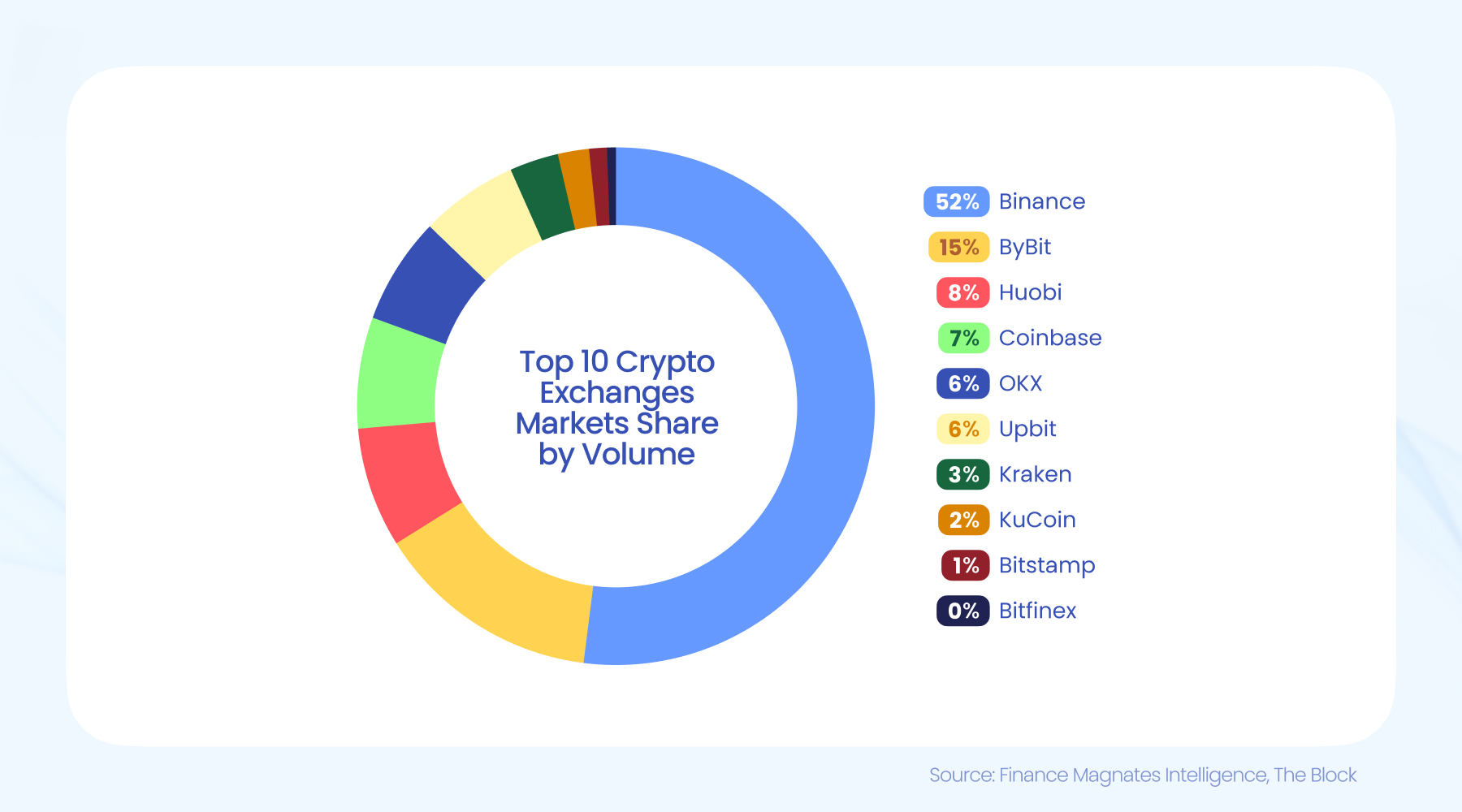
Daily volumes now consistently exceed $33 billion, with Binance capturing 52% of the market share.
A Bitcoin coin leaning against a laptop screen. Source: Unsplash
Bitcoin
(BTC) has grown to become one of the most traded digital assets in the world.
Its trading volume reflects the immense interest in this cryptocurrency, from
institutional investors to retail traders. In this article, we’ll explore the
reasons behind Bitcoin’s high trading activity and how the dynamics of the
crypto market drive its popularity in 2024.
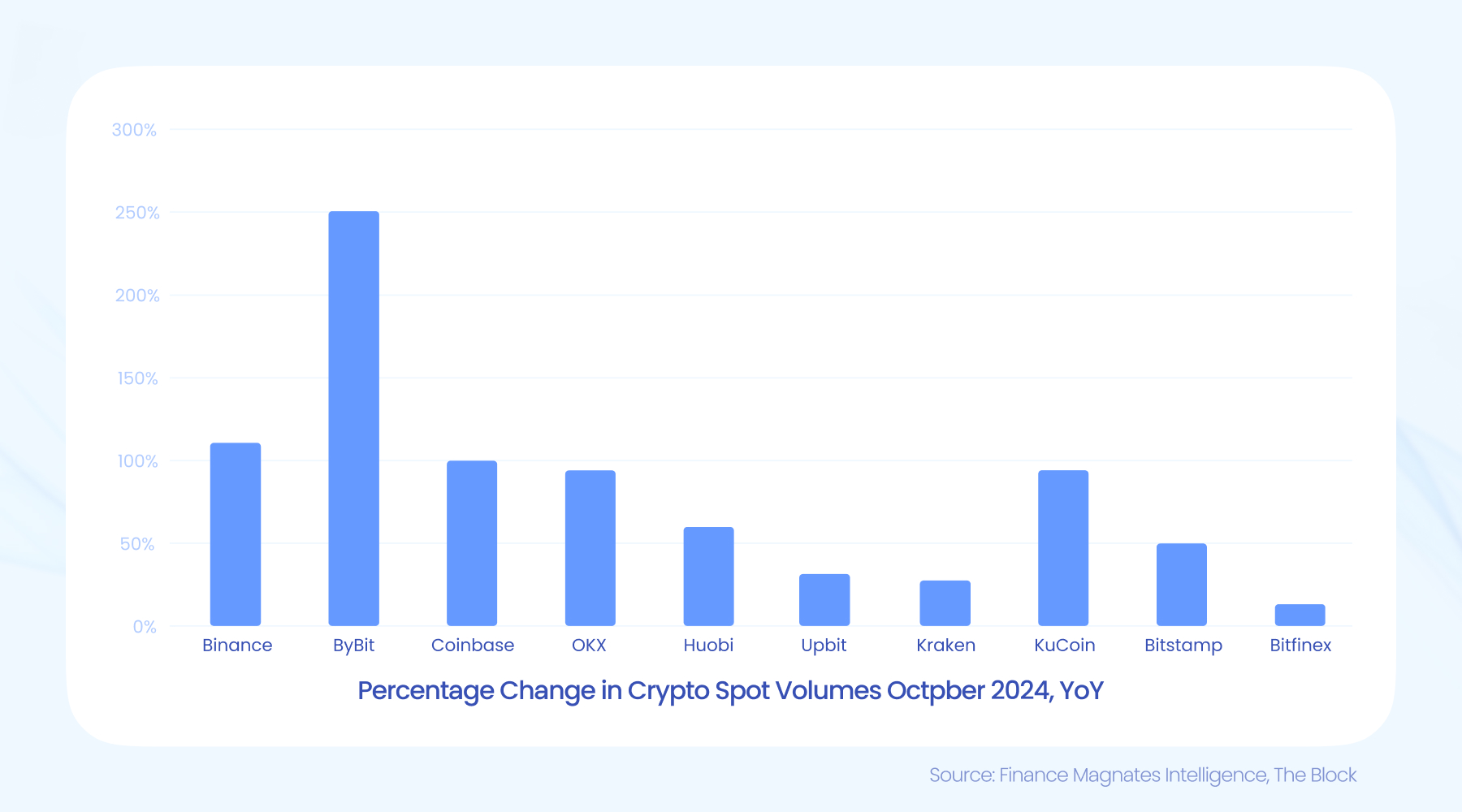
In October
2024, trading volumes reached some of the highest levels this year. Compared to
2023, there was an increase of over 80%, with some exchanges experiencing
growth up to 250%.
What Is Bitcoin Trading
Volume?
Bitcoin
trading volume refers to the total amount of Bitcoin bought and sold on
exchanges within a specific time period. It’s a key metric in the
cryptocurrency market, offering insights into liquidity, demand, and overall
market health.
Higher
volume often
indicates strong market activity and liquidity.
Lower
volume can suggest
reduced interest or a more volatile market environment.
Bitcoin
trading volumes can reach all-time highs during periods of market surges or
significant news events. For example, during the 2021 bull run, Bitcoin volumes
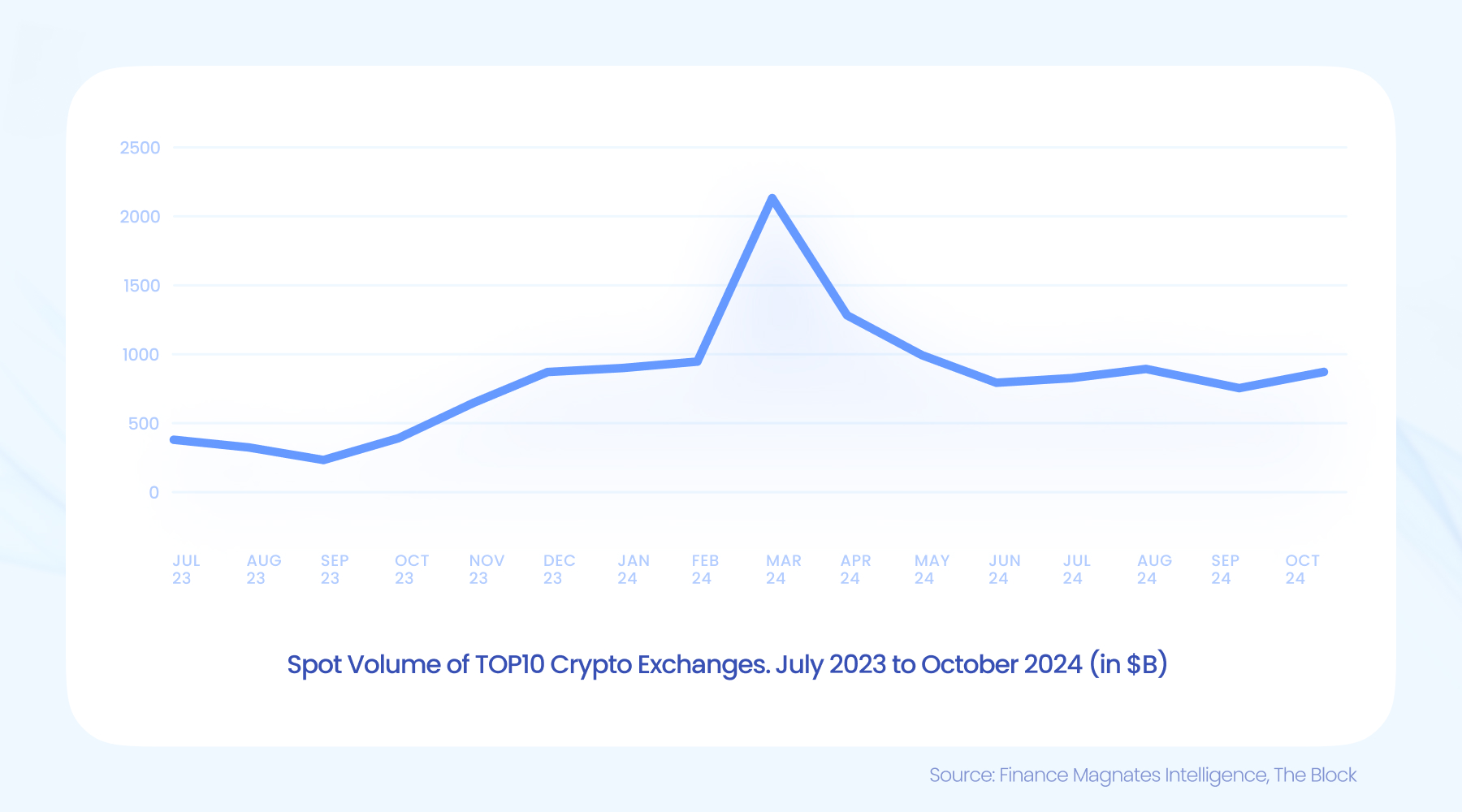
skyrocketed alongside its price surge. We observed the same dynamic in March
2024 and currently in October 2024.
Factors Driving High
Bitcoin Trading Volume
Institutional Adoption
Institutional
investors have embraced Bitcoin as a legitimate asset class.
Companies
like MicroStrategy and Tesla have added Bitcoin to their balance sheets.
The
approval of Bitcoin Exchange-Traded Funds (ETFs), including BlackRock’s, has
made it easier for financial institutions to invest.
Retail
investors remain a vital part of the crypto market.
Platforms
like Coinbase and Binance allow retail traders to engage in Bitcoin trading
with ease.
During
price surges, retail activity often spikes. For example, in October 2024,
Coinbase saw $62.5 billion in trading volume, marking a significant rise from
earlier months.
3. Global Adoption of Cryptocurrencies
Bitcoin’s
appeal as a currency and store of value has spread worldwide.
Countries
like El Salvador and the Central African Republic have adopted Bitcoin as legal
tender.
Digital
currencies like Bitcoin are gaining popularity as alternatives to fiat in
regions facing economic instability.
4. Volatility and Speculative Trading
Bitcoin’s
volatility is a double-edged sword, attracting both short-term speculators and
long-term investors.
In 2024,
Bitcoin’s price crossed $92,000 after a market surge triggered by favorable
regulatory developments and geopolitical changes.
Speculators
often use leverage on crypto exchanges like ByBit and OKX, amplifying trading
activity.
CryptoQuant founder: Bitcoin trading volume below $100,000 hits 3-year high
Ki Young Ju, founder and CEO of CryptoQuant, released data on the X platform saying that the trading volume of Bitcoin below $100,000 hit a three-year high, which indicates the entry of retail investor…
Whales, or
entities holding large amounts of Bitcoin, often contribute to trading spikes.
Large
trades can trigger significant trading activity, influencing market sentiment.
Trading
bots also account for a portion of trading volume, especially on platforms
offering algorithmic trading options.
Data: Bitcoin Trading
Volume by Exchange (October 2024)
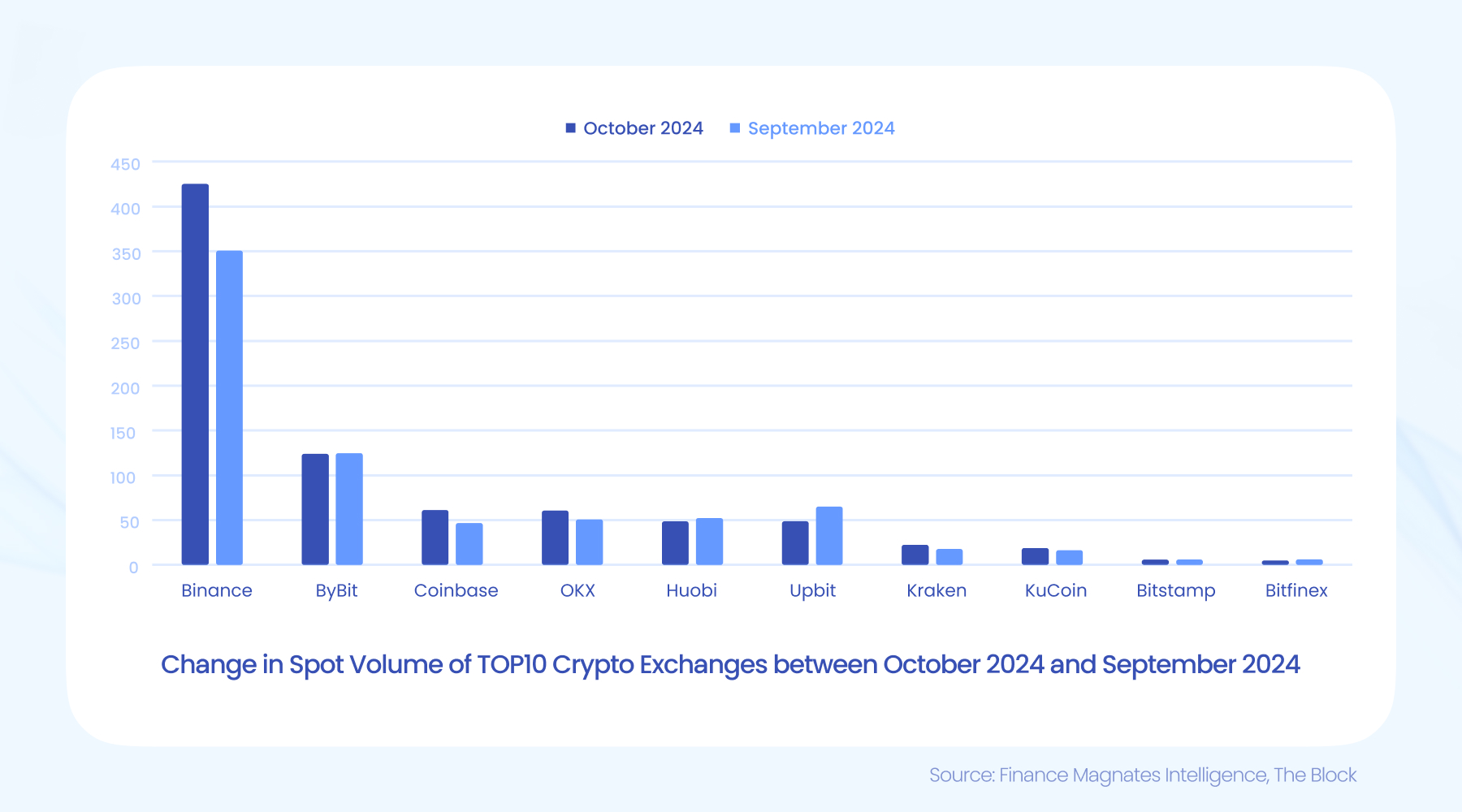
After a relatively weak September, with trading volumes dropping to the year's lowest level of $715 billion, October saw a clear rebound, reaching $820 billion. Although this figure is still far from the over $2 trillion reported in March when Bitcoin tested its all-time highs, the ongoing month of November is set to bring new records.
This is particularly notable as Bitcoin surpassed its previous historical peaks during November, climbing to $93,000. Significantly, trading volume grew sharply year-over-year, increasing by 83% compared to the $401 billion reported in October 2023. The strongest annual growth was o
Binance
dominates the cryptocurrency exchange landscape, processing over half of
Bitcoin's total trading volume. Smaller
platforms like OKX and Huobi contribute significantly to global Bitcoin trades.
The launch
of Bitcoin ETFs has simplified investment for institutions.
BlackRock’s
Bitcoin ETF surpassed $34 billion in assets within months of its launch.
Regulated
futures trading on platforms like the CME has drawn institutional capital into
the market.
Impact of Political Events
Global
political developments have a direct impact on Bitcoin trading.
In 2024,
Donald Trump’s re-election sparked a rally in cryptocurrency prices, pushing
Bitcoin to new highs.
Market
sentiment during uncertain times often turns bullish for Bitcoin, driving
trading volume.
Rising Popularity of Cryptocurrencies
Bitcoin
remains the most traded digital asset, but other cryptocurrencies like Ethereum
and Dogecoin also influence market activity.
Altcoins
like Ethereum often rise alongside Bitcoin, contributing to the overall trading
surge.
Stablecoins
such as Tether (USDT) provide liquidity to the market.
Spot Bitcoin ETFs had a net inflow of $1.644 billion last week, with a trading volume of $29 billion, the third largest weekly trading volume in history Meanwhile, the price of Bitcoin rose 14% last week, with $1.866 billion flowing into BlackRock, $153 million flowing out of…
High
trading volume ensures that Bitcoin remains liquid, making it easier for
traders to buy or sell without impacting prices. Liquidity is essential for
healthy market conditions and accurate price discovery.
Market Sentiment Indicator
Volume
often reflects market sentiment. Higher volumes during a rally indicate strong
investor confidence, while declining volumes may signal waning interest.
Opportunities and Risks
Opportunities: Active markets offer arbitrage
opportunities and tighter spreads.
Risks: High volume can also attract
scammers and market manipulators.
Challenges of High Trading
Volume
While high
trading volumes are generally positive, they come with challenges:
Volatility
spikes: High
trading activity can lead to rapid price swings.
Market
manipulation:
Whales and bots can distort prices and trading patterns.
Regulatory
concerns:
Governments and agencies like the Securities and Exchange Commission (SEC)
closely monitor high trading activity for signs of fraud or unbiased content
breaches.
How Retail Investors Can
Navigate High Volumes
For retail
investors, understanding the dynamics of cryptocurrency trading is essential:
Diversify
Portfolios: Include
stablecoins, altcoins, and Bitcoin to mitigate risks.
Use
Reliable Exchanges:
Platforms like Binance and Coinbase offer secure trading environments.
Bitcoin’s
high trading volume reflects its pivotal role in the crypto market. Factors
such as institutional adoption, global appeal, and market volatility have
contributed to its growth. As the cryptocurrency market continues to evolve,
Bitcoin remains at the center of attention, influencing the behavior of traders
and investors alike. By understanding the reasons behind its trading activity,
participants can make informed decisions in this dynamic market.
Bitcoin Volume, FAQ
Why is crypto volume so
high?
Cryptocurrency
trading volume has reached unprecedented levels due to several key factors in
2024. The primary driver is Trump's victory and his pro-crypto stance,
promising to make the US "the crypto capital of the planet."
Additionally, the approval of spot Bitcoin ETFs has brought significant
institutional money into the market, with over $19 billion in net inflows.
Why is trading volume
high?
Trading
volume is exceptionally high due to increased institutional participation, with
the Chicago Mercantile Exchange (CME) now holding 30.6% of Bitcoin's open
interest. The market has also seen improved infrastructure, reduced transaction
costs, and enhanced liquidity. Major exchanges like Binance dominate with 52%
market share, processing over $425 billion in monthly volume. Political factors
and regulatory clarity have further boosted trader confidence.
What is the trading volume
of Bitcoin?
Bitcoin's
current daily trading volume consistently exceeds $33 billion as of late 2024.
Monthly volumes show significant growth, with October 2024 reaching $820.21
billion across major exchanges. The first quarter of 2024 saw the highest
volume at $2.1 trillion in March, followed by $1.28 trillion in April. These
figures represent verified volume from legitimate exchanges, excluding wash
trading and artificial inflation.
Why is Bitcoin so high?
Bitcoin
reached a new all-time high of $93,495 in November 2024 due to several factors.
The primary catalyst was Trump's election victory and his promises of
crypto-friendly policies. The successful launch of spot Bitcoin ETFs brought
unprecedented institutional investment. Additionally, improved market
infrastructure, reduced transaction costs, and broader adoption by financial
institutions have contributed to price appreciation. The upcoming Bitcoin
halving in 2024 has also created positive market sentiment, as historically,
this event has preceded significant price increases.
Bitcoin
(BTC) has grown to become one of the most traded digital assets in the world.
Its trading volume reflects the immense interest in this cryptocurrency, from
institutional investors to retail traders. In this article, we’ll explore the
reasons behind Bitcoin’s high trading activity and how the dynamics of the
crypto market drive its popularity in 2024.
In October
2024, trading volumes reached some of the highest levels this year. Compared to
2023, there was an increase of over 80%, with some exchanges experiencing
growth up to 250%.
What Is Bitcoin Trading
Volume?
Bitcoin
trading volume refers to the total amount of Bitcoin bought and sold on
exchanges within a specific time period. It’s a key metric in the
cryptocurrency market, offering insights into liquidity, demand, and overall
market health.
Higher
volume often
indicates strong market activity and liquidity.
Lower
volume can suggest
reduced interest or a more volatile market environment.
Bitcoin
trading volumes can reach all-time highs during periods of market surges or
significant news events. For example, during the 2021 bull run, Bitcoin volumes
skyrocketed alongside its price surge. We observed the same dynamic in March
2024 and currently in October 2024.
Factors Driving High
Bitcoin Trading Volume
Institutional Adoption
Institutional
investors have embraced Bitcoin as a legitimate asset class.
Companies
like MicroStrategy and Tesla have added Bitcoin to their balance sheets.
The
approval of Bitcoin Exchange-Traded Funds (ETFs), including BlackRock’s, has
made it easier for financial institutions to invest.
Retail
investors remain a vital part of the crypto market.
Platforms
like Coinbase and Binance allow retail traders to engage in Bitcoin trading
with ease.
During
price surges, retail activity often spikes. For example, in October 2024,
Coinbase saw $62.5 billion in trading volume, marking a significant rise from
earlier months.
3. Global Adoption of Cryptocurrencies
Bitcoin’s
appeal as a currency and store of value has spread worldwide.
Countries
like El Salvador and the Central African Republic have adopted Bitcoin as legal
tender.
Digital
currencies like Bitcoin are gaining popularity as alternatives to fiat in
regions facing economic instability.
4. Volatility and Speculative Trading
Bitcoin’s
volatility is a double-edged sword, attracting both short-term speculators and
long-term investors.
In 2024,
Bitcoin’s price crossed $92,000 after a market surge triggered by favorable
regulatory developments and geopolitical changes.
Speculators
often use leverage on crypto exchanges like ByBit and OKX, amplifying trading
activity.
CryptoQuant founder: Bitcoin trading volume below $100,000 hits 3-year high
Ki Young Ju, founder and CEO of CryptoQuant, released data on the X platform saying that the trading volume of Bitcoin below $100,000 hit a three-year high, which indicates the entry of retail investor…
Whales, or
entities holding large amounts of Bitcoin, often contribute to trading spikes.
Large
trades can trigger significant trading activity, influencing market sentiment.
Trading
bots also account for a portion of trading volume, especially on platforms
offering algorithmic trading options.
Data: Bitcoin Trading
Volume by Exchange (October 2024)
After a relatively weak September, with trading volumes dropping to the year's lowest level of $715 billion, October saw a clear rebound, reaching $820 billion. Although this figure is still far from the over $2 trillion reported in March when Bitcoin tested its all-time highs, the ongoing month of November is set to bring new records.
This is particularly notable as Bitcoin surpassed its previous historical peaks during November, climbing to $93,000. Significantly, trading volume grew sharply year-over-year, increasing by 83% compared to the $401 billion reported in October 2023. The strongest annual growth was o
Binance
dominates the cryptocurrency exchange landscape, processing over half of
Bitcoin's total trading volume. Smaller
platforms like OKX and Huobi contribute significantly to global Bitcoin trades.
The launch
of Bitcoin ETFs has simplified investment for institutions.
BlackRock’s
Bitcoin ETF surpassed $34 billion in assets within months of its launch.
Regulated
futures trading on platforms like the CME has drawn institutional capital into
the market.
Impact of Political Events
Global
political developments have a direct impact on Bitcoin trading.
In 2024,
Donald Trump’s re-election sparked a rally in cryptocurrency prices, pushing
Bitcoin to new highs.
Market
sentiment during uncertain times often turns bullish for Bitcoin, driving
trading volume.
Rising Popularity of Cryptocurrencies
Bitcoin
remains the most traded digital asset, but other cryptocurrencies like Ethereum
and Dogecoin also influence market activity.
Altcoins
like Ethereum often rise alongside Bitcoin, contributing to the overall trading
surge.
Stablecoins
such as Tether (USDT) provide liquidity to the market.
Spot Bitcoin ETFs had a net inflow of $1.644 billion last week, with a trading volume of $29 billion, the third largest weekly trading volume in history Meanwhile, the price of Bitcoin rose 14% last week, with $1.866 billion flowing into BlackRock, $153 million flowing out of…
High
trading volume ensures that Bitcoin remains liquid, making it easier for
traders to buy or sell without impacting prices. Liquidity is essential for
healthy market conditions and accurate price discovery.
Market Sentiment Indicator
Volume
often reflects market sentiment. Higher volumes during a rally indicate strong
investor confidence, while declining volumes may signal waning interest.
Opportunities and Risks
Opportunities: Active markets offer arbitrage
opportunities and tighter spreads.
Risks: High volume can also attract
scammers and market manipulators.
Challenges of High Trading
Volume
While high
trading volumes are generally positive, they come with challenges:
Volatility
spikes: High
trading activity can lead to rapid price swings.
Market
manipulation:
Whales and bots can distort prices and trading patterns.
Regulatory
concerns:
Governments and agencies like the Securities and Exchange Commission (SEC)
closely monitor high trading activity for signs of fraud or unbiased content
breaches.
How Retail Investors Can
Navigate High Volumes
For retail
investors, understanding the dynamics of cryptocurrency trading is essential:
Diversify
Portfolios: Include
stablecoins, altcoins, and Bitcoin to mitigate risks.
Use
Reliable Exchanges:
Platforms like Binance and Coinbase offer secure trading environments.
Bitcoin’s
high trading volume reflects its pivotal role in the crypto market. Factors
such as institutional adoption, global appeal, and market volatility have
contributed to its growth. As the cryptocurrency market continues to evolve,
Bitcoin remains at the center of attention, influencing the behavior of traders
and investors alike. By understanding the reasons behind its trading activity,
participants can make informed decisions in this dynamic market.
Bitcoin Volume, FAQ
Why is crypto volume so
high?
Cryptocurrency
trading volume has reached unprecedented levels due to several key factors in
2024. The primary driver is Trump's victory and his pro-crypto stance,
promising to make the US "the crypto capital of the planet."
Additionally, the approval of spot Bitcoin ETFs has brought significant
institutional money into the market, with over $19 billion in net inflows.
Why is trading volume
high?
Trading
volume is exceptionally high due to increased institutional participation, with
the Chicago Mercantile Exchange (CME) now holding 30.6% of Bitcoin's open
interest. The market has also seen improved infrastructure, reduced transaction
costs, and enhanced liquidity. Major exchanges like Binance dominate with 52%
market share, processing over $425 billion in monthly volume. Political factors
and regulatory clarity have further boosted trader confidence.
What is the trading volume
of Bitcoin?
Bitcoin's
current daily trading volume consistently exceeds $33 billion as of late 2024.
Monthly volumes show significant growth, with October 2024 reaching $820.21
billion across major exchanges. The first quarter of 2024 saw the highest
volume at $2.1 trillion in March, followed by $1.28 trillion in April. These
figures represent verified volume from legitimate exchanges, excluding wash
trading and artificial inflation.
Why is Bitcoin so high?
Bitcoin
reached a new all-time high of $93,495 in November 2024 due to several factors.
The primary catalyst was Trump's election victory and his promises of
crypto-friendly policies. The successful launch of spot Bitcoin ETFs brought
unprecedented institutional investment. Additionally, improved market
infrastructure, reduced transaction costs, and broader adoption by financial
institutions have contributed to price appreciation. The upcoming Bitcoin
halving in 2024 has also created positive market sentiment, as historically,
this event has preceded significant price increases.
Damian Chmiel is a Senior Analyst & Editor at Finance Magnates with more than 15 years of experience in the CFD and online trading industry. Active as both a trader and journalist since 2010, he focuses on broker coverage, fintech innovation, and regulatory developments across Europe, the Middle East, and Asia.
His work includes interviews with C-level leaders at major brokerages and fintech platforms, as well as co-authoring Finance Magnates’ quarterly industry benchmarking reports. Damian’s reporting is data-driven, market-aware, and grounded in direct industry engagement. His analysis and commentary have also been cited by external media outlets, including Investing.com, Binance, The Asset, Stockhead, and Dispatch.
Education:
MA in Finance and Accounting, Cracow University of Economics
Kraken Steps Up Speed Race with New Equinix Colocation Service for Crypto Traders
Featured Videos
FP Markets Winner Spotlight 🏆 | Global Broker of the Year 2025 #Trading #Broker #Innovation #Shorts
FP Markets Winner Spotlight 🏆 | Global Broker of the Year 2025 #Trading #Broker #Innovation #Shorts
FP Markets Winner Spotlight 🏆 | Global Broker of the Year 2025 #Trading #Broker #Innovation #Shorts
FP Markets Winner Spotlight 🏆 | Global Broker of the Year 2025 #Trading #Broker #Innovation #Shorts
FP Markets takes the spotlight as Global Broker of the Year 2025 at the Finance Magnates Awards.
Martin Stoilov, Head of Client Experience, shares that trust, innovation, and people played a key role in the company’s success, supported by a strong foundation of integrity and client-centricity.
Following this milestone, FP Markets continues to focus on growth, technology investment, and its core values of transparency and excellence.
👉 Be part of FM Awards 2026: https://awards.financemagnates.com/#nominate
FP Markets takes the spotlight as Global Broker of the Year 2025 at the Finance Magnates Awards.
Martin Stoilov, Head of Client Experience, shares that trust, innovation, and people played a key role in the company’s success, supported by a strong foundation of integrity and client-centricity.
Following this milestone, FP Markets continues to focus on growth, technology investment, and its core values of transparency and excellence.
👉 Be part of FM Awards 2026: https://awards.financemagnates.com/#nominate
FP Markets takes the spotlight as Global Broker of the Year 2025 at the Finance Magnates Awards.
Martin Stoilov, Head of Client Experience, shares that trust, innovation, and people played a key role in the company’s success, supported by a strong foundation of integrity and client-centricity.
Following this milestone, FP Markets continues to focus on growth, technology investment, and its core values of transparency and excellence.
👉 Be part of FM Awards 2026: https://awards.financemagnates.com/#nominate
FP Markets takes the spotlight as Global Broker of the Year 2025 at the Finance Magnates Awards.
Martin Stoilov, Head of Client Experience, shares that trust, innovation, and people played a key role in the company’s success, supported by a strong foundation of integrity and client-centricity.
Following this milestone, FP Markets continues to focus on growth, technology investment, and its core values of transparency and excellence.
👉 Be part of FM Awards 2026: https://awards.financemagnates.com/#nominate
In this video, we review @HolaPrimeMarketsOfficial, a multi-asset forex and CFDs broker offering different account types, trading platforms, and flexible trading conditions.
We cover the broker’s overall offering, including account options, trading environment, platforms like MT4 and MT5, and additional services such as managed accounts and fast withdrawals.
Watch the full video to see if Hola Prime Markets fits your trading needs.
📣 Stay up to date with the latest in finance and trading. Follow Finance Magnates for industry news, insights, and global event coverage.
Connect with us:
🔗 LinkedIn: /financemagnates
👍 Facebook: /financemagnates
📸 Instagram: https://www.instagram.com/financemagnates
🐦 X: https://x.com/financemagnates
🎥 TikTok: https://www.tiktok.com/tag/financemagnates
▶️ YouTube: /@financemagnates_official
#HolaPrime #ForexBroker #CFDTrading #FinanceMagnates #Trading #Forex #BrokerReview
In this video, we review @HolaPrimeMarketsOfficial, a multi-asset forex and CFDs broker offering different account types, trading platforms, and flexible trading conditions.
We cover the broker’s overall offering, including account options, trading environment, platforms like MT4 and MT5, and additional services such as managed accounts and fast withdrawals.
Watch the full video to see if Hola Prime Markets fits your trading needs.
📣 Stay up to date with the latest in finance and trading. Follow Finance Magnates for industry news, insights, and global event coverage.
Connect with us:
🔗 LinkedIn: /financemagnates
👍 Facebook: /financemagnates
📸 Instagram: https://www.instagram.com/financemagnates
🐦 X: https://x.com/financemagnates
🎥 TikTok: https://www.tiktok.com/tag/financemagnates
▶️ YouTube: /@financemagnates_official
#HolaPrime #ForexBroker #CFDTrading #FinanceMagnates #Trading #Forex #BrokerReview
In this video, we review @HolaPrimeMarketsOfficial, a multi-asset forex and CFDs broker offering different account types, trading platforms, and flexible trading conditions.
We cover the broker’s overall offering, including account options, trading environment, platforms like MT4 and MT5, and additional services such as managed accounts and fast withdrawals.
Watch the full video to see if Hola Prime Markets fits your trading needs.
📣 Stay up to date with the latest in finance and trading. Follow Finance Magnates for industry news, insights, and global event coverage.
Connect with us:
🔗 LinkedIn: /financemagnates
👍 Facebook: /financemagnates
📸 Instagram: https://www.instagram.com/financemagnates
🐦 X: https://x.com/financemagnates
🎥 TikTok: https://www.tiktok.com/tag/financemagnates
▶️ YouTube: /@financemagnates_official
#HolaPrime #ForexBroker #CFDTrading #FinanceMagnates #Trading #Forex #BrokerReview
In this video, we review @HolaPrimeMarketsOfficial, a multi-asset forex and CFDs broker offering different account types, trading platforms, and flexible trading conditions.
We cover the broker’s overall offering, including account options, trading environment, platforms like MT4 and MT5, and additional services such as managed accounts and fast withdrawals.
Watch the full video to see if Hola Prime Markets fits your trading needs.
📣 Stay up to date with the latest in finance and trading. Follow Finance Magnates for industry news, insights, and global event coverage.
Connect with us:
🔗 LinkedIn: /financemagnates
👍 Facebook: /financemagnates
📸 Instagram: https://www.instagram.com/financemagnates
🐦 X: https://x.com/financemagnates
🎥 TikTok: https://www.tiktok.com/tag/financemagnates
▶️ YouTube: /@financemagnates_official
#HolaPrime #ForexBroker #CFDTrading #FinanceMagnates #Trading #Forex #BrokerReview
In this video, we review @HolaPrimeMarketsOfficial, a multi-asset forex and CFDs broker offering different account types, trading platforms, and flexible trading conditions.
We cover the broker’s overall offering, including account options, trading environment, platforms like MT4 and MT5, and additional services such as managed accounts and fast withdrawals.
Watch the full video to see if Hola Prime Markets fits your trading needs.
📣 Stay up to date with the latest in finance and trading. Follow Finance Magnates for industry news, insights, and global event coverage.
Connect with us:
🔗 LinkedIn: /financemagnates
👍 Facebook: /financemagnates
📸 Instagram: https://www.instagram.com/financemagnates
🐦 X: https://x.com/financemagnates
🎥 TikTok: https://www.tiktok.com/tag/financemagnates
▶️ YouTube: /@financemagnates_official
#HolaPrime #ForexBroker #CFDTrading #FinanceMagnates #Trading #Forex #BrokerReview
In this video, we review @HolaPrimeMarketsOfficial, a multi-asset forex and CFDs broker offering different account types, trading platforms, and flexible trading conditions.
We cover the broker’s overall offering, including account options, trading environment, platforms like MT4 and MT5, and additional services such as managed accounts and fast withdrawals.
Watch the full video to see if Hola Prime Markets fits your trading needs.
📣 Stay up to date with the latest in finance and trading. Follow Finance Magnates for industry news, insights, and global event coverage.
Connect with us:
🔗 LinkedIn: /financemagnates
👍 Facebook: /financemagnates
📸 Instagram: https://www.instagram.com/financemagnates
🐦 X: https://x.com/financemagnates
🎥 TikTok: https://www.tiktok.com/tag/financemagnates
▶️ YouTube: /@financemagnates_official
#HolaPrime #ForexBroker #CFDTrading #FinanceMagnates #Trading #Forex #BrokerReview
Hola Prime Review: What You Need to Know | Full Breakdown by Finance Magnates
Hola Prime Review: What You Need to Know | Full Breakdown by Finance Magnates
Hola Prime Review: What You Need to Know | Full Breakdown by Finance Magnates
Hola Prime Review: What You Need to Know | Full Breakdown by Finance Magnates
Hola Prime Review: What You Need to Know | Full Breakdown by Finance Magnates
Hola Prime Review: What You Need to Know | Full Breakdown by Finance Magnates
In this video, we review @HolaPrime_Global, a proprietary trading firm offering evaluation programs and performance-based payouts in simulated market environments.
We cover how the challenge model works, including account types, profit splits (up to 95%), trading rules, and what it takes to reach a funded account. You’ll also learn about available platforms like MT4, MT5, cTrader, and more, along with insights into payouts, support, and trading conditions.
Watch the full video to see if Hola Prime fits your trading style.
📣 Stay up to date with the latest in finance and trading. Follow Finance Magnates for industry news, insights, and global event coverage.
Connect with us:
🔗 LinkedIn: /financemagnates
👍 Facebook: /financemagnates
📸 Instagram: https://www.instagram.com/financemagnates
🐦 X: https://x.com/financemagnates
🎥 TikTok: https://www.tiktok.com/tag/financemagnates
▶️ YouTube: /@financemagnates_official
#HolaPrime #PropFirm #Trading #FinanceMagnates #Forex #FuturesTrading #TradingReview #PropFirmReview
In this video, we review @HolaPrime_Global, a proprietary trading firm offering evaluation programs and performance-based payouts in simulated market environments.
We cover how the challenge model works, including account types, profit splits (up to 95%), trading rules, and what it takes to reach a funded account. You’ll also learn about available platforms like MT4, MT5, cTrader, and more, along with insights into payouts, support, and trading conditions.
Watch the full video to see if Hola Prime fits your trading style.
📣 Stay up to date with the latest in finance and trading. Follow Finance Magnates for industry news, insights, and global event coverage.
Connect with us:
🔗 LinkedIn: /financemagnates
👍 Facebook: /financemagnates
📸 Instagram: https://www.instagram.com/financemagnates
🐦 X: https://x.com/financemagnates
🎥 TikTok: https://www.tiktok.com/tag/financemagnates
▶️ YouTube: /@financemagnates_official
#HolaPrime #PropFirm #Trading #FinanceMagnates #Forex #FuturesTrading #TradingReview #PropFirmReview
In this video, we review @HolaPrime_Global, a proprietary trading firm offering evaluation programs and performance-based payouts in simulated market environments.
We cover how the challenge model works, including account types, profit splits (up to 95%), trading rules, and what it takes to reach a funded account. You’ll also learn about available platforms like MT4, MT5, cTrader, and more, along with insights into payouts, support, and trading conditions.
Watch the full video to see if Hola Prime fits your trading style.
📣 Stay up to date with the latest in finance and trading. Follow Finance Magnates for industry news, insights, and global event coverage.
Connect with us:
🔗 LinkedIn: /financemagnates
👍 Facebook: /financemagnates
📸 Instagram: https://www.instagram.com/financemagnates
🐦 X: https://x.com/financemagnates
🎥 TikTok: https://www.tiktok.com/tag/financemagnates
▶️ YouTube: /@financemagnates_official
#HolaPrime #PropFirm #Trading #FinanceMagnates #Forex #FuturesTrading #TradingReview #PropFirmReview
In this video, we review @HolaPrime_Global, a proprietary trading firm offering evaluation programs and performance-based payouts in simulated market environments.
We cover how the challenge model works, including account types, profit splits (up to 95%), trading rules, and what it takes to reach a funded account. You’ll also learn about available platforms like MT4, MT5, cTrader, and more, along with insights into payouts, support, and trading conditions.
Watch the full video to see if Hola Prime fits your trading style.
📣 Stay up to date with the latest in finance and trading. Follow Finance Magnates for industry news, insights, and global event coverage.
Connect with us:
🔗 LinkedIn: /financemagnates
👍 Facebook: /financemagnates
📸 Instagram: https://www.instagram.com/financemagnates
🐦 X: https://x.com/financemagnates
🎥 TikTok: https://www.tiktok.com/tag/financemagnates
▶️ YouTube: /@financemagnates_official
#HolaPrime #PropFirm #Trading #FinanceMagnates #Forex #FuturesTrading #TradingReview #PropFirmReview
In this video, we review @HolaPrime_Global, a proprietary trading firm offering evaluation programs and performance-based payouts in simulated market environments.
We cover how the challenge model works, including account types, profit splits (up to 95%), trading rules, and what it takes to reach a funded account. You’ll also learn about available platforms like MT4, MT5, cTrader, and more, along with insights into payouts, support, and trading conditions.
Watch the full video to see if Hola Prime fits your trading style.
📣 Stay up to date with the latest in finance and trading. Follow Finance Magnates for industry news, insights, and global event coverage.
Connect with us:
🔗 LinkedIn: /financemagnates
👍 Facebook: /financemagnates
📸 Instagram: https://www.instagram.com/financemagnates
🐦 X: https://x.com/financemagnates
🎥 TikTok: https://www.tiktok.com/tag/financemagnates
▶️ YouTube: /@financemagnates_official
#HolaPrime #PropFirm #Trading #FinanceMagnates #Forex #FuturesTrading #TradingReview #PropFirmReview
In this video, we review @HolaPrime_Global, a proprietary trading firm offering evaluation programs and performance-based payouts in simulated market environments.
We cover how the challenge model works, including account types, profit splits (up to 95%), trading rules, and what it takes to reach a funded account. You’ll also learn about available platforms like MT4, MT5, cTrader, and more, along with insights into payouts, support, and trading conditions.
Watch the full video to see if Hola Prime fits your trading style.
📣 Stay up to date with the latest in finance and trading. Follow Finance Magnates for industry news, insights, and global event coverage.
Connect with us:
🔗 LinkedIn: /financemagnates
👍 Facebook: /financemagnates
📸 Instagram: https://www.instagram.com/financemagnates
🐦 X: https://x.com/financemagnates
🎥 TikTok: https://www.tiktok.com/tag/financemagnates
▶️ YouTube: /@financemagnates_official
#HolaPrime #PropFirm #Trading #FinanceMagnates #Forex #FuturesTrading #TradingReview #PropFirmReview
Axi Winner Spotlight 🏆 | Global Most Innovative Broker 2025 #Innovation #Trading #Fintech #Broker
Axi Winner Spotlight 🏆 | Global Most Innovative Broker 2025 #Innovation #Trading #Fintech #Broker
Axi Winner Spotlight 🏆 | Global Most Innovative Broker 2025 #Innovation #Trading #Fintech #Broker
Axi Winner Spotlight 🏆 | Global Most Innovative Broker 2025 #Innovation #Trading #Fintech #Broker
Axi Winner Spotlight 🏆 | Global Most Innovative Broker 2025 #Innovation #Trading #Fintech #Broker
Axi Winner Spotlight 🏆 | Global Most Innovative Broker 2025 #Innovation #Trading #Fintech #Broker
Axi takes the spotlight at the Finance Magnates Awards, winning Global Most Innovative Broker 2025.
Olivia Xenofontos and Ivanna Openko share how the team will feel: proud, motivated, and ready to keep delivering.
They also describe the night as well-organized, focused, and enjoyable for all.
👉 Be part of FM Awards 2026.
Axi takes the spotlight at the Finance Magnates Awards, winning Global Most Innovative Broker 2025.
Olivia Xenofontos and Ivanna Openko share how the team will feel: proud, motivated, and ready to keep delivering.
They also describe the night as well-organized, focused, and enjoyable for all.
👉 Be part of FM Awards 2026.
Axi takes the spotlight at the Finance Magnates Awards, winning Global Most Innovative Broker 2025.
Olivia Xenofontos and Ivanna Openko share how the team will feel: proud, motivated, and ready to keep delivering.
They also describe the night as well-organized, focused, and enjoyable for all.
👉 Be part of FM Awards 2026.
Axi takes the spotlight at the Finance Magnates Awards, winning Global Most Innovative Broker 2025.
Olivia Xenofontos and Ivanna Openko share how the team will feel: proud, motivated, and ready to keep delivering.
They also describe the night as well-organized, focused, and enjoyable for all.
👉 Be part of FM Awards 2026.
Axi takes the spotlight at the Finance Magnates Awards, winning Global Most Innovative Broker 2025.
Olivia Xenofontos and Ivanna Openko share how the team will feel: proud, motivated, and ready to keep delivering.
They also describe the night as well-organized, focused, and enjoyable for all.
👉 Be part of FM Awards 2026.
Axi takes the spotlight at the Finance Magnates Awards, winning Global Most Innovative Broker 2025.
Olivia Xenofontos and Ivanna Openko share how the team will feel: proud, motivated, and ready to keep delivering.
They also describe the night as well-organized, focused, and enjoyable for all.
👉 Be part of FM Awards 2026.
Recognition that matters.
Built on transparency.
Driven by the industry.
The Finance Magnates Awards 2026.
Nominations are now open.
🔗 https://awards.financemagnates.com/?utm_source=SM&utm_medium=social&utm_campaign=recognition-matters
Recognition that matters.
Built on transparency.
Driven by the industry.
The Finance Magnates Awards 2026.
Nominations are now open.
🔗 https://awards.financemagnates.com/?utm_source=SM&utm_medium=social&utm_campaign=recognition-matters
Recognition that matters.
Built on transparency.
Driven by the industry.
The Finance Magnates Awards 2026.
Nominations are now open.
🔗 https://awards.financemagnates.com/?utm_source=SM&utm_medium=social&utm_campaign=recognition-matters
Recognition that matters.
Built on transparency.
Driven by the industry.
The Finance Magnates Awards 2026.
Nominations are now open.
🔗 https://awards.financemagnates.com/?utm_source=SM&utm_medium=social&utm_campaign=recognition-matters
Recognition that matters.
Built on transparency.
Driven by the industry.
The Finance Magnates Awards 2026.
Nominations are now open.
🔗 https://awards.financemagnates.com/?utm_source=SM&utm_medium=social&utm_campaign=recognition-matters
Recognition that matters.
Built on transparency.
Driven by the industry.
The Finance Magnates Awards 2026.
Nominations are now open.
🔗 https://awards.financemagnates.com/?utm_source=SM&utm_medium=social&utm_campaign=recognition-matters