Bitcoin surged past $105,000, reacting to the latest Fed interest rate decision.
The BTC price rally was also fueled by Trump’s fintech and crypto push.
Let’s check why Bitcoin is surging and what the newest BTC price predictions are.
Bitcoin price prediction for 2025, 2026, 2030 and beyond, May 2025 edition
The world's
leading cryptocurrency continues its impressive run, reaching new heights as
Bitcoin (BTC) price surged past $105,500 on Thursday. This remarkable price
action comes amid two significant developments that have reshaped market
sentiment.
Why is Bitcoin Surging? Federal
Reserve's Steady Hand
The Federal
Reserve's (Fed’s) latest policy decision has provided a strong foundation for
Bitcoin's upward momentum. In a widely anticipated move, the central bank
maintained interest rates at 4.25%-4.50%, demonstrating a cautious approach to
monetary policy. Fed Chairman Jerome Powell's measured stance, emphasizing no
rush to implement further rate adjustments, has created a stable environment
for risk assets.
BREAKING: The Federal Reserve holds interest rates steady, defying pressure from Pres. Trump to lower them.
The decision to maintain the current level pauses a series of three consecutive interest rate cuts imposed by the Fed over the final months of 2024. pic.twitter.com/YAvRGQPDnV
While
Powell noted that the policy stance is "well-calibrated," the
cryptocurrency market has interpreted this patience as a positive signal. The
Fed's acknowledgment of stable unemployment and improving inflation readings
has reinforced investor confidence in digital assets.
Trump Media's Crypto
Embrace
A second
major catalyst for Bitcoin's surge emerged from an unexpected quarter. Trump
Media and Technology Group's announcement of Truth.Fi, its new fintech venture,
has injected fresh enthusiasm into the crypto market.
The
company's decision to allocate up to $250 million of its $700 million cash
reserves to various investments, including Bitcoin and other cryptocurrencies,
represents a significant institutional endorsement.
🚨 BREAKING: Trump Media and Technology Group announces the launch of Truth. Fi, expanding into fintech with $250M in investments focusing on SMAs, ETFs, and crypto. pic.twitter.com/rlFOgXxclI
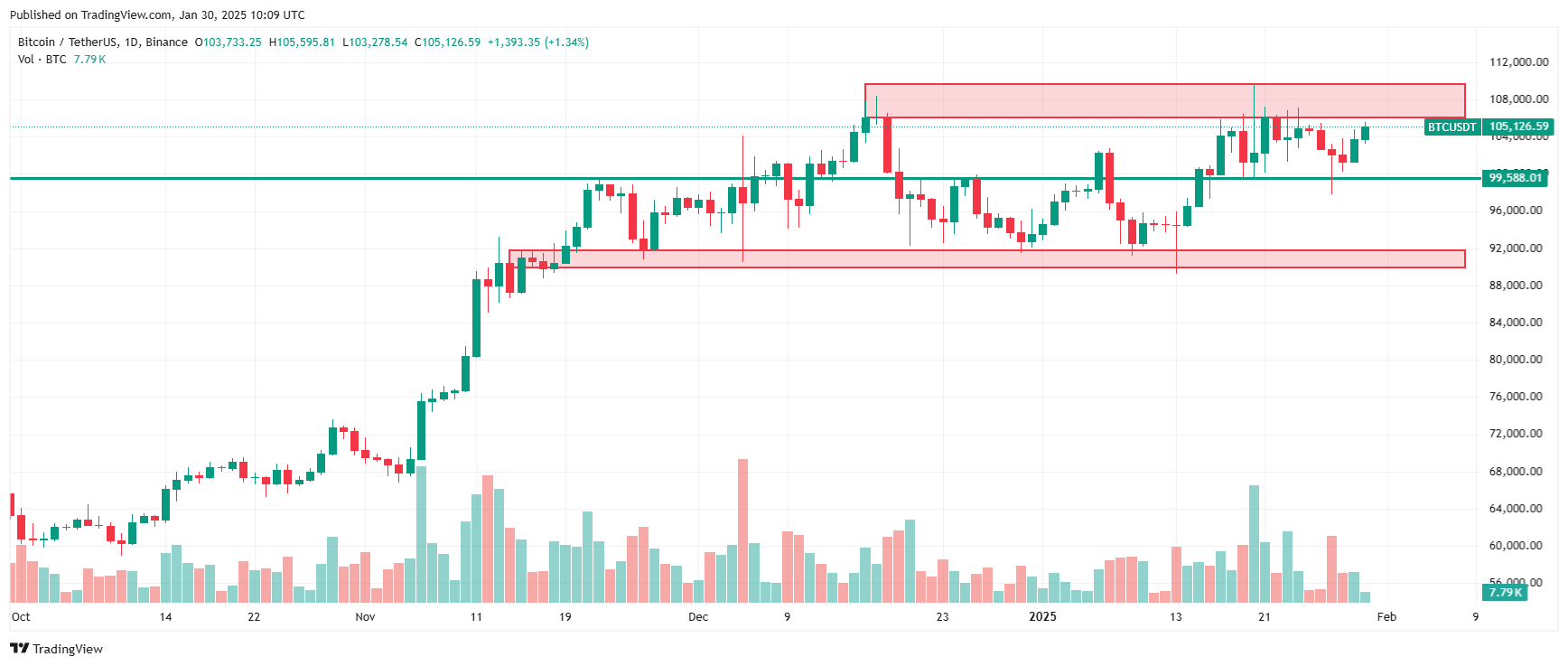
Bitcoin is currently moving inside a consolidation. Source: Tradingview.com
My
technical analysis reveals that Bitcoin is once again approaching the upper
boundary of a consolidation pattern that has been forming over the past two
months. The chart shows a potentially concerning double top formation, which
could activate if BTC price corrects and breaks below the lower boundary of the
sideways movement around $90-92 thousand. This could potentially open the path
for a correction toward the November lows near $70 thousand.
However, I
currently view this as a distant scenario. As
long as the $100 thousand level continues to act as support, I lean more
towards potential retests of the upper consolidation boundary and attempts to
establish new all-time highs above $108 thousand.
The
cryptocurrency market appears to be entering a new phase of maturity. The Fed's
measured approach to monetary policy provides a stable backdrop for continued
growth, while increasing institutional adoption through initiatives like
Truth.Fi suggests broader mainstream acceptance.
Bitcoin Price Prediction:
$117K Soon
Bitcoin's
price trajectory continues to show remarkable strength, with analysts
projecting potential movement between $95,000 and $117,000 in the coming weeks.
This forecast comes amid significant market developments and institutional
interest.
Vugar Usi Zade, Bitget's COO
Vugar Usi
Zade, Bitget's COO, offers a particularly bullish perspective on Bitcoin's
future: "Given Bitcoin's scarcity, with a total supply of 21 million, and
its narrative as digital gold, in the long term, with more funds flowing in and
market maturation, Bitcoin is expected to exhibit a steadily rising price trend.”
Bitcoin is
surging due to two key factors: the Federal Reserve's decision to maintain
interest rates at 4.25%-4.50%, which has created a stable environment for risk
assets, and Trump Media and Technology Group’s new fintech initiative,
Truth.Fi, which signals increased institutional adoption. Additionally, Trump’s
pro-crypto stance and the company's allocation of up to $250 million in crypto
investments have further boosted market sentiment.
What will Bitcoin be worth
in 2025?
Analysts
have projected that Bitcoin could reach new highs in 2025, with some estimates
suggesting prices could exceed $200,000. While shorter-term forecasts place
Bitcoin between $95,000 and $117,000, the long-term outlook remains bullish,
supported by increasing institutional interest and Bitcoin’s scarcity.
Is Bitcoin expected to
rise?
Yes,
Bitcoin is expected to continue rising, with analysts predicting potential
price increases driven by institutional adoption, ETF approvals, and favorable
macroeconomic conditions. However, volatility remains a factor, with risks tied
to regulatory policies, market sentiment, and macroeconomic factors. Despite
possible corrections, the long-term trend for Bitcoin is expected to remain
upward.
The world's
leading cryptocurrency continues its impressive run, reaching new heights as
Bitcoin (BTC) price surged past $105,500 on Thursday. This remarkable price
action comes amid two significant developments that have reshaped market
sentiment.
Why is Bitcoin Surging? Federal
Reserve's Steady Hand
The Federal
Reserve's (Fed’s) latest policy decision has provided a strong foundation for
Bitcoin's upward momentum. In a widely anticipated move, the central bank
maintained interest rates at 4.25%-4.50%, demonstrating a cautious approach to
monetary policy. Fed Chairman Jerome Powell's measured stance, emphasizing no
rush to implement further rate adjustments, has created a stable environment
for risk assets.
BREAKING: The Federal Reserve holds interest rates steady, defying pressure from Pres. Trump to lower them.
The decision to maintain the current level pauses a series of three consecutive interest rate cuts imposed by the Fed over the final months of 2024. pic.twitter.com/YAvRGQPDnV
While
Powell noted that the policy stance is "well-calibrated," the
cryptocurrency market has interpreted this patience as a positive signal. The
Fed's acknowledgment of stable unemployment and improving inflation readings
has reinforced investor confidence in digital assets.
Trump Media's Crypto
Embrace
A second
major catalyst for Bitcoin's surge emerged from an unexpected quarter. Trump
Media and Technology Group's announcement of Truth.Fi, its new fintech venture,
has injected fresh enthusiasm into the crypto market.
The
company's decision to allocate up to $250 million of its $700 million cash
reserves to various investments, including Bitcoin and other cryptocurrencies,
represents a significant institutional endorsement.
🚨 BREAKING: Trump Media and Technology Group announces the launch of Truth. Fi, expanding into fintech with $250M in investments focusing on SMAs, ETFs, and crypto. pic.twitter.com/rlFOgXxclI
Bitcoin is currently moving inside a consolidation. Source: Tradingview.com
My
technical analysis reveals that Bitcoin is once again approaching the upper
boundary of a consolidation pattern that has been forming over the past two
months. The chart shows a potentially concerning double top formation, which
could activate if BTC price corrects and breaks below the lower boundary of the
sideways movement around $90-92 thousand. This could potentially open the path
for a correction toward the November lows near $70 thousand.
However, I
currently view this as a distant scenario. As
long as the $100 thousand level continues to act as support, I lean more
towards potential retests of the upper consolidation boundary and attempts to
establish new all-time highs above $108 thousand.
The
cryptocurrency market appears to be entering a new phase of maturity. The Fed's
measured approach to monetary policy provides a stable backdrop for continued
growth, while increasing institutional adoption through initiatives like
Truth.Fi suggests broader mainstream acceptance.
Bitcoin Price Prediction:
$117K Soon
Bitcoin's
price trajectory continues to show remarkable strength, with analysts
projecting potential movement between $95,000 and $117,000 in the coming weeks.
This forecast comes amid significant market developments and institutional
interest.
Vugar Usi Zade, Bitget's COO
Vugar Usi
Zade, Bitget's COO, offers a particularly bullish perspective on Bitcoin's
future: "Given Bitcoin's scarcity, with a total supply of 21 million, and
its narrative as digital gold, in the long term, with more funds flowing in and
market maturation, Bitcoin is expected to exhibit a steadily rising price trend.”
Bitcoin is
surging due to two key factors: the Federal Reserve's decision to maintain
interest rates at 4.25%-4.50%, which has created a stable environment for risk
assets, and Trump Media and Technology Group’s new fintech initiative,
Truth.Fi, which signals increased institutional adoption. Additionally, Trump’s
pro-crypto stance and the company's allocation of up to $250 million in crypto
investments have further boosted market sentiment.
What will Bitcoin be worth
in 2025?
Analysts
have projected that Bitcoin could reach new highs in 2025, with some estimates
suggesting prices could exceed $200,000. While shorter-term forecasts place
Bitcoin between $95,000 and $117,000, the long-term outlook remains bullish,
supported by increasing institutional interest and Bitcoin’s scarcity.
Is Bitcoin expected to
rise?
Yes,
Bitcoin is expected to continue rising, with analysts predicting potential
price increases driven by institutional adoption, ETF approvals, and favorable
macroeconomic conditions. However, volatility remains a factor, with risks tied
to regulatory policies, market sentiment, and macroeconomic factors. Despite
possible corrections, the long-term trend for Bitcoin is expected to remain
upward.
Damian Chmiel is a Senior Analyst & Editor at Finance Magnates with more than 15 years of experience in the CFD and online trading industry. Active as both a trader and journalist since 2010, he focuses on broker coverage, fintech innovation, and regulatory developments across Europe, the Middle East, and Asia.
His work includes interviews with C-level leaders at major brokerages and fintech platforms, as well as co-authoring Finance Magnates’ quarterly industry benchmarking reports. Damian’s reporting is data-driven, market-aware, and grounded in direct industry engagement. His analysis and commentary have also been cited by external media outlets, including Investing.com, Binance, The Asset, Stockhead, and Dispatch.
Education:
MA in Finance and Accounting, Cracow University of Economics
Kraken Steps Up Speed Race with New Equinix Colocation Service for Crypto Traders
Featured Videos
FP Markets Winner Spotlight 🏆 | Global Broker of the Year 2025 #Trading #Broker #Innovation #Shorts
FP Markets Winner Spotlight 🏆 | Global Broker of the Year 2025 #Trading #Broker #Innovation #Shorts
FP Markets Winner Spotlight 🏆 | Global Broker of the Year 2025 #Trading #Broker #Innovation #Shorts
FP Markets Winner Spotlight 🏆 | Global Broker of the Year 2025 #Trading #Broker #Innovation #Shorts
FP Markets takes the spotlight as Global Broker of the Year 2025 at the Finance Magnates Awards.
Martin Stoilov, Head of Client Experience, shares that trust, innovation, and people played a key role in the company’s success, supported by a strong foundation of integrity and client-centricity.
Following this milestone, FP Markets continues to focus on growth, technology investment, and its core values of transparency and excellence.
👉 Be part of FM Awards 2026: https://awards.financemagnates.com/#nominate
FP Markets takes the spotlight as Global Broker of the Year 2025 at the Finance Magnates Awards.
Martin Stoilov, Head of Client Experience, shares that trust, innovation, and people played a key role in the company’s success, supported by a strong foundation of integrity and client-centricity.
Following this milestone, FP Markets continues to focus on growth, technology investment, and its core values of transparency and excellence.
👉 Be part of FM Awards 2026: https://awards.financemagnates.com/#nominate
FP Markets takes the spotlight as Global Broker of the Year 2025 at the Finance Magnates Awards.
Martin Stoilov, Head of Client Experience, shares that trust, innovation, and people played a key role in the company’s success, supported by a strong foundation of integrity and client-centricity.
Following this milestone, FP Markets continues to focus on growth, technology investment, and its core values of transparency and excellence.
👉 Be part of FM Awards 2026: https://awards.financemagnates.com/#nominate
FP Markets takes the spotlight as Global Broker of the Year 2025 at the Finance Magnates Awards.
Martin Stoilov, Head of Client Experience, shares that trust, innovation, and people played a key role in the company’s success, supported by a strong foundation of integrity and client-centricity.
Following this milestone, FP Markets continues to focus on growth, technology investment, and its core values of transparency and excellence.
👉 Be part of FM Awards 2026: https://awards.financemagnates.com/#nominate
In this video, we review @HolaPrimeMarketsOfficial, a multi-asset forex and CFDs broker offering different account types, trading platforms, and flexible trading conditions.
We cover the broker’s overall offering, including account options, trading environment, platforms like MT4 and MT5, and additional services such as managed accounts and fast withdrawals.
Watch the full video to see if Hola Prime Markets fits your trading needs.
📣 Stay up to date with the latest in finance and trading. Follow Finance Magnates for industry news, insights, and global event coverage.
Connect with us:
🔗 LinkedIn: /financemagnates
👍 Facebook: /financemagnates
📸 Instagram: https://www.instagram.com/financemagnates
🐦 X: https://x.com/financemagnates
🎥 TikTok: https://www.tiktok.com/tag/financemagnates
▶️ YouTube: /@financemagnates_official
#HolaPrime #ForexBroker #CFDTrading #FinanceMagnates #Trading #Forex #BrokerReview
In this video, we review @HolaPrimeMarketsOfficial, a multi-asset forex and CFDs broker offering different account types, trading platforms, and flexible trading conditions.
We cover the broker’s overall offering, including account options, trading environment, platforms like MT4 and MT5, and additional services such as managed accounts and fast withdrawals.
Watch the full video to see if Hola Prime Markets fits your trading needs.
📣 Stay up to date with the latest in finance and trading. Follow Finance Magnates for industry news, insights, and global event coverage.
Connect with us:
🔗 LinkedIn: /financemagnates
👍 Facebook: /financemagnates
📸 Instagram: https://www.instagram.com/financemagnates
🐦 X: https://x.com/financemagnates
🎥 TikTok: https://www.tiktok.com/tag/financemagnates
▶️ YouTube: /@financemagnates_official
#HolaPrime #ForexBroker #CFDTrading #FinanceMagnates #Trading #Forex #BrokerReview
In this video, we review @HolaPrimeMarketsOfficial, a multi-asset forex and CFDs broker offering different account types, trading platforms, and flexible trading conditions.
We cover the broker’s overall offering, including account options, trading environment, platforms like MT4 and MT5, and additional services such as managed accounts and fast withdrawals.
Watch the full video to see if Hola Prime Markets fits your trading needs.
📣 Stay up to date with the latest in finance and trading. Follow Finance Magnates for industry news, insights, and global event coverage.
Connect with us:
🔗 LinkedIn: /financemagnates
👍 Facebook: /financemagnates
📸 Instagram: https://www.instagram.com/financemagnates
🐦 X: https://x.com/financemagnates
🎥 TikTok: https://www.tiktok.com/tag/financemagnates
▶️ YouTube: /@financemagnates_official
#HolaPrime #ForexBroker #CFDTrading #FinanceMagnates #Trading #Forex #BrokerReview
In this video, we review @HolaPrimeMarketsOfficial, a multi-asset forex and CFDs broker offering different account types, trading platforms, and flexible trading conditions.
We cover the broker’s overall offering, including account options, trading environment, platforms like MT4 and MT5, and additional services such as managed accounts and fast withdrawals.
Watch the full video to see if Hola Prime Markets fits your trading needs.
📣 Stay up to date with the latest in finance and trading. Follow Finance Magnates for industry news, insights, and global event coverage.
Connect with us:
🔗 LinkedIn: /financemagnates
👍 Facebook: /financemagnates
📸 Instagram: https://www.instagram.com/financemagnates
🐦 X: https://x.com/financemagnates
🎥 TikTok: https://www.tiktok.com/tag/financemagnates
▶️ YouTube: /@financemagnates_official
#HolaPrime #ForexBroker #CFDTrading #FinanceMagnates #Trading #Forex #BrokerReview
In this video, we review @HolaPrimeMarketsOfficial, a multi-asset forex and CFDs broker offering different account types, trading platforms, and flexible trading conditions.
We cover the broker’s overall offering, including account options, trading environment, platforms like MT4 and MT5, and additional services such as managed accounts and fast withdrawals.
Watch the full video to see if Hola Prime Markets fits your trading needs.
📣 Stay up to date with the latest in finance and trading. Follow Finance Magnates for industry news, insights, and global event coverage.
Connect with us:
🔗 LinkedIn: /financemagnates
👍 Facebook: /financemagnates
📸 Instagram: https://www.instagram.com/financemagnates
🐦 X: https://x.com/financemagnates
🎥 TikTok: https://www.tiktok.com/tag/financemagnates
▶️ YouTube: /@financemagnates_official
#HolaPrime #ForexBroker #CFDTrading #FinanceMagnates #Trading #Forex #BrokerReview
In this video, we review @HolaPrimeMarketsOfficial, a multi-asset forex and CFDs broker offering different account types, trading platforms, and flexible trading conditions.
We cover the broker’s overall offering, including account options, trading environment, platforms like MT4 and MT5, and additional services such as managed accounts and fast withdrawals.
Watch the full video to see if Hola Prime Markets fits your trading needs.
📣 Stay up to date with the latest in finance and trading. Follow Finance Magnates for industry news, insights, and global event coverage.
Connect with us:
🔗 LinkedIn: /financemagnates
👍 Facebook: /financemagnates
📸 Instagram: https://www.instagram.com/financemagnates
🐦 X: https://x.com/financemagnates
🎥 TikTok: https://www.tiktok.com/tag/financemagnates
▶️ YouTube: /@financemagnates_official
#HolaPrime #ForexBroker #CFDTrading #FinanceMagnates #Trading #Forex #BrokerReview
Hola Prime Review: What You Need to Know | Full Breakdown by Finance Magnates
Hola Prime Review: What You Need to Know | Full Breakdown by Finance Magnates
Hola Prime Review: What You Need to Know | Full Breakdown by Finance Magnates
Hola Prime Review: What You Need to Know | Full Breakdown by Finance Magnates
Hola Prime Review: What You Need to Know | Full Breakdown by Finance Magnates
Hola Prime Review: What You Need to Know | Full Breakdown by Finance Magnates
In this video, we review @HolaPrime_Global, a proprietary trading firm offering evaluation programs and performance-based payouts in simulated market environments.
We cover how the challenge model works, including account types, profit splits (up to 95%), trading rules, and what it takes to reach a funded account. You’ll also learn about available platforms like MT4, MT5, cTrader, and more, along with insights into payouts, support, and trading conditions.
Watch the full video to see if Hola Prime fits your trading style.
📣 Stay up to date with the latest in finance and trading. Follow Finance Magnates for industry news, insights, and global event coverage.
Connect with us:
🔗 LinkedIn: /financemagnates
👍 Facebook: /financemagnates
📸 Instagram: https://www.instagram.com/financemagnates
🐦 X: https://x.com/financemagnates
🎥 TikTok: https://www.tiktok.com/tag/financemagnates
▶️ YouTube: /@financemagnates_official
#HolaPrime #PropFirm #Trading #FinanceMagnates #Forex #FuturesTrading #TradingReview #PropFirmReview
In this video, we review @HolaPrime_Global, a proprietary trading firm offering evaluation programs and performance-based payouts in simulated market environments.
We cover how the challenge model works, including account types, profit splits (up to 95%), trading rules, and what it takes to reach a funded account. You’ll also learn about available platforms like MT4, MT5, cTrader, and more, along with insights into payouts, support, and trading conditions.
Watch the full video to see if Hola Prime fits your trading style.
📣 Stay up to date with the latest in finance and trading. Follow Finance Magnates for industry news, insights, and global event coverage.
Connect with us:
🔗 LinkedIn: /financemagnates
👍 Facebook: /financemagnates
📸 Instagram: https://www.instagram.com/financemagnates
🐦 X: https://x.com/financemagnates
🎥 TikTok: https://www.tiktok.com/tag/financemagnates
▶️ YouTube: /@financemagnates_official
#HolaPrime #PropFirm #Trading #FinanceMagnates #Forex #FuturesTrading #TradingReview #PropFirmReview
In this video, we review @HolaPrime_Global, a proprietary trading firm offering evaluation programs and performance-based payouts in simulated market environments.
We cover how the challenge model works, including account types, profit splits (up to 95%), trading rules, and what it takes to reach a funded account. You’ll also learn about available platforms like MT4, MT5, cTrader, and more, along with insights into payouts, support, and trading conditions.
Watch the full video to see if Hola Prime fits your trading style.
📣 Stay up to date with the latest in finance and trading. Follow Finance Magnates for industry news, insights, and global event coverage.
Connect with us:
🔗 LinkedIn: /financemagnates
👍 Facebook: /financemagnates
📸 Instagram: https://www.instagram.com/financemagnates
🐦 X: https://x.com/financemagnates
🎥 TikTok: https://www.tiktok.com/tag/financemagnates
▶️ YouTube: /@financemagnates_official
#HolaPrime #PropFirm #Trading #FinanceMagnates #Forex #FuturesTrading #TradingReview #PropFirmReview
In this video, we review @HolaPrime_Global, a proprietary trading firm offering evaluation programs and performance-based payouts in simulated market environments.
We cover how the challenge model works, including account types, profit splits (up to 95%), trading rules, and what it takes to reach a funded account. You’ll also learn about available platforms like MT4, MT5, cTrader, and more, along with insights into payouts, support, and trading conditions.
Watch the full video to see if Hola Prime fits your trading style.
📣 Stay up to date with the latest in finance and trading. Follow Finance Magnates for industry news, insights, and global event coverage.
Connect with us:
🔗 LinkedIn: /financemagnates
👍 Facebook: /financemagnates
📸 Instagram: https://www.instagram.com/financemagnates
🐦 X: https://x.com/financemagnates
🎥 TikTok: https://www.tiktok.com/tag/financemagnates
▶️ YouTube: /@financemagnates_official
#HolaPrime #PropFirm #Trading #FinanceMagnates #Forex #FuturesTrading #TradingReview #PropFirmReview
In this video, we review @HolaPrime_Global, a proprietary trading firm offering evaluation programs and performance-based payouts in simulated market environments.
We cover how the challenge model works, including account types, profit splits (up to 95%), trading rules, and what it takes to reach a funded account. You’ll also learn about available platforms like MT4, MT5, cTrader, and more, along with insights into payouts, support, and trading conditions.
Watch the full video to see if Hola Prime fits your trading style.
📣 Stay up to date with the latest in finance and trading. Follow Finance Magnates for industry news, insights, and global event coverage.
Connect with us:
🔗 LinkedIn: /financemagnates
👍 Facebook: /financemagnates
📸 Instagram: https://www.instagram.com/financemagnates
🐦 X: https://x.com/financemagnates
🎥 TikTok: https://www.tiktok.com/tag/financemagnates
▶️ YouTube: /@financemagnates_official
#HolaPrime #PropFirm #Trading #FinanceMagnates #Forex #FuturesTrading #TradingReview #PropFirmReview
In this video, we review @HolaPrime_Global, a proprietary trading firm offering evaluation programs and performance-based payouts in simulated market environments.
We cover how the challenge model works, including account types, profit splits (up to 95%), trading rules, and what it takes to reach a funded account. You’ll also learn about available platforms like MT4, MT5, cTrader, and more, along with insights into payouts, support, and trading conditions.
Watch the full video to see if Hola Prime fits your trading style.
📣 Stay up to date with the latest in finance and trading. Follow Finance Magnates for industry news, insights, and global event coverage.
Connect with us:
🔗 LinkedIn: /financemagnates
👍 Facebook: /financemagnates
📸 Instagram: https://www.instagram.com/financemagnates
🐦 X: https://x.com/financemagnates
🎥 TikTok: https://www.tiktok.com/tag/financemagnates
▶️ YouTube: /@financemagnates_official
#HolaPrime #PropFirm #Trading #FinanceMagnates #Forex #FuturesTrading #TradingReview #PropFirmReview
Axi Winner Spotlight 🏆 | Global Most Innovative Broker 2025 #Innovation #Trading #Fintech #Broker
Axi Winner Spotlight 🏆 | Global Most Innovative Broker 2025 #Innovation #Trading #Fintech #Broker
Axi Winner Spotlight 🏆 | Global Most Innovative Broker 2025 #Innovation #Trading #Fintech #Broker
Axi Winner Spotlight 🏆 | Global Most Innovative Broker 2025 #Innovation #Trading #Fintech #Broker
Axi Winner Spotlight 🏆 | Global Most Innovative Broker 2025 #Innovation #Trading #Fintech #Broker
Axi Winner Spotlight 🏆 | Global Most Innovative Broker 2025 #Innovation #Trading #Fintech #Broker
Axi takes the spotlight at the Finance Magnates Awards, winning Global Most Innovative Broker 2025.
Olivia Xenofontos and Ivanna Openko share how the team will feel: proud, motivated, and ready to keep delivering.
They also describe the night as well-organized, focused, and enjoyable for all.
👉 Be part of FM Awards 2026.
Axi takes the spotlight at the Finance Magnates Awards, winning Global Most Innovative Broker 2025.
Olivia Xenofontos and Ivanna Openko share how the team will feel: proud, motivated, and ready to keep delivering.
They also describe the night as well-organized, focused, and enjoyable for all.
👉 Be part of FM Awards 2026.
Axi takes the spotlight at the Finance Magnates Awards, winning Global Most Innovative Broker 2025.
Olivia Xenofontos and Ivanna Openko share how the team will feel: proud, motivated, and ready to keep delivering.
They also describe the night as well-organized, focused, and enjoyable for all.
👉 Be part of FM Awards 2026.
Axi takes the spotlight at the Finance Magnates Awards, winning Global Most Innovative Broker 2025.
Olivia Xenofontos and Ivanna Openko share how the team will feel: proud, motivated, and ready to keep delivering.
They also describe the night as well-organized, focused, and enjoyable for all.
👉 Be part of FM Awards 2026.
Axi takes the spotlight at the Finance Magnates Awards, winning Global Most Innovative Broker 2025.
Olivia Xenofontos and Ivanna Openko share how the team will feel: proud, motivated, and ready to keep delivering.
They also describe the night as well-organized, focused, and enjoyable for all.
👉 Be part of FM Awards 2026.
Axi takes the spotlight at the Finance Magnates Awards, winning Global Most Innovative Broker 2025.
Olivia Xenofontos and Ivanna Openko share how the team will feel: proud, motivated, and ready to keep delivering.
They also describe the night as well-organized, focused, and enjoyable for all.
👉 Be part of FM Awards 2026.
Recognition that matters.
Built on transparency.
Driven by the industry.
The Finance Magnates Awards 2026.
Nominations are now open.
🔗 https://awards.financemagnates.com/?utm_source=SM&utm_medium=social&utm_campaign=recognition-matters
Recognition that matters.
Built on transparency.
Driven by the industry.
The Finance Magnates Awards 2026.
Nominations are now open.
🔗 https://awards.financemagnates.com/?utm_source=SM&utm_medium=social&utm_campaign=recognition-matters
Recognition that matters.
Built on transparency.
Driven by the industry.
The Finance Magnates Awards 2026.
Nominations are now open.
🔗 https://awards.financemagnates.com/?utm_source=SM&utm_medium=social&utm_campaign=recognition-matters
Recognition that matters.
Built on transparency.
Driven by the industry.
The Finance Magnates Awards 2026.
Nominations are now open.
🔗 https://awards.financemagnates.com/?utm_source=SM&utm_medium=social&utm_campaign=recognition-matters
Recognition that matters.
Built on transparency.
Driven by the industry.
The Finance Magnates Awards 2026.
Nominations are now open.
🔗 https://awards.financemagnates.com/?utm_source=SM&utm_medium=social&utm_campaign=recognition-matters
Recognition that matters.
Built on transparency.
Driven by the industry.
The Finance Magnates Awards 2026.
Nominations are now open.
🔗 https://awards.financemagnates.com/?utm_source=SM&utm_medium=social&utm_campaign=recognition-matters