In the same time frame, stablecoin transactions grew 147% year-over-year, according to the Finery Markets report.
The market expects accelerated institutional adoption in 2025, supported by favorable regulatory developments and expanded financial products.
The
cryptocurrency over-the-counter (OTC) market experienced unprecedented growth
in 2024, with trading volumes more than doubling amid strong institutional
adoption and favorable market conditions.
Total OTC
trading volume surged 106% year-over-year, while stablecoin transactions saw an
even more dramatic increase of 147%, according to a comprehensive analysis of 4
million spot trades conducted by Finery Markets.
From Skeptics to
Believers: Wall Street's Crypto Evolution
The
landscape of institutional crypto trading transformed dramatically throughout
2024, culminating in Bitcoin's
breakthrough above $100,000 in December. This milestone coincided with the
successful launch
of Bitcoin and Ethereum ETFs, which proved transformative for the market
structure. Notably, U.S. Bitcoin ETF inflows surpassed those of gold ETFs,
marking what Finery Markets describes as “the most successful
exchange-traded product launch in history.”
The year
showed consistent growth momentum, with each quarter presenting unique
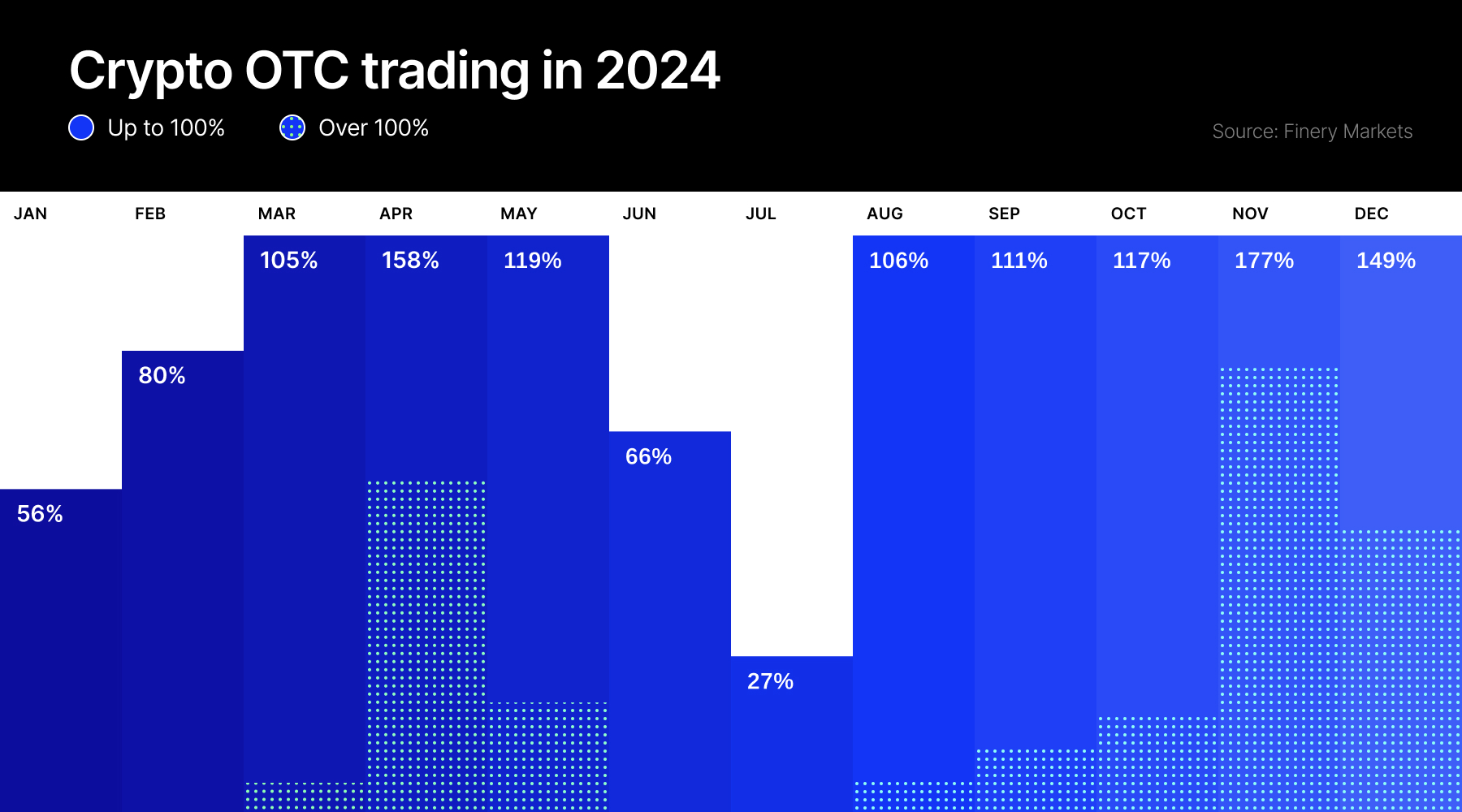
dynamics. The fourth quarter emerged as the strongest performer, achieving a 177%
year-over-year growth in total OTC volumes.
“Q4
trading activity significantly outpaced all other quarters. Q2,
benefiting from the successful BTC ETF launches, was the only other quarter
to achieve triple-digit growth at 110%. Q1 and Q3 followed with growth rates of
80% and 78%, respectively,” Finery Markets
added.
The company
recently
revealed that it partnered with Wintermute, a global algorithmic trading
firm, which in November 2024 completed the first RFQ trade on Finery Markets' crypto ECN platform.
Konstantin Shulga, CEO and Co-Founder of Finery Markets
“The institutional surge came as no surprise to us, as we designed our trading infrastructure from the start to meet the needs of institutional players, anticipating wider adoption,” Konstantin Shulga, Finery Markets CEO and Co-Founder, commented for Finance Magnates.
“Transaction
volumes exceeded those of Visa, underscoring their utility in the fast-paced
global business environment and exposing the limitations of legacy banking
infrastructure in meeting growing market demands,” the report further said.
Altcoin Renaissance
The
institutional appetite for altcoins also showed expansion, with their market
share more than doubling to 29% of total trading volume, up from 13% in 2023.
Solana emerged as the year's standout performer, recording a ninefold increase
in trading activity, with an exceptional 43-fold surge in the fourth quarter
alone. Litecoin maintained its strong position among institutional investors,
achieving a 149% increase over the year.
“In
2024, altcoins accounted for 29% of the total trading volume compared to 13%
last year,” Finery Markets added. “Our tech architecture is designed to enable our customers to trade with liquidity providers using credit lines while offering flexible risk management options. All trades are executed on a credit-screened basis to ensure that risk limits are checked before the trade is made.”
Institutional Crypto's Next Frontier
The market
structure appears poised for further evolution in 2025, with several key trends
emerging. The potential implementation of crypto-backed loans by institutions
could unlock new investment opportunities, while tokenized traditional assets
are expected to gain significant traction. This could fundamentally reshape
global trading strategies as markets adapt to 24/7 trading and improved
liquidity for traditionally illiquid assets.
“We anticipate a continued strengthening of market structures, driven by regulatory developments. This evolution will lead to a more balanced risk distribution and further diversification of the trade cycle,” Finery Markets commented for Finance Magnates. “A significant number of new companies and businesses are being established in key financial hubs such as Singapore, the UAE, London, and various European cities, particularly with the Markets in Crypto-Assets (MiCA) regulation leading the way.”
Finery
Markets partnered
back in October 2024 with technology and digital asset liquidity provider
Stillman Digital to expand its pool of global liquidity providers.
“A
potential BTC Reserve implementation could trigger global shifts as countries
and corporations abandon 'zero exposure' strategies,” the report concluded.
European
markets face particular scrutiny as MiCA regulations unfold, potentially
creating challenges for Tier 2 and Tier 3 cryptocurrency exchanges. These
regulatory developments may drive innovation in broker-dealer business models
and accelerate the adoption of advanced technology solutions.
The
cryptocurrency over-the-counter (OTC) market experienced unprecedented growth
in 2024, with trading volumes more than doubling amid strong institutional
adoption and favorable market conditions.
Total OTC
trading volume surged 106% year-over-year, while stablecoin transactions saw an
even more dramatic increase of 147%, according to a comprehensive analysis of 4
million spot trades conducted by Finery Markets.
From Skeptics to
Believers: Wall Street's Crypto Evolution
The
landscape of institutional crypto trading transformed dramatically throughout
2024, culminating in Bitcoin's
breakthrough above $100,000 in December. This milestone coincided with the
successful launch
of Bitcoin and Ethereum ETFs, which proved transformative for the market
structure. Notably, U.S. Bitcoin ETF inflows surpassed those of gold ETFs,
marking what Finery Markets describes as “the most successful
exchange-traded product launch in history.”
The year
showed consistent growth momentum, with each quarter presenting unique
dynamics. The fourth quarter emerged as the strongest performer, achieving a 177%
year-over-year growth in total OTC volumes.
“Q4
trading activity significantly outpaced all other quarters. Q2,
benefiting from the successful BTC ETF launches, was the only other quarter
to achieve triple-digit growth at 110%. Q1 and Q3 followed with growth rates of
80% and 78%, respectively,” Finery Markets
added.
The company
recently
revealed that it partnered with Wintermute, a global algorithmic trading
firm, which in November 2024 completed the first RFQ trade on Finery Markets' crypto ECN platform.
Konstantin Shulga, CEO and Co-Founder of Finery Markets
“The institutional surge came as no surprise to us, as we designed our trading infrastructure from the start to meet the needs of institutional players, anticipating wider adoption,” Konstantin Shulga, Finery Markets CEO and Co-Founder, commented for Finance Magnates.
“Transaction
volumes exceeded those of Visa, underscoring their utility in the fast-paced
global business environment and exposing the limitations of legacy banking
infrastructure in meeting growing market demands,” the report further said.
Altcoin Renaissance
The
institutional appetite for altcoins also showed expansion, with their market
share more than doubling to 29% of total trading volume, up from 13% in 2023.
Solana emerged as the year's standout performer, recording a ninefold increase
in trading activity, with an exceptional 43-fold surge in the fourth quarter
alone. Litecoin maintained its strong position among institutional investors,
achieving a 149% increase over the year.
“In
2024, altcoins accounted for 29% of the total trading volume compared to 13%
last year,” Finery Markets added. “Our tech architecture is designed to enable our customers to trade with liquidity providers using credit lines while offering flexible risk management options. All trades are executed on a credit-screened basis to ensure that risk limits are checked before the trade is made.”
Institutional Crypto's Next Frontier
The market
structure appears poised for further evolution in 2025, with several key trends
emerging. The potential implementation of crypto-backed loans by institutions
could unlock new investment opportunities, while tokenized traditional assets
are expected to gain significant traction. This could fundamentally reshape
global trading strategies as markets adapt to 24/7 trading and improved
liquidity for traditionally illiquid assets.
“We anticipate a continued strengthening of market structures, driven by regulatory developments. This evolution will lead to a more balanced risk distribution and further diversification of the trade cycle,” Finery Markets commented for Finance Magnates. “A significant number of new companies and businesses are being established in key financial hubs such as Singapore, the UAE, London, and various European cities, particularly with the Markets in Crypto-Assets (MiCA) regulation leading the way.”
Finery
Markets partnered
back in October 2024 with technology and digital asset liquidity provider
Stillman Digital to expand its pool of global liquidity providers.
“A
potential BTC Reserve implementation could trigger global shifts as countries
and corporations abandon 'zero exposure' strategies,” the report concluded.
European
markets face particular scrutiny as MiCA regulations unfold, potentially
creating challenges for Tier 2 and Tier 3 cryptocurrency exchanges. These
regulatory developments may drive innovation in broker-dealer business models
and accelerate the adoption of advanced technology solutions.
Damian's adventure with financial markets began at the Cracow University of Economics, where he obtained his MA in finance and accounting. Starting from the retail trader perspective, he collaborated with brokerage houses and financial portals in Poland as an independent editor and content manager. His adventure with Finance Magnates began in 2016, where he is working as a business intelligence analyst.
From Chat to Stock: xStocks Puts Tokenized U.S. Equities Inside TON Wallet on Telegram
Featured Videos
Executive Interview | Charlotte Bullock | Chief Product Officer, Bank of London | FMLS:25
In this interview, we sat down with Charlotte Bullock, Head of Product at The Bank of London, previously at SAP and now shaping product at one of the sector’s most ambitious new banking players.
Charlotte reflects on the Summit so far and talks about the culture inside fintech banks today. We look at the pressures that come with scaling, and how firms can hold onto the nimble approach that made them stand out early on.
We also cover the state of payments ahead of her appearance on the payments roundtable: the blockages financial firms face, the areas that still need fixing, and what a realistic solution looks like in 2026.
In this interview, we sat down with Charlotte Bullock, Head of Product at The Bank of London, previously at SAP and now shaping product at one of the sector’s most ambitious new banking players.
Charlotte reflects on the Summit so far and talks about the culture inside fintech banks today. We look at the pressures that come with scaling, and how firms can hold onto the nimble approach that made them stand out early on.
We also cover the state of payments ahead of her appearance on the payments roundtable: the blockages financial firms face, the areas that still need fixing, and what a realistic solution looks like in 2026.
In this interview, we sat down with Charlotte Bullock, Head of Product at The Bank of London, previously at SAP and now shaping product at one of the sector’s most ambitious new banking players.
Charlotte reflects on the Summit so far and talks about the culture inside fintech banks today. We look at the pressures that come with scaling, and how firms can hold onto the nimble approach that made them stand out early on.
We also cover the state of payments ahead of her appearance on the payments roundtable: the blockages financial firms face, the areas that still need fixing, and what a realistic solution looks like in 2026.
In this interview, we sat down with Charlotte Bullock, Head of Product at The Bank of London, previously at SAP and now shaping product at one of the sector’s most ambitious new banking players.
Charlotte reflects on the Summit so far and talks about the culture inside fintech banks today. We look at the pressures that come with scaling, and how firms can hold onto the nimble approach that made them stand out early on.
We also cover the state of payments ahead of her appearance on the payments roundtable: the blockages financial firms face, the areas that still need fixing, and what a realistic solution looks like in 2026.
In this conversation, we sit down with Drew Niv, CSO at ATFX Connect and one of the most influential figures in modern FX.
We speak about market structure, the institutional view on liquidity, and the sharp rise of prop trading, a sector Drew has been commenting on in recent months. Drew explains why he once dismissed prop trading, why his view changed, and what he now thinks the model means for brokers, clients and risk managers.
We explore subscription-fee dependency, the high reneging rate, and the long-term challenge: how brokers can build a more stable and honest version of the model. Drew also talks about the traffic advantage standalone prop firms have built and why brokers may still win in the long run if they take the right approach.
In this conversation, we sit down with Drew Niv, CSO at ATFX Connect and one of the most influential figures in modern FX.
We speak about market structure, the institutional view on liquidity, and the sharp rise of prop trading, a sector Drew has been commenting on in recent months. Drew explains why he once dismissed prop trading, why his view changed, and what he now thinks the model means for brokers, clients and risk managers.
We explore subscription-fee dependency, the high reneging rate, and the long-term challenge: how brokers can build a more stable and honest version of the model. Drew also talks about the traffic advantage standalone prop firms have built and why brokers may still win in the long run if they take the right approach.
In this conversation, we sit down with Drew Niv, CSO at ATFX Connect and one of the most influential figures in modern FX.
We speak about market structure, the institutional view on liquidity, and the sharp rise of prop trading, a sector Drew has been commenting on in recent months. Drew explains why he once dismissed prop trading, why his view changed, and what he now thinks the model means for brokers, clients and risk managers.
We explore subscription-fee dependency, the high reneging rate, and the long-term challenge: how brokers can build a more stable and honest version of the model. Drew also talks about the traffic advantage standalone prop firms have built and why brokers may still win in the long run if they take the right approach.
In this conversation, we sit down with Drew Niv, CSO at ATFX Connect and one of the most influential figures in modern FX.
We speak about market structure, the institutional view on liquidity, and the sharp rise of prop trading, a sector Drew has been commenting on in recent months. Drew explains why he once dismissed prop trading, why his view changed, and what he now thinks the model means for brokers, clients and risk managers.
We explore subscription-fee dependency, the high reneging rate, and the long-term challenge: how brokers can build a more stable and honest version of the model. Drew also talks about the traffic advantage standalone prop firms have built and why brokers may still win in the long run if they take the right approach.
In this conversation, we sit down with Drew Niv, CSO at ATFX Connect and one of the most influential figures in modern FX.
We speak about market structure, the institutional view on liquidity, and the sharp rise of prop trading, a sector Drew has been commenting on in recent months. Drew explains why he once dismissed prop trading, why his view changed, and what he now thinks the model means for brokers, clients and risk managers.
We explore subscription-fee dependency, the high reneging rate, and the long-term challenge: how brokers can build a more stable and honest version of the model. Drew also talks about the traffic advantage standalone prop firms have built and why brokers may still win in the long run if they take the right approach.
In this conversation, we sit down with Drew Niv, CSO at ATFX Connect and one of the most influential figures in modern FX.
We speak about market structure, the institutional view on liquidity, and the sharp rise of prop trading, a sector Drew has been commenting on in recent months. Drew explains why he once dismissed prop trading, why his view changed, and what he now thinks the model means for brokers, clients and risk managers.
We explore subscription-fee dependency, the high reneging rate, and the long-term challenge: how brokers can build a more stable and honest version of the model. Drew also talks about the traffic advantage standalone prop firms have built and why brokers may still win in the long run if they take the right approach.
Executive Interview | Remonda Z. Kirketerp Møller| CEO & Founder Muinmos | FMLS:25
In this interview, Remonda Z. Kirketerp Møller, founder of Muinmos, breaks down the state of AI in regtech and what responsible adoption really looks like for brokers. We talk about rising fragmentation, the pressures around compliance accuracy, and why most firms are still in the early stages of AI maturity.
Ramanda also shares insights on regulator sandboxes, shifting expectations around accountability, and the current reality of MiCA licensing and passporting in Europe.
A concise look at where compliance, onboarding, and AI-driven processes are heading next.
In this interview, Remonda Z. Kirketerp Møller, founder of Muinmos, breaks down the state of AI in regtech and what responsible adoption really looks like for brokers. We talk about rising fragmentation, the pressures around compliance accuracy, and why most firms are still in the early stages of AI maturity.
Ramanda also shares insights on regulator sandboxes, shifting expectations around accountability, and the current reality of MiCA licensing and passporting in Europe.
A concise look at where compliance, onboarding, and AI-driven processes are heading next.
In this interview, Remonda Z. Kirketerp Møller, founder of Muinmos, breaks down the state of AI in regtech and what responsible adoption really looks like for brokers. We talk about rising fragmentation, the pressures around compliance accuracy, and why most firms are still in the early stages of AI maturity.
Ramanda also shares insights on regulator sandboxes, shifting expectations around accountability, and the current reality of MiCA licensing and passporting in Europe.
A concise look at where compliance, onboarding, and AI-driven processes are heading next.
In this interview, Remonda Z. Kirketerp Møller, founder of Muinmos, breaks down the state of AI in regtech and what responsible adoption really looks like for brokers. We talk about rising fragmentation, the pressures around compliance accuracy, and why most firms are still in the early stages of AI maturity.
Ramanda also shares insights on regulator sandboxes, shifting expectations around accountability, and the current reality of MiCA licensing and passporting in Europe.
A concise look at where compliance, onboarding, and AI-driven processes are heading next.
In this interview, Remonda Z. Kirketerp Møller, founder of Muinmos, breaks down the state of AI in regtech and what responsible adoption really looks like for brokers. We talk about rising fragmentation, the pressures around compliance accuracy, and why most firms are still in the early stages of AI maturity.
Ramanda also shares insights on regulator sandboxes, shifting expectations around accountability, and the current reality of MiCA licensing and passporting in Europe.
A concise look at where compliance, onboarding, and AI-driven processes are heading next.
In this interview, Remonda Z. Kirketerp Møller, founder of Muinmos, breaks down the state of AI in regtech and what responsible adoption really looks like for brokers. We talk about rising fragmentation, the pressures around compliance accuracy, and why most firms are still in the early stages of AI maturity.
Ramanda also shares insights on regulator sandboxes, shifting expectations around accountability, and the current reality of MiCA licensing and passporting in Europe.
A concise look at where compliance, onboarding, and AI-driven processes are heading next.
In this conversation, we speak with Aydin Bonabi, CEO and co-founder of Surveill, a firm focused on fraud detection and AI-driven compliance tools for financial institutions.
We start with Aydin’s view of the Summit and the challenges brokers face as fraud tactics grow more complex. He explains how firms can stay ahead through real-time signals, data patterns, and early-stage detection.
We also talk about AI training and why compliance teams often struggle to keep models accurate, fair, and aligned with regulatory expectations. Aydin breaks down what “good” AI training looks like inside a financial environment, including the importance of clean data, domain expertise, and human oversight.
He closes with a clear message: fraud is scaling, and so must the tools that stop it.
In this conversation, we speak with Aydin Bonabi, CEO and co-founder of Surveill, a firm focused on fraud detection and AI-driven compliance tools for financial institutions.
We start with Aydin’s view of the Summit and the challenges brokers face as fraud tactics grow more complex. He explains how firms can stay ahead through real-time signals, data patterns, and early-stage detection.
We also talk about AI training and why compliance teams often struggle to keep models accurate, fair, and aligned with regulatory expectations. Aydin breaks down what “good” AI training looks like inside a financial environment, including the importance of clean data, domain expertise, and human oversight.
He closes with a clear message: fraud is scaling, and so must the tools that stop it.
In this conversation, we speak with Aydin Bonabi, CEO and co-founder of Surveill, a firm focused on fraud detection and AI-driven compliance tools for financial institutions.
We start with Aydin’s view of the Summit and the challenges brokers face as fraud tactics grow more complex. He explains how firms can stay ahead through real-time signals, data patterns, and early-stage detection.
We also talk about AI training and why compliance teams often struggle to keep models accurate, fair, and aligned with regulatory expectations. Aydin breaks down what “good” AI training looks like inside a financial environment, including the importance of clean data, domain expertise, and human oversight.
He closes with a clear message: fraud is scaling, and so must the tools that stop it.
In this conversation, we speak with Aydin Bonabi, CEO and co-founder of Surveill, a firm focused on fraud detection and AI-driven compliance tools for financial institutions.
We start with Aydin’s view of the Summit and the challenges brokers face as fraud tactics grow more complex. He explains how firms can stay ahead through real-time signals, data patterns, and early-stage detection.
We also talk about AI training and why compliance teams often struggle to keep models accurate, fair, and aligned with regulatory expectations. Aydin breaks down what “good” AI training looks like inside a financial environment, including the importance of clean data, domain expertise, and human oversight.
He closes with a clear message: fraud is scaling, and so must the tools that stop it.
In this conversation, we speak with Aydin Bonabi, CEO and co-founder of Surveill, a firm focused on fraud detection and AI-driven compliance tools for financial institutions.
We start with Aydin’s view of the Summit and the challenges brokers face as fraud tactics grow more complex. He explains how firms can stay ahead through real-time signals, data patterns, and early-stage detection.
We also talk about AI training and why compliance teams often struggle to keep models accurate, fair, and aligned with regulatory expectations. Aydin breaks down what “good” AI training looks like inside a financial environment, including the importance of clean data, domain expertise, and human oversight.
He closes with a clear message: fraud is scaling, and so must the tools that stop it.
In this conversation, we speak with Aydin Bonabi, CEO and co-founder of Surveill, a firm focused on fraud detection and AI-driven compliance tools for financial institutions.
We start with Aydin’s view of the Summit and the challenges brokers face as fraud tactics grow more complex. He explains how firms can stay ahead through real-time signals, data patterns, and early-stage detection.
We also talk about AI training and why compliance teams often struggle to keep models accurate, fair, and aligned with regulatory expectations. Aydin breaks down what “good” AI training looks like inside a financial environment, including the importance of clean data, domain expertise, and human oversight.
He closes with a clear message: fraud is scaling, and so must the tools that stop it.
Exness expands its presence in Africa: Inside our interview with Paul Margarites in Cape Town
Finance Magnates met with Paul Margarites, Exness regional commercial director for Sub-Saharan Africa, during a visit to the firm’s office opening in Cape Town. In this talk, led by Andrea Badiola Mateos, Co-CEO at Finance Magnates, Paul shares views on the South African trading space, local user behavior, mobile trends, regulation, team growth, and how Exness plans to grow in more markets across the region. @Exness
Read the article at: https://www.financemagnates.com/thought-leadership/exness-expands-its-presence-in-africa-inside-our-interview-with-paul-margarites/
#exness #financemagnates #exnesstrading #CFDtrading #tradeonline #africanews #capetown
Finance Magnates met with Paul Margarites, Exness regional commercial director for Sub-Saharan Africa, during a visit to the firm’s office opening in Cape Town. In this talk, led by Andrea Badiola Mateos, Co-CEO at Finance Magnates, Paul shares views on the South African trading space, local user behavior, mobile trends, regulation, team growth, and how Exness plans to grow in more markets across the region. @Exness
Read the article at: https://www.financemagnates.com/thought-leadership/exness-expands-its-presence-in-africa-inside-our-interview-with-paul-margarites/
#exness #financemagnates #exnesstrading #CFDtrading #tradeonline #africanews #capetown
Finance Magnates met with Paul Margarites, Exness regional commercial director for Sub-Saharan Africa, during a visit to the firm’s office opening in Cape Town. In this talk, led by Andrea Badiola Mateos, Co-CEO at Finance Magnates, Paul shares views on the South African trading space, local user behavior, mobile trends, regulation, team growth, and how Exness plans to grow in more markets across the region. @Exness
Read the article at: https://www.financemagnates.com/thought-leadership/exness-expands-its-presence-in-africa-inside-our-interview-with-paul-margarites/
#exness #financemagnates #exnesstrading #CFDtrading #tradeonline #africanews #capetown
Finance Magnates met with Paul Margarites, Exness regional commercial director for Sub-Saharan Africa, during a visit to the firm’s office opening in Cape Town. In this talk, led by Andrea Badiola Mateos, Co-CEO at Finance Magnates, Paul shares views on the South African trading space, local user behavior, mobile trends, regulation, team growth, and how Exness plans to grow in more markets across the region. @Exness
Read the article at: https://www.financemagnates.com/thought-leadership/exness-expands-its-presence-in-africa-inside-our-interview-with-paul-margarites/
#exness #financemagnates #exnesstrading #CFDtrading #tradeonline #africanews #capetown
Finance Magnates met with Paul Margarites, Exness regional commercial director for Sub-Saharan Africa, during a visit to the firm’s office opening in Cape Town. In this talk, led by Andrea Badiola Mateos, Co-CEO at Finance Magnates, Paul shares views on the South African trading space, local user behavior, mobile trends, regulation, team growth, and how Exness plans to grow in more markets across the region. @Exness
Read the article at: https://www.financemagnates.com/thought-leadership/exness-expands-its-presence-in-africa-inside-our-interview-with-paul-margarites/
#exness #financemagnates #exnesstrading #CFDtrading #tradeonline #africanews #capetown
Finance Magnates met with Paul Margarites, Exness regional commercial director for Sub-Saharan Africa, during a visit to the firm’s office opening in Cape Town. In this talk, led by Andrea Badiola Mateos, Co-CEO at Finance Magnates, Paul shares views on the South African trading space, local user behavior, mobile trends, regulation, team growth, and how Exness plans to grow in more markets across the region. @Exness
Read the article at: https://www.financemagnates.com/thought-leadership/exness-expands-its-presence-in-africa-inside-our-interview-with-paul-margarites/
#exness #financemagnates #exnesstrading #CFDtrading #tradeonline #africanews #capetown