This week, Bitfarms and CleanSpark reported their BTC production data for August.
The increasing difficulty of mining led to a production decrease of several percent.
The
increasing difficulty of mining cryptocurrencies and a further 9% drop in its
price has negatively impacted Wall Street Bitcoin (BTC) miners in August. The
publicly listed CleanSpark (NASDAQ: CLSK) and Bitfarms (NASDAQ:
BITF) have both
reported a decline in their Bitcoin production compared to the previous month.
CleanSpark and Bitfarms
Report Decreased Bitcoin Production in August 2024
CleanSpark,
which describes itself as “America's Bitcoin Miner,” and
is one of the biggest publicly listed BTC companies by market cap, mined
478 Bitcoin in August, down from 494 in July. This represents a 3.2% decrease
in monthly production. The company's average daily Bitcoin production also fell
slightly, from 15.94 in July to 15.43 in August.
Similarly,
Bitfarms experienced a more significant drop in its Bitcoin production. The
company mined 233 Bitcoin in August, compared to 253 in July, marking a 7.9%
decrease. Bitfarms attributed this decline to higher network difficulty, which
was partially offset by an increase in its operational hashrate.
Lower
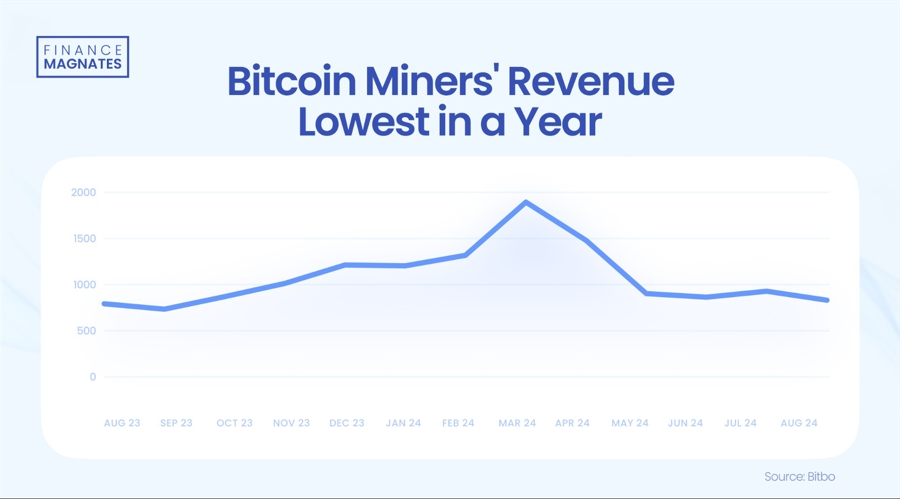
mining outputs also correspond with decreased earnings. According
to Bitbo data, cryptocurrency miners earned $828 million in August, marking
the lowest earnings since September 2023. Moreover, this represents a 57% drop
from the historical highs achieved in March of this year, when earnings nearly
reached $2 billion.
Despite
the decrease in production, both companies continued to expand their operations
and improve their mining capabilities:
CleanSpark
increased its total operating hashrate by 1.4 EH/s during August, ending the
month at 22.6 EH/s.
Bitfarms
reported an operational hashrate of 11.3 EH/s at the end of August, up 102%
year-over-year and 2% month-over-month.
Battling the Adverse Trend
Both
companies are pursuing aggressive expansion strategies. CleanSpark
expects to bring 65 MW of additional data center capacity online in
September.
Zach Bradford, CEO of CleanSpark
“As we
approach the end of our fiscal year, the team continues to work diligently to
optimize fleet efficiency and increase hashrate,” said Zach Bradford, CEO. “Our fleet upgrade is well
underway as we simultaneously prepare for 65 MW of capacity to be energized
during the month of September. These efforts are expected to result in a
meaningful increase in operating hashrate and bitcoin production as we close
out our fiscal year.”
Bitfarms,
on the other hand, has assumed control of its first mega-site in Sharon, PA,
with access to up to 120 MW. Earlier in August, the
company also acquired Stronghold.
“With this
transaction, we have finalized the acquisition of 110 MW, with 30 MW expected
to come online by the end of 2024,” commented Ben Gagnon, Chief Executive Officer of Bitfarms. “We have also signed a Letter of Intent for
an additional 10 MW site, which will increase our total site capacity to 120 MW
by 2025.”
The
decrease in Bitcoin production for both companies highlights the challenges
faced by miners as network difficulty increases and competition in the industry
intensifies. According to the latest JPMorgan report, mining
companies are still feeling April’s halving hangover.
The
increasing difficulty of mining cryptocurrencies and a further 9% drop in its
price has negatively impacted Wall Street Bitcoin (BTC) miners in August. The
publicly listed CleanSpark (NASDAQ: CLSK) and Bitfarms (NASDAQ:
BITF) have both
reported a decline in their Bitcoin production compared to the previous month.
CleanSpark and Bitfarms
Report Decreased Bitcoin Production in August 2024
CleanSpark,
which describes itself as “America's Bitcoin Miner,” and
is one of the biggest publicly listed BTC companies by market cap, mined
478 Bitcoin in August, down from 494 in July. This represents a 3.2% decrease
in monthly production. The company's average daily Bitcoin production also fell
slightly, from 15.94 in July to 15.43 in August.
Similarly,
Bitfarms experienced a more significant drop in its Bitcoin production. The
company mined 233 Bitcoin in August, compared to 253 in July, marking a 7.9%
decrease. Bitfarms attributed this decline to higher network difficulty, which
was partially offset by an increase in its operational hashrate.
Lower
mining outputs also correspond with decreased earnings. According
to Bitbo data, cryptocurrency miners earned $828 million in August, marking
the lowest earnings since September 2023. Moreover, this represents a 57% drop
from the historical highs achieved in March of this year, when earnings nearly
reached $2 billion.
Despite
the decrease in production, both companies continued to expand their operations
and improve their mining capabilities:
CleanSpark
increased its total operating hashrate by 1.4 EH/s during August, ending the
month at 22.6 EH/s.
Bitfarms
reported an operational hashrate of 11.3 EH/s at the end of August, up 102%
year-over-year and 2% month-over-month.
Battling the Adverse Trend
Both
companies are pursuing aggressive expansion strategies. CleanSpark
expects to bring 65 MW of additional data center capacity online in
September.
Zach Bradford, CEO of CleanSpark
“As we
approach the end of our fiscal year, the team continues to work diligently to
optimize fleet efficiency and increase hashrate,” said Zach Bradford, CEO. “Our fleet upgrade is well
underway as we simultaneously prepare for 65 MW of capacity to be energized
during the month of September. These efforts are expected to result in a
meaningful increase in operating hashrate and bitcoin production as we close
out our fiscal year.”
Bitfarms,
on the other hand, has assumed control of its first mega-site in Sharon, PA,
with access to up to 120 MW. Earlier in August, the
company also acquired Stronghold.
“With this
transaction, we have finalized the acquisition of 110 MW, with 30 MW expected
to come online by the end of 2024,” commented Ben Gagnon, Chief Executive Officer of Bitfarms. “We have also signed a Letter of Intent for
an additional 10 MW site, which will increase our total site capacity to 120 MW
by 2025.”
The
decrease in Bitcoin production for both companies highlights the challenges
faced by miners as network difficulty increases and competition in the industry
intensifies. According to the latest JPMorgan report, mining
companies are still feeling April’s halving hangover.
Damian Chmiel is a Senior Analyst & Editor at Finance Magnates with more than 15 years of experience in the CFD and online trading industry. Active as both a trader and journalist since 2010, he focuses on broker coverage, fintech innovation, and regulatory developments across Europe, the Middle East, and Asia.
His work includes interviews with C-level leaders at major brokerages and fintech platforms, as well as co-authoring Finance Magnates’ quarterly industry benchmarking reports. Damian’s reporting is data-driven, market-aware, and grounded in direct industry engagement. His analysis and commentary have also been cited by external media outlets, including Investing.com, Binance, The Asset, Stockhead, and Dispatch.
Education:
MA in Finance and Accounting, Cracow University of Economics
Kraken Steps Up Speed Race with New Equinix Colocation Service for Crypto Traders
FP Markets Winner Spotlight 🏆 | Global Broker of the Year 2025 #Trading #Broker #Innovation #Shorts
FP Markets Winner Spotlight 🏆 | Global Broker of the Year 2025 #Trading #Broker #Innovation #Shorts
FP Markets takes the spotlight as Global Broker of the Year 2025 at the Finance Magnates Awards.
Martin Stoilov, Head of Client Experience, shares that trust, innovation, and people played a key role in the company’s success, supported by a strong foundation of integrity and client-centricity.
Following this milestone, FP Markets continues to focus on growth, technology investment, and its core values of transparency and excellence.
👉 Be part of FM Awards 2026: https://awards.financemagnates.com/#nominate
FP Markets takes the spotlight as Global Broker of the Year 2025 at the Finance Magnates Awards.
Martin Stoilov, Head of Client Experience, shares that trust, innovation, and people played a key role in the company’s success, supported by a strong foundation of integrity and client-centricity.
Following this milestone, FP Markets continues to focus on growth, technology investment, and its core values of transparency and excellence.
👉 Be part of FM Awards 2026: https://awards.financemagnates.com/#nominate
In this video, we review @HolaPrimeMarketsOfficial, a multi-asset forex and CFDs broker offering different account types, trading platforms, and flexible trading conditions.
We cover the broker’s overall offering, including account options, trading environment, platforms like MT4 and MT5, and additional services such as managed accounts and fast withdrawals.
Watch the full video to see if Hola Prime Markets fits your trading needs.
📣 Stay up to date with the latest in finance and trading. Follow Finance Magnates for industry news, insights, and global event coverage.
Connect with us:
🔗 LinkedIn: /financemagnates
👍 Facebook: /financemagnates
📸 Instagram: https://www.instagram.com/financemagnates
🐦 X: https://x.com/financemagnates
🎥 TikTok: https://www.tiktok.com/tag/financemagnates
▶️ YouTube: /@financemagnates_official
#HolaPrime #ForexBroker #CFDTrading #FinanceMagnates #Trading #Forex #BrokerReview
In this video, we review @HolaPrimeMarketsOfficial, a multi-asset forex and CFDs broker offering different account types, trading platforms, and flexible trading conditions.
We cover the broker’s overall offering, including account options, trading environment, platforms like MT4 and MT5, and additional services such as managed accounts and fast withdrawals.
Watch the full video to see if Hola Prime Markets fits your trading needs.
📣 Stay up to date with the latest in finance and trading. Follow Finance Magnates for industry news, insights, and global event coverage.
Connect with us:
🔗 LinkedIn: /financemagnates
👍 Facebook: /financemagnates
📸 Instagram: https://www.instagram.com/financemagnates
🐦 X: https://x.com/financemagnates
🎥 TikTok: https://www.tiktok.com/tag/financemagnates
▶️ YouTube: /@financemagnates_official
#HolaPrime #ForexBroker #CFDTrading #FinanceMagnates #Trading #Forex #BrokerReview
Hola Prime Review: What You Need to Know | Full Breakdown by Finance Magnates
Hola Prime Review: What You Need to Know | Full Breakdown by Finance Magnates
In this video, we review @HolaPrime_Global, a proprietary trading firm offering evaluation programs and performance-based payouts in simulated market environments.
We cover how the challenge model works, including account types, profit splits (up to 95%), trading rules, and what it takes to reach a funded account. You’ll also learn about available platforms like MT4, MT5, cTrader, and more, along with insights into payouts, support, and trading conditions.
Watch the full video to see if Hola Prime fits your trading style.
📣 Stay up to date with the latest in finance and trading. Follow Finance Magnates for industry news, insights, and global event coverage.
Connect with us:
🔗 LinkedIn: /financemagnates
👍 Facebook: /financemagnates
📸 Instagram: https://www.instagram.com/financemagnates
🐦 X: https://x.com/financemagnates
🎥 TikTok: https://www.tiktok.com/tag/financemagnates
▶️ YouTube: /@financemagnates_official
#HolaPrime #PropFirm #Trading #FinanceMagnates #Forex #FuturesTrading #TradingReview #PropFirmReview
In this video, we review @HolaPrime_Global, a proprietary trading firm offering evaluation programs and performance-based payouts in simulated market environments.
We cover how the challenge model works, including account types, profit splits (up to 95%), trading rules, and what it takes to reach a funded account. You’ll also learn about available platforms like MT4, MT5, cTrader, and more, along with insights into payouts, support, and trading conditions.
Watch the full video to see if Hola Prime fits your trading style.
📣 Stay up to date with the latest in finance and trading. Follow Finance Magnates for industry news, insights, and global event coverage.
Connect with us:
🔗 LinkedIn: /financemagnates
👍 Facebook: /financemagnates
📸 Instagram: https://www.instagram.com/financemagnates
🐦 X: https://x.com/financemagnates
🎥 TikTok: https://www.tiktok.com/tag/financemagnates
▶️ YouTube: /@financemagnates_official
#HolaPrime #PropFirm #Trading #FinanceMagnates #Forex #FuturesTrading #TradingReview #PropFirmReview
Axi Winner Spotlight 🏆 | Global Most Innovative Broker 2025 #Innovation #Trading #Fintech #Broker
Axi Winner Spotlight 🏆 | Global Most Innovative Broker 2025 #Innovation #Trading #Fintech #Broker
Axi takes the spotlight at the Finance Magnates Awards, winning Global Most Innovative Broker 2025.
Olivia Xenofontos and Ivanna Openko share how the team will feel: proud, motivated, and ready to keep delivering.
They also describe the night as well-organized, focused, and enjoyable for all.
👉 Be part of FM Awards 2026.
Axi takes the spotlight at the Finance Magnates Awards, winning Global Most Innovative Broker 2025.
Olivia Xenofontos and Ivanna Openko share how the team will feel: proud, motivated, and ready to keep delivering.
They also describe the night as well-organized, focused, and enjoyable for all.
👉 Be part of FM Awards 2026.
Recognition that matters.
Built on transparency.
Driven by the industry.
The Finance Magnates Awards 2026.
Nominations are now open.
🔗 https://awards.financemagnates.com/?utm_source=SM&utm_medium=social&utm_campaign=recognition-matters
Recognition that matters.
Built on transparency.
Driven by the industry.
The Finance Magnates Awards 2026.
Nominations are now open.
🔗 https://awards.financemagnates.com/?utm_source=SM&utm_medium=social&utm_campaign=recognition-matters