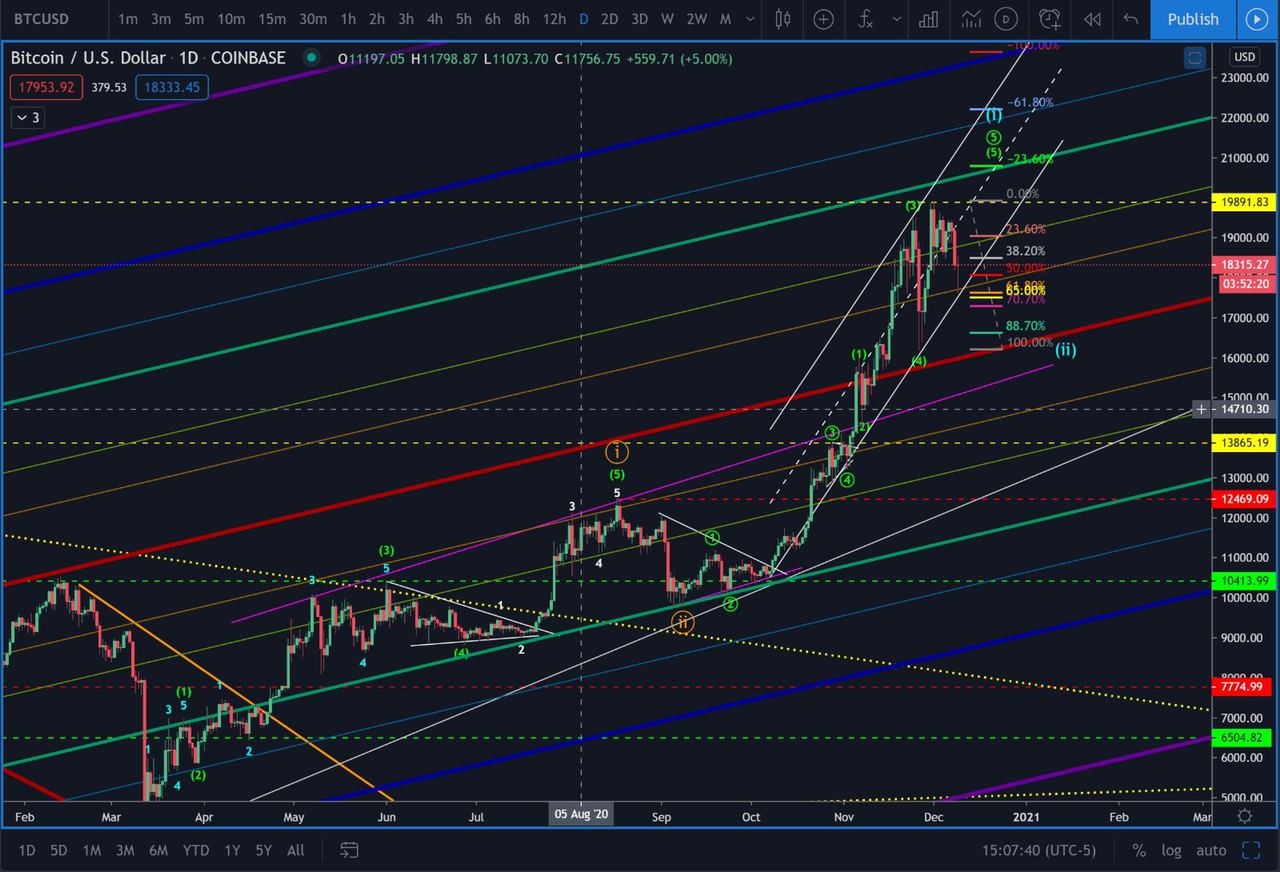
For example, over most of the past month, Bitcoin has been on a bullish trend toward $20,000. However, with prices sinking below $18,000, it seems as though Bitcoin may have officially started to retrace.
“The bears stepped in to prevent the price from breaking above the $20,000 psychological price point and were able to push it back below $18,000, tagging the 61.8% Fibonacci retracement level of the previous major pivot low.”
Bitcoin Could Retrace as Far as $16,000 before Rebounding
However, buyers have not let the price fall too far yet: “the bulls quickly stepped in to buy Bitcoin at this price and kept the price within the well-defined parallel channel,” Maksimenka told Finance Magnates.
“If $17,600 is defended and respected, then the bullish Elliott wave count shows a move up to test the $21,000 resistance level,” he continued. “If this level is not defended, I expect the bears to push it all the way back down to $16,000, where the median line of the pitchfork should act as support.”
Still, “the Elliott wave is fractal, so as long as Bitcoin continues to make higher highs, the trend is intact and we should continue to push to new highs."
But what could turn the bearish trend around?
Ilia Maksimenka, Chief Executive and Founder of PlasmaPay.
Indeed, Lennard Neo, Head of Research at crypto investment firm, Stack Funds, wrote in a report on Thursday that “our analysts believe more inertia is required to push bitcoin beyond the $20,000 psychology barrier.”
And indeed, “more inertia” could be in short order, or at least in the order of several months.
Further Economic Stimulus Could Be a Boon for Bitcoin
As CoinDesk reported, “it’s becoming tougher to get through a rundown of each day’s news without finding a story or several about economic stimulus”; only the details of how much stimulus and when it will be released are changing.
However, while there has not been consensus on the details of the stimulus plan yet, there has been consensus among analysts regarding the effects of economic stimulus on Bitcoin: it is a good thing.
In particular, these analysts point to quantitative easing as being particularly beneficial for Bitcoin because of the weakening effect it has on the United States dollar.
Unlike the USD, “Bitcoin Has a Fixed Inflation Rate, and Is Deflationary by Design.”
“Bitcoin has a fixed inflation rate, and is deflationary by design, with only 21-Million Bitcoin to ever be created in its existence,” he added.
Ehrlich explained that this deflationary quality is one of the reasons that Bitcoin has been attracting an increasingly impressive list of institutional and corporate investors: “more and more public companies, like MicroStrategy, Square, are adding Bitcoin to their balance sheet,” he said.
“It’s because their annual productivity and growth rate has to be greater than 15 percent to counteract the devaluation of their cash reserves on hand due to inflation.”
USD Is Likely to Continue to Weaken over the Long Term
Moreover, Ehrlich says that he does not see the USD’s weakening trend coming to an end anytime soon.
“The U.S. Dollar has weakened due to a number of factors,” he told Finance Magnates. “One, the economic uncertainty due to the recent pandemic and economic shutdowns, which has stifled some productivity and economic growth.”
Steve Ehrlich, Chief Executive Officer and Co-founder of crypto Trading Platform, Voyager.
“Secondly, the Federal Reserve has inflated the U.S. Dollar by more than 15 percent in 2020, leaving 21 percent of all U.S. Dollars ever printed having been printed in 2020,” he continued. “The current rate of inflation has no signs of slowing down, with necessary financial intervention and stimulus in the future, more and more dollars will be pumped into the economy, thus lowering their inherent value.”
Further, Ehrlich pointed out the fact that fewer people are using physical cash in order to avoid spreading COVID-19: “as well as more and more people doing their shopping online, it's estimated 40 percent to 70 percent of U.S. consumers will prefer to transact in digital mediums in the coming years,” he said.
In other words, “the place of physical cash in our current modern and unique time in history is under question.”
Indeed, “currently, there is no clear plan for the Federal Reserve to be able to slow down the inflation of the U.S. Dollar, and will continue to be 15% or more annually,” he said. “Until there is a proposed solution to the inflation problem, economic stimulus and recovery, we expect the dollar to continue to struggle. Unfortunately, those affected most by the devaluation of the dollar are the lower and middle class.”
Bitcoin’s Detriment Could Be a Boon to Some Altcoins
Therefore, while Bitcoin may be looking down the barrel of a retracement in the short-term, most analysts are unafraid of Bitcoin’s long-term price movements.
CoinDesk reported that Chris Thomas, Head of Digital Assets for Swissquote Bank, sees the retracement as “a buying opportunity for those who have a longer time frame.”
“I’m not scared by this,” he said. “It’s just providing a better entry point for those who want to invest mid-long term. I haven’t seen much [over-the-counter] or larger activity this week, though.”
However, while Bitcoin has been falling, some of the larger altcoins seem to have been growing. In fact, a number of analysts agree that investors seem to be selling off their Bitcoins in exchange for altcoins.
Specifically, Chris Thomas told CoinDesk “our data shows that in the last four weeks the volume of XRP has increased substantially” to the detriment of both Bitcoin and Ether, the second-largest cryptocurrency by market cap.
The increased level of interest in XRP could be caused in part by an airdrop that the issuers of the currency did in collaboration with Coinbase.
However, at press time, the price of XRP seemed to have hit a bump in the road. XRP was down 4.47 percent over the last 24 hours and 11.83 percent over the past 7 days.
ETH Trends down, Too
However, the fall of Bitcoin does not seem to be directly benefiting the price of Ether. In fact, at press time, data from CoinMarketCap showed the price of ETH was down 3.87 percent over the last 24 hours and 11.37 percent over the past 7 days.
Part of the drop could be because of the fact that the world’s first Ethereum ETF, dubbed 'The Ether Fund', made its on the Toronto Stock Exchange today under $QETH with a few hiccups.
Indeed, CoinTelegraph reported that “to the concern of interested traders, the fund was not available for trading upon the opening bell, officially halted because of a delay in closing the fund’s IPO prospectus.” As a result, the fund began trading two hours behind schedule, with 345,331 shares being traded across the rest of the day.
Beyond the ETF, the price of ETH is still relatively high, perhaps riding on the news that the Eth2.0 'Beacon Chain' was recently launched. Still, there could be some other factors that ETH will have to overcome before it can really take off.
For example, Vishal Shah, Founder of derivatives venue Alpha5, told CoinDesk that the launch of the Beacon chain has moved ETH forward, there is still a ways to go before it can be considered a truly 'established' protocol.
“ETH should have a higher volatility given that it’s a less established protocol than bitcoin,” he said. “It is materially smaller in market cap and has more uncertainties on the immediate horizon. The largest uncertainty would be the settling of [the Beacon Chain] and the transition to 2.0, it’s all a bit uncharted.“
For example, over most of the past month, Bitcoin has been on a bullish trend toward $20,000. However, with prices sinking below $18,000, it seems as though Bitcoin may have officially started to retrace.
“The bears stepped in to prevent the price from breaking above the $20,000 psychological price point and were able to push it back below $18,000, tagging the 61.8% Fibonacci retracement level of the previous major pivot low.”
Bitcoin Could Retrace as Far as $16,000 before Rebounding
However, buyers have not let the price fall too far yet: “the bulls quickly stepped in to buy Bitcoin at this price and kept the price within the well-defined parallel channel,” Maksimenka told Finance Magnates.
“If $17,600 is defended and respected, then the bullish Elliott wave count shows a move up to test the $21,000 resistance level,” he continued. “If this level is not defended, I expect the bears to push it all the way back down to $16,000, where the median line of the pitchfork should act as support.”
Still, “the Elliott wave is fractal, so as long as Bitcoin continues to make higher highs, the trend is intact and we should continue to push to new highs."
But what could turn the bearish trend around?
Ilia Maksimenka, Chief Executive and Founder of PlasmaPay.
Indeed, Lennard Neo, Head of Research at crypto investment firm, Stack Funds, wrote in a report on Thursday that “our analysts believe more inertia is required to push bitcoin beyond the $20,000 psychology barrier.”
And indeed, “more inertia” could be in short order, or at least in the order of several months.
Further Economic Stimulus Could Be a Boon for Bitcoin
As CoinDesk reported, “it’s becoming tougher to get through a rundown of each day’s news without finding a story or several about economic stimulus”; only the details of how much stimulus and when it will be released are changing.
However, while there has not been consensus on the details of the stimulus plan yet, there has been consensus among analysts regarding the effects of economic stimulus on Bitcoin: it is a good thing.
In particular, these analysts point to quantitative easing as being particularly beneficial for Bitcoin because of the weakening effect it has on the United States dollar.
Unlike the USD, “Bitcoin Has a Fixed Inflation Rate, and Is Deflationary by Design.”
“Bitcoin has a fixed inflation rate, and is deflationary by design, with only 21-Million Bitcoin to ever be created in its existence,” he added.
Ehrlich explained that this deflationary quality is one of the reasons that Bitcoin has been attracting an increasingly impressive list of institutional and corporate investors: “more and more public companies, like MicroStrategy, Square, are adding Bitcoin to their balance sheet,” he said.
“It’s because their annual productivity and growth rate has to be greater than 15 percent to counteract the devaluation of their cash reserves on hand due to inflation.”
USD Is Likely to Continue to Weaken over the Long Term
Moreover, Ehrlich says that he does not see the USD’s weakening trend coming to an end anytime soon.
“The U.S. Dollar has weakened due to a number of factors,” he told Finance Magnates. “One, the economic uncertainty due to the recent pandemic and economic shutdowns, which has stifled some productivity and economic growth.”
Steve Ehrlich, Chief Executive Officer and Co-founder of crypto Trading Platform, Voyager.
“Secondly, the Federal Reserve has inflated the U.S. Dollar by more than 15 percent in 2020, leaving 21 percent of all U.S. Dollars ever printed having been printed in 2020,” he continued. “The current rate of inflation has no signs of slowing down, with necessary financial intervention and stimulus in the future, more and more dollars will be pumped into the economy, thus lowering their inherent value.”
Further, Ehrlich pointed out the fact that fewer people are using physical cash in order to avoid spreading COVID-19: “as well as more and more people doing their shopping online, it's estimated 40 percent to 70 percent of U.S. consumers will prefer to transact in digital mediums in the coming years,” he said.
In other words, “the place of physical cash in our current modern and unique time in history is under question.”
Indeed, “currently, there is no clear plan for the Federal Reserve to be able to slow down the inflation of the U.S. Dollar, and will continue to be 15% or more annually,” he said. “Until there is a proposed solution to the inflation problem, economic stimulus and recovery, we expect the dollar to continue to struggle. Unfortunately, those affected most by the devaluation of the dollar are the lower and middle class.”
Bitcoin’s Detriment Could Be a Boon to Some Altcoins
Therefore, while Bitcoin may be looking down the barrel of a retracement in the short-term, most analysts are unafraid of Bitcoin’s long-term price movements.
CoinDesk reported that Chris Thomas, Head of Digital Assets for Swissquote Bank, sees the retracement as “a buying opportunity for those who have a longer time frame.”
“I’m not scared by this,” he said. “It’s just providing a better entry point for those who want to invest mid-long term. I haven’t seen much [over-the-counter] or larger activity this week, though.”
However, while Bitcoin has been falling, some of the larger altcoins seem to have been growing. In fact, a number of analysts agree that investors seem to be selling off their Bitcoins in exchange for altcoins.
Specifically, Chris Thomas told CoinDesk “our data shows that in the last four weeks the volume of XRP has increased substantially” to the detriment of both Bitcoin and Ether, the second-largest cryptocurrency by market cap.
The increased level of interest in XRP could be caused in part by an airdrop that the issuers of the currency did in collaboration with Coinbase.
However, at press time, the price of XRP seemed to have hit a bump in the road. XRP was down 4.47 percent over the last 24 hours and 11.83 percent over the past 7 days.
ETH Trends down, Too
However, the fall of Bitcoin does not seem to be directly benefiting the price of Ether. In fact, at press time, data from CoinMarketCap showed the price of ETH was down 3.87 percent over the last 24 hours and 11.37 percent over the past 7 days.
Part of the drop could be because of the fact that the world’s first Ethereum ETF, dubbed 'The Ether Fund', made its on the Toronto Stock Exchange today under $QETH with a few hiccups.
Indeed, CoinTelegraph reported that “to the concern of interested traders, the fund was not available for trading upon the opening bell, officially halted because of a delay in closing the fund’s IPO prospectus.” As a result, the fund began trading two hours behind schedule, with 345,331 shares being traded across the rest of the day.
Beyond the ETF, the price of ETH is still relatively high, perhaps riding on the news that the Eth2.0 'Beacon Chain' was recently launched. Still, there could be some other factors that ETH will have to overcome before it can really take off.
For example, Vishal Shah, Founder of derivatives venue Alpha5, told CoinDesk that the launch of the Beacon chain has moved ETH forward, there is still a ways to go before it can be considered a truly 'established' protocol.
“ETH should have a higher volatility given that it’s a less established protocol than bitcoin,” he said. “It is materially smaller in market cap and has more uncertainties on the immediate horizon. The largest uncertainty would be the settling of [the Beacon Chain] and the transition to 2.0, it’s all a bit uncharted.“
Rachel is a self-taught crypto geek and a passionate writer. She believes in the power that the written word has to educate, connect and empower individuals to make positive and powerful financial choices. She is the Podcast Host and a Cryptocurrency Editor at Finance Magnates.
Binance Claims Fastest $1 Billion Sprint in bStocks With $6 Billion in Share Conversions
Featured Videos
How Much Are CFD Industry Executives Making; Plus500 Buys Brazilian Broker
How Much Are CFD Industry Executives Making; Plus500 Buys Brazilian Broker
How Much Are CFD Industry Executives Making; Plus500 Buys Brazilian Broker
How Much Are CFD Industry Executives Making; Plus500 Buys Brazilian Broker
Today’s financial news recap covers FinTop Consulting shared its 2026 salary surveys for Dubai, London and Cyprus with Finance Magnates, Plus500 buys a Brazilian broker, and Google opens the door to CFD ads in Denmark and Chile.
Finance Magnates Daily Recap brings you the latest news from forex and CFD brokers, fintech, payments, cryptocurrency, digital assets, trading platforms, financial regulation and global markets.
Get the key company news, executive moves, deals, regulatory updates and market developments of the day, in just a few minutes. New episodes published every weekday.
Read more: https://www.financemagnates.com
#FinanceMagnates #ForexNews #FintechNews
Today’s financial news recap covers FinTop Consulting shared its 2026 salary surveys for Dubai, London and Cyprus with Finance Magnates, Plus500 buys a Brazilian broker, and Google opens the door to CFD ads in Denmark and Chile.
Finance Magnates Daily Recap brings you the latest news from forex and CFD brokers, fintech, payments, cryptocurrency, digital assets, trading platforms, financial regulation and global markets.
Get the key company news, executive moves, deals, regulatory updates and market developments of the day, in just a few minutes. New episodes published every weekday.
Read more: https://www.financemagnates.com
#FinanceMagnates #ForexNews #FintechNews
Today’s financial news recap covers FinTop Consulting shared its 2026 salary surveys for Dubai, London and Cyprus with Finance Magnates, Plus500 buys a Brazilian broker, and Google opens the door to CFD ads in Denmark and Chile.
Finance Magnates Daily Recap brings you the latest news from forex and CFD brokers, fintech, payments, cryptocurrency, digital assets, trading platforms, financial regulation and global markets.
Get the key company news, executive moves, deals, regulatory updates and market developments of the day, in just a few minutes. New episodes published every weekday.
Read more: https://www.financemagnates.com
#FinanceMagnates #ForexNews #FintechNews
Today’s financial news recap covers FinTop Consulting shared its 2026 salary surveys for Dubai, London and Cyprus with Finance Magnates, Plus500 buys a Brazilian broker, and Google opens the door to CFD ads in Denmark and Chile.
Finance Magnates Daily Recap brings you the latest news from forex and CFD brokers, fintech, payments, cryptocurrency, digital assets, trading platforms, financial regulation and global markets.
Get the key company news, executive moves, deals, regulatory updates and market developments of the day, in just a few minutes. New episodes published every weekday.
Read more: https://www.financemagnates.com
#FinanceMagnates #ForexNews #FintechNews
Capital.com UAE Clients Trade $1T in H1; Saxo Signs Nine Athletes
Capital.com UAE Clients Trade $1T in H1; Saxo Signs Nine Athletes
Capital.com UAE Clients Trade $1T in H1; Saxo Signs Nine Athletes
Capital.com UAE Clients Trade $1T in H1; Saxo Signs Nine Athletes
Capital.com UAE Clients Trade $1T in H1; Saxo Signs Nine Athletes
Capital.com UAE Clients Trade $1T in H1; Saxo Signs Nine Athletes
Today’s financial news recap covers Capital.com’s trading data, Saxo Bank’s athlete campaign, Revolut’s Gibraltar crypto licence, and eToro’s new desktop terminal.
Finance Magnates Daily Recap brings you the latest news from forex and CFD brokers, fintech, payments, cryptocurrency, digital assets, trading platforms, financial regulation and global markets.
Get the key company news, executive moves, deals, regulatory updates and market developments of the day, in just a few minutes. New episodes published every weekday.
Read more: https://www.financemagnates.com
#FinanceMagnates #ForexNews #FintechNews
Today’s financial news recap covers Capital.com’s trading data, Saxo Bank’s athlete campaign, Revolut’s Gibraltar crypto licence, and eToro’s new desktop terminal.
Finance Magnates Daily Recap brings you the latest news from forex and CFD brokers, fintech, payments, cryptocurrency, digital assets, trading platforms, financial regulation and global markets.
Get the key company news, executive moves, deals, regulatory updates and market developments of the day, in just a few minutes. New episodes published every weekday.
Read more: https://www.financemagnates.com
#FinanceMagnates #ForexNews #FintechNews
Today’s financial news recap covers Capital.com’s trading data, Saxo Bank’s athlete campaign, Revolut’s Gibraltar crypto licence, and eToro’s new desktop terminal.
Finance Magnates Daily Recap brings you the latest news from forex and CFD brokers, fintech, payments, cryptocurrency, digital assets, trading platforms, financial regulation and global markets.
Get the key company news, executive moves, deals, regulatory updates and market developments of the day, in just a few minutes. New episodes published every weekday.
Read more: https://www.financemagnates.com
#FinanceMagnates #ForexNews #FintechNews
Today’s financial news recap covers Capital.com’s trading data, Saxo Bank’s athlete campaign, Revolut’s Gibraltar crypto licence, and eToro’s new desktop terminal.
Finance Magnates Daily Recap brings you the latest news from forex and CFD brokers, fintech, payments, cryptocurrency, digital assets, trading platforms, financial regulation and global markets.
Get the key company news, executive moves, deals, regulatory updates and market developments of the day, in just a few minutes. New episodes published every weekday.
Read more: https://www.financemagnates.com
#FinanceMagnates #ForexNews #FintechNews
Today’s financial news recap covers Capital.com’s trading data, Saxo Bank’s athlete campaign, Revolut’s Gibraltar crypto licence, and eToro’s new desktop terminal.
Finance Magnates Daily Recap brings you the latest news from forex and CFD brokers, fintech, payments, cryptocurrency, digital assets, trading platforms, financial regulation and global markets.
Get the key company news, executive moves, deals, regulatory updates and market developments of the day, in just a few minutes. New episodes published every weekday.
Read more: https://www.financemagnates.com
#FinanceMagnates #ForexNews #FintechNews
Today’s financial news recap covers Capital.com’s trading data, Saxo Bank’s athlete campaign, Revolut’s Gibraltar crypto licence, and eToro’s new desktop terminal.
Finance Magnates Daily Recap brings you the latest news from forex and CFD brokers, fintech, payments, cryptocurrency, digital assets, trading platforms, financial regulation and global markets.
Get the key company news, executive moves, deals, regulatory updates and market developments of the day, in just a few minutes. New episodes published every weekday.
Read more: https://www.financemagnates.com
#FinanceMagnates #ForexNews #FintechNews
CXM Group to Buy TD Markets; Interactive Brokers Raises Dividend
CXM Group to Buy TD Markets; Interactive Brokers Raises Dividend
CXM Group to Buy TD Markets; Interactive Brokers Raises Dividend
CXM Group to Buy TD Markets; Interactive Brokers Raises Dividend
CXM Group to Buy TD Markets; Interactive Brokers Raises Dividend
CXM Group to Buy TD Markets; Interactive Brokers Raises Dividend
Today’s financial news recap covers CXM Group agrees to acquire TD Markets, Interactive Brokers raises its dividend, Your Bourse and 4XPORTAL formalise a technology partnership, and IC completes its rebranding from IC Markets.
Finance Magnates Daily Recap brings you the latest news from forex and CFD brokers, fintech, payments, cryptocurrency, digital assets, trading platforms, financial regulation and global markets.
Get the key company news, executive moves, deals, regulatory updates and market developments of the day, in just a few minutes. New episodes published every weekday.
Read more: https://www.financemagnates.com
#FinanceMagnates #ForexNews #FintechNews
Today’s financial news recap covers CXM Group agrees to acquire TD Markets, Interactive Brokers raises its dividend, Your Bourse and 4XPORTAL formalise a technology partnership, and IC completes its rebranding from IC Markets.
Finance Magnates Daily Recap brings you the latest news from forex and CFD brokers, fintech, payments, cryptocurrency, digital assets, trading platforms, financial regulation and global markets.
Get the key company news, executive moves, deals, regulatory updates and market developments of the day, in just a few minutes. New episodes published every weekday.
Read more: https://www.financemagnates.com
#FinanceMagnates #ForexNews #FintechNews
Today’s financial news recap covers CXM Group agrees to acquire TD Markets, Interactive Brokers raises its dividend, Your Bourse and 4XPORTAL formalise a technology partnership, and IC completes its rebranding from IC Markets.
Finance Magnates Daily Recap brings you the latest news from forex and CFD brokers, fintech, payments, cryptocurrency, digital assets, trading platforms, financial regulation and global markets.
Get the key company news, executive moves, deals, regulatory updates and market developments of the day, in just a few minutes. New episodes published every weekday.
Read more: https://www.financemagnates.com
#FinanceMagnates #ForexNews #FintechNews
Today’s financial news recap covers CXM Group agrees to acquire TD Markets, Interactive Brokers raises its dividend, Your Bourse and 4XPORTAL formalise a technology partnership, and IC completes its rebranding from IC Markets.
Finance Magnates Daily Recap brings you the latest news from forex and CFD brokers, fintech, payments, cryptocurrency, digital assets, trading platforms, financial regulation and global markets.
Get the key company news, executive moves, deals, regulatory updates and market developments of the day, in just a few minutes. New episodes published every weekday.
Read more: https://www.financemagnates.com
#FinanceMagnates #ForexNews #FintechNews
Today’s financial news recap covers CXM Group agrees to acquire TD Markets, Interactive Brokers raises its dividend, Your Bourse and 4XPORTAL formalise a technology partnership, and IC completes its rebranding from IC Markets.
Finance Magnates Daily Recap brings you the latest news from forex and CFD brokers, fintech, payments, cryptocurrency, digital assets, trading platforms, financial regulation and global markets.
Get the key company news, executive moves, deals, regulatory updates and market developments of the day, in just a few minutes. New episodes published every weekday.
Read more: https://www.financemagnates.com
#FinanceMagnates #ForexNews #FintechNews
Today’s financial news recap covers CXM Group agrees to acquire TD Markets, Interactive Brokers raises its dividend, Your Bourse and 4XPORTAL formalise a technology partnership, and IC completes its rebranding from IC Markets.
Finance Magnates Daily Recap brings you the latest news from forex and CFD brokers, fintech, payments, cryptocurrency, digital assets, trading platforms, financial regulation and global markets.
Get the key company news, executive moves, deals, regulatory updates and market developments of the day, in just a few minutes. New episodes published every weekday.
Read more: https://www.financemagnates.com
#FinanceMagnates #ForexNews #FintechNews
Trade Nation Enters Poland; FCA Finds Gaps at Seven Brokers
Trade Nation Enters Poland; FCA Finds Gaps at Seven Brokers
Trade Nation Enters Poland; FCA Finds Gaps at Seven Brokers
Trade Nation Enters Poland; FCA Finds Gaps at Seven Brokers
Trade Nation Enters Poland; FCA Finds Gaps at Seven Brokers
Trade Nation Enters Poland; FCA Finds Gaps at Seven Brokers
Today’s financial news recap covers Trade Nation expands into Poland, the FCA finds surveillance gaps at seven UK retail brokers, perpetual futures on US stocks could launch within weeks, and Australia's crypto platforms face a new regulatory deadline.
Finance Magnates Daily Recap brings you the latest news from forex and CFD brokers, fintech, payments, cryptocurrency, digital assets, trading platforms, financial regulation and global markets.
Get the key company news, executive moves, deals, regulatory updates and market developments of the day, in just a few minutes. New episodes published every weekday.
Read more: https://www.financemagnates.com
#FinanceMagnates #ForexNews #FintechNews
Today’s financial news recap covers Trade Nation expands into Poland, the FCA finds surveillance gaps at seven UK retail brokers, perpetual futures on US stocks could launch within weeks, and Australia's crypto platforms face a new regulatory deadline.
Finance Magnates Daily Recap brings you the latest news from forex and CFD brokers, fintech, payments, cryptocurrency, digital assets, trading platforms, financial regulation and global markets.
Get the key company news, executive moves, deals, regulatory updates and market developments of the day, in just a few minutes. New episodes published every weekday.
Read more: https://www.financemagnates.com
#FinanceMagnates #ForexNews #FintechNews
Today’s financial news recap covers Trade Nation expands into Poland, the FCA finds surveillance gaps at seven UK retail brokers, perpetual futures on US stocks could launch within weeks, and Australia's crypto platforms face a new regulatory deadline.
Finance Magnates Daily Recap brings you the latest news from forex and CFD brokers, fintech, payments, cryptocurrency, digital assets, trading platforms, financial regulation and global markets.
Get the key company news, executive moves, deals, regulatory updates and market developments of the day, in just a few minutes. New episodes published every weekday.
Read more: https://www.financemagnates.com
#FinanceMagnates #ForexNews #FintechNews
Today’s financial news recap covers Trade Nation expands into Poland, the FCA finds surveillance gaps at seven UK retail brokers, perpetual futures on US stocks could launch within weeks, and Australia's crypto platforms face a new regulatory deadline.
Finance Magnates Daily Recap brings you the latest news from forex and CFD brokers, fintech, payments, cryptocurrency, digital assets, trading platforms, financial regulation and global markets.
Get the key company news, executive moves, deals, regulatory updates and market developments of the day, in just a few minutes. New episodes published every weekday.
Read more: https://www.financemagnates.com
#FinanceMagnates #ForexNews #FintechNews
Today’s financial news recap covers Trade Nation expands into Poland, the FCA finds surveillance gaps at seven UK retail brokers, perpetual futures on US stocks could launch within weeks, and Australia's crypto platforms face a new regulatory deadline.
Finance Magnates Daily Recap brings you the latest news from forex and CFD brokers, fintech, payments, cryptocurrency, digital assets, trading platforms, financial regulation and global markets.
Get the key company news, executive moves, deals, regulatory updates and market developments of the day, in just a few minutes. New episodes published every weekday.
Read more: https://www.financemagnates.com
#FinanceMagnates #ForexNews #FintechNews
Today’s financial news recap covers Trade Nation expands into Poland, the FCA finds surveillance gaps at seven UK retail brokers, perpetual futures on US stocks could launch within weeks, and Australia's crypto platforms face a new regulatory deadline.
Finance Magnates Daily Recap brings you the latest news from forex and CFD brokers, fintech, payments, cryptocurrency, digital assets, trading platforms, financial regulation and global markets.
Get the key company news, executive moves, deals, regulatory updates and market developments of the day, in just a few minutes. New episodes published every weekday.
Read more: https://www.financemagnates.com
#FinanceMagnates #ForexNews #FintechNews
FxPro Sells EU Clients to Capital.com; NAGA H1 Profit Revised
FxPro Sells EU Clients to Capital.com; NAGA H1 Profit Revised
FxPro Sells EU Clients to Capital.com; NAGA H1 Profit Revised
FxPro Sells EU Clients to Capital.com; NAGA H1 Profit Revised
FxPro Sells EU Clients to Capital.com; NAGA H1 Profit Revised
FxPro Sells EU Clients to Capital.com; NAGA H1 Profit Revised
Today’s financial news recap covers FxPro agrees to sell its European client book to Capital.com, NAGA raises its first-half profit estimate, Trade Republic prepares a fee-free pension account, and Interactive Brokers introduces Ether staking.
Finance Magnates Daily Recap brings you the latest news from forex and CFD brokers, fintech, payments, cryptocurrency, digital assets, trading platforms, financial regulation and global markets.
Get the key company news, executive moves, deals, regulatory updates and market developments of the day, in just a few minutes. New episodes published every weekday.
Read more: https://www.financemagnates.com
#FinanceMagnates #ForexNews #FintechNews
Today’s financial news recap covers FxPro agrees to sell its European client book to Capital.com, NAGA raises its first-half profit estimate, Trade Republic prepares a fee-free pension account, and Interactive Brokers introduces Ether staking.
Finance Magnates Daily Recap brings you the latest news from forex and CFD brokers, fintech, payments, cryptocurrency, digital assets, trading platforms, financial regulation and global markets.
Get the key company news, executive moves, deals, regulatory updates and market developments of the day, in just a few minutes. New episodes published every weekday.
Read more: https://www.financemagnates.com
#FinanceMagnates #ForexNews #FintechNews
Today’s financial news recap covers FxPro agrees to sell its European client book to Capital.com, NAGA raises its first-half profit estimate, Trade Republic prepares a fee-free pension account, and Interactive Brokers introduces Ether staking.
Finance Magnates Daily Recap brings you the latest news from forex and CFD brokers, fintech, payments, cryptocurrency, digital assets, trading platforms, financial regulation and global markets.
Get the key company news, executive moves, deals, regulatory updates and market developments of the day, in just a few minutes. New episodes published every weekday.
Read more: https://www.financemagnates.com
#FinanceMagnates #ForexNews #FintechNews
Today’s financial news recap covers FxPro agrees to sell its European client book to Capital.com, NAGA raises its first-half profit estimate, Trade Republic prepares a fee-free pension account, and Interactive Brokers introduces Ether staking.
Finance Magnates Daily Recap brings you the latest news from forex and CFD brokers, fintech, payments, cryptocurrency, digital assets, trading platforms, financial regulation and global markets.
Get the key company news, executive moves, deals, regulatory updates and market developments of the day, in just a few minutes. New episodes published every weekday.
Read more: https://www.financemagnates.com
#FinanceMagnates #ForexNews #FintechNews
Today’s financial news recap covers FxPro agrees to sell its European client book to Capital.com, NAGA raises its first-half profit estimate, Trade Republic prepares a fee-free pension account, and Interactive Brokers introduces Ether staking.
Finance Magnates Daily Recap brings you the latest news from forex and CFD brokers, fintech, payments, cryptocurrency, digital assets, trading platforms, financial regulation and global markets.
Get the key company news, executive moves, deals, regulatory updates and market developments of the day, in just a few minutes. New episodes published every weekday.
Read more: https://www.financemagnates.com
#FinanceMagnates #ForexNews #FintechNews
Today’s financial news recap covers FxPro agrees to sell its European client book to Capital.com, NAGA raises its first-half profit estimate, Trade Republic prepares a fee-free pension account, and Interactive Brokers introduces Ether staking.
Finance Magnates Daily Recap brings you the latest news from forex and CFD brokers, fintech, payments, cryptocurrency, digital assets, trading platforms, financial regulation and global markets.
Get the key company news, executive moves, deals, regulatory updates and market developments of the day, in just a few minutes. New episodes published every weekday.
Read more: https://www.financemagnates.com
#FinanceMagnates #ForexNews #FintechNews