More and more stablecoins are entering onto the market. Which stablecoin will reach the top?
FM
The number of stablecoins on the map from the beginning of 2018 to the end has grown exponentially. What was once a fringe concept is now a mainstay of the cryptocurrency markets--one that may be heading toward adoption into the mainstream economy.
Stablecoins have become so popular that they appear in every corner of the crypto world. Cryptocurrency exchanges are issuing their own stablecoins; even some banks and governments are launching stablecoins. The most popular option, however, are stablecoins that are available for public use. As more and more of these publicly available stablecoins appear, the competition between them grows ever more fierce.
So here, in order of market cap, are three of the most widely-used stablecoins currently on the market. Which stablecoin will rule them all? Only the users can decide.
Storied and Controversial, Yet High in Volume: Tether
If we’re going to talk about stablecoins, we have to talk about Tether. Launched all the way back in 2015, Tether is one of the oldest cryptocurrencies--let alone stablecoins--on the market. Tether is a fiat-collateralized stablecoin: for every one Tether Dollar, Tether claims that there is one USD in its bank accounts.
However, consistent failure to provide the public with a valid audit for several years has caused quite a bit of doubt that Tether has as much money as it says that it does. A $30 million hack near the end of 2017 also caused quite a bit of distrust in the currency.
There has also been some controversy surrounding the legal language in Tether’s user policy. An archived version of the coin’s user policy reads: “Tethers are not money and are not monetary instruments…they are also not stored value or currency…there is no contractual right or other right or legal claim against us to redeem or exchange your Tethers for money.”
Now, the policy reads that “in order to cause Tether Tokens to be issued or redeemed by Tether, you must be a verified customer of Tether. No exceptions will be made to this provision. The right to have Tethers redeemed or issued is a contractual right personal to you.” However, the ability to become a “verified” customer has been unavailable since before the first of the year.
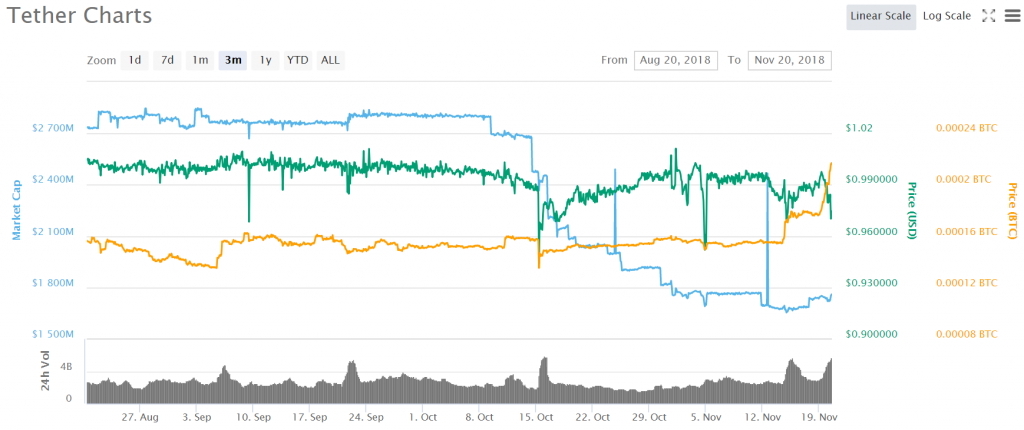
Most recently, a dip in the price of Tether this October caused even more questions regarding the stability of this stablecoin. At one point, the coin dipped as low as $0.94; on cryptocurrency exchange Kraken, USDT sank all the way down to $0.90.
Despite the controversy, however, Tether is still one of the most widely-used stablecoins in the world. At the time of writing, it had a $1.7B market cap and a 24-hour trading volume of $5.7 billion. Notably, however, Tether’s market cap has taken a significant hit over the course of the last several months.
TrueUSD Earnestly Attempts to Reach the Top
Like Tether, TrueUSD is a fiat-collateralized, 1-to-1-backed cryptocurrency. Unlike Tether, however, TrueUSD was created with the specific mission to greatly improve upon the transparency and legal practices that Tether has engaged in.
TrueUSD has promised to regularly publish audits conducted by Cohen & Co., an investment management firm based in Philadelphia. TrustToken, the company responsible for the launch of TrueUSD, keeps its funds in multiple escrow accounts to prevent large-scale hacks or other kinds of theft.
TrueUSD has reached a market cap of nearly $90 million - you can view the most recent independent attestation of the collateralized funds below #Crypto#stablecoinhttps://t.co/coD13IdPO9
“We’ve partnered with professional trust companies to manage the escrow accounts that hold the TrueUSD collateral,” reads a blog post by TrustToken.
Still, not all of these companies are known. “These trust companies include Alliance Trust Company of Nevada and Prime Trust. Their correspondent banking relationships include US bank, Alliance Bank, Mercantile Bank, and others. We’re in discussions with other trust companies and banking partners.”
Additionally, the company has come under some scrutiny for similarities in the language of its user policy to Tether’s user policy.
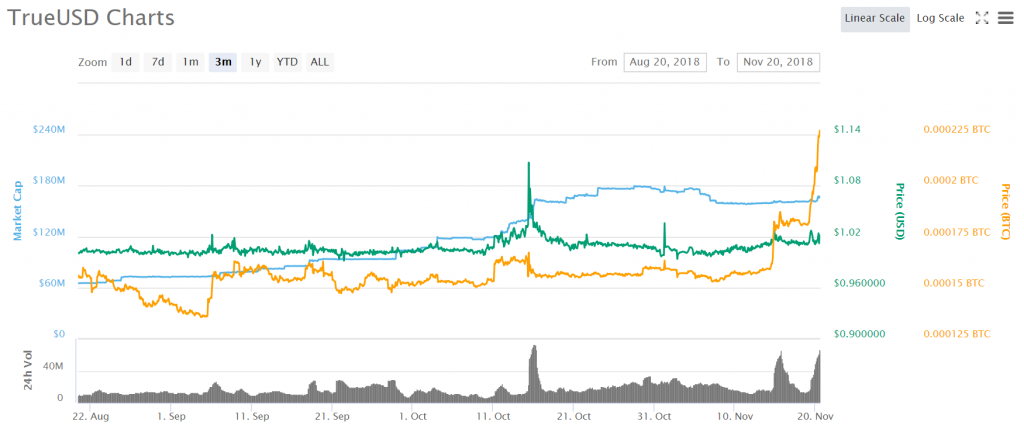
Still, TrueUSD is well on its way to becoming the industry’s go-to stablecoin. Overall, its marketcap and 24-hour trading volume were far below Tether’s at the time of writing ($165.9 million and $66.7 million respectively.) However, while Tether’s market cap seems to be steadily falling, TrueUSD’s seems to be steadily rising.
MakerDAO/DAI: A Crypto-Collateralized Stablecoin Based on Smart Contracts
MakerDAO is a decentralized autonomous organization that has a unique approach to the creation of stablecoins. Unlike TrueUSD and Tether, DAI coins (MakerDAO’s currency) are collateralized to another cryptocurrency--Ethereum.
DAI is not the first or the only stablecoin to be collateralized against another cryptocurrency. Dan Larimer’s BitShares introduced ‘BitUSD,’ a BitShares-pegged coin, all the way back in 2014.
Unlike BitUSD, DAI is pegged to Ethereum. Also unlike BitUSD, users do not purchase DAI tokens. Instead, users lock their ETH tokens into the MakerDAO system in exchange for DAI. When they return their DAI, they are given the equivalent amount that was collateralized upon locking in. Of course, while this model may address some legal concerns, the value of a single DAI token is affected by price volatility in Ethereum; however, the coin has been designed in such a way that its value has stayed fairly static since its launch.
Kingsley Advani, Founder & Partner at Chainfund Capital, explained in a Medium post that this system was created as a way to solve the legal problems associated with stablecoins. “Dai recognises several of the problems plaguing fiat-pegged cryptocurrencies. Namely, so long as any stable coin is backed by real fiat currency existing in bank accounts, foul play or legal action involving the account holder will invariably place the token’s value in jeopardy,” he wrote.
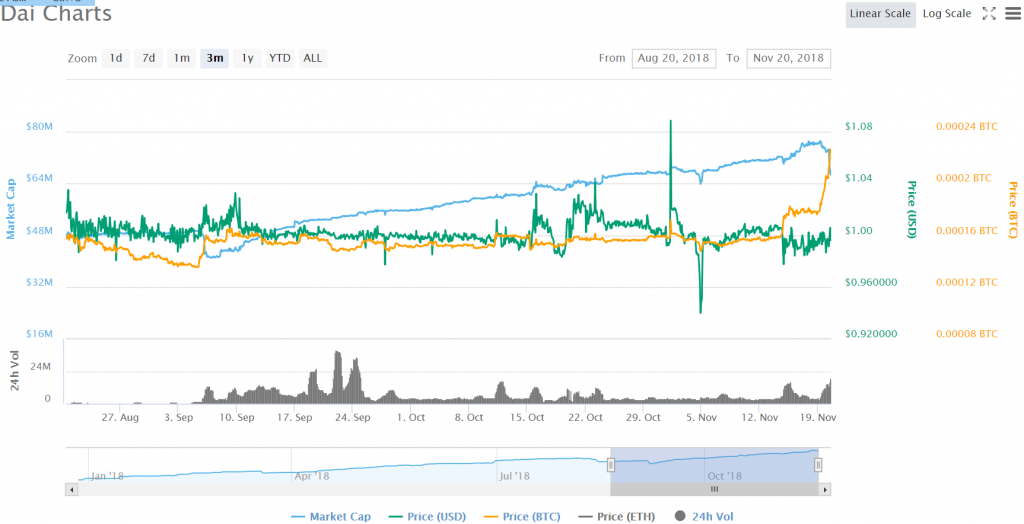
MakerDAO is far from any sort of widespread adoption. At press time, its market cap was just $67 million, and its 24-hour trading volume was $18.9 million. However, its market cap is steadily growing.
The number of stablecoins on the map from the beginning of 2018 to the end has grown exponentially. What was once a fringe concept is now a mainstay of the cryptocurrency markets--one that may be heading toward adoption into the mainstream economy.
Stablecoins have become so popular that they appear in every corner of the crypto world. Cryptocurrency exchanges are issuing their own stablecoins; even some banks and governments are launching stablecoins. The most popular option, however, are stablecoins that are available for public use. As more and more of these publicly available stablecoins appear, the competition between them grows ever more fierce.
So here, in order of market cap, are three of the most widely-used stablecoins currently on the market. Which stablecoin will rule them all? Only the users can decide.
Storied and Controversial, Yet High in Volume: Tether
If we’re going to talk about stablecoins, we have to talk about Tether. Launched all the way back in 2015, Tether is one of the oldest cryptocurrencies--let alone stablecoins--on the market. Tether is a fiat-collateralized stablecoin: for every one Tether Dollar, Tether claims that there is one USD in its bank accounts.
However, consistent failure to provide the public with a valid audit for several years has caused quite a bit of doubt that Tether has as much money as it says that it does. A $30 million hack near the end of 2017 also caused quite a bit of distrust in the currency.
There has also been some controversy surrounding the legal language in Tether’s user policy. An archived version of the coin’s user policy reads: “Tethers are not money and are not monetary instruments…they are also not stored value or currency…there is no contractual right or other right or legal claim against us to redeem or exchange your Tethers for money.”
Now, the policy reads that “in order to cause Tether Tokens to be issued or redeemed by Tether, you must be a verified customer of Tether. No exceptions will be made to this provision. The right to have Tethers redeemed or issued is a contractual right personal to you.” However, the ability to become a “verified” customer has been unavailable since before the first of the year.
Most recently, a dip in the price of Tether this October caused even more questions regarding the stability of this stablecoin. At one point, the coin dipped as low as $0.94; on cryptocurrency exchange Kraken, USDT sank all the way down to $0.90.
Despite the controversy, however, Tether is still one of the most widely-used stablecoins in the world. At the time of writing, it had a $1.7B market cap and a 24-hour trading volume of $5.7 billion. Notably, however, Tether’s market cap has taken a significant hit over the course of the last several months.
TrueUSD Earnestly Attempts to Reach the Top
Like Tether, TrueUSD is a fiat-collateralized, 1-to-1-backed cryptocurrency. Unlike Tether, however, TrueUSD was created with the specific mission to greatly improve upon the transparency and legal practices that Tether has engaged in.
TrueUSD has promised to regularly publish audits conducted by Cohen & Co., an investment management firm based in Philadelphia. TrustToken, the company responsible for the launch of TrueUSD, keeps its funds in multiple escrow accounts to prevent large-scale hacks or other kinds of theft.
TrueUSD has reached a market cap of nearly $90 million - you can view the most recent independent attestation of the collateralized funds below #Crypto#stablecoinhttps://t.co/coD13IdPO9
“We’ve partnered with professional trust companies to manage the escrow accounts that hold the TrueUSD collateral,” reads a blog post by TrustToken.
Still, not all of these companies are known. “These trust companies include Alliance Trust Company of Nevada and Prime Trust. Their correspondent banking relationships include US bank, Alliance Bank, Mercantile Bank, and others. We’re in discussions with other trust companies and banking partners.”
Additionally, the company has come under some scrutiny for similarities in the language of its user policy to Tether’s user policy.
Still, TrueUSD is well on its way to becoming the industry’s go-to stablecoin. Overall, its marketcap and 24-hour trading volume were far below Tether’s at the time of writing ($165.9 million and $66.7 million respectively.) However, while Tether’s market cap seems to be steadily falling, TrueUSD’s seems to be steadily rising.
MakerDAO/DAI: A Crypto-Collateralized Stablecoin Based on Smart Contracts
MakerDAO is a decentralized autonomous organization that has a unique approach to the creation of stablecoins. Unlike TrueUSD and Tether, DAI coins (MakerDAO’s currency) are collateralized to another cryptocurrency--Ethereum.
DAI is not the first or the only stablecoin to be collateralized against another cryptocurrency. Dan Larimer’s BitShares introduced ‘BitUSD,’ a BitShares-pegged coin, all the way back in 2014.
Unlike BitUSD, DAI is pegged to Ethereum. Also unlike BitUSD, users do not purchase DAI tokens. Instead, users lock their ETH tokens into the MakerDAO system in exchange for DAI. When they return their DAI, they are given the equivalent amount that was collateralized upon locking in. Of course, while this model may address some legal concerns, the value of a single DAI token is affected by price volatility in Ethereum; however, the coin has been designed in such a way that its value has stayed fairly static since its launch.
Kingsley Advani, Founder & Partner at Chainfund Capital, explained in a Medium post that this system was created as a way to solve the legal problems associated with stablecoins. “Dai recognises several of the problems plaguing fiat-pegged cryptocurrencies. Namely, so long as any stable coin is backed by real fiat currency existing in bank accounts, foul play or legal action involving the account holder will invariably place the token’s value in jeopardy,” he wrote.
MakerDAO is far from any sort of widespread adoption. At press time, its market cap was just $67 million, and its 24-hour trading volume was $18.9 million. However, its market cap is steadily growing.
Rachel is a self-taught crypto geek and a passionate writer. She believes in the power that the written word has to educate, connect and empower individuals to make positive and powerful financial choices. She is the Podcast Host and a Cryptocurrency Editor at Finance Magnates.
Crypto Built More Rails, but the Next Battle Is Over How Much Work a Dollar Can Do
Featured Videos
FP Markets Winner Spotlight 🏆 | Global Broker of the Year 2025 #Trading #Broker #Innovation #Shorts
FP Markets Winner Spotlight 🏆 | Global Broker of the Year 2025 #Trading #Broker #Innovation #Shorts
FP Markets Winner Spotlight 🏆 | Global Broker of the Year 2025 #Trading #Broker #Innovation #Shorts
FP Markets Winner Spotlight 🏆 | Global Broker of the Year 2025 #Trading #Broker #Innovation #Shorts
FP Markets takes the spotlight as Global Broker of the Year 2025 at the Finance Magnates Awards.
Martin Stoilov, Head of Client Experience, shares that trust, innovation, and people played a key role in the company’s success, supported by a strong foundation of integrity and client-centricity.
Following this milestone, FP Markets continues to focus on growth, technology investment, and its core values of transparency and excellence.
👉 Be part of FM Awards 2026: https://awards.financemagnates.com/#nominate
FP Markets takes the spotlight as Global Broker of the Year 2025 at the Finance Magnates Awards.
Martin Stoilov, Head of Client Experience, shares that trust, innovation, and people played a key role in the company’s success, supported by a strong foundation of integrity and client-centricity.
Following this milestone, FP Markets continues to focus on growth, technology investment, and its core values of transparency and excellence.
👉 Be part of FM Awards 2026: https://awards.financemagnates.com/#nominate
FP Markets takes the spotlight as Global Broker of the Year 2025 at the Finance Magnates Awards.
Martin Stoilov, Head of Client Experience, shares that trust, innovation, and people played a key role in the company’s success, supported by a strong foundation of integrity and client-centricity.
Following this milestone, FP Markets continues to focus on growth, technology investment, and its core values of transparency and excellence.
👉 Be part of FM Awards 2026: https://awards.financemagnates.com/#nominate
FP Markets takes the spotlight as Global Broker of the Year 2025 at the Finance Magnates Awards.
Martin Stoilov, Head of Client Experience, shares that trust, innovation, and people played a key role in the company’s success, supported by a strong foundation of integrity and client-centricity.
Following this milestone, FP Markets continues to focus on growth, technology investment, and its core values of transparency and excellence.
👉 Be part of FM Awards 2026: https://awards.financemagnates.com/#nominate
In this video, we review @HolaPrimeMarketsOfficial, a multi-asset forex and CFDs broker offering different account types, trading platforms, and flexible trading conditions.
We cover the broker’s overall offering, including account options, trading environment, platforms like MT4 and MT5, and additional services such as managed accounts and fast withdrawals.
Watch the full video to see if Hola Prime Markets fits your trading needs.
📣 Stay up to date with the latest in finance and trading. Follow Finance Magnates for industry news, insights, and global event coverage.
Connect with us:
🔗 LinkedIn: /financemagnates
👍 Facebook: /financemagnates
📸 Instagram: https://www.instagram.com/financemagnates
🐦 X: https://x.com/financemagnates
🎥 TikTok: https://www.tiktok.com/tag/financemagnates
▶️ YouTube: /@financemagnates_official
#HolaPrime #ForexBroker #CFDTrading #FinanceMagnates #Trading #Forex #BrokerReview
In this video, we review @HolaPrimeMarketsOfficial, a multi-asset forex and CFDs broker offering different account types, trading platforms, and flexible trading conditions.
We cover the broker’s overall offering, including account options, trading environment, platforms like MT4 and MT5, and additional services such as managed accounts and fast withdrawals.
Watch the full video to see if Hola Prime Markets fits your trading needs.
📣 Stay up to date with the latest in finance and trading. Follow Finance Magnates for industry news, insights, and global event coverage.
Connect with us:
🔗 LinkedIn: /financemagnates
👍 Facebook: /financemagnates
📸 Instagram: https://www.instagram.com/financemagnates
🐦 X: https://x.com/financemagnates
🎥 TikTok: https://www.tiktok.com/tag/financemagnates
▶️ YouTube: /@financemagnates_official
#HolaPrime #ForexBroker #CFDTrading #FinanceMagnates #Trading #Forex #BrokerReview
In this video, we review @HolaPrimeMarketsOfficial, a multi-asset forex and CFDs broker offering different account types, trading platforms, and flexible trading conditions.
We cover the broker’s overall offering, including account options, trading environment, platforms like MT4 and MT5, and additional services such as managed accounts and fast withdrawals.
Watch the full video to see if Hola Prime Markets fits your trading needs.
📣 Stay up to date with the latest in finance and trading. Follow Finance Magnates for industry news, insights, and global event coverage.
Connect with us:
🔗 LinkedIn: /financemagnates
👍 Facebook: /financemagnates
📸 Instagram: https://www.instagram.com/financemagnates
🐦 X: https://x.com/financemagnates
🎥 TikTok: https://www.tiktok.com/tag/financemagnates
▶️ YouTube: /@financemagnates_official
#HolaPrime #ForexBroker #CFDTrading #FinanceMagnates #Trading #Forex #BrokerReview
In this video, we review @HolaPrimeMarketsOfficial, a multi-asset forex and CFDs broker offering different account types, trading platforms, and flexible trading conditions.
We cover the broker’s overall offering, including account options, trading environment, platforms like MT4 and MT5, and additional services such as managed accounts and fast withdrawals.
Watch the full video to see if Hola Prime Markets fits your trading needs.
📣 Stay up to date with the latest in finance and trading. Follow Finance Magnates for industry news, insights, and global event coverage.
Connect with us:
🔗 LinkedIn: /financemagnates
👍 Facebook: /financemagnates
📸 Instagram: https://www.instagram.com/financemagnates
🐦 X: https://x.com/financemagnates
🎥 TikTok: https://www.tiktok.com/tag/financemagnates
▶️ YouTube: /@financemagnates_official
#HolaPrime #ForexBroker #CFDTrading #FinanceMagnates #Trading #Forex #BrokerReview
In this video, we review @HolaPrimeMarketsOfficial, a multi-asset forex and CFDs broker offering different account types, trading platforms, and flexible trading conditions.
We cover the broker’s overall offering, including account options, trading environment, platforms like MT4 and MT5, and additional services such as managed accounts and fast withdrawals.
Watch the full video to see if Hola Prime Markets fits your trading needs.
📣 Stay up to date with the latest in finance and trading. Follow Finance Magnates for industry news, insights, and global event coverage.
Connect with us:
🔗 LinkedIn: /financemagnates
👍 Facebook: /financemagnates
📸 Instagram: https://www.instagram.com/financemagnates
🐦 X: https://x.com/financemagnates
🎥 TikTok: https://www.tiktok.com/tag/financemagnates
▶️ YouTube: /@financemagnates_official
#HolaPrime #ForexBroker #CFDTrading #FinanceMagnates #Trading #Forex #BrokerReview
In this video, we review @HolaPrimeMarketsOfficial, a multi-asset forex and CFDs broker offering different account types, trading platforms, and flexible trading conditions.
We cover the broker’s overall offering, including account options, trading environment, platforms like MT4 and MT5, and additional services such as managed accounts and fast withdrawals.
Watch the full video to see if Hola Prime Markets fits your trading needs.
📣 Stay up to date with the latest in finance and trading. Follow Finance Magnates for industry news, insights, and global event coverage.
Connect with us:
🔗 LinkedIn: /financemagnates
👍 Facebook: /financemagnates
📸 Instagram: https://www.instagram.com/financemagnates
🐦 X: https://x.com/financemagnates
🎥 TikTok: https://www.tiktok.com/tag/financemagnates
▶️ YouTube: /@financemagnates_official
#HolaPrime #ForexBroker #CFDTrading #FinanceMagnates #Trading #Forex #BrokerReview
Hola Prime Review: What You Need to Know | Full Breakdown by Finance Magnates
Hola Prime Review: What You Need to Know | Full Breakdown by Finance Magnates
Hola Prime Review: What You Need to Know | Full Breakdown by Finance Magnates
Hola Prime Review: What You Need to Know | Full Breakdown by Finance Magnates
Hola Prime Review: What You Need to Know | Full Breakdown by Finance Magnates
Hola Prime Review: What You Need to Know | Full Breakdown by Finance Magnates
In this video, we review @HolaPrime_Global, a proprietary trading firm offering evaluation programs and performance-based payouts in simulated market environments.
We cover how the challenge model works, including account types, profit splits (up to 95%), trading rules, and what it takes to reach a funded account. You’ll also learn about available platforms like MT4, MT5, cTrader, and more, along with insights into payouts, support, and trading conditions.
Watch the full video to see if Hola Prime fits your trading style.
📣 Stay up to date with the latest in finance and trading. Follow Finance Magnates for industry news, insights, and global event coverage.
Connect with us:
🔗 LinkedIn: /financemagnates
👍 Facebook: /financemagnates
📸 Instagram: https://www.instagram.com/financemagnates
🐦 X: https://x.com/financemagnates
🎥 TikTok: https://www.tiktok.com/tag/financemagnates
▶️ YouTube: /@financemagnates_official
#HolaPrime #PropFirm #Trading #FinanceMagnates #Forex #FuturesTrading #TradingReview #PropFirmReview
In this video, we review @HolaPrime_Global, a proprietary trading firm offering evaluation programs and performance-based payouts in simulated market environments.
We cover how the challenge model works, including account types, profit splits (up to 95%), trading rules, and what it takes to reach a funded account. You’ll also learn about available platforms like MT4, MT5, cTrader, and more, along with insights into payouts, support, and trading conditions.
Watch the full video to see if Hola Prime fits your trading style.
📣 Stay up to date with the latest in finance and trading. Follow Finance Magnates for industry news, insights, and global event coverage.
Connect with us:
🔗 LinkedIn: /financemagnates
👍 Facebook: /financemagnates
📸 Instagram: https://www.instagram.com/financemagnates
🐦 X: https://x.com/financemagnates
🎥 TikTok: https://www.tiktok.com/tag/financemagnates
▶️ YouTube: /@financemagnates_official
#HolaPrime #PropFirm #Trading #FinanceMagnates #Forex #FuturesTrading #TradingReview #PropFirmReview
In this video, we review @HolaPrime_Global, a proprietary trading firm offering evaluation programs and performance-based payouts in simulated market environments.
We cover how the challenge model works, including account types, profit splits (up to 95%), trading rules, and what it takes to reach a funded account. You’ll also learn about available platforms like MT4, MT5, cTrader, and more, along with insights into payouts, support, and trading conditions.
Watch the full video to see if Hola Prime fits your trading style.
📣 Stay up to date with the latest in finance and trading. Follow Finance Magnates for industry news, insights, and global event coverage.
Connect with us:
🔗 LinkedIn: /financemagnates
👍 Facebook: /financemagnates
📸 Instagram: https://www.instagram.com/financemagnates
🐦 X: https://x.com/financemagnates
🎥 TikTok: https://www.tiktok.com/tag/financemagnates
▶️ YouTube: /@financemagnates_official
#HolaPrime #PropFirm #Trading #FinanceMagnates #Forex #FuturesTrading #TradingReview #PropFirmReview
In this video, we review @HolaPrime_Global, a proprietary trading firm offering evaluation programs and performance-based payouts in simulated market environments.
We cover how the challenge model works, including account types, profit splits (up to 95%), trading rules, and what it takes to reach a funded account. You’ll also learn about available platforms like MT4, MT5, cTrader, and more, along with insights into payouts, support, and trading conditions.
Watch the full video to see if Hola Prime fits your trading style.
📣 Stay up to date with the latest in finance and trading. Follow Finance Magnates for industry news, insights, and global event coverage.
Connect with us:
🔗 LinkedIn: /financemagnates
👍 Facebook: /financemagnates
📸 Instagram: https://www.instagram.com/financemagnates
🐦 X: https://x.com/financemagnates
🎥 TikTok: https://www.tiktok.com/tag/financemagnates
▶️ YouTube: /@financemagnates_official
#HolaPrime #PropFirm #Trading #FinanceMagnates #Forex #FuturesTrading #TradingReview #PropFirmReview
In this video, we review @HolaPrime_Global, a proprietary trading firm offering evaluation programs and performance-based payouts in simulated market environments.
We cover how the challenge model works, including account types, profit splits (up to 95%), trading rules, and what it takes to reach a funded account. You’ll also learn about available platforms like MT4, MT5, cTrader, and more, along with insights into payouts, support, and trading conditions.
Watch the full video to see if Hola Prime fits your trading style.
📣 Stay up to date with the latest in finance and trading. Follow Finance Magnates for industry news, insights, and global event coverage.
Connect with us:
🔗 LinkedIn: /financemagnates
👍 Facebook: /financemagnates
📸 Instagram: https://www.instagram.com/financemagnates
🐦 X: https://x.com/financemagnates
🎥 TikTok: https://www.tiktok.com/tag/financemagnates
▶️ YouTube: /@financemagnates_official
#HolaPrime #PropFirm #Trading #FinanceMagnates #Forex #FuturesTrading #TradingReview #PropFirmReview
In this video, we review @HolaPrime_Global, a proprietary trading firm offering evaluation programs and performance-based payouts in simulated market environments.
We cover how the challenge model works, including account types, profit splits (up to 95%), trading rules, and what it takes to reach a funded account. You’ll also learn about available platforms like MT4, MT5, cTrader, and more, along with insights into payouts, support, and trading conditions.
Watch the full video to see if Hola Prime fits your trading style.
📣 Stay up to date with the latest in finance and trading. Follow Finance Magnates for industry news, insights, and global event coverage.
Connect with us:
🔗 LinkedIn: /financemagnates
👍 Facebook: /financemagnates
📸 Instagram: https://www.instagram.com/financemagnates
🐦 X: https://x.com/financemagnates
🎥 TikTok: https://www.tiktok.com/tag/financemagnates
▶️ YouTube: /@financemagnates_official
#HolaPrime #PropFirm #Trading #FinanceMagnates #Forex #FuturesTrading #TradingReview #PropFirmReview
Axi Winner Spotlight 🏆 | Global Most Innovative Broker 2025 #Innovation #Trading #Fintech #Broker
Axi Winner Spotlight 🏆 | Global Most Innovative Broker 2025 #Innovation #Trading #Fintech #Broker
Axi Winner Spotlight 🏆 | Global Most Innovative Broker 2025 #Innovation #Trading #Fintech #Broker
Axi Winner Spotlight 🏆 | Global Most Innovative Broker 2025 #Innovation #Trading #Fintech #Broker
Axi Winner Spotlight 🏆 | Global Most Innovative Broker 2025 #Innovation #Trading #Fintech #Broker
Axi Winner Spotlight 🏆 | Global Most Innovative Broker 2025 #Innovation #Trading #Fintech #Broker
Axi takes the spotlight at the Finance Magnates Awards, winning Global Most Innovative Broker 2025.
Olivia Xenofontos and Ivanna Openko share how the team will feel: proud, motivated, and ready to keep delivering.
They also describe the night as well-organized, focused, and enjoyable for all.
👉 Be part of FM Awards 2026.
Axi takes the spotlight at the Finance Magnates Awards, winning Global Most Innovative Broker 2025.
Olivia Xenofontos and Ivanna Openko share how the team will feel: proud, motivated, and ready to keep delivering.
They also describe the night as well-organized, focused, and enjoyable for all.
👉 Be part of FM Awards 2026.
Axi takes the spotlight at the Finance Magnates Awards, winning Global Most Innovative Broker 2025.
Olivia Xenofontos and Ivanna Openko share how the team will feel: proud, motivated, and ready to keep delivering.
They also describe the night as well-organized, focused, and enjoyable for all.
👉 Be part of FM Awards 2026.
Axi takes the spotlight at the Finance Magnates Awards, winning Global Most Innovative Broker 2025.
Olivia Xenofontos and Ivanna Openko share how the team will feel: proud, motivated, and ready to keep delivering.
They also describe the night as well-organized, focused, and enjoyable for all.
👉 Be part of FM Awards 2026.
Axi takes the spotlight at the Finance Magnates Awards, winning Global Most Innovative Broker 2025.
Olivia Xenofontos and Ivanna Openko share how the team will feel: proud, motivated, and ready to keep delivering.
They also describe the night as well-organized, focused, and enjoyable for all.
👉 Be part of FM Awards 2026.
Axi takes the spotlight at the Finance Magnates Awards, winning Global Most Innovative Broker 2025.
Olivia Xenofontos and Ivanna Openko share how the team will feel: proud, motivated, and ready to keep delivering.
They also describe the night as well-organized, focused, and enjoyable for all.
👉 Be part of FM Awards 2026.
Recognition that matters.
Built on transparency.
Driven by the industry.
The Finance Magnates Awards 2026.
Nominations are now open.
🔗 https://awards.financemagnates.com/?utm_source=SM&utm_medium=social&utm_campaign=recognition-matters
Recognition that matters.
Built on transparency.
Driven by the industry.
The Finance Magnates Awards 2026.
Nominations are now open.
🔗 https://awards.financemagnates.com/?utm_source=SM&utm_medium=social&utm_campaign=recognition-matters
Recognition that matters.
Built on transparency.
Driven by the industry.
The Finance Magnates Awards 2026.
Nominations are now open.
🔗 https://awards.financemagnates.com/?utm_source=SM&utm_medium=social&utm_campaign=recognition-matters
Recognition that matters.
Built on transparency.
Driven by the industry.
The Finance Magnates Awards 2026.
Nominations are now open.
🔗 https://awards.financemagnates.com/?utm_source=SM&utm_medium=social&utm_campaign=recognition-matters
Recognition that matters.
Built on transparency.
Driven by the industry.
The Finance Magnates Awards 2026.
Nominations are now open.
🔗 https://awards.financemagnates.com/?utm_source=SM&utm_medium=social&utm_campaign=recognition-matters
Recognition that matters.
Built on transparency.
Driven by the industry.
The Finance Magnates Awards 2026.
Nominations are now open.
🔗 https://awards.financemagnates.com/?utm_source=SM&utm_medium=social&utm_campaign=recognition-matters