Ilan Sterk, VP of Trading at Hexa Group & Orbs, talks institutional trading and adoption in crypto.
In terms of institutional adoption, the cryptocurrency industry has come a long way--but there is still a long way to go. Institutional investors have entered the markets in greater numbers than ever before, but most cryptocurrency exchanges lack the infrastructure to adequately support them; regulators have not provided the clarity that is needed to assure investors that their activities are within the law.
Recently, Finance Magnates spoke to Ilan Sterk, who serves as the VP of Trading at Hexa Group & Orbs, and as the VP of Business Development at Alef Bit Technologies. Sterk specializes in Digital assets, Global Assets, Derivatives and FX, with expertise in investments, risk management, compliance and technical analysis.
Sterk spoke about the progress that the cryptocurrency industry has been making in terms of adoption into other industries, and about what institutional traders need before they can enter the cryptocurrency markets in larger numbers.
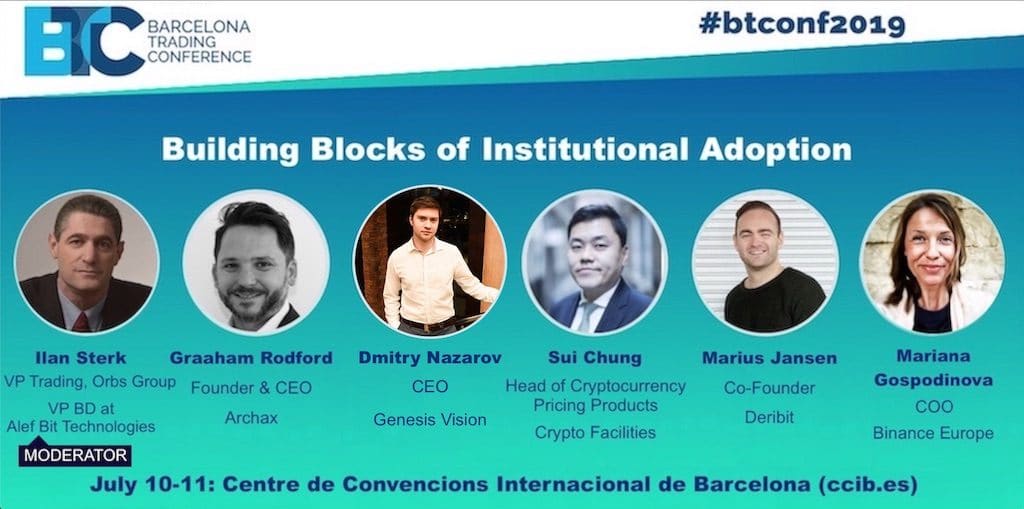
Sterk will be moderating a panel at the upcoming Finance Magnates Barcelona Trading Conference (July 10th-11th) entitled “Building Blocks of Institutional Adoption.” For more information, click the image below.
The entry of Fidelity, HSBC, Starbucks, Whole Foods, and others into crypto signifies progress
“If we start with the HSBC bank, they did the first letter of credit transaction a few months ago using blockchain,” he added.
Indeed, “For a long time, there has been speculation about when institutional investors will start to invest in crypto, and I think that one of the most significant moments has been the announcement by Fidelity, which manages over $7 trillion in assets. They set up a subsidiary called Fidelity Digital Assets, which will provide custodial services in digital assets for institutional investors, trading services in a number of markets, consulting services and strategies in crypto.”
In short, “there is no doubt that the entry of a significant institution such as Fidelity to the crypto markets constitutes an important milestone for investment in the field.”
Additionally, “we see enterprises in the US starting to accept Bitcoin [as payment] with apps like BitPay, including [companies like] AT&T, Nordstrom, Whole Foods, and Starbucks. So adoption is starting to gain traction [in that respect.]”
“In addition, I certainly believe that the recent announcement by Facebook about the Libra blockchain that will run the Libra Coin, and the Libra Association, with founding members like Mastercard, Visa, eBay, and Uber--and also the Calibra, which is the digital wallets that will store the Libra cryptocurrency and will enable Libra payment transactions--is a turning point that can lead to the mass adoption of digital currencies in the future.”
“When discussing the institutional exposure to Bitcoin, we can see from [institutional interest] in CME’s Bitcoin futures, that it hits new records--80 percent--year-over-year.”
CME Bitcoin futures (BTC) shows growing signs of institutional interest. BTC open interest rose by a record 643 contracts in a single day, establishing a new all-time high of 5,311 contracts on June 17 (26,555 equivalent bitcoin; ~$250M notional). https://t.co/I6A3jD6Iq3pic.twitter.com/ljz6EbvK79
“According to one of the world’s largest Bitcoin derivatives marketplace, the number of open BTC contracts reached a record value of $250 million (notional) last week. This equates to around 26,000 Bitcoins.”
"The regulation in most of the world is unclear"
“I think that institutional investors all over the world have avoided crypto assets because of multiple issues, the first being custodianship. As I mentioned before, Fidelity has begun to offer custodial services, and also Coinbase has launch custodial issues. So, hopefully, the custodial issue has been solved,” he said.
“When we talk about institutional investors--in order to gain trust in the system, regulation must be put in place. I can say that at Orbs Group, we took up the responsibility and the mission to beef up the ecosystem, including working closely with government officers to build up proper and advanced regulation.”
As it stands now in Israel, where Orbs is based, Sterk explained that “most of the banks in Israel don’t accept any fiat that originated from crypto. Although a new amendment to AML laws [mentions] crypto, certain issues remain vague, and the bank’s future moves [based on this] remain unknown.”
“Also, Israel’s securities authority warned of substantial risk in the crypto markets several months ago. So, after the warning, how could institutional investors invest in crypto?”
The bottom line is that, as in Israel, “the regulation in most of the world is unclear, and this another complication for institutional investors. In my opinion, clearer regulation would lead to more participants in the digital asset market.”
”We must have sophisticated trading platforms": when it comes to institutional adoption, crypto exchanges are their own worst enemy
Sterk said that institutional traders also generally need more support on the technological side of trading.
“At Alef Bit, for example, we provide sub-accounts to each trader using our funds. Currently, only a few crypto exchanges offer such a functionality versus trading systems in the traditional markets, who offer this as a standard part of their interface,” Sterk said.
“So when discussing institutional adoption, this is one example of how technology can speed up market adoption. We must have sophisticated trading platforms.”
Sterk explained that in addition to sub-accounts, these “sophisticated” platforms must also include algorithms. “In the traditional markets, you have many types of algorithmic trading--VW, or volume-weighted average trading, and TW, time-weighted average percentage of the volume. These kinds of things you don’t find in most [cryptocurrency exchanges.]”
For example, “if we are talking about a large amount [of an asset] that you need to buy, in a traditional market you can place an order via an algorithm to buy a $100 million share of Microsoft,” he said. The algorithm enables the investor to “buy it over the course of the day.”
In the crypto markets, however, “you don’t have it.”
“So, that’s why it limits institutional adoption, Sterk explained, adding that the lack of this kind of infrastructure on most cryptocurrency exchanges is why institutional investors often rely on OTC desks for making large cryptocurrency trades.
”OTC desks will continue to be the solution”
“OTC desks provide institutional investors with liquidity solutions. OTC desks can offer liquidity for large transactions with large amounts, while exchanges cannot provide this.”
As such, “institutions that need to buy or sell large amounts of digital assets will need to do this through one of the OTC brokers since large amounts can impact the price on an exchange. So, at the moment, OTC is the preferred solution.”
“One thing to note is the spread on which the OTc will charge you, so institutionals need to compare the price between the OTC broker and, for example, GDAX, Coinbase, or the TradeBlock, which is an aggregate of prices from different exchanges.”
“Since there are no fees for OTC trades,” Sterk said, explaining that “OTC brokers are charging spreads, not fees.”
“So, in my opinion, the OTC desks will continue to be the solution and will be the dominant player on the institutional side in the short to medium term--as the industry is not so developed yet, the spreads that [brokers] charge are narrow.”
“Today, the unregulated exchanges have much more liquidity than the regulated ones, but I assume that this will change in the future as that traders and institutional investors will feel more comfortable to trade in regulated exchanges.”
Sterk explained that unregulated exchanges have more liquidity than unregulated exchanges because the crypto market “is not a mature market--it’s in its early days. Many exchanges--for example, in Asia--don’t require full KYC from the traders. You can open an account with only an email address.”
“BitMEX, for example, is one of the largest exchanges. It’s not regulated; you open an account with an email--that’s all. Then you deposit your Bitcoin and you can trade.”
Sterk explained that he believes that these unregulated exchanges are so popular precisely because of their lax KYC requirements--but this won’t last in the long-term.
There’s also a chance that regulated exchanges could eventually overtake OTC trading, but only in the “long-long-term.”
This was an excerpt. To hear Finance Magnates' full interview with Ilan Sterk, click the Soundcloud or Youtube links.
In terms of institutional adoption, the cryptocurrency industry has come a long way--but there is still a long way to go. Institutional investors have entered the markets in greater numbers than ever before, but most cryptocurrency exchanges lack the infrastructure to adequately support them; regulators have not provided the clarity that is needed to assure investors that their activities are within the law.
Recently, Finance Magnates spoke to Ilan Sterk, who serves as the VP of Trading at Hexa Group & Orbs, and as the VP of Business Development at Alef Bit Technologies. Sterk specializes in Digital assets, Global Assets, Derivatives and FX, with expertise in investments, risk management, compliance and technical analysis.
Sterk spoke about the progress that the cryptocurrency industry has been making in terms of adoption into other industries, and about what institutional traders need before they can enter the cryptocurrency markets in larger numbers.
Sterk will be moderating a panel at the upcoming Finance Magnates Barcelona Trading Conference (July 10th-11th) entitled “Building Blocks of Institutional Adoption.” For more information, click the image below.
The entry of Fidelity, HSBC, Starbucks, Whole Foods, and others into crypto signifies progress
“If we start with the HSBC bank, they did the first letter of credit transaction a few months ago using blockchain,” he added.
Indeed, “For a long time, there has been speculation about when institutional investors will start to invest in crypto, and I think that one of the most significant moments has been the announcement by Fidelity, which manages over $7 trillion in assets. They set up a subsidiary called Fidelity Digital Assets, which will provide custodial services in digital assets for institutional investors, trading services in a number of markets, consulting services and strategies in crypto.”
In short, “there is no doubt that the entry of a significant institution such as Fidelity to the crypto markets constitutes an important milestone for investment in the field.”
Additionally, “we see enterprises in the US starting to accept Bitcoin [as payment] with apps like BitPay, including [companies like] AT&T, Nordstrom, Whole Foods, and Starbucks. So adoption is starting to gain traction [in that respect.]”
“In addition, I certainly believe that the recent announcement by Facebook about the Libra blockchain that will run the Libra Coin, and the Libra Association, with founding members like Mastercard, Visa, eBay, and Uber--and also the Calibra, which is the digital wallets that will store the Libra cryptocurrency and will enable Libra payment transactions--is a turning point that can lead to the mass adoption of digital currencies in the future.”
“When discussing the institutional exposure to Bitcoin, we can see from [institutional interest] in CME’s Bitcoin futures, that it hits new records--80 percent--year-over-year.”
CME Bitcoin futures (BTC) shows growing signs of institutional interest. BTC open interest rose by a record 643 contracts in a single day, establishing a new all-time high of 5,311 contracts on June 17 (26,555 equivalent bitcoin; ~$250M notional). https://t.co/I6A3jD6Iq3pic.twitter.com/ljz6EbvK79
“According to one of the world’s largest Bitcoin derivatives marketplace, the number of open BTC contracts reached a record value of $250 million (notional) last week. This equates to around 26,000 Bitcoins.”
"The regulation in most of the world is unclear"
“I think that institutional investors all over the world have avoided crypto assets because of multiple issues, the first being custodianship. As I mentioned before, Fidelity has begun to offer custodial services, and also Coinbase has launch custodial issues. So, hopefully, the custodial issue has been solved,” he said.
“When we talk about institutional investors--in order to gain trust in the system, regulation must be put in place. I can say that at Orbs Group, we took up the responsibility and the mission to beef up the ecosystem, including working closely with government officers to build up proper and advanced regulation.”
As it stands now in Israel, where Orbs is based, Sterk explained that “most of the banks in Israel don’t accept any fiat that originated from crypto. Although a new amendment to AML laws [mentions] crypto, certain issues remain vague, and the bank’s future moves [based on this] remain unknown.”
“Also, Israel’s securities authority warned of substantial risk in the crypto markets several months ago. So, after the warning, how could institutional investors invest in crypto?”
The bottom line is that, as in Israel, “the regulation in most of the world is unclear, and this another complication for institutional investors. In my opinion, clearer regulation would lead to more participants in the digital asset market.”
”We must have sophisticated trading platforms": when it comes to institutional adoption, crypto exchanges are their own worst enemy
Sterk said that institutional traders also generally need more support on the technological side of trading.
“At Alef Bit, for example, we provide sub-accounts to each trader using our funds. Currently, only a few crypto exchanges offer such a functionality versus trading systems in the traditional markets, who offer this as a standard part of their interface,” Sterk said.
“So when discussing institutional adoption, this is one example of how technology can speed up market adoption. We must have sophisticated trading platforms.”
Sterk explained that in addition to sub-accounts, these “sophisticated” platforms must also include algorithms. “In the traditional markets, you have many types of algorithmic trading--VW, or volume-weighted average trading, and TW, time-weighted average percentage of the volume. These kinds of things you don’t find in most [cryptocurrency exchanges.]”
For example, “if we are talking about a large amount [of an asset] that you need to buy, in a traditional market you can place an order via an algorithm to buy a $100 million share of Microsoft,” he said. The algorithm enables the investor to “buy it over the course of the day.”
In the crypto markets, however, “you don’t have it.”
“So, that’s why it limits institutional adoption, Sterk explained, adding that the lack of this kind of infrastructure on most cryptocurrency exchanges is why institutional investors often rely on OTC desks for making large cryptocurrency trades.
”OTC desks will continue to be the solution”
“OTC desks provide institutional investors with liquidity solutions. OTC desks can offer liquidity for large transactions with large amounts, while exchanges cannot provide this.”
As such, “institutions that need to buy or sell large amounts of digital assets will need to do this through one of the OTC brokers since large amounts can impact the price on an exchange. So, at the moment, OTC is the preferred solution.”
“One thing to note is the spread on which the OTc will charge you, so institutionals need to compare the price between the OTC broker and, for example, GDAX, Coinbase, or the TradeBlock, which is an aggregate of prices from different exchanges.”
“Since there are no fees for OTC trades,” Sterk said, explaining that “OTC brokers are charging spreads, not fees.”
“So, in my opinion, the OTC desks will continue to be the solution and will be the dominant player on the institutional side in the short to medium term--as the industry is not so developed yet, the spreads that [brokers] charge are narrow.”
“Today, the unregulated exchanges have much more liquidity than the regulated ones, but I assume that this will change in the future as that traders and institutional investors will feel more comfortable to trade in regulated exchanges.”
Sterk explained that unregulated exchanges have more liquidity than unregulated exchanges because the crypto market “is not a mature market--it’s in its early days. Many exchanges--for example, in Asia--don’t require full KYC from the traders. You can open an account with only an email address.”
“BitMEX, for example, is one of the largest exchanges. It’s not regulated; you open an account with an email--that’s all. Then you deposit your Bitcoin and you can trade.”
Sterk explained that he believes that these unregulated exchanges are so popular precisely because of their lax KYC requirements--but this won’t last in the long-term.
Rachel is a self-taught crypto geek and a passionate writer. She believes in the power that the written word has to educate, connect and empower individuals to make positive and powerful financial choices. She is the Podcast Host and a Cryptocurrency Editor at Finance Magnates.
Crypto Built More Rails, but the Next Battle Is Over How Much Work a Dollar Can Do
Featured Videos
FP Markets Winner Spotlight 🏆 | Global Broker of the Year 2025 #Trading #Broker #Innovation #Shorts
FP Markets Winner Spotlight 🏆 | Global Broker of the Year 2025 #Trading #Broker #Innovation #Shorts
FP Markets Winner Spotlight 🏆 | Global Broker of the Year 2025 #Trading #Broker #Innovation #Shorts
FP Markets Winner Spotlight 🏆 | Global Broker of the Year 2025 #Trading #Broker #Innovation #Shorts
FP Markets takes the spotlight as Global Broker of the Year 2025 at the Finance Magnates Awards.
Martin Stoilov, Head of Client Experience, shares that trust, innovation, and people played a key role in the company’s success, supported by a strong foundation of integrity and client-centricity.
Following this milestone, FP Markets continues to focus on growth, technology investment, and its core values of transparency and excellence.
👉 Be part of FM Awards 2026: https://awards.financemagnates.com/#nominate
FP Markets takes the spotlight as Global Broker of the Year 2025 at the Finance Magnates Awards.
Martin Stoilov, Head of Client Experience, shares that trust, innovation, and people played a key role in the company’s success, supported by a strong foundation of integrity and client-centricity.
Following this milestone, FP Markets continues to focus on growth, technology investment, and its core values of transparency and excellence.
👉 Be part of FM Awards 2026: https://awards.financemagnates.com/#nominate
FP Markets takes the spotlight as Global Broker of the Year 2025 at the Finance Magnates Awards.
Martin Stoilov, Head of Client Experience, shares that trust, innovation, and people played a key role in the company’s success, supported by a strong foundation of integrity and client-centricity.
Following this milestone, FP Markets continues to focus on growth, technology investment, and its core values of transparency and excellence.
👉 Be part of FM Awards 2026: https://awards.financemagnates.com/#nominate
FP Markets takes the spotlight as Global Broker of the Year 2025 at the Finance Magnates Awards.
Martin Stoilov, Head of Client Experience, shares that trust, innovation, and people played a key role in the company’s success, supported by a strong foundation of integrity and client-centricity.
Following this milestone, FP Markets continues to focus on growth, technology investment, and its core values of transparency and excellence.
👉 Be part of FM Awards 2026: https://awards.financemagnates.com/#nominate
In this video, we review @HolaPrimeMarketsOfficial, a multi-asset forex and CFDs broker offering different account types, trading platforms, and flexible trading conditions.
We cover the broker’s overall offering, including account options, trading environment, platforms like MT4 and MT5, and additional services such as managed accounts and fast withdrawals.
Watch the full video to see if Hola Prime Markets fits your trading needs.
📣 Stay up to date with the latest in finance and trading. Follow Finance Magnates for industry news, insights, and global event coverage.
Connect with us:
🔗 LinkedIn: /financemagnates
👍 Facebook: /financemagnates
📸 Instagram: https://www.instagram.com/financemagnates
🐦 X: https://x.com/financemagnates
🎥 TikTok: https://www.tiktok.com/tag/financemagnates
▶️ YouTube: /@financemagnates_official
#HolaPrime #ForexBroker #CFDTrading #FinanceMagnates #Trading #Forex #BrokerReview
In this video, we review @HolaPrimeMarketsOfficial, a multi-asset forex and CFDs broker offering different account types, trading platforms, and flexible trading conditions.
We cover the broker’s overall offering, including account options, trading environment, platforms like MT4 and MT5, and additional services such as managed accounts and fast withdrawals.
Watch the full video to see if Hola Prime Markets fits your trading needs.
📣 Stay up to date with the latest in finance and trading. Follow Finance Magnates for industry news, insights, and global event coverage.
Connect with us:
🔗 LinkedIn: /financemagnates
👍 Facebook: /financemagnates
📸 Instagram: https://www.instagram.com/financemagnates
🐦 X: https://x.com/financemagnates
🎥 TikTok: https://www.tiktok.com/tag/financemagnates
▶️ YouTube: /@financemagnates_official
#HolaPrime #ForexBroker #CFDTrading #FinanceMagnates #Trading #Forex #BrokerReview
In this video, we review @HolaPrimeMarketsOfficial, a multi-asset forex and CFDs broker offering different account types, trading platforms, and flexible trading conditions.
We cover the broker’s overall offering, including account options, trading environment, platforms like MT4 and MT5, and additional services such as managed accounts and fast withdrawals.
Watch the full video to see if Hola Prime Markets fits your trading needs.
📣 Stay up to date with the latest in finance and trading. Follow Finance Magnates for industry news, insights, and global event coverage.
Connect with us:
🔗 LinkedIn: /financemagnates
👍 Facebook: /financemagnates
📸 Instagram: https://www.instagram.com/financemagnates
🐦 X: https://x.com/financemagnates
🎥 TikTok: https://www.tiktok.com/tag/financemagnates
▶️ YouTube: /@financemagnates_official
#HolaPrime #ForexBroker #CFDTrading #FinanceMagnates #Trading #Forex #BrokerReview
In this video, we review @HolaPrimeMarketsOfficial, a multi-asset forex and CFDs broker offering different account types, trading platforms, and flexible trading conditions.
We cover the broker’s overall offering, including account options, trading environment, platforms like MT4 and MT5, and additional services such as managed accounts and fast withdrawals.
Watch the full video to see if Hola Prime Markets fits your trading needs.
📣 Stay up to date with the latest in finance and trading. Follow Finance Magnates for industry news, insights, and global event coverage.
Connect with us:
🔗 LinkedIn: /financemagnates
👍 Facebook: /financemagnates
📸 Instagram: https://www.instagram.com/financemagnates
🐦 X: https://x.com/financemagnates
🎥 TikTok: https://www.tiktok.com/tag/financemagnates
▶️ YouTube: /@financemagnates_official
#HolaPrime #ForexBroker #CFDTrading #FinanceMagnates #Trading #Forex #BrokerReview
In this video, we review @HolaPrimeMarketsOfficial, a multi-asset forex and CFDs broker offering different account types, trading platforms, and flexible trading conditions.
We cover the broker’s overall offering, including account options, trading environment, platforms like MT4 and MT5, and additional services such as managed accounts and fast withdrawals.
Watch the full video to see if Hola Prime Markets fits your trading needs.
📣 Stay up to date with the latest in finance and trading. Follow Finance Magnates for industry news, insights, and global event coverage.
Connect with us:
🔗 LinkedIn: /financemagnates
👍 Facebook: /financemagnates
📸 Instagram: https://www.instagram.com/financemagnates
🐦 X: https://x.com/financemagnates
🎥 TikTok: https://www.tiktok.com/tag/financemagnates
▶️ YouTube: /@financemagnates_official
#HolaPrime #ForexBroker #CFDTrading #FinanceMagnates #Trading #Forex #BrokerReview
In this video, we review @HolaPrimeMarketsOfficial, a multi-asset forex and CFDs broker offering different account types, trading platforms, and flexible trading conditions.
We cover the broker’s overall offering, including account options, trading environment, platforms like MT4 and MT5, and additional services such as managed accounts and fast withdrawals.
Watch the full video to see if Hola Prime Markets fits your trading needs.
📣 Stay up to date with the latest in finance and trading. Follow Finance Magnates for industry news, insights, and global event coverage.
Connect with us:
🔗 LinkedIn: /financemagnates
👍 Facebook: /financemagnates
📸 Instagram: https://www.instagram.com/financemagnates
🐦 X: https://x.com/financemagnates
🎥 TikTok: https://www.tiktok.com/tag/financemagnates
▶️ YouTube: /@financemagnates_official
#HolaPrime #ForexBroker #CFDTrading #FinanceMagnates #Trading #Forex #BrokerReview
Hola Prime Review: What You Need to Know | Full Breakdown by Finance Magnates
Hola Prime Review: What You Need to Know | Full Breakdown by Finance Magnates
Hola Prime Review: What You Need to Know | Full Breakdown by Finance Magnates
Hola Prime Review: What You Need to Know | Full Breakdown by Finance Magnates
Hola Prime Review: What You Need to Know | Full Breakdown by Finance Magnates
Hola Prime Review: What You Need to Know | Full Breakdown by Finance Magnates
In this video, we review @HolaPrime_Global, a proprietary trading firm offering evaluation programs and performance-based payouts in simulated market environments.
We cover how the challenge model works, including account types, profit splits (up to 95%), trading rules, and what it takes to reach a funded account. You’ll also learn about available platforms like MT4, MT5, cTrader, and more, along with insights into payouts, support, and trading conditions.
Watch the full video to see if Hola Prime fits your trading style.
📣 Stay up to date with the latest in finance and trading. Follow Finance Magnates for industry news, insights, and global event coverage.
Connect with us:
🔗 LinkedIn: /financemagnates
👍 Facebook: /financemagnates
📸 Instagram: https://www.instagram.com/financemagnates
🐦 X: https://x.com/financemagnates
🎥 TikTok: https://www.tiktok.com/tag/financemagnates
▶️ YouTube: /@financemagnates_official
#HolaPrime #PropFirm #Trading #FinanceMagnates #Forex #FuturesTrading #TradingReview #PropFirmReview
In this video, we review @HolaPrime_Global, a proprietary trading firm offering evaluation programs and performance-based payouts in simulated market environments.
We cover how the challenge model works, including account types, profit splits (up to 95%), trading rules, and what it takes to reach a funded account. You’ll also learn about available platforms like MT4, MT5, cTrader, and more, along with insights into payouts, support, and trading conditions.
Watch the full video to see if Hola Prime fits your trading style.
📣 Stay up to date with the latest in finance and trading. Follow Finance Magnates for industry news, insights, and global event coverage.
Connect with us:
🔗 LinkedIn: /financemagnates
👍 Facebook: /financemagnates
📸 Instagram: https://www.instagram.com/financemagnates
🐦 X: https://x.com/financemagnates
🎥 TikTok: https://www.tiktok.com/tag/financemagnates
▶️ YouTube: /@financemagnates_official
#HolaPrime #PropFirm #Trading #FinanceMagnates #Forex #FuturesTrading #TradingReview #PropFirmReview
In this video, we review @HolaPrime_Global, a proprietary trading firm offering evaluation programs and performance-based payouts in simulated market environments.
We cover how the challenge model works, including account types, profit splits (up to 95%), trading rules, and what it takes to reach a funded account. You’ll also learn about available platforms like MT4, MT5, cTrader, and more, along with insights into payouts, support, and trading conditions.
Watch the full video to see if Hola Prime fits your trading style.
📣 Stay up to date with the latest in finance and trading. Follow Finance Magnates for industry news, insights, and global event coverage.
Connect with us:
🔗 LinkedIn: /financemagnates
👍 Facebook: /financemagnates
📸 Instagram: https://www.instagram.com/financemagnates
🐦 X: https://x.com/financemagnates
🎥 TikTok: https://www.tiktok.com/tag/financemagnates
▶️ YouTube: /@financemagnates_official
#HolaPrime #PropFirm #Trading #FinanceMagnates #Forex #FuturesTrading #TradingReview #PropFirmReview
In this video, we review @HolaPrime_Global, a proprietary trading firm offering evaluation programs and performance-based payouts in simulated market environments.
We cover how the challenge model works, including account types, profit splits (up to 95%), trading rules, and what it takes to reach a funded account. You’ll also learn about available platforms like MT4, MT5, cTrader, and more, along with insights into payouts, support, and trading conditions.
Watch the full video to see if Hola Prime fits your trading style.
📣 Stay up to date with the latest in finance and trading. Follow Finance Magnates for industry news, insights, and global event coverage.
Connect with us:
🔗 LinkedIn: /financemagnates
👍 Facebook: /financemagnates
📸 Instagram: https://www.instagram.com/financemagnates
🐦 X: https://x.com/financemagnates
🎥 TikTok: https://www.tiktok.com/tag/financemagnates
▶️ YouTube: /@financemagnates_official
#HolaPrime #PropFirm #Trading #FinanceMagnates #Forex #FuturesTrading #TradingReview #PropFirmReview
In this video, we review @HolaPrime_Global, a proprietary trading firm offering evaluation programs and performance-based payouts in simulated market environments.
We cover how the challenge model works, including account types, profit splits (up to 95%), trading rules, and what it takes to reach a funded account. You’ll also learn about available platforms like MT4, MT5, cTrader, and more, along with insights into payouts, support, and trading conditions.
Watch the full video to see if Hola Prime fits your trading style.
📣 Stay up to date with the latest in finance and trading. Follow Finance Magnates for industry news, insights, and global event coverage.
Connect with us:
🔗 LinkedIn: /financemagnates
👍 Facebook: /financemagnates
📸 Instagram: https://www.instagram.com/financemagnates
🐦 X: https://x.com/financemagnates
🎥 TikTok: https://www.tiktok.com/tag/financemagnates
▶️ YouTube: /@financemagnates_official
#HolaPrime #PropFirm #Trading #FinanceMagnates #Forex #FuturesTrading #TradingReview #PropFirmReview
In this video, we review @HolaPrime_Global, a proprietary trading firm offering evaluation programs and performance-based payouts in simulated market environments.
We cover how the challenge model works, including account types, profit splits (up to 95%), trading rules, and what it takes to reach a funded account. You’ll also learn about available platforms like MT4, MT5, cTrader, and more, along with insights into payouts, support, and trading conditions.
Watch the full video to see if Hola Prime fits your trading style.
📣 Stay up to date with the latest in finance and trading. Follow Finance Magnates for industry news, insights, and global event coverage.
Connect with us:
🔗 LinkedIn: /financemagnates
👍 Facebook: /financemagnates
📸 Instagram: https://www.instagram.com/financemagnates
🐦 X: https://x.com/financemagnates
🎥 TikTok: https://www.tiktok.com/tag/financemagnates
▶️ YouTube: /@financemagnates_official
#HolaPrime #PropFirm #Trading #FinanceMagnates #Forex #FuturesTrading #TradingReview #PropFirmReview
Axi Winner Spotlight 🏆 | Global Most Innovative Broker 2025 #Innovation #Trading #Fintech #Broker
Axi Winner Spotlight 🏆 | Global Most Innovative Broker 2025 #Innovation #Trading #Fintech #Broker
Axi Winner Spotlight 🏆 | Global Most Innovative Broker 2025 #Innovation #Trading #Fintech #Broker
Axi Winner Spotlight 🏆 | Global Most Innovative Broker 2025 #Innovation #Trading #Fintech #Broker
Axi Winner Spotlight 🏆 | Global Most Innovative Broker 2025 #Innovation #Trading #Fintech #Broker
Axi Winner Spotlight 🏆 | Global Most Innovative Broker 2025 #Innovation #Trading #Fintech #Broker
Axi takes the spotlight at the Finance Magnates Awards, winning Global Most Innovative Broker 2025.
Olivia Xenofontos and Ivanna Openko share how the team will feel: proud, motivated, and ready to keep delivering.
They also describe the night as well-organized, focused, and enjoyable for all.
👉 Be part of FM Awards 2026.
Axi takes the spotlight at the Finance Magnates Awards, winning Global Most Innovative Broker 2025.
Olivia Xenofontos and Ivanna Openko share how the team will feel: proud, motivated, and ready to keep delivering.
They also describe the night as well-organized, focused, and enjoyable for all.
👉 Be part of FM Awards 2026.
Axi takes the spotlight at the Finance Magnates Awards, winning Global Most Innovative Broker 2025.
Olivia Xenofontos and Ivanna Openko share how the team will feel: proud, motivated, and ready to keep delivering.
They also describe the night as well-organized, focused, and enjoyable for all.
👉 Be part of FM Awards 2026.
Axi takes the spotlight at the Finance Magnates Awards, winning Global Most Innovative Broker 2025.
Olivia Xenofontos and Ivanna Openko share how the team will feel: proud, motivated, and ready to keep delivering.
They also describe the night as well-organized, focused, and enjoyable for all.
👉 Be part of FM Awards 2026.
Axi takes the spotlight at the Finance Magnates Awards, winning Global Most Innovative Broker 2025.
Olivia Xenofontos and Ivanna Openko share how the team will feel: proud, motivated, and ready to keep delivering.
They also describe the night as well-organized, focused, and enjoyable for all.
👉 Be part of FM Awards 2026.
Axi takes the spotlight at the Finance Magnates Awards, winning Global Most Innovative Broker 2025.
Olivia Xenofontos and Ivanna Openko share how the team will feel: proud, motivated, and ready to keep delivering.
They also describe the night as well-organized, focused, and enjoyable for all.
👉 Be part of FM Awards 2026.
Recognition that matters.
Built on transparency.
Driven by the industry.
The Finance Magnates Awards 2026.
Nominations are now open.
🔗 https://awards.financemagnates.com/?utm_source=SM&utm_medium=social&utm_campaign=recognition-matters
Recognition that matters.
Built on transparency.
Driven by the industry.
The Finance Magnates Awards 2026.
Nominations are now open.
🔗 https://awards.financemagnates.com/?utm_source=SM&utm_medium=social&utm_campaign=recognition-matters
Recognition that matters.
Built on transparency.
Driven by the industry.
The Finance Magnates Awards 2026.
Nominations are now open.
🔗 https://awards.financemagnates.com/?utm_source=SM&utm_medium=social&utm_campaign=recognition-matters
Recognition that matters.
Built on transparency.
Driven by the industry.
The Finance Magnates Awards 2026.
Nominations are now open.
🔗 https://awards.financemagnates.com/?utm_source=SM&utm_medium=social&utm_campaign=recognition-matters
Recognition that matters.
Built on transparency.
Driven by the industry.
The Finance Magnates Awards 2026.
Nominations are now open.
🔗 https://awards.financemagnates.com/?utm_source=SM&utm_medium=social&utm_campaign=recognition-matters
Recognition that matters.
Built on transparency.
Driven by the industry.
The Finance Magnates Awards 2026.
Nominations are now open.
🔗 https://awards.financemagnates.com/?utm_source=SM&utm_medium=social&utm_campaign=recognition-matters