The largest cryptocurrency networks have not been adopted for use on any kind of widespread scale.
While more institutional players have entered into the market--and a few companies have started to accept crypto as payment--the world isn’t really any closer to adopting Bitcoin (or any other crypto) as its singular currency.
Indeed, the Bitcoin network has been struggling with the same scalability issues that it is had for years; while web apps for Ethereum and other blockchains are continuously being developed, the technology that powers these major networks (and their respective coins) simply hasn’t been able to match the speed and user-friendliness that Fiat-powered, centralized apps have.
However, there is one corner of the cryptosphere that has been blossoming where mainstream crypto companies have lagged behind: stablecoins. Stablecoins are cryptocurrencies that have stable valuations, usually by “pegging” coins to fiat currencies and other assets--and new ones have been appearing on the scene at an accelerating pace.
What is Causing the Stablecoin Explosion?
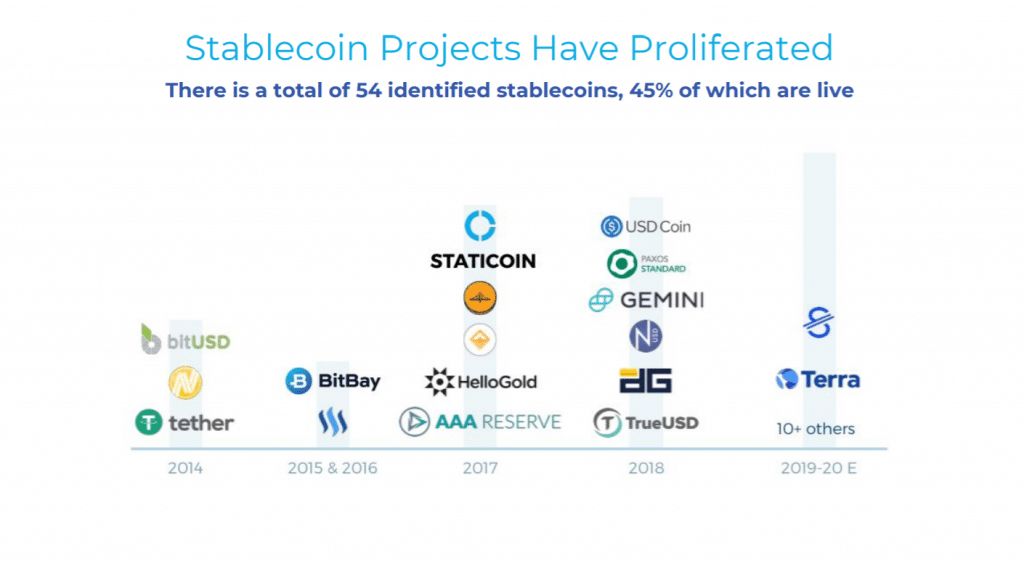
According to a report from crypto research firm Blockchain, there were only a handful of stablecoins on the market at the end of 2017; now, there are dozens--54, to be exact.
Stablecoin proliferation. Source: Blockchain
These 54 stablecoins now comprise 2.7 percent of the total market share of all cryptocurrencies, up from 1 percent in 2018; over $260 million in venture funding has been raised by stablecoin projects as of February of this year. Eighty-three percent of existing stablecoins are asset-backed, while the remaining 17 percent are algorithmic.
As the number of stablecoins continues to rise, competition between them continues to grow fiercer. Is there room in the market for all of them--or will some of them have to go?
In-House Stablecoins Could Bring in Big Profits for Corporations
“Generally the explosion of stablecoins reflects a competitive scramble, and generally more activity in the market is a good thing,” said Stan Stalnaker, Founding Director of Hub Culture, in an email to Finance Magnates.
He added that this activity is likely to continue: “the reality is that soon most banks are likely to have a stable of stablecoins in the market as tokenization and blockchains make it possible to issue value into the market.”
Additionally, it seems that corporations and financial institutions are starting to catch onto the benefits of building their own stablecoin ecosystems. Several mainstream companies, including Nike and Facebook, have either floated the idea of launching a coin or are in the process of launching one already.
“Even if they back their coins 1:1 with the asset that the coin is tied to, they can receive interest on overnight loans of their collateral. The more coins that they mint, the more collateral they have to lend, and the more money they make.”
Issuing a stablecoin can be an even more profitable if it manages to become adopted as a widely-used means of exchange: “the goal is to have your stablecoin become a leading currency for commerce,” Stollman said. “Then trillions of dollars worth of the coin will be needed. It doesn't take high-interest rates to make money on trillions of dollars of collateral.”
“Facebook's stablecoin has some potential to become a dominant stablecoin if they are able to excite their huge user base into using it... But just because Facebook has a large user base does not mean that they will all begin using their stablecoin.”
However, the widespread use of Facebook’s currency could serve to lift other stablecoins rather than stamp them out entirely: “if enough people start using it, it will move stablecoins to the next level,” Stollman explained.
A recent report by Binance Research on the evolution of the cryptocurrency industry came to a similar conclusion.
"As a result, these companies may help to define future key growth drivers for both the global payment and the digital asset industry.”
Whatever the Cause, The Net Effect of Stablecoin Explosion Has Been Positive
Regardless of what may or may not be causing the number of stablecoins to rise, “the increase of stablecoins eager to prove their solvency is having a positive effect on the industry,” said Angelo Frisina, Founder and CEO Sunlight Media LLC. After all, “a year ago, there were only a few stablecoins in existence, some of them with rather shady and controversial reputations,” he added, referring to Tether.
And stablecoin companies will continue to race to create products that will entice new users. “For these new technologies to be adopted by consumers, they need to provide a user experience that is straightforward, simple, familiar and ultimately better and cheaper than what consumers already use.”
Indeed, “the population at large is not interested in complicated technology for the sake of something different or new or unique. They are interested in things that make their lives simpler, easier, and make their transactions and purchases cheaper.” Stablecoin companies who can’t manage to do that for their customers--whether they be individuals or financial institutions--are unlikely to survive long term.
Projects that Will Survive Longterm
Which are the projects that will survive long term? Stability and trustworthiness are certainly essential--“the best stablecoins will become indistinguishable from digital cash because they are reliably backed in full and exchangeable,” said Stan Stalnaker.
Stan Stalnaker.
However, once unreliable coins are weeded out, he believes that there is room for more than one coin at the top: “coins that fail to achieve that level of security and reliability will have a hard time succeeding, while the rest will converge into a convertible ecosystem,” he said.
Stablecoins that have proved themselves to be unworthy of users’ trust are already starting to lose market share. According to a report by research firm Diar, Tether is beginning to lose its grip on the market, although it is still the most widely-used stablecoin by far.
“Tether is less secure as a store of value than other stablecoins,” Jeffrey Stollman said, adding that “the issuers of tether have not been content to merely obtain interest on short-term lending of their assets, they have made medium-term loans that reduce the cash available to back their currency.”
“Coins such as Gemini maintain their 1:1 backing and are more secure. So tether will likely continue to lose ground to better stablecoins. But the key is acceptance of other stablecoins by the exchanges.”
Stablecoins Are Probably the Ultimate Path to Crypto Adoption
Regardless of whether the future market will consist of five or five hundred stablecoins, it seems that they are a vital part of crypto’s path forward.
“Stablecoins are the key to any viable transition from cash to crypto,” Jeff Stollman said. In a way, they offer the best of both worlds: “while many zealots decry the fact that stablecoins are tied to a sovereign currency, this is the main benefit.”
After all, “most large economies have stable currencies. And they also enjoy stable pricing. Stablecoins provide a transition to cryptocurrencies and their benefits while still providing users with a known value for their holdings.”
The largest cryptocurrency networks have not been adopted for use on any kind of widespread scale.
While more institutional players have entered into the market--and a few companies have started to accept crypto as payment--the world isn’t really any closer to adopting Bitcoin (or any other crypto) as its singular currency.
Indeed, the Bitcoin network has been struggling with the same scalability issues that it is had for years; while web apps for Ethereum and other blockchains are continuously being developed, the technology that powers these major networks (and their respective coins) simply hasn’t been able to match the speed and user-friendliness that Fiat-powered, centralized apps have.
However, there is one corner of the cryptosphere that has been blossoming where mainstream crypto companies have lagged behind: stablecoins. Stablecoins are cryptocurrencies that have stable valuations, usually by “pegging” coins to fiat currencies and other assets--and new ones have been appearing on the scene at an accelerating pace.
What is Causing the Stablecoin Explosion?
According to a report from crypto research firm Blockchain, there were only a handful of stablecoins on the market at the end of 2017; now, there are dozens--54, to be exact.
Stablecoin proliferation. Source: Blockchain
These 54 stablecoins now comprise 2.7 percent of the total market share of all cryptocurrencies, up from 1 percent in 2018; over $260 million in venture funding has been raised by stablecoin projects as of February of this year. Eighty-three percent of existing stablecoins are asset-backed, while the remaining 17 percent are algorithmic.
As the number of stablecoins continues to rise, competition between them continues to grow fiercer. Is there room in the market for all of them--or will some of them have to go?
In-House Stablecoins Could Bring in Big Profits for Corporations
“Generally the explosion of stablecoins reflects a competitive scramble, and generally more activity in the market is a good thing,” said Stan Stalnaker, Founding Director of Hub Culture, in an email to Finance Magnates.
He added that this activity is likely to continue: “the reality is that soon most banks are likely to have a stable of stablecoins in the market as tokenization and blockchains make it possible to issue value into the market.”
Additionally, it seems that corporations and financial institutions are starting to catch onto the benefits of building their own stablecoin ecosystems. Several mainstream companies, including Nike and Facebook, have either floated the idea of launching a coin or are in the process of launching one already.
“Even if they back their coins 1:1 with the asset that the coin is tied to, they can receive interest on overnight loans of their collateral. The more coins that they mint, the more collateral they have to lend, and the more money they make.”
Issuing a stablecoin can be an even more profitable if it manages to become adopted as a widely-used means of exchange: “the goal is to have your stablecoin become a leading currency for commerce,” Stollman said. “Then trillions of dollars worth of the coin will be needed. It doesn't take high-interest rates to make money on trillions of dollars of collateral.”
“Facebook's stablecoin has some potential to become a dominant stablecoin if they are able to excite their huge user base into using it... But just because Facebook has a large user base does not mean that they will all begin using their stablecoin.”
However, the widespread use of Facebook’s currency could serve to lift other stablecoins rather than stamp them out entirely: “if enough people start using it, it will move stablecoins to the next level,” Stollman explained.
A recent report by Binance Research on the evolution of the cryptocurrency industry came to a similar conclusion.
"As a result, these companies may help to define future key growth drivers for both the global payment and the digital asset industry.”
Whatever the Cause, The Net Effect of Stablecoin Explosion Has Been Positive
Regardless of what may or may not be causing the number of stablecoins to rise, “the increase of stablecoins eager to prove their solvency is having a positive effect on the industry,” said Angelo Frisina, Founder and CEO Sunlight Media LLC. After all, “a year ago, there were only a few stablecoins in existence, some of them with rather shady and controversial reputations,” he added, referring to Tether.
And stablecoin companies will continue to race to create products that will entice new users. “For these new technologies to be adopted by consumers, they need to provide a user experience that is straightforward, simple, familiar and ultimately better and cheaper than what consumers already use.”
Indeed, “the population at large is not interested in complicated technology for the sake of something different or new or unique. They are interested in things that make their lives simpler, easier, and make their transactions and purchases cheaper.” Stablecoin companies who can’t manage to do that for their customers--whether they be individuals or financial institutions--are unlikely to survive long term.
Projects that Will Survive Longterm
Which are the projects that will survive long term? Stability and trustworthiness are certainly essential--“the best stablecoins will become indistinguishable from digital cash because they are reliably backed in full and exchangeable,” said Stan Stalnaker.
Stan Stalnaker.
However, once unreliable coins are weeded out, he believes that there is room for more than one coin at the top: “coins that fail to achieve that level of security and reliability will have a hard time succeeding, while the rest will converge into a convertible ecosystem,” he said.
Stablecoins that have proved themselves to be unworthy of users’ trust are already starting to lose market share. According to a report by research firm Diar, Tether is beginning to lose its grip on the market, although it is still the most widely-used stablecoin by far.
“Tether is less secure as a store of value than other stablecoins,” Jeffrey Stollman said, adding that “the issuers of tether have not been content to merely obtain interest on short-term lending of their assets, they have made medium-term loans that reduce the cash available to back their currency.”
“Coins such as Gemini maintain their 1:1 backing and are more secure. So tether will likely continue to lose ground to better stablecoins. But the key is acceptance of other stablecoins by the exchanges.”
Stablecoins Are Probably the Ultimate Path to Crypto Adoption
Regardless of whether the future market will consist of five or five hundred stablecoins, it seems that they are a vital part of crypto’s path forward.
“Stablecoins are the key to any viable transition from cash to crypto,” Jeff Stollman said. In a way, they offer the best of both worlds: “while many zealots decry the fact that stablecoins are tied to a sovereign currency, this is the main benefit.”
After all, “most large economies have stable currencies. And they also enjoy stable pricing. Stablecoins provide a transition to cryptocurrencies and their benefits while still providing users with a known value for their holdings.”
Rachel is a self-taught crypto geek and a passionate writer. She believes in the power that the written word has to educate, connect and empower individuals to make positive and powerful financial choices. She is the Podcast Host and a Cryptocurrency Editor at Finance Magnates.
Crypto Built More Rails, but the Next Battle Is Over How Much Work a Dollar Can Do
Featured Videos
FP Markets Winner Spotlight 🏆 | Global Broker of the Year 2025 #Trading #Broker #Innovation #Shorts
FP Markets Winner Spotlight 🏆 | Global Broker of the Year 2025 #Trading #Broker #Innovation #Shorts
FP Markets Winner Spotlight 🏆 | Global Broker of the Year 2025 #Trading #Broker #Innovation #Shorts
FP Markets Winner Spotlight 🏆 | Global Broker of the Year 2025 #Trading #Broker #Innovation #Shorts
FP Markets takes the spotlight as Global Broker of the Year 2025 at the Finance Magnates Awards.
Martin Stoilov, Head of Client Experience, shares that trust, innovation, and people played a key role in the company’s success, supported by a strong foundation of integrity and client-centricity.
Following this milestone, FP Markets continues to focus on growth, technology investment, and its core values of transparency and excellence.
👉 Be part of FM Awards 2026: https://awards.financemagnates.com/#nominate
FP Markets takes the spotlight as Global Broker of the Year 2025 at the Finance Magnates Awards.
Martin Stoilov, Head of Client Experience, shares that trust, innovation, and people played a key role in the company’s success, supported by a strong foundation of integrity and client-centricity.
Following this milestone, FP Markets continues to focus on growth, technology investment, and its core values of transparency and excellence.
👉 Be part of FM Awards 2026: https://awards.financemagnates.com/#nominate
FP Markets takes the spotlight as Global Broker of the Year 2025 at the Finance Magnates Awards.
Martin Stoilov, Head of Client Experience, shares that trust, innovation, and people played a key role in the company’s success, supported by a strong foundation of integrity and client-centricity.
Following this milestone, FP Markets continues to focus on growth, technology investment, and its core values of transparency and excellence.
👉 Be part of FM Awards 2026: https://awards.financemagnates.com/#nominate
FP Markets takes the spotlight as Global Broker of the Year 2025 at the Finance Magnates Awards.
Martin Stoilov, Head of Client Experience, shares that trust, innovation, and people played a key role in the company’s success, supported by a strong foundation of integrity and client-centricity.
Following this milestone, FP Markets continues to focus on growth, technology investment, and its core values of transparency and excellence.
👉 Be part of FM Awards 2026: https://awards.financemagnates.com/#nominate
In this video, we review @HolaPrimeMarketsOfficial, a multi-asset forex and CFDs broker offering different account types, trading platforms, and flexible trading conditions.
We cover the broker’s overall offering, including account options, trading environment, platforms like MT4 and MT5, and additional services such as managed accounts and fast withdrawals.
Watch the full video to see if Hola Prime Markets fits your trading needs.
📣 Stay up to date with the latest in finance and trading. Follow Finance Magnates for industry news, insights, and global event coverage.
Connect with us:
🔗 LinkedIn: /financemagnates
👍 Facebook: /financemagnates
📸 Instagram: https://www.instagram.com/financemagnates
🐦 X: https://x.com/financemagnates
🎥 TikTok: https://www.tiktok.com/tag/financemagnates
▶️ YouTube: /@financemagnates_official
#HolaPrime #ForexBroker #CFDTrading #FinanceMagnates #Trading #Forex #BrokerReview
In this video, we review @HolaPrimeMarketsOfficial, a multi-asset forex and CFDs broker offering different account types, trading platforms, and flexible trading conditions.
We cover the broker’s overall offering, including account options, trading environment, platforms like MT4 and MT5, and additional services such as managed accounts and fast withdrawals.
Watch the full video to see if Hola Prime Markets fits your trading needs.
📣 Stay up to date with the latest in finance and trading. Follow Finance Magnates for industry news, insights, and global event coverage.
Connect with us:
🔗 LinkedIn: /financemagnates
👍 Facebook: /financemagnates
📸 Instagram: https://www.instagram.com/financemagnates
🐦 X: https://x.com/financemagnates
🎥 TikTok: https://www.tiktok.com/tag/financemagnates
▶️ YouTube: /@financemagnates_official
#HolaPrime #ForexBroker #CFDTrading #FinanceMagnates #Trading #Forex #BrokerReview
In this video, we review @HolaPrimeMarketsOfficial, a multi-asset forex and CFDs broker offering different account types, trading platforms, and flexible trading conditions.
We cover the broker’s overall offering, including account options, trading environment, platforms like MT4 and MT5, and additional services such as managed accounts and fast withdrawals.
Watch the full video to see if Hola Prime Markets fits your trading needs.
📣 Stay up to date with the latest in finance and trading. Follow Finance Magnates for industry news, insights, and global event coverage.
Connect with us:
🔗 LinkedIn: /financemagnates
👍 Facebook: /financemagnates
📸 Instagram: https://www.instagram.com/financemagnates
🐦 X: https://x.com/financemagnates
🎥 TikTok: https://www.tiktok.com/tag/financemagnates
▶️ YouTube: /@financemagnates_official
#HolaPrime #ForexBroker #CFDTrading #FinanceMagnates #Trading #Forex #BrokerReview
In this video, we review @HolaPrimeMarketsOfficial, a multi-asset forex and CFDs broker offering different account types, trading platforms, and flexible trading conditions.
We cover the broker’s overall offering, including account options, trading environment, platforms like MT4 and MT5, and additional services such as managed accounts and fast withdrawals.
Watch the full video to see if Hola Prime Markets fits your trading needs.
📣 Stay up to date with the latest in finance and trading. Follow Finance Magnates for industry news, insights, and global event coverage.
Connect with us:
🔗 LinkedIn: /financemagnates
👍 Facebook: /financemagnates
📸 Instagram: https://www.instagram.com/financemagnates
🐦 X: https://x.com/financemagnates
🎥 TikTok: https://www.tiktok.com/tag/financemagnates
▶️ YouTube: /@financemagnates_official
#HolaPrime #ForexBroker #CFDTrading #FinanceMagnates #Trading #Forex #BrokerReview
In this video, we review @HolaPrimeMarketsOfficial, a multi-asset forex and CFDs broker offering different account types, trading platforms, and flexible trading conditions.
We cover the broker’s overall offering, including account options, trading environment, platforms like MT4 and MT5, and additional services such as managed accounts and fast withdrawals.
Watch the full video to see if Hola Prime Markets fits your trading needs.
📣 Stay up to date with the latest in finance and trading. Follow Finance Magnates for industry news, insights, and global event coverage.
Connect with us:
🔗 LinkedIn: /financemagnates
👍 Facebook: /financemagnates
📸 Instagram: https://www.instagram.com/financemagnates
🐦 X: https://x.com/financemagnates
🎥 TikTok: https://www.tiktok.com/tag/financemagnates
▶️ YouTube: /@financemagnates_official
#HolaPrime #ForexBroker #CFDTrading #FinanceMagnates #Trading #Forex #BrokerReview
In this video, we review @HolaPrimeMarketsOfficial, a multi-asset forex and CFDs broker offering different account types, trading platforms, and flexible trading conditions.
We cover the broker’s overall offering, including account options, trading environment, platforms like MT4 and MT5, and additional services such as managed accounts and fast withdrawals.
Watch the full video to see if Hola Prime Markets fits your trading needs.
📣 Stay up to date with the latest in finance and trading. Follow Finance Magnates for industry news, insights, and global event coverage.
Connect with us:
🔗 LinkedIn: /financemagnates
👍 Facebook: /financemagnates
📸 Instagram: https://www.instagram.com/financemagnates
🐦 X: https://x.com/financemagnates
🎥 TikTok: https://www.tiktok.com/tag/financemagnates
▶️ YouTube: /@financemagnates_official
#HolaPrime #ForexBroker #CFDTrading #FinanceMagnates #Trading #Forex #BrokerReview
Hola Prime Review: What You Need to Know | Full Breakdown by Finance Magnates
Hola Prime Review: What You Need to Know | Full Breakdown by Finance Magnates
Hola Prime Review: What You Need to Know | Full Breakdown by Finance Magnates
Hola Prime Review: What You Need to Know | Full Breakdown by Finance Magnates
Hola Prime Review: What You Need to Know | Full Breakdown by Finance Magnates
Hola Prime Review: What You Need to Know | Full Breakdown by Finance Magnates
In this video, we review @HolaPrime_Global, a proprietary trading firm offering evaluation programs and performance-based payouts in simulated market environments.
We cover how the challenge model works, including account types, profit splits (up to 95%), trading rules, and what it takes to reach a funded account. You’ll also learn about available platforms like MT4, MT5, cTrader, and more, along with insights into payouts, support, and trading conditions.
Watch the full video to see if Hola Prime fits your trading style.
📣 Stay up to date with the latest in finance and trading. Follow Finance Magnates for industry news, insights, and global event coverage.
Connect with us:
🔗 LinkedIn: /financemagnates
👍 Facebook: /financemagnates
📸 Instagram: https://www.instagram.com/financemagnates
🐦 X: https://x.com/financemagnates
🎥 TikTok: https://www.tiktok.com/tag/financemagnates
▶️ YouTube: /@financemagnates_official
#HolaPrime #PropFirm #Trading #FinanceMagnates #Forex #FuturesTrading #TradingReview #PropFirmReview
In this video, we review @HolaPrime_Global, a proprietary trading firm offering evaluation programs and performance-based payouts in simulated market environments.
We cover how the challenge model works, including account types, profit splits (up to 95%), trading rules, and what it takes to reach a funded account. You’ll also learn about available platforms like MT4, MT5, cTrader, and more, along with insights into payouts, support, and trading conditions.
Watch the full video to see if Hola Prime fits your trading style.
📣 Stay up to date with the latest in finance and trading. Follow Finance Magnates for industry news, insights, and global event coverage.
Connect with us:
🔗 LinkedIn: /financemagnates
👍 Facebook: /financemagnates
📸 Instagram: https://www.instagram.com/financemagnates
🐦 X: https://x.com/financemagnates
🎥 TikTok: https://www.tiktok.com/tag/financemagnates
▶️ YouTube: /@financemagnates_official
#HolaPrime #PropFirm #Trading #FinanceMagnates #Forex #FuturesTrading #TradingReview #PropFirmReview
In this video, we review @HolaPrime_Global, a proprietary trading firm offering evaluation programs and performance-based payouts in simulated market environments.
We cover how the challenge model works, including account types, profit splits (up to 95%), trading rules, and what it takes to reach a funded account. You’ll also learn about available platforms like MT4, MT5, cTrader, and more, along with insights into payouts, support, and trading conditions.
Watch the full video to see if Hola Prime fits your trading style.
📣 Stay up to date with the latest in finance and trading. Follow Finance Magnates for industry news, insights, and global event coverage.
Connect with us:
🔗 LinkedIn: /financemagnates
👍 Facebook: /financemagnates
📸 Instagram: https://www.instagram.com/financemagnates
🐦 X: https://x.com/financemagnates
🎥 TikTok: https://www.tiktok.com/tag/financemagnates
▶️ YouTube: /@financemagnates_official
#HolaPrime #PropFirm #Trading #FinanceMagnates #Forex #FuturesTrading #TradingReview #PropFirmReview
In this video, we review @HolaPrime_Global, a proprietary trading firm offering evaluation programs and performance-based payouts in simulated market environments.
We cover how the challenge model works, including account types, profit splits (up to 95%), trading rules, and what it takes to reach a funded account. You’ll also learn about available platforms like MT4, MT5, cTrader, and more, along with insights into payouts, support, and trading conditions.
Watch the full video to see if Hola Prime fits your trading style.
📣 Stay up to date with the latest in finance and trading. Follow Finance Magnates for industry news, insights, and global event coverage.
Connect with us:
🔗 LinkedIn: /financemagnates
👍 Facebook: /financemagnates
📸 Instagram: https://www.instagram.com/financemagnates
🐦 X: https://x.com/financemagnates
🎥 TikTok: https://www.tiktok.com/tag/financemagnates
▶️ YouTube: /@financemagnates_official
#HolaPrime #PropFirm #Trading #FinanceMagnates #Forex #FuturesTrading #TradingReview #PropFirmReview
In this video, we review @HolaPrime_Global, a proprietary trading firm offering evaluation programs and performance-based payouts in simulated market environments.
We cover how the challenge model works, including account types, profit splits (up to 95%), trading rules, and what it takes to reach a funded account. You’ll also learn about available platforms like MT4, MT5, cTrader, and more, along with insights into payouts, support, and trading conditions.
Watch the full video to see if Hola Prime fits your trading style.
📣 Stay up to date with the latest in finance and trading. Follow Finance Magnates for industry news, insights, and global event coverage.
Connect with us:
🔗 LinkedIn: /financemagnates
👍 Facebook: /financemagnates
📸 Instagram: https://www.instagram.com/financemagnates
🐦 X: https://x.com/financemagnates
🎥 TikTok: https://www.tiktok.com/tag/financemagnates
▶️ YouTube: /@financemagnates_official
#HolaPrime #PropFirm #Trading #FinanceMagnates #Forex #FuturesTrading #TradingReview #PropFirmReview
In this video, we review @HolaPrime_Global, a proprietary trading firm offering evaluation programs and performance-based payouts in simulated market environments.
We cover how the challenge model works, including account types, profit splits (up to 95%), trading rules, and what it takes to reach a funded account. You’ll also learn about available platforms like MT4, MT5, cTrader, and more, along with insights into payouts, support, and trading conditions.
Watch the full video to see if Hola Prime fits your trading style.
📣 Stay up to date with the latest in finance and trading. Follow Finance Magnates for industry news, insights, and global event coverage.
Connect with us:
🔗 LinkedIn: /financemagnates
👍 Facebook: /financemagnates
📸 Instagram: https://www.instagram.com/financemagnates
🐦 X: https://x.com/financemagnates
🎥 TikTok: https://www.tiktok.com/tag/financemagnates
▶️ YouTube: /@financemagnates_official
#HolaPrime #PropFirm #Trading #FinanceMagnates #Forex #FuturesTrading #TradingReview #PropFirmReview
Axi Winner Spotlight 🏆 | Global Most Innovative Broker 2025 #Innovation #Trading #Fintech #Broker
Axi Winner Spotlight 🏆 | Global Most Innovative Broker 2025 #Innovation #Trading #Fintech #Broker
Axi Winner Spotlight 🏆 | Global Most Innovative Broker 2025 #Innovation #Trading #Fintech #Broker
Axi Winner Spotlight 🏆 | Global Most Innovative Broker 2025 #Innovation #Trading #Fintech #Broker
Axi Winner Spotlight 🏆 | Global Most Innovative Broker 2025 #Innovation #Trading #Fintech #Broker
Axi Winner Spotlight 🏆 | Global Most Innovative Broker 2025 #Innovation #Trading #Fintech #Broker
Axi takes the spotlight at the Finance Magnates Awards, winning Global Most Innovative Broker 2025.
Olivia Xenofontos and Ivanna Openko share how the team will feel: proud, motivated, and ready to keep delivering.
They also describe the night as well-organized, focused, and enjoyable for all.
👉 Be part of FM Awards 2026.
Axi takes the spotlight at the Finance Magnates Awards, winning Global Most Innovative Broker 2025.
Olivia Xenofontos and Ivanna Openko share how the team will feel: proud, motivated, and ready to keep delivering.
They also describe the night as well-organized, focused, and enjoyable for all.
👉 Be part of FM Awards 2026.
Axi takes the spotlight at the Finance Magnates Awards, winning Global Most Innovative Broker 2025.
Olivia Xenofontos and Ivanna Openko share how the team will feel: proud, motivated, and ready to keep delivering.
They also describe the night as well-organized, focused, and enjoyable for all.
👉 Be part of FM Awards 2026.
Axi takes the spotlight at the Finance Magnates Awards, winning Global Most Innovative Broker 2025.
Olivia Xenofontos and Ivanna Openko share how the team will feel: proud, motivated, and ready to keep delivering.
They also describe the night as well-organized, focused, and enjoyable for all.
👉 Be part of FM Awards 2026.
Axi takes the spotlight at the Finance Magnates Awards, winning Global Most Innovative Broker 2025.
Olivia Xenofontos and Ivanna Openko share how the team will feel: proud, motivated, and ready to keep delivering.
They also describe the night as well-organized, focused, and enjoyable for all.
👉 Be part of FM Awards 2026.
Axi takes the spotlight at the Finance Magnates Awards, winning Global Most Innovative Broker 2025.
Olivia Xenofontos and Ivanna Openko share how the team will feel: proud, motivated, and ready to keep delivering.
They also describe the night as well-organized, focused, and enjoyable for all.
👉 Be part of FM Awards 2026.
Recognition that matters.
Built on transparency.
Driven by the industry.
The Finance Magnates Awards 2026.
Nominations are now open.
🔗 https://awards.financemagnates.com/?utm_source=SM&utm_medium=social&utm_campaign=recognition-matters
Recognition that matters.
Built on transparency.
Driven by the industry.
The Finance Magnates Awards 2026.
Nominations are now open.
🔗 https://awards.financemagnates.com/?utm_source=SM&utm_medium=social&utm_campaign=recognition-matters
Recognition that matters.
Built on transparency.
Driven by the industry.
The Finance Magnates Awards 2026.
Nominations are now open.
🔗 https://awards.financemagnates.com/?utm_source=SM&utm_medium=social&utm_campaign=recognition-matters
Recognition that matters.
Built on transparency.
Driven by the industry.
The Finance Magnates Awards 2026.
Nominations are now open.
🔗 https://awards.financemagnates.com/?utm_source=SM&utm_medium=social&utm_campaign=recognition-matters
Recognition that matters.
Built on transparency.
Driven by the industry.
The Finance Magnates Awards 2026.
Nominations are now open.
🔗 https://awards.financemagnates.com/?utm_source=SM&utm_medium=social&utm_campaign=recognition-matters
Recognition that matters.
Built on transparency.
Driven by the industry.
The Finance Magnates Awards 2026.
Nominations are now open.
🔗 https://awards.financemagnates.com/?utm_source=SM&utm_medium=social&utm_campaign=recognition-matters