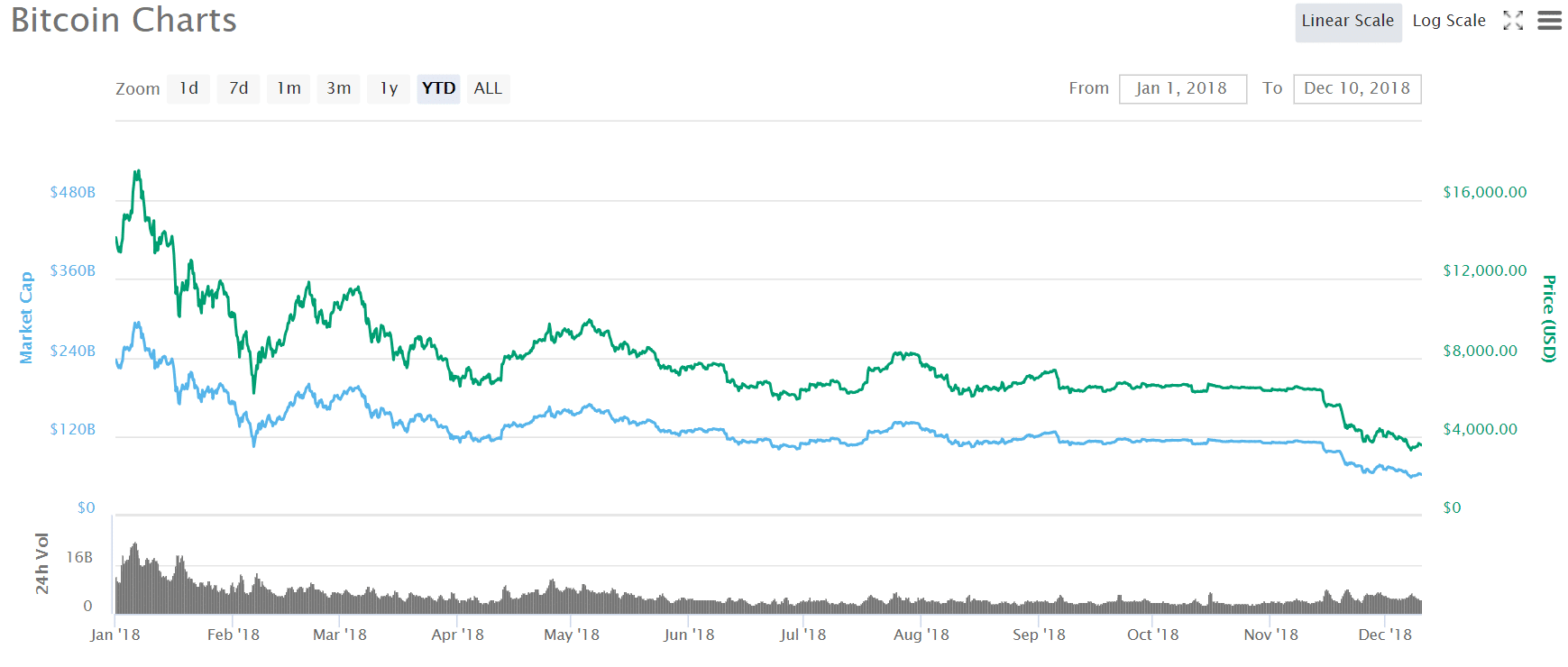
Despite the bear market that has plagued Bitcoin throughout the year 2018, some analysts are optimistic.
FM
It’s been a horrendous year for Bitcoin. It started bad, and it’s finishing even worse. The recovery that Bitcoin bulls were hoping would come at some point this year is all but a pipe dream at this point--even within the past month, Bitcoin’s valuation has nearly halved from $6400 to roughly $3565 at the time of writing.
And yet, some analysts, executives, and traders have refused to drop their bullish predictions for Bitcoin. Squeezing their optimism to the last drop, they hold onto the idea that Bitcoin will not only recover, but it will shatter expectations, pushing past its all-time high of $20,000 and straight “to the moon.”
Who are these relentless bulls, and why are they holding onto these predictions?
Bobby Lee Sees Triple in 2021
At first glance, it seems that Bobby Lee has a somewhat realistic approach to Bitcoin price predictions (at least in the short-term sense.) Lee is a Bitcoin Foundation board member and co-founder of the BTCC cryptocurrency exchange. On December 7th, 2018, Lee tweeted that he believes that Bitcoin will “bottom out” at $2500 in January of 2019.
Lee’s long-term predictions may be a little less realistic. He went onto say that the next rally will begin in late 2020, bringing a height of $333,000 in December 2021, followed by a crash at $41,000 in January of 2023.
If history repeats perfectly, then the current bear market for #Bitcoin would bottom out at $2,500 next month, in Jan 2019.
And then the next rally would start in late 2020, peak out in Dec 2021 at $333,000, and then crash back down to $41,000 in Jan 2023.
Something like that?? https://t.co/M8ljIVnt73
— Bobby Lee (@bobbyclee) December 7, 2018
Lee’s predictions are apparently primarily based on a simple “history-repeating itself” pattern. He also explained that his rationale is based on his prediction that Bitcoin’s market cap will eventually surpass gold’s market cap. “One more coincidence: If the next #bitcoin rally (in 2021?) does indeed reach $333,000, that’ll bring Bitcoin’s price to roughly that of #Gold, at $7 trillion each!”, he wrote.
From then all-time high of USD $1,200 in Dec 2013, for next 13 months, #Bitcoin went down by over 87% to bottom out at just $150 in Jan 2015. Rock bottom! #AllHopeLost?
Now from Dec 2017 high of $20,000, going down 87% would take it to $2,500. So maybe bottom out in Jan 2019? ?
— Bobby Lee (@bobbyclee) December 7, 2018
John McAfee Says that a $1 Million Valuation by 2020 is a “Conservative” Estimate
Lee’s long-term predictions may sound outlandish, but he’s not the only one with pie-in-the-sky high hopes. John McAfee, founder of McAfee cybersecurity software firm and eccentric millionaire, told CoinTelegraph in November that a Bitcoin valuation of $1 million by the year 2020 is a “conservative” prediction. However, he did add a small caveat, saying that the “real value” of $1 million could be reflected differently in the future due to hyperinflation in fiat markets or other widespread fiscal problems.
Yeah, right.
Perhaps McAfee could be a little bit worried about having to fulfill a small promise that he made last year.
if not, I will eat my dick on national television.
According to McAfee, his method of prediction is “simple”--he’s simply drawing a correlation between the growing number of transactions increased amount of users on the Bitcoin network. By these standards, McAfee explained that the value of the Bitcoin network is “growing tremendously.”
So what of the bear market? McAfee says that BTC’s downward spiral is only “temporary,” the result of “artificial pressures.”
Fiat Collapse Could Bring the Price of Bitcoin Up
McAfee added in his interview with CoinTelegraph that an increase in BTC valuation could also be caused by what he sees as an inevitable collapse of fiat currencies. “You will see the collapse of fiat,” he said, ominously.
This is evidenced by countries who have experienced financial crises that have destroyed their national currencies. Take Venezuela, for example--as the Bolivar collapsed and hyperinflation plagued the country’s economy, citizens turned to Bitcoin as a method of storing the value of their savings; mining Bitcoin and other cryptocurrencies provide a source of income for individuals and families who lacked the funds to buy necessities, like food and clean water.
Before Venezuela, a similar phenomenon happened in Zimbabwe. Long before Bitcoin hit $10,000 in the rest of the world, the value of BTC on Zimbabwean exchange Golix was pushed to $14,000 because of high trading volume within the country.
Smart Valor CEO Olga Feldmeier spoke about the phenomena of Bitcoin as a financial safe-haven in an interview with Finance Magnates conducted earlier this year. “Bitcoin and decentralized money give the same [privileges] to everybody,” she said. “You can always purchase one or two Bitcoins, and [use it as protection] from inflation in your home country.”
However, relying on some sort of "inevitable" financial collapse isn't exactly solid ground to base a price prediction on.
An ETF Could Bring BTC Back from the Dead
Other Bitcoin bulls are counting on the approval of a Bitcoin ETF (exchange-traded fund) to breathe life back into BTC.
More recently, though, a study published by tom Alford at TotalCrypto.io has predicted a 500% increase in the price of Bitcoin should an application for a Bitcoin ETF be approved. There are currently several applications under review, including one by VanEck and SolidX, and one by CBOE. While the jury is still out (and likely will be for several months), many voices across the financial community believe that at least one of these applications has the stuff to get an approval.
BitPay COO Sonny Singh also believes that the appearance of a Bitcoin ETF on the market could send Bitcoin up again. Singh told Bloomberg that he believes that the price of Bitcoin could reinvent itself throughout the first two quarters of 2019, resulting in a valuation of anywhere from $15,000-$20,000 per BTC.
New Capital On-Ramps for Institutions Could Fatten BTC
Some analysts argue that another factor that has been contributing to Bitcoin’s decline is a lack of investment on-ramps for institutions and high-volume investors.
“Number one, the on-ramps for new capital is very difficult,” said digital assets trader at Susquehanna Bart Smith. “If you’re a global institution, it is still very difficult to buy Bitcoin in a way you might want to. A wealthy individual from the G.I. Generation is not going to take a high-resolution picture of their driver’s license and send it to a website and send money there.
Instead, Smith argues these kinds of investors want the security that comes with traditional institutions: “they want to invest with Fidelity. They want to invest with Bank of America.”
So, the lack of these kinds of avenues into Bitcoin has left many big investors out of the game. However, more and more platforms that have been designed to serve high-volume and institutional investors specifically have appeared on the scene. ICE’s subsidiary exchange Bakkt is one of these; ErisX also recently launched a trading platform designed for institutional investors.
The Three-Body Problem
Of course, no matter what your opinion on the future of Bitcoin may be, it’s extremely important to remember that the only person who really knows what will happen is named Josiah Stimm, and he lives on a tiny and undiscovered island in the Atlantic ocean, where he is completely unreachable by telephone or any other means.
Ok, you got me--that was a lie. There is no such Josiah Stimm. The real answer is that no one knows.
“These forecasts are, for the most part, exercises in futility,” wrote opinion columnist Barry Ritholtz in a recent article for Bloomberg. Ritholtz also pointed to his colleague Nick Maggiulli, who reminded us all in a tweet that it is impossible to predict chaotic systems.
Where did all these people go wrong? When they made a Bitcoin price prediction in the first place.
The Three-Body problem refers to the problem of taking three different point masses and predicting the way that they will interact with one another based on Newton’s laws of motion and gravitation--it’s impossible.
Of course, there are those who do not view Bitcoin as such a chaotic system. Renowned researcher and cryptocurrency analyst Willy Woo has developed an algorithm that actually sort of mirror’s Bobby Lee’s predictions for the future price of Bitcoin--shorter-term fall and a longer-term boom.
However if you're into timing games, then my own NVT Ratio is saying we are still in the middle of a bear market. NVT is simply the ratio of volume carried by the blockchain to the historic price. (This indicator is due for recalibration after the Liquid Sidechain launch) pic.twitter.com/hcnI50QAnd
The fact is, though, that we cannot predict the future based on the past alone. Sure, there are some data points that we can track and analyze various types of patterns. But the economy shrinks, grows, and changes every day with unprecedented inputs and losses. We can’t reliably predict the future of Bitcoin because we can’t reliably predict the future of anything.
It’s been a horrendous year for Bitcoin. It started bad, and it’s finishing even worse. The recovery that Bitcoin bulls were hoping would come at some point this year is all but a pipe dream at this point--even within the past month, Bitcoin’s valuation has nearly halved from $6400 to roughly $3565 at the time of writing.
And yet, some analysts, executives, and traders have refused to drop their bullish predictions for Bitcoin. Squeezing their optimism to the last drop, they hold onto the idea that Bitcoin will not only recover, but it will shatter expectations, pushing past its all-time high of $20,000 and straight “to the moon.”
Who are these relentless bulls, and why are they holding onto these predictions?
Bobby Lee Sees Triple in 2021
At first glance, it seems that Bobby Lee has a somewhat realistic approach to Bitcoin price predictions (at least in the short-term sense.) Lee is a Bitcoin Foundation board member and co-founder of the BTCC cryptocurrency exchange. On December 7th, 2018, Lee tweeted that he believes that Bitcoin will “bottom out” at $2500 in January of 2019.
Lee’s long-term predictions may be a little less realistic. He went onto say that the next rally will begin in late 2020, bringing a height of $333,000 in December 2021, followed by a crash at $41,000 in January of 2023.
If history repeats perfectly, then the current bear market for #Bitcoin would bottom out at $2,500 next month, in Jan 2019.
And then the next rally would start in late 2020, peak out in Dec 2021 at $333,000, and then crash back down to $41,000 in Jan 2023.
Something like that?? https://t.co/M8ljIVnt73
— Bobby Lee (@bobbyclee) December 7, 2018
Lee’s predictions are apparently primarily based on a simple “history-repeating itself” pattern. He also explained that his rationale is based on his prediction that Bitcoin’s market cap will eventually surpass gold’s market cap. “One more coincidence: If the next #bitcoin rally (in 2021?) does indeed reach $333,000, that’ll bring Bitcoin’s price to roughly that of #Gold, at $7 trillion each!”, he wrote.
From then all-time high of USD $1,200 in Dec 2013, for next 13 months, #Bitcoin went down by over 87% to bottom out at just $150 in Jan 2015. Rock bottom! #AllHopeLost?
Now from Dec 2017 high of $20,000, going down 87% would take it to $2,500. So maybe bottom out in Jan 2019? ?
— Bobby Lee (@bobbyclee) December 7, 2018
John McAfee Says that a $1 Million Valuation by 2020 is a “Conservative” Estimate
Lee’s long-term predictions may sound outlandish, but he’s not the only one with pie-in-the-sky high hopes. John McAfee, founder of McAfee cybersecurity software firm and eccentric millionaire, told CoinTelegraph in November that a Bitcoin valuation of $1 million by the year 2020 is a “conservative” prediction. However, he did add a small caveat, saying that the “real value” of $1 million could be reflected differently in the future due to hyperinflation in fiat markets or other widespread fiscal problems.
Yeah, right.
Perhaps McAfee could be a little bit worried about having to fulfill a small promise that he made last year.
if not, I will eat my dick on national television.
According to McAfee, his method of prediction is “simple”--he’s simply drawing a correlation between the growing number of transactions increased amount of users on the Bitcoin network. By these standards, McAfee explained that the value of the Bitcoin network is “growing tremendously.”
So what of the bear market? McAfee says that BTC’s downward spiral is only “temporary,” the result of “artificial pressures.”
Fiat Collapse Could Bring the Price of Bitcoin Up
McAfee added in his interview with CoinTelegraph that an increase in BTC valuation could also be caused by what he sees as an inevitable collapse of fiat currencies. “You will see the collapse of fiat,” he said, ominously.
This is evidenced by countries who have experienced financial crises that have destroyed their national currencies. Take Venezuela, for example--as the Bolivar collapsed and hyperinflation plagued the country’s economy, citizens turned to Bitcoin as a method of storing the value of their savings; mining Bitcoin and other cryptocurrencies provide a source of income for individuals and families who lacked the funds to buy necessities, like food and clean water.
Before Venezuela, a similar phenomenon happened in Zimbabwe. Long before Bitcoin hit $10,000 in the rest of the world, the value of BTC on Zimbabwean exchange Golix was pushed to $14,000 because of high trading volume within the country.
Smart Valor CEO Olga Feldmeier spoke about the phenomena of Bitcoin as a financial safe-haven in an interview with Finance Magnates conducted earlier this year. “Bitcoin and decentralized money give the same [privileges] to everybody,” she said. “You can always purchase one or two Bitcoins, and [use it as protection] from inflation in your home country.”
However, relying on some sort of "inevitable" financial collapse isn't exactly solid ground to base a price prediction on.
An ETF Could Bring BTC Back from the Dead
Other Bitcoin bulls are counting on the approval of a Bitcoin ETF (exchange-traded fund) to breathe life back into BTC.
More recently, though, a study published by tom Alford at TotalCrypto.io has predicted a 500% increase in the price of Bitcoin should an application for a Bitcoin ETF be approved. There are currently several applications under review, including one by VanEck and SolidX, and one by CBOE. While the jury is still out (and likely will be for several months), many voices across the financial community believe that at least one of these applications has the stuff to get an approval.
BitPay COO Sonny Singh also believes that the appearance of a Bitcoin ETF on the market could send Bitcoin up again. Singh told Bloomberg that he believes that the price of Bitcoin could reinvent itself throughout the first two quarters of 2019, resulting in a valuation of anywhere from $15,000-$20,000 per BTC.
New Capital On-Ramps for Institutions Could Fatten BTC
Some analysts argue that another factor that has been contributing to Bitcoin’s decline is a lack of investment on-ramps for institutions and high-volume investors.
“Number one, the on-ramps for new capital is very difficult,” said digital assets trader at Susquehanna Bart Smith. “If you’re a global institution, it is still very difficult to buy Bitcoin in a way you might want to. A wealthy individual from the G.I. Generation is not going to take a high-resolution picture of their driver’s license and send it to a website and send money there.
Instead, Smith argues these kinds of investors want the security that comes with traditional institutions: “they want to invest with Fidelity. They want to invest with Bank of America.”
So, the lack of these kinds of avenues into Bitcoin has left many big investors out of the game. However, more and more platforms that have been designed to serve high-volume and institutional investors specifically have appeared on the scene. ICE’s subsidiary exchange Bakkt is one of these; ErisX also recently launched a trading platform designed for institutional investors.
The Three-Body Problem
Of course, no matter what your opinion on the future of Bitcoin may be, it’s extremely important to remember that the only person who really knows what will happen is named Josiah Stimm, and he lives on a tiny and undiscovered island in the Atlantic ocean, where he is completely unreachable by telephone or any other means.
Ok, you got me--that was a lie. There is no such Josiah Stimm. The real answer is that no one knows.
“These forecasts are, for the most part, exercises in futility,” wrote opinion columnist Barry Ritholtz in a recent article for Bloomberg. Ritholtz also pointed to his colleague Nick Maggiulli, who reminded us all in a tweet that it is impossible to predict chaotic systems.
Where did all these people go wrong? When they made a Bitcoin price prediction in the first place.
The Three-Body problem refers to the problem of taking three different point masses and predicting the way that they will interact with one another based on Newton’s laws of motion and gravitation--it’s impossible.
Of course, there are those who do not view Bitcoin as such a chaotic system. Renowned researcher and cryptocurrency analyst Willy Woo has developed an algorithm that actually sort of mirror’s Bobby Lee’s predictions for the future price of Bitcoin--shorter-term fall and a longer-term boom.
However if you're into timing games, then my own NVT Ratio is saying we are still in the middle of a bear market. NVT is simply the ratio of volume carried by the blockchain to the historic price. (This indicator is due for recalibration after the Liquid Sidechain launch) pic.twitter.com/hcnI50QAnd
The fact is, though, that we cannot predict the future based on the past alone. Sure, there are some data points that we can track and analyze various types of patterns. But the economy shrinks, grows, and changes every day with unprecedented inputs and losses. We can’t reliably predict the future of Bitcoin because we can’t reliably predict the future of anything.
Rachel is a self-taught crypto geek and a passionate writer. She believes in the power that the written word has to educate, connect and empower individuals to make positive and powerful financial choices. She is the Podcast Host and a Cryptocurrency Editor at Finance Magnates.
Crypto Built More Rails, but the Next Battle Is Over How Much Work a Dollar Can Do
Featured Videos
FP Markets Winner Spotlight 🏆 | Global Broker of the Year 2025 #Trading #Broker #Innovation #Shorts
FP Markets Winner Spotlight 🏆 | Global Broker of the Year 2025 #Trading #Broker #Innovation #Shorts
FP Markets Winner Spotlight 🏆 | Global Broker of the Year 2025 #Trading #Broker #Innovation #Shorts
FP Markets Winner Spotlight 🏆 | Global Broker of the Year 2025 #Trading #Broker #Innovation #Shorts
FP Markets takes the spotlight as Global Broker of the Year 2025 at the Finance Magnates Awards.
Martin Stoilov, Head of Client Experience, shares that trust, innovation, and people played a key role in the company’s success, supported by a strong foundation of integrity and client-centricity.
Following this milestone, FP Markets continues to focus on growth, technology investment, and its core values of transparency and excellence.
👉 Be part of FM Awards 2026: https://awards.financemagnates.com/#nominate
FP Markets takes the spotlight as Global Broker of the Year 2025 at the Finance Magnates Awards.
Martin Stoilov, Head of Client Experience, shares that trust, innovation, and people played a key role in the company’s success, supported by a strong foundation of integrity and client-centricity.
Following this milestone, FP Markets continues to focus on growth, technology investment, and its core values of transparency and excellence.
👉 Be part of FM Awards 2026: https://awards.financemagnates.com/#nominate
FP Markets takes the spotlight as Global Broker of the Year 2025 at the Finance Magnates Awards.
Martin Stoilov, Head of Client Experience, shares that trust, innovation, and people played a key role in the company’s success, supported by a strong foundation of integrity and client-centricity.
Following this milestone, FP Markets continues to focus on growth, technology investment, and its core values of transparency and excellence.
👉 Be part of FM Awards 2026: https://awards.financemagnates.com/#nominate
FP Markets takes the spotlight as Global Broker of the Year 2025 at the Finance Magnates Awards.
Martin Stoilov, Head of Client Experience, shares that trust, innovation, and people played a key role in the company’s success, supported by a strong foundation of integrity and client-centricity.
Following this milestone, FP Markets continues to focus on growth, technology investment, and its core values of transparency and excellence.
👉 Be part of FM Awards 2026: https://awards.financemagnates.com/#nominate
In this video, we review @HolaPrimeMarketsOfficial, a multi-asset forex and CFDs broker offering different account types, trading platforms, and flexible trading conditions.
We cover the broker’s overall offering, including account options, trading environment, platforms like MT4 and MT5, and additional services such as managed accounts and fast withdrawals.
Watch the full video to see if Hola Prime Markets fits your trading needs.
📣 Stay up to date with the latest in finance and trading. Follow Finance Magnates for industry news, insights, and global event coverage.
Connect with us:
🔗 LinkedIn: /financemagnates
👍 Facebook: /financemagnates
📸 Instagram: https://www.instagram.com/financemagnates
🐦 X: https://x.com/financemagnates
🎥 TikTok: https://www.tiktok.com/tag/financemagnates
▶️ YouTube: /@financemagnates_official
#HolaPrime #ForexBroker #CFDTrading #FinanceMagnates #Trading #Forex #BrokerReview
In this video, we review @HolaPrimeMarketsOfficial, a multi-asset forex and CFDs broker offering different account types, trading platforms, and flexible trading conditions.
We cover the broker’s overall offering, including account options, trading environment, platforms like MT4 and MT5, and additional services such as managed accounts and fast withdrawals.
Watch the full video to see if Hola Prime Markets fits your trading needs.
📣 Stay up to date with the latest in finance and trading. Follow Finance Magnates for industry news, insights, and global event coverage.
Connect with us:
🔗 LinkedIn: /financemagnates
👍 Facebook: /financemagnates
📸 Instagram: https://www.instagram.com/financemagnates
🐦 X: https://x.com/financemagnates
🎥 TikTok: https://www.tiktok.com/tag/financemagnates
▶️ YouTube: /@financemagnates_official
#HolaPrime #ForexBroker #CFDTrading #FinanceMagnates #Trading #Forex #BrokerReview
In this video, we review @HolaPrimeMarketsOfficial, a multi-asset forex and CFDs broker offering different account types, trading platforms, and flexible trading conditions.
We cover the broker’s overall offering, including account options, trading environment, platforms like MT4 and MT5, and additional services such as managed accounts and fast withdrawals.
Watch the full video to see if Hola Prime Markets fits your trading needs.
📣 Stay up to date with the latest in finance and trading. Follow Finance Magnates for industry news, insights, and global event coverage.
Connect with us:
🔗 LinkedIn: /financemagnates
👍 Facebook: /financemagnates
📸 Instagram: https://www.instagram.com/financemagnates
🐦 X: https://x.com/financemagnates
🎥 TikTok: https://www.tiktok.com/tag/financemagnates
▶️ YouTube: /@financemagnates_official
#HolaPrime #ForexBroker #CFDTrading #FinanceMagnates #Trading #Forex #BrokerReview
In this video, we review @HolaPrimeMarketsOfficial, a multi-asset forex and CFDs broker offering different account types, trading platforms, and flexible trading conditions.
We cover the broker’s overall offering, including account options, trading environment, platforms like MT4 and MT5, and additional services such as managed accounts and fast withdrawals.
Watch the full video to see if Hola Prime Markets fits your trading needs.
📣 Stay up to date with the latest in finance and trading. Follow Finance Magnates for industry news, insights, and global event coverage.
Connect with us:
🔗 LinkedIn: /financemagnates
👍 Facebook: /financemagnates
📸 Instagram: https://www.instagram.com/financemagnates
🐦 X: https://x.com/financemagnates
🎥 TikTok: https://www.tiktok.com/tag/financemagnates
▶️ YouTube: /@financemagnates_official
#HolaPrime #ForexBroker #CFDTrading #FinanceMagnates #Trading #Forex #BrokerReview
In this video, we review @HolaPrimeMarketsOfficial, a multi-asset forex and CFDs broker offering different account types, trading platforms, and flexible trading conditions.
We cover the broker’s overall offering, including account options, trading environment, platforms like MT4 and MT5, and additional services such as managed accounts and fast withdrawals.
Watch the full video to see if Hola Prime Markets fits your trading needs.
📣 Stay up to date with the latest in finance and trading. Follow Finance Magnates for industry news, insights, and global event coverage.
Connect with us:
🔗 LinkedIn: /financemagnates
👍 Facebook: /financemagnates
📸 Instagram: https://www.instagram.com/financemagnates
🐦 X: https://x.com/financemagnates
🎥 TikTok: https://www.tiktok.com/tag/financemagnates
▶️ YouTube: /@financemagnates_official
#HolaPrime #ForexBroker #CFDTrading #FinanceMagnates #Trading #Forex #BrokerReview
In this video, we review @HolaPrimeMarketsOfficial, a multi-asset forex and CFDs broker offering different account types, trading platforms, and flexible trading conditions.
We cover the broker’s overall offering, including account options, trading environment, platforms like MT4 and MT5, and additional services such as managed accounts and fast withdrawals.
Watch the full video to see if Hola Prime Markets fits your trading needs.
📣 Stay up to date with the latest in finance and trading. Follow Finance Magnates for industry news, insights, and global event coverage.
Connect with us:
🔗 LinkedIn: /financemagnates
👍 Facebook: /financemagnates
📸 Instagram: https://www.instagram.com/financemagnates
🐦 X: https://x.com/financemagnates
🎥 TikTok: https://www.tiktok.com/tag/financemagnates
▶️ YouTube: /@financemagnates_official
#HolaPrime #ForexBroker #CFDTrading #FinanceMagnates #Trading #Forex #BrokerReview
Hola Prime Review: What You Need to Know | Full Breakdown by Finance Magnates
Hola Prime Review: What You Need to Know | Full Breakdown by Finance Magnates
Hola Prime Review: What You Need to Know | Full Breakdown by Finance Magnates
Hola Prime Review: What You Need to Know | Full Breakdown by Finance Magnates
Hola Prime Review: What You Need to Know | Full Breakdown by Finance Magnates
Hola Prime Review: What You Need to Know | Full Breakdown by Finance Magnates
In this video, we review @HolaPrime_Global, a proprietary trading firm offering evaluation programs and performance-based payouts in simulated market environments.
We cover how the challenge model works, including account types, profit splits (up to 95%), trading rules, and what it takes to reach a funded account. You’ll also learn about available platforms like MT4, MT5, cTrader, and more, along with insights into payouts, support, and trading conditions.
Watch the full video to see if Hola Prime fits your trading style.
📣 Stay up to date with the latest in finance and trading. Follow Finance Magnates for industry news, insights, and global event coverage.
Connect with us:
🔗 LinkedIn: /financemagnates
👍 Facebook: /financemagnates
📸 Instagram: https://www.instagram.com/financemagnates
🐦 X: https://x.com/financemagnates
🎥 TikTok: https://www.tiktok.com/tag/financemagnates
▶️ YouTube: /@financemagnates_official
#HolaPrime #PropFirm #Trading #FinanceMagnates #Forex #FuturesTrading #TradingReview #PropFirmReview
In this video, we review @HolaPrime_Global, a proprietary trading firm offering evaluation programs and performance-based payouts in simulated market environments.
We cover how the challenge model works, including account types, profit splits (up to 95%), trading rules, and what it takes to reach a funded account. You’ll also learn about available platforms like MT4, MT5, cTrader, and more, along with insights into payouts, support, and trading conditions.
Watch the full video to see if Hola Prime fits your trading style.
📣 Stay up to date with the latest in finance and trading. Follow Finance Magnates for industry news, insights, and global event coverage.
Connect with us:
🔗 LinkedIn: /financemagnates
👍 Facebook: /financemagnates
📸 Instagram: https://www.instagram.com/financemagnates
🐦 X: https://x.com/financemagnates
🎥 TikTok: https://www.tiktok.com/tag/financemagnates
▶️ YouTube: /@financemagnates_official
#HolaPrime #PropFirm #Trading #FinanceMagnates #Forex #FuturesTrading #TradingReview #PropFirmReview
In this video, we review @HolaPrime_Global, a proprietary trading firm offering evaluation programs and performance-based payouts in simulated market environments.
We cover how the challenge model works, including account types, profit splits (up to 95%), trading rules, and what it takes to reach a funded account. You’ll also learn about available platforms like MT4, MT5, cTrader, and more, along with insights into payouts, support, and trading conditions.
Watch the full video to see if Hola Prime fits your trading style.
📣 Stay up to date with the latest in finance and trading. Follow Finance Magnates for industry news, insights, and global event coverage.
Connect with us:
🔗 LinkedIn: /financemagnates
👍 Facebook: /financemagnates
📸 Instagram: https://www.instagram.com/financemagnates
🐦 X: https://x.com/financemagnates
🎥 TikTok: https://www.tiktok.com/tag/financemagnates
▶️ YouTube: /@financemagnates_official
#HolaPrime #PropFirm #Trading #FinanceMagnates #Forex #FuturesTrading #TradingReview #PropFirmReview
In this video, we review @HolaPrime_Global, a proprietary trading firm offering evaluation programs and performance-based payouts in simulated market environments.
We cover how the challenge model works, including account types, profit splits (up to 95%), trading rules, and what it takes to reach a funded account. You’ll also learn about available platforms like MT4, MT5, cTrader, and more, along with insights into payouts, support, and trading conditions.
Watch the full video to see if Hola Prime fits your trading style.
📣 Stay up to date with the latest in finance and trading. Follow Finance Magnates for industry news, insights, and global event coverage.
Connect with us:
🔗 LinkedIn: /financemagnates
👍 Facebook: /financemagnates
📸 Instagram: https://www.instagram.com/financemagnates
🐦 X: https://x.com/financemagnates
🎥 TikTok: https://www.tiktok.com/tag/financemagnates
▶️ YouTube: /@financemagnates_official
#HolaPrime #PropFirm #Trading #FinanceMagnates #Forex #FuturesTrading #TradingReview #PropFirmReview
In this video, we review @HolaPrime_Global, a proprietary trading firm offering evaluation programs and performance-based payouts in simulated market environments.
We cover how the challenge model works, including account types, profit splits (up to 95%), trading rules, and what it takes to reach a funded account. You’ll also learn about available platforms like MT4, MT5, cTrader, and more, along with insights into payouts, support, and trading conditions.
Watch the full video to see if Hola Prime fits your trading style.
📣 Stay up to date with the latest in finance and trading. Follow Finance Magnates for industry news, insights, and global event coverage.
Connect with us:
🔗 LinkedIn: /financemagnates
👍 Facebook: /financemagnates
📸 Instagram: https://www.instagram.com/financemagnates
🐦 X: https://x.com/financemagnates
🎥 TikTok: https://www.tiktok.com/tag/financemagnates
▶️ YouTube: /@financemagnates_official
#HolaPrime #PropFirm #Trading #FinanceMagnates #Forex #FuturesTrading #TradingReview #PropFirmReview
In this video, we review @HolaPrime_Global, a proprietary trading firm offering evaluation programs and performance-based payouts in simulated market environments.
We cover how the challenge model works, including account types, profit splits (up to 95%), trading rules, and what it takes to reach a funded account. You’ll also learn about available platforms like MT4, MT5, cTrader, and more, along with insights into payouts, support, and trading conditions.
Watch the full video to see if Hola Prime fits your trading style.
📣 Stay up to date with the latest in finance and trading. Follow Finance Magnates for industry news, insights, and global event coverage.
Connect with us:
🔗 LinkedIn: /financemagnates
👍 Facebook: /financemagnates
📸 Instagram: https://www.instagram.com/financemagnates
🐦 X: https://x.com/financemagnates
🎥 TikTok: https://www.tiktok.com/tag/financemagnates
▶️ YouTube: /@financemagnates_official
#HolaPrime #PropFirm #Trading #FinanceMagnates #Forex #FuturesTrading #TradingReview #PropFirmReview
Axi Winner Spotlight 🏆 | Global Most Innovative Broker 2025 #Innovation #Trading #Fintech #Broker
Axi Winner Spotlight 🏆 | Global Most Innovative Broker 2025 #Innovation #Trading #Fintech #Broker
Axi Winner Spotlight 🏆 | Global Most Innovative Broker 2025 #Innovation #Trading #Fintech #Broker
Axi Winner Spotlight 🏆 | Global Most Innovative Broker 2025 #Innovation #Trading #Fintech #Broker
Axi Winner Spotlight 🏆 | Global Most Innovative Broker 2025 #Innovation #Trading #Fintech #Broker
Axi Winner Spotlight 🏆 | Global Most Innovative Broker 2025 #Innovation #Trading #Fintech #Broker
Axi takes the spotlight at the Finance Magnates Awards, winning Global Most Innovative Broker 2025.
Olivia Xenofontos and Ivanna Openko share how the team will feel: proud, motivated, and ready to keep delivering.
They also describe the night as well-organized, focused, and enjoyable for all.
👉 Be part of FM Awards 2026.
Axi takes the spotlight at the Finance Magnates Awards, winning Global Most Innovative Broker 2025.
Olivia Xenofontos and Ivanna Openko share how the team will feel: proud, motivated, and ready to keep delivering.
They also describe the night as well-organized, focused, and enjoyable for all.
👉 Be part of FM Awards 2026.
Axi takes the spotlight at the Finance Magnates Awards, winning Global Most Innovative Broker 2025.
Olivia Xenofontos and Ivanna Openko share how the team will feel: proud, motivated, and ready to keep delivering.
They also describe the night as well-organized, focused, and enjoyable for all.
👉 Be part of FM Awards 2026.
Axi takes the spotlight at the Finance Magnates Awards, winning Global Most Innovative Broker 2025.
Olivia Xenofontos and Ivanna Openko share how the team will feel: proud, motivated, and ready to keep delivering.
They also describe the night as well-organized, focused, and enjoyable for all.
👉 Be part of FM Awards 2026.
Axi takes the spotlight at the Finance Magnates Awards, winning Global Most Innovative Broker 2025.
Olivia Xenofontos and Ivanna Openko share how the team will feel: proud, motivated, and ready to keep delivering.
They also describe the night as well-organized, focused, and enjoyable for all.
👉 Be part of FM Awards 2026.
Axi takes the spotlight at the Finance Magnates Awards, winning Global Most Innovative Broker 2025.
Olivia Xenofontos and Ivanna Openko share how the team will feel: proud, motivated, and ready to keep delivering.
They also describe the night as well-organized, focused, and enjoyable for all.
👉 Be part of FM Awards 2026.
Recognition that matters.
Built on transparency.
Driven by the industry.
The Finance Magnates Awards 2026.
Nominations are now open.
🔗 https://awards.financemagnates.com/?utm_source=SM&utm_medium=social&utm_campaign=recognition-matters
Recognition that matters.
Built on transparency.
Driven by the industry.
The Finance Magnates Awards 2026.
Nominations are now open.
🔗 https://awards.financemagnates.com/?utm_source=SM&utm_medium=social&utm_campaign=recognition-matters
Recognition that matters.
Built on transparency.
Driven by the industry.
The Finance Magnates Awards 2026.
Nominations are now open.
🔗 https://awards.financemagnates.com/?utm_source=SM&utm_medium=social&utm_campaign=recognition-matters
Recognition that matters.
Built on transparency.
Driven by the industry.
The Finance Magnates Awards 2026.
Nominations are now open.
🔗 https://awards.financemagnates.com/?utm_source=SM&utm_medium=social&utm_campaign=recognition-matters
Recognition that matters.
Built on transparency.
Driven by the industry.
The Finance Magnates Awards 2026.
Nominations are now open.
🔗 https://awards.financemagnates.com/?utm_source=SM&utm_medium=social&utm_campaign=recognition-matters
Recognition that matters.
Built on transparency.
Driven by the industry.
The Finance Magnates Awards 2026.
Nominations are now open.
🔗 https://awards.financemagnates.com/?utm_source=SM&utm_medium=social&utm_campaign=recognition-matters