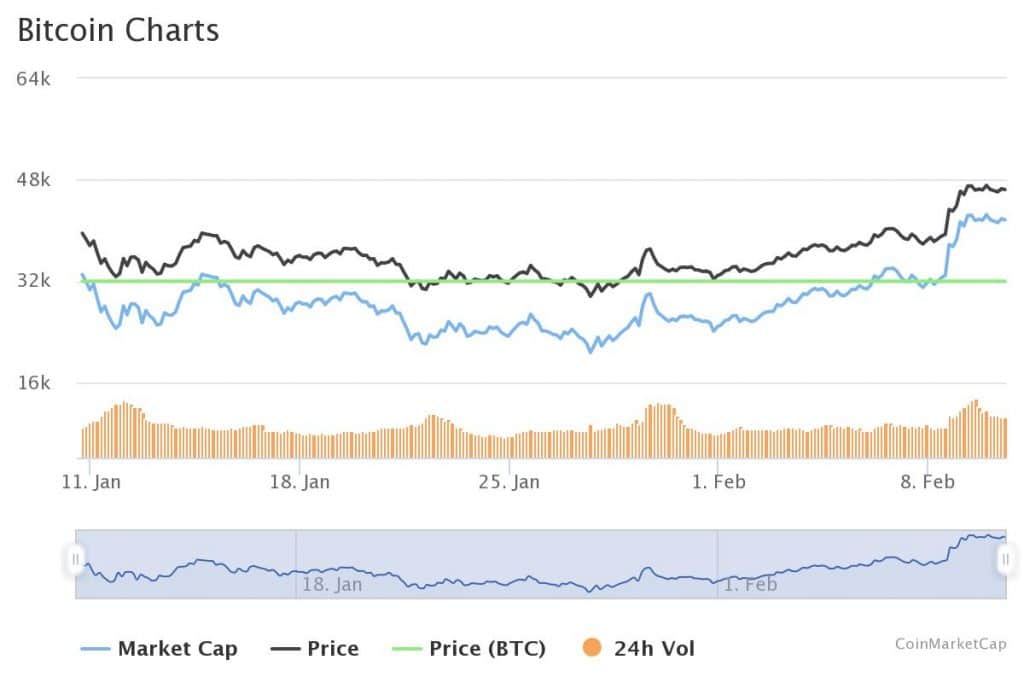
The firm was not the first large-scale corporation to make a major Bitcoin purchase, after all, Microstrategy, Stone Ridge, Square and a number of other companies have publicly announced multi-million or even multi-billion dollar BTC purchases over the last several months. However, a number of analysts believe that Tesla’s move represents a sort of ‘tipping point’ for Bitcoin, and perhaps for the cryptocurrency industry at large.
Indeed, Paolo Ardoino, Chief Technical Officer of crypto exchange, Bitfinex, told Finance Magnates that: “Tesla’s announcement may be bringing cryptocurrency to a new level.”
“There may not be any going back,” he said. “I expect bitcoin to be added to the balance sheet of many corporations as its quality as a form of digital gold becomes only more relevant.”
In five years (or less) EVERY Fortune 500 company has #Bitcoin on its balance sheet, EVERY major central bank has bitcoin on its balance sheet, and EVERY investor factors bitcoin into portfolio construction.
Simon Peters, cryptoasset analyst at multi-asset investment platform, eToro, also told Finance Magnates that: “already there is talk of copycat moves from Apple and Google,” who may buy Bitcoin and “[link] it to their own payment systems.”
And indeed, if there is 'no going back', then the price of Bitcoin is poised for even bigger gains: “all the stars may be aligning for bitcoin as mainstream adoption happens in real-time.”
Simon Peters, analyst at eToro.
As such, the spotlight is once again on BTC: investors are once again wondering if now is the right time to buy Bitcoin in hopes of further gains. However, Bitcoin is bigger than it has ever been: is now the right time to buy Bitcoin? Is it too late? Or are we still early in the game?
"Never Trade with Resources You Are Not Prepared to Lose Entirely.”
Bitfinex’s Paolo Ardoino believes that whenever one is considering an investment in Bitcoin or any other cryptocurrency, it is important to be sure that fear is not a motivating factor, specifically, fear of missing out, or 'FOMO'.
Bitfinex CTO, Paolo Ardoino
“Rather than succumb to FOMO, those new to the space should take the time to educate themselves about this amazing technology rather than seeking to speculate on it,” Ardoino told Finance Magnates. “Always do your own research and never trade with resources you are not prepared to lose entirely.”
However, it can be difficult for newer traders to reign in their emotional responses to rapid developments: “meanwhile, attention is turning towards who will be next to jump on the bitcoin train as the space evolves at a breakneck pace,” Ardoino said.
Still, it is incredibly important to remember that what goes up must come down: while it may be tempting to buy Bitcoin while the numbers are flashing green, many analysts anticipate a correction before further gains are possible.
Market analyst Rekt Capital wrote on Twitter on February 9th that: “in 2017, [the] average retrace time #BTC was 16 days,” and the “average correction depth was 35%.”
And things have not changed much, the “most recent #Bitcoin correction from a few weeks ago was 19 days long & -31% deep,” Rekt Capital explained, adding that this was a “totally normal correction,” and that there will be “more like this one” to come “later in this cycle.”
In other words, it may be wise to wait for a correction before jumping head-first into Bitcoin. If Bitcoin’s typical correction cycle shaves roughly 30-45% off of its price, Bitcoin could go as low as ~$31,500 within the next several weeks.
But, then again, you never really know when moments of change will strike: while Elon Musk had been jokingly hinting at an interest in cryptocurrency over the last several months, there was no major indication that Tesla would be adding Bitcoin to its balance sheet in February, let alone at all. And, if other companies invest in Bitcoin, the timeline will probably be somewhat similar, which is to say, the public will not know when it is about to happen.
“Remember when JP Morgan said #Bitcoin wouldn’t hit 40k again this cycle? Yea. That was like two weeks ago,” wrote Jon, the Chief Product Officer of cryptocurrency exchange, Shapeshift. “Remember that the next time we see a silly prognostication like that after the next correction.”
Remember when JP Morgan said #Bitcoin wouldn’t hit 40k again this cycle?
Yea. That was like 2 weeks ago.
Remember that the next time we see a silly prognostication like that after the next correction.
Crypto Markets Are Still Very Much at the Mercy of the Unexpected
However, it can be argued that JPMorgan’s prediction may have come true without the influx of capital into Bitcoin from the Tesla media cycle.
Indeed, for better or for worse, the Bitcoin market is still very much at the mercy of the unexpected, and, depending on who you talk to, this can either be the most compelling reason to buy crypto or to stay as far away from it as you possibly can.
The latter view seems to have been espoused in an opinion piece for the Financial Times entitled: 'Elon Musk’s effect on crypto world shows how irrational markets are', in which analyst, Katie Martin wrote that: “just as markets can remain irrational longer than you can remain solvent, amateur investors are demonstrating that their wild speculation can be wilder, and potentially longer lasting, than anything we have seen before.”
In other words, the “memeification” of crypto is a real thing, and it can have outsized effects on cryptocurrency markets. (After all, before Tesla made a $1.5 billion investment into Bitcoin, Elon Musk spent weeks sharing memes about DogeCoin and writing things like “Bitcoin is my safeword.”)
However, on the other hand, a number of crypto industry supporters have argued that the kinds of antics that happen on a fairly regular basis in the cryptocurrency world have been happening for years in the traditional investing world, only, behind the scenes, and within a relatively small group of fairly elite investors.
This was the same sentiment that kicked of the r/WallStreetBets movement that is still pouring money into GameStop (NYSE:GME) and other 'meme stocks': if elite traders can make big bets, so can everyone else.
I’m glad that Tesla’s volatility is finally hedged with the stability of Bitcoin
But, while Elon Musk may have joked about DogeCoin, Tesla’s move into Bitcoin is no joke: many analysts agree that this will open the doors for a flow of corporate capital into BTC. Also, Tesla may have already made $300 million to $500 million off of the $1.5 billion that it poured into Bitcoin earlier this month. (That, my friends, is also no joke.)
TSLA is up between $300MM and $500MM on its bitcoin holdings
Perhaps ironically, Tesla’s $300-500 million haul is likely primarily because of the fact that the investment was made public.
Bitcoin is still riding high on the Tesla news cycle. The BTC Fear and Greed Index, which is a measurement of whether traders are more likely to sell (fear) or buy (greed), is reading at 'extreme greed'. This is an indication that hodlers and hodlers in anticipation of even higher prices in the short-term while the cycle continues over the coming days.
Rekt Capital believes that the current bull cycle could continue for some time, “in 2017, #BTC spent 73% of the entire year in uptrends. [The] average uptrend was ~50 days, [the] longest uptrend was 78 days, [and the] shortest just over a month long.”
“Now that the recent #Bitcoin correction is over, this new uptrend could keep going for at least a month,” Rekt explained.
In 2017, #BTC spent 73% of the entire year in uptrends
Average uptrend was ~50 days
Longest uptrend was 78 days
Shortest just over a month long
Now that the recent #Bitcoin correction is over...
"It's Likely the Price Will Hit $50,000 by the End of the Week."
Therefore, $50K may be in the cards sooner than later, and, as such, perhaps this is some kind of a “tipping point.”
And indeed, while Bitcoin may have seemed like a far-fetched addition to any serious corporation’s balance sheet several years ago, times have changed. COVID-19 has wrought major changes on global society, including the creation of trillions more dollars, euros, pounds, and other fiat currencies, as such, a growing number of retail and institutional investors alike are beginning to see BTC as a hedge against inflation.
Simon Peters told Finance Magnates that: “we believe other companies will also look to hold some bitcoin as both a diversifier, and as an insurance policy against the devaluation of other currencies.”
“This has far-reaching implications for companies,” Peters explained. “If corporates the size of Tesla, valued at nearly $1 trillion, believe bitcoin can be used in this way, and are willing to back its views with action, then others will undoubtedly start to consider it. Tesla has diversified its own business by investing in bitcoin on a grand scale.”
In addition to the changes in global monetary policy, COVID has caused a grand re-wiring in terms of how much time the world spends online: “the world is moving online more and more,” Peters said, adding that “bitcoin sits at the heart of online transactions.”
“With this kind of endorsement from a multi-billion dollar company, it's likely the price will hit $50,000 by the end of the week.”
The firm was not the first large-scale corporation to make a major Bitcoin purchase, after all, Microstrategy, Stone Ridge, Square and a number of other companies have publicly announced multi-million or even multi-billion dollar BTC purchases over the last several months. However, a number of analysts believe that Tesla’s move represents a sort of ‘tipping point’ for Bitcoin, and perhaps for the cryptocurrency industry at large.
Indeed, Paolo Ardoino, Chief Technical Officer of crypto exchange, Bitfinex, told Finance Magnates that: “Tesla’s announcement may be bringing cryptocurrency to a new level.”
“There may not be any going back,” he said. “I expect bitcoin to be added to the balance sheet of many corporations as its quality as a form of digital gold becomes only more relevant.”
In five years (or less) EVERY Fortune 500 company has #Bitcoin on its balance sheet, EVERY major central bank has bitcoin on its balance sheet, and EVERY investor factors bitcoin into portfolio construction.
Simon Peters, cryptoasset analyst at multi-asset investment platform, eToro, also told Finance Magnates that: “already there is talk of copycat moves from Apple and Google,” who may buy Bitcoin and “[link] it to their own payment systems.”
And indeed, if there is 'no going back', then the price of Bitcoin is poised for even bigger gains: “all the stars may be aligning for bitcoin as mainstream adoption happens in real-time.”
Simon Peters, analyst at eToro.
As such, the spotlight is once again on BTC: investors are once again wondering if now is the right time to buy Bitcoin in hopes of further gains. However, Bitcoin is bigger than it has ever been: is now the right time to buy Bitcoin? Is it too late? Or are we still early in the game?
"Never Trade with Resources You Are Not Prepared to Lose Entirely.”
Bitfinex’s Paolo Ardoino believes that whenever one is considering an investment in Bitcoin or any other cryptocurrency, it is important to be sure that fear is not a motivating factor, specifically, fear of missing out, or 'FOMO'.
Bitfinex CTO, Paolo Ardoino
“Rather than succumb to FOMO, those new to the space should take the time to educate themselves about this amazing technology rather than seeking to speculate on it,” Ardoino told Finance Magnates. “Always do your own research and never trade with resources you are not prepared to lose entirely.”
However, it can be difficult for newer traders to reign in their emotional responses to rapid developments: “meanwhile, attention is turning towards who will be next to jump on the bitcoin train as the space evolves at a breakneck pace,” Ardoino said.
Still, it is incredibly important to remember that what goes up must come down: while it may be tempting to buy Bitcoin while the numbers are flashing green, many analysts anticipate a correction before further gains are possible.
Market analyst Rekt Capital wrote on Twitter on February 9th that: “in 2017, [the] average retrace time #BTC was 16 days,” and the “average correction depth was 35%.”
And things have not changed much, the “most recent #Bitcoin correction from a few weeks ago was 19 days long & -31% deep,” Rekt Capital explained, adding that this was a “totally normal correction,” and that there will be “more like this one” to come “later in this cycle.”
In other words, it may be wise to wait for a correction before jumping head-first into Bitcoin. If Bitcoin’s typical correction cycle shaves roughly 30-45% off of its price, Bitcoin could go as low as ~$31,500 within the next several weeks.
But, then again, you never really know when moments of change will strike: while Elon Musk had been jokingly hinting at an interest in cryptocurrency over the last several months, there was no major indication that Tesla would be adding Bitcoin to its balance sheet in February, let alone at all. And, if other companies invest in Bitcoin, the timeline will probably be somewhat similar, which is to say, the public will not know when it is about to happen.
“Remember when JP Morgan said #Bitcoin wouldn’t hit 40k again this cycle? Yea. That was like two weeks ago,” wrote Jon, the Chief Product Officer of cryptocurrency exchange, Shapeshift. “Remember that the next time we see a silly prognostication like that after the next correction.”
Remember when JP Morgan said #Bitcoin wouldn’t hit 40k again this cycle?
Yea. That was like 2 weeks ago.
Remember that the next time we see a silly prognostication like that after the next correction.
Crypto Markets Are Still Very Much at the Mercy of the Unexpected
However, it can be argued that JPMorgan’s prediction may have come true without the influx of capital into Bitcoin from the Tesla media cycle.
Indeed, for better or for worse, the Bitcoin market is still very much at the mercy of the unexpected, and, depending on who you talk to, this can either be the most compelling reason to buy crypto or to stay as far away from it as you possibly can.
The latter view seems to have been espoused in an opinion piece for the Financial Times entitled: 'Elon Musk’s effect on crypto world shows how irrational markets are', in which analyst, Katie Martin wrote that: “just as markets can remain irrational longer than you can remain solvent, amateur investors are demonstrating that their wild speculation can be wilder, and potentially longer lasting, than anything we have seen before.”
In other words, the “memeification” of crypto is a real thing, and it can have outsized effects on cryptocurrency markets. (After all, before Tesla made a $1.5 billion investment into Bitcoin, Elon Musk spent weeks sharing memes about DogeCoin and writing things like “Bitcoin is my safeword.”)
However, on the other hand, a number of crypto industry supporters have argued that the kinds of antics that happen on a fairly regular basis in the cryptocurrency world have been happening for years in the traditional investing world, only, behind the scenes, and within a relatively small group of fairly elite investors.
This was the same sentiment that kicked of the r/WallStreetBets movement that is still pouring money into GameStop (NYSE:GME) and other 'meme stocks': if elite traders can make big bets, so can everyone else.
I’m glad that Tesla’s volatility is finally hedged with the stability of Bitcoin
But, while Elon Musk may have joked about DogeCoin, Tesla’s move into Bitcoin is no joke: many analysts agree that this will open the doors for a flow of corporate capital into BTC. Also, Tesla may have already made $300 million to $500 million off of the $1.5 billion that it poured into Bitcoin earlier this month. (That, my friends, is also no joke.)
TSLA is up between $300MM and $500MM on its bitcoin holdings
Perhaps ironically, Tesla’s $300-500 million haul is likely primarily because of the fact that the investment was made public.
Bitcoin is still riding high on the Tesla news cycle. The BTC Fear and Greed Index, which is a measurement of whether traders are more likely to sell (fear) or buy (greed), is reading at 'extreme greed'. This is an indication that hodlers and hodlers in anticipation of even higher prices in the short-term while the cycle continues over the coming days.
Rekt Capital believes that the current bull cycle could continue for some time, “in 2017, #BTC spent 73% of the entire year in uptrends. [The] average uptrend was ~50 days, [the] longest uptrend was 78 days, [and the] shortest just over a month long.”
“Now that the recent #Bitcoin correction is over, this new uptrend could keep going for at least a month,” Rekt explained.
In 2017, #BTC spent 73% of the entire year in uptrends
Average uptrend was ~50 days
Longest uptrend was 78 days
Shortest just over a month long
Now that the recent #Bitcoin correction is over...
"It's Likely the Price Will Hit $50,000 by the End of the Week."
Therefore, $50K may be in the cards sooner than later, and, as such, perhaps this is some kind of a “tipping point.”
And indeed, while Bitcoin may have seemed like a far-fetched addition to any serious corporation’s balance sheet several years ago, times have changed. COVID-19 has wrought major changes on global society, including the creation of trillions more dollars, euros, pounds, and other fiat currencies, as such, a growing number of retail and institutional investors alike are beginning to see BTC as a hedge against inflation.
Simon Peters told Finance Magnates that: “we believe other companies will also look to hold some bitcoin as both a diversifier, and as an insurance policy against the devaluation of other currencies.”
“This has far-reaching implications for companies,” Peters explained. “If corporates the size of Tesla, valued at nearly $1 trillion, believe bitcoin can be used in this way, and are willing to back its views with action, then others will undoubtedly start to consider it. Tesla has diversified its own business by investing in bitcoin on a grand scale.”
In addition to the changes in global monetary policy, COVID has caused a grand re-wiring in terms of how much time the world spends online: “the world is moving online more and more,” Peters said, adding that “bitcoin sits at the heart of online transactions.”
“With this kind of endorsement from a multi-billion dollar company, it's likely the price will hit $50,000 by the end of the week.”
Rachel is a self-taught crypto geek and a passionate writer. She believes in the power that the written word has to educate, connect and empower individuals to make positive and powerful financial choices. She is the Podcast Host and a Cryptocurrency Editor at Finance Magnates.
Binance Launches Retail AI Assistant, Repackages Existing Trading Tools
Featured Videos
AvaTrade to Acquire Most of FXCM; NAGA Raises $8M
AvaTrade to Acquire Most of FXCM; NAGA Raises $8M
AvaTrade to Acquire Most of FXCM; NAGA Raises $8M
AvaTrade to Acquire Most of FXCM; NAGA Raises $8M
Today’s financial news recap covers AvaTrade agrees to acquire most of FXCM, NAGA secures eight million dollars in new financing, and Wise seeks a tax settlement in the UK.
Finance Magnates Daily Recap brings you the latest news from forex and CFD brokers, fintech, payments, cryptocurrency, digital assets, trading platforms, financial regulation and global markets.
Get the key company news, executive moves, deals, regulatory updates and market developments of the day, in just a few minutes. New episodes published every weekday.
Read more: https://www.financemagnates.com
#FinanceMagnates #ForexNews #FintechNews
Today’s financial news recap covers AvaTrade agrees to acquire most of FXCM, NAGA secures eight million dollars in new financing, and Wise seeks a tax settlement in the UK.
Finance Magnates Daily Recap brings you the latest news from forex and CFD brokers, fintech, payments, cryptocurrency, digital assets, trading platforms, financial regulation and global markets.
Get the key company news, executive moves, deals, regulatory updates and market developments of the day, in just a few minutes. New episodes published every weekday.
Read more: https://www.financemagnates.com
#FinanceMagnates #ForexNews #FintechNews
Today’s financial news recap covers AvaTrade agrees to acquire most of FXCM, NAGA secures eight million dollars in new financing, and Wise seeks a tax settlement in the UK.
Finance Magnates Daily Recap brings you the latest news from forex and CFD brokers, fintech, payments, cryptocurrency, digital assets, trading platforms, financial regulation and global markets.
Get the key company news, executive moves, deals, regulatory updates and market developments of the day, in just a few minutes. New episodes published every weekday.
Read more: https://www.financemagnates.com
#FinanceMagnates #ForexNews #FintechNews
Today’s financial news recap covers AvaTrade agrees to acquire most of FXCM, NAGA secures eight million dollars in new financing, and Wise seeks a tax settlement in the UK.
Finance Magnates Daily Recap brings you the latest news from forex and CFD brokers, fintech, payments, cryptocurrency, digital assets, trading platforms, financial regulation and global markets.
Get the key company news, executive moves, deals, regulatory updates and market developments of the day, in just a few minutes. New episodes published every weekday.
Read more: https://www.financemagnates.com
#FinanceMagnates #ForexNews #FintechNews
XTB Adds Overnight US Stock Trading; Nasdaq Ventures Invests in One Trading
XTB Adds Overnight US Stock Trading; Nasdaq Ventures Invests in One Trading
XTB Adds Overnight US Stock Trading; Nasdaq Ventures Invests in One Trading
XTB Adds Overnight US Stock Trading; Nasdaq Ventures Invests in One Trading
XTB Adds Overnight US Stock Trading; Nasdaq Ventures Invests in One Trading
XTB Adds Overnight US Stock Trading; Nasdaq Ventures Invests in One Trading
Today’s financial news recap covers XTB expands overnight US stock trading, Fortrade reports higher revenue, Nasdaq backs One Trading, and Vest Labs raises 13 million dollars.
Finance Magnates Daily Recap brings you the latest news from forex and CFD brokers, fintech, payments, cryptocurrency, digital assets, trading platforms, financial regulation and global markets.
Get the key company news, executive moves, deals, regulatory updates and market developments of the day, in just a few minutes. New episodes published every weekday.
Read more: https://www.financemagnates.com
#FinanceMagnates #ForexNews #FintechNews
Today’s financial news recap covers XTB expands overnight US stock trading, Fortrade reports higher revenue, Nasdaq backs One Trading, and Vest Labs raises 13 million dollars.
Finance Magnates Daily Recap brings you the latest news from forex and CFD brokers, fintech, payments, cryptocurrency, digital assets, trading platforms, financial regulation and global markets.
Get the key company news, executive moves, deals, regulatory updates and market developments of the day, in just a few minutes. New episodes published every weekday.
Read more: https://www.financemagnates.com
#FinanceMagnates #ForexNews #FintechNews
Today’s financial news recap covers XTB expands overnight US stock trading, Fortrade reports higher revenue, Nasdaq backs One Trading, and Vest Labs raises 13 million dollars.
Finance Magnates Daily Recap brings you the latest news from forex and CFD brokers, fintech, payments, cryptocurrency, digital assets, trading platforms, financial regulation and global markets.
Get the key company news, executive moves, deals, regulatory updates and market developments of the day, in just a few minutes. New episodes published every weekday.
Read more: https://www.financemagnates.com
#FinanceMagnates #ForexNews #FintechNews
Today’s financial news recap covers XTB expands overnight US stock trading, Fortrade reports higher revenue, Nasdaq backs One Trading, and Vest Labs raises 13 million dollars.
Finance Magnates Daily Recap brings you the latest news from forex and CFD brokers, fintech, payments, cryptocurrency, digital assets, trading platforms, financial regulation and global markets.
Get the key company news, executive moves, deals, regulatory updates and market developments of the day, in just a few minutes. New episodes published every weekday.
Read more: https://www.financemagnates.com
#FinanceMagnates #ForexNews #FintechNews
Today’s financial news recap covers XTB expands overnight US stock trading, Fortrade reports higher revenue, Nasdaq backs One Trading, and Vest Labs raises 13 million dollars.
Finance Magnates Daily Recap brings you the latest news from forex and CFD brokers, fintech, payments, cryptocurrency, digital assets, trading platforms, financial regulation and global markets.
Get the key company news, executive moves, deals, regulatory updates and market developments of the day, in just a few minutes. New episodes published every weekday.
Read more: https://www.financemagnates.com
#FinanceMagnates #ForexNews #FintechNews
Today’s financial news recap covers XTB expands overnight US stock trading, Fortrade reports higher revenue, Nasdaq backs One Trading, and Vest Labs raises 13 million dollars.
Finance Magnates Daily Recap brings you the latest news from forex and CFD brokers, fintech, payments, cryptocurrency, digital assets, trading platforms, financial regulation and global markets.
Get the key company news, executive moves, deals, regulatory updates and market developments of the day, in just a few minutes. New episodes published every weekday.
Read more: https://www.financemagnates.com
#FinanceMagnates #ForexNews #FintechNews
CMC Founder Downplays Volatility Hit; Devexperts Names CEO
CMC Founder Downplays Volatility Hit; Devexperts Names CEO
CMC Founder Downplays Volatility Hit; Devexperts Names CEO
CMC Founder Downplays Volatility Hit; Devexperts Names CEO
CMC Founder Downplays Volatility Hit; Devexperts Names CEO
CMC Founder Downplays Volatility Hit; Devexperts Names CEO
Today’s financial news recap covers low volatility pressures brokers, Devexperts names a new CEO, Saxo cuts onboarding time, and OKX reaches a 25 billion dollar valuation.
Finance Magnates Daily Recap brings you the latest news from forex and CFD brokers, fintech, payments, cryptocurrency, digital assets, trading platforms, financial regulation and global markets.
Get the key company news, executive moves, deals, regulatory updates and market developments of the day, in just a few minutes. New episodes published every weekday.
Read more: https://www.financemagnates.com
#FinanceMagnates #ForexNews #FintechNews
Today’s financial news recap covers low volatility pressures brokers, Devexperts names a new CEO, Saxo cuts onboarding time, and OKX reaches a 25 billion dollar valuation.
Finance Magnates Daily Recap brings you the latest news from forex and CFD brokers, fintech, payments, cryptocurrency, digital assets, trading platforms, financial regulation and global markets.
Get the key company news, executive moves, deals, regulatory updates and market developments of the day, in just a few minutes. New episodes published every weekday.
Read more: https://www.financemagnates.com
#FinanceMagnates #ForexNews #FintechNews
Today’s financial news recap covers low volatility pressures brokers, Devexperts names a new CEO, Saxo cuts onboarding time, and OKX reaches a 25 billion dollar valuation.
Finance Magnates Daily Recap brings you the latest news from forex and CFD brokers, fintech, payments, cryptocurrency, digital assets, trading platforms, financial regulation and global markets.
Get the key company news, executive moves, deals, regulatory updates and market developments of the day, in just a few minutes. New episodes published every weekday.
Read more: https://www.financemagnates.com
#FinanceMagnates #ForexNews #FintechNews
Today’s financial news recap covers low volatility pressures brokers, Devexperts names a new CEO, Saxo cuts onboarding time, and OKX reaches a 25 billion dollar valuation.
Finance Magnates Daily Recap brings you the latest news from forex and CFD brokers, fintech, payments, cryptocurrency, digital assets, trading platforms, financial regulation and global markets.
Get the key company news, executive moves, deals, regulatory updates and market developments of the day, in just a few minutes. New episodes published every weekday.
Read more: https://www.financemagnates.com
#FinanceMagnates #ForexNews #FintechNews
Today’s financial news recap covers low volatility pressures brokers, Devexperts names a new CEO, Saxo cuts onboarding time, and OKX reaches a 25 billion dollar valuation.
Finance Magnates Daily Recap brings you the latest news from forex and CFD brokers, fintech, payments, cryptocurrency, digital assets, trading platforms, financial regulation and global markets.
Get the key company news, executive moves, deals, regulatory updates and market developments of the day, in just a few minutes. New episodes published every weekday.
Read more: https://www.financemagnates.com
#FinanceMagnates #ForexNews #FintechNews
Today’s financial news recap covers low volatility pressures brokers, Devexperts names a new CEO, Saxo cuts onboarding time, and OKX reaches a 25 billion dollar valuation.
Finance Magnates Daily Recap brings you the latest news from forex and CFD brokers, fintech, payments, cryptocurrency, digital assets, trading platforms, financial regulation and global markets.
Get the key company news, executive moves, deals, regulatory updates and market developments of the day, in just a few minutes. New episodes published every weekday.
Read more: https://www.financemagnates.com
#FinanceMagnates #ForexNews #FintechNews
Today’s financial news recap covers Trade Nation buys FXCM's UK client book, Trading 212 reports higher revenue, the CFTC's move to allow perpetual index futures.
Finance Magnates Daily Recap brings you the latest news from forex and CFD brokers, fintech, payments, cryptocurrency, digital assets, trading platforms, financial regulation and global markets.
Get the key company news, executive moves, deals, regulatory updates and market developments of the day, in just a few minutes. New episodes published every weekday.
Read more: https://www.financemagnates.com
#FinanceMagnates #ForexNews #FintechNews
Today’s financial news recap covers Trade Nation buys FXCM's UK client book, Trading 212 reports higher revenue, the CFTC's move to allow perpetual index futures.
Finance Magnates Daily Recap brings you the latest news from forex and CFD brokers, fintech, payments, cryptocurrency, digital assets, trading platforms, financial regulation and global markets.
Get the key company news, executive moves, deals, regulatory updates and market developments of the day, in just a few minutes. New episodes published every weekday.
Read more: https://www.financemagnates.com
#FinanceMagnates #ForexNews #FintechNews
Today’s financial news recap covers Trade Nation buys FXCM's UK client book, Trading 212 reports higher revenue, the CFTC's move to allow perpetual index futures.
Finance Magnates Daily Recap brings you the latest news from forex and CFD brokers, fintech, payments, cryptocurrency, digital assets, trading platforms, financial regulation and global markets.
Get the key company news, executive moves, deals, regulatory updates and market developments of the day, in just a few minutes. New episodes published every weekday.
Read more: https://www.financemagnates.com
#FinanceMagnates #ForexNews #FintechNews
Today’s financial news recap covers Trade Nation buys FXCM's UK client book, Trading 212 reports higher revenue, the CFTC's move to allow perpetual index futures.
Finance Magnates Daily Recap brings you the latest news from forex and CFD brokers, fintech, payments, cryptocurrency, digital assets, trading platforms, financial regulation and global markets.
Get the key company news, executive moves, deals, regulatory updates and market developments of the day, in just a few minutes. New episodes published every weekday.
Read more: https://www.financemagnates.com
#FinanceMagnates #ForexNews #FintechNews
Today’s financial news recap covers Trade Nation buys FXCM's UK client book, Trading 212 reports higher revenue, the CFTC's move to allow perpetual index futures.
Finance Magnates Daily Recap brings you the latest news from forex and CFD brokers, fintech, payments, cryptocurrency, digital assets, trading platforms, financial regulation and global markets.
Get the key company news, executive moves, deals, regulatory updates and market developments of the day, in just a few minutes. New episodes published every weekday.
Read more: https://www.financemagnates.com
#FinanceMagnates #ForexNews #FintechNews
Today’s financial news recap covers Trade Nation buys FXCM's UK client book, Trading 212 reports higher revenue, the CFTC's move to allow perpetual index futures.
Finance Magnates Daily Recap brings you the latest news from forex and CFD brokers, fintech, payments, cryptocurrency, digital assets, trading platforms, financial regulation and global markets.
Get the key company news, executive moves, deals, regulatory updates and market developments of the day, in just a few minutes. New episodes published every weekday.
Read more: https://www.financemagnates.com
#FinanceMagnates #ForexNews #FintechNews
Your career isn’t a linear path.
Your career isn’t a linear path.
Your career isn’t a linear path.
Your career isn’t a linear path.
Your career isn’t a linear path.
Your career isn’t a linear path.
Roles change. Career goals change. Sometimes you want a completely new challenge.
But the skills and knowledge you build along the way can stay with you and give you something to build on.
For Jeff Patterson, that continued growth is key to long-term career development.
You bring the skills. FM Academy helps you build the knowledge.
#FMAcademy #FinanceMagnates #FinanceCareers #ProfessionalDevelopment #Fintech
Roles change. Career goals change. Sometimes you want a completely new challenge.
But the skills and knowledge you build along the way can stay with you and give you something to build on.
For Jeff Patterson, that continued growth is key to long-term career development.
You bring the skills. FM Academy helps you build the knowledge.
#FMAcademy #FinanceMagnates #FinanceCareers #ProfessionalDevelopment #Fintech
Roles change. Career goals change. Sometimes you want a completely new challenge.
But the skills and knowledge you build along the way can stay with you and give you something to build on.
For Jeff Patterson, that continued growth is key to long-term career development.
You bring the skills. FM Academy helps you build the knowledge.
#FMAcademy #FinanceMagnates #FinanceCareers #ProfessionalDevelopment #Fintech
Roles change. Career goals change. Sometimes you want a completely new challenge.
But the skills and knowledge you build along the way can stay with you and give you something to build on.
For Jeff Patterson, that continued growth is key to long-term career development.
You bring the skills. FM Academy helps you build the knowledge.
#FMAcademy #FinanceMagnates #FinanceCareers #ProfessionalDevelopment #Fintech
Roles change. Career goals change. Sometimes you want a completely new challenge.
But the skills and knowledge you build along the way can stay with you and give you something to build on.
For Jeff Patterson, that continued growth is key to long-term career development.
You bring the skills. FM Academy helps you build the knowledge.
#FMAcademy #FinanceMagnates #FinanceCareers #ProfessionalDevelopment #Fintech
Roles change. Career goals change. Sometimes you want a completely new challenge.
But the skills and knowledge you build along the way can stay with you and give you something to build on.
For Jeff Patterson, that continued growth is key to long-term career development.
You bring the skills. FM Academy helps you build the knowledge.
#FMAcademy #FinanceMagnates #FinanceCareers #ProfessionalDevelopment #Fintech