The outbreak of the coronavirus has caused serious decline in the global economy for the past two weeks.
Boston skyline - the Federal Reserve building is on the left
In an emergency announcement made on Sunday afternoon, the United States Federal Reserve has declared that it will be cutting interest rates to zero for the first time since the 2008 financial crisis. The move effectively cuts interest rates by 100 basis points following the Fed’s sudden decision to cut rates by 50 basis points less than two weeks ago. However, the Fed is not considering negative interest rates.
The central bank will also begin quantitative easing by buying at least $700 billion in assets, with plans to make $500 billion in Treasury purchases and at least $200 billion in agency mortgage-backed securities purchases “over [the] coming months.” The purchases have no weekly or monthly cap.
“The desk is going to go out and buy at a strong rate that we think will restore market function, Liquidity , as quickly as it can be restored. That language is open-ended,” said Federal Reserve Chairman Jerome Powell.
The move appears to have had little effect on the economic cliff dive that markets have been making over the past several weeks. Following the announcement on Sunday afternoon, CNN reported that US stock futures fell another 5%, eventually hitting the “limit down,” meaning that they cannot fall any further.
At the same time, both the Dow (INDU) and Nasdaq (COMP) futures plunged 1,041 points (roughly 4.5%), while the S&P500 futures fell (4.8%). All three indexes fell into a bear market last week after shedding more than 20% from their recent peaks.
Australian shares also plunged 7% as the full trading week began in Asia Pacific on Monday morning.
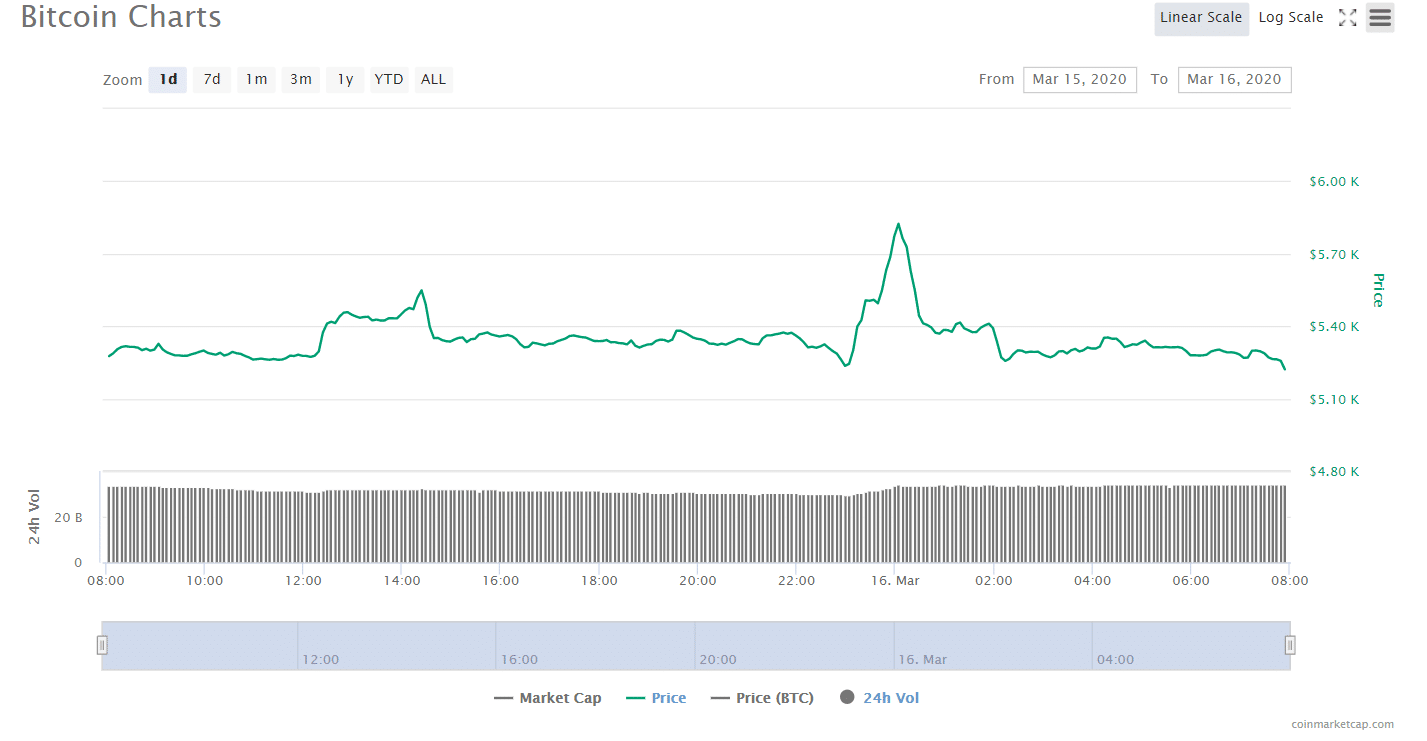
The price of Bitcoin briefly spiked roughly 10% following the announcement before continuing to trade sideways around $5,200.
The cuts will "matter a lot more when the economy begins to recover."
According to Chairman Powell, the Fed will keep rates at the new level “until it is confident that the economy has weathered recent events and is on track” to achieving strong employment and stable prices.
The Fed’s decisions are part of an effort to use its “full range of tools” to combat the impact of the coronavirus on the economy.
Chairman Powell stated several times during a press conference on Sunday night that the Fed’s actions are intended to encourage banks to support businesses as quarantines around the country continue to fuel concerns that layoffs and temporary shutdowns may be imminent.
"[Lowering rats to zero] will matter to borrowers who will get some relief from our cuts, but they’ll matter a lot more when the economy begins to recover,” Chairman Powell said.
“The actions we have announced today will help American families and businesses, and indeed, our entire economy weather this difficult period and will foster a more vigorous return to normal once the disruptions from the coronavirus abate."
Chairman Powell also said that although the United States’ economy appeared to be on “strong footing” before the outbreak of the coronavirus, the impact on travel, leisure, and hospitality sectors are likely an indication that economic growth in “the second quarter is probably going to be weak.”
Powell also said that while he expected a “significant economic effect” from the virus in the short-term, the virus’s long term effects on the economy are “unknowable.”
However, some analysts are concerned that the timing of the decision was off. Anthony Pompliano, a partner at Morgan Creek, wrote on Twitter that "Fed Chairman Jerome Powell was just asked if he would consider negative interest rates. He said they do not see negative interest rates as appropriate policy here in the United States. Either they won't cut again or he will have to change his mind."
United States President Donald Trump has intensely criticized Chairman Powell in relation to the time he took to make the decision to cut rates, which Trump thinks was far too long. On Saturday, Trump alleged that he had the power to remove Powell from his position among a number of other threats against the Fed’s leader.
In an emergency announcement made on Sunday afternoon, the United States Federal Reserve has declared that it will be cutting interest rates to zero for the first time since the 2008 financial crisis. The move effectively cuts interest rates by 100 basis points following the Fed’s sudden decision to cut rates by 50 basis points less than two weeks ago. However, the Fed is not considering negative interest rates.
The central bank will also begin quantitative easing by buying at least $700 billion in assets, with plans to make $500 billion in Treasury purchases and at least $200 billion in agency mortgage-backed securities purchases “over [the] coming months.” The purchases have no weekly or monthly cap.
“The desk is going to go out and buy at a strong rate that we think will restore market function, Liquidity , as quickly as it can be restored. That language is open-ended,” said Federal Reserve Chairman Jerome Powell.
The move appears to have had little effect on the economic cliff dive that markets have been making over the past several weeks. Following the announcement on Sunday afternoon, CNN reported that US stock futures fell another 5%, eventually hitting the “limit down,” meaning that they cannot fall any further.
At the same time, both the Dow (INDU) and Nasdaq (COMP) futures plunged 1,041 points (roughly 4.5%), while the S&P500 futures fell (4.8%). All three indexes fell into a bear market last week after shedding more than 20% from their recent peaks.
Australian shares also plunged 7% as the full trading week began in Asia Pacific on Monday morning.
The price of Bitcoin briefly spiked roughly 10% following the announcement before continuing to trade sideways around $5,200.
The cuts will "matter a lot more when the economy begins to recover."
According to Chairman Powell, the Fed will keep rates at the new level “until it is confident that the economy has weathered recent events and is on track” to achieving strong employment and stable prices.
The Fed’s decisions are part of an effort to use its “full range of tools” to combat the impact of the coronavirus on the economy.
Chairman Powell stated several times during a press conference on Sunday night that the Fed’s actions are intended to encourage banks to support businesses as quarantines around the country continue to fuel concerns that layoffs and temporary shutdowns may be imminent.
"[Lowering rats to zero] will matter to borrowers who will get some relief from our cuts, but they’ll matter a lot more when the economy begins to recover,” Chairman Powell said.
“The actions we have announced today will help American families and businesses, and indeed, our entire economy weather this difficult period and will foster a more vigorous return to normal once the disruptions from the coronavirus abate."
Chairman Powell also said that although the United States’ economy appeared to be on “strong footing” before the outbreak of the coronavirus, the impact on travel, leisure, and hospitality sectors are likely an indication that economic growth in “the second quarter is probably going to be weak.”
Powell also said that while he expected a “significant economic effect” from the virus in the short-term, the virus’s long term effects on the economy are “unknowable.”
However, some analysts are concerned that the timing of the decision was off. Anthony Pompliano, a partner at Morgan Creek, wrote on Twitter that "Fed Chairman Jerome Powell was just asked if he would consider negative interest rates. He said they do not see negative interest rates as appropriate policy here in the United States. Either they won't cut again or he will have to change his mind."
United States President Donald Trump has intensely criticized Chairman Powell in relation to the time he took to make the decision to cut rates, which Trump thinks was far too long. On Saturday, Trump alleged that he had the power to remove Powell from his position among a number of other threats against the Fed’s leader.
Rachel is a self-taught crypto geek and a passionate writer. She believes in the power that the written word has to educate, connect and empower individuals to make positive and powerful financial choices. She is the Podcast Host and a Cryptocurrency Editor at Finance Magnates.
Crypto Built More Rails, but the Next Battle Is Over How Much Work a Dollar Can Do
FP Markets Winner Spotlight 🏆 | Global Broker of the Year 2025 #Trading #Broker #Innovation #Shorts
FP Markets Winner Spotlight 🏆 | Global Broker of the Year 2025 #Trading #Broker #Innovation #Shorts
FP Markets takes the spotlight as Global Broker of the Year 2025 at the Finance Magnates Awards.
Martin Stoilov, Head of Client Experience, shares that trust, innovation, and people played a key role in the company’s success, supported by a strong foundation of integrity and client-centricity.
Following this milestone, FP Markets continues to focus on growth, technology investment, and its core values of transparency and excellence.
👉 Be part of FM Awards 2026: https://awards.financemagnates.com/#nominate
FP Markets takes the spotlight as Global Broker of the Year 2025 at the Finance Magnates Awards.
Martin Stoilov, Head of Client Experience, shares that trust, innovation, and people played a key role in the company’s success, supported by a strong foundation of integrity and client-centricity.
Following this milestone, FP Markets continues to focus on growth, technology investment, and its core values of transparency and excellence.
👉 Be part of FM Awards 2026: https://awards.financemagnates.com/#nominate
In this video, we review @HolaPrimeMarketsOfficial, a multi-asset forex and CFDs broker offering different account types, trading platforms, and flexible trading conditions.
We cover the broker’s overall offering, including account options, trading environment, platforms like MT4 and MT5, and additional services such as managed accounts and fast withdrawals.
Watch the full video to see if Hola Prime Markets fits your trading needs.
📣 Stay up to date with the latest in finance and trading. Follow Finance Magnates for industry news, insights, and global event coverage.
Connect with us:
🔗 LinkedIn: /financemagnates
👍 Facebook: /financemagnates
📸 Instagram: https://www.instagram.com/financemagnates
🐦 X: https://x.com/financemagnates
🎥 TikTok: https://www.tiktok.com/tag/financemagnates
▶️ YouTube: /@financemagnates_official
#HolaPrime #ForexBroker #CFDTrading #FinanceMagnates #Trading #Forex #BrokerReview
In this video, we review @HolaPrimeMarketsOfficial, a multi-asset forex and CFDs broker offering different account types, trading platforms, and flexible trading conditions.
We cover the broker’s overall offering, including account options, trading environment, platforms like MT4 and MT5, and additional services such as managed accounts and fast withdrawals.
Watch the full video to see if Hola Prime Markets fits your trading needs.
📣 Stay up to date with the latest in finance and trading. Follow Finance Magnates for industry news, insights, and global event coverage.
Connect with us:
🔗 LinkedIn: /financemagnates
👍 Facebook: /financemagnates
📸 Instagram: https://www.instagram.com/financemagnates
🐦 X: https://x.com/financemagnates
🎥 TikTok: https://www.tiktok.com/tag/financemagnates
▶️ YouTube: /@financemagnates_official
#HolaPrime #ForexBroker #CFDTrading #FinanceMagnates #Trading #Forex #BrokerReview
Hola Prime Review: What You Need to Know | Full Breakdown by Finance Magnates
Hola Prime Review: What You Need to Know | Full Breakdown by Finance Magnates
In this video, we review @HolaPrime_Global, a proprietary trading firm offering evaluation programs and performance-based payouts in simulated market environments.
We cover how the challenge model works, including account types, profit splits (up to 95%), trading rules, and what it takes to reach a funded account. You’ll also learn about available platforms like MT4, MT5, cTrader, and more, along with insights into payouts, support, and trading conditions.
Watch the full video to see if Hola Prime fits your trading style.
📣 Stay up to date with the latest in finance and trading. Follow Finance Magnates for industry news, insights, and global event coverage.
Connect with us:
🔗 LinkedIn: /financemagnates
👍 Facebook: /financemagnates
📸 Instagram: https://www.instagram.com/financemagnates
🐦 X: https://x.com/financemagnates
🎥 TikTok: https://www.tiktok.com/tag/financemagnates
▶️ YouTube: /@financemagnates_official
#HolaPrime #PropFirm #Trading #FinanceMagnates #Forex #FuturesTrading #TradingReview #PropFirmReview
In this video, we review @HolaPrime_Global, a proprietary trading firm offering evaluation programs and performance-based payouts in simulated market environments.
We cover how the challenge model works, including account types, profit splits (up to 95%), trading rules, and what it takes to reach a funded account. You’ll also learn about available platforms like MT4, MT5, cTrader, and more, along with insights into payouts, support, and trading conditions.
Watch the full video to see if Hola Prime fits your trading style.
📣 Stay up to date with the latest in finance and trading. Follow Finance Magnates for industry news, insights, and global event coverage.
Connect with us:
🔗 LinkedIn: /financemagnates
👍 Facebook: /financemagnates
📸 Instagram: https://www.instagram.com/financemagnates
🐦 X: https://x.com/financemagnates
🎥 TikTok: https://www.tiktok.com/tag/financemagnates
▶️ YouTube: /@financemagnates_official
#HolaPrime #PropFirm #Trading #FinanceMagnates #Forex #FuturesTrading #TradingReview #PropFirmReview
Axi Winner Spotlight 🏆 | Global Most Innovative Broker 2025 #Innovation #Trading #Fintech #Broker
Axi Winner Spotlight 🏆 | Global Most Innovative Broker 2025 #Innovation #Trading #Fintech #Broker
Axi takes the spotlight at the Finance Magnates Awards, winning Global Most Innovative Broker 2025.
Olivia Xenofontos and Ivanna Openko share how the team will feel: proud, motivated, and ready to keep delivering.
They also describe the night as well-organized, focused, and enjoyable for all.
👉 Be part of FM Awards 2026.
Axi takes the spotlight at the Finance Magnates Awards, winning Global Most Innovative Broker 2025.
Olivia Xenofontos and Ivanna Openko share how the team will feel: proud, motivated, and ready to keep delivering.
They also describe the night as well-organized, focused, and enjoyable for all.
👉 Be part of FM Awards 2026.
Recognition that matters.
Built on transparency.
Driven by the industry.
The Finance Magnates Awards 2026.
Nominations are now open.
🔗 https://awards.financemagnates.com/?utm_source=SM&utm_medium=social&utm_campaign=recognition-matters
Recognition that matters.
Built on transparency.
Driven by the industry.
The Finance Magnates Awards 2026.
Nominations are now open.
🔗 https://awards.financemagnates.com/?utm_source=SM&utm_medium=social&utm_campaign=recognition-matters