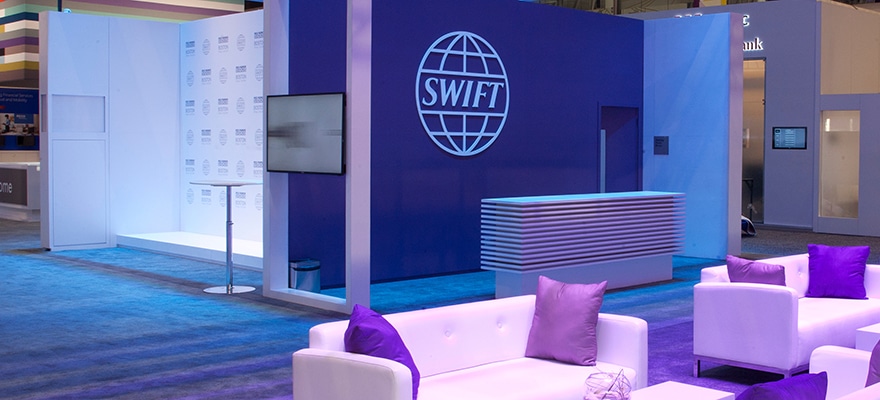
This appears to have been driven at least partially by a popular rumour on the internet - that an upcoming upgrade on the SWIFT network will make Ripple products available to around 4,000 extra banks. A SWIFT spokesperson told Finance Magnates on Tuesday that these rumours are untrue.
However, it is not so surprising. Over the last year, Ethereum has been declining in value due to competition from new smart contract platforms, and upgrades which seem to be permanently stuck in the 'coming soon' stage. Ripple, on the other hand, has been signing deals with major financial institutions left, right and centre.
The upgrade is a technical one, attaching a tracking reference to all transactions. It was announced in March 2018 and will be enacted on the 18th of November.
Finance Magnates reached out to SWIFT. A spokesperson for SWIFT (specifically, an employee of public relations company Finsbury) responded: "I’m not sure where those rumours are coming from but the upcoming standards release ... is entirely unrelated to RippleNet. Its primary purpose is to ensure all payments include a tracking reference (UETR, Unique End-to-end Transaction Reference) which will allow banks to track their gpi payments end-to-end in real time."
A source close to the matter told Finance Magnates that having checked with both parties, no evidence could be found of an integration.
What Are These Rumours Then?
This Twitter user is excited because a SWIFT board member left his job at HSBC to work with Ripple:
1. Has swift partnered with Ripple? Marcus treacher who is on swifts board leaves hsbc to work with ripple. Also swift have recently stated xborder payments can settle within seconds which is worlds apart from the 30+ mins stated on the last pic, THREAD $xrp $xrpcommunity $btcpic.twitter.com/edKGO6oxGA
One driver of the rumours is a popular Twitter user called 'SamIam', whose secondary username is '@ripple_me_this'. Like the previous Twitter user cited, Mr. Iam posts enthusiastically about XRP/Ripple several times every day. The gloating Twitter post (the one in which the word 'wave' is misspelt) seen at the beginning of this article is one of his.
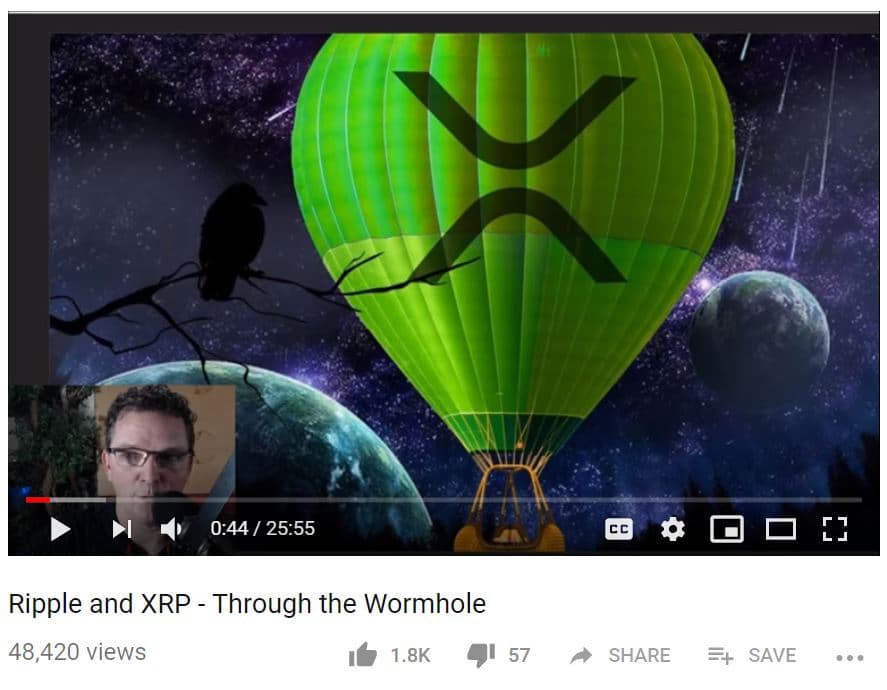
Source: youtube.com
Both of these users argue that software provider Temenos is the link between Ripple and SWIFT, being as it is a partner of both. SamIam explains (try to ignore that he does not know the difference between 'your' and 'you're'):
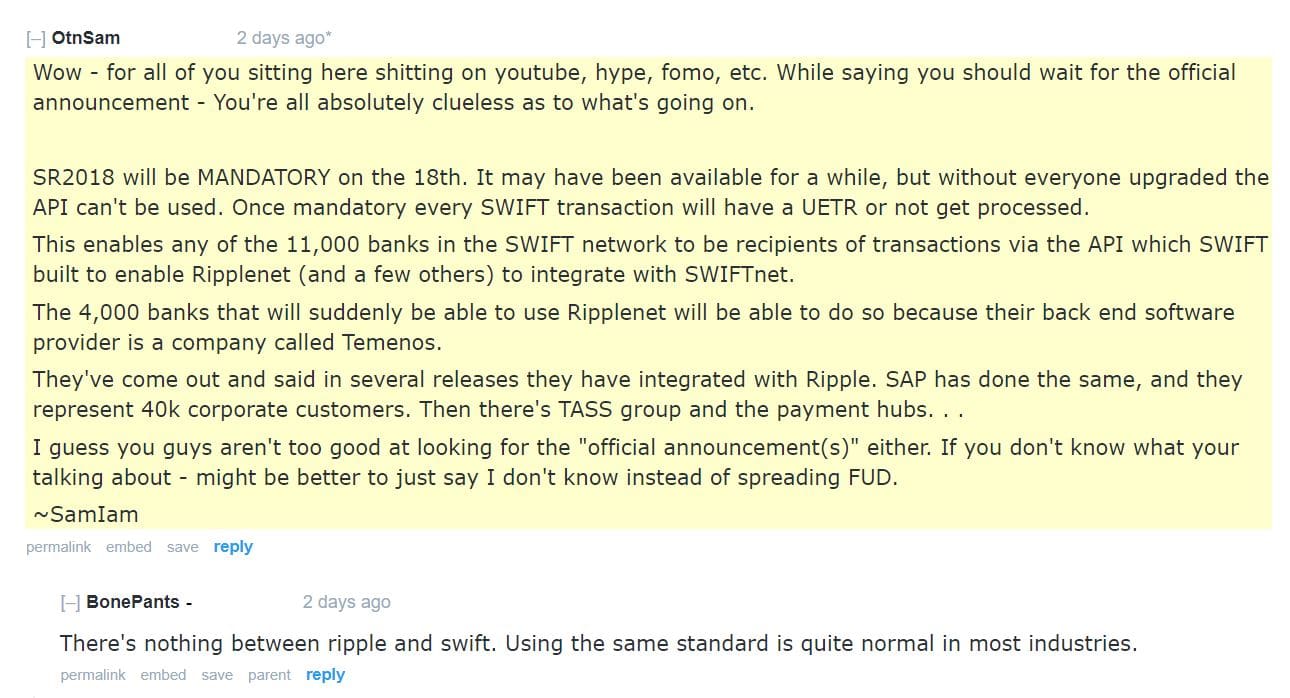
Source: Reddit
Finance Magnates has reached out to Temenos and will update this article when a reply is received.
YouTube videos also abound with the integration theory:
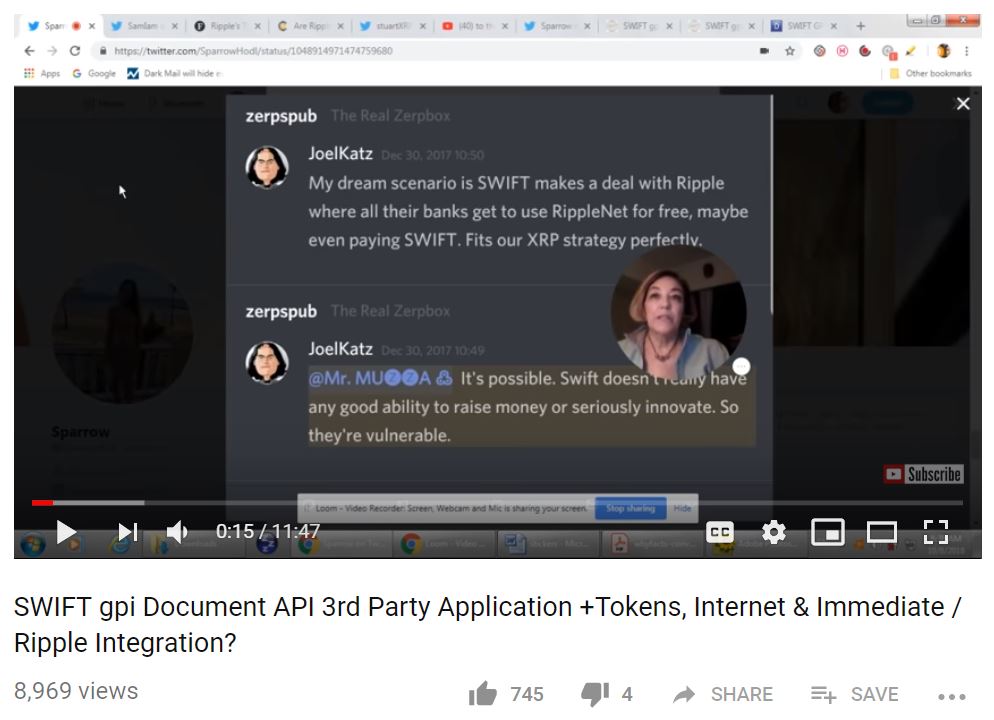
Source: youtube.com
Featured in the above image is an old Twitter post from Ripple's Chief Technical Officer, which is pointed to as evidence by the individual that posted this video.
Additionally, a cryptocurrency news outlet called Coinnounce has published several articles on this subject. It has pointed out that a SWIFT technical upgrade on the 21st of September led to a price spike in Ripple, that the two companies have very similar aims, and that a representative from Ripple is taking part in a panel discussion at a banking conference (AFP Chicago 2018).
True or not, the speculation is not harming the price of XRP:
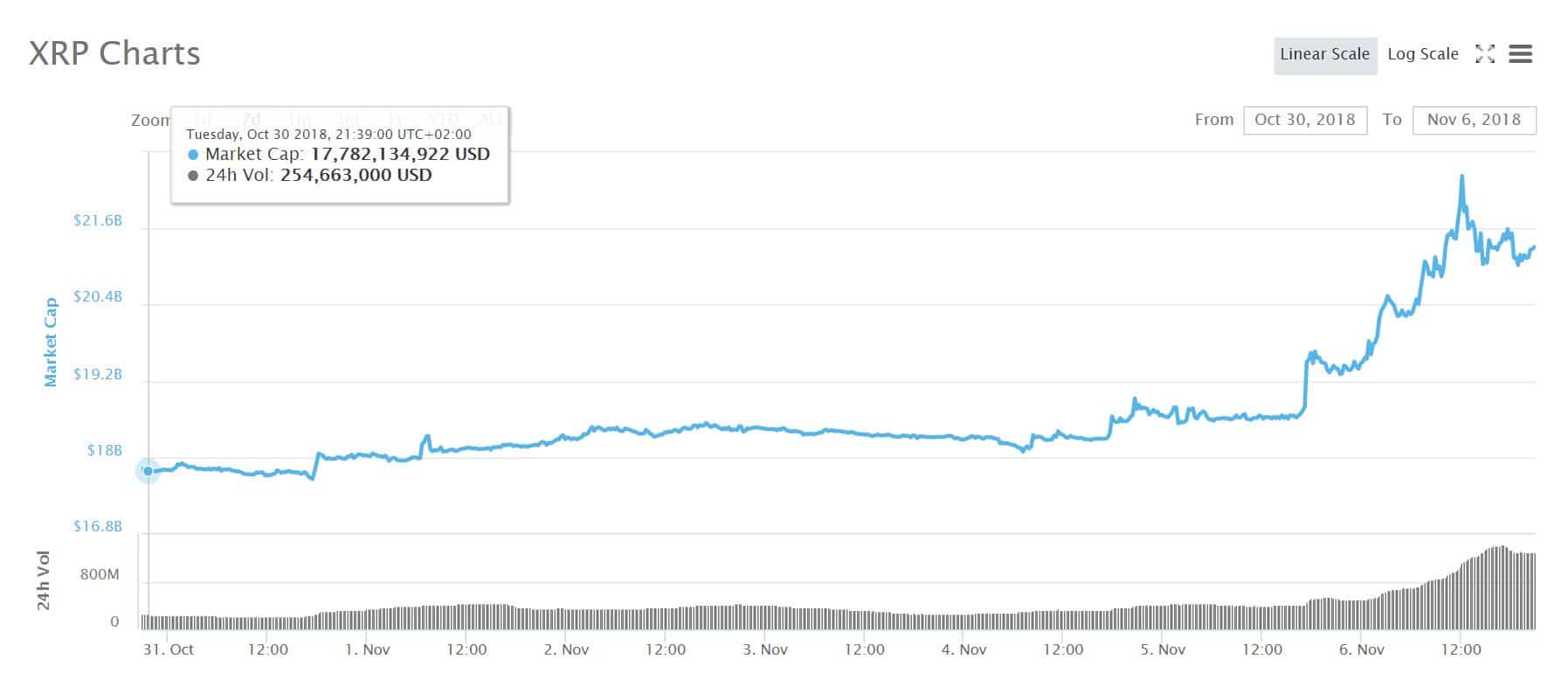
Source: coinmarketcap.com
The common understanding is that Ripple and SWIFT are competitors. Or is this writer just spreading FUD?
Getting pretty tired of the utmost stupidity, hostility and delusion every anti #SWIFT / @Ripple collab tweet attracts.
Please free to unfollow if you insist $XRP is $589 by eoy and #SWIFT switches on #xRapid by Nov 18th.
Don't need that toxicity on my feed.
— Crypto Joe (@Dave_Jonez_02) November 7, 2018
XRP, the cryptocurrency associated with payment network Ripple, temporarily overtook Ethereum in market capitalisation earlier on Tuesday.
This appears to have been driven at least partially by a popular rumour on the internet - that an upcoming upgrade on the SWIFT network will make Ripple products available to around 4,000 extra banks. A SWIFT spokesperson told Finance Magnates on Tuesday that these rumours are untrue.
However, it is not so surprising. Over the last year, Ethereum has been declining in value due to competition from new smart contract platforms, and upgrades which seem to be permanently stuck in the 'coming soon' stage. Ripple, on the other hand, has been signing deals with major financial institutions left, right and centre.
The upgrade is a technical one, attaching a tracking reference to all transactions. It was announced in March 2018 and will be enacted on the 18th of November.
Finance Magnates reached out to SWIFT. A spokesperson for SWIFT (specifically, an employee of public relations company Finsbury) responded: "I’m not sure where those rumours are coming from but the upcoming standards release ... is entirely unrelated to RippleNet. Its primary purpose is to ensure all payments include a tracking reference (UETR, Unique End-to-end Transaction Reference) which will allow banks to track their gpi payments end-to-end in real time."
A source close to the matter told Finance Magnates that having checked with both parties, no evidence could be found of an integration.
What Are These Rumours Then?
This Twitter user is excited because a SWIFT board member left his job at HSBC to work with Ripple:
1. Has swift partnered with Ripple? Marcus treacher who is on swifts board leaves hsbc to work with ripple. Also swift have recently stated xborder payments can settle within seconds which is worlds apart from the 30+ mins stated on the last pic, THREAD $xrp $xrpcommunity $btcpic.twitter.com/edKGO6oxGA
One driver of the rumours is a popular Twitter user called 'SamIam', whose secondary username is '@ripple_me_this'. Like the previous Twitter user cited, Mr. Iam posts enthusiastically about XRP/Ripple several times every day. The gloating Twitter post (the one in which the word 'wave' is misspelt) seen at the beginning of this article is one of his.
Source: youtube.com
Both of these users argue that software provider Temenos is the link between Ripple and SWIFT, being as it is a partner of both. SamIam explains (try to ignore that he does not know the difference between 'your' and 'you're'):
Source: Reddit
Finance Magnates has reached out to Temenos and will update this article when a reply is received.
YouTube videos also abound with the integration theory:
Source: youtube.com
Featured in the above image is an old Twitter post from Ripple's Chief Technical Officer, which is pointed to as evidence by the individual that posted this video.
Additionally, a cryptocurrency news outlet called Coinnounce has published several articles on this subject. It has pointed out that a SWIFT technical upgrade on the 21st of September led to a price spike in Ripple, that the two companies have very similar aims, and that a representative from Ripple is taking part in a panel discussion at a banking conference (AFP Chicago 2018).
True or not, the speculation is not harming the price of XRP:
Source: coinmarketcap.com
The common understanding is that Ripple and SWIFT are competitors. Or is this writer just spreading FUD?
Getting pretty tired of the utmost stupidity, hostility and delusion every anti #SWIFT / @Ripple collab tweet attracts.
Please free to unfollow if you insist $XRP is $589 by eoy and #SWIFT switches on #xRapid by Nov 18th.
Don't need that toxicity on my feed.
— Crypto Joe (@Dave_Jonez_02) November 7, 2018
Schwab Aims Crypto Custody at Its $5 Trillion Advisor Channel by 2027
Featured Videos
Buying The Deep: Digital Asset Adoption in APAC and Beyond
The persisting price drops test the industry's commitment to crypto adoption. While on-chain innovation is making headway across market mechanics, from stablecoins to tokenization, investors remains cautious.
This session brings together market structure experts and institutional investors to explore how a prolonged bear market affects their long-term strategy, and where the opportunities lie ahead of the next cycle.
Attendees will walk away with:
First-hand account of the bear market's impact on various industry players
Understanding of what custody, connectivity, and settlement gaps still hamper growth in APAC
Insight into how client mandates and operational readiness are shaping who moves and who waits
Perspective on what institutional investors need to move toward actual digital asset capital deployment
The persisting price drops test the industry's commitment to crypto adoption. While on-chain innovation is making headway across market mechanics, from stablecoins to tokenization, investors remains cautious.
This session brings together market structure experts and institutional investors to explore how a prolonged bear market affects their long-term strategy, and where the opportunities lie ahead of the next cycle.
Attendees will walk away with:
First-hand account of the bear market's impact on various industry players
Understanding of what custody, connectivity, and settlement gaps still hamper growth in APAC
Insight into how client mandates and operational readiness are shaping who moves and who waits
Perspective on what institutional investors need to move toward actual digital asset capital deployment
The persisting price drops test the industry's commitment to crypto adoption. While on-chain innovation is making headway across market mechanics, from stablecoins to tokenization, investors remains cautious.
This session brings together market structure experts and institutional investors to explore how a prolonged bear market affects their long-term strategy, and where the opportunities lie ahead of the next cycle.
Attendees will walk away with:
First-hand account of the bear market's impact on various industry players
Understanding of what custody, connectivity, and settlement gaps still hamper growth in APAC
Insight into how client mandates and operational readiness are shaping who moves and who waits
Perspective on what institutional investors need to move toward actual digital asset capital deployment
The persisting price drops test the industry's commitment to crypto adoption. While on-chain innovation is making headway across market mechanics, from stablecoins to tokenization, investors remains cautious.
This session brings together market structure experts and institutional investors to explore how a prolonged bear market affects their long-term strategy, and where the opportunities lie ahead of the next cycle.
Attendees will walk away with:
First-hand account of the bear market's impact on various industry players
Understanding of what custody, connectivity, and settlement gaps still hamper growth in APAC
Insight into how client mandates and operational readiness are shaping who moves and who waits
Perspective on what institutional investors need to move toward actual digital asset capital deployment
This panel explores the key insights and emerging trends shaping modern trading behavior, examining how user expectations are evolving across global markets and what these shifts mean for industry participants.
Funding & Exit in Singapore from Pre-Seed to Liquidity
Singapore's capital infrastructure is wider than its reputation for stability suggests.
Sovereign backing from Temasek and GIC, a growing family office network, sector-specialized venture funds, and a public market pathway through the Singapore Exchange, the city-state supports capital formation at every stage of the lifecycle.
Held in partnership with 8Circle, this session gathers practitioners across the capital stack to examine how Singapore functions as both an investment and an exit destination.
Attendees will walk away with:
Understanding of what makes SGX a credible listing pathway for high-growth companies in 2026
Insight into alternative exit channels: private secondary markets, digital marketplace exits, and strategic acquisitions
Perspective on what founders and capital allocators should be doing at each stage to preserve exit optionality
Singapore's capital infrastructure is wider than its reputation for stability suggests.
Sovereign backing from Temasek and GIC, a growing family office network, sector-specialized venture funds, and a public market pathway through the Singapore Exchange, the city-state supports capital formation at every stage of the lifecycle.
Held in partnership with 8Circle, this session gathers practitioners across the capital stack to examine how Singapore functions as both an investment and an exit destination.
Attendees will walk away with:
Understanding of what makes SGX a credible listing pathway for high-growth companies in 2026
Insight into alternative exit channels: private secondary markets, digital marketplace exits, and strategic acquisitions
Perspective on what founders and capital allocators should be doing at each stage to preserve exit optionality
Singapore's capital infrastructure is wider than its reputation for stability suggests.
Sovereign backing from Temasek and GIC, a growing family office network, sector-specialized venture funds, and a public market pathway through the Singapore Exchange, the city-state supports capital formation at every stage of the lifecycle.
Held in partnership with 8Circle, this session gathers practitioners across the capital stack to examine how Singapore functions as both an investment and an exit destination.
Attendees will walk away with:
Understanding of what makes SGX a credible listing pathway for high-growth companies in 2026
Insight into alternative exit channels: private secondary markets, digital marketplace exits, and strategic acquisitions
Perspective on what founders and capital allocators should be doing at each stage to preserve exit optionality
Singapore's capital infrastructure is wider than its reputation for stability suggests.
Sovereign backing from Temasek and GIC, a growing family office network, sector-specialized venture funds, and a public market pathway through the Singapore Exchange, the city-state supports capital formation at every stage of the lifecycle.
Held in partnership with 8Circle, this session gathers practitioners across the capital stack to examine how Singapore functions as both an investment and an exit destination.
Attendees will walk away with:
Understanding of what makes SGX a credible listing pathway for high-growth companies in 2026
Insight into alternative exit channels: private secondary markets, digital marketplace exits, and strategic acquisitions
Perspective on what founders and capital allocators should be doing at each stage to preserve exit optionality
Singapore's capital infrastructure is wider than its reputation for stability suggests.
Sovereign backing from Temasek and GIC, a growing family office network, sector-specialized venture funds, and a public market pathway through the Singapore Exchange, the city-state supports capital formation at every stage of the lifecycle.
Held in partnership with 8Circle, this session gathers practitioners across the capital stack to examine how Singapore functions as both an investment and an exit destination.
Attendees will walk away with:
Understanding of what makes SGX a credible listing pathway for high-growth companies in 2026
Insight into alternative exit channels: private secondary markets, digital marketplace exits, and strategic acquisitions
Perspective on what founders and capital allocators should be doing at each stage to preserve exit optionality
Singapore's capital infrastructure is wider than its reputation for stability suggests.
Sovereign backing from Temasek and GIC, a growing family office network, sector-specialized venture funds, and a public market pathway through the Singapore Exchange, the city-state supports capital formation at every stage of the lifecycle.
Held in partnership with 8Circle, this session gathers practitioners across the capital stack to examine how Singapore functions as both an investment and an exit destination.
Attendees will walk away with:
Understanding of what makes SGX a credible listing pathway for high-growth companies in 2026
Insight into alternative exit channels: private secondary markets, digital marketplace exits, and strategic acquisitions
Perspective on what founders and capital allocators should be doing at each stage to preserve exit optionality
FM Daily Brief – 10 June 2026
Today’s Wednesday, the 10th of June 2026, and these are our main stories: Bybit’s zero-fee stock CFD push, prop trading access to SpaceX shares, and TradeStation’s European expansion into US markets.
AI Getting Real for Brokers
Brokers and providers moved from the noise phase to treating AI tools as a core product question, with implications on anything from hiring priorities to acquisition strategy.
This session gathers retail brokers, platform builders, and AI tool providers to examine how LLMs change affect client trust, results, and risk.
Attendees will walk away with:
A first-hand account of where AI-driven trading tools generate real client value
Insight into how institutional adoption is raising client expectations and what brokers need to do to keep pace
Clarity on the liability question: when an AI-driven recommendation leads to a bad trade, where does responsibility
Brokers and providers moved from the noise phase to treating AI tools as a core product question, with implications on anything from hiring priorities to acquisition strategy.
This session gathers retail brokers, platform builders, and AI tool providers to examine how LLMs change affect client trust, results, and risk.
Attendees will walk away with:
A first-hand account of where AI-driven trading tools generate real client value
Insight into how institutional adoption is raising client expectations and what brokers need to do to keep pace
Clarity on the liability question: when an AI-driven recommendation leads to a bad trade, where does responsibility
Brokers and providers moved from the noise phase to treating AI tools as a core product question, with implications on anything from hiring priorities to acquisition strategy.
This session gathers retail brokers, platform builders, and AI tool providers to examine how LLMs change affect client trust, results, and risk.
Attendees will walk away with:
A first-hand account of where AI-driven trading tools generate real client value
Insight into how institutional adoption is raising client expectations and what brokers need to do to keep pace
Clarity on the liability question: when an AI-driven recommendation leads to a bad trade, where does responsibility
Brokers and providers moved from the noise phase to treating AI tools as a core product question, with implications on anything from hiring priorities to acquisition strategy.
This session gathers retail brokers, platform builders, and AI tool providers to examine how LLMs change affect client trust, results, and risk.
Attendees will walk away with:
A first-hand account of where AI-driven trading tools generate real client value
Insight into how institutional adoption is raising client expectations and what brokers need to do to keep pace
Clarity on the liability question: when an AI-driven recommendation leads to a bad trade, where does responsibility
Brokers and providers moved from the noise phase to treating AI tools as a core product question, with implications on anything from hiring priorities to acquisition strategy.
This session gathers retail brokers, platform builders, and AI tool providers to examine how LLMs change affect client trust, results, and risk.
Attendees will walk away with:
A first-hand account of where AI-driven trading tools generate real client value
Insight into how institutional adoption is raising client expectations and what brokers need to do to keep pace
Clarity on the liability question: when an AI-driven recommendation leads to a bad trade, where does responsibility
Brokers and providers moved from the noise phase to treating AI tools as a core product question, with implications on anything from hiring priorities to acquisition strategy.
This session gathers retail brokers, platform builders, and AI tool providers to examine how LLMs change affect client trust, results, and risk.
Attendees will walk away with:
A first-hand account of where AI-driven trading tools generate real client value
Insight into how institutional adoption is raising client expectations and what brokers need to do to keep pace
Clarity on the liability question: when an AI-driven recommendation leads to a bad trade, where does responsibility