Local news media source Xinhua Net said that Xi specifically called for the adoption of blockchain technology in “digital finance, Internet of Things, intelligent manufacturing, supply chain management, digital asset trading, and other fields.” (Translated quote.)
He also said that China would be investing in the development of blockchain technology.
Some direct consequences you might be interested in after President Xi's blockchain talk.
1/ No doubt that blockchain is intensively reported on national TV channels, on covers/headlines of national newspapers and websites. pic.twitter.com/qXVSjR5Tho
— cnLedger (@cnLedger) October 28, 2019
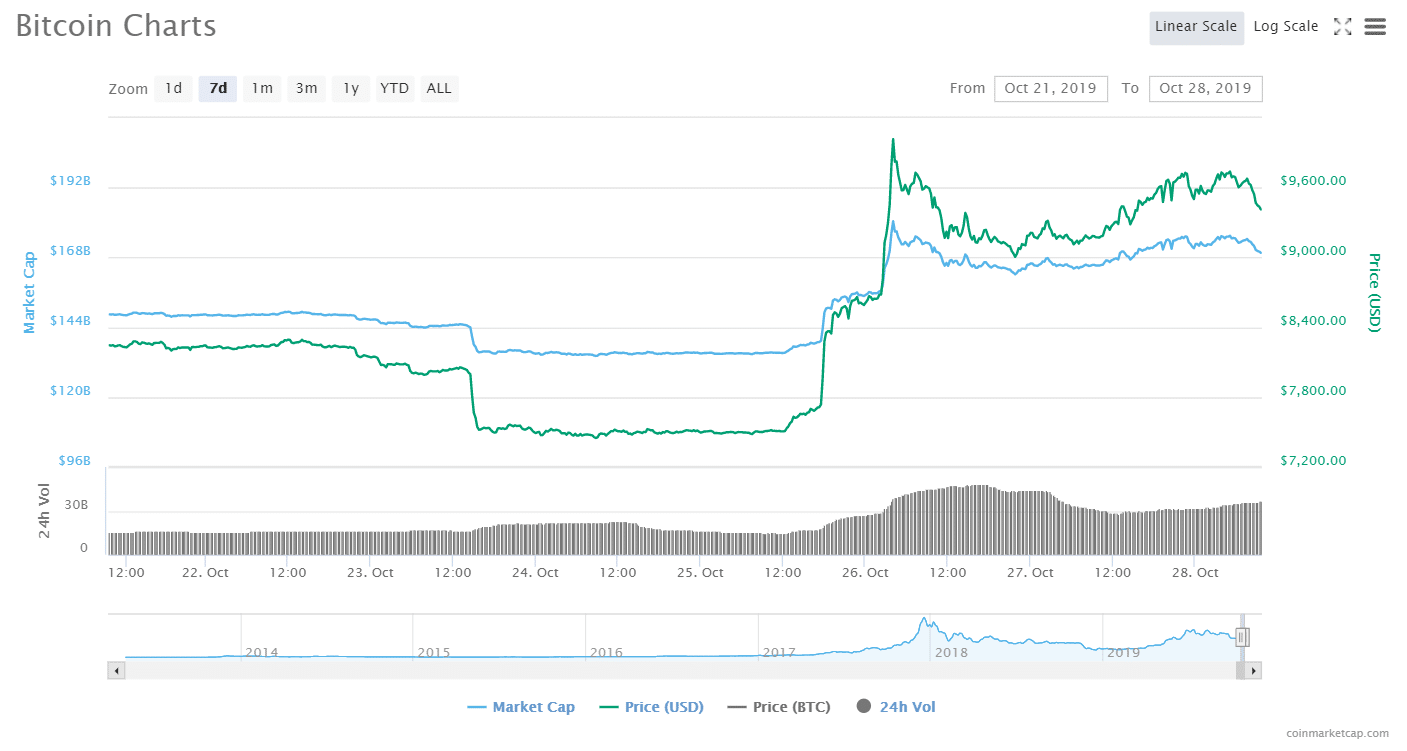
So, when Bitcoin began to rally over the weekend--briefly peaking over $10,000--a number of analysts were quick to connect the dots: after all, the Chinese president’s support of blockchain is certainly a good sign for Bitcoin, right?
Perhaps--but, as a data scientist and creator of UsefulTulips.com Matt Ahlborg said several weeks ago regarding connections between Hong Kong protests and a BTC price bump, “be mindful of narrative pushers on every side of Bitcoin, including myself.”
[5/6] So there you have it. As most people with a brain know, a single week of volume from a single source isn’t enough to conclude anything. Be mindful of narrative pushers on every side of Bitcoin, including myself...
— Matt Ahlborg [UsefulTulips.org] (@MattAhlborg) October 4, 2019
Indeed, saying that Xi Jinping’s comments on blockchain were the cause of Bitcoin’s rise is certainly an easy connection to make--but what are the facts?
Here’s what we know: a look at the data
There certainly does seem to be a strong correlation between the timing of the reporting on Xi’s comments and Bitcoin’s upward journey.
Indeed, when reports of Xi’s speech hit the web at 06:14 AM EST, the price of Bitcoin began to move up within several minutes. Within the first hour that the news was live, BTC rose from roughly $7500 to $7600. Within six hours, the price had spiked to $8400; just after the clock struck 1:00 PM in New York City, BTC had reached $8800.
Additionally, well-known industry analyst and Primitive Crypto founder Dovey Wan tweeted that on search engine Baidu, “where most newbies actively search for stuff they come to know for the first time,” there was a massive spike in the search terms “Blockchain” and “Bitcoin” following Xi’s speech.
Specifically, Wan said that there was a “whopping over 1300% increase in Blockchain search on 25th, surpass[ing] Bitcoin.”
Wan also pointed out rises in the search terms “blockchain” and “Bitcoin” on WeChat’s search index following the news, noting that “Bitcoin query also dipped/stayed flat on 25th as Wechat, and jumped back up on 26th.”
2/ Wechat, where most industry ppl came to know abt it the first hand (most of white-collar usually don't watch CCP news) see a significant spike in Blockchain right on 25th, Bitcoin dipped a little (-5%); Bitcoin spiked on 26th, which I suspect a lagging indicator to the price pic.twitter.com/fMtHjdntBx
Do investors know the difference between Bitcoin and blockchain…?
However, as analyst Kyle Torpey wrote in a piece for LongHash that “the connection between Xi’s remarks and the Bitcoin price is somewhat unclear, as the president’s comments don’t have much to do with Bitcoin’s key value proposition as an apolitical, uncontrollable digital money.”
In other words, the fact that Xi is a fan of blockchain is great--but it really doesn’t have anything to do with Bitcoin. In fact, China’s official policy has been famously anti-crypto since the fourth quarter of 2017, when the country instituted a sweeping set of bans that outlawed ICOs, banned domestic cryptocurrency exchanges, and blocked internet access to cryptocurrency exchanges.
Therefore, Torpey pointed out that if Xi’s remarks did indeed cause the spike, that investors may not really know the difference between Bitcoin and blockchain.
President Xi's comments on blockchain were followed by an 18% jump in Bitcoin's price. China supports blockchain tech, but doesn't particularly like Bitcoin. The price jump suggests investors don't see difference between the two https://t.co/sF1DJ2pBse Analysis by @kyletorpey
Indeed, even though “China continues to go down the road of ‘blockchain not Bitcoin’...the price jump shows [that] investors don’t seem able to differentiate between the two,” Torpey wrote.
David Hsiao, CEO of Block Journal, also tweeted that “Xi Jinping says China will put focus on blockchain development. Remember: Keyword [is] ‘blockchain,’ not Bitcoin. Big difference.”
"It's pretty funny that Bitcoin is up on Xi Jinping saying nice things about blockchain."
Seeming to come to a similar conclusion regarding the apparent confusion between Bitcoin and blockchain, Gady Epstein, The Economist’s China Affairs Editor, tweeted that “it’s pretty funny that Bitcoin is up on Xi Jinping saying nice things about blockchain.”
It’s pretty funny that Bitcoin is up on Xi Jinping saying nice things about blockchain
And indeed, even though China is currently working on producing a national cryptocurrency of its own, this is not a positive sign for Bitcoin or for the cryptocurrency industry: "this will only increase government’s control of our money. Now it will be easier for them to tax you or track where you move your money, not to mention them keeping their ability to ‘print money,’” said Canadian anarcho-capitalist and entrepreneur Jeff Berwick in an interview with Finance Magnates conducted earlier this year.
If anything, Bitcoin stands in direct opposition to what China may be trying to accomplish with its adoption of blockchain technology: "Bitcoin has changed quite a bit over the last few years and it’s been regulated," Berwick said. "However, it still is a currency totally outside of the control of central banks or governments. That truly is a libertarian dream."
Canadian anarcho-capitalist and entrepreneur Jeff Berwick.
Chinese blockchain companies see massive increases in stock prices
However, the fact that practically each and every China-based blockchain firm saw a rise in its stock value following Xi’s speech seems to indicate that there are at least some investors who do seem to know the difference.
“Chinese investors snapped up every blockchain-related stock in sight after President Xi Jinping said Beijing wants to speed up development of the technology,” says a report from Bloomberg published on October 28th.
“The market reaction shows how far an endorsement from Xi can go in China, where high-level officials on Monday began their first major policy meeting since early 2018,” the piece said, also pointing to the fact that “[the] Shenzhen tech index surge[d] 5.3%, the most in eight months.”
cnLedger, a popular Twitter account that shares news about the blockchain and cryptocurrency industry in China, also reported that “Xunlei, a company selling cloud downloading services and claimed heavily invested in blockchain, just doubled its stock marketcap over the night. (sic)”
4/ Stocks related to blockchain spikes high. For example, Xunlei, a company selling cloud downloading services and claimed heavily invested in blockchain, just doubled its stock marketcap over the night.
It’s difficult to “isolate” Bitcoin from blockchain...perhaps especially in China
Additionally, Dovey Wan pointed out that it’s difficult to isolate Bitcoin from the rest of the blockchain industry: “the Blockchain shill from Xi definitely helps Bitcoin awareness as well, the two concepts are interrelated, hard to isolate one from each other,” she wrote on Twitter.
In her opinion, “we can also see that the news didn't pump Bitcoin instantly (both materially and mentally) on 25th, it's more as a aftermath. (sic)”
Indeed, “this Xi Shill is definitely bullish for the whole industry, especially as the highest level of recognition from CCP, when previously "blockchain/bitcoin is a scam" is the leading narrative among average Chinese ppl,” she wrote, adding that "’China FUD’ in the west can also shut up to some extent,” referring to western holders’ tendency to blame bad news in China for fluctuations in Bitcoin’s price.
Wan also pointed out that the “China Merchant Bank just announced invested in BitPie, the Bitcoin wallet with [the] longest history and most users back in China.”
“All I can say is this to me it's a sign of beginning of the nationalization of Bitcoin/Cryptocurrency related infra in mainland, (sic)” she wrote. “Eventually, all things can be state-owned, or at least partially (mining, ASIC, exchanges, wallets, etc etc).”
All I can say is this to me it's a sign of begining of the nationalization of Bitcoin/Cryptocurrency related infra in mainland
Eventually, all things can be state-owned, or at least partially (mining, ASIC, exchanges, wallets, etc etc)
— Dovey 以德服人 Wan ? ? (@DoveyWan) October 28, 2019
And the Chinese government has made some nods toward Bitcoin bullishness in the past. Earlier this year, Samson Mow, CEO of Pixelmatic, pointed out on Twitter that the Bank of China posted an educational piece on Bitcoin.
Other things that could be influencing the price of Bitcoin include “sentiment for Mastercard, futurity for gold, volume for ETFs, and buzz sentiment for blockchain.”
Selbert explained that “this really implies–if you look at the entity [itself]–that Bitcoin is part of a much larger ecosystem, and what moves it could be anything that happens in that ecosystem."
Local news media source Xinhua Net said that Xi specifically called for the adoption of blockchain technology in “digital finance, Internet of Things, intelligent manufacturing, supply chain management, digital asset trading, and other fields.” (Translated quote.)
He also said that China would be investing in the development of blockchain technology.
Some direct consequences you might be interested in after President Xi's blockchain talk.
1/ No doubt that blockchain is intensively reported on national TV channels, on covers/headlines of national newspapers and websites. pic.twitter.com/qXVSjR5Tho
— cnLedger (@cnLedger) October 28, 2019
So, when Bitcoin began to rally over the weekend--briefly peaking over $10,000--a number of analysts were quick to connect the dots: after all, the Chinese president’s support of blockchain is certainly a good sign for Bitcoin, right?
Perhaps--but, as a data scientist and creator of UsefulTulips.com Matt Ahlborg said several weeks ago regarding connections between Hong Kong protests and a BTC price bump, “be mindful of narrative pushers on every side of Bitcoin, including myself.”
[5/6] So there you have it. As most people with a brain know, a single week of volume from a single source isn’t enough to conclude anything. Be mindful of narrative pushers on every side of Bitcoin, including myself...
— Matt Ahlborg [UsefulTulips.org] (@MattAhlborg) October 4, 2019
Indeed, saying that Xi Jinping’s comments on blockchain were the cause of Bitcoin’s rise is certainly an easy connection to make--but what are the facts?
Here’s what we know: a look at the data
There certainly does seem to be a strong correlation between the timing of the reporting on Xi’s comments and Bitcoin’s upward journey.
Indeed, when reports of Xi’s speech hit the web at 06:14 AM EST, the price of Bitcoin began to move up within several minutes. Within the first hour that the news was live, BTC rose from roughly $7500 to $7600. Within six hours, the price had spiked to $8400; just after the clock struck 1:00 PM in New York City, BTC had reached $8800.
Additionally, well-known industry analyst and Primitive Crypto founder Dovey Wan tweeted that on search engine Baidu, “where most newbies actively search for stuff they come to know for the first time,” there was a massive spike in the search terms “Blockchain” and “Bitcoin” following Xi’s speech.
Specifically, Wan said that there was a “whopping over 1300% increase in Blockchain search on 25th, surpass[ing] Bitcoin.”
Wan also pointed out rises in the search terms “blockchain” and “Bitcoin” on WeChat’s search index following the news, noting that “Bitcoin query also dipped/stayed flat on 25th as Wechat, and jumped back up on 26th.”
2/ Wechat, where most industry ppl came to know abt it the first hand (most of white-collar usually don't watch CCP news) see a significant spike in Blockchain right on 25th, Bitcoin dipped a little (-5%); Bitcoin spiked on 26th, which I suspect a lagging indicator to the price pic.twitter.com/fMtHjdntBx
Do investors know the difference between Bitcoin and blockchain…?
However, as analyst Kyle Torpey wrote in a piece for LongHash that “the connection between Xi’s remarks and the Bitcoin price is somewhat unclear, as the president’s comments don’t have much to do with Bitcoin’s key value proposition as an apolitical, uncontrollable digital money.”
In other words, the fact that Xi is a fan of blockchain is great--but it really doesn’t have anything to do with Bitcoin. In fact, China’s official policy has been famously anti-crypto since the fourth quarter of 2017, when the country instituted a sweeping set of bans that outlawed ICOs, banned domestic cryptocurrency exchanges, and blocked internet access to cryptocurrency exchanges.
Therefore, Torpey pointed out that if Xi’s remarks did indeed cause the spike, that investors may not really know the difference between Bitcoin and blockchain.
President Xi's comments on blockchain were followed by an 18% jump in Bitcoin's price. China supports blockchain tech, but doesn't particularly like Bitcoin. The price jump suggests investors don't see difference between the two https://t.co/sF1DJ2pBse Analysis by @kyletorpey
Indeed, even though “China continues to go down the road of ‘blockchain not Bitcoin’...the price jump shows [that] investors don’t seem able to differentiate between the two,” Torpey wrote.
David Hsiao, CEO of Block Journal, also tweeted that “Xi Jinping says China will put focus on blockchain development. Remember: Keyword [is] ‘blockchain,’ not Bitcoin. Big difference.”
"It's pretty funny that Bitcoin is up on Xi Jinping saying nice things about blockchain."
Seeming to come to a similar conclusion regarding the apparent confusion between Bitcoin and blockchain, Gady Epstein, The Economist’s China Affairs Editor, tweeted that “it’s pretty funny that Bitcoin is up on Xi Jinping saying nice things about blockchain.”
It’s pretty funny that Bitcoin is up on Xi Jinping saying nice things about blockchain
And indeed, even though China is currently working on producing a national cryptocurrency of its own, this is not a positive sign for Bitcoin or for the cryptocurrency industry: "this will only increase government’s control of our money. Now it will be easier for them to tax you or track where you move your money, not to mention them keeping their ability to ‘print money,’” said Canadian anarcho-capitalist and entrepreneur Jeff Berwick in an interview with Finance Magnates conducted earlier this year.
If anything, Bitcoin stands in direct opposition to what China may be trying to accomplish with its adoption of blockchain technology: "Bitcoin has changed quite a bit over the last few years and it’s been regulated," Berwick said. "However, it still is a currency totally outside of the control of central banks or governments. That truly is a libertarian dream."
Canadian anarcho-capitalist and entrepreneur Jeff Berwick.
Chinese blockchain companies see massive increases in stock prices
However, the fact that practically each and every China-based blockchain firm saw a rise in its stock value following Xi’s speech seems to indicate that there are at least some investors who do seem to know the difference.
“Chinese investors snapped up every blockchain-related stock in sight after President Xi Jinping said Beijing wants to speed up development of the technology,” says a report from Bloomberg published on October 28th.
“The market reaction shows how far an endorsement from Xi can go in China, where high-level officials on Monday began their first major policy meeting since early 2018,” the piece said, also pointing to the fact that “[the] Shenzhen tech index surge[d] 5.3%, the most in eight months.”
cnLedger, a popular Twitter account that shares news about the blockchain and cryptocurrency industry in China, also reported that “Xunlei, a company selling cloud downloading services and claimed heavily invested in blockchain, just doubled its stock marketcap over the night. (sic)”
4/ Stocks related to blockchain spikes high. For example, Xunlei, a company selling cloud downloading services and claimed heavily invested in blockchain, just doubled its stock marketcap over the night.
It’s difficult to “isolate” Bitcoin from blockchain...perhaps especially in China
Additionally, Dovey Wan pointed out that it’s difficult to isolate Bitcoin from the rest of the blockchain industry: “the Blockchain shill from Xi definitely helps Bitcoin awareness as well, the two concepts are interrelated, hard to isolate one from each other,” she wrote on Twitter.
In her opinion, “we can also see that the news didn't pump Bitcoin instantly (both materially and mentally) on 25th, it's more as a aftermath. (sic)”
Indeed, “this Xi Shill is definitely bullish for the whole industry, especially as the highest level of recognition from CCP, when previously "blockchain/bitcoin is a scam" is the leading narrative among average Chinese ppl,” she wrote, adding that "’China FUD’ in the west can also shut up to some extent,” referring to western holders’ tendency to blame bad news in China for fluctuations in Bitcoin’s price.
Wan also pointed out that the “China Merchant Bank just announced invested in BitPie, the Bitcoin wallet with [the] longest history and most users back in China.”
“All I can say is this to me it's a sign of beginning of the nationalization of Bitcoin/Cryptocurrency related infra in mainland, (sic)” she wrote. “Eventually, all things can be state-owned, or at least partially (mining, ASIC, exchanges, wallets, etc etc).”
All I can say is this to me it's a sign of begining of the nationalization of Bitcoin/Cryptocurrency related infra in mainland
Eventually, all things can be state-owned, or at least partially (mining, ASIC, exchanges, wallets, etc etc)
— Dovey 以德服人 Wan ? ? (@DoveyWan) October 28, 2019
And the Chinese government has made some nods toward Bitcoin bullishness in the past. Earlier this year, Samson Mow, CEO of Pixelmatic, pointed out on Twitter that the Bank of China posted an educational piece on Bitcoin.
Other things that could be influencing the price of Bitcoin include “sentiment for Mastercard, futurity for gold, volume for ETFs, and buzz sentiment for blockchain.”
Selbert explained that “this really implies–if you look at the entity [itself]–that Bitcoin is part of a much larger ecosystem, and what moves it could be anything that happens in that ecosystem."
Rachel is a self-taught crypto geek and a passionate writer. She believes in the power that the written word has to educate, connect and empower individuals to make positive and powerful financial choices. She is the Podcast Host and a Cryptocurrency Editor at Finance Magnates.
Crypto Built More Rails, but the Next Battle Is Over How Much Work a Dollar Can Do
Featured Videos
FP Markets Winner Spotlight 🏆 | Global Broker of the Year 2025 #Trading #Broker #Innovation #Shorts
FP Markets Winner Spotlight 🏆 | Global Broker of the Year 2025 #Trading #Broker #Innovation #Shorts
FP Markets Winner Spotlight 🏆 | Global Broker of the Year 2025 #Trading #Broker #Innovation #Shorts
FP Markets Winner Spotlight 🏆 | Global Broker of the Year 2025 #Trading #Broker #Innovation #Shorts
FP Markets takes the spotlight as Global Broker of the Year 2025 at the Finance Magnates Awards.
Martin Stoilov, Head of Client Experience, shares that trust, innovation, and people played a key role in the company’s success, supported by a strong foundation of integrity and client-centricity.
Following this milestone, FP Markets continues to focus on growth, technology investment, and its core values of transparency and excellence.
👉 Be part of FM Awards 2026: https://awards.financemagnates.com/#nominate
FP Markets takes the spotlight as Global Broker of the Year 2025 at the Finance Magnates Awards.
Martin Stoilov, Head of Client Experience, shares that trust, innovation, and people played a key role in the company’s success, supported by a strong foundation of integrity and client-centricity.
Following this milestone, FP Markets continues to focus on growth, technology investment, and its core values of transparency and excellence.
👉 Be part of FM Awards 2026: https://awards.financemagnates.com/#nominate
FP Markets takes the spotlight as Global Broker of the Year 2025 at the Finance Magnates Awards.
Martin Stoilov, Head of Client Experience, shares that trust, innovation, and people played a key role in the company’s success, supported by a strong foundation of integrity and client-centricity.
Following this milestone, FP Markets continues to focus on growth, technology investment, and its core values of transparency and excellence.
👉 Be part of FM Awards 2026: https://awards.financemagnates.com/#nominate
FP Markets takes the spotlight as Global Broker of the Year 2025 at the Finance Magnates Awards.
Martin Stoilov, Head of Client Experience, shares that trust, innovation, and people played a key role in the company’s success, supported by a strong foundation of integrity and client-centricity.
Following this milestone, FP Markets continues to focus on growth, technology investment, and its core values of transparency and excellence.
👉 Be part of FM Awards 2026: https://awards.financemagnates.com/#nominate
In this video, we review @HolaPrimeMarketsOfficial, a multi-asset forex and CFDs broker offering different account types, trading platforms, and flexible trading conditions.
We cover the broker’s overall offering, including account options, trading environment, platforms like MT4 and MT5, and additional services such as managed accounts and fast withdrawals.
Watch the full video to see if Hola Prime Markets fits your trading needs.
📣 Stay up to date with the latest in finance and trading. Follow Finance Magnates for industry news, insights, and global event coverage.
Connect with us:
🔗 LinkedIn: /financemagnates
👍 Facebook: /financemagnates
📸 Instagram: https://www.instagram.com/financemagnates
🐦 X: https://x.com/financemagnates
🎥 TikTok: https://www.tiktok.com/tag/financemagnates
▶️ YouTube: /@financemagnates_official
#HolaPrime #ForexBroker #CFDTrading #FinanceMagnates #Trading #Forex #BrokerReview
In this video, we review @HolaPrimeMarketsOfficial, a multi-asset forex and CFDs broker offering different account types, trading platforms, and flexible trading conditions.
We cover the broker’s overall offering, including account options, trading environment, platforms like MT4 and MT5, and additional services such as managed accounts and fast withdrawals.
Watch the full video to see if Hola Prime Markets fits your trading needs.
📣 Stay up to date with the latest in finance and trading. Follow Finance Magnates for industry news, insights, and global event coverage.
Connect with us:
🔗 LinkedIn: /financemagnates
👍 Facebook: /financemagnates
📸 Instagram: https://www.instagram.com/financemagnates
🐦 X: https://x.com/financemagnates
🎥 TikTok: https://www.tiktok.com/tag/financemagnates
▶️ YouTube: /@financemagnates_official
#HolaPrime #ForexBroker #CFDTrading #FinanceMagnates #Trading #Forex #BrokerReview
In this video, we review @HolaPrimeMarketsOfficial, a multi-asset forex and CFDs broker offering different account types, trading platforms, and flexible trading conditions.
We cover the broker’s overall offering, including account options, trading environment, platforms like MT4 and MT5, and additional services such as managed accounts and fast withdrawals.
Watch the full video to see if Hola Prime Markets fits your trading needs.
📣 Stay up to date with the latest in finance and trading. Follow Finance Magnates for industry news, insights, and global event coverage.
Connect with us:
🔗 LinkedIn: /financemagnates
👍 Facebook: /financemagnates
📸 Instagram: https://www.instagram.com/financemagnates
🐦 X: https://x.com/financemagnates
🎥 TikTok: https://www.tiktok.com/tag/financemagnates
▶️ YouTube: /@financemagnates_official
#HolaPrime #ForexBroker #CFDTrading #FinanceMagnates #Trading #Forex #BrokerReview
In this video, we review @HolaPrimeMarketsOfficial, a multi-asset forex and CFDs broker offering different account types, trading platforms, and flexible trading conditions.
We cover the broker’s overall offering, including account options, trading environment, platforms like MT4 and MT5, and additional services such as managed accounts and fast withdrawals.
Watch the full video to see if Hola Prime Markets fits your trading needs.
📣 Stay up to date with the latest in finance and trading. Follow Finance Magnates for industry news, insights, and global event coverage.
Connect with us:
🔗 LinkedIn: /financemagnates
👍 Facebook: /financemagnates
📸 Instagram: https://www.instagram.com/financemagnates
🐦 X: https://x.com/financemagnates
🎥 TikTok: https://www.tiktok.com/tag/financemagnates
▶️ YouTube: /@financemagnates_official
#HolaPrime #ForexBroker #CFDTrading #FinanceMagnates #Trading #Forex #BrokerReview
In this video, we review @HolaPrimeMarketsOfficial, a multi-asset forex and CFDs broker offering different account types, trading platforms, and flexible trading conditions.
We cover the broker’s overall offering, including account options, trading environment, platforms like MT4 and MT5, and additional services such as managed accounts and fast withdrawals.
Watch the full video to see if Hola Prime Markets fits your trading needs.
📣 Stay up to date with the latest in finance and trading. Follow Finance Magnates for industry news, insights, and global event coverage.
Connect with us:
🔗 LinkedIn: /financemagnates
👍 Facebook: /financemagnates
📸 Instagram: https://www.instagram.com/financemagnates
🐦 X: https://x.com/financemagnates
🎥 TikTok: https://www.tiktok.com/tag/financemagnates
▶️ YouTube: /@financemagnates_official
#HolaPrime #ForexBroker #CFDTrading #FinanceMagnates #Trading #Forex #BrokerReview
In this video, we review @HolaPrimeMarketsOfficial, a multi-asset forex and CFDs broker offering different account types, trading platforms, and flexible trading conditions.
We cover the broker’s overall offering, including account options, trading environment, platforms like MT4 and MT5, and additional services such as managed accounts and fast withdrawals.
Watch the full video to see if Hola Prime Markets fits your trading needs.
📣 Stay up to date with the latest in finance and trading. Follow Finance Magnates for industry news, insights, and global event coverage.
Connect with us:
🔗 LinkedIn: /financemagnates
👍 Facebook: /financemagnates
📸 Instagram: https://www.instagram.com/financemagnates
🐦 X: https://x.com/financemagnates
🎥 TikTok: https://www.tiktok.com/tag/financemagnates
▶️ YouTube: /@financemagnates_official
#HolaPrime #ForexBroker #CFDTrading #FinanceMagnates #Trading #Forex #BrokerReview
Hola Prime Review: What You Need to Know | Full Breakdown by Finance Magnates
Hola Prime Review: What You Need to Know | Full Breakdown by Finance Magnates
Hola Prime Review: What You Need to Know | Full Breakdown by Finance Magnates
Hola Prime Review: What You Need to Know | Full Breakdown by Finance Magnates
Hola Prime Review: What You Need to Know | Full Breakdown by Finance Magnates
Hola Prime Review: What You Need to Know | Full Breakdown by Finance Magnates
In this video, we review @HolaPrime_Global, a proprietary trading firm offering evaluation programs and performance-based payouts in simulated market environments.
We cover how the challenge model works, including account types, profit splits (up to 95%), trading rules, and what it takes to reach a funded account. You’ll also learn about available platforms like MT4, MT5, cTrader, and more, along with insights into payouts, support, and trading conditions.
Watch the full video to see if Hola Prime fits your trading style.
📣 Stay up to date with the latest in finance and trading. Follow Finance Magnates for industry news, insights, and global event coverage.
Connect with us:
🔗 LinkedIn: /financemagnates
👍 Facebook: /financemagnates
📸 Instagram: https://www.instagram.com/financemagnates
🐦 X: https://x.com/financemagnates
🎥 TikTok: https://www.tiktok.com/tag/financemagnates
▶️ YouTube: /@financemagnates_official
#HolaPrime #PropFirm #Trading #FinanceMagnates #Forex #FuturesTrading #TradingReview #PropFirmReview
In this video, we review @HolaPrime_Global, a proprietary trading firm offering evaluation programs and performance-based payouts in simulated market environments.
We cover how the challenge model works, including account types, profit splits (up to 95%), trading rules, and what it takes to reach a funded account. You’ll also learn about available platforms like MT4, MT5, cTrader, and more, along with insights into payouts, support, and trading conditions.
Watch the full video to see if Hola Prime fits your trading style.
📣 Stay up to date with the latest in finance and trading. Follow Finance Magnates for industry news, insights, and global event coverage.
Connect with us:
🔗 LinkedIn: /financemagnates
👍 Facebook: /financemagnates
📸 Instagram: https://www.instagram.com/financemagnates
🐦 X: https://x.com/financemagnates
🎥 TikTok: https://www.tiktok.com/tag/financemagnates
▶️ YouTube: /@financemagnates_official
#HolaPrime #PropFirm #Trading #FinanceMagnates #Forex #FuturesTrading #TradingReview #PropFirmReview
In this video, we review @HolaPrime_Global, a proprietary trading firm offering evaluation programs and performance-based payouts in simulated market environments.
We cover how the challenge model works, including account types, profit splits (up to 95%), trading rules, and what it takes to reach a funded account. You’ll also learn about available platforms like MT4, MT5, cTrader, and more, along with insights into payouts, support, and trading conditions.
Watch the full video to see if Hola Prime fits your trading style.
📣 Stay up to date with the latest in finance and trading. Follow Finance Magnates for industry news, insights, and global event coverage.
Connect with us:
🔗 LinkedIn: /financemagnates
👍 Facebook: /financemagnates
📸 Instagram: https://www.instagram.com/financemagnates
🐦 X: https://x.com/financemagnates
🎥 TikTok: https://www.tiktok.com/tag/financemagnates
▶️ YouTube: /@financemagnates_official
#HolaPrime #PropFirm #Trading #FinanceMagnates #Forex #FuturesTrading #TradingReview #PropFirmReview
In this video, we review @HolaPrime_Global, a proprietary trading firm offering evaluation programs and performance-based payouts in simulated market environments.
We cover how the challenge model works, including account types, profit splits (up to 95%), trading rules, and what it takes to reach a funded account. You’ll also learn about available platforms like MT4, MT5, cTrader, and more, along with insights into payouts, support, and trading conditions.
Watch the full video to see if Hola Prime fits your trading style.
📣 Stay up to date with the latest in finance and trading. Follow Finance Magnates for industry news, insights, and global event coverage.
Connect with us:
🔗 LinkedIn: /financemagnates
👍 Facebook: /financemagnates
📸 Instagram: https://www.instagram.com/financemagnates
🐦 X: https://x.com/financemagnates
🎥 TikTok: https://www.tiktok.com/tag/financemagnates
▶️ YouTube: /@financemagnates_official
#HolaPrime #PropFirm #Trading #FinanceMagnates #Forex #FuturesTrading #TradingReview #PropFirmReview
In this video, we review @HolaPrime_Global, a proprietary trading firm offering evaluation programs and performance-based payouts in simulated market environments.
We cover how the challenge model works, including account types, profit splits (up to 95%), trading rules, and what it takes to reach a funded account. You’ll also learn about available platforms like MT4, MT5, cTrader, and more, along with insights into payouts, support, and trading conditions.
Watch the full video to see if Hola Prime fits your trading style.
📣 Stay up to date with the latest in finance and trading. Follow Finance Magnates for industry news, insights, and global event coverage.
Connect with us:
🔗 LinkedIn: /financemagnates
👍 Facebook: /financemagnates
📸 Instagram: https://www.instagram.com/financemagnates
🐦 X: https://x.com/financemagnates
🎥 TikTok: https://www.tiktok.com/tag/financemagnates
▶️ YouTube: /@financemagnates_official
#HolaPrime #PropFirm #Trading #FinanceMagnates #Forex #FuturesTrading #TradingReview #PropFirmReview
In this video, we review @HolaPrime_Global, a proprietary trading firm offering evaluation programs and performance-based payouts in simulated market environments.
We cover how the challenge model works, including account types, profit splits (up to 95%), trading rules, and what it takes to reach a funded account. You’ll also learn about available platforms like MT4, MT5, cTrader, and more, along with insights into payouts, support, and trading conditions.
Watch the full video to see if Hola Prime fits your trading style.
📣 Stay up to date with the latest in finance and trading. Follow Finance Magnates for industry news, insights, and global event coverage.
Connect with us:
🔗 LinkedIn: /financemagnates
👍 Facebook: /financemagnates
📸 Instagram: https://www.instagram.com/financemagnates
🐦 X: https://x.com/financemagnates
🎥 TikTok: https://www.tiktok.com/tag/financemagnates
▶️ YouTube: /@financemagnates_official
#HolaPrime #PropFirm #Trading #FinanceMagnates #Forex #FuturesTrading #TradingReview #PropFirmReview
Axi Winner Spotlight 🏆 | Global Most Innovative Broker 2025 #Innovation #Trading #Fintech #Broker
Axi Winner Spotlight 🏆 | Global Most Innovative Broker 2025 #Innovation #Trading #Fintech #Broker
Axi Winner Spotlight 🏆 | Global Most Innovative Broker 2025 #Innovation #Trading #Fintech #Broker
Axi Winner Spotlight 🏆 | Global Most Innovative Broker 2025 #Innovation #Trading #Fintech #Broker
Axi Winner Spotlight 🏆 | Global Most Innovative Broker 2025 #Innovation #Trading #Fintech #Broker
Axi Winner Spotlight 🏆 | Global Most Innovative Broker 2025 #Innovation #Trading #Fintech #Broker
Axi takes the spotlight at the Finance Magnates Awards, winning Global Most Innovative Broker 2025.
Olivia Xenofontos and Ivanna Openko share how the team will feel: proud, motivated, and ready to keep delivering.
They also describe the night as well-organized, focused, and enjoyable for all.
👉 Be part of FM Awards 2026.
Axi takes the spotlight at the Finance Magnates Awards, winning Global Most Innovative Broker 2025.
Olivia Xenofontos and Ivanna Openko share how the team will feel: proud, motivated, and ready to keep delivering.
They also describe the night as well-organized, focused, and enjoyable for all.
👉 Be part of FM Awards 2026.
Axi takes the spotlight at the Finance Magnates Awards, winning Global Most Innovative Broker 2025.
Olivia Xenofontos and Ivanna Openko share how the team will feel: proud, motivated, and ready to keep delivering.
They also describe the night as well-organized, focused, and enjoyable for all.
👉 Be part of FM Awards 2026.
Axi takes the spotlight at the Finance Magnates Awards, winning Global Most Innovative Broker 2025.
Olivia Xenofontos and Ivanna Openko share how the team will feel: proud, motivated, and ready to keep delivering.
They also describe the night as well-organized, focused, and enjoyable for all.
👉 Be part of FM Awards 2026.
Axi takes the spotlight at the Finance Magnates Awards, winning Global Most Innovative Broker 2025.
Olivia Xenofontos and Ivanna Openko share how the team will feel: proud, motivated, and ready to keep delivering.
They also describe the night as well-organized, focused, and enjoyable for all.
👉 Be part of FM Awards 2026.
Axi takes the spotlight at the Finance Magnates Awards, winning Global Most Innovative Broker 2025.
Olivia Xenofontos and Ivanna Openko share how the team will feel: proud, motivated, and ready to keep delivering.
They also describe the night as well-organized, focused, and enjoyable for all.
👉 Be part of FM Awards 2026.
Recognition that matters.
Built on transparency.
Driven by the industry.
The Finance Magnates Awards 2026.
Nominations are now open.
🔗 https://awards.financemagnates.com/?utm_source=SM&utm_medium=social&utm_campaign=recognition-matters
Recognition that matters.
Built on transparency.
Driven by the industry.
The Finance Magnates Awards 2026.
Nominations are now open.
🔗 https://awards.financemagnates.com/?utm_source=SM&utm_medium=social&utm_campaign=recognition-matters
Recognition that matters.
Built on transparency.
Driven by the industry.
The Finance Magnates Awards 2026.
Nominations are now open.
🔗 https://awards.financemagnates.com/?utm_source=SM&utm_medium=social&utm_campaign=recognition-matters
Recognition that matters.
Built on transparency.
Driven by the industry.
The Finance Magnates Awards 2026.
Nominations are now open.
🔗 https://awards.financemagnates.com/?utm_source=SM&utm_medium=social&utm_campaign=recognition-matters
Recognition that matters.
Built on transparency.
Driven by the industry.
The Finance Magnates Awards 2026.
Nominations are now open.
🔗 https://awards.financemagnates.com/?utm_source=SM&utm_medium=social&utm_campaign=recognition-matters
Recognition that matters.
Built on transparency.
Driven by the industry.
The Finance Magnates Awards 2026.
Nominations are now open.
🔗 https://awards.financemagnates.com/?utm_source=SM&utm_medium=social&utm_campaign=recognition-matters