After beginning the year on a fairly steady course towards the $10k mark, Bitcoin--along with the rest of the economy--tanked.
At the end of the second week of March, crypto markets fell so sharply that March 12th came to be colloquially known as “Crypto’s Black Thursday." Between Wednesday, March 11th, and Friday, March 13th, the price of BTC fell from nearly $8,000 to roughly $4,700; by the end of the month, Bitcoin had recovered to roughly $6,400.
Since then, things have recovered considerably for BTC: by the end of April, Bitcoin had already hit back over the $9,000 level, where it managed to stay around for the rest of the quarter; the coin even briefly surpassed $10,000 on June 1st, and has floated between $9,000 and $10,000 ever since.
What has ensued since then has been--well, almost boring; almost a little too boring: in fact, the last 8 weeks or so have constituted one of the least volatile time-periods in Bitcoin’s recent history.
“This is very uncharacteristic of Bitcoin, as it is known for its rampant volatility,” he said.
Therefore, he believes that this period is not likely to continue for too much longer: “it is unlikely that this will continue and quite possible that BTC is gearing up for a big move,” he said. “In fact, the last time that Bitcoin was behaving like this was in April 2019 just before making a huge move.”
OKEx CEO Jay Hao.
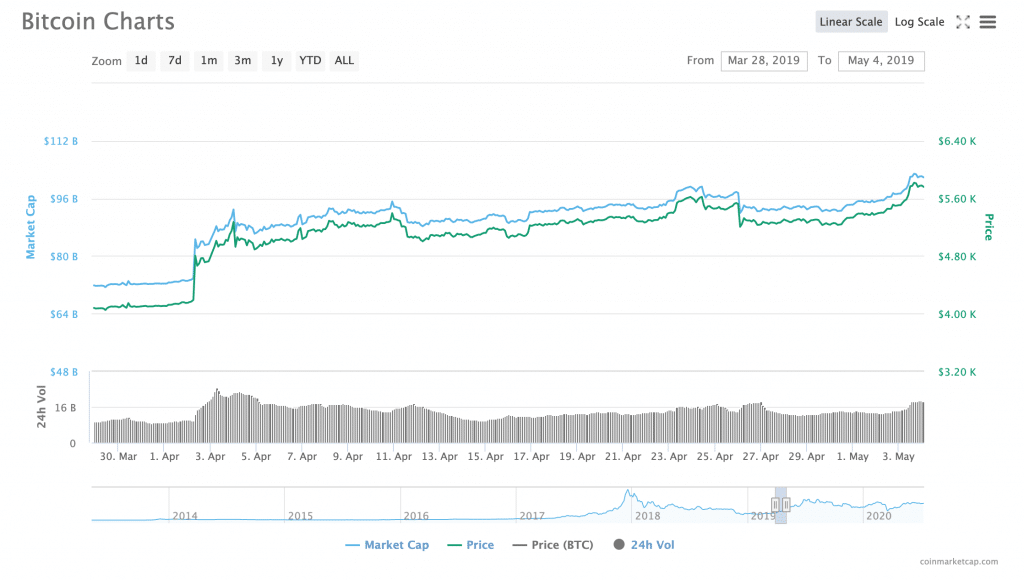
Indeed, April 2019 was quite a stable time for Bitcoin: after a jump upward at the beginning of the month, BTC floated between $4,800 and $5,300; by mid-May, the price of BTC was over $8000, and eventually peaked over $13,000 in July of 2019.
Therefore, it could be that Bitcoin is poised for another large upward movement: David Waslen, co-founder and chief executive of HedgeTrade, also told Finance Magnates that “generally speaking, a drawn-out period of low-volatility price consolidation will lead to a huge move on either side.”
“The longer the consolidation persists, the more violent the breakout or breakdown will end up being,” he explained.
”Investors are sitting on the sidelines, waiting to see which way the market is going to move after breaking this range.”
But will the movement be a breakout or a breakdown?
“The volatility decline could likely be the result of a noticeable lack in clear directional bias concerning the market,” Waslen said. In other words: nobody knows.
Indeed, “uncertainty” seems to be the name of the game at the moment: Tanim Rasul, Head of Operations for Canadian cryptocurrency exchange NDAX, told Finance Magnates that uncertainty is the primary cause of the lack of volatility.
“The case for the bulls versus bears has been ongoing since Bitcoin has recovered from the COVID-19 price drop,” Rasul said.
Tanim Rasul, Head of Operations for Canadian cryptocurrency exchange NDAX.
Therefore, the lack of movement is resulting from--well, a lack of movement: “essentially, the price has been ranging for the past couple of months and many investors are sitting on the sidelines, waiting to see which way the market is going to move after breaking this range,” Rasul explained.
Like Waslen and Hao, Rasul believes that extended flatlining in Bitcoin’s price could give way to a big move: “historically, Bitcoin's volatility index paints a picture that low volatility does not last long and if the past repeats itself, we may see an incoming volatility spike.”
Bitcoin “is starting to act in similar ways to the stock market.”
But could the circumstances of the Bitcoin market alter the historical pattern of consolidation before volatility?
Indeed, OKEx’s Jay Hao told Finance Magnates that Bitcoin’s lack of volatility could be explained by the fact that “BTC is maturing as an asset class with a developed derivatives infrastructure, and it is therefore becoming less volatile.”
Collin Plume, founder and chief executive of Noble Gold Investments, also told Finance Magnates that the development of trading infrastructure could have something to do with the lack of volatility in Bitcoin.
“Now that Bitcoin has moved into the world of day traders and hedge funds, it is starting to act in similar ways to the stock market,” he said.
Therefore, a larger number of investors may be engaging with Bitcoin as they would with traditional markets--specifically, “one of the famous quotes in regards to the stock market is ‘sell in May, and go away’,” Plume said. “Traders used to liquidate their major trades and go on vacation for the summer.”
Collin Plume, chief executive and founder of Noble Gold Investments.
While there haven’t been signs of liquidation in recent months (aside from the market crash in March), it may very well be that the entrance of more traditional institutional traders into the space could mean that the summer months increasingly bring a ‘cooling’ effect to Bitcoin’s volatility levels--though, historically speaking, this hasn’t been the case.
”BTC traders love volatility”--so they may be looking for other markets
However, even if there has been an increase in Bitcoin traders who interact with the Bitcoin market as though it were the stock market, the Bitcoin traders who have traditionally focused on Bitcoin because of its volatility may have been left out in the cold by Bitcoin’s lack of movement.
David Waslen explained that indeed, traditionally speaking, “BTC traders love volatility.”
David Waslen, chief executive and founder of HedgeTrade.
“To be able to profit off an asset class that can move 10% in a matter of minutes provides opportunities that you're unable to find in a lot of the traditional asset classes,” he said. “Superior traders have been able to lock massive returns in the past.”
Therefore, “with the drop in volatility you've seen a drop in [trading] volume as traders are hesitant to take positions, as there are fewer opportunities.”
”Exchanges have seen very low trading volume lately.”
This is indeed the case--cryptocurrency exchanges that typically pull in much of their profits from BTC trades have gotten significantly less revenue from Bitcoin trading than they usually do.
OKEx’s Jay Hao said that indeed, “exchanges have seen very low trading volume lately.”
“Spot trading volume is the lowest that it has been in half a year, and the same pattern can be seen in derivatives,” he said.
“Since the value of Bitcoin derivatives is mainly reflected in hedging market risks, there is a stronger trading demand during periods of high volatility. The decline in bitcoin futures trading volume is mainly due to the continued decline in Bitcoin volatility.”
However, trading volumes on trading platforms outside of spot and derivatives markets don’t seem to have been affected in the same way: “that's not necessarily the case with other cryptocurrency platforms, such as over-the-counter [trading venues,” Jay said.
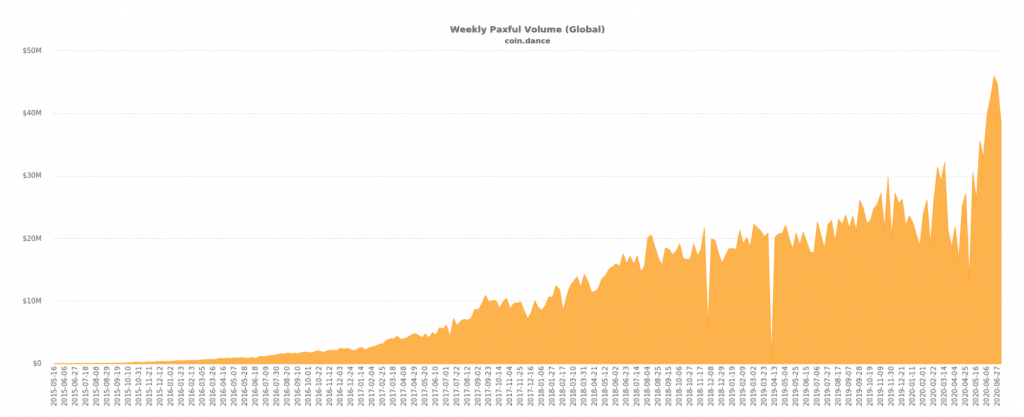
For example, “if you consider Localbitcoins and Paxful, not only has trading volume not decreased, but it has actually increased in some places,” Hao said.
via Coin.Dance
Is this the beginning of altcoin season?
Additionally, while the lack of volatility in Bitcoin may have caused a decrease in Bitcoin-related trading volume on exchanges, it seems to have caused an increase in trading volume related to altcoins, which have maintained higher levels of volatility.
“Traders looking to make big gains may start looking to the altcoin markets where coins like DOGE and COMP are allowing traders to capitalize off of high volatility,” Jay Hao said. This has “[...led] some to say that altcoin season has begun. If this is the case, then it is normal that we see less trading action on BTC.
Jay pointed specifically to tokens that have originated from the decentralized finance space as possible points of attention in crypto trading markets: “there has also been a lot of action in the DeFi space with DeFi tokens seeing massive gains,” he said.
DeFi tokens could be a new hotspot for traders in search of volatility
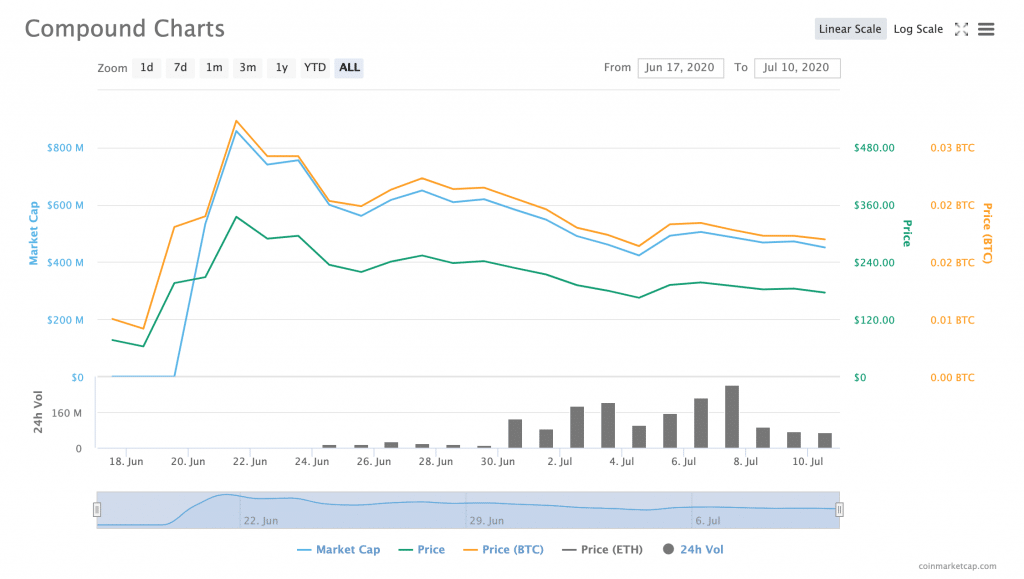
Indeed, the thing that seems to have called the most attention to the DeFi sphere in recent times is the surge in value of governance tokens of certain DeFi platforms–most famously, perhaps, the rise of COMP: the governance token of decentralized loan platform Compound, which jumped nearly 300% in value within a week of its mid-June launch.
So far, COMP has delivered on volatility: after peaking at roughly $372 last month, COMP gradually slipped as low as $165 over the course of several weeks–a decrease of roughly 55 percent. (By press time, the price had recovered to $176.
The quick succession of boom and bust has a number of analysts predicting further volatility in the future as the market eventually settles on what may be a more appropriate valuation of the company: Twitter commentator @ThetaSeek wrote that the project was overvalued, saying that “[…] The value of the Protocol is an AUM business and AUM businesses are normally valued at less than 1/3 or 1/4 of the companies’ AUM.
ThetaSeek said, pointing to BlockFi as an example: “@realblockfi is valued at around 200M when their AUM was 650M. (This is generous as Goldman Sachs is valued at less than 1/50 of their AUM),” he said. Therefore, he believes that COMP should be valued at something like $50.
Editor's note: This article previously and erroneously contained a picture of Bilal Hammoud, President & CEO of NDAX, rather than Tanim Rasul, Head of Operations for Canadian cryptocurrency exchange NDAX. Finance Magnates apologizes to NDAX and to readers for the confusion.
After beginning the year on a fairly steady course towards the $10k mark, Bitcoin--along with the rest of the economy--tanked.
At the end of the second week of March, crypto markets fell so sharply that March 12th came to be colloquially known as “Crypto’s Black Thursday." Between Wednesday, March 11th, and Friday, March 13th, the price of BTC fell from nearly $8,000 to roughly $4,700; by the end of the month, Bitcoin had recovered to roughly $6,400.
Since then, things have recovered considerably for BTC: by the end of April, Bitcoin had already hit back over the $9,000 level, where it managed to stay around for the rest of the quarter; the coin even briefly surpassed $10,000 on June 1st, and has floated between $9,000 and $10,000 ever since.
What has ensued since then has been--well, almost boring; almost a little too boring: in fact, the last 8 weeks or so have constituted one of the least volatile time-periods in Bitcoin’s recent history.
“This is very uncharacteristic of Bitcoin, as it is known for its rampant volatility,” he said.
Therefore, he believes that this period is not likely to continue for too much longer: “it is unlikely that this will continue and quite possible that BTC is gearing up for a big move,” he said. “In fact, the last time that Bitcoin was behaving like this was in April 2019 just before making a huge move.”
OKEx CEO Jay Hao.
Indeed, April 2019 was quite a stable time for Bitcoin: after a jump upward at the beginning of the month, BTC floated between $4,800 and $5,300; by mid-May, the price of BTC was over $8000, and eventually peaked over $13,000 in July of 2019.
Therefore, it could be that Bitcoin is poised for another large upward movement: David Waslen, co-founder and chief executive of HedgeTrade, also told Finance Magnates that “generally speaking, a drawn-out period of low-volatility price consolidation will lead to a huge move on either side.”
“The longer the consolidation persists, the more violent the breakout or breakdown will end up being,” he explained.
”Investors are sitting on the sidelines, waiting to see which way the market is going to move after breaking this range.”
But will the movement be a breakout or a breakdown?
“The volatility decline could likely be the result of a noticeable lack in clear directional bias concerning the market,” Waslen said. In other words: nobody knows.
Indeed, “uncertainty” seems to be the name of the game at the moment: Tanim Rasul, Head of Operations for Canadian cryptocurrency exchange NDAX, told Finance Magnates that uncertainty is the primary cause of the lack of volatility.
“The case for the bulls versus bears has been ongoing since Bitcoin has recovered from the COVID-19 price drop,” Rasul said.
Tanim Rasul, Head of Operations for Canadian cryptocurrency exchange NDAX.
Therefore, the lack of movement is resulting from--well, a lack of movement: “essentially, the price has been ranging for the past couple of months and many investors are sitting on the sidelines, waiting to see which way the market is going to move after breaking this range,” Rasul explained.
Like Waslen and Hao, Rasul believes that extended flatlining in Bitcoin’s price could give way to a big move: “historically, Bitcoin's volatility index paints a picture that low volatility does not last long and if the past repeats itself, we may see an incoming volatility spike.”
Bitcoin “is starting to act in similar ways to the stock market.”
But could the circumstances of the Bitcoin market alter the historical pattern of consolidation before volatility?
Indeed, OKEx’s Jay Hao told Finance Magnates that Bitcoin’s lack of volatility could be explained by the fact that “BTC is maturing as an asset class with a developed derivatives infrastructure, and it is therefore becoming less volatile.”
Collin Plume, founder and chief executive of Noble Gold Investments, also told Finance Magnates that the development of trading infrastructure could have something to do with the lack of volatility in Bitcoin.
“Now that Bitcoin has moved into the world of day traders and hedge funds, it is starting to act in similar ways to the stock market,” he said.
Therefore, a larger number of investors may be engaging with Bitcoin as they would with traditional markets--specifically, “one of the famous quotes in regards to the stock market is ‘sell in May, and go away’,” Plume said. “Traders used to liquidate their major trades and go on vacation for the summer.”
Collin Plume, chief executive and founder of Noble Gold Investments.
While there haven’t been signs of liquidation in recent months (aside from the market crash in March), it may very well be that the entrance of more traditional institutional traders into the space could mean that the summer months increasingly bring a ‘cooling’ effect to Bitcoin’s volatility levels--though, historically speaking, this hasn’t been the case.
”BTC traders love volatility”--so they may be looking for other markets
However, even if there has been an increase in Bitcoin traders who interact with the Bitcoin market as though it were the stock market, the Bitcoin traders who have traditionally focused on Bitcoin because of its volatility may have been left out in the cold by Bitcoin’s lack of movement.
David Waslen explained that indeed, traditionally speaking, “BTC traders love volatility.”
David Waslen, chief executive and founder of HedgeTrade.
“To be able to profit off an asset class that can move 10% in a matter of minutes provides opportunities that you're unable to find in a lot of the traditional asset classes,” he said. “Superior traders have been able to lock massive returns in the past.”
Therefore, “with the drop in volatility you've seen a drop in [trading] volume as traders are hesitant to take positions, as there are fewer opportunities.”
”Exchanges have seen very low trading volume lately.”
This is indeed the case--cryptocurrency exchanges that typically pull in much of their profits from BTC trades have gotten significantly less revenue from Bitcoin trading than they usually do.
OKEx’s Jay Hao said that indeed, “exchanges have seen very low trading volume lately.”
“Spot trading volume is the lowest that it has been in half a year, and the same pattern can be seen in derivatives,” he said.
“Since the value of Bitcoin derivatives is mainly reflected in hedging market risks, there is a stronger trading demand during periods of high volatility. The decline in bitcoin futures trading volume is mainly due to the continued decline in Bitcoin volatility.”
However, trading volumes on trading platforms outside of spot and derivatives markets don’t seem to have been affected in the same way: “that's not necessarily the case with other cryptocurrency platforms, such as over-the-counter [trading venues,” Jay said.
For example, “if you consider Localbitcoins and Paxful, not only has trading volume not decreased, but it has actually increased in some places,” Hao said.
via Coin.Dance
Is this the beginning of altcoin season?
Additionally, while the lack of volatility in Bitcoin may have caused a decrease in Bitcoin-related trading volume on exchanges, it seems to have caused an increase in trading volume related to altcoins, which have maintained higher levels of volatility.
“Traders looking to make big gains may start looking to the altcoin markets where coins like DOGE and COMP are allowing traders to capitalize off of high volatility,” Jay Hao said. This has “[...led] some to say that altcoin season has begun. If this is the case, then it is normal that we see less trading action on BTC.
Jay pointed specifically to tokens that have originated from the decentralized finance space as possible points of attention in crypto trading markets: “there has also been a lot of action in the DeFi space with DeFi tokens seeing massive gains,” he said.
DeFi tokens could be a new hotspot for traders in search of volatility
Indeed, the thing that seems to have called the most attention to the DeFi sphere in recent times is the surge in value of governance tokens of certain DeFi platforms–most famously, perhaps, the rise of COMP: the governance token of decentralized loan platform Compound, which jumped nearly 300% in value within a week of its mid-June launch.
So far, COMP has delivered on volatility: after peaking at roughly $372 last month, COMP gradually slipped as low as $165 over the course of several weeks–a decrease of roughly 55 percent. (By press time, the price had recovered to $176.
The quick succession of boom and bust has a number of analysts predicting further volatility in the future as the market eventually settles on what may be a more appropriate valuation of the company: Twitter commentator @ThetaSeek wrote that the project was overvalued, saying that “[…] The value of the Protocol is an AUM business and AUM businesses are normally valued at less than 1/3 or 1/4 of the companies’ AUM.
ThetaSeek said, pointing to BlockFi as an example: “@realblockfi is valued at around 200M when their AUM was 650M. (This is generous as Goldman Sachs is valued at less than 1/50 of their AUM),” he said. Therefore, he believes that COMP should be valued at something like $50.
Editor's note: This article previously and erroneously contained a picture of Bilal Hammoud, President & CEO of NDAX, rather than Tanim Rasul, Head of Operations for Canadian cryptocurrency exchange NDAX. Finance Magnates apologizes to NDAX and to readers for the confusion.
Rachel is a self-taught crypto geek and a passionate writer. She believes in the power that the written word has to educate, connect and empower individuals to make positive and powerful financial choices. She is the Podcast Host and a Cryptocurrency Editor at Finance Magnates.
Crypto Built More Rails, but the Next Battle Is Over How Much Work a Dollar Can Do
Featured Videos
FP Markets Winner Spotlight 🏆 | Global Broker of the Year 2025 #Trading #Broker #Innovation #Shorts
FP Markets Winner Spotlight 🏆 | Global Broker of the Year 2025 #Trading #Broker #Innovation #Shorts
FP Markets Winner Spotlight 🏆 | Global Broker of the Year 2025 #Trading #Broker #Innovation #Shorts
FP Markets Winner Spotlight 🏆 | Global Broker of the Year 2025 #Trading #Broker #Innovation #Shorts
FP Markets takes the spotlight as Global Broker of the Year 2025 at the Finance Magnates Awards.
Martin Stoilov, Head of Client Experience, shares that trust, innovation, and people played a key role in the company’s success, supported by a strong foundation of integrity and client-centricity.
Following this milestone, FP Markets continues to focus on growth, technology investment, and its core values of transparency and excellence.
👉 Be part of FM Awards 2026: https://awards.financemagnates.com/#nominate
FP Markets takes the spotlight as Global Broker of the Year 2025 at the Finance Magnates Awards.
Martin Stoilov, Head of Client Experience, shares that trust, innovation, and people played a key role in the company’s success, supported by a strong foundation of integrity and client-centricity.
Following this milestone, FP Markets continues to focus on growth, technology investment, and its core values of transparency and excellence.
👉 Be part of FM Awards 2026: https://awards.financemagnates.com/#nominate
FP Markets takes the spotlight as Global Broker of the Year 2025 at the Finance Magnates Awards.
Martin Stoilov, Head of Client Experience, shares that trust, innovation, and people played a key role in the company’s success, supported by a strong foundation of integrity and client-centricity.
Following this milestone, FP Markets continues to focus on growth, technology investment, and its core values of transparency and excellence.
👉 Be part of FM Awards 2026: https://awards.financemagnates.com/#nominate
FP Markets takes the spotlight as Global Broker of the Year 2025 at the Finance Magnates Awards.
Martin Stoilov, Head of Client Experience, shares that trust, innovation, and people played a key role in the company’s success, supported by a strong foundation of integrity and client-centricity.
Following this milestone, FP Markets continues to focus on growth, technology investment, and its core values of transparency and excellence.
👉 Be part of FM Awards 2026: https://awards.financemagnates.com/#nominate
In this video, we review @HolaPrimeMarketsOfficial, a multi-asset forex and CFDs broker offering different account types, trading platforms, and flexible trading conditions.
We cover the broker’s overall offering, including account options, trading environment, platforms like MT4 and MT5, and additional services such as managed accounts and fast withdrawals.
Watch the full video to see if Hola Prime Markets fits your trading needs.
📣 Stay up to date with the latest in finance and trading. Follow Finance Magnates for industry news, insights, and global event coverage.
Connect with us:
🔗 LinkedIn: /financemagnates
👍 Facebook: /financemagnates
📸 Instagram: https://www.instagram.com/financemagnates
🐦 X: https://x.com/financemagnates
🎥 TikTok: https://www.tiktok.com/tag/financemagnates
▶️ YouTube: /@financemagnates_official
#HolaPrime #ForexBroker #CFDTrading #FinanceMagnates #Trading #Forex #BrokerReview
In this video, we review @HolaPrimeMarketsOfficial, a multi-asset forex and CFDs broker offering different account types, trading platforms, and flexible trading conditions.
We cover the broker’s overall offering, including account options, trading environment, platforms like MT4 and MT5, and additional services such as managed accounts and fast withdrawals.
Watch the full video to see if Hola Prime Markets fits your trading needs.
📣 Stay up to date with the latest in finance and trading. Follow Finance Magnates for industry news, insights, and global event coverage.
Connect with us:
🔗 LinkedIn: /financemagnates
👍 Facebook: /financemagnates
📸 Instagram: https://www.instagram.com/financemagnates
🐦 X: https://x.com/financemagnates
🎥 TikTok: https://www.tiktok.com/tag/financemagnates
▶️ YouTube: /@financemagnates_official
#HolaPrime #ForexBroker #CFDTrading #FinanceMagnates #Trading #Forex #BrokerReview
In this video, we review @HolaPrimeMarketsOfficial, a multi-asset forex and CFDs broker offering different account types, trading platforms, and flexible trading conditions.
We cover the broker’s overall offering, including account options, trading environment, platforms like MT4 and MT5, and additional services such as managed accounts and fast withdrawals.
Watch the full video to see if Hola Prime Markets fits your trading needs.
📣 Stay up to date with the latest in finance and trading. Follow Finance Magnates for industry news, insights, and global event coverage.
Connect with us:
🔗 LinkedIn: /financemagnates
👍 Facebook: /financemagnates
📸 Instagram: https://www.instagram.com/financemagnates
🐦 X: https://x.com/financemagnates
🎥 TikTok: https://www.tiktok.com/tag/financemagnates
▶️ YouTube: /@financemagnates_official
#HolaPrime #ForexBroker #CFDTrading #FinanceMagnates #Trading #Forex #BrokerReview
In this video, we review @HolaPrimeMarketsOfficial, a multi-asset forex and CFDs broker offering different account types, trading platforms, and flexible trading conditions.
We cover the broker’s overall offering, including account options, trading environment, platforms like MT4 and MT5, and additional services such as managed accounts and fast withdrawals.
Watch the full video to see if Hola Prime Markets fits your trading needs.
📣 Stay up to date with the latest in finance and trading. Follow Finance Magnates for industry news, insights, and global event coverage.
Connect with us:
🔗 LinkedIn: /financemagnates
👍 Facebook: /financemagnates
📸 Instagram: https://www.instagram.com/financemagnates
🐦 X: https://x.com/financemagnates
🎥 TikTok: https://www.tiktok.com/tag/financemagnates
▶️ YouTube: /@financemagnates_official
#HolaPrime #ForexBroker #CFDTrading #FinanceMagnates #Trading #Forex #BrokerReview
In this video, we review @HolaPrimeMarketsOfficial, a multi-asset forex and CFDs broker offering different account types, trading platforms, and flexible trading conditions.
We cover the broker’s overall offering, including account options, trading environment, platforms like MT4 and MT5, and additional services such as managed accounts and fast withdrawals.
Watch the full video to see if Hola Prime Markets fits your trading needs.
📣 Stay up to date with the latest in finance and trading. Follow Finance Magnates for industry news, insights, and global event coverage.
Connect with us:
🔗 LinkedIn: /financemagnates
👍 Facebook: /financemagnates
📸 Instagram: https://www.instagram.com/financemagnates
🐦 X: https://x.com/financemagnates
🎥 TikTok: https://www.tiktok.com/tag/financemagnates
▶️ YouTube: /@financemagnates_official
#HolaPrime #ForexBroker #CFDTrading #FinanceMagnates #Trading #Forex #BrokerReview
In this video, we review @HolaPrimeMarketsOfficial, a multi-asset forex and CFDs broker offering different account types, trading platforms, and flexible trading conditions.
We cover the broker’s overall offering, including account options, trading environment, platforms like MT4 and MT5, and additional services such as managed accounts and fast withdrawals.
Watch the full video to see if Hola Prime Markets fits your trading needs.
📣 Stay up to date with the latest in finance and trading. Follow Finance Magnates for industry news, insights, and global event coverage.
Connect with us:
🔗 LinkedIn: /financemagnates
👍 Facebook: /financemagnates
📸 Instagram: https://www.instagram.com/financemagnates
🐦 X: https://x.com/financemagnates
🎥 TikTok: https://www.tiktok.com/tag/financemagnates
▶️ YouTube: /@financemagnates_official
#HolaPrime #ForexBroker #CFDTrading #FinanceMagnates #Trading #Forex #BrokerReview
Hola Prime Review: What You Need to Know | Full Breakdown by Finance Magnates
Hola Prime Review: What You Need to Know | Full Breakdown by Finance Magnates
Hola Prime Review: What You Need to Know | Full Breakdown by Finance Magnates
Hola Prime Review: What You Need to Know | Full Breakdown by Finance Magnates
Hola Prime Review: What You Need to Know | Full Breakdown by Finance Magnates
Hola Prime Review: What You Need to Know | Full Breakdown by Finance Magnates
In this video, we review @HolaPrime_Global, a proprietary trading firm offering evaluation programs and performance-based payouts in simulated market environments.
We cover how the challenge model works, including account types, profit splits (up to 95%), trading rules, and what it takes to reach a funded account. You’ll also learn about available platforms like MT4, MT5, cTrader, and more, along with insights into payouts, support, and trading conditions.
Watch the full video to see if Hola Prime fits your trading style.
📣 Stay up to date with the latest in finance and trading. Follow Finance Magnates for industry news, insights, and global event coverage.
Connect with us:
🔗 LinkedIn: /financemagnates
👍 Facebook: /financemagnates
📸 Instagram: https://www.instagram.com/financemagnates
🐦 X: https://x.com/financemagnates
🎥 TikTok: https://www.tiktok.com/tag/financemagnates
▶️ YouTube: /@financemagnates_official
#HolaPrime #PropFirm #Trading #FinanceMagnates #Forex #FuturesTrading #TradingReview #PropFirmReview
In this video, we review @HolaPrime_Global, a proprietary trading firm offering evaluation programs and performance-based payouts in simulated market environments.
We cover how the challenge model works, including account types, profit splits (up to 95%), trading rules, and what it takes to reach a funded account. You’ll also learn about available platforms like MT4, MT5, cTrader, and more, along with insights into payouts, support, and trading conditions.
Watch the full video to see if Hola Prime fits your trading style.
📣 Stay up to date with the latest in finance and trading. Follow Finance Magnates for industry news, insights, and global event coverage.
Connect with us:
🔗 LinkedIn: /financemagnates
👍 Facebook: /financemagnates
📸 Instagram: https://www.instagram.com/financemagnates
🐦 X: https://x.com/financemagnates
🎥 TikTok: https://www.tiktok.com/tag/financemagnates
▶️ YouTube: /@financemagnates_official
#HolaPrime #PropFirm #Trading #FinanceMagnates #Forex #FuturesTrading #TradingReview #PropFirmReview
In this video, we review @HolaPrime_Global, a proprietary trading firm offering evaluation programs and performance-based payouts in simulated market environments.
We cover how the challenge model works, including account types, profit splits (up to 95%), trading rules, and what it takes to reach a funded account. You’ll also learn about available platforms like MT4, MT5, cTrader, and more, along with insights into payouts, support, and trading conditions.
Watch the full video to see if Hola Prime fits your trading style.
📣 Stay up to date with the latest in finance and trading. Follow Finance Magnates for industry news, insights, and global event coverage.
Connect with us:
🔗 LinkedIn: /financemagnates
👍 Facebook: /financemagnates
📸 Instagram: https://www.instagram.com/financemagnates
🐦 X: https://x.com/financemagnates
🎥 TikTok: https://www.tiktok.com/tag/financemagnates
▶️ YouTube: /@financemagnates_official
#HolaPrime #PropFirm #Trading #FinanceMagnates #Forex #FuturesTrading #TradingReview #PropFirmReview
In this video, we review @HolaPrime_Global, a proprietary trading firm offering evaluation programs and performance-based payouts in simulated market environments.
We cover how the challenge model works, including account types, profit splits (up to 95%), trading rules, and what it takes to reach a funded account. You’ll also learn about available platforms like MT4, MT5, cTrader, and more, along with insights into payouts, support, and trading conditions.
Watch the full video to see if Hola Prime fits your trading style.
📣 Stay up to date with the latest in finance and trading. Follow Finance Magnates for industry news, insights, and global event coverage.
Connect with us:
🔗 LinkedIn: /financemagnates
👍 Facebook: /financemagnates
📸 Instagram: https://www.instagram.com/financemagnates
🐦 X: https://x.com/financemagnates
🎥 TikTok: https://www.tiktok.com/tag/financemagnates
▶️ YouTube: /@financemagnates_official
#HolaPrime #PropFirm #Trading #FinanceMagnates #Forex #FuturesTrading #TradingReview #PropFirmReview
In this video, we review @HolaPrime_Global, a proprietary trading firm offering evaluation programs and performance-based payouts in simulated market environments.
We cover how the challenge model works, including account types, profit splits (up to 95%), trading rules, and what it takes to reach a funded account. You’ll also learn about available platforms like MT4, MT5, cTrader, and more, along with insights into payouts, support, and trading conditions.
Watch the full video to see if Hola Prime fits your trading style.
📣 Stay up to date with the latest in finance and trading. Follow Finance Magnates for industry news, insights, and global event coverage.
Connect with us:
🔗 LinkedIn: /financemagnates
👍 Facebook: /financemagnates
📸 Instagram: https://www.instagram.com/financemagnates
🐦 X: https://x.com/financemagnates
🎥 TikTok: https://www.tiktok.com/tag/financemagnates
▶️ YouTube: /@financemagnates_official
#HolaPrime #PropFirm #Trading #FinanceMagnates #Forex #FuturesTrading #TradingReview #PropFirmReview
In this video, we review @HolaPrime_Global, a proprietary trading firm offering evaluation programs and performance-based payouts in simulated market environments.
We cover how the challenge model works, including account types, profit splits (up to 95%), trading rules, and what it takes to reach a funded account. You’ll also learn about available platforms like MT4, MT5, cTrader, and more, along with insights into payouts, support, and trading conditions.
Watch the full video to see if Hola Prime fits your trading style.
📣 Stay up to date with the latest in finance and trading. Follow Finance Magnates for industry news, insights, and global event coverage.
Connect with us:
🔗 LinkedIn: /financemagnates
👍 Facebook: /financemagnates
📸 Instagram: https://www.instagram.com/financemagnates
🐦 X: https://x.com/financemagnates
🎥 TikTok: https://www.tiktok.com/tag/financemagnates
▶️ YouTube: /@financemagnates_official
#HolaPrime #PropFirm #Trading #FinanceMagnates #Forex #FuturesTrading #TradingReview #PropFirmReview
Axi Winner Spotlight 🏆 | Global Most Innovative Broker 2025 #Innovation #Trading #Fintech #Broker
Axi Winner Spotlight 🏆 | Global Most Innovative Broker 2025 #Innovation #Trading #Fintech #Broker
Axi Winner Spotlight 🏆 | Global Most Innovative Broker 2025 #Innovation #Trading #Fintech #Broker
Axi Winner Spotlight 🏆 | Global Most Innovative Broker 2025 #Innovation #Trading #Fintech #Broker
Axi Winner Spotlight 🏆 | Global Most Innovative Broker 2025 #Innovation #Trading #Fintech #Broker
Axi Winner Spotlight 🏆 | Global Most Innovative Broker 2025 #Innovation #Trading #Fintech #Broker
Axi takes the spotlight at the Finance Magnates Awards, winning Global Most Innovative Broker 2025.
Olivia Xenofontos and Ivanna Openko share how the team will feel: proud, motivated, and ready to keep delivering.
They also describe the night as well-organized, focused, and enjoyable for all.
👉 Be part of FM Awards 2026.
Axi takes the spotlight at the Finance Magnates Awards, winning Global Most Innovative Broker 2025.
Olivia Xenofontos and Ivanna Openko share how the team will feel: proud, motivated, and ready to keep delivering.
They also describe the night as well-organized, focused, and enjoyable for all.
👉 Be part of FM Awards 2026.
Axi takes the spotlight at the Finance Magnates Awards, winning Global Most Innovative Broker 2025.
Olivia Xenofontos and Ivanna Openko share how the team will feel: proud, motivated, and ready to keep delivering.
They also describe the night as well-organized, focused, and enjoyable for all.
👉 Be part of FM Awards 2026.
Axi takes the spotlight at the Finance Magnates Awards, winning Global Most Innovative Broker 2025.
Olivia Xenofontos and Ivanna Openko share how the team will feel: proud, motivated, and ready to keep delivering.
They also describe the night as well-organized, focused, and enjoyable for all.
👉 Be part of FM Awards 2026.
Axi takes the spotlight at the Finance Magnates Awards, winning Global Most Innovative Broker 2025.
Olivia Xenofontos and Ivanna Openko share how the team will feel: proud, motivated, and ready to keep delivering.
They also describe the night as well-organized, focused, and enjoyable for all.
👉 Be part of FM Awards 2026.
Axi takes the spotlight at the Finance Magnates Awards, winning Global Most Innovative Broker 2025.
Olivia Xenofontos and Ivanna Openko share how the team will feel: proud, motivated, and ready to keep delivering.
They also describe the night as well-organized, focused, and enjoyable for all.
👉 Be part of FM Awards 2026.
Recognition that matters.
Built on transparency.
Driven by the industry.
The Finance Magnates Awards 2026.
Nominations are now open.
🔗 https://awards.financemagnates.com/?utm_source=SM&utm_medium=social&utm_campaign=recognition-matters
Recognition that matters.
Built on transparency.
Driven by the industry.
The Finance Magnates Awards 2026.
Nominations are now open.
🔗 https://awards.financemagnates.com/?utm_source=SM&utm_medium=social&utm_campaign=recognition-matters
Recognition that matters.
Built on transparency.
Driven by the industry.
The Finance Magnates Awards 2026.
Nominations are now open.
🔗 https://awards.financemagnates.com/?utm_source=SM&utm_medium=social&utm_campaign=recognition-matters
Recognition that matters.
Built on transparency.
Driven by the industry.
The Finance Magnates Awards 2026.
Nominations are now open.
🔗 https://awards.financemagnates.com/?utm_source=SM&utm_medium=social&utm_campaign=recognition-matters
Recognition that matters.
Built on transparency.
Driven by the industry.
The Finance Magnates Awards 2026.
Nominations are now open.
🔗 https://awards.financemagnates.com/?utm_source=SM&utm_medium=social&utm_campaign=recognition-matters
Recognition that matters.
Built on transparency.
Driven by the industry.
The Finance Magnates Awards 2026.
Nominations are now open.
🔗 https://awards.financemagnates.com/?utm_source=SM&utm_medium=social&utm_campaign=recognition-matters