Four nearly a month, Bitcoin has traded fairly consistently at over $45K.
FM
After a few harrowing moments last week, the price of Bitcoin seems to have stabilized, at least, for now.
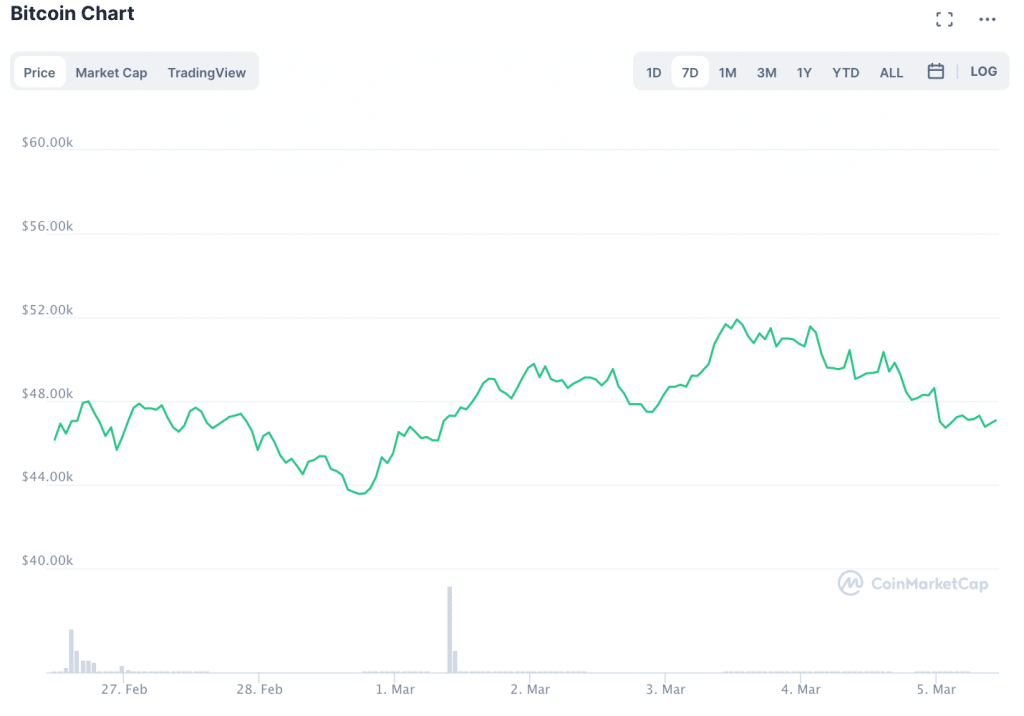
Indeed, Bitcoin sank as low as $43K on Sunday, February 28th, before making a recovery above $46K on Monday. Since then, Bitcoin has breached the $51K resistance line, and, at press time, settled around $47,200.
As Bitcoin continues to maintain levels above $45K, questions about whether or not Bitcoin will be diving below $40K (or even $30K) seem to be less of a concern for Bitcoin hodlers.
In fact, a number of headlines over the past 24 hours point in the opposite direction. Bloomberg reported that Galaxy Digital Founder, Mike Novogratz recently reiterated his prediction for Bitcoin at $100,000; The Block reported that a “Goldman Sachs crypto survey show[ed] 22% of respondents expect $100,000-plus bitcoin.”
According to Reuters, Goldman announced earlier this week that it had “restarted its cryptocurrency trading desk and will begin dealing bitcoin futures and non-deliverable forwards for clients from next week.” In other news, Purpose Bitcoin ETF, the first bitcoin exchange-traded fund (ETF) in North America, announced this week that it now holds over 11,000 bitcoins.
In other words, $100,000 may very well be in the future for Bitcoin. However, for now, Bitcoin still has a lot of growing to do and a lot of growing pains to overcome. What is contributing to Bitcoin’s stability of $45K, and what is next for BTC?
“The Initial Fear of Missing Out Has Scaled Back. Now Investors Are Holding BTC as an Alternative to Cash Balances.”
Richard Gardner, Chief Executive of tech services provider firm, Modulus, also told Finance Magnates that BTC’s price stabilization is largely due to the fact that “mainstream entities are beginning to buy in.”
Yuriy Anosov, the Head of Trading at digital asset custody firm, Anchorage.
“From Elon Musk and PayPal to institutions like BNY Mellon and payment processors like MasterCard. Even longtime crypto foes like Shark Tank's Kevin O'Leary,” he said. “[...] The few people left naysaying Bitcoin are either those looking to buy-in at a cheaper price, or those with a vested interest in making sure that it fails.”
However, Yuriy Anosov, the Head of Trading at digital asset custody firm, Anchorage, told Finance Magnates that it is not just the fact that more institutions are buying into Bitcoin. It is the way that they are doing it.
“The initial fear of missing out has scaled back, now investors are holding BTC as an alternative to cash balances,” Anosov said. Indeed, institutional investors in particular seem to increasingly see Bitcoin as a hedge against inflation or a store-of-value as the Federal Reserve continues to print more USD.
”We’re Seeing Institutional Investors Ask for Services That Make Money Whether Bitcoin’s Price Moves up or Down.”
Companies that buy Bitcoin may not have large portions of their balance sheets in BTC holdings, but Anosov explained that the companies that have taken the leap are in it for the long haul.
“Tesla and Microstrategy’s moves have become the play for a devoted group of corporations and retail,” he said, adding that “at Anchorage, we’re seeing institutional investors ask for services that make money whether bitcoin’s price moves up or down.”
“We are starting to see crypto native companies such as Coinbase and BitGo reporting through various filings that they hold significant BTC on their balance sheets, which is giving investors more confidence in long-term crypto investments,” he added.
”March Is Historically a Bearish Month for Bitcoin.”
Barney Mannerings, Founder of Vega, also told Finance Magnates that Bitcoin’s recent price stabilization is par for the course. Vega is a decentralized derivatives trading protocol that bridges traditional finance and DeFi.
Barney Mannerings, Founder of Vega.
"Aggressive moves are always accompanied by periods of consolidation, which occur when traders collectively sell out of their positions to book profits,” Mannerings explained, although he does not see Bitcoin’s hold over $45K as 'stabilization' so much as a 'correction'.
“Bitcoin appears to be entering into a prolonged corrective period around $50K, rather than stabilizing at a constant price,” he explained. “How long the market will trade sideways for is difficult to predict, though many speculate that March is historically a bearish month for Bitcoin as a result of the tax cycle coming to an end in many major economies."
Gardner told Finance Magnates that indeed, “Bitcoin will be Bitcoin.”
Richard Gardner, Chief Executive of tech services provider firm, Modulus.
However, Mannerings believes that these corrective periods in the altcoin space are ultimately a positive thing. "Corrective periods in Bitcoin bull markets often represent good opportunities to acquire altcoins at a discounted price,” he said.
“Altcoins correlate heavily with Bitcoin, but they are much more volatile. For many traders, this offers them a chance to pick up altcoins at a large discount compared to their recent highs. We often see a lot of accumulation taking place before prices run even higher than they were before as the Bitcoin market begins to move higher yet again."
“The Altcoin Market Is Being Affected Tremendously.”
And, even if altcoin markets have more corrections ahead in the near future, Gardner pointed out that pieces are still on the upswing in terms of longer-term trends. “The altcoin market is being affected tremendously, most notably through a resurgence in interest,” he said. “Prices are rising as they were in 2018, and those who invested in altcoins at the 2018 highwater mark and held onto it. Those people are now in the black.”
Beyond token prices, the price of Bitcoin is having an effect on the DeFi lending platforms that offer Bitcoin products to their clients.
Anosov told Finance Magnates that: “while BTC itself does not much impact the crypto markets besides their innate correlation, DeFi continues to attract more volume as crypto lenders rely on DeFi platforms more to source coins they are looking to lend to their clients.”
DeFi Presses Onward
And, while DeFi token prices may continue to be even more volatile than Bitcoin, a number of projects within the space are continuing to steadily work towards their technological goals.
Wall Street veteran, Jim Bianco, who is also the president of Bianco Research and a Bloomberg columnist, recently told Fox News that “DeFi could disrupt the current financial system the way ride-sharing companies disrupted taxi companies or the internet disrupted newspapers, or e-commerce disrupted retailing.”
Indeed, the amount of viable DeFi projects is continuing to grow. For example, Coindesk recently reported that: “Insurance broker Aon is dipping a toe into decentralized finance (DeFi)”: the company has partnered with insurtech platform Nayms to provide cryptocurrency holders with decentralized insurance that will cover software- and hack-induced losses.
There is certainly a market for this kind of insurance in the DeFi space. Just this week, a DeFi project known as 'Meerkat Finance' claimed that it had been robbed of $31 million in a single day after its launch on the Binance Smart Chain.
Unfortunately, these kinds of incidents are a fairly regular occurrence in the DeFi space. Jim Bianco said that DeFi is “nascent and buggy. It’s got problems, but they will solve those.”
After a few harrowing moments last week, the price of Bitcoin seems to have stabilized, at least, for now.
Indeed, Bitcoin sank as low as $43K on Sunday, February 28th, before making a recovery above $46K on Monday. Since then, Bitcoin has breached the $51K resistance line, and, at press time, settled around $47,200.
As Bitcoin continues to maintain levels above $45K, questions about whether or not Bitcoin will be diving below $40K (or even $30K) seem to be less of a concern for Bitcoin hodlers.
In fact, a number of headlines over the past 24 hours point in the opposite direction. Bloomberg reported that Galaxy Digital Founder, Mike Novogratz recently reiterated his prediction for Bitcoin at $100,000; The Block reported that a “Goldman Sachs crypto survey show[ed] 22% of respondents expect $100,000-plus bitcoin.”
According to Reuters, Goldman announced earlier this week that it had “restarted its cryptocurrency trading desk and will begin dealing bitcoin futures and non-deliverable forwards for clients from next week.” In other news, Purpose Bitcoin ETF, the first bitcoin exchange-traded fund (ETF) in North America, announced this week that it now holds over 11,000 bitcoins.
In other words, $100,000 may very well be in the future for Bitcoin. However, for now, Bitcoin still has a lot of growing to do and a lot of growing pains to overcome. What is contributing to Bitcoin’s stability of $45K, and what is next for BTC?
“The Initial Fear of Missing Out Has Scaled Back. Now Investors Are Holding BTC as an Alternative to Cash Balances.”
Richard Gardner, Chief Executive of tech services provider firm, Modulus, also told Finance Magnates that BTC’s price stabilization is largely due to the fact that “mainstream entities are beginning to buy in.”
Yuriy Anosov, the Head of Trading at digital asset custody firm, Anchorage.
“From Elon Musk and PayPal to institutions like BNY Mellon and payment processors like MasterCard. Even longtime crypto foes like Shark Tank's Kevin O'Leary,” he said. “[...] The few people left naysaying Bitcoin are either those looking to buy-in at a cheaper price, or those with a vested interest in making sure that it fails.”
However, Yuriy Anosov, the Head of Trading at digital asset custody firm, Anchorage, told Finance Magnates that it is not just the fact that more institutions are buying into Bitcoin. It is the way that they are doing it.
“The initial fear of missing out has scaled back, now investors are holding BTC as an alternative to cash balances,” Anosov said. Indeed, institutional investors in particular seem to increasingly see Bitcoin as a hedge against inflation or a store-of-value as the Federal Reserve continues to print more USD.
”We’re Seeing Institutional Investors Ask for Services That Make Money Whether Bitcoin’s Price Moves up or Down.”
Companies that buy Bitcoin may not have large portions of their balance sheets in BTC holdings, but Anosov explained that the companies that have taken the leap are in it for the long haul.
“Tesla and Microstrategy’s moves have become the play for a devoted group of corporations and retail,” he said, adding that “at Anchorage, we’re seeing institutional investors ask for services that make money whether bitcoin’s price moves up or down.”
“We are starting to see crypto native companies such as Coinbase and BitGo reporting through various filings that they hold significant BTC on their balance sheets, which is giving investors more confidence in long-term crypto investments,” he added.
”March Is Historically a Bearish Month for Bitcoin.”
Barney Mannerings, Founder of Vega, also told Finance Magnates that Bitcoin’s recent price stabilization is par for the course. Vega is a decentralized derivatives trading protocol that bridges traditional finance and DeFi.
Barney Mannerings, Founder of Vega.
"Aggressive moves are always accompanied by periods of consolidation, which occur when traders collectively sell out of their positions to book profits,” Mannerings explained, although he does not see Bitcoin’s hold over $45K as 'stabilization' so much as a 'correction'.
“Bitcoin appears to be entering into a prolonged corrective period around $50K, rather than stabilizing at a constant price,” he explained. “How long the market will trade sideways for is difficult to predict, though many speculate that March is historically a bearish month for Bitcoin as a result of the tax cycle coming to an end in many major economies."
Gardner told Finance Magnates that indeed, “Bitcoin will be Bitcoin.”
Richard Gardner, Chief Executive of tech services provider firm, Modulus.
However, Mannerings believes that these corrective periods in the altcoin space are ultimately a positive thing. "Corrective periods in Bitcoin bull markets often represent good opportunities to acquire altcoins at a discounted price,” he said.
“Altcoins correlate heavily with Bitcoin, but they are much more volatile. For many traders, this offers them a chance to pick up altcoins at a large discount compared to their recent highs. We often see a lot of accumulation taking place before prices run even higher than they were before as the Bitcoin market begins to move higher yet again."
“The Altcoin Market Is Being Affected Tremendously.”
And, even if altcoin markets have more corrections ahead in the near future, Gardner pointed out that pieces are still on the upswing in terms of longer-term trends. “The altcoin market is being affected tremendously, most notably through a resurgence in interest,” he said. “Prices are rising as they were in 2018, and those who invested in altcoins at the 2018 highwater mark and held onto it. Those people are now in the black.”
Beyond token prices, the price of Bitcoin is having an effect on the DeFi lending platforms that offer Bitcoin products to their clients.
Anosov told Finance Magnates that: “while BTC itself does not much impact the crypto markets besides their innate correlation, DeFi continues to attract more volume as crypto lenders rely on DeFi platforms more to source coins they are looking to lend to their clients.”
DeFi Presses Onward
And, while DeFi token prices may continue to be even more volatile than Bitcoin, a number of projects within the space are continuing to steadily work towards their technological goals.
Wall Street veteran, Jim Bianco, who is also the president of Bianco Research and a Bloomberg columnist, recently told Fox News that “DeFi could disrupt the current financial system the way ride-sharing companies disrupted taxi companies or the internet disrupted newspapers, or e-commerce disrupted retailing.”
Indeed, the amount of viable DeFi projects is continuing to grow. For example, Coindesk recently reported that: “Insurance broker Aon is dipping a toe into decentralized finance (DeFi)”: the company has partnered with insurtech platform Nayms to provide cryptocurrency holders with decentralized insurance that will cover software- and hack-induced losses.
There is certainly a market for this kind of insurance in the DeFi space. Just this week, a DeFi project known as 'Meerkat Finance' claimed that it had been robbed of $31 million in a single day after its launch on the Binance Smart Chain.
Unfortunately, these kinds of incidents are a fairly regular occurrence in the DeFi space. Jim Bianco said that DeFi is “nascent and buggy. It’s got problems, but they will solve those.”
Rachel is a self-taught crypto geek and a passionate writer. She believes in the power that the written word has to educate, connect and empower individuals to make positive and powerful financial choices. She is the Podcast Host and a Cryptocurrency Editor at Finance Magnates.
Crypto Built More Rails, but the Next Battle Is Over How Much Work a Dollar Can Do
Featured Videos
FP Markets Winner Spotlight 🏆 | Global Broker of the Year 2025 #Trading #Broker #Innovation #Shorts
FP Markets Winner Spotlight 🏆 | Global Broker of the Year 2025 #Trading #Broker #Innovation #Shorts
FP Markets Winner Spotlight 🏆 | Global Broker of the Year 2025 #Trading #Broker #Innovation #Shorts
FP Markets Winner Spotlight 🏆 | Global Broker of the Year 2025 #Trading #Broker #Innovation #Shorts
FP Markets takes the spotlight as Global Broker of the Year 2025 at the Finance Magnates Awards.
Martin Stoilov, Head of Client Experience, shares that trust, innovation, and people played a key role in the company’s success, supported by a strong foundation of integrity and client-centricity.
Following this milestone, FP Markets continues to focus on growth, technology investment, and its core values of transparency and excellence.
👉 Be part of FM Awards 2026: https://awards.financemagnates.com/#nominate
FP Markets takes the spotlight as Global Broker of the Year 2025 at the Finance Magnates Awards.
Martin Stoilov, Head of Client Experience, shares that trust, innovation, and people played a key role in the company’s success, supported by a strong foundation of integrity and client-centricity.
Following this milestone, FP Markets continues to focus on growth, technology investment, and its core values of transparency and excellence.
👉 Be part of FM Awards 2026: https://awards.financemagnates.com/#nominate
FP Markets takes the spotlight as Global Broker of the Year 2025 at the Finance Magnates Awards.
Martin Stoilov, Head of Client Experience, shares that trust, innovation, and people played a key role in the company’s success, supported by a strong foundation of integrity and client-centricity.
Following this milestone, FP Markets continues to focus on growth, technology investment, and its core values of transparency and excellence.
👉 Be part of FM Awards 2026: https://awards.financemagnates.com/#nominate
FP Markets takes the spotlight as Global Broker of the Year 2025 at the Finance Magnates Awards.
Martin Stoilov, Head of Client Experience, shares that trust, innovation, and people played a key role in the company’s success, supported by a strong foundation of integrity and client-centricity.
Following this milestone, FP Markets continues to focus on growth, technology investment, and its core values of transparency and excellence.
👉 Be part of FM Awards 2026: https://awards.financemagnates.com/#nominate
In this video, we review @HolaPrimeMarketsOfficial, a multi-asset forex and CFDs broker offering different account types, trading platforms, and flexible trading conditions.
We cover the broker’s overall offering, including account options, trading environment, platforms like MT4 and MT5, and additional services such as managed accounts and fast withdrawals.
Watch the full video to see if Hola Prime Markets fits your trading needs.
📣 Stay up to date with the latest in finance and trading. Follow Finance Magnates for industry news, insights, and global event coverage.
Connect with us:
🔗 LinkedIn: /financemagnates
👍 Facebook: /financemagnates
📸 Instagram: https://www.instagram.com/financemagnates
🐦 X: https://x.com/financemagnates
🎥 TikTok: https://www.tiktok.com/tag/financemagnates
▶️ YouTube: /@financemagnates_official
#HolaPrime #ForexBroker #CFDTrading #FinanceMagnates #Trading #Forex #BrokerReview
In this video, we review @HolaPrimeMarketsOfficial, a multi-asset forex and CFDs broker offering different account types, trading platforms, and flexible trading conditions.
We cover the broker’s overall offering, including account options, trading environment, platforms like MT4 and MT5, and additional services such as managed accounts and fast withdrawals.
Watch the full video to see if Hola Prime Markets fits your trading needs.
📣 Stay up to date with the latest in finance and trading. Follow Finance Magnates for industry news, insights, and global event coverage.
Connect with us:
🔗 LinkedIn: /financemagnates
👍 Facebook: /financemagnates
📸 Instagram: https://www.instagram.com/financemagnates
🐦 X: https://x.com/financemagnates
🎥 TikTok: https://www.tiktok.com/tag/financemagnates
▶️ YouTube: /@financemagnates_official
#HolaPrime #ForexBroker #CFDTrading #FinanceMagnates #Trading #Forex #BrokerReview
In this video, we review @HolaPrimeMarketsOfficial, a multi-asset forex and CFDs broker offering different account types, trading platforms, and flexible trading conditions.
We cover the broker’s overall offering, including account options, trading environment, platforms like MT4 and MT5, and additional services such as managed accounts and fast withdrawals.
Watch the full video to see if Hola Prime Markets fits your trading needs.
📣 Stay up to date with the latest in finance and trading. Follow Finance Magnates for industry news, insights, and global event coverage.
Connect with us:
🔗 LinkedIn: /financemagnates
👍 Facebook: /financemagnates
📸 Instagram: https://www.instagram.com/financemagnates
🐦 X: https://x.com/financemagnates
🎥 TikTok: https://www.tiktok.com/tag/financemagnates
▶️ YouTube: /@financemagnates_official
#HolaPrime #ForexBroker #CFDTrading #FinanceMagnates #Trading #Forex #BrokerReview
In this video, we review @HolaPrimeMarketsOfficial, a multi-asset forex and CFDs broker offering different account types, trading platforms, and flexible trading conditions.
We cover the broker’s overall offering, including account options, trading environment, platforms like MT4 and MT5, and additional services such as managed accounts and fast withdrawals.
Watch the full video to see if Hola Prime Markets fits your trading needs.
📣 Stay up to date with the latest in finance and trading. Follow Finance Magnates for industry news, insights, and global event coverage.
Connect with us:
🔗 LinkedIn: /financemagnates
👍 Facebook: /financemagnates
📸 Instagram: https://www.instagram.com/financemagnates
🐦 X: https://x.com/financemagnates
🎥 TikTok: https://www.tiktok.com/tag/financemagnates
▶️ YouTube: /@financemagnates_official
#HolaPrime #ForexBroker #CFDTrading #FinanceMagnates #Trading #Forex #BrokerReview
In this video, we review @HolaPrimeMarketsOfficial, a multi-asset forex and CFDs broker offering different account types, trading platforms, and flexible trading conditions.
We cover the broker’s overall offering, including account options, trading environment, platforms like MT4 and MT5, and additional services such as managed accounts and fast withdrawals.
Watch the full video to see if Hola Prime Markets fits your trading needs.
📣 Stay up to date with the latest in finance and trading. Follow Finance Magnates for industry news, insights, and global event coverage.
Connect with us:
🔗 LinkedIn: /financemagnates
👍 Facebook: /financemagnates
📸 Instagram: https://www.instagram.com/financemagnates
🐦 X: https://x.com/financemagnates
🎥 TikTok: https://www.tiktok.com/tag/financemagnates
▶️ YouTube: /@financemagnates_official
#HolaPrime #ForexBroker #CFDTrading #FinanceMagnates #Trading #Forex #BrokerReview
In this video, we review @HolaPrimeMarketsOfficial, a multi-asset forex and CFDs broker offering different account types, trading platforms, and flexible trading conditions.
We cover the broker’s overall offering, including account options, trading environment, platforms like MT4 and MT5, and additional services such as managed accounts and fast withdrawals.
Watch the full video to see if Hola Prime Markets fits your trading needs.
📣 Stay up to date with the latest in finance and trading. Follow Finance Magnates for industry news, insights, and global event coverage.
Connect with us:
🔗 LinkedIn: /financemagnates
👍 Facebook: /financemagnates
📸 Instagram: https://www.instagram.com/financemagnates
🐦 X: https://x.com/financemagnates
🎥 TikTok: https://www.tiktok.com/tag/financemagnates
▶️ YouTube: /@financemagnates_official
#HolaPrime #ForexBroker #CFDTrading #FinanceMagnates #Trading #Forex #BrokerReview
Hola Prime Review: What You Need to Know | Full Breakdown by Finance Magnates
Hola Prime Review: What You Need to Know | Full Breakdown by Finance Magnates
Hola Prime Review: What You Need to Know | Full Breakdown by Finance Magnates
Hola Prime Review: What You Need to Know | Full Breakdown by Finance Magnates
Hola Prime Review: What You Need to Know | Full Breakdown by Finance Magnates
Hola Prime Review: What You Need to Know | Full Breakdown by Finance Magnates
In this video, we review @HolaPrime_Global, a proprietary trading firm offering evaluation programs and performance-based payouts in simulated market environments.
We cover how the challenge model works, including account types, profit splits (up to 95%), trading rules, and what it takes to reach a funded account. You’ll also learn about available platforms like MT4, MT5, cTrader, and more, along with insights into payouts, support, and trading conditions.
Watch the full video to see if Hola Prime fits your trading style.
📣 Stay up to date with the latest in finance and trading. Follow Finance Magnates for industry news, insights, and global event coverage.
Connect with us:
🔗 LinkedIn: /financemagnates
👍 Facebook: /financemagnates
📸 Instagram: https://www.instagram.com/financemagnates
🐦 X: https://x.com/financemagnates
🎥 TikTok: https://www.tiktok.com/tag/financemagnates
▶️ YouTube: /@financemagnates_official
#HolaPrime #PropFirm #Trading #FinanceMagnates #Forex #FuturesTrading #TradingReview #PropFirmReview
In this video, we review @HolaPrime_Global, a proprietary trading firm offering evaluation programs and performance-based payouts in simulated market environments.
We cover how the challenge model works, including account types, profit splits (up to 95%), trading rules, and what it takes to reach a funded account. You’ll also learn about available platforms like MT4, MT5, cTrader, and more, along with insights into payouts, support, and trading conditions.
Watch the full video to see if Hola Prime fits your trading style.
📣 Stay up to date with the latest in finance and trading. Follow Finance Magnates for industry news, insights, and global event coverage.
Connect with us:
🔗 LinkedIn: /financemagnates
👍 Facebook: /financemagnates
📸 Instagram: https://www.instagram.com/financemagnates
🐦 X: https://x.com/financemagnates
🎥 TikTok: https://www.tiktok.com/tag/financemagnates
▶️ YouTube: /@financemagnates_official
#HolaPrime #PropFirm #Trading #FinanceMagnates #Forex #FuturesTrading #TradingReview #PropFirmReview
In this video, we review @HolaPrime_Global, a proprietary trading firm offering evaluation programs and performance-based payouts in simulated market environments.
We cover how the challenge model works, including account types, profit splits (up to 95%), trading rules, and what it takes to reach a funded account. You’ll also learn about available platforms like MT4, MT5, cTrader, and more, along with insights into payouts, support, and trading conditions.
Watch the full video to see if Hola Prime fits your trading style.
📣 Stay up to date with the latest in finance and trading. Follow Finance Magnates for industry news, insights, and global event coverage.
Connect with us:
🔗 LinkedIn: /financemagnates
👍 Facebook: /financemagnates
📸 Instagram: https://www.instagram.com/financemagnates
🐦 X: https://x.com/financemagnates
🎥 TikTok: https://www.tiktok.com/tag/financemagnates
▶️ YouTube: /@financemagnates_official
#HolaPrime #PropFirm #Trading #FinanceMagnates #Forex #FuturesTrading #TradingReview #PropFirmReview
In this video, we review @HolaPrime_Global, a proprietary trading firm offering evaluation programs and performance-based payouts in simulated market environments.
We cover how the challenge model works, including account types, profit splits (up to 95%), trading rules, and what it takes to reach a funded account. You’ll also learn about available platforms like MT4, MT5, cTrader, and more, along with insights into payouts, support, and trading conditions.
Watch the full video to see if Hola Prime fits your trading style.
📣 Stay up to date with the latest in finance and trading. Follow Finance Magnates for industry news, insights, and global event coverage.
Connect with us:
🔗 LinkedIn: /financemagnates
👍 Facebook: /financemagnates
📸 Instagram: https://www.instagram.com/financemagnates
🐦 X: https://x.com/financemagnates
🎥 TikTok: https://www.tiktok.com/tag/financemagnates
▶️ YouTube: /@financemagnates_official
#HolaPrime #PropFirm #Trading #FinanceMagnates #Forex #FuturesTrading #TradingReview #PropFirmReview
In this video, we review @HolaPrime_Global, a proprietary trading firm offering evaluation programs and performance-based payouts in simulated market environments.
We cover how the challenge model works, including account types, profit splits (up to 95%), trading rules, and what it takes to reach a funded account. You’ll also learn about available platforms like MT4, MT5, cTrader, and more, along with insights into payouts, support, and trading conditions.
Watch the full video to see if Hola Prime fits your trading style.
📣 Stay up to date with the latest in finance and trading. Follow Finance Magnates for industry news, insights, and global event coverage.
Connect with us:
🔗 LinkedIn: /financemagnates
👍 Facebook: /financemagnates
📸 Instagram: https://www.instagram.com/financemagnates
🐦 X: https://x.com/financemagnates
🎥 TikTok: https://www.tiktok.com/tag/financemagnates
▶️ YouTube: /@financemagnates_official
#HolaPrime #PropFirm #Trading #FinanceMagnates #Forex #FuturesTrading #TradingReview #PropFirmReview
In this video, we review @HolaPrime_Global, a proprietary trading firm offering evaluation programs and performance-based payouts in simulated market environments.
We cover how the challenge model works, including account types, profit splits (up to 95%), trading rules, and what it takes to reach a funded account. You’ll also learn about available platforms like MT4, MT5, cTrader, and more, along with insights into payouts, support, and trading conditions.
Watch the full video to see if Hola Prime fits your trading style.
📣 Stay up to date with the latest in finance and trading. Follow Finance Magnates for industry news, insights, and global event coverage.
Connect with us:
🔗 LinkedIn: /financemagnates
👍 Facebook: /financemagnates
📸 Instagram: https://www.instagram.com/financemagnates
🐦 X: https://x.com/financemagnates
🎥 TikTok: https://www.tiktok.com/tag/financemagnates
▶️ YouTube: /@financemagnates_official
#HolaPrime #PropFirm #Trading #FinanceMagnates #Forex #FuturesTrading #TradingReview #PropFirmReview
Axi Winner Spotlight 🏆 | Global Most Innovative Broker 2025 #Innovation #Trading #Fintech #Broker
Axi Winner Spotlight 🏆 | Global Most Innovative Broker 2025 #Innovation #Trading #Fintech #Broker
Axi Winner Spotlight 🏆 | Global Most Innovative Broker 2025 #Innovation #Trading #Fintech #Broker
Axi Winner Spotlight 🏆 | Global Most Innovative Broker 2025 #Innovation #Trading #Fintech #Broker
Axi Winner Spotlight 🏆 | Global Most Innovative Broker 2025 #Innovation #Trading #Fintech #Broker
Axi Winner Spotlight 🏆 | Global Most Innovative Broker 2025 #Innovation #Trading #Fintech #Broker
Axi takes the spotlight at the Finance Magnates Awards, winning Global Most Innovative Broker 2025.
Olivia Xenofontos and Ivanna Openko share how the team will feel: proud, motivated, and ready to keep delivering.
They also describe the night as well-organized, focused, and enjoyable for all.
👉 Be part of FM Awards 2026.
Axi takes the spotlight at the Finance Magnates Awards, winning Global Most Innovative Broker 2025.
Olivia Xenofontos and Ivanna Openko share how the team will feel: proud, motivated, and ready to keep delivering.
They also describe the night as well-organized, focused, and enjoyable for all.
👉 Be part of FM Awards 2026.
Axi takes the spotlight at the Finance Magnates Awards, winning Global Most Innovative Broker 2025.
Olivia Xenofontos and Ivanna Openko share how the team will feel: proud, motivated, and ready to keep delivering.
They also describe the night as well-organized, focused, and enjoyable for all.
👉 Be part of FM Awards 2026.
Axi takes the spotlight at the Finance Magnates Awards, winning Global Most Innovative Broker 2025.
Olivia Xenofontos and Ivanna Openko share how the team will feel: proud, motivated, and ready to keep delivering.
They also describe the night as well-organized, focused, and enjoyable for all.
👉 Be part of FM Awards 2026.
Axi takes the spotlight at the Finance Magnates Awards, winning Global Most Innovative Broker 2025.
Olivia Xenofontos and Ivanna Openko share how the team will feel: proud, motivated, and ready to keep delivering.
They also describe the night as well-organized, focused, and enjoyable for all.
👉 Be part of FM Awards 2026.
Axi takes the spotlight at the Finance Magnates Awards, winning Global Most Innovative Broker 2025.
Olivia Xenofontos and Ivanna Openko share how the team will feel: proud, motivated, and ready to keep delivering.
They also describe the night as well-organized, focused, and enjoyable for all.
👉 Be part of FM Awards 2026.
Recognition that matters.
Built on transparency.
Driven by the industry.
The Finance Magnates Awards 2026.
Nominations are now open.
🔗 https://awards.financemagnates.com/?utm_source=SM&utm_medium=social&utm_campaign=recognition-matters
Recognition that matters.
Built on transparency.
Driven by the industry.
The Finance Magnates Awards 2026.
Nominations are now open.
🔗 https://awards.financemagnates.com/?utm_source=SM&utm_medium=social&utm_campaign=recognition-matters
Recognition that matters.
Built on transparency.
Driven by the industry.
The Finance Magnates Awards 2026.
Nominations are now open.
🔗 https://awards.financemagnates.com/?utm_source=SM&utm_medium=social&utm_campaign=recognition-matters
Recognition that matters.
Built on transparency.
Driven by the industry.
The Finance Magnates Awards 2026.
Nominations are now open.
🔗 https://awards.financemagnates.com/?utm_source=SM&utm_medium=social&utm_campaign=recognition-matters
Recognition that matters.
Built on transparency.
Driven by the industry.
The Finance Magnates Awards 2026.
Nominations are now open.
🔗 https://awards.financemagnates.com/?utm_source=SM&utm_medium=social&utm_campaign=recognition-matters
Recognition that matters.
Built on transparency.
Driven by the industry.
The Finance Magnates Awards 2026.
Nominations are now open.
🔗 https://awards.financemagnates.com/?utm_source=SM&utm_medium=social&utm_campaign=recognition-matters