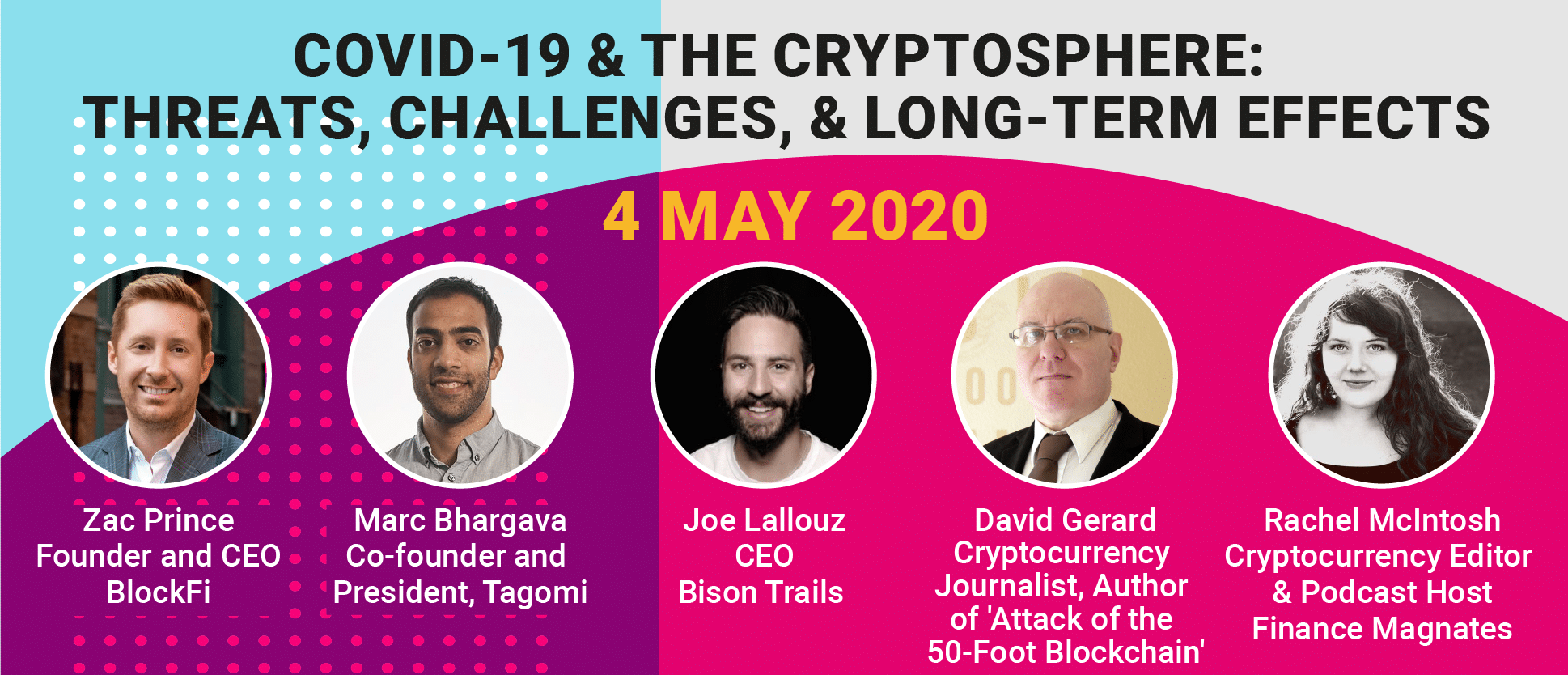
Finance Magnates is pleased to announce the completion of first-ever in a series of online cryptocurrency-focused webinars. On Monday, May 4th, we discussed the coronavirus and its effects on cryptocurrency with four leading experts in the crypto space. To listen to the full discussion of the session, which was entitled 'COVID-19 & the Cryptosphere: Threats, Opportunities, & Long-Term Effects," click the SoundCloud or YouTube links below.
David Gerard: Crypto is "functionally a bit of a dollar derivative.”
The discussion began with a discussion about what has been revealed about the cryptocurrency ecosystem as a result of the economic fallout from the coronavirus.
“The thing about the COVID-19 crisis is that it was the end of the ‘long bull run’: after the 2008 crisis, we basically had a decade where stocks just went up. That ended all of a sudden in one, big bang,” David Gerard said.
“Everybody took all their money out of everything else, and put it into the ‘asset of last resort’ in a crisis, and that asset turned out to be dollars--buying up treasuries, or just getting cash.”
David Gerard, author of Attack of the 50-Foot Blockchain.
Additionally, conventional markets “just completely went nuts--nobody knows what anything is worth anymore. Stock prices make no sense at the moment.”
And “crypto crashed as well.”
David explained that this is because “the great difficulty that crypto continues to have is that there really isn’t really a crypto economy--there’s no circular flow of income; no one ‘lives their lives’ in crypto. As an investment, it’s functionally a bit of a dollar derivative.”
“[...] So, the lesson there is that everything crypto did, it did during the best possible conditions: when markets were going up, investments were all looking good...now, it’s the bad times, and crypto really has to make a case--and I’m really not seeing it make one at the moment.”
Zac Prince: Dollars are "sucking the life out of everything else.”
Zac Prince responded: “I think you brought up a really interesting point about the flight to dollars--that’s very accurate...dollars are going to be the biggest thing moving around the crypto economy or the crypto ecosystem over the next one to five years.”
“Historically, it’s been kind of a challenge in the industry for some folks to square that as a concept, because a lot of the most hardcore cryptocurrency believers will say things like, ‘cryptocurrency is going to replace the dollar’ and ‘fiat currencies are total trash’--I believe the exact opposite.”
In fact, “I believe there’s a great sucking sound in the world economy, and it’s dollars sucking the life out of everything else.”
However, “what’s unique about the cryptocurrency industry, and specifically the payment rails that are created by some of these networks (like Ethereum), is that it enables people to move dollars around at a speed and scale that was simply not possible using the traditional banking ecosystem.”
Zac Prince, chief executive of NYC-based cryptocurrency lending firm BlockFi.
As a result, “you’re going to see more and more people do things that the used to do more expensively with the traditional banking system, or not be able to do at all with the traditional banking system--[they’ll] move into the traditional crypto world, [and] get one step closer to Bitcoin.”
Zac also pointed out that Bitcoin is nearly back to the price point that it was hovering around in the pre-corona days: “[Bitcoin] has rebounded better than the stock market, performed better than gold this year...there might be a big benefit to Bitcoin for not being as connected to the traditional system as other assets are.”
Joe Lallouz: The upcoming Bitcoin halving may be heavily influenced by trading infrastructure
With regards to Bitcoin’s price, Joe Lallouz also shared his thoughts about the possible effects of the upcoming Bitcoin halving or ‘halvening’ that is scheduled to take place next week. Halvings are regular occurrences in which mining rewards on the Bitcoin network are cut in half; some analysts believe that these events inevitably lead to price increases.
Joe Lallouz explained that “Compared to previous halvings, where folks are looking at the history and saying ‘look at the previous halvings--[they resulted] in serious price adjustments, most of which were upwards,’” which is to say that “the Bitcoin price has been mostly tied to the activity in the network.”
However, the Bitcoin trading landscape has evolved since the last halving, which took place in 2016. “Right now, a lot of the activity is margin trading in places like BitMEX,” Joe said.
Joe Lallouz, founder and chief executive of blockchain infrastructure firm Bison Trails.
In other words, “in previous halvings, there wasn’t the infrastructure around trading that we have today, and so there wasn’t the opportunity for margin trading on BitMEX to dictate the price [when the last halving occurred.]”
“It’s a different world, and we’re seeing it progress,” he added.
However, “what’s actually a good thing is that we are seeing the markets sort of adjusting to the platforms that exist, the trading activity that exists, the mining activity that exists, the purchasing activity that exists.”
How will this affect the price of BTC? “[...] It’s very possible that the halving is already priced in, or that the trading activity is dominating any kind of mining activity that would be dictating the price--we don’t actually know.”
Marc Bhargava: The halving will have an important "narrative effect" on Bitcoin
Marc Bhargava also brought up the similarities and differences in circumstances surrounding Bitcoin halvings in the past.
“If you look at the last halving in 2016 and the year that followed,” that time period “was also the rise of Ethereum,” he said. “There was a lot of excitement around it: the community, the building--those two things were so clearly connected, and kind of moved prices together in the subsequent year of 2017.”
“So, I think that in terms of the halving in and of itself, there definitely can be a positive narrative [with] a lot of press; it can also be a negative narrative (i.e. ‘nothing’s happening during the halving, I thought that was supposed to be the moment--should we all get out of this?’)”
“There certainly will be a narrative effect--a PR effect--and that could go either way, in my opinion; I think more important are other confounding variables that could come in around use cases, around tech and development and things like that.”
Marc Bhargava, president and co-founder of cryptocurrency prime brokerage Tagomi.
“If there are those things, and there is an increase in demand, then, of course, a cutback in supply could cause a very noticeable change,” Marc continued. However, “I guess I’m a bit more ‘demand-focused’ on it in terms of use cases and daily trading activity.”
Marc specifically pointed to “what’s going on on BitMEX and some of the exchanges that are tied to the index BitMEX uses.”
“It’s very true that [this trading activity] drives a lot of the volatility, but I think in terms of longer-term price trends...you find that there’s a base community [of users and traders] to take into account.”
Finance Magnates is pleased to announce the completion of first-ever in a series of online cryptocurrency-focused webinars. On Monday, May 4th, we discussed the coronavirus and its effects on cryptocurrency with four leading experts in the crypto space. To listen to the full discussion of the session, which was entitled 'COVID-19 & the Cryptosphere: Threats, Opportunities, & Long-Term Effects," click the SoundCloud or YouTube links below.
David Gerard: Crypto is "functionally a bit of a dollar derivative.”
The discussion began with a discussion about what has been revealed about the cryptocurrency ecosystem as a result of the economic fallout from the coronavirus.
“The thing about the COVID-19 crisis is that it was the end of the ‘long bull run’: after the 2008 crisis, we basically had a decade where stocks just went up. That ended all of a sudden in one, big bang,” David Gerard said.
“Everybody took all their money out of everything else, and put it into the ‘asset of last resort’ in a crisis, and that asset turned out to be dollars--buying up treasuries, or just getting cash.”
David Gerard, author of Attack of the 50-Foot Blockchain.
Additionally, conventional markets “just completely went nuts--nobody knows what anything is worth anymore. Stock prices make no sense at the moment.”
And “crypto crashed as well.”
David explained that this is because “the great difficulty that crypto continues to have is that there really isn’t really a crypto economy--there’s no circular flow of income; no one ‘lives their lives’ in crypto. As an investment, it’s functionally a bit of a dollar derivative.”
“[...] So, the lesson there is that everything crypto did, it did during the best possible conditions: when markets were going up, investments were all looking good...now, it’s the bad times, and crypto really has to make a case--and I’m really not seeing it make one at the moment.”
Zac Prince: Dollars are "sucking the life out of everything else.”
Zac Prince responded: “I think you brought up a really interesting point about the flight to dollars--that’s very accurate...dollars are going to be the biggest thing moving around the crypto economy or the crypto ecosystem over the next one to five years.”
“Historically, it’s been kind of a challenge in the industry for some folks to square that as a concept, because a lot of the most hardcore cryptocurrency believers will say things like, ‘cryptocurrency is going to replace the dollar’ and ‘fiat currencies are total trash’--I believe the exact opposite.”
In fact, “I believe there’s a great sucking sound in the world economy, and it’s dollars sucking the life out of everything else.”
However, “what’s unique about the cryptocurrency industry, and specifically the payment rails that are created by some of these networks (like Ethereum), is that it enables people to move dollars around at a speed and scale that was simply not possible using the traditional banking ecosystem.”
Zac Prince, chief executive of NYC-based cryptocurrency lending firm BlockFi.
As a result, “you’re going to see more and more people do things that the used to do more expensively with the traditional banking system, or not be able to do at all with the traditional banking system--[they’ll] move into the traditional crypto world, [and] get one step closer to Bitcoin.”
Zac also pointed out that Bitcoin is nearly back to the price point that it was hovering around in the pre-corona days: “[Bitcoin] has rebounded better than the stock market, performed better than gold this year...there might be a big benefit to Bitcoin for not being as connected to the traditional system as other assets are.”
Joe Lallouz: The upcoming Bitcoin halving may be heavily influenced by trading infrastructure
With regards to Bitcoin’s price, Joe Lallouz also shared his thoughts about the possible effects of the upcoming Bitcoin halving or ‘halvening’ that is scheduled to take place next week. Halvings are regular occurrences in which mining rewards on the Bitcoin network are cut in half; some analysts believe that these events inevitably lead to price increases.
Joe Lallouz explained that “Compared to previous halvings, where folks are looking at the history and saying ‘look at the previous halvings--[they resulted] in serious price adjustments, most of which were upwards,’” which is to say that “the Bitcoin price has been mostly tied to the activity in the network.”
However, the Bitcoin trading landscape has evolved since the last halving, which took place in 2016. “Right now, a lot of the activity is margin trading in places like BitMEX,” Joe said.
Joe Lallouz, founder and chief executive of blockchain infrastructure firm Bison Trails.
In other words, “in previous halvings, there wasn’t the infrastructure around trading that we have today, and so there wasn’t the opportunity for margin trading on BitMEX to dictate the price [when the last halving occurred.]”
“It’s a different world, and we’re seeing it progress,” he added.
However, “what’s actually a good thing is that we are seeing the markets sort of adjusting to the platforms that exist, the trading activity that exists, the mining activity that exists, the purchasing activity that exists.”
How will this affect the price of BTC? “[...] It’s very possible that the halving is already priced in, or that the trading activity is dominating any kind of mining activity that would be dictating the price--we don’t actually know.”
Marc Bhargava: The halving will have an important "narrative effect" on Bitcoin
Marc Bhargava also brought up the similarities and differences in circumstances surrounding Bitcoin halvings in the past.
“If you look at the last halving in 2016 and the year that followed,” that time period “was also the rise of Ethereum,” he said. “There was a lot of excitement around it: the community, the building--those two things were so clearly connected, and kind of moved prices together in the subsequent year of 2017.”
“So, I think that in terms of the halving in and of itself, there definitely can be a positive narrative [with] a lot of press; it can also be a negative narrative (i.e. ‘nothing’s happening during the halving, I thought that was supposed to be the moment--should we all get out of this?’)”
“There certainly will be a narrative effect--a PR effect--and that could go either way, in my opinion; I think more important are other confounding variables that could come in around use cases, around tech and development and things like that.”
Marc Bhargava, president and co-founder of cryptocurrency prime brokerage Tagomi.
“If there are those things, and there is an increase in demand, then, of course, a cutback in supply could cause a very noticeable change,” Marc continued. However, “I guess I’m a bit more ‘demand-focused’ on it in terms of use cases and daily trading activity.”
Marc specifically pointed to “what’s going on on BitMEX and some of the exchanges that are tied to the index BitMEX uses.”
“It’s very true that [this trading activity] drives a lot of the volatility, but I think in terms of longer-term price trends...you find that there’s a base community [of users and traders] to take into account.”
Rachel is a self-taught crypto geek and a passionate writer. She believes in the power that the written word has to educate, connect and empower individuals to make positive and powerful financial choices. She is the Podcast Host and a Cryptocurrency Editor at Finance Magnates.
Crypto Built More Rails, but the Next Battle Is Over How Much Work a Dollar Can Do
Featured Videos
FP Markets Winner Spotlight 🏆 | Global Broker of the Year 2025 #Trading #Broker #Innovation #Shorts
FP Markets Winner Spotlight 🏆 | Global Broker of the Year 2025 #Trading #Broker #Innovation #Shorts
FP Markets Winner Spotlight 🏆 | Global Broker of the Year 2025 #Trading #Broker #Innovation #Shorts
FP Markets Winner Spotlight 🏆 | Global Broker of the Year 2025 #Trading #Broker #Innovation #Shorts
FP Markets takes the spotlight as Global Broker of the Year 2025 at the Finance Magnates Awards.
Martin Stoilov, Head of Client Experience, shares that trust, innovation, and people played a key role in the company’s success, supported by a strong foundation of integrity and client-centricity.
Following this milestone, FP Markets continues to focus on growth, technology investment, and its core values of transparency and excellence.
👉 Be part of FM Awards 2026: https://awards.financemagnates.com/#nominate
FP Markets takes the spotlight as Global Broker of the Year 2025 at the Finance Magnates Awards.
Martin Stoilov, Head of Client Experience, shares that trust, innovation, and people played a key role in the company’s success, supported by a strong foundation of integrity and client-centricity.
Following this milestone, FP Markets continues to focus on growth, technology investment, and its core values of transparency and excellence.
👉 Be part of FM Awards 2026: https://awards.financemagnates.com/#nominate
FP Markets takes the spotlight as Global Broker of the Year 2025 at the Finance Magnates Awards.
Martin Stoilov, Head of Client Experience, shares that trust, innovation, and people played a key role in the company’s success, supported by a strong foundation of integrity and client-centricity.
Following this milestone, FP Markets continues to focus on growth, technology investment, and its core values of transparency and excellence.
👉 Be part of FM Awards 2026: https://awards.financemagnates.com/#nominate
FP Markets takes the spotlight as Global Broker of the Year 2025 at the Finance Magnates Awards.
Martin Stoilov, Head of Client Experience, shares that trust, innovation, and people played a key role in the company’s success, supported by a strong foundation of integrity and client-centricity.
Following this milestone, FP Markets continues to focus on growth, technology investment, and its core values of transparency and excellence.
👉 Be part of FM Awards 2026: https://awards.financemagnates.com/#nominate
In this video, we review @HolaPrimeMarketsOfficial, a multi-asset forex and CFDs broker offering different account types, trading platforms, and flexible trading conditions.
We cover the broker’s overall offering, including account options, trading environment, platforms like MT4 and MT5, and additional services such as managed accounts and fast withdrawals.
Watch the full video to see if Hola Prime Markets fits your trading needs.
📣 Stay up to date with the latest in finance and trading. Follow Finance Magnates for industry news, insights, and global event coverage.
Connect with us:
🔗 LinkedIn: /financemagnates
👍 Facebook: /financemagnates
📸 Instagram: https://www.instagram.com/financemagnates
🐦 X: https://x.com/financemagnates
🎥 TikTok: https://www.tiktok.com/tag/financemagnates
▶️ YouTube: /@financemagnates_official
#HolaPrime #ForexBroker #CFDTrading #FinanceMagnates #Trading #Forex #BrokerReview
In this video, we review @HolaPrimeMarketsOfficial, a multi-asset forex and CFDs broker offering different account types, trading platforms, and flexible trading conditions.
We cover the broker’s overall offering, including account options, trading environment, platforms like MT4 and MT5, and additional services such as managed accounts and fast withdrawals.
Watch the full video to see if Hola Prime Markets fits your trading needs.
📣 Stay up to date with the latest in finance and trading. Follow Finance Magnates for industry news, insights, and global event coverage.
Connect with us:
🔗 LinkedIn: /financemagnates
👍 Facebook: /financemagnates
📸 Instagram: https://www.instagram.com/financemagnates
🐦 X: https://x.com/financemagnates
🎥 TikTok: https://www.tiktok.com/tag/financemagnates
▶️ YouTube: /@financemagnates_official
#HolaPrime #ForexBroker #CFDTrading #FinanceMagnates #Trading #Forex #BrokerReview
In this video, we review @HolaPrimeMarketsOfficial, a multi-asset forex and CFDs broker offering different account types, trading platforms, and flexible trading conditions.
We cover the broker’s overall offering, including account options, trading environment, platforms like MT4 and MT5, and additional services such as managed accounts and fast withdrawals.
Watch the full video to see if Hola Prime Markets fits your trading needs.
📣 Stay up to date with the latest in finance and trading. Follow Finance Magnates for industry news, insights, and global event coverage.
Connect with us:
🔗 LinkedIn: /financemagnates
👍 Facebook: /financemagnates
📸 Instagram: https://www.instagram.com/financemagnates
🐦 X: https://x.com/financemagnates
🎥 TikTok: https://www.tiktok.com/tag/financemagnates
▶️ YouTube: /@financemagnates_official
#HolaPrime #ForexBroker #CFDTrading #FinanceMagnates #Trading #Forex #BrokerReview
In this video, we review @HolaPrimeMarketsOfficial, a multi-asset forex and CFDs broker offering different account types, trading platforms, and flexible trading conditions.
We cover the broker’s overall offering, including account options, trading environment, platforms like MT4 and MT5, and additional services such as managed accounts and fast withdrawals.
Watch the full video to see if Hola Prime Markets fits your trading needs.
📣 Stay up to date with the latest in finance and trading. Follow Finance Magnates for industry news, insights, and global event coverage.
Connect with us:
🔗 LinkedIn: /financemagnates
👍 Facebook: /financemagnates
📸 Instagram: https://www.instagram.com/financemagnates
🐦 X: https://x.com/financemagnates
🎥 TikTok: https://www.tiktok.com/tag/financemagnates
▶️ YouTube: /@financemagnates_official
#HolaPrime #ForexBroker #CFDTrading #FinanceMagnates #Trading #Forex #BrokerReview
In this video, we review @HolaPrimeMarketsOfficial, a multi-asset forex and CFDs broker offering different account types, trading platforms, and flexible trading conditions.
We cover the broker’s overall offering, including account options, trading environment, platforms like MT4 and MT5, and additional services such as managed accounts and fast withdrawals.
Watch the full video to see if Hola Prime Markets fits your trading needs.
📣 Stay up to date with the latest in finance and trading. Follow Finance Magnates for industry news, insights, and global event coverage.
Connect with us:
🔗 LinkedIn: /financemagnates
👍 Facebook: /financemagnates
📸 Instagram: https://www.instagram.com/financemagnates
🐦 X: https://x.com/financemagnates
🎥 TikTok: https://www.tiktok.com/tag/financemagnates
▶️ YouTube: /@financemagnates_official
#HolaPrime #ForexBroker #CFDTrading #FinanceMagnates #Trading #Forex #BrokerReview
In this video, we review @HolaPrimeMarketsOfficial, a multi-asset forex and CFDs broker offering different account types, trading platforms, and flexible trading conditions.
We cover the broker’s overall offering, including account options, trading environment, platforms like MT4 and MT5, and additional services such as managed accounts and fast withdrawals.
Watch the full video to see if Hola Prime Markets fits your trading needs.
📣 Stay up to date with the latest in finance and trading. Follow Finance Magnates for industry news, insights, and global event coverage.
Connect with us:
🔗 LinkedIn: /financemagnates
👍 Facebook: /financemagnates
📸 Instagram: https://www.instagram.com/financemagnates
🐦 X: https://x.com/financemagnates
🎥 TikTok: https://www.tiktok.com/tag/financemagnates
▶️ YouTube: /@financemagnates_official
#HolaPrime #ForexBroker #CFDTrading #FinanceMagnates #Trading #Forex #BrokerReview
Hola Prime Review: What You Need to Know | Full Breakdown by Finance Magnates
Hola Prime Review: What You Need to Know | Full Breakdown by Finance Magnates
Hola Prime Review: What You Need to Know | Full Breakdown by Finance Magnates
Hola Prime Review: What You Need to Know | Full Breakdown by Finance Magnates
Hola Prime Review: What You Need to Know | Full Breakdown by Finance Magnates
Hola Prime Review: What You Need to Know | Full Breakdown by Finance Magnates
In this video, we review @HolaPrime_Global, a proprietary trading firm offering evaluation programs and performance-based payouts in simulated market environments.
We cover how the challenge model works, including account types, profit splits (up to 95%), trading rules, and what it takes to reach a funded account. You’ll also learn about available platforms like MT4, MT5, cTrader, and more, along with insights into payouts, support, and trading conditions.
Watch the full video to see if Hola Prime fits your trading style.
📣 Stay up to date with the latest in finance and trading. Follow Finance Magnates for industry news, insights, and global event coverage.
Connect with us:
🔗 LinkedIn: /financemagnates
👍 Facebook: /financemagnates
📸 Instagram: https://www.instagram.com/financemagnates
🐦 X: https://x.com/financemagnates
🎥 TikTok: https://www.tiktok.com/tag/financemagnates
▶️ YouTube: /@financemagnates_official
#HolaPrime #PropFirm #Trading #FinanceMagnates #Forex #FuturesTrading #TradingReview #PropFirmReview
In this video, we review @HolaPrime_Global, a proprietary trading firm offering evaluation programs and performance-based payouts in simulated market environments.
We cover how the challenge model works, including account types, profit splits (up to 95%), trading rules, and what it takes to reach a funded account. You’ll also learn about available platforms like MT4, MT5, cTrader, and more, along with insights into payouts, support, and trading conditions.
Watch the full video to see if Hola Prime fits your trading style.
📣 Stay up to date with the latest in finance and trading. Follow Finance Magnates for industry news, insights, and global event coverage.
Connect with us:
🔗 LinkedIn: /financemagnates
👍 Facebook: /financemagnates
📸 Instagram: https://www.instagram.com/financemagnates
🐦 X: https://x.com/financemagnates
🎥 TikTok: https://www.tiktok.com/tag/financemagnates
▶️ YouTube: /@financemagnates_official
#HolaPrime #PropFirm #Trading #FinanceMagnates #Forex #FuturesTrading #TradingReview #PropFirmReview
In this video, we review @HolaPrime_Global, a proprietary trading firm offering evaluation programs and performance-based payouts in simulated market environments.
We cover how the challenge model works, including account types, profit splits (up to 95%), trading rules, and what it takes to reach a funded account. You’ll also learn about available platforms like MT4, MT5, cTrader, and more, along with insights into payouts, support, and trading conditions.
Watch the full video to see if Hola Prime fits your trading style.
📣 Stay up to date with the latest in finance and trading. Follow Finance Magnates for industry news, insights, and global event coverage.
Connect with us:
🔗 LinkedIn: /financemagnates
👍 Facebook: /financemagnates
📸 Instagram: https://www.instagram.com/financemagnates
🐦 X: https://x.com/financemagnates
🎥 TikTok: https://www.tiktok.com/tag/financemagnates
▶️ YouTube: /@financemagnates_official
#HolaPrime #PropFirm #Trading #FinanceMagnates #Forex #FuturesTrading #TradingReview #PropFirmReview
In this video, we review @HolaPrime_Global, a proprietary trading firm offering evaluation programs and performance-based payouts in simulated market environments.
We cover how the challenge model works, including account types, profit splits (up to 95%), trading rules, and what it takes to reach a funded account. You’ll also learn about available platforms like MT4, MT5, cTrader, and more, along with insights into payouts, support, and trading conditions.
Watch the full video to see if Hola Prime fits your trading style.
📣 Stay up to date with the latest in finance and trading. Follow Finance Magnates for industry news, insights, and global event coverage.
Connect with us:
🔗 LinkedIn: /financemagnates
👍 Facebook: /financemagnates
📸 Instagram: https://www.instagram.com/financemagnates
🐦 X: https://x.com/financemagnates
🎥 TikTok: https://www.tiktok.com/tag/financemagnates
▶️ YouTube: /@financemagnates_official
#HolaPrime #PropFirm #Trading #FinanceMagnates #Forex #FuturesTrading #TradingReview #PropFirmReview
In this video, we review @HolaPrime_Global, a proprietary trading firm offering evaluation programs and performance-based payouts in simulated market environments.
We cover how the challenge model works, including account types, profit splits (up to 95%), trading rules, and what it takes to reach a funded account. You’ll also learn about available platforms like MT4, MT5, cTrader, and more, along with insights into payouts, support, and trading conditions.
Watch the full video to see if Hola Prime fits your trading style.
📣 Stay up to date with the latest in finance and trading. Follow Finance Magnates for industry news, insights, and global event coverage.
Connect with us:
🔗 LinkedIn: /financemagnates
👍 Facebook: /financemagnates
📸 Instagram: https://www.instagram.com/financemagnates
🐦 X: https://x.com/financemagnates
🎥 TikTok: https://www.tiktok.com/tag/financemagnates
▶️ YouTube: /@financemagnates_official
#HolaPrime #PropFirm #Trading #FinanceMagnates #Forex #FuturesTrading #TradingReview #PropFirmReview
In this video, we review @HolaPrime_Global, a proprietary trading firm offering evaluation programs and performance-based payouts in simulated market environments.
We cover how the challenge model works, including account types, profit splits (up to 95%), trading rules, and what it takes to reach a funded account. You’ll also learn about available platforms like MT4, MT5, cTrader, and more, along with insights into payouts, support, and trading conditions.
Watch the full video to see if Hola Prime fits your trading style.
📣 Stay up to date with the latest in finance and trading. Follow Finance Magnates for industry news, insights, and global event coverage.
Connect with us:
🔗 LinkedIn: /financemagnates
👍 Facebook: /financemagnates
📸 Instagram: https://www.instagram.com/financemagnates
🐦 X: https://x.com/financemagnates
🎥 TikTok: https://www.tiktok.com/tag/financemagnates
▶️ YouTube: /@financemagnates_official
#HolaPrime #PropFirm #Trading #FinanceMagnates #Forex #FuturesTrading #TradingReview #PropFirmReview
Axi Winner Spotlight 🏆 | Global Most Innovative Broker 2025 #Innovation #Trading #Fintech #Broker
Axi Winner Spotlight 🏆 | Global Most Innovative Broker 2025 #Innovation #Trading #Fintech #Broker
Axi Winner Spotlight 🏆 | Global Most Innovative Broker 2025 #Innovation #Trading #Fintech #Broker
Axi Winner Spotlight 🏆 | Global Most Innovative Broker 2025 #Innovation #Trading #Fintech #Broker
Axi Winner Spotlight 🏆 | Global Most Innovative Broker 2025 #Innovation #Trading #Fintech #Broker
Axi Winner Spotlight 🏆 | Global Most Innovative Broker 2025 #Innovation #Trading #Fintech #Broker
Axi takes the spotlight at the Finance Magnates Awards, winning Global Most Innovative Broker 2025.
Olivia Xenofontos and Ivanna Openko share how the team will feel: proud, motivated, and ready to keep delivering.
They also describe the night as well-organized, focused, and enjoyable for all.
👉 Be part of FM Awards 2026.
Axi takes the spotlight at the Finance Magnates Awards, winning Global Most Innovative Broker 2025.
Olivia Xenofontos and Ivanna Openko share how the team will feel: proud, motivated, and ready to keep delivering.
They also describe the night as well-organized, focused, and enjoyable for all.
👉 Be part of FM Awards 2026.
Axi takes the spotlight at the Finance Magnates Awards, winning Global Most Innovative Broker 2025.
Olivia Xenofontos and Ivanna Openko share how the team will feel: proud, motivated, and ready to keep delivering.
They also describe the night as well-organized, focused, and enjoyable for all.
👉 Be part of FM Awards 2026.
Axi takes the spotlight at the Finance Magnates Awards, winning Global Most Innovative Broker 2025.
Olivia Xenofontos and Ivanna Openko share how the team will feel: proud, motivated, and ready to keep delivering.
They also describe the night as well-organized, focused, and enjoyable for all.
👉 Be part of FM Awards 2026.
Axi takes the spotlight at the Finance Magnates Awards, winning Global Most Innovative Broker 2025.
Olivia Xenofontos and Ivanna Openko share how the team will feel: proud, motivated, and ready to keep delivering.
They also describe the night as well-organized, focused, and enjoyable for all.
👉 Be part of FM Awards 2026.
Axi takes the spotlight at the Finance Magnates Awards, winning Global Most Innovative Broker 2025.
Olivia Xenofontos and Ivanna Openko share how the team will feel: proud, motivated, and ready to keep delivering.
They also describe the night as well-organized, focused, and enjoyable for all.
👉 Be part of FM Awards 2026.
Recognition that matters.
Built on transparency.
Driven by the industry.
The Finance Magnates Awards 2026.
Nominations are now open.
🔗 https://awards.financemagnates.com/?utm_source=SM&utm_medium=social&utm_campaign=recognition-matters
Recognition that matters.
Built on transparency.
Driven by the industry.
The Finance Magnates Awards 2026.
Nominations are now open.
🔗 https://awards.financemagnates.com/?utm_source=SM&utm_medium=social&utm_campaign=recognition-matters
Recognition that matters.
Built on transparency.
Driven by the industry.
The Finance Magnates Awards 2026.
Nominations are now open.
🔗 https://awards.financemagnates.com/?utm_source=SM&utm_medium=social&utm_campaign=recognition-matters
Recognition that matters.
Built on transparency.
Driven by the industry.
The Finance Magnates Awards 2026.
Nominations are now open.
🔗 https://awards.financemagnates.com/?utm_source=SM&utm_medium=social&utm_campaign=recognition-matters
Recognition that matters.
Built on transparency.
Driven by the industry.
The Finance Magnates Awards 2026.
Nominations are now open.
🔗 https://awards.financemagnates.com/?utm_source=SM&utm_medium=social&utm_campaign=recognition-matters
Recognition that matters.
Built on transparency.
Driven by the industry.
The Finance Magnates Awards 2026.
Nominations are now open.
🔗 https://awards.financemagnates.com/?utm_source=SM&utm_medium=social&utm_campaign=recognition-matters