Another historic week for BTC. Now that Bitcoin has passed $50,000, what's next for crypto markets?
FM
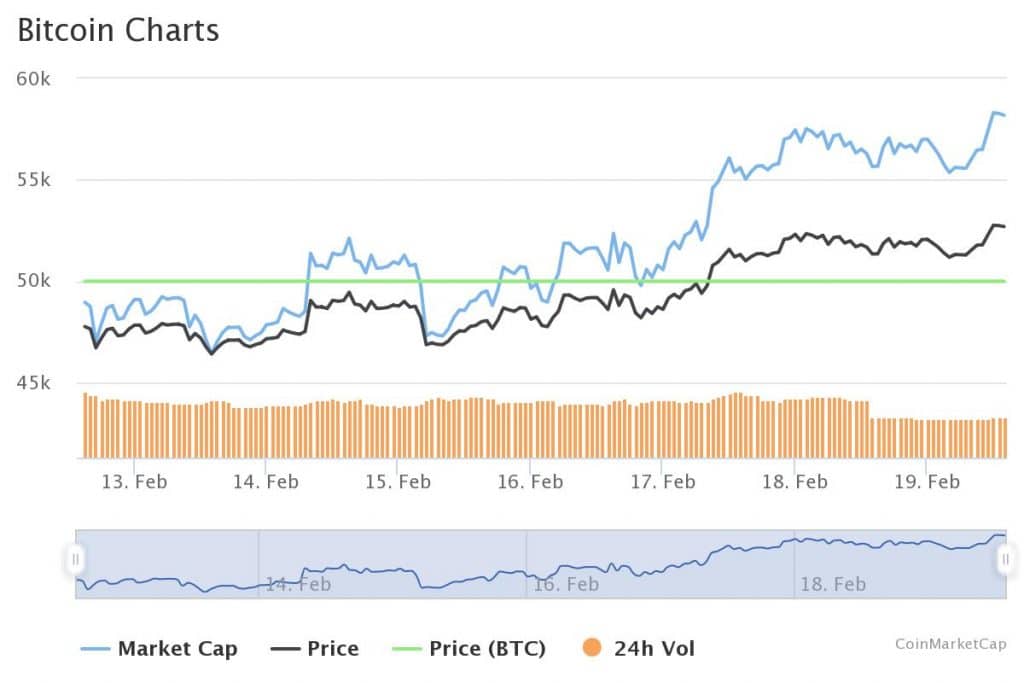
Another week in 2021 witnessed another few historic moments for Bitcoin. Last week saw a $1.5 billion investment in BTC by Tesla, and Mastercard’s announcement that it would be accepting Bitcoin on its network. This week, BTC crossed through the $50,000 mark for the first time and held levels above $50K for most of the week.
The move past $50K has brought with it much media attention: Bitcoin, which was already riding high in the headlines because of the Tesla announcement, has stayed in the center of attention although not all of that attention has been positive.
Bitcoin’s Rally Continues, and So Do Its PR Problems
For example, Tesla Chief Executive Elon Musk appeared to put some distance between himself and Bitcoin in a series of Tweets on Thursday night. In response to a Bloomberg interview with Binance Chief Executive Changpeng Zhao, Musk wrote that: “Bitcoin is almost as bs as fiat money. The key word is ‘almost’.”
Yellen also referenced Bitcoin’s association with illegal activities: “I think it’s important to make sure that it is not used as a vehicle for elicit transactions and that there’s investor protection,” she said.
However, the Treasury Secretary did say that she believes that proper regulation could solve some of Bitcoin’s problems: “regulating institutions that deal in Bitcoin, making sure that they adhere to their regulatory responsibilities, I think is certainly important.”
In an interview with Finance Magnates earlier this week, Argo Chief Executive Peter Wall commented that this is a problem the Bitcoin community needs to solve: “It doesn’t make sense to be burning coal to make Bitcoin. That’s just not cool,” he said. “The planet has enough problems as it is [without] adding carbon to the atmosphere to create Bitcoin.”
Fields of Green across the Board, for Now
Still, it may be for Bitcoin that there is no such thing as bad publicly: in spite of the pieces of negative commentary that have been raised against Bitcoin this week, Bitcoin was stronger than ever. At press time, BTC was sitting at roughly $52,800, and showed no signs of backing down.
While BTC may have taken up most of the media spotlight over the past several weeks, it has not been the only cryptocurrency that performed well this week. At press time, Ether (ETH) was sitting at $1930, just $20 short of its latest all-time high; Binance Coin (BNB) had shot up over 40 percent over the last 24 hours, bringing its value to $259.39 at press time. Bitcoin and ETH were both up roughly 10% over the course of the week; BNB had risen a whopping 100%.
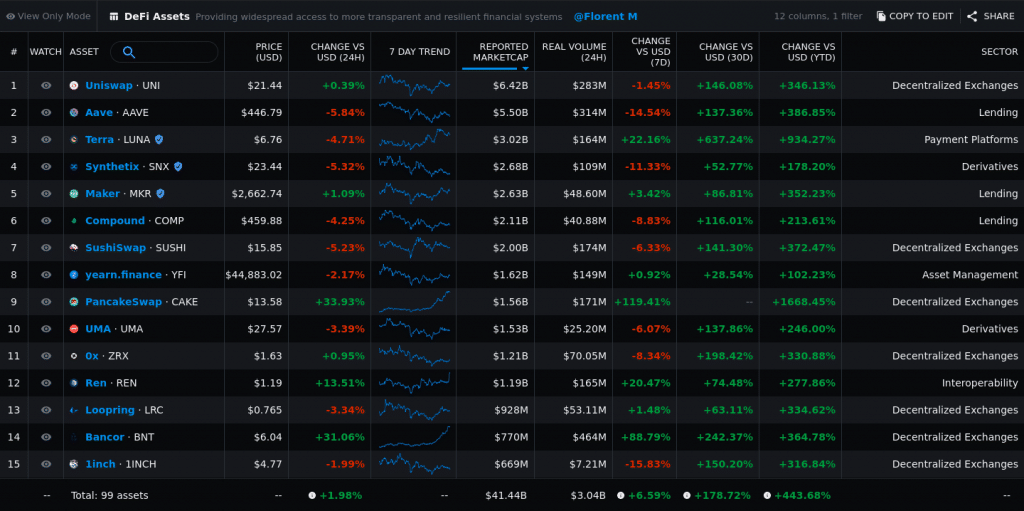
Additionally, a number of DeFi assets were performing rather well at press time. According to data from Messari, a number of tokens associated with DeFi projects were up in double-digit or triple-digit percentages over the course of the last seven days; at least 30 of 80 DeFi assets showed gains over the last 24-hour period; of those that showed drops, the worst was less than 25 percent.
A number of analysts have pointed out that when Bitcoin is doing well, DeFi tokens and other altcoins tend to follow: that Bitcoin has some sort of a 'run-off' effect. Do Kwon, Co-Founder and CEO of Terraform Labs (TFL), explained the phenomenon to Finance Magnates last week in this way: “as the flagship cryptocurrency, Bitcoin tends to lead while the rest of the industry follows.
In other words, crypto markets seem to have entered a sort of halcyon period: Bitcoin is booming, and altcoins, which are already doing quite well, may soon follow.
However, as well as know, nothing gold can stay. How did we get here, and what Is next?
The Channels for Institutional BTC Investment Are More Accessible Than Ever Before
Additionally, Craig Kirsner, MBA, and President of Stuart Estate Planning Wealth Advisors, pointed out to Finance Magnates that institutions have recently been very active with other investing channels related to Bitcoin, specifically, Bitcoin futures markets.
Kirsner explained that the Chicago Mercantile Exchange (CME) “has reported volume spikes” in its BTC futures offerings. Additionally, “open interest for large institutional holders in the bitcoin futures contracts [is] at an all-time high. You can also invest in BTC on the publicly traded markets by buying GBTC (the Grayscale Bitcoin Trust.)”
Institutional Cash in Bitcoin Could Eventually Roll into Altcoin Markets
However, Tesla’s public investment in Bitcoin last week may have been something of a turning point for BTC: the first time a major publicly-traded company made a sizeable, public investment in BTC.
Therefore, Wu believes that the Bitcoin world is at some kind of a turning point: “institutions are just now turning the corner on accepting bitcoin as a high-quality, investable asset, and I suspect bitcoin will continue to be the first asset in every institution's foray into crypto,” he said. “Bitcoin will still be the main gateway for most, fulfilling the ‘digital gold’ and ‘store of value’ role.”
But, just as is often the case with retail investors, Bitcoin’s 'run-off' effect could also apply to some of the institutional investors that make their way into Bitcoin.
“I hope [Bitcoin] will open their eyes to projects that are just outside the bitcoin frame,” Wu told Finance Magnates.
“There has been massive progress and pockets of true innovation across the ecosystem with networks enabling entirely new use cases like decentralized finance to flourish. It will also separate the winning platforms from the losers as investors looking to find the next BTC or ETH must examine each project individually, rather than assessing them as a collective.”
Craig Kirsner, MBA and President of Stuart Estate Planning Wealth Advisors.
”I Think That Bitcoin Will Hit $55,000 and Then Pull Back Sharply.”
However, while altcoins will likely follow BTC as it continues to gain higher levels, they will also likely follow Bitcoin when it begins to lose steam. While it is not clear when this might happen, analysts seem to agree that it is an inevitability.
But, when could a pullback happen, and how low could it go? “From a technical analysis standpoint, I think that BTC will hit $55,000 then pull back sharply,” Kirsner told Finance Magnates, adding that: “this pullback should be a good time to buy if you haven't bought it before.”
Michael Calce, Advisor for TrustSwap, told Finance Magnates that a pullback in the price of Bitcoin could erase some of the FOMO-induced gains that may have come as a result of the latest media cycle around the Bitcoin-related Tesla and Mastercard announcements. In other words, those who bought into Bitcoin with the expectation that it will continue to appreciate in a linear fashion may exit the market.
“The worst-case scenario for a retrace will make people upset about losses and induce a panic to sell,” Calce said. “However, sometimes retracing is healthy, especially when a coin can rally back to its previous marker or even higher.”
”People Are Starting to Trust Bitcoin More Than Before.”
However, even if a pullback is in the cards for Bitcoin in the near future, a number of analysts agree that the narrative of Bitcoin as a store-of-value is gaining strength. As such, Bitcoin is developing fundamental value.
“I do think that Bitcoin can be considered a ‘safe-haven’ or ‘store-of-value’ asset,” Kirsner told Finance Magnates. “There is a finite amount of it and it is a true growing technology.” Therefore, “I do believe crypto adoption will increase in 2021 amongst both institutional investors and average investors,” he said.
Therefore, even if there is a pullback at $55K, it may not be long before BTC reaches back to $55,000 and beyond. Calce said: “as we see more people and companies get involved with Bitcoin, it will organically rise and surpass $55K.”
“[...] Trust is always the main component and people are starting to trust Bitcoin more than before,” Calce explained.
Another week in 2021 witnessed another few historic moments for Bitcoin. Last week saw a $1.5 billion investment in BTC by Tesla, and Mastercard’s announcement that it would be accepting Bitcoin on its network. This week, BTC crossed through the $50,000 mark for the first time and held levels above $50K for most of the week.
The move past $50K has brought with it much media attention: Bitcoin, which was already riding high in the headlines because of the Tesla announcement, has stayed in the center of attention although not all of that attention has been positive.
Bitcoin’s Rally Continues, and So Do Its PR Problems
For example, Tesla Chief Executive Elon Musk appeared to put some distance between himself and Bitcoin in a series of Tweets on Thursday night. In response to a Bloomberg interview with Binance Chief Executive Changpeng Zhao, Musk wrote that: “Bitcoin is almost as bs as fiat money. The key word is ‘almost’.”
Yellen also referenced Bitcoin’s association with illegal activities: “I think it’s important to make sure that it is not used as a vehicle for elicit transactions and that there’s investor protection,” she said.
However, the Treasury Secretary did say that she believes that proper regulation could solve some of Bitcoin’s problems: “regulating institutions that deal in Bitcoin, making sure that they adhere to their regulatory responsibilities, I think is certainly important.”
In an interview with Finance Magnates earlier this week, Argo Chief Executive Peter Wall commented that this is a problem the Bitcoin community needs to solve: “It doesn’t make sense to be burning coal to make Bitcoin. That’s just not cool,” he said. “The planet has enough problems as it is [without] adding carbon to the atmosphere to create Bitcoin.”
Fields of Green across the Board, for Now
Still, it may be for Bitcoin that there is no such thing as bad publicly: in spite of the pieces of negative commentary that have been raised against Bitcoin this week, Bitcoin was stronger than ever. At press time, BTC was sitting at roughly $52,800, and showed no signs of backing down.
While BTC may have taken up most of the media spotlight over the past several weeks, it has not been the only cryptocurrency that performed well this week. At press time, Ether (ETH) was sitting at $1930, just $20 short of its latest all-time high; Binance Coin (BNB) had shot up over 40 percent over the last 24 hours, bringing its value to $259.39 at press time. Bitcoin and ETH were both up roughly 10% over the course of the week; BNB had risen a whopping 100%.
Additionally, a number of DeFi assets were performing rather well at press time. According to data from Messari, a number of tokens associated with DeFi projects were up in double-digit or triple-digit percentages over the course of the last seven days; at least 30 of 80 DeFi assets showed gains over the last 24-hour period; of those that showed drops, the worst was less than 25 percent.
A number of analysts have pointed out that when Bitcoin is doing well, DeFi tokens and other altcoins tend to follow: that Bitcoin has some sort of a 'run-off' effect. Do Kwon, Co-Founder and CEO of Terraform Labs (TFL), explained the phenomenon to Finance Magnates last week in this way: “as the flagship cryptocurrency, Bitcoin tends to lead while the rest of the industry follows.
In other words, crypto markets seem to have entered a sort of halcyon period: Bitcoin is booming, and altcoins, which are already doing quite well, may soon follow.
However, as well as know, nothing gold can stay. How did we get here, and what Is next?
The Channels for Institutional BTC Investment Are More Accessible Than Ever Before
Additionally, Craig Kirsner, MBA, and President of Stuart Estate Planning Wealth Advisors, pointed out to Finance Magnates that institutions have recently been very active with other investing channels related to Bitcoin, specifically, Bitcoin futures markets.
Kirsner explained that the Chicago Mercantile Exchange (CME) “has reported volume spikes” in its BTC futures offerings. Additionally, “open interest for large institutional holders in the bitcoin futures contracts [is] at an all-time high. You can also invest in BTC on the publicly traded markets by buying GBTC (the Grayscale Bitcoin Trust.)”
Institutional Cash in Bitcoin Could Eventually Roll into Altcoin Markets
However, Tesla’s public investment in Bitcoin last week may have been something of a turning point for BTC: the first time a major publicly-traded company made a sizeable, public investment in BTC.
Therefore, Wu believes that the Bitcoin world is at some kind of a turning point: “institutions are just now turning the corner on accepting bitcoin as a high-quality, investable asset, and I suspect bitcoin will continue to be the first asset in every institution's foray into crypto,” he said. “Bitcoin will still be the main gateway for most, fulfilling the ‘digital gold’ and ‘store of value’ role.”
But, just as is often the case with retail investors, Bitcoin’s 'run-off' effect could also apply to some of the institutional investors that make their way into Bitcoin.
“I hope [Bitcoin] will open their eyes to projects that are just outside the bitcoin frame,” Wu told Finance Magnates.
“There has been massive progress and pockets of true innovation across the ecosystem with networks enabling entirely new use cases like decentralized finance to flourish. It will also separate the winning platforms from the losers as investors looking to find the next BTC or ETH must examine each project individually, rather than assessing them as a collective.”
Craig Kirsner, MBA and President of Stuart Estate Planning Wealth Advisors.
”I Think That Bitcoin Will Hit $55,000 and Then Pull Back Sharply.”
However, while altcoins will likely follow BTC as it continues to gain higher levels, they will also likely follow Bitcoin when it begins to lose steam. While it is not clear when this might happen, analysts seem to agree that it is an inevitability.
But, when could a pullback happen, and how low could it go? “From a technical analysis standpoint, I think that BTC will hit $55,000 then pull back sharply,” Kirsner told Finance Magnates, adding that: “this pullback should be a good time to buy if you haven't bought it before.”
Michael Calce, Advisor for TrustSwap, told Finance Magnates that a pullback in the price of Bitcoin could erase some of the FOMO-induced gains that may have come as a result of the latest media cycle around the Bitcoin-related Tesla and Mastercard announcements. In other words, those who bought into Bitcoin with the expectation that it will continue to appreciate in a linear fashion may exit the market.
“The worst-case scenario for a retrace will make people upset about losses and induce a panic to sell,” Calce said. “However, sometimes retracing is healthy, especially when a coin can rally back to its previous marker or even higher.”
”People Are Starting to Trust Bitcoin More Than Before.”
However, even if a pullback is in the cards for Bitcoin in the near future, a number of analysts agree that the narrative of Bitcoin as a store-of-value is gaining strength. As such, Bitcoin is developing fundamental value.
“I do think that Bitcoin can be considered a ‘safe-haven’ or ‘store-of-value’ asset,” Kirsner told Finance Magnates. “There is a finite amount of it and it is a true growing technology.” Therefore, “I do believe crypto adoption will increase in 2021 amongst both institutional investors and average investors,” he said.
Therefore, even if there is a pullback at $55K, it may not be long before BTC reaches back to $55,000 and beyond. Calce said: “as we see more people and companies get involved with Bitcoin, it will organically rise and surpass $55K.”
“[...] Trust is always the main component and people are starting to trust Bitcoin more than before,” Calce explained.
Rachel is a self-taught crypto geek and a passionate writer. She believes in the power that the written word has to educate, connect and empower individuals to make positive and powerful financial choices. She is the Podcast Host and a Cryptocurrency Editor at Finance Magnates.
Exness sees trust as the key theme for growth in MENA Trading Growth for 2026
Exness sees trust as the key theme for growth in MENA Trading Growth for 2026
Exness sees trust as the key theme for growth in MENA Trading Growth for 2026
Exness sees trust as the key theme for growth in MENA Trading Growth for 2026
Exness sees trust as the key theme for growth in MENA Trading Growth for 2026
Exness sees trust as the key theme for growth in MENA Trading Growth for 2026
Mohammad Amer, Regional Commercial Director at Exness, sits down to discuss the booming MENA financial trading market. Find out why Dubai is key to the company's growth strategy, how a mobile-first generation is changing expectations, and why trust will be the defining theme for traders in 2026.
In this interview, you'll learn:
* Why Dubai and the MENA region are critical growth markets for fintech and online trading.
* How Exness is addressing the demands of mobile-first, younger traders through engineering, platform stability, and transparent conditions.
* The essential role local talent plays in providing a culturally relevant and compliant user experience.
* Mohammad Amer's outlook on the future of the online trading industry and why stronger controls and systems are necessary.
* Why "trust" isn't just a brand value, but has commercial value—and why he predicts 2026 will be the "Year of Trust."
Key Takeaways:
➡️ The MENA region is rapidly shaping global financial markets.
➡️ New traders expect stability, precise execution, and transparency.
➡️ Local expertise is key to regulatory compliance and user experience.
➡️ Future success belongs to firms capable of meeting rising standards across regulation and platform consistency.
Read the full article at: https://www.financemagnates.com/thought-leadership/exness-sees-trust-as-the-key-theme-for-growth-in-mena-trading-growth-for-2026/
#Exness #MENA #Trading #FinTech #Dubai #OnlineTrading #FinanceMagnates #MohammadAmer #Trust #MobileTrading
Mohammad Amer, Regional Commercial Director at Exness, sits down to discuss the booming MENA financial trading market. Find out why Dubai is key to the company's growth strategy, how a mobile-first generation is changing expectations, and why trust will be the defining theme for traders in 2026.
In this interview, you'll learn:
* Why Dubai and the MENA region are critical growth markets for fintech and online trading.
* How Exness is addressing the demands of mobile-first, younger traders through engineering, platform stability, and transparent conditions.
* The essential role local talent plays in providing a culturally relevant and compliant user experience.
* Mohammad Amer's outlook on the future of the online trading industry and why stronger controls and systems are necessary.
* Why "trust" isn't just a brand value, but has commercial value—and why he predicts 2026 will be the "Year of Trust."
Key Takeaways:
➡️ The MENA region is rapidly shaping global financial markets.
➡️ New traders expect stability, precise execution, and transparency.
➡️ Local expertise is key to regulatory compliance and user experience.
➡️ Future success belongs to firms capable of meeting rising standards across regulation and platform consistency.
Read the full article at: https://www.financemagnates.com/thought-leadership/exness-sees-trust-as-the-key-theme-for-growth-in-mena-trading-growth-for-2026/
#Exness #MENA #Trading #FinTech #Dubai #OnlineTrading #FinanceMagnates #MohammadAmer #Trust #MobileTrading
Mohammad Amer, Regional Commercial Director at Exness, sits down to discuss the booming MENA financial trading market. Find out why Dubai is key to the company's growth strategy, how a mobile-first generation is changing expectations, and why trust will be the defining theme for traders in 2026.
In this interview, you'll learn:
* Why Dubai and the MENA region are critical growth markets for fintech and online trading.
* How Exness is addressing the demands of mobile-first, younger traders through engineering, platform stability, and transparent conditions.
* The essential role local talent plays in providing a culturally relevant and compliant user experience.
* Mohammad Amer's outlook on the future of the online trading industry and why stronger controls and systems are necessary.
* Why "trust" isn't just a brand value, but has commercial value—and why he predicts 2026 will be the "Year of Trust."
Key Takeaways:
➡️ The MENA region is rapidly shaping global financial markets.
➡️ New traders expect stability, precise execution, and transparency.
➡️ Local expertise is key to regulatory compliance and user experience.
➡️ Future success belongs to firms capable of meeting rising standards across regulation and platform consistency.
Read the full article at: https://www.financemagnates.com/thought-leadership/exness-sees-trust-as-the-key-theme-for-growth-in-mena-trading-growth-for-2026/
#Exness #MENA #Trading #FinTech #Dubai #OnlineTrading #FinanceMagnates #MohammadAmer #Trust #MobileTrading
Mohammad Amer, Regional Commercial Director at Exness, sits down to discuss the booming MENA financial trading market. Find out why Dubai is key to the company's growth strategy, how a mobile-first generation is changing expectations, and why trust will be the defining theme for traders in 2026.
In this interview, you'll learn:
* Why Dubai and the MENA region are critical growth markets for fintech and online trading.
* How Exness is addressing the demands of mobile-first, younger traders through engineering, platform stability, and transparent conditions.
* The essential role local talent plays in providing a culturally relevant and compliant user experience.
* Mohammad Amer's outlook on the future of the online trading industry and why stronger controls and systems are necessary.
* Why "trust" isn't just a brand value, but has commercial value—and why he predicts 2026 will be the "Year of Trust."
Key Takeaways:
➡️ The MENA region is rapidly shaping global financial markets.
➡️ New traders expect stability, precise execution, and transparency.
➡️ Local expertise is key to regulatory compliance and user experience.
➡️ Future success belongs to firms capable of meeting rising standards across regulation and platform consistency.
Read the full article at: https://www.financemagnates.com/thought-leadership/exness-sees-trust-as-the-key-theme-for-growth-in-mena-trading-growth-for-2026/
#Exness #MENA #Trading #FinTech #Dubai #OnlineTrading #FinanceMagnates #MohammadAmer #Trust #MobileTrading
Mohammad Amer, Regional Commercial Director at Exness, sits down to discuss the booming MENA financial trading market. Find out why Dubai is key to the company's growth strategy, how a mobile-first generation is changing expectations, and why trust will be the defining theme for traders in 2026.
In this interview, you'll learn:
* Why Dubai and the MENA region are critical growth markets for fintech and online trading.
* How Exness is addressing the demands of mobile-first, younger traders through engineering, platform stability, and transparent conditions.
* The essential role local talent plays in providing a culturally relevant and compliant user experience.
* Mohammad Amer's outlook on the future of the online trading industry and why stronger controls and systems are necessary.
* Why "trust" isn't just a brand value, but has commercial value—and why he predicts 2026 will be the "Year of Trust."
Key Takeaways:
➡️ The MENA region is rapidly shaping global financial markets.
➡️ New traders expect stability, precise execution, and transparency.
➡️ Local expertise is key to regulatory compliance and user experience.
➡️ Future success belongs to firms capable of meeting rising standards across regulation and platform consistency.
Read the full article at: https://www.financemagnates.com/thought-leadership/exness-sees-trust-as-the-key-theme-for-growth-in-mena-trading-growth-for-2026/
#Exness #MENA #Trading #FinTech #Dubai #OnlineTrading #FinanceMagnates #MohammadAmer #Trust #MobileTrading
Mohammad Amer, Regional Commercial Director at Exness, sits down to discuss the booming MENA financial trading market. Find out why Dubai is key to the company's growth strategy, how a mobile-first generation is changing expectations, and why trust will be the defining theme for traders in 2026.
In this interview, you'll learn:
* Why Dubai and the MENA region are critical growth markets for fintech and online trading.
* How Exness is addressing the demands of mobile-first, younger traders through engineering, platform stability, and transparent conditions.
* The essential role local talent plays in providing a culturally relevant and compliant user experience.
* Mohammad Amer's outlook on the future of the online trading industry and why stronger controls and systems are necessary.
* Why "trust" isn't just a brand value, but has commercial value—and why he predicts 2026 will be the "Year of Trust."
Key Takeaways:
➡️ The MENA region is rapidly shaping global financial markets.
➡️ New traders expect stability, precise execution, and transparency.
➡️ Local expertise is key to regulatory compliance and user experience.
➡️ Future success belongs to firms capable of meeting rising standards across regulation and platform consistency.
Read the full article at: https://www.financemagnates.com/thought-leadership/exness-sees-trust-as-the-key-theme-for-growth-in-mena-trading-growth-for-2026/
#Exness #MENA #Trading #FinTech #Dubai #OnlineTrading #FinanceMagnates #MohammadAmer #Trust #MobileTrading
Paytiko CEO Razi Salih on Why Payment Orchestration is a MUST-HAVE for Brokers in 2026
Paytiko CEO Razi Salih on Why Payment Orchestration is a MUST-HAVE for Brokers in 2026
Paytiko CEO Razi Salih on Why Payment Orchestration is a MUST-HAVE for Brokers in 2026
Paytiko CEO Razi Salih on Why Payment Orchestration is a MUST-HAVE for Brokers in 2026
Paytiko CEO Razi Salih on Why Payment Orchestration is a MUST-HAVE for Brokers in 2026
Paytiko CEO Razi Salih on Why Payment Orchestration is a MUST-HAVE for Brokers in 2026
At iFX Expo Dubai, Finance Magnates spoke with Razi Salih, CEO at Paytiko, about the evolution of the payments ecosystem and why payment orchestration has shifted from an option to a necessity for brokers, prop firms, and exchanges.
Mr. Salih explains how global expansion, the need for deep localisation, and the sheer number of new payment methods, from instant banking to stablecoins, are driving this critical infrastructure shift.
#PaymentOrchestration #Fintech #Brokerage #TradingPayments #RaziSalih #Paytiko #iFXExpoDubai #Stablecoins #AIinFintech
At iFX Expo Dubai, Finance Magnates spoke with Razi Salih, CEO at Paytiko, about the evolution of the payments ecosystem and why payment orchestration has shifted from an option to a necessity for brokers, prop firms, and exchanges.
Mr. Salih explains how global expansion, the need for deep localisation, and the sheer number of new payment methods, from instant banking to stablecoins, are driving this critical infrastructure shift.
#PaymentOrchestration #Fintech #Brokerage #TradingPayments #RaziSalih #Paytiko #iFXExpoDubai #Stablecoins #AIinFintech
At iFX Expo Dubai, Finance Magnates spoke with Razi Salih, CEO at Paytiko, about the evolution of the payments ecosystem and why payment orchestration has shifted from an option to a necessity for brokers, prop firms, and exchanges.
Mr. Salih explains how global expansion, the need for deep localisation, and the sheer number of new payment methods, from instant banking to stablecoins, are driving this critical infrastructure shift.
#PaymentOrchestration #Fintech #Brokerage #TradingPayments #RaziSalih #Paytiko #iFXExpoDubai #Stablecoins #AIinFintech
At iFX Expo Dubai, Finance Magnates spoke with Razi Salih, CEO at Paytiko, about the evolution of the payments ecosystem and why payment orchestration has shifted from an option to a necessity for brokers, prop firms, and exchanges.
Mr. Salih explains how global expansion, the need for deep localisation, and the sheer number of new payment methods, from instant banking to stablecoins, are driving this critical infrastructure shift.
#PaymentOrchestration #Fintech #Brokerage #TradingPayments #RaziSalih #Paytiko #iFXExpoDubai #Stablecoins #AIinFintech
At iFX Expo Dubai, Finance Magnates spoke with Razi Salih, CEO at Paytiko, about the evolution of the payments ecosystem and why payment orchestration has shifted from an option to a necessity for brokers, prop firms, and exchanges.
Mr. Salih explains how global expansion, the need for deep localisation, and the sheer number of new payment methods, from instant banking to stablecoins, are driving this critical infrastructure shift.
#PaymentOrchestration #Fintech #Brokerage #TradingPayments #RaziSalih #Paytiko #iFXExpoDubai #Stablecoins #AIinFintech
At iFX Expo Dubai, Finance Magnates spoke with Razi Salih, CEO at Paytiko, about the evolution of the payments ecosystem and why payment orchestration has shifted from an option to a necessity for brokers, prop firms, and exchanges.
Mr. Salih explains how global expansion, the need for deep localisation, and the sheer number of new payment methods, from instant banking to stablecoins, are driving this critical infrastructure shift.
#PaymentOrchestration #Fintech #Brokerage #TradingPayments #RaziSalih #Paytiko #iFXExpoDubai #Stablecoins #AIinFintech
Altima CTO Sunil Jadhav: Solving Data Fragmentation & Lag for Brokers & Prop Firms
Altima CTO Sunil Jadhav: Solving Data Fragmentation & Lag for Brokers & Prop Firms
Altima CTO Sunil Jadhav: Solving Data Fragmentation & Lag for Brokers & Prop Firms
Altima CTO Sunil Jadhav: Solving Data Fragmentation & Lag for Brokers & Prop Firms
Altima CTO Sunil Jadhav: Solving Data Fragmentation & Lag for Brokers & Prop Firms
Altima CTO Sunil Jadhav: Solving Data Fragmentation & Lag for Brokers & Prop Firms
Altima CTO Sunil Jadhav sits down with Finance Magnates to discuss the core technology challenges facing CFD brokers and proprietary trading firms today.
Jadhav explains how the industry's reliance on batch processing and fragmented systems (where CRMs, risk tools, and trading platforms operate with separate 'sources of truth') leads to delayed data and inconsistent operational decisions. He argues that real-time event processing is essential for managing fast-moving trading activity and risk.
Learn how Altima's unified, event-driven architecture, connecting Altima CRM, Altima Prop, IB systems, and risk management through a single backbone, is designed to provide synchronous data and better operational coordination for modern brokerage and prop firm stacks.
Key Topics:
- Broker and Prop Firm Data Challenges
- The problem of delayed data processing (batch processing vs. real-time events)
- Fragmented systems and conflicting data sources
- Altima's unified, event-driven solution architecture
- The concept of a "risk-aware CRM"
- Built-in risk management in Altima Prop
#Altima #financemagnates #iFXDubai #FinTech #BrokerTech #PropFirm #CFDBroker #TradingTechnology #RealTimeData #RiskManagement #CRM #FinancialMarkets #EventDrivenArchitecture
Altima CTO Sunil Jadhav sits down with Finance Magnates to discuss the core technology challenges facing CFD brokers and proprietary trading firms today.
Jadhav explains how the industry's reliance on batch processing and fragmented systems (where CRMs, risk tools, and trading platforms operate with separate 'sources of truth') leads to delayed data and inconsistent operational decisions. He argues that real-time event processing is essential for managing fast-moving trading activity and risk.
Learn how Altima's unified, event-driven architecture, connecting Altima CRM, Altima Prop, IB systems, and risk management through a single backbone, is designed to provide synchronous data and better operational coordination for modern brokerage and prop firm stacks.
Key Topics:
- Broker and Prop Firm Data Challenges
- The problem of delayed data processing (batch processing vs. real-time events)
- Fragmented systems and conflicting data sources
- Altima's unified, event-driven solution architecture
- The concept of a "risk-aware CRM"
- Built-in risk management in Altima Prop
#Altima #financemagnates #iFXDubai #FinTech #BrokerTech #PropFirm #CFDBroker #TradingTechnology #RealTimeData #RiskManagement #CRM #FinancialMarkets #EventDrivenArchitecture
Altima CTO Sunil Jadhav sits down with Finance Magnates to discuss the core technology challenges facing CFD brokers and proprietary trading firms today.
Jadhav explains how the industry's reliance on batch processing and fragmented systems (where CRMs, risk tools, and trading platforms operate with separate 'sources of truth') leads to delayed data and inconsistent operational decisions. He argues that real-time event processing is essential for managing fast-moving trading activity and risk.
Learn how Altima's unified, event-driven architecture, connecting Altima CRM, Altima Prop, IB systems, and risk management through a single backbone, is designed to provide synchronous data and better operational coordination for modern brokerage and prop firm stacks.
Key Topics:
- Broker and Prop Firm Data Challenges
- The problem of delayed data processing (batch processing vs. real-time events)
- Fragmented systems and conflicting data sources
- Altima's unified, event-driven solution architecture
- The concept of a "risk-aware CRM"
- Built-in risk management in Altima Prop
#Altima #financemagnates #iFXDubai #FinTech #BrokerTech #PropFirm #CFDBroker #TradingTechnology #RealTimeData #RiskManagement #CRM #FinancialMarkets #EventDrivenArchitecture
Altima CTO Sunil Jadhav sits down with Finance Magnates to discuss the core technology challenges facing CFD brokers and proprietary trading firms today.
Jadhav explains how the industry's reliance on batch processing and fragmented systems (where CRMs, risk tools, and trading platforms operate with separate 'sources of truth') leads to delayed data and inconsistent operational decisions. He argues that real-time event processing is essential for managing fast-moving trading activity and risk.
Learn how Altima's unified, event-driven architecture, connecting Altima CRM, Altima Prop, IB systems, and risk management through a single backbone, is designed to provide synchronous data and better operational coordination for modern brokerage and prop firm stacks.
Key Topics:
- Broker and Prop Firm Data Challenges
- The problem of delayed data processing (batch processing vs. real-time events)
- Fragmented systems and conflicting data sources
- Altima's unified, event-driven solution architecture
- The concept of a "risk-aware CRM"
- Built-in risk management in Altima Prop
#Altima #financemagnates #iFXDubai #FinTech #BrokerTech #PropFirm #CFDBroker #TradingTechnology #RealTimeData #RiskManagement #CRM #FinancialMarkets #EventDrivenArchitecture
Altima CTO Sunil Jadhav sits down with Finance Magnates to discuss the core technology challenges facing CFD brokers and proprietary trading firms today.
Jadhav explains how the industry's reliance on batch processing and fragmented systems (where CRMs, risk tools, and trading platforms operate with separate 'sources of truth') leads to delayed data and inconsistent operational decisions. He argues that real-time event processing is essential for managing fast-moving trading activity and risk.
Learn how Altima's unified, event-driven architecture, connecting Altima CRM, Altima Prop, IB systems, and risk management through a single backbone, is designed to provide synchronous data and better operational coordination for modern brokerage and prop firm stacks.
Key Topics:
- Broker and Prop Firm Data Challenges
- The problem of delayed data processing (batch processing vs. real-time events)
- Fragmented systems and conflicting data sources
- Altima's unified, event-driven solution architecture
- The concept of a "risk-aware CRM"
- Built-in risk management in Altima Prop
#Altima #financemagnates #iFXDubai #FinTech #BrokerTech #PropFirm #CFDBroker #TradingTechnology #RealTimeData #RiskManagement #CRM #FinancialMarkets #EventDrivenArchitecture
Altima CTO Sunil Jadhav sits down with Finance Magnates to discuss the core technology challenges facing CFD brokers and proprietary trading firms today.
Jadhav explains how the industry's reliance on batch processing and fragmented systems (where CRMs, risk tools, and trading platforms operate with separate 'sources of truth') leads to delayed data and inconsistent operational decisions. He argues that real-time event processing is essential for managing fast-moving trading activity and risk.
Learn how Altima's unified, event-driven architecture, connecting Altima CRM, Altima Prop, IB systems, and risk management through a single backbone, is designed to provide synchronous data and better operational coordination for modern brokerage and prop firm stacks.
Key Topics:
- Broker and Prop Firm Data Challenges
- The problem of delayed data processing (batch processing vs. real-time events)
- Fragmented systems and conflicting data sources
- Altima's unified, event-driven solution architecture
- The concept of a "risk-aware CRM"
- Built-in risk management in Altima Prop
#Altima #financemagnates #iFXDubai #FinTech #BrokerTech #PropFirm #CFDBroker #TradingTechnology #RealTimeData #RiskManagement #CRM #FinancialMarkets #EventDrivenArchitecture
Why Brokers Choose Modular Platforms: Scale Trade on Fast Launch & 'Control Without Complexity'
Why Brokers Choose Modular Platforms: Scale Trade on Fast Launch & 'Control Without Complexity'
Why Brokers Choose Modular Platforms: Scale Trade on Fast Launch & 'Control Without Complexity'
Why Brokers Choose Modular Platforms: Scale Trade on Fast Launch & 'Control Without Complexity'
Why Brokers Choose Modular Platforms: Scale Trade on Fast Launch & 'Control Without Complexity'
Why Brokers Choose Modular Platforms: Scale Trade on Fast Launch & 'Control Without Complexity'
At iFX Dubai, Scale Trade CEO Arutyun Iskandaryan and Senior Sales Manager Daniel Kovalenko break down why brokerages are ditching the "build-it-yourself" approach for modular, self-hosted trading platforms like ST Trader. @scaletrade2101
Discover what the fastest route to market looks like for new and established brokers seeking control without complexity.
In this executive interview, you'll learn:
- Why the demand for multi-asset trading and tighter regulation is forcing brokers to adopt flexible, scalable platforms.
- How Scale Trade ensures fast launch (1-2 weeks) and seamless migration without operational downtime.
- The key regional differences driving platform requirements (Compliance in Europe, Mobile in Asia, Payments in the Middle East).
- Scale Trade's four major trends shaping broker technology, including the role of AI in risk management.
Scale Trade's ready-made, self-hosted ecosystem delivers everything a broker needs—from price feeds and risk management to flexible liquidity, allowing them to focus on business growth, not becoming a software company.
#financemagnates #ScaleTrade #BrokerTechnology #TradingPlatform #FinTech #ModularPlatform #STTrader #GoToMarket
At iFX Dubai, Scale Trade CEO Arutyun Iskandaryan and Senior Sales Manager Daniel Kovalenko break down why brokerages are ditching the "build-it-yourself" approach for modular, self-hosted trading platforms like ST Trader. @scaletrade2101
Discover what the fastest route to market looks like for new and established brokers seeking control without complexity.
In this executive interview, you'll learn:
- Why the demand for multi-asset trading and tighter regulation is forcing brokers to adopt flexible, scalable platforms.
- How Scale Trade ensures fast launch (1-2 weeks) and seamless migration without operational downtime.
- The key regional differences driving platform requirements (Compliance in Europe, Mobile in Asia, Payments in the Middle East).
- Scale Trade's four major trends shaping broker technology, including the role of AI in risk management.
Scale Trade's ready-made, self-hosted ecosystem delivers everything a broker needs—from price feeds and risk management to flexible liquidity, allowing them to focus on business growth, not becoming a software company.
#financemagnates #ScaleTrade #BrokerTechnology #TradingPlatform #FinTech #ModularPlatform #STTrader #GoToMarket
At iFX Dubai, Scale Trade CEO Arutyun Iskandaryan and Senior Sales Manager Daniel Kovalenko break down why brokerages are ditching the "build-it-yourself" approach for modular, self-hosted trading platforms like ST Trader. @scaletrade2101
Discover what the fastest route to market looks like for new and established brokers seeking control without complexity.
In this executive interview, you'll learn:
- Why the demand for multi-asset trading and tighter regulation is forcing brokers to adopt flexible, scalable platforms.
- How Scale Trade ensures fast launch (1-2 weeks) and seamless migration without operational downtime.
- The key regional differences driving platform requirements (Compliance in Europe, Mobile in Asia, Payments in the Middle East).
- Scale Trade's four major trends shaping broker technology, including the role of AI in risk management.
Scale Trade's ready-made, self-hosted ecosystem delivers everything a broker needs—from price feeds and risk management to flexible liquidity, allowing them to focus on business growth, not becoming a software company.
#financemagnates #ScaleTrade #BrokerTechnology #TradingPlatform #FinTech #ModularPlatform #STTrader #GoToMarket
At iFX Dubai, Scale Trade CEO Arutyun Iskandaryan and Senior Sales Manager Daniel Kovalenko break down why brokerages are ditching the "build-it-yourself" approach for modular, self-hosted trading platforms like ST Trader. @scaletrade2101
Discover what the fastest route to market looks like for new and established brokers seeking control without complexity.
In this executive interview, you'll learn:
- Why the demand for multi-asset trading and tighter regulation is forcing brokers to adopt flexible, scalable platforms.
- How Scale Trade ensures fast launch (1-2 weeks) and seamless migration without operational downtime.
- The key regional differences driving platform requirements (Compliance in Europe, Mobile in Asia, Payments in the Middle East).
- Scale Trade's four major trends shaping broker technology, including the role of AI in risk management.
Scale Trade's ready-made, self-hosted ecosystem delivers everything a broker needs—from price feeds and risk management to flexible liquidity, allowing them to focus on business growth, not becoming a software company.
#financemagnates #ScaleTrade #BrokerTechnology #TradingPlatform #FinTech #ModularPlatform #STTrader #GoToMarket
At iFX Dubai, Scale Trade CEO Arutyun Iskandaryan and Senior Sales Manager Daniel Kovalenko break down why brokerages are ditching the "build-it-yourself" approach for modular, self-hosted trading platforms like ST Trader. @scaletrade2101
Discover what the fastest route to market looks like for new and established brokers seeking control without complexity.
In this executive interview, you'll learn:
- Why the demand for multi-asset trading and tighter regulation is forcing brokers to adopt flexible, scalable platforms.
- How Scale Trade ensures fast launch (1-2 weeks) and seamless migration without operational downtime.
- The key regional differences driving platform requirements (Compliance in Europe, Mobile in Asia, Payments in the Middle East).
- Scale Trade's four major trends shaping broker technology, including the role of AI in risk management.
Scale Trade's ready-made, self-hosted ecosystem delivers everything a broker needs—from price feeds and risk management to flexible liquidity, allowing them to focus on business growth, not becoming a software company.
#financemagnates #ScaleTrade #BrokerTechnology #TradingPlatform #FinTech #ModularPlatform #STTrader #GoToMarket
At iFX Dubai, Scale Trade CEO Arutyun Iskandaryan and Senior Sales Manager Daniel Kovalenko break down why brokerages are ditching the "build-it-yourself" approach for modular, self-hosted trading platforms like ST Trader. @scaletrade2101
Discover what the fastest route to market looks like for new and established brokers seeking control without complexity.
In this executive interview, you'll learn:
- Why the demand for multi-asset trading and tighter regulation is forcing brokers to adopt flexible, scalable platforms.
- How Scale Trade ensures fast launch (1-2 weeks) and seamless migration without operational downtime.
- The key regional differences driving platform requirements (Compliance in Europe, Mobile in Asia, Payments in the Middle East).
- Scale Trade's four major trends shaping broker technology, including the role of AI in risk management.
Scale Trade's ready-made, self-hosted ecosystem delivers everything a broker needs—from price feeds and risk management to flexible liquidity, allowing them to focus on business growth, not becoming a software company.
#financemagnates #ScaleTrade #BrokerTechnology #TradingPlatform #FinTech #ModularPlatform #STTrader #GoToMarket