The price crashes that coronavirus wrought on the cryptosphere brought exchanges some of their highest trading volumes ever.
FM
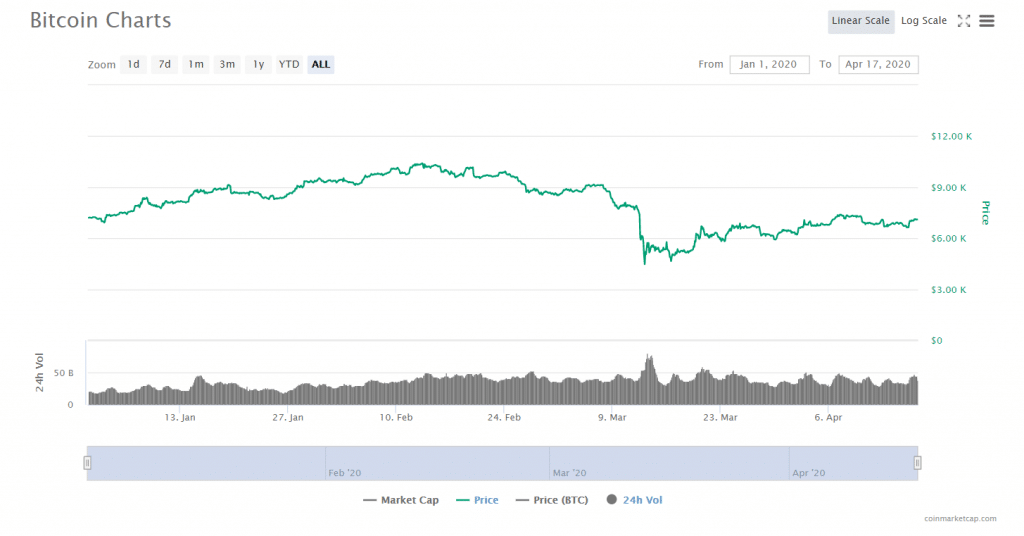
The effect of the coronavirus on the price of Bitcoin has been drastic. After several weeks bouncing between the $8,000-$10,5000 range Bitcoin took a veritable cliff dive from roughly $8,000 to nearly $4,000 over the course of several days; by the end of March, it had stabilized around $6,100.
So far this month, the price of Bitcoin has continued to slowly recover, staying largely between the $6,900 to $7,300 range--and of course, outside of crypto markets, many argue that the global economy is still months away from finding its footing again.
However, while the coronavirus-related economic fallout has negatively affected most of the world’s industries and businesses, there have been a few corners of the world that have actually managed to increase the amount of business that they are doing.
Beyond the crypto world, medical supply manufacturers and home-delivery retail companies are booming; inside the crypto world, cryptocurrency exchanges are having some of their best weeks and months in quite some time in terms of crypto trading volume.
Indeed, a quarterly report on crypto exchanges by crypto research firm CryptoCompare said that while trading volumes on cryptocurrency exchanges have gradually been increasing each month this year, March saw a 35 percent increase in trading volume “from many of the largest Top Tier exchanges” over February. Crypto derivatives volumes also saw a 5 percent increase from February to March.
What happened? And will it continue?
OTC trading volumes began to pick up before spot trading volumes
While the impact of the coronavirus on cryptocurrency prices and spot exchange volumes wasn’t necessarily ‘clearly visible’ until March, reports that the virus could be impacting trading volumes on OTC platforms emerged as early as February.
Indeed, CoinDesk reported in late February that OTC crypto trading volume “has been on the rise since the virus became a constant part of the news cycle.”
Michael Leon, a trader at Chicago-based Althena Investor Services (which serves OTC crypto clients), told the publication that, at the time, “we have been seeing a significant uptick in volume over the last 60 days.”
However, “when Wuhan was placed under quarantine on January 23rd, bitcoin’s real volume (spot and derivatives exchanges that have reliable volume) was recovering from lows at the end of December,” explained Jose Llisterri, co-founder of cryptocurrency derivatives exchange Interdax, in an email to Finance Magnates.
Interdax co-founder and Chief Product Officer Jose Llisterri.
Then, as the outbreak continued to rage in Wuhan--but hadn’t yet reached the rest of the world--“Bitcoin’s trading volume steadily increased from January 23rd into March.”
However, as the month of March progressed, trading volume exploded: “as the World Health Organisation declared Covid-19 a pandemic on March 11th, the following two days saw a bloodbath in both traditional and cryptocurrency markets as panic selling ran rampant,” Llisterri explained. “Professional traders and investors cashed out of equities as financial markets slumped.”
Trading volumes spike as the Coronavirus’s economic fallout ravaged financial markets, including Bitcoin
Indeed, according to data from CoinMarketCap.com, BTC’s trading volume on March 1st was roughly $35.3 billion. It climbed steadily over the next several days, reaching as high as $43 billion on Tuesday, March 3rd; the next several days sat approximately between the $35 billion to $41 billion.
Indeed, crypto markets fell from $263 billion at 05.00 GMT on Saturday, March 7th, to $225 billion at the same time on Monday, March 9th, representing a decline of roughly 14.4%. The most significant decline took place over the latter half of the two-day period, when the market cap fell from $251 billion from $225 billion (roughly 10.3%).
At the same time, Bitcoin’s trading volume saw its first bump that seemed to be directly related to the coronavirus, peaking around $48.6 billion around 17.00 UTC.
However, the action didn’t really get going until later in the week, when (from March 12 to March 14th), Bitcoin’s trading volume spiked, hanging largely between $70 billion and $80 billion for several days.
The spike in trading volume coincided with a cliff-dive in the price of Bitcoin, which sank below $5000 for the first time in over a year.
CryptoCompare said that “the massive market crash on March 12th-13th saw daily volumes hit $75.9bn in a single day (13th March)--the single greatest daily volume recorded in cryptoasset history).”
“Long-term holders sat it out, but traders went short.”
What happened, exactly? Jose Llisterri explained that “long-term holders sat it out, but traders went short.”
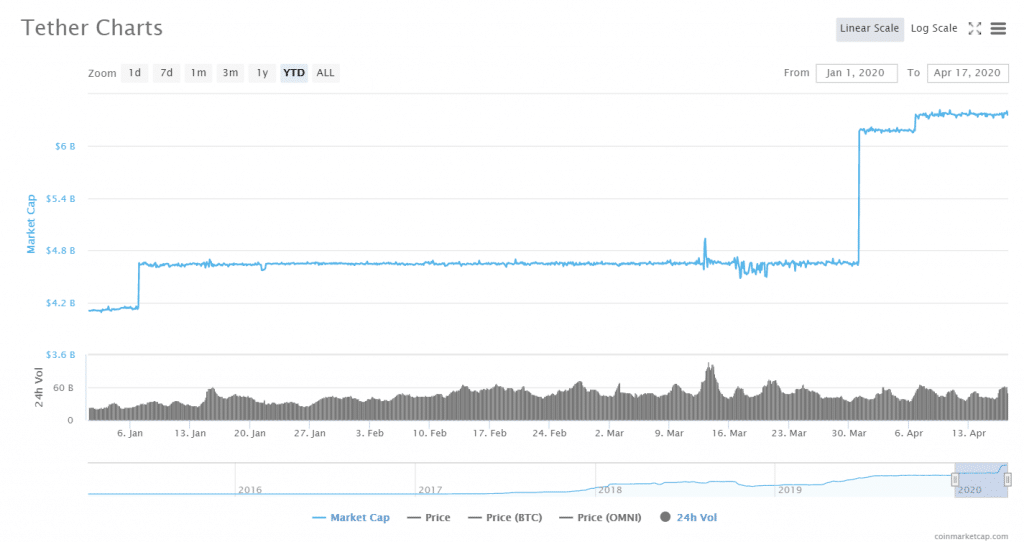
Stablecoin issuer Tether also saw the monthly volume of its USD-backed stablecoin, Tether Dollars (USDT), triple during the month of March as crypto traders desperately sought to get out of more volatile markets.
The dash for cash brought a massive amount of BTC back onto cryptocurrency exchanges; however, after this massive influx of BTC onto cryptocurrency exchanges, Llisterri said that the trend began to reverse: “the large inflows of BTC to exchanges during March 9th-13th have now mostly flowed out of exchanges,” he explained.
“Most transfers were above $10,000 on the Bitcoin network, lots of BTC were moved in very large chunks. High-value withdrawals also accounted for most of the outflows, suggesting professional traders and large investors were moving markets.”
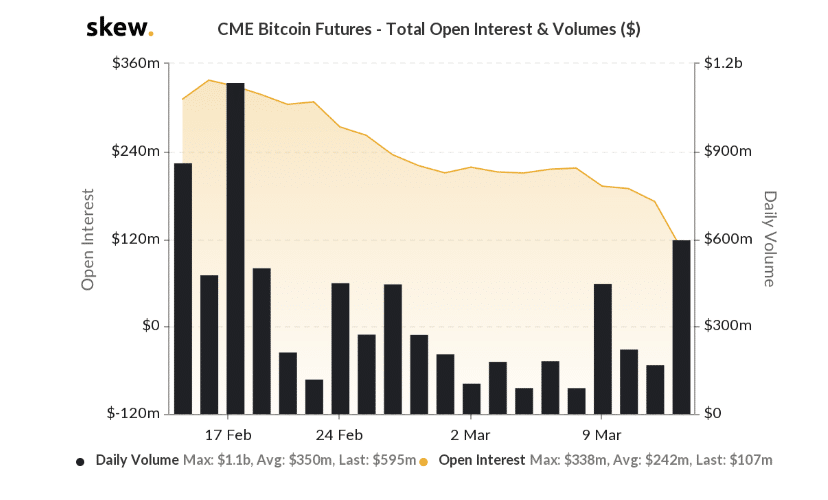
A massive drop in CME trading volume could indicate that institutional traders were some of the first to exit the crypto derivatives market
The exodus of professional traders and large investors from crypto markets during this time period was also demonstrated by significant movements within the crypto derivatives exchange space.
Indeed, while it’s true that crypto derivatives volumes also saw a 5 percent increase from February to March (bringing in a new all-time high, at that), CryptoCompare reported that CME, which operates a regulated Bitcoin derivatives exchange based in the United States, saw its trading volume for Bitcoin futures dive to the tune of 44 percent from February to March.
Some analysts have claimed that the decrease can be attributed in particular to the possibility that quantitative easing and economic efforts by the United States government and other governments around the world have largely been targeted toward more traditional asset markets.
Indeed, in a report for CoinTelegraph, analyst Antonio Madeira wrote that “the quantitative easing program launched by the U.S. Federal Reserve brought a small degree of trust back to the stock markets for institutional investors. The same cannot be said for Bitcoin.”
DEX volumes also saw a spike: "solving a real problem" for the first time, "not just a toy anymore.”
And, apparently, the same cannot be said for Ethereum-based assets, either. In addition to boosts in Bitcoin trading volumes on centralized BTC exchanges, so too was there an increase in activity on decentralized exchanges that are primarily used to trade Ethereum-based assets.
Indeed, citing a report by research firm Dune Analytics, The Block Crypto reported that the total volume for non-custodial exchanges, also known as decentralized exchanges (DEXs), reached a new all-time high of $668 million in the month of March. The figure represented a 53 percent increase over trading volume in February.
This is particularly signficant due to the fact that DEX volume hit a nine-month low in December of 2019, though The Block said that the share of volume traded on these exchanges was relatively high compared to their centralized counterparts.
Dune Analytics also noted in its report that this was the first time that volumes on these DEXs were rising in accordance with falling ether (ETH) prices, saying that it seemed that DEXs might actually be "solving a real problem" for the first time, and are "not just a toy anymore.”
What are your thoughts on the ways that the coronavirus has affected crypto exchanges and trading volumes? Let us know in the comments below.
The effect of the coronavirus on the price of Bitcoin has been drastic. After several weeks bouncing between the $8,000-$10,5000 range Bitcoin took a veritable cliff dive from roughly $8,000 to nearly $4,000 over the course of several days; by the end of March, it had stabilized around $6,100.
So far this month, the price of Bitcoin has continued to slowly recover, staying largely between the $6,900 to $7,300 range--and of course, outside of crypto markets, many argue that the global economy is still months away from finding its footing again.
However, while the coronavirus-related economic fallout has negatively affected most of the world’s industries and businesses, there have been a few corners of the world that have actually managed to increase the amount of business that they are doing.
Beyond the crypto world, medical supply manufacturers and home-delivery retail companies are booming; inside the crypto world, cryptocurrency exchanges are having some of their best weeks and months in quite some time in terms of crypto trading volume.
Indeed, a quarterly report on crypto exchanges by crypto research firm CryptoCompare said that while trading volumes on cryptocurrency exchanges have gradually been increasing each month this year, March saw a 35 percent increase in trading volume “from many of the largest Top Tier exchanges” over February. Crypto derivatives volumes also saw a 5 percent increase from February to March.
What happened? And will it continue?
OTC trading volumes began to pick up before spot trading volumes
While the impact of the coronavirus on cryptocurrency prices and spot exchange volumes wasn’t necessarily ‘clearly visible’ until March, reports that the virus could be impacting trading volumes on OTC platforms emerged as early as February.
Indeed, CoinDesk reported in late February that OTC crypto trading volume “has been on the rise since the virus became a constant part of the news cycle.”
Michael Leon, a trader at Chicago-based Althena Investor Services (which serves OTC crypto clients), told the publication that, at the time, “we have been seeing a significant uptick in volume over the last 60 days.”
However, “when Wuhan was placed under quarantine on January 23rd, bitcoin’s real volume (spot and derivatives exchanges that have reliable volume) was recovering from lows at the end of December,” explained Jose Llisterri, co-founder of cryptocurrency derivatives exchange Interdax, in an email to Finance Magnates.
Interdax co-founder and Chief Product Officer Jose Llisterri.
Then, as the outbreak continued to rage in Wuhan--but hadn’t yet reached the rest of the world--“Bitcoin’s trading volume steadily increased from January 23rd into March.”
However, as the month of March progressed, trading volume exploded: “as the World Health Organisation declared Covid-19 a pandemic on March 11th, the following two days saw a bloodbath in both traditional and cryptocurrency markets as panic selling ran rampant,” Llisterri explained. “Professional traders and investors cashed out of equities as financial markets slumped.”
Trading volumes spike as the Coronavirus’s economic fallout ravaged financial markets, including Bitcoin
Indeed, according to data from CoinMarketCap.com, BTC’s trading volume on March 1st was roughly $35.3 billion. It climbed steadily over the next several days, reaching as high as $43 billion on Tuesday, March 3rd; the next several days sat approximately between the $35 billion to $41 billion.
Indeed, crypto markets fell from $263 billion at 05.00 GMT on Saturday, March 7th, to $225 billion at the same time on Monday, March 9th, representing a decline of roughly 14.4%. The most significant decline took place over the latter half of the two-day period, when the market cap fell from $251 billion from $225 billion (roughly 10.3%).
At the same time, Bitcoin’s trading volume saw its first bump that seemed to be directly related to the coronavirus, peaking around $48.6 billion around 17.00 UTC.
However, the action didn’t really get going until later in the week, when (from March 12 to March 14th), Bitcoin’s trading volume spiked, hanging largely between $70 billion and $80 billion for several days.
The spike in trading volume coincided with a cliff-dive in the price of Bitcoin, which sank below $5000 for the first time in over a year.
CryptoCompare said that “the massive market crash on March 12th-13th saw daily volumes hit $75.9bn in a single day (13th March)--the single greatest daily volume recorded in cryptoasset history).”
“Long-term holders sat it out, but traders went short.”
What happened, exactly? Jose Llisterri explained that “long-term holders sat it out, but traders went short.”
Stablecoin issuer Tether also saw the monthly volume of its USD-backed stablecoin, Tether Dollars (USDT), triple during the month of March as crypto traders desperately sought to get out of more volatile markets.
The dash for cash brought a massive amount of BTC back onto cryptocurrency exchanges; however, after this massive influx of BTC onto cryptocurrency exchanges, Llisterri said that the trend began to reverse: “the large inflows of BTC to exchanges during March 9th-13th have now mostly flowed out of exchanges,” he explained.
“Most transfers were above $10,000 on the Bitcoin network, lots of BTC were moved in very large chunks. High-value withdrawals also accounted for most of the outflows, suggesting professional traders and large investors were moving markets.”
A massive drop in CME trading volume could indicate that institutional traders were some of the first to exit the crypto derivatives market
The exodus of professional traders and large investors from crypto markets during this time period was also demonstrated by significant movements within the crypto derivatives exchange space.
Indeed, while it’s true that crypto derivatives volumes also saw a 5 percent increase from February to March (bringing in a new all-time high, at that), CryptoCompare reported that CME, which operates a regulated Bitcoin derivatives exchange based in the United States, saw its trading volume for Bitcoin futures dive to the tune of 44 percent from February to March.
Some analysts have claimed that the decrease can be attributed in particular to the possibility that quantitative easing and economic efforts by the United States government and other governments around the world have largely been targeted toward more traditional asset markets.
Indeed, in a report for CoinTelegraph, analyst Antonio Madeira wrote that “the quantitative easing program launched by the U.S. Federal Reserve brought a small degree of trust back to the stock markets for institutional investors. The same cannot be said for Bitcoin.”
DEX volumes also saw a spike: "solving a real problem" for the first time, "not just a toy anymore.”
And, apparently, the same cannot be said for Ethereum-based assets, either. In addition to boosts in Bitcoin trading volumes on centralized BTC exchanges, so too was there an increase in activity on decentralized exchanges that are primarily used to trade Ethereum-based assets.
Indeed, citing a report by research firm Dune Analytics, The Block Crypto reported that the total volume for non-custodial exchanges, also known as decentralized exchanges (DEXs), reached a new all-time high of $668 million in the month of March. The figure represented a 53 percent increase over trading volume in February.
This is particularly signficant due to the fact that DEX volume hit a nine-month low in December of 2019, though The Block said that the share of volume traded on these exchanges was relatively high compared to their centralized counterparts.
Dune Analytics also noted in its report that this was the first time that volumes on these DEXs were rising in accordance with falling ether (ETH) prices, saying that it seemed that DEXs might actually be "solving a real problem" for the first time, and are "not just a toy anymore.”
What are your thoughts on the ways that the coronavirus has affected crypto exchanges and trading volumes? Let us know in the comments below.
Rachel is a self-taught crypto geek and a passionate writer. She believes in the power that the written word has to educate, connect and empower individuals to make positive and powerful financial choices. She is the Podcast Host and a Cryptocurrency Editor at Finance Magnates.
Crypto Built More Rails, but the Next Battle Is Over How Much Work a Dollar Can Do
Featured Videos
FP Markets Winner Spotlight 🏆 | Global Broker of the Year 2025 #Trading #Broker #Innovation #Shorts
FP Markets Winner Spotlight 🏆 | Global Broker of the Year 2025 #Trading #Broker #Innovation #Shorts
FP Markets Winner Spotlight 🏆 | Global Broker of the Year 2025 #Trading #Broker #Innovation #Shorts
FP Markets Winner Spotlight 🏆 | Global Broker of the Year 2025 #Trading #Broker #Innovation #Shorts
FP Markets takes the spotlight as Global Broker of the Year 2025 at the Finance Magnates Awards.
Martin Stoilov, Head of Client Experience, shares that trust, innovation, and people played a key role in the company’s success, supported by a strong foundation of integrity and client-centricity.
Following this milestone, FP Markets continues to focus on growth, technology investment, and its core values of transparency and excellence.
👉 Be part of FM Awards 2026: https://awards.financemagnates.com/#nominate
FP Markets takes the spotlight as Global Broker of the Year 2025 at the Finance Magnates Awards.
Martin Stoilov, Head of Client Experience, shares that trust, innovation, and people played a key role in the company’s success, supported by a strong foundation of integrity and client-centricity.
Following this milestone, FP Markets continues to focus on growth, technology investment, and its core values of transparency and excellence.
👉 Be part of FM Awards 2026: https://awards.financemagnates.com/#nominate
FP Markets takes the spotlight as Global Broker of the Year 2025 at the Finance Magnates Awards.
Martin Stoilov, Head of Client Experience, shares that trust, innovation, and people played a key role in the company’s success, supported by a strong foundation of integrity and client-centricity.
Following this milestone, FP Markets continues to focus on growth, technology investment, and its core values of transparency and excellence.
👉 Be part of FM Awards 2026: https://awards.financemagnates.com/#nominate
FP Markets takes the spotlight as Global Broker of the Year 2025 at the Finance Magnates Awards.
Martin Stoilov, Head of Client Experience, shares that trust, innovation, and people played a key role in the company’s success, supported by a strong foundation of integrity and client-centricity.
Following this milestone, FP Markets continues to focus on growth, technology investment, and its core values of transparency and excellence.
👉 Be part of FM Awards 2026: https://awards.financemagnates.com/#nominate
In this video, we review @HolaPrimeMarketsOfficial, a multi-asset forex and CFDs broker offering different account types, trading platforms, and flexible trading conditions.
We cover the broker’s overall offering, including account options, trading environment, platforms like MT4 and MT5, and additional services such as managed accounts and fast withdrawals.
Watch the full video to see if Hola Prime Markets fits your trading needs.
📣 Stay up to date with the latest in finance and trading. Follow Finance Magnates for industry news, insights, and global event coverage.
Connect with us:
🔗 LinkedIn: /financemagnates
👍 Facebook: /financemagnates
📸 Instagram: https://www.instagram.com/financemagnates
🐦 X: https://x.com/financemagnates
🎥 TikTok: https://www.tiktok.com/tag/financemagnates
▶️ YouTube: /@financemagnates_official
#HolaPrime #ForexBroker #CFDTrading #FinanceMagnates #Trading #Forex #BrokerReview
In this video, we review @HolaPrimeMarketsOfficial, a multi-asset forex and CFDs broker offering different account types, trading platforms, and flexible trading conditions.
We cover the broker’s overall offering, including account options, trading environment, platforms like MT4 and MT5, and additional services such as managed accounts and fast withdrawals.
Watch the full video to see if Hola Prime Markets fits your trading needs.
📣 Stay up to date with the latest in finance and trading. Follow Finance Magnates for industry news, insights, and global event coverage.
Connect with us:
🔗 LinkedIn: /financemagnates
👍 Facebook: /financemagnates
📸 Instagram: https://www.instagram.com/financemagnates
🐦 X: https://x.com/financemagnates
🎥 TikTok: https://www.tiktok.com/tag/financemagnates
▶️ YouTube: /@financemagnates_official
#HolaPrime #ForexBroker #CFDTrading #FinanceMagnates #Trading #Forex #BrokerReview
In this video, we review @HolaPrimeMarketsOfficial, a multi-asset forex and CFDs broker offering different account types, trading platforms, and flexible trading conditions.
We cover the broker’s overall offering, including account options, trading environment, platforms like MT4 and MT5, and additional services such as managed accounts and fast withdrawals.
Watch the full video to see if Hola Prime Markets fits your trading needs.
📣 Stay up to date with the latest in finance and trading. Follow Finance Magnates for industry news, insights, and global event coverage.
Connect with us:
🔗 LinkedIn: /financemagnates
👍 Facebook: /financemagnates
📸 Instagram: https://www.instagram.com/financemagnates
🐦 X: https://x.com/financemagnates
🎥 TikTok: https://www.tiktok.com/tag/financemagnates
▶️ YouTube: /@financemagnates_official
#HolaPrime #ForexBroker #CFDTrading #FinanceMagnates #Trading #Forex #BrokerReview
In this video, we review @HolaPrimeMarketsOfficial, a multi-asset forex and CFDs broker offering different account types, trading platforms, and flexible trading conditions.
We cover the broker’s overall offering, including account options, trading environment, platforms like MT4 and MT5, and additional services such as managed accounts and fast withdrawals.
Watch the full video to see if Hola Prime Markets fits your trading needs.
📣 Stay up to date with the latest in finance and trading. Follow Finance Magnates for industry news, insights, and global event coverage.
Connect with us:
🔗 LinkedIn: /financemagnates
👍 Facebook: /financemagnates
📸 Instagram: https://www.instagram.com/financemagnates
🐦 X: https://x.com/financemagnates
🎥 TikTok: https://www.tiktok.com/tag/financemagnates
▶️ YouTube: /@financemagnates_official
#HolaPrime #ForexBroker #CFDTrading #FinanceMagnates #Trading #Forex #BrokerReview
In this video, we review @HolaPrimeMarketsOfficial, a multi-asset forex and CFDs broker offering different account types, trading platforms, and flexible trading conditions.
We cover the broker’s overall offering, including account options, trading environment, platforms like MT4 and MT5, and additional services such as managed accounts and fast withdrawals.
Watch the full video to see if Hola Prime Markets fits your trading needs.
📣 Stay up to date with the latest in finance and trading. Follow Finance Magnates for industry news, insights, and global event coverage.
Connect with us:
🔗 LinkedIn: /financemagnates
👍 Facebook: /financemagnates
📸 Instagram: https://www.instagram.com/financemagnates
🐦 X: https://x.com/financemagnates
🎥 TikTok: https://www.tiktok.com/tag/financemagnates
▶️ YouTube: /@financemagnates_official
#HolaPrime #ForexBroker #CFDTrading #FinanceMagnates #Trading #Forex #BrokerReview
In this video, we review @HolaPrimeMarketsOfficial, a multi-asset forex and CFDs broker offering different account types, trading platforms, and flexible trading conditions.
We cover the broker’s overall offering, including account options, trading environment, platforms like MT4 and MT5, and additional services such as managed accounts and fast withdrawals.
Watch the full video to see if Hola Prime Markets fits your trading needs.
📣 Stay up to date with the latest in finance and trading. Follow Finance Magnates for industry news, insights, and global event coverage.
Connect with us:
🔗 LinkedIn: /financemagnates
👍 Facebook: /financemagnates
📸 Instagram: https://www.instagram.com/financemagnates
🐦 X: https://x.com/financemagnates
🎥 TikTok: https://www.tiktok.com/tag/financemagnates
▶️ YouTube: /@financemagnates_official
#HolaPrime #ForexBroker #CFDTrading #FinanceMagnates #Trading #Forex #BrokerReview
Hola Prime Review: What You Need to Know | Full Breakdown by Finance Magnates
Hola Prime Review: What You Need to Know | Full Breakdown by Finance Magnates
Hola Prime Review: What You Need to Know | Full Breakdown by Finance Magnates
Hola Prime Review: What You Need to Know | Full Breakdown by Finance Magnates
Hola Prime Review: What You Need to Know | Full Breakdown by Finance Magnates
Hola Prime Review: What You Need to Know | Full Breakdown by Finance Magnates
In this video, we review @HolaPrime_Global, a proprietary trading firm offering evaluation programs and performance-based payouts in simulated market environments.
We cover how the challenge model works, including account types, profit splits (up to 95%), trading rules, and what it takes to reach a funded account. You’ll also learn about available platforms like MT4, MT5, cTrader, and more, along with insights into payouts, support, and trading conditions.
Watch the full video to see if Hola Prime fits your trading style.
📣 Stay up to date with the latest in finance and trading. Follow Finance Magnates for industry news, insights, and global event coverage.
Connect with us:
🔗 LinkedIn: /financemagnates
👍 Facebook: /financemagnates
📸 Instagram: https://www.instagram.com/financemagnates
🐦 X: https://x.com/financemagnates
🎥 TikTok: https://www.tiktok.com/tag/financemagnates
▶️ YouTube: /@financemagnates_official
#HolaPrime #PropFirm #Trading #FinanceMagnates #Forex #FuturesTrading #TradingReview #PropFirmReview
In this video, we review @HolaPrime_Global, a proprietary trading firm offering evaluation programs and performance-based payouts in simulated market environments.
We cover how the challenge model works, including account types, profit splits (up to 95%), trading rules, and what it takes to reach a funded account. You’ll also learn about available platforms like MT4, MT5, cTrader, and more, along with insights into payouts, support, and trading conditions.
Watch the full video to see if Hola Prime fits your trading style.
📣 Stay up to date with the latest in finance and trading. Follow Finance Magnates for industry news, insights, and global event coverage.
Connect with us:
🔗 LinkedIn: /financemagnates
👍 Facebook: /financemagnates
📸 Instagram: https://www.instagram.com/financemagnates
🐦 X: https://x.com/financemagnates
🎥 TikTok: https://www.tiktok.com/tag/financemagnates
▶️ YouTube: /@financemagnates_official
#HolaPrime #PropFirm #Trading #FinanceMagnates #Forex #FuturesTrading #TradingReview #PropFirmReview
In this video, we review @HolaPrime_Global, a proprietary trading firm offering evaluation programs and performance-based payouts in simulated market environments.
We cover how the challenge model works, including account types, profit splits (up to 95%), trading rules, and what it takes to reach a funded account. You’ll also learn about available platforms like MT4, MT5, cTrader, and more, along with insights into payouts, support, and trading conditions.
Watch the full video to see if Hola Prime fits your trading style.
📣 Stay up to date with the latest in finance and trading. Follow Finance Magnates for industry news, insights, and global event coverage.
Connect with us:
🔗 LinkedIn: /financemagnates
👍 Facebook: /financemagnates
📸 Instagram: https://www.instagram.com/financemagnates
🐦 X: https://x.com/financemagnates
🎥 TikTok: https://www.tiktok.com/tag/financemagnates
▶️ YouTube: /@financemagnates_official
#HolaPrime #PropFirm #Trading #FinanceMagnates #Forex #FuturesTrading #TradingReview #PropFirmReview
In this video, we review @HolaPrime_Global, a proprietary trading firm offering evaluation programs and performance-based payouts in simulated market environments.
We cover how the challenge model works, including account types, profit splits (up to 95%), trading rules, and what it takes to reach a funded account. You’ll also learn about available platforms like MT4, MT5, cTrader, and more, along with insights into payouts, support, and trading conditions.
Watch the full video to see if Hola Prime fits your trading style.
📣 Stay up to date with the latest in finance and trading. Follow Finance Magnates for industry news, insights, and global event coverage.
Connect with us:
🔗 LinkedIn: /financemagnates
👍 Facebook: /financemagnates
📸 Instagram: https://www.instagram.com/financemagnates
🐦 X: https://x.com/financemagnates
🎥 TikTok: https://www.tiktok.com/tag/financemagnates
▶️ YouTube: /@financemagnates_official
#HolaPrime #PropFirm #Trading #FinanceMagnates #Forex #FuturesTrading #TradingReview #PropFirmReview
In this video, we review @HolaPrime_Global, a proprietary trading firm offering evaluation programs and performance-based payouts in simulated market environments.
We cover how the challenge model works, including account types, profit splits (up to 95%), trading rules, and what it takes to reach a funded account. You’ll also learn about available platforms like MT4, MT5, cTrader, and more, along with insights into payouts, support, and trading conditions.
Watch the full video to see if Hola Prime fits your trading style.
📣 Stay up to date with the latest in finance and trading. Follow Finance Magnates for industry news, insights, and global event coverage.
Connect with us:
🔗 LinkedIn: /financemagnates
👍 Facebook: /financemagnates
📸 Instagram: https://www.instagram.com/financemagnates
🐦 X: https://x.com/financemagnates
🎥 TikTok: https://www.tiktok.com/tag/financemagnates
▶️ YouTube: /@financemagnates_official
#HolaPrime #PropFirm #Trading #FinanceMagnates #Forex #FuturesTrading #TradingReview #PropFirmReview
In this video, we review @HolaPrime_Global, a proprietary trading firm offering evaluation programs and performance-based payouts in simulated market environments.
We cover how the challenge model works, including account types, profit splits (up to 95%), trading rules, and what it takes to reach a funded account. You’ll also learn about available platforms like MT4, MT5, cTrader, and more, along with insights into payouts, support, and trading conditions.
Watch the full video to see if Hola Prime fits your trading style.
📣 Stay up to date with the latest in finance and trading. Follow Finance Magnates for industry news, insights, and global event coverage.
Connect with us:
🔗 LinkedIn: /financemagnates
👍 Facebook: /financemagnates
📸 Instagram: https://www.instagram.com/financemagnates
🐦 X: https://x.com/financemagnates
🎥 TikTok: https://www.tiktok.com/tag/financemagnates
▶️ YouTube: /@financemagnates_official
#HolaPrime #PropFirm #Trading #FinanceMagnates #Forex #FuturesTrading #TradingReview #PropFirmReview
Axi Winner Spotlight 🏆 | Global Most Innovative Broker 2025 #Innovation #Trading #Fintech #Broker
Axi Winner Spotlight 🏆 | Global Most Innovative Broker 2025 #Innovation #Trading #Fintech #Broker
Axi Winner Spotlight 🏆 | Global Most Innovative Broker 2025 #Innovation #Trading #Fintech #Broker
Axi Winner Spotlight 🏆 | Global Most Innovative Broker 2025 #Innovation #Trading #Fintech #Broker
Axi Winner Spotlight 🏆 | Global Most Innovative Broker 2025 #Innovation #Trading #Fintech #Broker
Axi Winner Spotlight 🏆 | Global Most Innovative Broker 2025 #Innovation #Trading #Fintech #Broker
Axi takes the spotlight at the Finance Magnates Awards, winning Global Most Innovative Broker 2025.
Olivia Xenofontos and Ivanna Openko share how the team will feel: proud, motivated, and ready to keep delivering.
They also describe the night as well-organized, focused, and enjoyable for all.
👉 Be part of FM Awards 2026.
Axi takes the spotlight at the Finance Magnates Awards, winning Global Most Innovative Broker 2025.
Olivia Xenofontos and Ivanna Openko share how the team will feel: proud, motivated, and ready to keep delivering.
They also describe the night as well-organized, focused, and enjoyable for all.
👉 Be part of FM Awards 2026.
Axi takes the spotlight at the Finance Magnates Awards, winning Global Most Innovative Broker 2025.
Olivia Xenofontos and Ivanna Openko share how the team will feel: proud, motivated, and ready to keep delivering.
They also describe the night as well-organized, focused, and enjoyable for all.
👉 Be part of FM Awards 2026.
Axi takes the spotlight at the Finance Magnates Awards, winning Global Most Innovative Broker 2025.
Olivia Xenofontos and Ivanna Openko share how the team will feel: proud, motivated, and ready to keep delivering.
They also describe the night as well-organized, focused, and enjoyable for all.
👉 Be part of FM Awards 2026.
Axi takes the spotlight at the Finance Magnates Awards, winning Global Most Innovative Broker 2025.
Olivia Xenofontos and Ivanna Openko share how the team will feel: proud, motivated, and ready to keep delivering.
They also describe the night as well-organized, focused, and enjoyable for all.
👉 Be part of FM Awards 2026.
Axi takes the spotlight at the Finance Magnates Awards, winning Global Most Innovative Broker 2025.
Olivia Xenofontos and Ivanna Openko share how the team will feel: proud, motivated, and ready to keep delivering.
They also describe the night as well-organized, focused, and enjoyable for all.
👉 Be part of FM Awards 2026.
Recognition that matters.
Built on transparency.
Driven by the industry.
The Finance Magnates Awards 2026.
Nominations are now open.
🔗 https://awards.financemagnates.com/?utm_source=SM&utm_medium=social&utm_campaign=recognition-matters
Recognition that matters.
Built on transparency.
Driven by the industry.
The Finance Magnates Awards 2026.
Nominations are now open.
🔗 https://awards.financemagnates.com/?utm_source=SM&utm_medium=social&utm_campaign=recognition-matters
Recognition that matters.
Built on transparency.
Driven by the industry.
The Finance Magnates Awards 2026.
Nominations are now open.
🔗 https://awards.financemagnates.com/?utm_source=SM&utm_medium=social&utm_campaign=recognition-matters
Recognition that matters.
Built on transparency.
Driven by the industry.
The Finance Magnates Awards 2026.
Nominations are now open.
🔗 https://awards.financemagnates.com/?utm_source=SM&utm_medium=social&utm_campaign=recognition-matters
Recognition that matters.
Built on transparency.
Driven by the industry.
The Finance Magnates Awards 2026.
Nominations are now open.
🔗 https://awards.financemagnates.com/?utm_source=SM&utm_medium=social&utm_campaign=recognition-matters
Recognition that matters.
Built on transparency.
Driven by the industry.
The Finance Magnates Awards 2026.
Nominations are now open.
🔗 https://awards.financemagnates.com/?utm_source=SM&utm_medium=social&utm_campaign=recognition-matters