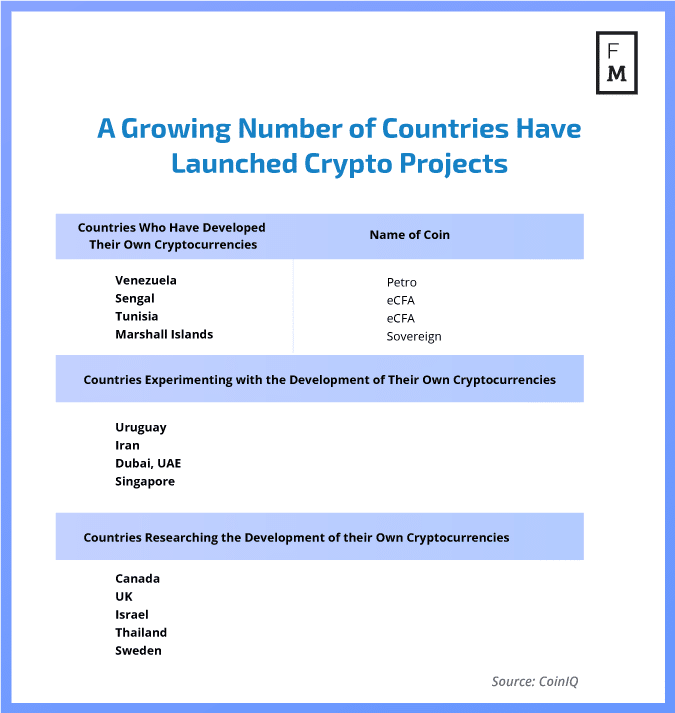
Several national cryptocurrencies have made headlines over the last year, but not all of the publicity has been good.
In late 2017 and early 2018, national stablecoins were the talk of the industry. Rumors - some confirmed, some unconfirmed - that Estonia, Sweden, Iran, Russia, Venezuela, and others may be exploring the launch of a national stablecoin spread like wildfire.
Many believed that the launch of national cryptocurrencies was the thing - the thing that would finally prove cryptocurrencies as a valid transactional instrument, as a worthy investment, as more than just a fad.
However, the hype around many of these national cryptocurrency projects--just like the hype around many cryptocurrency projects--came and went. In most cases, national crypto initiatives faded out of the spotlight or disappeared altogether; in the worst cases, these national crypto projects were used as vehicles to avoid international sanctions and commit large-scale financial crimes.
How have these projects evolved over the last year? And how have they influenced the world’s view of cryptocurrency?
Whatever Happened with the Petro?
Perhaps the most infamous example of a national cryptocurrency gone wrong is the Venezuelan Petro. The Petro, a cryptocurrency that is allegedly backed by oil and other commodities, was launched by President Nicholas Maduro as a possible solution to the country’s financial crisis. Hyperinflation has struck the nation’s economy so severely that in the worst of times, a loaf of bread costs close to 500,000 Bolivars.
At the launch of the Petro, the Venezuelan government is alleged to have allocated five billion barrels of oil to it. Each single Petro coin was worth one barrel. The government said that the Petro would be “a second accounting unit of the Republic and will begin operations as a mandatory accounting unit of our PDVSA oil industry.”
“The new Bolivar with five zeroes dropped is not “anchored” (to the #petro#fraud crypto) as #maduro said). It is rather attached to an ANVIL amd will sink faster.” No policies against #hyperinflation but more petrol for the fire. https://t.co/J6FjHsp01A
Preceding the launch of the Petro, the Venezuelan government came under fire from other government bodies around the world, which accused the country of developing the Petro as a way to evade sanctions and access international debt markets. Some governments even barred their own citizens from taking part in the Petro’s token sale.
Almost immediately after the launch of the Petro, accusations emerged that Maduro and his associates were directly involved in a huge money-laundering scheme with the Petro at the center of it. More specifically, the allegations were made in connection with the $735 million that was raised within hours after the Petro went public.
“The mention of agreements with the ghost company ‘Aerotrading’, does not figure in the [Petro’s] ecosystem of development and neither on the internet,” a report by the company read (translated from Spanish.) “In addition, the Zeus company dissociates itself from the agreements made, while the Venezuelan government is still naming the companies and the NEM foundation as the parties directly responsible for the integration of the Token [Petro].”
Interesante...
La cuestión es que el 'Petro' es un #ENTE fantasma ?
No llega ni a la categoría de criptomoneda basura...
Suspicions were raised even higher when a Reuter’s investigation conducted in August of 2018 revealed that the man who had been named as Venezuela’s Superintendent of Cryptocurrencies did not have an industry in the Ministry of Finance and that the office’s promoted website did not exist. Ataparire, the parish where the project’s oil reserves were supposedly based, had seen no oil-related activity; oil rigs found in the area appeared to have lain abandoned for some time.
Additionally, Reuters could not identify any actual human being that had been able to buy the petro at all. In the end, it seems that the project was one giant lie.
As you can perhaps imagine, this did not do wonders for the cryptocurrency industry. Most of the public saw yet another example of cryptocurrency being linked with illicit activity. However, the debacle did serve as a learning experience for governments interested in learning how to better regulate their own interactions with cryptocurrency projects.
The US Fights Against the Iranian ‘PayMon’
Another national cryptocurrency project that has garnered quite a bit of negative attention is the Iranian PayMon, a digital currency that would be backed by national reserves of gold. Similar to the Petro, the project has been criticized for having been developed as a method of evading international sanctions.
Anticipating these, US lawmakers introduced a bill due impose further sanctions that would hinder the development and use of the PayMon. The “Blocking Iran Illicit Finance Act,” which was published in late 2018, would place sanctions on foreign individuals who are involved in the transfer, holding, sale, or supply of the PayMon.
#Iran's economy has been creaking badly under the reimposed US sanctions, which were activated in H2/2018; the #PayMon is one of those innovations borne of dire circumstances
The act also requests that a comprehensive report on the project be made to Congress. A similar bill was introduced by Ted Cruz around the same time.
According to a report from CoinTelegraph, cryptocurrencies have already been widely used by Iranians who are seeking to evade sanctions. Additionally, crypto and blockchain technology have been eyed as an alternative to the SWIFT financial messaging services, as a number of Iranian banks have been forcibly removed from the SWIFT system.
Iran’s crypto-rial has sparked controversies. While the gold-backed "PayMon" can be used to invest in the country, critics suggest that #Iran is trying to evade U.S sanctions. The question now is: does it have a future? #paymon#cryptocurrency#CryptoNewshttps://t.co/8iUpww5vD0
So, Iran is in a tight spot. A sovereign cryptocurrency could indeed improve the country’s own financial services--a problem that is particularly acute due to the absence of SWIFT from some of its banks. However, its financial and political situations could worsen more generally if the countries pursues the creation of the PayMon any further.
Governments Could Reduce Crime and Increase Efficiency With their Own Cryptocurrencies
Despite the mixed results of the national cryptocurrency projects that have appeared over the course of the last two years, many analysts believe that a growing number of countries will eventually have some kind of cryptocurrency or blockchain-based system within their financial infrastructure.
In fact, Christine Lagarde, head of the International Monetary Fund (IMF), recently endorsed the concept of national cryptocurrencies in order to prevent systems like the Bitcoin network from becoming havens for money-launderers and other kinds of criminals.
Lagarde also said that integrating regulated cryptocurrency and blockchain systems into national banks could greatly increase efficiency and lower costs. “The advantage is clear. Your payment would be immediate, safe, cheap, and potentially semi-anonymous,” she explained, speaking at a fintech conference in Singapore last year.
“Putting it another way. The central bank focuses on its comparative advantage – back-end settlement – and financial institutions and start-ups are free to focus on what they do best – client interface and innovation. This is [a] public-private partnership at its best.”
Countries With Legit Projects are Plugging Along, But Most Projects are Far From Release
One country that is working on developing a blockchain-based system that could improve its own banking services is Thailand. The Thai central bank, along with eight other Thai financial institutions, teamed up in August to create a cryptocurrency to be used between banks. The announcement of the coin is meant to “enhance the efficiency of the Thai financial market infrastructure.”
After the interbank cryptocurrency system is established, the project is set to expand into cross-border transactions. “Building upon the findings and outcomes from Phase 1, the project participants aim to further develop the capabilities of the prototype for broader functions including third party funds transfer and cross-border funds transfer,” the announcement explained. No public news of the project has emerged since its launch.
A number of similar projects have emerged--projects that appear to be well-regulated and created with the intent to operate in line with international sanctions.
Tunisia has developed a transaction platform that would also serve as a digital ID; it would be used for salary transfers, loans, and bill payments. Sweden is creating the ‘e-krona’ - among other use-cases, the e-krona is set to be used by asylum seekers as a verifiable and secure method of transaction. A similar platform is being developed by Finnish company MONI in collaboration with the Finnish government.
Some countries are even working to create cryptocurrencies as a way to become less reliant on the international economy. Marshall Islands President Hilda Heina has declared her support for the creation of a sovereign cryptocurrency as a way to become more independent from the US and its banking system. A growing number of small island nations have also been considering developing their own cryptocurrencies for similar reasons.
It’s unclear when any of these projects will come to fruition. However, what’s clear is that the speculation around these projects has increased, so too has the apparent need for international regulations and infrastructure that would allow these cryptocurrencies to function on a legal scale.
In late 2017 and early 2018, national stablecoins were the talk of the industry. Rumors - some confirmed, some unconfirmed - that Estonia, Sweden, Iran, Russia, Venezuela, and others may be exploring the launch of a national stablecoin spread like wildfire.
Many believed that the launch of national cryptocurrencies was the thing - the thing that would finally prove cryptocurrencies as a valid transactional instrument, as a worthy investment, as more than just a fad.
However, the hype around many of these national cryptocurrency projects--just like the hype around many cryptocurrency projects--came and went. In most cases, national crypto initiatives faded out of the spotlight or disappeared altogether; in the worst cases, these national crypto projects were used as vehicles to avoid international sanctions and commit large-scale financial crimes.
How have these projects evolved over the last year? And how have they influenced the world’s view of cryptocurrency?
Whatever Happened with the Petro?
Perhaps the most infamous example of a national cryptocurrency gone wrong is the Venezuelan Petro. The Petro, a cryptocurrency that is allegedly backed by oil and other commodities, was launched by President Nicholas Maduro as a possible solution to the country’s financial crisis. Hyperinflation has struck the nation’s economy so severely that in the worst of times, a loaf of bread costs close to 500,000 Bolivars.
At the launch of the Petro, the Venezuelan government is alleged to have allocated five billion barrels of oil to it. Each single Petro coin was worth one barrel. The government said that the Petro would be “a second accounting unit of the Republic and will begin operations as a mandatory accounting unit of our PDVSA oil industry.”
“The new Bolivar with five zeroes dropped is not “anchored” (to the #petro#fraud crypto) as #maduro said). It is rather attached to an ANVIL amd will sink faster.” No policies against #hyperinflation but more petrol for the fire. https://t.co/J6FjHsp01A
Preceding the launch of the Petro, the Venezuelan government came under fire from other government bodies around the world, which accused the country of developing the Petro as a way to evade sanctions and access international debt markets. Some governments even barred their own citizens from taking part in the Petro’s token sale.
Almost immediately after the launch of the Petro, accusations emerged that Maduro and his associates were directly involved in a huge money-laundering scheme with the Petro at the center of it. More specifically, the allegations were made in connection with the $735 million that was raised within hours after the Petro went public.
“The mention of agreements with the ghost company ‘Aerotrading’, does not figure in the [Petro’s] ecosystem of development and neither on the internet,” a report by the company read (translated from Spanish.) “In addition, the Zeus company dissociates itself from the agreements made, while the Venezuelan government is still naming the companies and the NEM foundation as the parties directly responsible for the integration of the Token [Petro].”
Interesante...
La cuestión es que el 'Petro' es un #ENTE fantasma ?
No llega ni a la categoría de criptomoneda basura...
Suspicions were raised even higher when a Reuter’s investigation conducted in August of 2018 revealed that the man who had been named as Venezuela’s Superintendent of Cryptocurrencies did not have an industry in the Ministry of Finance and that the office’s promoted website did not exist. Ataparire, the parish where the project’s oil reserves were supposedly based, had seen no oil-related activity; oil rigs found in the area appeared to have lain abandoned for some time.
Additionally, Reuters could not identify any actual human being that had been able to buy the petro at all. In the end, it seems that the project was one giant lie.
As you can perhaps imagine, this did not do wonders for the cryptocurrency industry. Most of the public saw yet another example of cryptocurrency being linked with illicit activity. However, the debacle did serve as a learning experience for governments interested in learning how to better regulate their own interactions with cryptocurrency projects.
The US Fights Against the Iranian ‘PayMon’
Another national cryptocurrency project that has garnered quite a bit of negative attention is the Iranian PayMon, a digital currency that would be backed by national reserves of gold. Similar to the Petro, the project has been criticized for having been developed as a method of evading international sanctions.
Anticipating these, US lawmakers introduced a bill due impose further sanctions that would hinder the development and use of the PayMon. The “Blocking Iran Illicit Finance Act,” which was published in late 2018, would place sanctions on foreign individuals who are involved in the transfer, holding, sale, or supply of the PayMon.
#Iran's economy has been creaking badly under the reimposed US sanctions, which were activated in H2/2018; the #PayMon is one of those innovations borne of dire circumstances
The act also requests that a comprehensive report on the project be made to Congress. A similar bill was introduced by Ted Cruz around the same time.
According to a report from CoinTelegraph, cryptocurrencies have already been widely used by Iranians who are seeking to evade sanctions. Additionally, crypto and blockchain technology have been eyed as an alternative to the SWIFT financial messaging services, as a number of Iranian banks have been forcibly removed from the SWIFT system.
Iran’s crypto-rial has sparked controversies. While the gold-backed "PayMon" can be used to invest in the country, critics suggest that #Iran is trying to evade U.S sanctions. The question now is: does it have a future? #paymon#cryptocurrency#CryptoNewshttps://t.co/8iUpww5vD0
So, Iran is in a tight spot. A sovereign cryptocurrency could indeed improve the country’s own financial services--a problem that is particularly acute due to the absence of SWIFT from some of its banks. However, its financial and political situations could worsen more generally if the countries pursues the creation of the PayMon any further.
Governments Could Reduce Crime and Increase Efficiency With their Own Cryptocurrencies
Despite the mixed results of the national cryptocurrency projects that have appeared over the course of the last two years, many analysts believe that a growing number of countries will eventually have some kind of cryptocurrency or blockchain-based system within their financial infrastructure.
In fact, Christine Lagarde, head of the International Monetary Fund (IMF), recently endorsed the concept of national cryptocurrencies in order to prevent systems like the Bitcoin network from becoming havens for money-launderers and other kinds of criminals.
Lagarde also said that integrating regulated cryptocurrency and blockchain systems into national banks could greatly increase efficiency and lower costs. “The advantage is clear. Your payment would be immediate, safe, cheap, and potentially semi-anonymous,” she explained, speaking at a fintech conference in Singapore last year.
“Putting it another way. The central bank focuses on its comparative advantage – back-end settlement – and financial institutions and start-ups are free to focus on what they do best – client interface and innovation. This is [a] public-private partnership at its best.”
Countries With Legit Projects are Plugging Along, But Most Projects are Far From Release
One country that is working on developing a blockchain-based system that could improve its own banking services is Thailand. The Thai central bank, along with eight other Thai financial institutions, teamed up in August to create a cryptocurrency to be used between banks. The announcement of the coin is meant to “enhance the efficiency of the Thai financial market infrastructure.”
After the interbank cryptocurrency system is established, the project is set to expand into cross-border transactions. “Building upon the findings and outcomes from Phase 1, the project participants aim to further develop the capabilities of the prototype for broader functions including third party funds transfer and cross-border funds transfer,” the announcement explained. No public news of the project has emerged since its launch.
A number of similar projects have emerged--projects that appear to be well-regulated and created with the intent to operate in line with international sanctions.
Tunisia has developed a transaction platform that would also serve as a digital ID; it would be used for salary transfers, loans, and bill payments. Sweden is creating the ‘e-krona’ - among other use-cases, the e-krona is set to be used by asylum seekers as a verifiable and secure method of transaction. A similar platform is being developed by Finnish company MONI in collaboration with the Finnish government.
Some countries are even working to create cryptocurrencies as a way to become less reliant on the international economy. Marshall Islands President Hilda Heina has declared her support for the creation of a sovereign cryptocurrency as a way to become more independent from the US and its banking system. A growing number of small island nations have also been considering developing their own cryptocurrencies for similar reasons.
It’s unclear when any of these projects will come to fruition. However, what’s clear is that the speculation around these projects has increased, so too has the apparent need for international regulations and infrastructure that would allow these cryptocurrencies to function on a legal scale.
Rachel is a self-taught crypto geek and a passionate writer. She believes in the power that the written word has to educate, connect and empower individuals to make positive and powerful financial choices. She is the Podcast Host and a Cryptocurrency Editor at Finance Magnates.
After SoFi’s Return, Charles Schwab Enters Retail Crypto Trading with Phased Rollout
Featured Videos
TradingPro Winner Spotlight 🏆 | Global Best Overall Broker 2025
TradingPro Winner Spotlight 🏆 | Global Best Overall Broker 2025
TradingPro Winner Spotlight 🏆 | Global Best Overall Broker 2025
TradingPro Winner Spotlight 🏆 | Global Best Overall Broker 2025
TradingPro takes the spotlight as Global Best Overall Broker 2025 at the Finance Magnates Awards.
Yusna Yusman, Head of Global Marketing, describes the night as inspiring, elegant, and full of energy.
She also shares a message of appreciation to the clients and community whose support made this achievement possible.
👉 Be part of FM Awards 2026.
#FinanceMagnatesAwards #TradingPro #Trading #Fintech #Broker #WinnerSpotlight #Shorts
TradingPro takes the spotlight as Global Best Overall Broker 2025 at the Finance Magnates Awards.
Yusna Yusman, Head of Global Marketing, describes the night as inspiring, elegant, and full of energy.
She also shares a message of appreciation to the clients and community whose support made this achievement possible.
👉 Be part of FM Awards 2026.
#FinanceMagnatesAwards #TradingPro #Trading #Fintech #Broker #WinnerSpotlight #Shorts
TradingPro takes the spotlight as Global Best Overall Broker 2025 at the Finance Magnates Awards.
Yusna Yusman, Head of Global Marketing, describes the night as inspiring, elegant, and full of energy.
She also shares a message of appreciation to the clients and community whose support made this achievement possible.
👉 Be part of FM Awards 2026.
#FinanceMagnatesAwards #TradingPro #Trading #Fintech #Broker #WinnerSpotlight #Shorts
TradingPro takes the spotlight as Global Best Overall Broker 2025 at the Finance Magnates Awards.
Yusna Yusman, Head of Global Marketing, describes the night as inspiring, elegant, and full of energy.
She also shares a message of appreciation to the clients and community whose support made this achievement possible.
👉 Be part of FM Awards 2026.
#FinanceMagnatesAwards #TradingPro #Trading #Fintech #Broker #WinnerSpotlight #Shorts
In this video, we review @deriv an online broker offering CFDs and options across a wide range of markets, including forex, stocks, indices, commodities, cryptocurrencies, and derived indices.
We cover the broker’s overall offering, including its multi-jurisdiction regulatory structure, platform ecosystem, and range of account types. We also explore key features such as product availability, funding options, and trading conditions.
Watch the full video to see if Deriv fits your trading needs.
#Deriv #ForexBroker #CFDTrading #FinanceMagnates #Trading #BrokerReview #OnlineTrading
In this video, we review @deriv an online broker offering CFDs and options across a wide range of markets, including forex, stocks, indices, commodities, cryptocurrencies, and derived indices.
We cover the broker’s overall offering, including its multi-jurisdiction regulatory structure, platform ecosystem, and range of account types. We also explore key features such as product availability, funding options, and trading conditions.
Watch the full video to see if Deriv fits your trading needs.
#Deriv #ForexBroker #CFDTrading #FinanceMagnates #Trading #BrokerReview #OnlineTrading
In this video, we review @deriv an online broker offering CFDs and options across a wide range of markets, including forex, stocks, indices, commodities, cryptocurrencies, and derived indices.
We cover the broker’s overall offering, including its multi-jurisdiction regulatory structure, platform ecosystem, and range of account types. We also explore key features such as product availability, funding options, and trading conditions.
Watch the full video to see if Deriv fits your trading needs.
#Deriv #ForexBroker #CFDTrading #FinanceMagnates #Trading #BrokerReview #OnlineTrading
In this video, we review @deriv an online broker offering CFDs and options across a wide range of markets, including forex, stocks, indices, commodities, cryptocurrencies, and derived indices.
We cover the broker’s overall offering, including its multi-jurisdiction regulatory structure, platform ecosystem, and range of account types. We also explore key features such as product availability, funding options, and trading conditions.
Watch the full video to see if Deriv fits your trading needs.
#Deriv #ForexBroker #CFDTrading #FinanceMagnates #Trading #BrokerReview #OnlineTrading
In this video, we review @deriv an online broker offering CFDs and options across a wide range of markets, including forex, stocks, indices, commodities, cryptocurrencies, and derived indices.
We cover the broker’s overall offering, including its multi-jurisdiction regulatory structure, platform ecosystem, and range of account types. We also explore key features such as product availability, funding options, and trading conditions.
Watch the full video to see if Deriv fits your trading needs.
#Deriv #ForexBroker #CFDTrading #FinanceMagnates #Trading #BrokerReview #OnlineTrading
In this video, we review @deriv an online broker offering CFDs and options across a wide range of markets, including forex, stocks, indices, commodities, cryptocurrencies, and derived indices.
We cover the broker’s overall offering, including its multi-jurisdiction regulatory structure, platform ecosystem, and range of account types. We also explore key features such as product availability, funding options, and trading conditions.
Watch the full video to see if Deriv fits your trading needs.
#Deriv #ForexBroker #CFDTrading #FinanceMagnates #Trading #BrokerReview #OnlineTrading
Opening-Up eWallets’ Future: The Enduring Value of eWallets in the Trading Space ︳FM Talks x Paysafe
Opening-Up eWallets’ Future: The Enduring Value of eWallets in the Trading Space ︳FM Talks x Paysafe
Opening-Up eWallets’ Future: The Enduring Value of eWallets in the Trading Space ︳FM Talks x Paysafe
Opening-Up eWallets’ Future: The Enduring Value of eWallets in the Trading Space ︳FM Talks x Paysafe
Opening-Up eWallets’ Future: The Enduring Value of eWallets in the Trading Space ︳FM Talks x Paysafe
Opening-Up eWallets’ Future: The Enduring Value of eWallets in the Trading Space ︳FM Talks x Paysafe
eWallets aren’t just moving money anymore, they’re running the show.
In this episode of FM Talks, Adonis Adoni (News Editor at Finance Magnates) sits down with Paysafe 's:
•Bob Legters, Chief Product Officer
•Jeannie Lam, VP of Sales & Account Management for Forex & Financial Trading
to break down how wallets evolved from simple payment tools into core trading infrastructure.
💥 Inside the conversation:
•Why wallets now drive growth, retention, and global scale for brokers
•The hidden power behind deposit success, fraud prevention, and UX
•Stablecoins: hype, reality, and where they actually fit today
•AI in wallets: smarter flows vs rising fraud risks
•The rise of white-label wallets and full ecosystem control
•What the future looks like when wallets become your financial brain
🔗 Learn more about @PaysafeGroup : https://www.paysafe.com/en/optimize-forex-payments-for-growth-in-2026/fm/?utm_source=fm&utm_medium=podcast&utm_campaign=2026-q1-fx-demand-gen&utm_content=podcast
From fiat to crypto, payments to trading, everything is converging and wallets are right at the center of it.
#Fintech #eWallets #Trading #DigitalPayments #Stablecoins #Crypto #AIinFintech #FutureOfFinance #Paysafe #FMtalks
eWallets aren’t just moving money anymore, they’re running the show.
In this episode of FM Talks, Adonis Adoni (News Editor at Finance Magnates) sits down with Paysafe 's:
•Bob Legters, Chief Product Officer
•Jeannie Lam, VP of Sales & Account Management for Forex & Financial Trading
to break down how wallets evolved from simple payment tools into core trading infrastructure.
💥 Inside the conversation:
•Why wallets now drive growth, retention, and global scale for brokers
•The hidden power behind deposit success, fraud prevention, and UX
•Stablecoins: hype, reality, and where they actually fit today
•AI in wallets: smarter flows vs rising fraud risks
•The rise of white-label wallets and full ecosystem control
•What the future looks like when wallets become your financial brain
🔗 Learn more about @PaysafeGroup : https://www.paysafe.com/en/optimize-forex-payments-for-growth-in-2026/fm/?utm_source=fm&utm_medium=podcast&utm_campaign=2026-q1-fx-demand-gen&utm_content=podcast
From fiat to crypto, payments to trading, everything is converging and wallets are right at the center of it.
#Fintech #eWallets #Trading #DigitalPayments #Stablecoins #Crypto #AIinFintech #FutureOfFinance #Paysafe #FMtalks
eWallets aren’t just moving money anymore, they’re running the show.
In this episode of FM Talks, Adonis Adoni (News Editor at Finance Magnates) sits down with Paysafe 's:
•Bob Legters, Chief Product Officer
•Jeannie Lam, VP of Sales & Account Management for Forex & Financial Trading
to break down how wallets evolved from simple payment tools into core trading infrastructure.
💥 Inside the conversation:
•Why wallets now drive growth, retention, and global scale for brokers
•The hidden power behind deposit success, fraud prevention, and UX
•Stablecoins: hype, reality, and where they actually fit today
•AI in wallets: smarter flows vs rising fraud risks
•The rise of white-label wallets and full ecosystem control
•What the future looks like when wallets become your financial brain
🔗 Learn more about @PaysafeGroup : https://www.paysafe.com/en/optimize-forex-payments-for-growth-in-2026/fm/?utm_source=fm&utm_medium=podcast&utm_campaign=2026-q1-fx-demand-gen&utm_content=podcast
From fiat to crypto, payments to trading, everything is converging and wallets are right at the center of it.
#Fintech #eWallets #Trading #DigitalPayments #Stablecoins #Crypto #AIinFintech #FutureOfFinance #Paysafe #FMtalks
eWallets aren’t just moving money anymore, they’re running the show.
In this episode of FM Talks, Adonis Adoni (News Editor at Finance Magnates) sits down with Paysafe 's:
•Bob Legters, Chief Product Officer
•Jeannie Lam, VP of Sales & Account Management for Forex & Financial Trading
to break down how wallets evolved from simple payment tools into core trading infrastructure.
💥 Inside the conversation:
•Why wallets now drive growth, retention, and global scale for brokers
•The hidden power behind deposit success, fraud prevention, and UX
•Stablecoins: hype, reality, and where they actually fit today
•AI in wallets: smarter flows vs rising fraud risks
•The rise of white-label wallets and full ecosystem control
•What the future looks like when wallets become your financial brain
🔗 Learn more about @PaysafeGroup : https://www.paysafe.com/en/optimize-forex-payments-for-growth-in-2026/fm/?utm_source=fm&utm_medium=podcast&utm_campaign=2026-q1-fx-demand-gen&utm_content=podcast
From fiat to crypto, payments to trading, everything is converging and wallets are right at the center of it.
#Fintech #eWallets #Trading #DigitalPayments #Stablecoins #Crypto #AIinFintech #FutureOfFinance #Paysafe #FMtalks
eWallets aren’t just moving money anymore, they’re running the show.
In this episode of FM Talks, Adonis Adoni (News Editor at Finance Magnates) sits down with Paysafe 's:
•Bob Legters, Chief Product Officer
•Jeannie Lam, VP of Sales & Account Management for Forex & Financial Trading
to break down how wallets evolved from simple payment tools into core trading infrastructure.
💥 Inside the conversation:
•Why wallets now drive growth, retention, and global scale for brokers
•The hidden power behind deposit success, fraud prevention, and UX
•Stablecoins: hype, reality, and where they actually fit today
•AI in wallets: smarter flows vs rising fraud risks
•The rise of white-label wallets and full ecosystem control
•What the future looks like when wallets become your financial brain
🔗 Learn more about @PaysafeGroup : https://www.paysafe.com/en/optimize-forex-payments-for-growth-in-2026/fm/?utm_source=fm&utm_medium=podcast&utm_campaign=2026-q1-fx-demand-gen&utm_content=podcast
From fiat to crypto, payments to trading, everything is converging and wallets are right at the center of it.
#Fintech #eWallets #Trading #DigitalPayments #Stablecoins #Crypto #AIinFintech #FutureOfFinance #Paysafe #FMtalks
eWallets aren’t just moving money anymore, they’re running the show.
In this episode of FM Talks, Adonis Adoni (News Editor at Finance Magnates) sits down with Paysafe 's:
•Bob Legters, Chief Product Officer
•Jeannie Lam, VP of Sales & Account Management for Forex & Financial Trading
to break down how wallets evolved from simple payment tools into core trading infrastructure.
💥 Inside the conversation:
•Why wallets now drive growth, retention, and global scale for brokers
•The hidden power behind deposit success, fraud prevention, and UX
•Stablecoins: hype, reality, and where they actually fit today
•AI in wallets: smarter flows vs rising fraud risks
•The rise of white-label wallets and full ecosystem control
•What the future looks like when wallets become your financial brain
🔗 Learn more about @PaysafeGroup : https://www.paysafe.com/en/optimize-forex-payments-for-growth-in-2026/fm/?utm_source=fm&utm_medium=podcast&utm_campaign=2026-q1-fx-demand-gen&utm_content=podcast
From fiat to crypto, payments to trading, everything is converging and wallets are right at the center of it.
#Fintech #eWallets #Trading #DigitalPayments #Stablecoins #Crypto #AIinFintech #FutureOfFinance #Paysafe #FMtalks
FP Markets Review: Forex & CFD Broker Overview for Asia Traders | Finance Magnates
FP Markets Review: Forex & CFD Broker Overview for Asia Traders | Finance Magnates
FP Markets Review: Forex & CFD Broker Overview for Asia Traders | Finance Magnates
FP Markets Review: Forex & CFD Broker Overview for Asia Traders | Finance Magnates
FP Markets Review: Forex & CFD Broker Overview for Asia Traders | Finance Magnates
FP Markets Review: Forex & CFD Broker Overview for Asia Traders | Finance Magnates
In this video, we review @fpmarkets a multi-asset forex and CFDs broker operating across multiple regulated entities worldwide.
We cover the broker’s overall offering, including its regulatory structure, trading platforms, as well as its account types and product range. We also explore key considerations for traders in Asia, including entity differences, leverage, and market access.
Watch the full video to see if FP Markets fits your trading needs.
📣 Stay up to date with the latest in finance and trading. Follow Finance Magnates for industry news, insights, and global event coverage.
Connect with us:
🔗 LinkedIn: /financemagnates
👍 Facebook: /financemagnates
📸 Instagram: https://www.instagram.com/financemagnates
🐦 X: https://x.com/financemagnates
🎥 TikTok: https://www.tiktok.com/tag/financemagnates
▶️ YouTube: /@financemagnates_official
#FPMarkets #ForexBroker #CFDTrading #FinanceMagnates #Trading #Forex #BrokerReview
In this video, we review @fpmarkets a multi-asset forex and CFDs broker operating across multiple regulated entities worldwide.
We cover the broker’s overall offering, including its regulatory structure, trading platforms, as well as its account types and product range. We also explore key considerations for traders in Asia, including entity differences, leverage, and market access.
Watch the full video to see if FP Markets fits your trading needs.
📣 Stay up to date with the latest in finance and trading. Follow Finance Magnates for industry news, insights, and global event coverage.
Connect with us:
🔗 LinkedIn: /financemagnates
👍 Facebook: /financemagnates
📸 Instagram: https://www.instagram.com/financemagnates
🐦 X: https://x.com/financemagnates
🎥 TikTok: https://www.tiktok.com/tag/financemagnates
▶️ YouTube: /@financemagnates_official
#FPMarkets #ForexBroker #CFDTrading #FinanceMagnates #Trading #Forex #BrokerReview
In this video, we review @fpmarkets a multi-asset forex and CFDs broker operating across multiple regulated entities worldwide.
We cover the broker’s overall offering, including its regulatory structure, trading platforms, as well as its account types and product range. We also explore key considerations for traders in Asia, including entity differences, leverage, and market access.
Watch the full video to see if FP Markets fits your trading needs.
📣 Stay up to date with the latest in finance and trading. Follow Finance Magnates for industry news, insights, and global event coverage.
Connect with us:
🔗 LinkedIn: /financemagnates
👍 Facebook: /financemagnates
📸 Instagram: https://www.instagram.com/financemagnates
🐦 X: https://x.com/financemagnates
🎥 TikTok: https://www.tiktok.com/tag/financemagnates
▶️ YouTube: /@financemagnates_official
#FPMarkets #ForexBroker #CFDTrading #FinanceMagnates #Trading #Forex #BrokerReview
In this video, we review @fpmarkets a multi-asset forex and CFDs broker operating across multiple regulated entities worldwide.
We cover the broker’s overall offering, including its regulatory structure, trading platforms, as well as its account types and product range. We also explore key considerations for traders in Asia, including entity differences, leverage, and market access.
Watch the full video to see if FP Markets fits your trading needs.
📣 Stay up to date with the latest in finance and trading. Follow Finance Magnates for industry news, insights, and global event coverage.
Connect with us:
🔗 LinkedIn: /financemagnates
👍 Facebook: /financemagnates
📸 Instagram: https://www.instagram.com/financemagnates
🐦 X: https://x.com/financemagnates
🎥 TikTok: https://www.tiktok.com/tag/financemagnates
▶️ YouTube: /@financemagnates_official
#FPMarkets #ForexBroker #CFDTrading #FinanceMagnates #Trading #Forex #BrokerReview
In this video, we review @fpmarkets a multi-asset forex and CFDs broker operating across multiple regulated entities worldwide.
We cover the broker’s overall offering, including its regulatory structure, trading platforms, as well as its account types and product range. We also explore key considerations for traders in Asia, including entity differences, leverage, and market access.
Watch the full video to see if FP Markets fits your trading needs.
📣 Stay up to date with the latest in finance and trading. Follow Finance Magnates for industry news, insights, and global event coverage.
Connect with us:
🔗 LinkedIn: /financemagnates
👍 Facebook: /financemagnates
📸 Instagram: https://www.instagram.com/financemagnates
🐦 X: https://x.com/financemagnates
🎥 TikTok: https://www.tiktok.com/tag/financemagnates
▶️ YouTube: /@financemagnates_official
#FPMarkets #ForexBroker #CFDTrading #FinanceMagnates #Trading #Forex #BrokerReview
In this video, we review @fpmarkets a multi-asset forex and CFDs broker operating across multiple regulated entities worldwide.
We cover the broker’s overall offering, including its regulatory structure, trading platforms, as well as its account types and product range. We also explore key considerations for traders in Asia, including entity differences, leverage, and market access.
Watch the full video to see if FP Markets fits your trading needs.
📣 Stay up to date with the latest in finance and trading. Follow Finance Magnates for industry news, insights, and global event coverage.
Connect with us:
🔗 LinkedIn: /financemagnates
👍 Facebook: /financemagnates
📸 Instagram: https://www.instagram.com/financemagnates
🐦 X: https://x.com/financemagnates
🎥 TikTok: https://www.tiktok.com/tag/financemagnates
▶️ YouTube: /@financemagnates_official
#FPMarkets #ForexBroker #CFDTrading #FinanceMagnates #Trading #Forex #BrokerReview
FP Markets Winner Spotlight 🏆 | Global Broker of the Year 2025 #Trading #Broker #Innovation #Shorts
FP Markets Winner Spotlight 🏆 | Global Broker of the Year 2025 #Trading #Broker #Innovation #Shorts
FP Markets Winner Spotlight 🏆 | Global Broker of the Year 2025 #Trading #Broker #Innovation #Shorts
FP Markets Winner Spotlight 🏆 | Global Broker of the Year 2025 #Trading #Broker #Innovation #Shorts
FP Markets Winner Spotlight 🏆 | Global Broker of the Year 2025 #Trading #Broker #Innovation #Shorts
FP Markets Winner Spotlight 🏆 | Global Broker of the Year 2025 #Trading #Broker #Innovation #Shorts
FP Markets takes the spotlight as Global Broker of the Year 2025 at the Finance Magnates Awards.
Martin Stoilov, Head of Client Experience, shares that trust, innovation, and people played a key role in the company’s success, supported by a strong foundation of integrity and client-centricity.
Following this milestone, FP Markets continues to focus on growth, technology investment, and its core values of transparency and excellence.
👉 Be part of FM Awards 2026: https://awards.financemagnates.com/#nominate
FP Markets takes the spotlight as Global Broker of the Year 2025 at the Finance Magnates Awards.
Martin Stoilov, Head of Client Experience, shares that trust, innovation, and people played a key role in the company’s success, supported by a strong foundation of integrity and client-centricity.
Following this milestone, FP Markets continues to focus on growth, technology investment, and its core values of transparency and excellence.
👉 Be part of FM Awards 2026: https://awards.financemagnates.com/#nominate
FP Markets takes the spotlight as Global Broker of the Year 2025 at the Finance Magnates Awards.
Martin Stoilov, Head of Client Experience, shares that trust, innovation, and people played a key role in the company’s success, supported by a strong foundation of integrity and client-centricity.
Following this milestone, FP Markets continues to focus on growth, technology investment, and its core values of transparency and excellence.
👉 Be part of FM Awards 2026: https://awards.financemagnates.com/#nominate
FP Markets takes the spotlight as Global Broker of the Year 2025 at the Finance Magnates Awards.
Martin Stoilov, Head of Client Experience, shares that trust, innovation, and people played a key role in the company’s success, supported by a strong foundation of integrity and client-centricity.
Following this milestone, FP Markets continues to focus on growth, technology investment, and its core values of transparency and excellence.
👉 Be part of FM Awards 2026: https://awards.financemagnates.com/#nominate
FP Markets takes the spotlight as Global Broker of the Year 2025 at the Finance Magnates Awards.
Martin Stoilov, Head of Client Experience, shares that trust, innovation, and people played a key role in the company’s success, supported by a strong foundation of integrity and client-centricity.
Following this milestone, FP Markets continues to focus on growth, technology investment, and its core values of transparency and excellence.
👉 Be part of FM Awards 2026: https://awards.financemagnates.com/#nominate
FP Markets takes the spotlight as Global Broker of the Year 2025 at the Finance Magnates Awards.
Martin Stoilov, Head of Client Experience, shares that trust, innovation, and people played a key role in the company’s success, supported by a strong foundation of integrity and client-centricity.
Following this milestone, FP Markets continues to focus on growth, technology investment, and its core values of transparency and excellence.
👉 Be part of FM Awards 2026: https://awards.financemagnates.com/#nominate