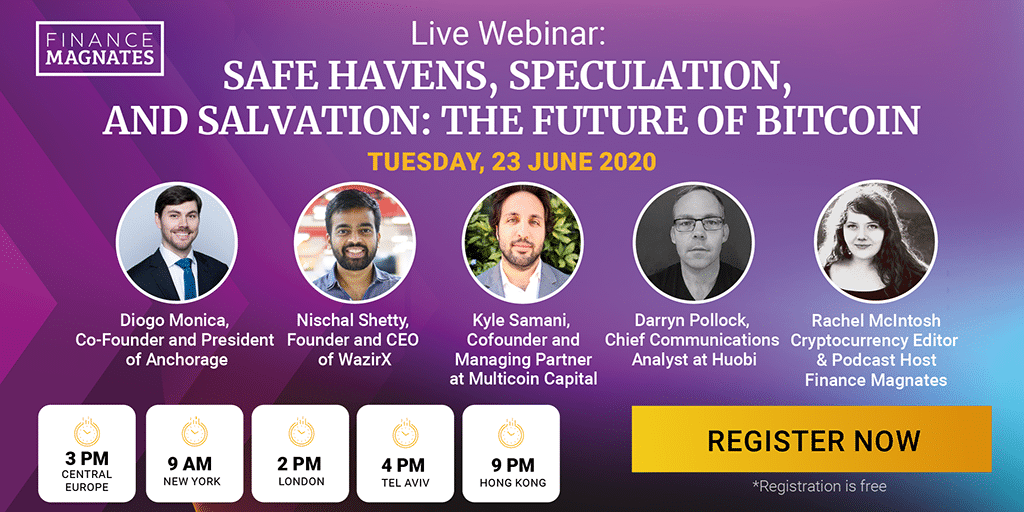
Finance Magnates met with four leading experts to discuss the future of Bitcoin in a post-COVID-19 world.
As you and I both know, dear Reader, the fallout from the coronavirus have been felt far and wide--many of our perceptions of the systems and structures that we rely on in our every day life have been irrevocably altered. The economic fallout from the coronavirus may have also shown the world some uncomfortable truths--and some unprecedented revelations--about the Bitcoin network.
On Tuesday, June 23rd, Finance Magnates met with Multicoin Capital’s Kyle Samani, Anchorage’s Diogo Monica, WazirX’s Nischal Shetty, and Huobi’s Darryn Pollock to discuss Bitcoin in a post-COVID world. The following is an excerpt of the discussion that has been edited for clarity and length.
To listen to the full panel discussion, which was entitled ‘Safe Havens, Speculation, & Salvation: The Future of Bitcoin,” click the SoundCloud or YouTube links.
Government stimulus cash may have reinforced Bitcoin’s status as a safe haven
We asked each of the guests to share their thoughts on whether or not Bitcoin’s status as a safe-haven asset was changed as a result of the COVID-19 pandemic.
“Bitcoin might not be a safe-haven asset in the traditional sense, but it does offer unique advantages compared to government-issued currencies and other traditional assets,” said Darryn Pollock.
Darryn Pollock, chief communications analyst at Huobi.
“For example, one of the main value propositions of Bitcoin is its decentralized nature--it makes it less vulnerable towards geopolitical risk and central bank monetary policy measures, which we’re seeing a lot of at the moment.”
However, “that’s not to say that Bitcoin is completely immune from economic volatility, as we’ve seen. But there isn’t really a direct cause-and-effect relationship between Bitcoin and any one nation, which means that it can add to the hedge against government-driven economic risks, like inflation and even currency devaluation, which we’re starting to see coming into effect with the pandemic.”
Pollock also said that he believes that Bitcoin’s status as a safe haven “within the context of this government-driven economic intervention”, including quantitative easing and artificially lowering interest rates, has “definitely become more prevalent within COVID-19.”
“Bitcoin has been traditionally uncorrelated,” Kyle Samani said. “If you look at any kind of rolling negative correlation on Bitcoin between 2011 and 2020, correlation was more or less zero throughout that period, and then spiked up to be pretty high around mid-February or so.”
“Since then, they’ve kind de-coupled again, and Bitcoin is going back to what’s looking like correlations that reflect pre-February 2020. So, I think the biggest take away is that in a flight to liquidity, people want to sell all assets for USD--or they want to sell whatever assets they have for whatever their loans are denominated in,” which is largely USD.
“I hate to call February and March a fluke, but that seems to be what is bearing out in the data,” he added.
Kyle Samani, co-founder and managing partner partner at Multicoin Capital.
Diogo Monica reinforced Kyle’s observations by drawing a parallel between Bitcoin and the precious metal that is largely considered to be the world’s oldest and most secure safe-haven asset: “if we look at gold, it had a similar behavior,” he said.
“All we know is that during the pandemic, all assets seemed to be correlated on the way down. I think that’s a lot more indicative of a liquidity crunch than it is indicative of Bitcoin somehow losing its status as a ‘safe haven’--and, as I said, gold had a similar behavior,” he said. Therefore, “I think the liquidity crunch is an explanation that could actually justify that.
This is the first time that Bitcoin was tested in a global financial crisis
Nischal Shetty pointed out that Bitcoin was created “just after the financial crisis was ending back in 2009.”
Since that time, “this is probably the first time that Bitcoin is experiencing what it was supposed to experience,” he said. “And we are still not out of it--we are still in the middle of this economic turmoil that’s just about to happen...I think that it will [continue to happen] over the next several months.”
This is because “if you look at what traditionally happens when there’s financial turmoil--when your securities and fiat start losing value--people move on to gold, because this is what everyone knows. This is the herd mentality; this is what people know should be done when there’s an economic crisis.”
However, “nobody knows what’s supposed to be done with Bitcoin when we are in a crisis,” he said. “Are we supposed to go into Bitcoin, or are we supposed to get out of it?”
“Right now, everyone’s still learning,” he said. “The next several months will tell us what’s supposed to happen.”
For now, though, “everyone’s still learning,” he said. “The next several months will tell us what’s supposed to happen.”
How can crypto's liquidity problem be solved?
However, regardless of whether Bitcoin will weaken or bolster its status as a safe-haven asset overtime, the crypto community did learn some important lessons about one of the industry’s weaknesses--trading infrastructure.
Kyle Samani commented that in March--particularly on the 12th, also known as Crypto’s Black Thursday--it became apparent that “there were some pretty clear structural problems.”
“Basically, the market structure kind of failed,” with the most notable example of this probably being BitMEX. “The liquidation engine just kind of fell apart at the worst moment,” he said.
Therefore, “the most obvious and large thing that we need to address is the need for better liquidation engines on the major derivatives exchanges,” he said. “There are all kinds of proposals out there on how to do this, but we haven’t yet seen any of the major exchanges make a big jump forward in the space.”
Diogo Monica, co-founder and president of Anchorage.
“I would love to see major exchanges--instead of just doing market buys or market sells on their own order books--[to start] quoting market makers, and saying ‘hey, let’s pay 50 of the top market makers,’ and say ‘give me a quote for X amount of BTC--you’ve got two seconds to respond.’”
“If they could just do that in a systematic way, they can at least bridge liquidity from all the other major exchanges,” he continued, “and prevent these kinds of cascading liquidations.”
Kyle also pointed out that “exchanges know they can do this, and they haven’t, because they want to keep trading volume on their own platforms--so, you have kind of a classic problem here.”
How can exchanges effectively work with each other to prevent liquidity crunches?
Darryn Pollock also acknowledged the competition between cryptocurrency exchanges as a possible barrier to improving liquidity and user experience.
“There’s obviously tribalism that’s so prevalent in the cryptocurrency space, and that then extends to different exchanges and different services,” he said.
However, “within the actual exchange businesses,” exchanges aren’t “mortal enemies.” Instead, “our goal as an exchange is to provide someone with a service--and it’s up to that someone to choose that service,” he said.
“If we’re trying to fight with other exchanges, it’s wasted energy; if we are trying to put the input into what we can offer someone, and it suits them better than another exchange, then so be it--there’s no point in us running down another exchange for the sake of it.”
Nischal Shetty commented that the infrastructure to build liquidity exchanges exists, but that a cross-exchange liquidity provider will have to be built by a third-party service: “these are going to be built by new startups that come in and find that liquidity can be pulled everywhere in a very efficient way.”
Nischal Shetty, founder and CEO of crypto exchange WazirX.
However, “the only problem right now” is that “it’s just too early in the game for these things to happen.
The shortcomings of "pirate custody"
Diogo Monica also pointed out that the economic fallout from COVID-19 in crypto markets revealed several infrastructural problems when it comes to the custody of Bitcoin and other cryptocurrency assets.
Diogo explained that “we saw two types of issues” related to COVID.
“The other issue was [with regards] to custodians themselves and the way that people usually operate,” he continued.
“By and large…as of a year ago, there was still this meme of a cold storage narrative, which I personally and affectionately call ‘pirate custody’, where people are storing these keys in treasure chests and burying them in islands somewhere in the Caribbean.”
“One of the issues is that in a COVID-19 world, where your employees cannot go to the office--they cannot access these vaults. They cannot go to banks. They cannot be together assembling these keys and actually participating in these ‘ceremonies’.”
“How do you access the keys, if that’s what you’ve done?”, he asked. “If what you’ve done is physical security as a proxy for digital security, and now you can’t assemble in person and you can’t stay closer than six feet apart--how do you do it?”
“The answer is that you don’t,” he said. “Or, you take way, way longer to do it."
Unfortunately, “the lack of technological sophistication from a lot of the players in the market exacerbated these issues quite significantly.”
This was an excerpt. To listen to the full panel discussion, which was entitled ‘Safe Havens, Speculation, & Salvation: The Future of Bitcoin,” click the SoundCloud or YouTube links.
As you and I both know, dear Reader, the fallout from the coronavirus have been felt far and wide--many of our perceptions of the systems and structures that we rely on in our every day life have been irrevocably altered. The economic fallout from the coronavirus may have also shown the world some uncomfortable truths--and some unprecedented revelations--about the Bitcoin network.
On Tuesday, June 23rd, Finance Magnates met with Multicoin Capital’s Kyle Samani, Anchorage’s Diogo Monica, WazirX’s Nischal Shetty, and Huobi’s Darryn Pollock to discuss Bitcoin in a post-COVID world. The following is an excerpt of the discussion that has been edited for clarity and length.
To listen to the full panel discussion, which was entitled ‘Safe Havens, Speculation, & Salvation: The Future of Bitcoin,” click the SoundCloud or YouTube links.
Government stimulus cash may have reinforced Bitcoin’s status as a safe haven
We asked each of the guests to share their thoughts on whether or not Bitcoin’s status as a safe-haven asset was changed as a result of the COVID-19 pandemic.
“Bitcoin might not be a safe-haven asset in the traditional sense, but it does offer unique advantages compared to government-issued currencies and other traditional assets,” said Darryn Pollock.
Darryn Pollock, chief communications analyst at Huobi.
“For example, one of the main value propositions of Bitcoin is its decentralized nature--it makes it less vulnerable towards geopolitical risk and central bank monetary policy measures, which we’re seeing a lot of at the moment.”
However, “that’s not to say that Bitcoin is completely immune from economic volatility, as we’ve seen. But there isn’t really a direct cause-and-effect relationship between Bitcoin and any one nation, which means that it can add to the hedge against government-driven economic risks, like inflation and even currency devaluation, which we’re starting to see coming into effect with the pandemic.”
Pollock also said that he believes that Bitcoin’s status as a safe haven “within the context of this government-driven economic intervention”, including quantitative easing and artificially lowering interest rates, has “definitely become more prevalent within COVID-19.”
“Bitcoin has been traditionally uncorrelated,” Kyle Samani said. “If you look at any kind of rolling negative correlation on Bitcoin between 2011 and 2020, correlation was more or less zero throughout that period, and then spiked up to be pretty high around mid-February or so.”
“Since then, they’ve kind de-coupled again, and Bitcoin is going back to what’s looking like correlations that reflect pre-February 2020. So, I think the biggest take away is that in a flight to liquidity, people want to sell all assets for USD--or they want to sell whatever assets they have for whatever their loans are denominated in,” which is largely USD.
“I hate to call February and March a fluke, but that seems to be what is bearing out in the data,” he added.
Kyle Samani, co-founder and managing partner partner at Multicoin Capital.
Diogo Monica reinforced Kyle’s observations by drawing a parallel between Bitcoin and the precious metal that is largely considered to be the world’s oldest and most secure safe-haven asset: “if we look at gold, it had a similar behavior,” he said.
“All we know is that during the pandemic, all assets seemed to be correlated on the way down. I think that’s a lot more indicative of a liquidity crunch than it is indicative of Bitcoin somehow losing its status as a ‘safe haven’--and, as I said, gold had a similar behavior,” he said. Therefore, “I think the liquidity crunch is an explanation that could actually justify that.
This is the first time that Bitcoin was tested in a global financial crisis
Nischal Shetty pointed out that Bitcoin was created “just after the financial crisis was ending back in 2009.”
Since that time, “this is probably the first time that Bitcoin is experiencing what it was supposed to experience,” he said. “And we are still not out of it--we are still in the middle of this economic turmoil that’s just about to happen...I think that it will [continue to happen] over the next several months.”
This is because “if you look at what traditionally happens when there’s financial turmoil--when your securities and fiat start losing value--people move on to gold, because this is what everyone knows. This is the herd mentality; this is what people know should be done when there’s an economic crisis.”
However, “nobody knows what’s supposed to be done with Bitcoin when we are in a crisis,” he said. “Are we supposed to go into Bitcoin, or are we supposed to get out of it?”
“Right now, everyone’s still learning,” he said. “The next several months will tell us what’s supposed to happen.”
For now, though, “everyone’s still learning,” he said. “The next several months will tell us what’s supposed to happen.”
How can crypto's liquidity problem be solved?
However, regardless of whether Bitcoin will weaken or bolster its status as a safe-haven asset overtime, the crypto community did learn some important lessons about one of the industry’s weaknesses--trading infrastructure.
Kyle Samani commented that in March--particularly on the 12th, also known as Crypto’s Black Thursday--it became apparent that “there were some pretty clear structural problems.”
“Basically, the market structure kind of failed,” with the most notable example of this probably being BitMEX. “The liquidation engine just kind of fell apart at the worst moment,” he said.
Therefore, “the most obvious and large thing that we need to address is the need for better liquidation engines on the major derivatives exchanges,” he said. “There are all kinds of proposals out there on how to do this, but we haven’t yet seen any of the major exchanges make a big jump forward in the space.”
Diogo Monica, co-founder and president of Anchorage.
“I would love to see major exchanges--instead of just doing market buys or market sells on their own order books--[to start] quoting market makers, and saying ‘hey, let’s pay 50 of the top market makers,’ and say ‘give me a quote for X amount of BTC--you’ve got two seconds to respond.’”
“If they could just do that in a systematic way, they can at least bridge liquidity from all the other major exchanges,” he continued, “and prevent these kinds of cascading liquidations.”
Kyle also pointed out that “exchanges know they can do this, and they haven’t, because they want to keep trading volume on their own platforms--so, you have kind of a classic problem here.”
How can exchanges effectively work with each other to prevent liquidity crunches?
Darryn Pollock also acknowledged the competition between cryptocurrency exchanges as a possible barrier to improving liquidity and user experience.
“There’s obviously tribalism that’s so prevalent in the cryptocurrency space, and that then extends to different exchanges and different services,” he said.
However, “within the actual exchange businesses,” exchanges aren’t “mortal enemies.” Instead, “our goal as an exchange is to provide someone with a service--and it’s up to that someone to choose that service,” he said.
“If we’re trying to fight with other exchanges, it’s wasted energy; if we are trying to put the input into what we can offer someone, and it suits them better than another exchange, then so be it--there’s no point in us running down another exchange for the sake of it.”
Nischal Shetty commented that the infrastructure to build liquidity exchanges exists, but that a cross-exchange liquidity provider will have to be built by a third-party service: “these are going to be built by new startups that come in and find that liquidity can be pulled everywhere in a very efficient way.”
Nischal Shetty, founder and CEO of crypto exchange WazirX.
However, “the only problem right now” is that “it’s just too early in the game for these things to happen.
The shortcomings of "pirate custody"
Diogo Monica also pointed out that the economic fallout from COVID-19 in crypto markets revealed several infrastructural problems when it comes to the custody of Bitcoin and other cryptocurrency assets.
Diogo explained that “we saw two types of issues” related to COVID.
“The other issue was [with regards] to custodians themselves and the way that people usually operate,” he continued.
“By and large…as of a year ago, there was still this meme of a cold storage narrative, which I personally and affectionately call ‘pirate custody’, where people are storing these keys in treasure chests and burying them in islands somewhere in the Caribbean.”
“One of the issues is that in a COVID-19 world, where your employees cannot go to the office--they cannot access these vaults. They cannot go to banks. They cannot be together assembling these keys and actually participating in these ‘ceremonies’.”
“How do you access the keys, if that’s what you’ve done?”, he asked. “If what you’ve done is physical security as a proxy for digital security, and now you can’t assemble in person and you can’t stay closer than six feet apart--how do you do it?”
“The answer is that you don’t,” he said. “Or, you take way, way longer to do it."
Unfortunately, “the lack of technological sophistication from a lot of the players in the market exacerbated these issues quite significantly.”
This was an excerpt. To listen to the full panel discussion, which was entitled ‘Safe Havens, Speculation, & Salvation: The Future of Bitcoin,” click the SoundCloud or YouTube links.
Rachel is a self-taught crypto geek and a passionate writer. She believes in the power that the written word has to educate, connect and empower individuals to make positive and powerful financial choices. She is the Podcast Host and a Cryptocurrency Editor at Finance Magnates.
Crypto Built More Rails, but the Next Battle Is Over How Much Work a Dollar Can Do
Featured Videos
FP Markets Winner Spotlight 🏆 | Global Broker of the Year 2025 #Trading #Broker #Innovation #Shorts
FP Markets Winner Spotlight 🏆 | Global Broker of the Year 2025 #Trading #Broker #Innovation #Shorts
FP Markets Winner Spotlight 🏆 | Global Broker of the Year 2025 #Trading #Broker #Innovation #Shorts
FP Markets Winner Spotlight 🏆 | Global Broker of the Year 2025 #Trading #Broker #Innovation #Shorts
FP Markets takes the spotlight as Global Broker of the Year 2025 at the Finance Magnates Awards.
Martin Stoilov, Head of Client Experience, shares that trust, innovation, and people played a key role in the company’s success, supported by a strong foundation of integrity and client-centricity.
Following this milestone, FP Markets continues to focus on growth, technology investment, and its core values of transparency and excellence.
👉 Be part of FM Awards 2026: https://awards.financemagnates.com/#nominate
FP Markets takes the spotlight as Global Broker of the Year 2025 at the Finance Magnates Awards.
Martin Stoilov, Head of Client Experience, shares that trust, innovation, and people played a key role in the company’s success, supported by a strong foundation of integrity and client-centricity.
Following this milestone, FP Markets continues to focus on growth, technology investment, and its core values of transparency and excellence.
👉 Be part of FM Awards 2026: https://awards.financemagnates.com/#nominate
FP Markets takes the spotlight as Global Broker of the Year 2025 at the Finance Magnates Awards.
Martin Stoilov, Head of Client Experience, shares that trust, innovation, and people played a key role in the company’s success, supported by a strong foundation of integrity and client-centricity.
Following this milestone, FP Markets continues to focus on growth, technology investment, and its core values of transparency and excellence.
👉 Be part of FM Awards 2026: https://awards.financemagnates.com/#nominate
FP Markets takes the spotlight as Global Broker of the Year 2025 at the Finance Magnates Awards.
Martin Stoilov, Head of Client Experience, shares that trust, innovation, and people played a key role in the company’s success, supported by a strong foundation of integrity and client-centricity.
Following this milestone, FP Markets continues to focus on growth, technology investment, and its core values of transparency and excellence.
👉 Be part of FM Awards 2026: https://awards.financemagnates.com/#nominate
In this video, we review @HolaPrimeMarketsOfficial, a multi-asset forex and CFDs broker offering different account types, trading platforms, and flexible trading conditions.
We cover the broker’s overall offering, including account options, trading environment, platforms like MT4 and MT5, and additional services such as managed accounts and fast withdrawals.
Watch the full video to see if Hola Prime Markets fits your trading needs.
📣 Stay up to date with the latest in finance and trading. Follow Finance Magnates for industry news, insights, and global event coverage.
Connect with us:
🔗 LinkedIn: /financemagnates
👍 Facebook: /financemagnates
📸 Instagram: https://www.instagram.com/financemagnates
🐦 X: https://x.com/financemagnates
🎥 TikTok: https://www.tiktok.com/tag/financemagnates
▶️ YouTube: /@financemagnates_official
#HolaPrime #ForexBroker #CFDTrading #FinanceMagnates #Trading #Forex #BrokerReview
In this video, we review @HolaPrimeMarketsOfficial, a multi-asset forex and CFDs broker offering different account types, trading platforms, and flexible trading conditions.
We cover the broker’s overall offering, including account options, trading environment, platforms like MT4 and MT5, and additional services such as managed accounts and fast withdrawals.
Watch the full video to see if Hola Prime Markets fits your trading needs.
📣 Stay up to date with the latest in finance and trading. Follow Finance Magnates for industry news, insights, and global event coverage.
Connect with us:
🔗 LinkedIn: /financemagnates
👍 Facebook: /financemagnates
📸 Instagram: https://www.instagram.com/financemagnates
🐦 X: https://x.com/financemagnates
🎥 TikTok: https://www.tiktok.com/tag/financemagnates
▶️ YouTube: /@financemagnates_official
#HolaPrime #ForexBroker #CFDTrading #FinanceMagnates #Trading #Forex #BrokerReview
In this video, we review @HolaPrimeMarketsOfficial, a multi-asset forex and CFDs broker offering different account types, trading platforms, and flexible trading conditions.
We cover the broker’s overall offering, including account options, trading environment, platforms like MT4 and MT5, and additional services such as managed accounts and fast withdrawals.
Watch the full video to see if Hola Prime Markets fits your trading needs.
📣 Stay up to date with the latest in finance and trading. Follow Finance Magnates for industry news, insights, and global event coverage.
Connect with us:
🔗 LinkedIn: /financemagnates
👍 Facebook: /financemagnates
📸 Instagram: https://www.instagram.com/financemagnates
🐦 X: https://x.com/financemagnates
🎥 TikTok: https://www.tiktok.com/tag/financemagnates
▶️ YouTube: /@financemagnates_official
#HolaPrime #ForexBroker #CFDTrading #FinanceMagnates #Trading #Forex #BrokerReview
In this video, we review @HolaPrimeMarketsOfficial, a multi-asset forex and CFDs broker offering different account types, trading platforms, and flexible trading conditions.
We cover the broker’s overall offering, including account options, trading environment, platforms like MT4 and MT5, and additional services such as managed accounts and fast withdrawals.
Watch the full video to see if Hola Prime Markets fits your trading needs.
📣 Stay up to date with the latest in finance and trading. Follow Finance Magnates for industry news, insights, and global event coverage.
Connect with us:
🔗 LinkedIn: /financemagnates
👍 Facebook: /financemagnates
📸 Instagram: https://www.instagram.com/financemagnates
🐦 X: https://x.com/financemagnates
🎥 TikTok: https://www.tiktok.com/tag/financemagnates
▶️ YouTube: /@financemagnates_official
#HolaPrime #ForexBroker #CFDTrading #FinanceMagnates #Trading #Forex #BrokerReview
In this video, we review @HolaPrimeMarketsOfficial, a multi-asset forex and CFDs broker offering different account types, trading platforms, and flexible trading conditions.
We cover the broker’s overall offering, including account options, trading environment, platforms like MT4 and MT5, and additional services such as managed accounts and fast withdrawals.
Watch the full video to see if Hola Prime Markets fits your trading needs.
📣 Stay up to date with the latest in finance and trading. Follow Finance Magnates for industry news, insights, and global event coverage.
Connect with us:
🔗 LinkedIn: /financemagnates
👍 Facebook: /financemagnates
📸 Instagram: https://www.instagram.com/financemagnates
🐦 X: https://x.com/financemagnates
🎥 TikTok: https://www.tiktok.com/tag/financemagnates
▶️ YouTube: /@financemagnates_official
#HolaPrime #ForexBroker #CFDTrading #FinanceMagnates #Trading #Forex #BrokerReview
In this video, we review @HolaPrimeMarketsOfficial, a multi-asset forex and CFDs broker offering different account types, trading platforms, and flexible trading conditions.
We cover the broker’s overall offering, including account options, trading environment, platforms like MT4 and MT5, and additional services such as managed accounts and fast withdrawals.
Watch the full video to see if Hola Prime Markets fits your trading needs.
📣 Stay up to date with the latest in finance and trading. Follow Finance Magnates for industry news, insights, and global event coverage.
Connect with us:
🔗 LinkedIn: /financemagnates
👍 Facebook: /financemagnates
📸 Instagram: https://www.instagram.com/financemagnates
🐦 X: https://x.com/financemagnates
🎥 TikTok: https://www.tiktok.com/tag/financemagnates
▶️ YouTube: /@financemagnates_official
#HolaPrime #ForexBroker #CFDTrading #FinanceMagnates #Trading #Forex #BrokerReview
Hola Prime Review: What You Need to Know | Full Breakdown by Finance Magnates
Hola Prime Review: What You Need to Know | Full Breakdown by Finance Magnates
Hola Prime Review: What You Need to Know | Full Breakdown by Finance Magnates
Hola Prime Review: What You Need to Know | Full Breakdown by Finance Magnates
Hola Prime Review: What You Need to Know | Full Breakdown by Finance Magnates
Hola Prime Review: What You Need to Know | Full Breakdown by Finance Magnates
In this video, we review @HolaPrime_Global, a proprietary trading firm offering evaluation programs and performance-based payouts in simulated market environments.
We cover how the challenge model works, including account types, profit splits (up to 95%), trading rules, and what it takes to reach a funded account. You’ll also learn about available platforms like MT4, MT5, cTrader, and more, along with insights into payouts, support, and trading conditions.
Watch the full video to see if Hola Prime fits your trading style.
📣 Stay up to date with the latest in finance and trading. Follow Finance Magnates for industry news, insights, and global event coverage.
Connect with us:
🔗 LinkedIn: /financemagnates
👍 Facebook: /financemagnates
📸 Instagram: https://www.instagram.com/financemagnates
🐦 X: https://x.com/financemagnates
🎥 TikTok: https://www.tiktok.com/tag/financemagnates
▶️ YouTube: /@financemagnates_official
#HolaPrime #PropFirm #Trading #FinanceMagnates #Forex #FuturesTrading #TradingReview #PropFirmReview
In this video, we review @HolaPrime_Global, a proprietary trading firm offering evaluation programs and performance-based payouts in simulated market environments.
We cover how the challenge model works, including account types, profit splits (up to 95%), trading rules, and what it takes to reach a funded account. You’ll also learn about available platforms like MT4, MT5, cTrader, and more, along with insights into payouts, support, and trading conditions.
Watch the full video to see if Hola Prime fits your trading style.
📣 Stay up to date with the latest in finance and trading. Follow Finance Magnates for industry news, insights, and global event coverage.
Connect with us:
🔗 LinkedIn: /financemagnates
👍 Facebook: /financemagnates
📸 Instagram: https://www.instagram.com/financemagnates
🐦 X: https://x.com/financemagnates
🎥 TikTok: https://www.tiktok.com/tag/financemagnates
▶️ YouTube: /@financemagnates_official
#HolaPrime #PropFirm #Trading #FinanceMagnates #Forex #FuturesTrading #TradingReview #PropFirmReview
In this video, we review @HolaPrime_Global, a proprietary trading firm offering evaluation programs and performance-based payouts in simulated market environments.
We cover how the challenge model works, including account types, profit splits (up to 95%), trading rules, and what it takes to reach a funded account. You’ll also learn about available platforms like MT4, MT5, cTrader, and more, along with insights into payouts, support, and trading conditions.
Watch the full video to see if Hola Prime fits your trading style.
📣 Stay up to date with the latest in finance and trading. Follow Finance Magnates for industry news, insights, and global event coverage.
Connect with us:
🔗 LinkedIn: /financemagnates
👍 Facebook: /financemagnates
📸 Instagram: https://www.instagram.com/financemagnates
🐦 X: https://x.com/financemagnates
🎥 TikTok: https://www.tiktok.com/tag/financemagnates
▶️ YouTube: /@financemagnates_official
#HolaPrime #PropFirm #Trading #FinanceMagnates #Forex #FuturesTrading #TradingReview #PropFirmReview
In this video, we review @HolaPrime_Global, a proprietary trading firm offering evaluation programs and performance-based payouts in simulated market environments.
We cover how the challenge model works, including account types, profit splits (up to 95%), trading rules, and what it takes to reach a funded account. You’ll also learn about available platforms like MT4, MT5, cTrader, and more, along with insights into payouts, support, and trading conditions.
Watch the full video to see if Hola Prime fits your trading style.
📣 Stay up to date with the latest in finance and trading. Follow Finance Magnates for industry news, insights, and global event coverage.
Connect with us:
🔗 LinkedIn: /financemagnates
👍 Facebook: /financemagnates
📸 Instagram: https://www.instagram.com/financemagnates
🐦 X: https://x.com/financemagnates
🎥 TikTok: https://www.tiktok.com/tag/financemagnates
▶️ YouTube: /@financemagnates_official
#HolaPrime #PropFirm #Trading #FinanceMagnates #Forex #FuturesTrading #TradingReview #PropFirmReview
In this video, we review @HolaPrime_Global, a proprietary trading firm offering evaluation programs and performance-based payouts in simulated market environments.
We cover how the challenge model works, including account types, profit splits (up to 95%), trading rules, and what it takes to reach a funded account. You’ll also learn about available platforms like MT4, MT5, cTrader, and more, along with insights into payouts, support, and trading conditions.
Watch the full video to see if Hola Prime fits your trading style.
📣 Stay up to date with the latest in finance and trading. Follow Finance Magnates for industry news, insights, and global event coverage.
Connect with us:
🔗 LinkedIn: /financemagnates
👍 Facebook: /financemagnates
📸 Instagram: https://www.instagram.com/financemagnates
🐦 X: https://x.com/financemagnates
🎥 TikTok: https://www.tiktok.com/tag/financemagnates
▶️ YouTube: /@financemagnates_official
#HolaPrime #PropFirm #Trading #FinanceMagnates #Forex #FuturesTrading #TradingReview #PropFirmReview
In this video, we review @HolaPrime_Global, a proprietary trading firm offering evaluation programs and performance-based payouts in simulated market environments.
We cover how the challenge model works, including account types, profit splits (up to 95%), trading rules, and what it takes to reach a funded account. You’ll also learn about available platforms like MT4, MT5, cTrader, and more, along with insights into payouts, support, and trading conditions.
Watch the full video to see if Hola Prime fits your trading style.
📣 Stay up to date with the latest in finance and trading. Follow Finance Magnates for industry news, insights, and global event coverage.
Connect with us:
🔗 LinkedIn: /financemagnates
👍 Facebook: /financemagnates
📸 Instagram: https://www.instagram.com/financemagnates
🐦 X: https://x.com/financemagnates
🎥 TikTok: https://www.tiktok.com/tag/financemagnates
▶️ YouTube: /@financemagnates_official
#HolaPrime #PropFirm #Trading #FinanceMagnates #Forex #FuturesTrading #TradingReview #PropFirmReview
Axi Winner Spotlight 🏆 | Global Most Innovative Broker 2025 #Innovation #Trading #Fintech #Broker
Axi Winner Spotlight 🏆 | Global Most Innovative Broker 2025 #Innovation #Trading #Fintech #Broker
Axi Winner Spotlight 🏆 | Global Most Innovative Broker 2025 #Innovation #Trading #Fintech #Broker
Axi Winner Spotlight 🏆 | Global Most Innovative Broker 2025 #Innovation #Trading #Fintech #Broker
Axi Winner Spotlight 🏆 | Global Most Innovative Broker 2025 #Innovation #Trading #Fintech #Broker
Axi Winner Spotlight 🏆 | Global Most Innovative Broker 2025 #Innovation #Trading #Fintech #Broker
Axi takes the spotlight at the Finance Magnates Awards, winning Global Most Innovative Broker 2025.
Olivia Xenofontos and Ivanna Openko share how the team will feel: proud, motivated, and ready to keep delivering.
They also describe the night as well-organized, focused, and enjoyable for all.
👉 Be part of FM Awards 2026.
Axi takes the spotlight at the Finance Magnates Awards, winning Global Most Innovative Broker 2025.
Olivia Xenofontos and Ivanna Openko share how the team will feel: proud, motivated, and ready to keep delivering.
They also describe the night as well-organized, focused, and enjoyable for all.
👉 Be part of FM Awards 2026.
Axi takes the spotlight at the Finance Magnates Awards, winning Global Most Innovative Broker 2025.
Olivia Xenofontos and Ivanna Openko share how the team will feel: proud, motivated, and ready to keep delivering.
They also describe the night as well-organized, focused, and enjoyable for all.
👉 Be part of FM Awards 2026.
Axi takes the spotlight at the Finance Magnates Awards, winning Global Most Innovative Broker 2025.
Olivia Xenofontos and Ivanna Openko share how the team will feel: proud, motivated, and ready to keep delivering.
They also describe the night as well-organized, focused, and enjoyable for all.
👉 Be part of FM Awards 2026.
Axi takes the spotlight at the Finance Magnates Awards, winning Global Most Innovative Broker 2025.
Olivia Xenofontos and Ivanna Openko share how the team will feel: proud, motivated, and ready to keep delivering.
They also describe the night as well-organized, focused, and enjoyable for all.
👉 Be part of FM Awards 2026.
Axi takes the spotlight at the Finance Magnates Awards, winning Global Most Innovative Broker 2025.
Olivia Xenofontos and Ivanna Openko share how the team will feel: proud, motivated, and ready to keep delivering.
They also describe the night as well-organized, focused, and enjoyable for all.
👉 Be part of FM Awards 2026.
Recognition that matters.
Built on transparency.
Driven by the industry.
The Finance Magnates Awards 2026.
Nominations are now open.
🔗 https://awards.financemagnates.com/?utm_source=SM&utm_medium=social&utm_campaign=recognition-matters
Recognition that matters.
Built on transparency.
Driven by the industry.
The Finance Magnates Awards 2026.
Nominations are now open.
🔗 https://awards.financemagnates.com/?utm_source=SM&utm_medium=social&utm_campaign=recognition-matters
Recognition that matters.
Built on transparency.
Driven by the industry.
The Finance Magnates Awards 2026.
Nominations are now open.
🔗 https://awards.financemagnates.com/?utm_source=SM&utm_medium=social&utm_campaign=recognition-matters
Recognition that matters.
Built on transparency.
Driven by the industry.
The Finance Magnates Awards 2026.
Nominations are now open.
🔗 https://awards.financemagnates.com/?utm_source=SM&utm_medium=social&utm_campaign=recognition-matters
Recognition that matters.
Built on transparency.
Driven by the industry.
The Finance Magnates Awards 2026.
Nominations are now open.
🔗 https://awards.financemagnates.com/?utm_source=SM&utm_medium=social&utm_campaign=recognition-matters
Recognition that matters.
Built on transparency.
Driven by the industry.
The Finance Magnates Awards 2026.
Nominations are now open.
🔗 https://awards.financemagnates.com/?utm_source=SM&utm_medium=social&utm_campaign=recognition-matters