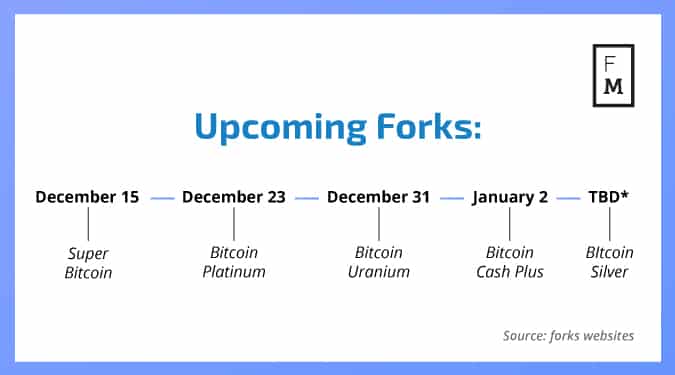
Super Bitcoin, Bitcoin Platinum, Bitcoin Uranium, Bitcoin Cash Plus, and Bitcoin Silver could threaten the Bitcoin ecosystem.
FM
As Bitcoin continues its rapid journey to unprecedented heights, the plot thickens: at least three Bitcoin forks have been scheduled for the month of December, with more to follow in January, February, and March of 2018. Bitcoinist questioned if the sudden rash of Bitcoin forks was “the dawn of the ‘initial fork offering’”.
Super Bitcoin, Bitcoin Cash Plus, Bitcoin Silver, Bitcoin Platinum, and Bitcoin Uranium (which has the quaint ticker symbol 'BUM') are all on the menu. Each of these coins claims in its own way to solve the issues of scalability and centralization that have plagued the Bitcoin network, although none of them really seem to have proven that they have the technological basis to do so.
Additionally, while BTCS does have a whitepaper, it is devoid of any actual technical explanation of the coin’s development. Although it is a forked currency, BTCS is also in the process of holding an ICO, which is suspicious (at the very least).
The rising trend of Bitcoin forks comes on the heels of the decline of the age of ICOs. According to cryptofinance research firm Smith + Crown, only 69 of the 169 ICOs that were held in the month of October managed to reach their goals. The rest were forced to extend, postpone, or even cancel their sales outright.
In addition to a saturated ICO market, countries around the world are cracking down on the practice with regulations that are intended to tax the funds raised as well as protect vulnerable investors from scamming. It appears that the forks may be just the latest way to make a (regulation-free) quick buck.
Bitcoin-Forked Coins Present Opportunities for Centralization, Scams
When most cryptocurrencies are born, they are initially worth just a few dollars (or even just a few cents). Even Bitcoins were worth just a few cents apiece, once upon a time - Kristoffer Koch of Norway legendarily bought 500 BTC for $27 in 2009, a holding that is now worth millions. However, cryptocurrencies created from Bitcoin hard forks have a serious advantage when it comes to their valuation.
Because hard forks behave like stock splits, the cryptocurrencies they create are already widely circulated as soon as they are created, although there is often a waiting period before certain wallet companies will allow the new currencies to be withdrawn.
In any case, the automatic wide circulation artificially pumps up the value of the new coins, a pump that is followed by an inevitable correction when exchanges adopt the coins for buying and selling. Holders dump the coins en masse, cashing out on their free money.
The price subsequently drops significantly, which may lead some opportunistic buyers to scoop up as many of the tokens as they can. This can lead to centralization of a coin’s network; it is suspected that Bitcoin Cash may have fallen victim to centralization through this process.
When Bitcoin Cash was born on August 1st, everyone who held BTC tokens was awarded a corresponding amount of BCH tokens on a 1:1 ratio. On the day of their birth, BCH tokens were worth more than $220; the next day, their value briefly spiked to nearly $700 before falling back down to roughly $200.
Suspicions of centralization arose when the value of BCH briefly spiked from around $630 to nearly $2000 over the weekend of November 11-12. The spike came in tandem with a few crypto bigwigs (most prominently "Bitcoin Jesus” - turned ”Judas” - Roger Ver) ringing the death knell of Bitcoin while singing the praise of Bitcoin Cash. Ver has since publicly referred to Bitcoin Cash as “my project”, inadvertently confirming the suspicions of centralization.
The Monday following the spike saw a “death drop” for Bitcoin Cash; the coin’s value fell nearly fifty percent. It has since recovered, but hasn’t managed to regain its highest point; now, a single BTC token is worth almost $1600. With a $26.49 billion market cap, it is the third-largest cryptocurrency in the world.
Bitcon Gold’s Founders Gave Themselves a $30+ Million Endowment
There is more than one way that a Bitcoin-forked coin can become centralized. The creators of Bitcoin Gold, another hard fork of BTC that emerged on exchanges in mid-November, claimed that their coin’s mission was to disrupt the Bitcoin mining industry by existing as a more functional, scalable network than Bitcoin that was less susceptible to centralization-by-mining.
BTG tokens were created and distributed in much the same way as BCH tokens; BTG tokens have never been worth less than $120, and their value was pumped all the way past $500 on the day of their release (at the time of writing, BTG tokens are worth roughly $330).
Here’s the kicker: shortly after Bitcoin Gold went live, the creators of the network mined 100,000 BTG for themselves. At current valuation, that’s an endowment worth about $33 million.
The Bitcoin Gold network has been the subject of some additional controversy as it was discovered last week that the official Bitcoin Gold wallet file (which was available for download on GitHub) had been infected with two files of unknown origin. While the files did not set off the alarms of any antivirus software, BTG’s creators warned users that they should treat the files as though they were malicious.
Additionally, some Bitcoin holders seeking the BTG tokens they were entitled to after the fork were the target of scammers. MyBTGwallet.com prompted users to enter their BTC’s private keys in order to retrieve their BTG tokens. As a result, more than $3 million worth of BTC and BTG tokens were stolen.
Indeed, the process of retrieving the coins created by hard forks can be risky without the proper technical know-how. If you are a BTC holder, getting the newly-forked coins you are entitled to does require the use of your private keys.
Theoretically, someone could create a new Bitcoin-forked currency expressly for the purpose of stealing BTC tokens via the private keys provided to receive the new coins. (By the way, Bitcoin Core developer Gavin Andresen recommends moving your BTC to a new address before attempting to retrieve any newly-forked coins to avoid becoming a victim of theft.)
Bitcoin Gold’s organization does not seem to be actively contributing to the malicious behavior by any means. However, it does seem like the rash of scams and other issues is evidence of a development team that wasn’t necessarily ready to be at the helm of a $5.5 billion cryptocurrency. Bitcoin Gold has also been criticized for the absence of big-name advisors in its organization as well as the lack of 'replay protection' in its development, a factor that makes duplicate transactions on the BTC and BTG networks more likely.
If there’s a Bitcoin fork that does seem to be a little less-than-legitimate, however, it’s the Bitcoin Diamond fork that took place on November 24. The Bitcoin Diamond website does not list any actual faces or names on its team of developers; rather, the coin was supposedly developed by two mining teams: 007 and Evey. Additionally, there is no Bitcoin Diamond whitepaper explaining any of the technology that supposedly makes the new crypto a better Bitcoin.
BCD futures are currently trading around $45. Because of the lack of technical information about the project, there’s no way to know how susceptible the BCD market will be to centralization. Because the project’s developers are not identified, they could theoretically centralize and manipulate the BCD market easily and without much (if any) consequence.
Mixed Attitudes from Exchanges and Wallets
It appears that some savvy crypto wallets and exchanges became wise to the opportunistic nature of the forks early on. On November 23, the day before the Bitcoin Diamond hard fork, Binance put out an announcement to its users saying: “Going forward, we foresee there to be many coins forked off of BTC. Binance is not supportive of forks that occur simply for the sake of forking”. Most of the more “legitimate” exchanges, like Poloniex and Bittrex, will not list a coin that has not been vetted to a certain degree in order to protect their users.
Indeed, many in the crypto community are concerned that an overabundance of Bitcoin forks could ultimately fragment the market and therefore weaken the Bitcoin ecosystem. Others are concerned that the rise of suspicion of centralization and scams that surround these new coins could attribute to cryptocurrency’s reputation of being volatile and insecure.
On the other hand, some wallets and exchanges are treating the new forks as opportunistically as the forked-coin's creators seem to be doing. According to its website, Bitcoin Diamond will be supported by more than 30 exchanges, including one named “Coin Whale”.
It’s only logical that the swarm of forks is appearing as the original Bitcoin soars to new heights. At the time of writing, BTC was closing in on $12,000; CME’s upcoming launch of Bitcoin futures trading is continuing to drive the price even higher.
Undoubtedly, these forks are just the beginning of a larger trend, one that could ultimately damage the Bitcoin ecosystem. Then again, it could have no effect at all; the ecosystem could even somehow benefit from the wave of forks.
While BTC holders may stand to gain from the free coins that they will receive as a result of the forks, it is imperative to keep a clear head and to take care when trying to retrieve new coins. Bitcoin is on fire, and there are plenty of people who are trying to get ahold of BTC in any way they can. If you are trying to retrieve your new coins, be sure to you protect yourself and your tokens.
As Bitcoin continues its rapid journey to unprecedented heights, the plot thickens: at least three Bitcoin forks have been scheduled for the month of December, with more to follow in January, February, and March of 2018. Bitcoinist questioned if the sudden rash of Bitcoin forks was “the dawn of the ‘initial fork offering’”.
Super Bitcoin, Bitcoin Cash Plus, Bitcoin Silver, Bitcoin Platinum, and Bitcoin Uranium (which has the quaint ticker symbol 'BUM') are all on the menu. Each of these coins claims in its own way to solve the issues of scalability and centralization that have plagued the Bitcoin network, although none of them really seem to have proven that they have the technological basis to do so.
Additionally, while BTCS does have a whitepaper, it is devoid of any actual technical explanation of the coin’s development. Although it is a forked currency, BTCS is also in the process of holding an ICO, which is suspicious (at the very least).
The rising trend of Bitcoin forks comes on the heels of the decline of the age of ICOs. According to cryptofinance research firm Smith + Crown, only 69 of the 169 ICOs that were held in the month of October managed to reach their goals. The rest were forced to extend, postpone, or even cancel their sales outright.
In addition to a saturated ICO market, countries around the world are cracking down on the practice with regulations that are intended to tax the funds raised as well as protect vulnerable investors from scamming. It appears that the forks may be just the latest way to make a (regulation-free) quick buck.
Bitcoin-Forked Coins Present Opportunities for Centralization, Scams
When most cryptocurrencies are born, they are initially worth just a few dollars (or even just a few cents). Even Bitcoins were worth just a few cents apiece, once upon a time - Kristoffer Koch of Norway legendarily bought 500 BTC for $27 in 2009, a holding that is now worth millions. However, cryptocurrencies created from Bitcoin hard forks have a serious advantage when it comes to their valuation.
Because hard forks behave like stock splits, the cryptocurrencies they create are already widely circulated as soon as they are created, although there is often a waiting period before certain wallet companies will allow the new currencies to be withdrawn.
In any case, the automatic wide circulation artificially pumps up the value of the new coins, a pump that is followed by an inevitable correction when exchanges adopt the coins for buying and selling. Holders dump the coins en masse, cashing out on their free money.
The price subsequently drops significantly, which may lead some opportunistic buyers to scoop up as many of the tokens as they can. This can lead to centralization of a coin’s network; it is suspected that Bitcoin Cash may have fallen victim to centralization through this process.
When Bitcoin Cash was born on August 1st, everyone who held BTC tokens was awarded a corresponding amount of BCH tokens on a 1:1 ratio. On the day of their birth, BCH tokens were worth more than $220; the next day, their value briefly spiked to nearly $700 before falling back down to roughly $200.
Suspicions of centralization arose when the value of BCH briefly spiked from around $630 to nearly $2000 over the weekend of November 11-12. The spike came in tandem with a few crypto bigwigs (most prominently "Bitcoin Jesus” - turned ”Judas” - Roger Ver) ringing the death knell of Bitcoin while singing the praise of Bitcoin Cash. Ver has since publicly referred to Bitcoin Cash as “my project”, inadvertently confirming the suspicions of centralization.
The Monday following the spike saw a “death drop” for Bitcoin Cash; the coin’s value fell nearly fifty percent. It has since recovered, but hasn’t managed to regain its highest point; now, a single BTC token is worth almost $1600. With a $26.49 billion market cap, it is the third-largest cryptocurrency in the world.
Bitcon Gold’s Founders Gave Themselves a $30+ Million Endowment
There is more than one way that a Bitcoin-forked coin can become centralized. The creators of Bitcoin Gold, another hard fork of BTC that emerged on exchanges in mid-November, claimed that their coin’s mission was to disrupt the Bitcoin mining industry by existing as a more functional, scalable network than Bitcoin that was less susceptible to centralization-by-mining.
BTG tokens were created and distributed in much the same way as BCH tokens; BTG tokens have never been worth less than $120, and their value was pumped all the way past $500 on the day of their release (at the time of writing, BTG tokens are worth roughly $330).
Here’s the kicker: shortly after Bitcoin Gold went live, the creators of the network mined 100,000 BTG for themselves. At current valuation, that’s an endowment worth about $33 million.
The Bitcoin Gold network has been the subject of some additional controversy as it was discovered last week that the official Bitcoin Gold wallet file (which was available for download on GitHub) had been infected with two files of unknown origin. While the files did not set off the alarms of any antivirus software, BTG’s creators warned users that they should treat the files as though they were malicious.
Additionally, some Bitcoin holders seeking the BTG tokens they were entitled to after the fork were the target of scammers. MyBTGwallet.com prompted users to enter their BTC’s private keys in order to retrieve their BTG tokens. As a result, more than $3 million worth of BTC and BTG tokens were stolen.
Indeed, the process of retrieving the coins created by hard forks can be risky without the proper technical know-how. If you are a BTC holder, getting the newly-forked coins you are entitled to does require the use of your private keys.
Theoretically, someone could create a new Bitcoin-forked currency expressly for the purpose of stealing BTC tokens via the private keys provided to receive the new coins. (By the way, Bitcoin Core developer Gavin Andresen recommends moving your BTC to a new address before attempting to retrieve any newly-forked coins to avoid becoming a victim of theft.)
Bitcoin Gold’s organization does not seem to be actively contributing to the malicious behavior by any means. However, it does seem like the rash of scams and other issues is evidence of a development team that wasn’t necessarily ready to be at the helm of a $5.5 billion cryptocurrency. Bitcoin Gold has also been criticized for the absence of big-name advisors in its organization as well as the lack of 'replay protection' in its development, a factor that makes duplicate transactions on the BTC and BTG networks more likely.
If there’s a Bitcoin fork that does seem to be a little less-than-legitimate, however, it’s the Bitcoin Diamond fork that took place on November 24. The Bitcoin Diamond website does not list any actual faces or names on its team of developers; rather, the coin was supposedly developed by two mining teams: 007 and Evey. Additionally, there is no Bitcoin Diamond whitepaper explaining any of the technology that supposedly makes the new crypto a better Bitcoin.
BCD futures are currently trading around $45. Because of the lack of technical information about the project, there’s no way to know how susceptible the BCD market will be to centralization. Because the project’s developers are not identified, they could theoretically centralize and manipulate the BCD market easily and without much (if any) consequence.
Mixed Attitudes from Exchanges and Wallets
It appears that some savvy crypto wallets and exchanges became wise to the opportunistic nature of the forks early on. On November 23, the day before the Bitcoin Diamond hard fork, Binance put out an announcement to its users saying: “Going forward, we foresee there to be many coins forked off of BTC. Binance is not supportive of forks that occur simply for the sake of forking”. Most of the more “legitimate” exchanges, like Poloniex and Bittrex, will not list a coin that has not been vetted to a certain degree in order to protect their users.
Indeed, many in the crypto community are concerned that an overabundance of Bitcoin forks could ultimately fragment the market and therefore weaken the Bitcoin ecosystem. Others are concerned that the rise of suspicion of centralization and scams that surround these new coins could attribute to cryptocurrency’s reputation of being volatile and insecure.
On the other hand, some wallets and exchanges are treating the new forks as opportunistically as the forked-coin's creators seem to be doing. According to its website, Bitcoin Diamond will be supported by more than 30 exchanges, including one named “Coin Whale”.
It’s only logical that the swarm of forks is appearing as the original Bitcoin soars to new heights. At the time of writing, BTC was closing in on $12,000; CME’s upcoming launch of Bitcoin futures trading is continuing to drive the price even higher.
Undoubtedly, these forks are just the beginning of a larger trend, one that could ultimately damage the Bitcoin ecosystem. Then again, it could have no effect at all; the ecosystem could even somehow benefit from the wave of forks.
While BTC holders may stand to gain from the free coins that they will receive as a result of the forks, it is imperative to keep a clear head and to take care when trying to retrieve new coins. Bitcoin is on fire, and there are plenty of people who are trying to get ahold of BTC in any way they can. If you are trying to retrieve your new coins, be sure to you protect yourself and your tokens.
Rachel is a self-taught crypto geek and a passionate writer. She believes in the power that the written word has to educate, connect and empower individuals to make positive and powerful financial choices. She is the Podcast Host and a Cryptocurrency Editor at Finance Magnates.
Kraken Steps Up Speed Race with New Equinix Colocation Service for Crypto Traders
Featured Videos
FP Markets Winner Spotlight 🏆 | Global Broker of the Year 2025 #Trading #Broker #Innovation #Shorts
FP Markets Winner Spotlight 🏆 | Global Broker of the Year 2025 #Trading #Broker #Innovation #Shorts
FP Markets Winner Spotlight 🏆 | Global Broker of the Year 2025 #Trading #Broker #Innovation #Shorts
FP Markets Winner Spotlight 🏆 | Global Broker of the Year 2025 #Trading #Broker #Innovation #Shorts
FP Markets takes the spotlight as Global Broker of the Year 2025 at the Finance Magnates Awards.
Martin Stoilov, Head of Client Experience, shares that trust, innovation, and people played a key role in the company’s success, supported by a strong foundation of integrity and client-centricity.
Following this milestone, FP Markets continues to focus on growth, technology investment, and its core values of transparency and excellence.
👉 Be part of FM Awards 2026: https://awards.financemagnates.com/#nominate
FP Markets takes the spotlight as Global Broker of the Year 2025 at the Finance Magnates Awards.
Martin Stoilov, Head of Client Experience, shares that trust, innovation, and people played a key role in the company’s success, supported by a strong foundation of integrity and client-centricity.
Following this milestone, FP Markets continues to focus on growth, technology investment, and its core values of transparency and excellence.
👉 Be part of FM Awards 2026: https://awards.financemagnates.com/#nominate
FP Markets takes the spotlight as Global Broker of the Year 2025 at the Finance Magnates Awards.
Martin Stoilov, Head of Client Experience, shares that trust, innovation, and people played a key role in the company’s success, supported by a strong foundation of integrity and client-centricity.
Following this milestone, FP Markets continues to focus on growth, technology investment, and its core values of transparency and excellence.
👉 Be part of FM Awards 2026: https://awards.financemagnates.com/#nominate
FP Markets takes the spotlight as Global Broker of the Year 2025 at the Finance Magnates Awards.
Martin Stoilov, Head of Client Experience, shares that trust, innovation, and people played a key role in the company’s success, supported by a strong foundation of integrity and client-centricity.
Following this milestone, FP Markets continues to focus on growth, technology investment, and its core values of transparency and excellence.
👉 Be part of FM Awards 2026: https://awards.financemagnates.com/#nominate
In this video, we review @HolaPrimeMarketsOfficial, a multi-asset forex and CFDs broker offering different account types, trading platforms, and flexible trading conditions.
We cover the broker’s overall offering, including account options, trading environment, platforms like MT4 and MT5, and additional services such as managed accounts and fast withdrawals.
Watch the full video to see if Hola Prime Markets fits your trading needs.
📣 Stay up to date with the latest in finance and trading. Follow Finance Magnates for industry news, insights, and global event coverage.
Connect with us:
🔗 LinkedIn: /financemagnates
👍 Facebook: /financemagnates
📸 Instagram: https://www.instagram.com/financemagnates
🐦 X: https://x.com/financemagnates
🎥 TikTok: https://www.tiktok.com/tag/financemagnates
▶️ YouTube: /@financemagnates_official
#HolaPrime #ForexBroker #CFDTrading #FinanceMagnates #Trading #Forex #BrokerReview
In this video, we review @HolaPrimeMarketsOfficial, a multi-asset forex and CFDs broker offering different account types, trading platforms, and flexible trading conditions.
We cover the broker’s overall offering, including account options, trading environment, platforms like MT4 and MT5, and additional services such as managed accounts and fast withdrawals.
Watch the full video to see if Hola Prime Markets fits your trading needs.
📣 Stay up to date with the latest in finance and trading. Follow Finance Magnates for industry news, insights, and global event coverage.
Connect with us:
🔗 LinkedIn: /financemagnates
👍 Facebook: /financemagnates
📸 Instagram: https://www.instagram.com/financemagnates
🐦 X: https://x.com/financemagnates
🎥 TikTok: https://www.tiktok.com/tag/financemagnates
▶️ YouTube: /@financemagnates_official
#HolaPrime #ForexBroker #CFDTrading #FinanceMagnates #Trading #Forex #BrokerReview
In this video, we review @HolaPrimeMarketsOfficial, a multi-asset forex and CFDs broker offering different account types, trading platforms, and flexible trading conditions.
We cover the broker’s overall offering, including account options, trading environment, platforms like MT4 and MT5, and additional services such as managed accounts and fast withdrawals.
Watch the full video to see if Hola Prime Markets fits your trading needs.
📣 Stay up to date with the latest in finance and trading. Follow Finance Magnates for industry news, insights, and global event coverage.
Connect with us:
🔗 LinkedIn: /financemagnates
👍 Facebook: /financemagnates
📸 Instagram: https://www.instagram.com/financemagnates
🐦 X: https://x.com/financemagnates
🎥 TikTok: https://www.tiktok.com/tag/financemagnates
▶️ YouTube: /@financemagnates_official
#HolaPrime #ForexBroker #CFDTrading #FinanceMagnates #Trading #Forex #BrokerReview
In this video, we review @HolaPrimeMarketsOfficial, a multi-asset forex and CFDs broker offering different account types, trading platforms, and flexible trading conditions.
We cover the broker’s overall offering, including account options, trading environment, platforms like MT4 and MT5, and additional services such as managed accounts and fast withdrawals.
Watch the full video to see if Hola Prime Markets fits your trading needs.
📣 Stay up to date with the latest in finance and trading. Follow Finance Magnates for industry news, insights, and global event coverage.
Connect with us:
🔗 LinkedIn: /financemagnates
👍 Facebook: /financemagnates
📸 Instagram: https://www.instagram.com/financemagnates
🐦 X: https://x.com/financemagnates
🎥 TikTok: https://www.tiktok.com/tag/financemagnates
▶️ YouTube: /@financemagnates_official
#HolaPrime #ForexBroker #CFDTrading #FinanceMagnates #Trading #Forex #BrokerReview
In this video, we review @HolaPrimeMarketsOfficial, a multi-asset forex and CFDs broker offering different account types, trading platforms, and flexible trading conditions.
We cover the broker’s overall offering, including account options, trading environment, platforms like MT4 and MT5, and additional services such as managed accounts and fast withdrawals.
Watch the full video to see if Hola Prime Markets fits your trading needs.
📣 Stay up to date with the latest in finance and trading. Follow Finance Magnates for industry news, insights, and global event coverage.
Connect with us:
🔗 LinkedIn: /financemagnates
👍 Facebook: /financemagnates
📸 Instagram: https://www.instagram.com/financemagnates
🐦 X: https://x.com/financemagnates
🎥 TikTok: https://www.tiktok.com/tag/financemagnates
▶️ YouTube: /@financemagnates_official
#HolaPrime #ForexBroker #CFDTrading #FinanceMagnates #Trading #Forex #BrokerReview
In this video, we review @HolaPrimeMarketsOfficial, a multi-asset forex and CFDs broker offering different account types, trading platforms, and flexible trading conditions.
We cover the broker’s overall offering, including account options, trading environment, platforms like MT4 and MT5, and additional services such as managed accounts and fast withdrawals.
Watch the full video to see if Hola Prime Markets fits your trading needs.
📣 Stay up to date with the latest in finance and trading. Follow Finance Magnates for industry news, insights, and global event coverage.
Connect with us:
🔗 LinkedIn: /financemagnates
👍 Facebook: /financemagnates
📸 Instagram: https://www.instagram.com/financemagnates
🐦 X: https://x.com/financemagnates
🎥 TikTok: https://www.tiktok.com/tag/financemagnates
▶️ YouTube: /@financemagnates_official
#HolaPrime #ForexBroker #CFDTrading #FinanceMagnates #Trading #Forex #BrokerReview
Hola Prime Review: What You Need to Know | Full Breakdown by Finance Magnates
Hola Prime Review: What You Need to Know | Full Breakdown by Finance Magnates
Hola Prime Review: What You Need to Know | Full Breakdown by Finance Magnates
Hola Prime Review: What You Need to Know | Full Breakdown by Finance Magnates
Hola Prime Review: What You Need to Know | Full Breakdown by Finance Magnates
Hola Prime Review: What You Need to Know | Full Breakdown by Finance Magnates
In this video, we review @HolaPrime_Global, a proprietary trading firm offering evaluation programs and performance-based payouts in simulated market environments.
We cover how the challenge model works, including account types, profit splits (up to 95%), trading rules, and what it takes to reach a funded account. You’ll also learn about available platforms like MT4, MT5, cTrader, and more, along with insights into payouts, support, and trading conditions.
Watch the full video to see if Hola Prime fits your trading style.
📣 Stay up to date with the latest in finance and trading. Follow Finance Magnates for industry news, insights, and global event coverage.
Connect with us:
🔗 LinkedIn: /financemagnates
👍 Facebook: /financemagnates
📸 Instagram: https://www.instagram.com/financemagnates
🐦 X: https://x.com/financemagnates
🎥 TikTok: https://www.tiktok.com/tag/financemagnates
▶️ YouTube: /@financemagnates_official
#HolaPrime #PropFirm #Trading #FinanceMagnates #Forex #FuturesTrading #TradingReview #PropFirmReview
In this video, we review @HolaPrime_Global, a proprietary trading firm offering evaluation programs and performance-based payouts in simulated market environments.
We cover how the challenge model works, including account types, profit splits (up to 95%), trading rules, and what it takes to reach a funded account. You’ll also learn about available platforms like MT4, MT5, cTrader, and more, along with insights into payouts, support, and trading conditions.
Watch the full video to see if Hola Prime fits your trading style.
📣 Stay up to date with the latest in finance and trading. Follow Finance Magnates for industry news, insights, and global event coverage.
Connect with us:
🔗 LinkedIn: /financemagnates
👍 Facebook: /financemagnates
📸 Instagram: https://www.instagram.com/financemagnates
🐦 X: https://x.com/financemagnates
🎥 TikTok: https://www.tiktok.com/tag/financemagnates
▶️ YouTube: /@financemagnates_official
#HolaPrime #PropFirm #Trading #FinanceMagnates #Forex #FuturesTrading #TradingReview #PropFirmReview
In this video, we review @HolaPrime_Global, a proprietary trading firm offering evaluation programs and performance-based payouts in simulated market environments.
We cover how the challenge model works, including account types, profit splits (up to 95%), trading rules, and what it takes to reach a funded account. You’ll also learn about available platforms like MT4, MT5, cTrader, and more, along with insights into payouts, support, and trading conditions.
Watch the full video to see if Hola Prime fits your trading style.
📣 Stay up to date with the latest in finance and trading. Follow Finance Magnates for industry news, insights, and global event coverage.
Connect with us:
🔗 LinkedIn: /financemagnates
👍 Facebook: /financemagnates
📸 Instagram: https://www.instagram.com/financemagnates
🐦 X: https://x.com/financemagnates
🎥 TikTok: https://www.tiktok.com/tag/financemagnates
▶️ YouTube: /@financemagnates_official
#HolaPrime #PropFirm #Trading #FinanceMagnates #Forex #FuturesTrading #TradingReview #PropFirmReview
In this video, we review @HolaPrime_Global, a proprietary trading firm offering evaluation programs and performance-based payouts in simulated market environments.
We cover how the challenge model works, including account types, profit splits (up to 95%), trading rules, and what it takes to reach a funded account. You’ll also learn about available platforms like MT4, MT5, cTrader, and more, along with insights into payouts, support, and trading conditions.
Watch the full video to see if Hola Prime fits your trading style.
📣 Stay up to date with the latest in finance and trading. Follow Finance Magnates for industry news, insights, and global event coverage.
Connect with us:
🔗 LinkedIn: /financemagnates
👍 Facebook: /financemagnates
📸 Instagram: https://www.instagram.com/financemagnates
🐦 X: https://x.com/financemagnates
🎥 TikTok: https://www.tiktok.com/tag/financemagnates
▶️ YouTube: /@financemagnates_official
#HolaPrime #PropFirm #Trading #FinanceMagnates #Forex #FuturesTrading #TradingReview #PropFirmReview
In this video, we review @HolaPrime_Global, a proprietary trading firm offering evaluation programs and performance-based payouts in simulated market environments.
We cover how the challenge model works, including account types, profit splits (up to 95%), trading rules, and what it takes to reach a funded account. You’ll also learn about available platforms like MT4, MT5, cTrader, and more, along with insights into payouts, support, and trading conditions.
Watch the full video to see if Hola Prime fits your trading style.
📣 Stay up to date with the latest in finance and trading. Follow Finance Magnates for industry news, insights, and global event coverage.
Connect with us:
🔗 LinkedIn: /financemagnates
👍 Facebook: /financemagnates
📸 Instagram: https://www.instagram.com/financemagnates
🐦 X: https://x.com/financemagnates
🎥 TikTok: https://www.tiktok.com/tag/financemagnates
▶️ YouTube: /@financemagnates_official
#HolaPrime #PropFirm #Trading #FinanceMagnates #Forex #FuturesTrading #TradingReview #PropFirmReview
In this video, we review @HolaPrime_Global, a proprietary trading firm offering evaluation programs and performance-based payouts in simulated market environments.
We cover how the challenge model works, including account types, profit splits (up to 95%), trading rules, and what it takes to reach a funded account. You’ll also learn about available platforms like MT4, MT5, cTrader, and more, along with insights into payouts, support, and trading conditions.
Watch the full video to see if Hola Prime fits your trading style.
📣 Stay up to date with the latest in finance and trading. Follow Finance Magnates for industry news, insights, and global event coverage.
Connect with us:
🔗 LinkedIn: /financemagnates
👍 Facebook: /financemagnates
📸 Instagram: https://www.instagram.com/financemagnates
🐦 X: https://x.com/financemagnates
🎥 TikTok: https://www.tiktok.com/tag/financemagnates
▶️ YouTube: /@financemagnates_official
#HolaPrime #PropFirm #Trading #FinanceMagnates #Forex #FuturesTrading #TradingReview #PropFirmReview
Axi Winner Spotlight 🏆 | Global Most Innovative Broker 2025 #Innovation #Trading #Fintech #Broker
Axi Winner Spotlight 🏆 | Global Most Innovative Broker 2025 #Innovation #Trading #Fintech #Broker
Axi Winner Spotlight 🏆 | Global Most Innovative Broker 2025 #Innovation #Trading #Fintech #Broker
Axi Winner Spotlight 🏆 | Global Most Innovative Broker 2025 #Innovation #Trading #Fintech #Broker
Axi Winner Spotlight 🏆 | Global Most Innovative Broker 2025 #Innovation #Trading #Fintech #Broker
Axi Winner Spotlight 🏆 | Global Most Innovative Broker 2025 #Innovation #Trading #Fintech #Broker
Axi takes the spotlight at the Finance Magnates Awards, winning Global Most Innovative Broker 2025.
Olivia Xenofontos and Ivanna Openko share how the team will feel: proud, motivated, and ready to keep delivering.
They also describe the night as well-organized, focused, and enjoyable for all.
👉 Be part of FM Awards 2026.
Axi takes the spotlight at the Finance Magnates Awards, winning Global Most Innovative Broker 2025.
Olivia Xenofontos and Ivanna Openko share how the team will feel: proud, motivated, and ready to keep delivering.
They also describe the night as well-organized, focused, and enjoyable for all.
👉 Be part of FM Awards 2026.
Axi takes the spotlight at the Finance Magnates Awards, winning Global Most Innovative Broker 2025.
Olivia Xenofontos and Ivanna Openko share how the team will feel: proud, motivated, and ready to keep delivering.
They also describe the night as well-organized, focused, and enjoyable for all.
👉 Be part of FM Awards 2026.
Axi takes the spotlight at the Finance Magnates Awards, winning Global Most Innovative Broker 2025.
Olivia Xenofontos and Ivanna Openko share how the team will feel: proud, motivated, and ready to keep delivering.
They also describe the night as well-organized, focused, and enjoyable for all.
👉 Be part of FM Awards 2026.
Axi takes the spotlight at the Finance Magnates Awards, winning Global Most Innovative Broker 2025.
Olivia Xenofontos and Ivanna Openko share how the team will feel: proud, motivated, and ready to keep delivering.
They also describe the night as well-organized, focused, and enjoyable for all.
👉 Be part of FM Awards 2026.
Axi takes the spotlight at the Finance Magnates Awards, winning Global Most Innovative Broker 2025.
Olivia Xenofontos and Ivanna Openko share how the team will feel: proud, motivated, and ready to keep delivering.
They also describe the night as well-organized, focused, and enjoyable for all.
👉 Be part of FM Awards 2026.
Recognition that matters.
Built on transparency.
Driven by the industry.
The Finance Magnates Awards 2026.
Nominations are now open.
🔗 https://awards.financemagnates.com/?utm_source=SM&utm_medium=social&utm_campaign=recognition-matters
Recognition that matters.
Built on transparency.
Driven by the industry.
The Finance Magnates Awards 2026.
Nominations are now open.
🔗 https://awards.financemagnates.com/?utm_source=SM&utm_medium=social&utm_campaign=recognition-matters
Recognition that matters.
Built on transparency.
Driven by the industry.
The Finance Magnates Awards 2026.
Nominations are now open.
🔗 https://awards.financemagnates.com/?utm_source=SM&utm_medium=social&utm_campaign=recognition-matters
Recognition that matters.
Built on transparency.
Driven by the industry.
The Finance Magnates Awards 2026.
Nominations are now open.
🔗 https://awards.financemagnates.com/?utm_source=SM&utm_medium=social&utm_campaign=recognition-matters
Recognition that matters.
Built on transparency.
Driven by the industry.
The Finance Magnates Awards 2026.
Nominations are now open.
🔗 https://awards.financemagnates.com/?utm_source=SM&utm_medium=social&utm_campaign=recognition-matters
Recognition that matters.
Built on transparency.
Driven by the industry.
The Finance Magnates Awards 2026.
Nominations are now open.
🔗 https://awards.financemagnates.com/?utm_source=SM&utm_medium=social&utm_campaign=recognition-matters