A mass exodus from the crypto market could reveal that the money just isn’t there.
Tether
It's been a difficult few months for Tether. Questions surrounding the legitimacy of the token arose in the crypto community throughout 2017 as new USDT flooded into the crypto market; public struggles with banks led the world to wonder how it could be possible that so many new USDT coins could possibly be backed by 'real-world' fiat.
Additionally, Tether's uncomfortably close relationship with the Bitfinex exchange has led to suspicions that illegitimate tokens may have had an all-too-easy route into the cryptosphere. A December subpoena of the two companies, which share two high-ranking executive operators, raised even more eyebrows.
In order to understand why the legitimacy of Tether has come under fire so vehemently, we must understand how the currency functions in the first place.
Tether’s primary purpose has been demonstrated as a vehicle for off-boarding and on-boarding onto exchanges--a way to stabilize digital assets without the hassle of converting crypto to fiat, a potentially costly process that requires a bit of technical know-how.
The New York Times reported Tether Limited, the company responsible for the creation of Tether, is based in the British Virgin Islands. Tether’s website says that it is “incorporated in Hong Kong with US offices in Santa Monica, CA and on the East Coast.”
Over the past several months, there’s been growing doubt as to whether or not Tether is actually backed by USD on a one-to-one basis. On its landing page, Tether writes that its "reserve holdings are published daily and subject to frequent professional audits. All tethers in circulation always match our reserves."
(Not So) "Frequent Audits"
However, those frequent audits have been anything but--an unofficial audit by mid-sized accounting firm Friedman LLP that started in May 2017 was not published until September 2017; the banks in which the accounts are supposedly held were blacked out of the report.
Eyebrows were raised further on January 27 of this year when Tether broke off its relationship with the auditors at Friedman LLP. In an official company announcement, Tether cited Friedman’s detailed methods as the reason for the split: “Given the excruciatingly detailed procedures Friedman was undertaking for the relatively simple balance sheet of Tether, it became clear that an audit would be unattainable in a reasonable time frame.”
The announcement continued to say that “as Tether is the first company in the space to undergo this process and pursue this level of transparency, there is no precedent set to guide the process nor any benchmark against which to measure its success."
Controversy: Are Tether Tokens Really Tied to Fiat on a One-to-One Basis?
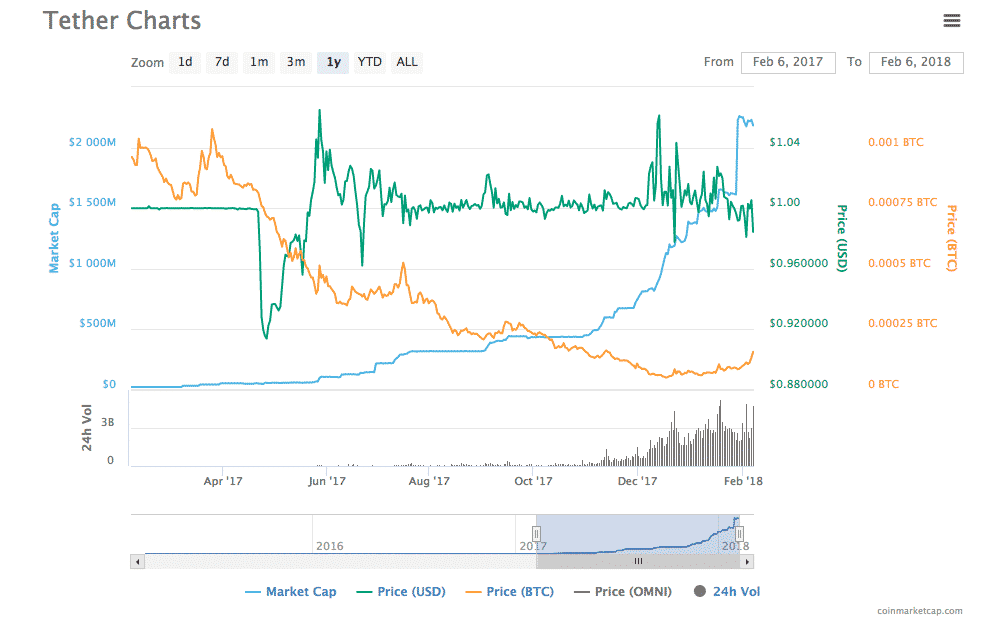
The lack of audits has been particularly troubling because of the rapid rise in the supply of Tether tokens that has taken place over the last several months. In February 2017, there were roughly $25 million worth of Tether tokens in circulation; six months later, in August 2017, there were $320 million. By the end of 2017, there were more than $1.3 billion Tether tokens in circulation; now, in early February, 2018, there are nearly $2.2 billion worth of Tether tokens.
The factor of this equation that has stirred the most controversy is that according to a company announcement, "all incoming international wires to Tether have been blocked and refused by [Tether’s] Taiwanese banks since April 18, 2017." The announcement continued to say that "as such, [Tether does] not expect the supply of tethers to increase substantially until these constraints have been lifted."
So, the question is--if Tether has not been able to receive incoming wire transfers, where are all of these new Tether dollars coming from?
Could Fake Tether Tokens Be Artificially Propping Up the Price of BTC?
Many in the crypto community have suspected that Tether is ‘printing’ tokens based on no real-world value, including security researched Tony Arcieri, who wrote in a late-January blog post: “I, and many others, suspect Tether is being used to effectively counterfeit hundreds of millions of dollars of perceived value, which are being immediately reinvested into Bitcoin to keep it from collapsing.” In other words, Tether dollars could be being created to artificially prop up the price of Bitcoin every time it falls.
More recently, an anonymously-authored public report commissioned by crypto investor pool 1000x Group explained that if Tether is removed from the equation, the price of BTC would be just $4,500, roughly twenty-five percent lower than its current valuation of around $6,000.
The report went on to say that a 30-80% price reduction in BTC could be forecast "if there is questionable activity." Several scenarios were laid out in which the price of Bitcoin should have been as little as thirteen percent of what it was at the height of its December boom.
The report also revealed a suspicious correlation between influxes of new Tether tokens and sudden, sharp rises in the price of Bitcoin. “48.8% of BTC’s price rise in the period studied occurred in the two-hour periods following the arrival of 91 different Tether grants to the Bitfinex wallet.”
Tether is "Printing in Response to Market Conditions"
The author of the report comes to an alarming conclusion: “It is highly unlikely that Tether is growing through any organic business process, rather that they are printing in response to market conditions.”
It is certainly possible that Tether could have $2.2 billion worth of USDT sitting quietly in a bank account of unknown origin, but so far, the company has not made any concrete, public plans to hire a new auditor or produce any evidence of the existence of such a large sum.
Tether did publish a document in 2017 confirming that on March 31, there were $44 million spread across seven Tether bank accounts, a figure that matched the circulating supply of Tether tokens at the time. However, the next document that Tether published--the unofficial Friedman audit that was released in September--raised some significant concerns.
The Friedman report noted that $443 million were accounted for across only two separate bank accounts. However, as Ars Technica reported, $60 million of that sum were not listed in an account under Tether’s name, but the name of "an individual connected to Tether." Furthermore, Friedman "makes no representations about the sufficiency or enforceability of any trust agreement" between Tether and this individual.
It’s possible that Tether made the decision to redact the names of the banks associated with the accounts holding the funds because of a wish to avoid further trouble with regulators in the countries where the accounts are located, but again--the lack of an official audit is somewhat telling that something is amiss.
Implications for the Future
As analyst Timothy Lee wrote, “because a dollar-pegged cryptocurrency like tether is so useful, demand is likely to outstrip supply as long as the cryptocurrency economy is expanding.” That is to say that in the midst of a boom--like the one we saw in December--the rapid influx of new investors caused a spike in the demand for Tether dollars, making it less likely for anyone to notice that they may be having trouble cashing out their cryptocoins into fiat.
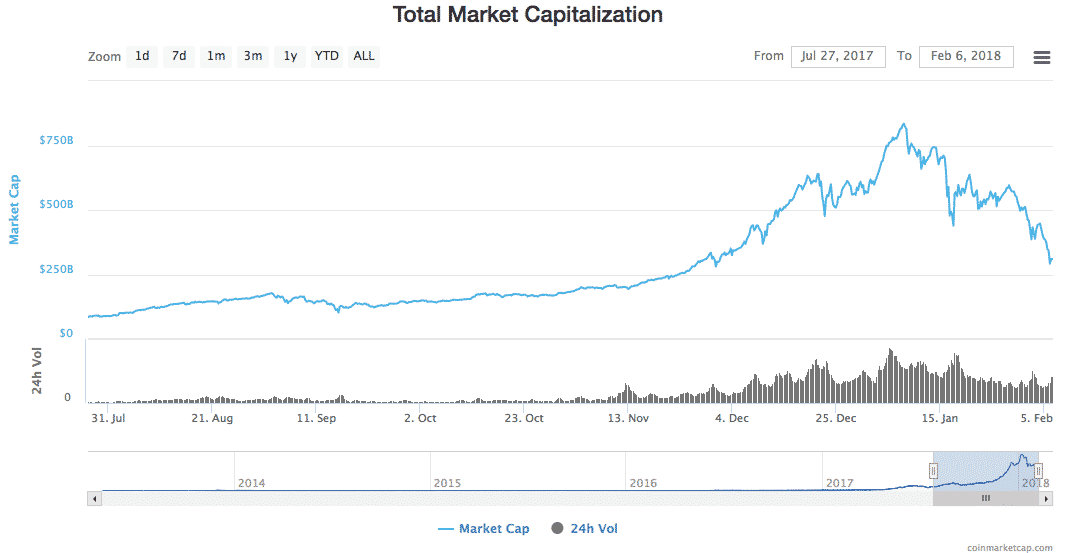
The December crypto boom has been followed by a massive sell-off.
However, now that the crypto markets have been shrinking for several weeks (with no end in sight), investors are starting to want to cash out of the market. While there’s no hard evidence that any of the speculation surrounding the insolvency of Tether and Bitfinex is the real truth, a mass exodus from the crypto markets could reveal that the money, well--it just isn’t there.
It's been a difficult few months for Tether. Questions surrounding the legitimacy of the token arose in the crypto community throughout 2017 as new USDT flooded into the crypto market; public struggles with banks led the world to wonder how it could be possible that so many new USDT coins could possibly be backed by 'real-world' fiat.
Additionally, Tether's uncomfortably close relationship with the Bitfinex exchange has led to suspicions that illegitimate tokens may have had an all-too-easy route into the cryptosphere. A December subpoena of the two companies, which share two high-ranking executive operators, raised even more eyebrows.
In order to understand why the legitimacy of Tether has come under fire so vehemently, we must understand how the currency functions in the first place.
Tether’s primary purpose has been demonstrated as a vehicle for off-boarding and on-boarding onto exchanges--a way to stabilize digital assets without the hassle of converting crypto to fiat, a potentially costly process that requires a bit of technical know-how.
The New York Times reported Tether Limited, the company responsible for the creation of Tether, is based in the British Virgin Islands. Tether’s website says that it is “incorporated in Hong Kong with US offices in Santa Monica, CA and on the East Coast.”
Over the past several months, there’s been growing doubt as to whether or not Tether is actually backed by USD on a one-to-one basis. On its landing page, Tether writes that its "reserve holdings are published daily and subject to frequent professional audits. All tethers in circulation always match our reserves."
(Not So) "Frequent Audits"
However, those frequent audits have been anything but--an unofficial audit by mid-sized accounting firm Friedman LLP that started in May 2017 was not published until September 2017; the banks in which the accounts are supposedly held were blacked out of the report.
Eyebrows were raised further on January 27 of this year when Tether broke off its relationship with the auditors at Friedman LLP. In an official company announcement, Tether cited Friedman’s detailed methods as the reason for the split: “Given the excruciatingly detailed procedures Friedman was undertaking for the relatively simple balance sheet of Tether, it became clear that an audit would be unattainable in a reasonable time frame.”
The announcement continued to say that “as Tether is the first company in the space to undergo this process and pursue this level of transparency, there is no precedent set to guide the process nor any benchmark against which to measure its success."
Controversy: Are Tether Tokens Really Tied to Fiat on a One-to-One Basis?
The lack of audits has been particularly troubling because of the rapid rise in the supply of Tether tokens that has taken place over the last several months. In February 2017, there were roughly $25 million worth of Tether tokens in circulation; six months later, in August 2017, there were $320 million. By the end of 2017, there were more than $1.3 billion Tether tokens in circulation; now, in early February, 2018, there are nearly $2.2 billion worth of Tether tokens.
The factor of this equation that has stirred the most controversy is that according to a company announcement, "all incoming international wires to Tether have been blocked and refused by [Tether’s] Taiwanese banks since April 18, 2017." The announcement continued to say that "as such, [Tether does] not expect the supply of tethers to increase substantially until these constraints have been lifted."
So, the question is--if Tether has not been able to receive incoming wire transfers, where are all of these new Tether dollars coming from?
Could Fake Tether Tokens Be Artificially Propping Up the Price of BTC?
Many in the crypto community have suspected that Tether is ‘printing’ tokens based on no real-world value, including security researched Tony Arcieri, who wrote in a late-January blog post: “I, and many others, suspect Tether is being used to effectively counterfeit hundreds of millions of dollars of perceived value, which are being immediately reinvested into Bitcoin to keep it from collapsing.” In other words, Tether dollars could be being created to artificially prop up the price of Bitcoin every time it falls.
More recently, an anonymously-authored public report commissioned by crypto investor pool 1000x Group explained that if Tether is removed from the equation, the price of BTC would be just $4,500, roughly twenty-five percent lower than its current valuation of around $6,000.
The report went on to say that a 30-80% price reduction in BTC could be forecast "if there is questionable activity." Several scenarios were laid out in which the price of Bitcoin should have been as little as thirteen percent of what it was at the height of its December boom.
The report also revealed a suspicious correlation between influxes of new Tether tokens and sudden, sharp rises in the price of Bitcoin. “48.8% of BTC’s price rise in the period studied occurred in the two-hour periods following the arrival of 91 different Tether grants to the Bitfinex wallet.”
Tether is "Printing in Response to Market Conditions"
The author of the report comes to an alarming conclusion: “It is highly unlikely that Tether is growing through any organic business process, rather that they are printing in response to market conditions.”
It is certainly possible that Tether could have $2.2 billion worth of USDT sitting quietly in a bank account of unknown origin, but so far, the company has not made any concrete, public plans to hire a new auditor or produce any evidence of the existence of such a large sum.
Tether did publish a document in 2017 confirming that on March 31, there were $44 million spread across seven Tether bank accounts, a figure that matched the circulating supply of Tether tokens at the time. However, the next document that Tether published--the unofficial Friedman audit that was released in September--raised some significant concerns.
The Friedman report noted that $443 million were accounted for across only two separate bank accounts. However, as Ars Technica reported, $60 million of that sum were not listed in an account under Tether’s name, but the name of "an individual connected to Tether." Furthermore, Friedman "makes no representations about the sufficiency or enforceability of any trust agreement" between Tether and this individual.
It’s possible that Tether made the decision to redact the names of the banks associated with the accounts holding the funds because of a wish to avoid further trouble with regulators in the countries where the accounts are located, but again--the lack of an official audit is somewhat telling that something is amiss.
Implications for the Future
As analyst Timothy Lee wrote, “because a dollar-pegged cryptocurrency like tether is so useful, demand is likely to outstrip supply as long as the cryptocurrency economy is expanding.” That is to say that in the midst of a boom--like the one we saw in December--the rapid influx of new investors caused a spike in the demand for Tether dollars, making it less likely for anyone to notice that they may be having trouble cashing out their cryptocoins into fiat.
The December crypto boom has been followed by a massive sell-off.
However, now that the crypto markets have been shrinking for several weeks (with no end in sight), investors are starting to want to cash out of the market. While there’s no hard evidence that any of the speculation surrounding the insolvency of Tether and Bitfinex is the real truth, a mass exodus from the crypto markets could reveal that the money, well--it just isn’t there.
Rachel is a self-taught crypto geek and a passionate writer. She believes in the power that the written word has to educate, connect and empower individuals to make positive and powerful financial choices. She is the Podcast Host and a Cryptocurrency Editor at Finance Magnates.
Kraken Steps Up Speed Race with New Equinix Colocation Service for Crypto Traders
Featured Videos
FP Markets Winner Spotlight 🏆 | Global Broker of the Year 2025 #Trading #Broker #Innovation #Shorts
FP Markets Winner Spotlight 🏆 | Global Broker of the Year 2025 #Trading #Broker #Innovation #Shorts
FP Markets Winner Spotlight 🏆 | Global Broker of the Year 2025 #Trading #Broker #Innovation #Shorts
FP Markets Winner Spotlight 🏆 | Global Broker of the Year 2025 #Trading #Broker #Innovation #Shorts
FP Markets takes the spotlight as Global Broker of the Year 2025 at the Finance Magnates Awards.
Martin Stoilov, Head of Client Experience, shares that trust, innovation, and people played a key role in the company’s success, supported by a strong foundation of integrity and client-centricity.
Following this milestone, FP Markets continues to focus on growth, technology investment, and its core values of transparency and excellence.
👉 Be part of FM Awards 2026: https://awards.financemagnates.com/#nominate
FP Markets takes the spotlight as Global Broker of the Year 2025 at the Finance Magnates Awards.
Martin Stoilov, Head of Client Experience, shares that trust, innovation, and people played a key role in the company’s success, supported by a strong foundation of integrity and client-centricity.
Following this milestone, FP Markets continues to focus on growth, technology investment, and its core values of transparency and excellence.
👉 Be part of FM Awards 2026: https://awards.financemagnates.com/#nominate
FP Markets takes the spotlight as Global Broker of the Year 2025 at the Finance Magnates Awards.
Martin Stoilov, Head of Client Experience, shares that trust, innovation, and people played a key role in the company’s success, supported by a strong foundation of integrity and client-centricity.
Following this milestone, FP Markets continues to focus on growth, technology investment, and its core values of transparency and excellence.
👉 Be part of FM Awards 2026: https://awards.financemagnates.com/#nominate
FP Markets takes the spotlight as Global Broker of the Year 2025 at the Finance Magnates Awards.
Martin Stoilov, Head of Client Experience, shares that trust, innovation, and people played a key role in the company’s success, supported by a strong foundation of integrity and client-centricity.
Following this milestone, FP Markets continues to focus on growth, technology investment, and its core values of transparency and excellence.
👉 Be part of FM Awards 2026: https://awards.financemagnates.com/#nominate
In this video, we review @HolaPrimeMarketsOfficial, a multi-asset forex and CFDs broker offering different account types, trading platforms, and flexible trading conditions.
We cover the broker’s overall offering, including account options, trading environment, platforms like MT4 and MT5, and additional services such as managed accounts and fast withdrawals.
Watch the full video to see if Hola Prime Markets fits your trading needs.
📣 Stay up to date with the latest in finance and trading. Follow Finance Magnates for industry news, insights, and global event coverage.
Connect with us:
🔗 LinkedIn: /financemagnates
👍 Facebook: /financemagnates
📸 Instagram: https://www.instagram.com/financemagnates
🐦 X: https://x.com/financemagnates
🎥 TikTok: https://www.tiktok.com/tag/financemagnates
▶️ YouTube: /@financemagnates_official
#HolaPrime #ForexBroker #CFDTrading #FinanceMagnates #Trading #Forex #BrokerReview
In this video, we review @HolaPrimeMarketsOfficial, a multi-asset forex and CFDs broker offering different account types, trading platforms, and flexible trading conditions.
We cover the broker’s overall offering, including account options, trading environment, platforms like MT4 and MT5, and additional services such as managed accounts and fast withdrawals.
Watch the full video to see if Hola Prime Markets fits your trading needs.
📣 Stay up to date with the latest in finance and trading. Follow Finance Magnates for industry news, insights, and global event coverage.
Connect with us:
🔗 LinkedIn: /financemagnates
👍 Facebook: /financemagnates
📸 Instagram: https://www.instagram.com/financemagnates
🐦 X: https://x.com/financemagnates
🎥 TikTok: https://www.tiktok.com/tag/financemagnates
▶️ YouTube: /@financemagnates_official
#HolaPrime #ForexBroker #CFDTrading #FinanceMagnates #Trading #Forex #BrokerReview
In this video, we review @HolaPrimeMarketsOfficial, a multi-asset forex and CFDs broker offering different account types, trading platforms, and flexible trading conditions.
We cover the broker’s overall offering, including account options, trading environment, platforms like MT4 and MT5, and additional services such as managed accounts and fast withdrawals.
Watch the full video to see if Hola Prime Markets fits your trading needs.
📣 Stay up to date with the latest in finance and trading. Follow Finance Magnates for industry news, insights, and global event coverage.
Connect with us:
🔗 LinkedIn: /financemagnates
👍 Facebook: /financemagnates
📸 Instagram: https://www.instagram.com/financemagnates
🐦 X: https://x.com/financemagnates
🎥 TikTok: https://www.tiktok.com/tag/financemagnates
▶️ YouTube: /@financemagnates_official
#HolaPrime #ForexBroker #CFDTrading #FinanceMagnates #Trading #Forex #BrokerReview
In this video, we review @HolaPrimeMarketsOfficial, a multi-asset forex and CFDs broker offering different account types, trading platforms, and flexible trading conditions.
We cover the broker’s overall offering, including account options, trading environment, platforms like MT4 and MT5, and additional services such as managed accounts and fast withdrawals.
Watch the full video to see if Hola Prime Markets fits your trading needs.
📣 Stay up to date with the latest in finance and trading. Follow Finance Magnates for industry news, insights, and global event coverage.
Connect with us:
🔗 LinkedIn: /financemagnates
👍 Facebook: /financemagnates
📸 Instagram: https://www.instagram.com/financemagnates
🐦 X: https://x.com/financemagnates
🎥 TikTok: https://www.tiktok.com/tag/financemagnates
▶️ YouTube: /@financemagnates_official
#HolaPrime #ForexBroker #CFDTrading #FinanceMagnates #Trading #Forex #BrokerReview
In this video, we review @HolaPrimeMarketsOfficial, a multi-asset forex and CFDs broker offering different account types, trading platforms, and flexible trading conditions.
We cover the broker’s overall offering, including account options, trading environment, platforms like MT4 and MT5, and additional services such as managed accounts and fast withdrawals.
Watch the full video to see if Hola Prime Markets fits your trading needs.
📣 Stay up to date with the latest in finance and trading. Follow Finance Magnates for industry news, insights, and global event coverage.
Connect with us:
🔗 LinkedIn: /financemagnates
👍 Facebook: /financemagnates
📸 Instagram: https://www.instagram.com/financemagnates
🐦 X: https://x.com/financemagnates
🎥 TikTok: https://www.tiktok.com/tag/financemagnates
▶️ YouTube: /@financemagnates_official
#HolaPrime #ForexBroker #CFDTrading #FinanceMagnates #Trading #Forex #BrokerReview
In this video, we review @HolaPrimeMarketsOfficial, a multi-asset forex and CFDs broker offering different account types, trading platforms, and flexible trading conditions.
We cover the broker’s overall offering, including account options, trading environment, platforms like MT4 and MT5, and additional services such as managed accounts and fast withdrawals.
Watch the full video to see if Hola Prime Markets fits your trading needs.
📣 Stay up to date with the latest in finance and trading. Follow Finance Magnates for industry news, insights, and global event coverage.
Connect with us:
🔗 LinkedIn: /financemagnates
👍 Facebook: /financemagnates
📸 Instagram: https://www.instagram.com/financemagnates
🐦 X: https://x.com/financemagnates
🎥 TikTok: https://www.tiktok.com/tag/financemagnates
▶️ YouTube: /@financemagnates_official
#HolaPrime #ForexBroker #CFDTrading #FinanceMagnates #Trading #Forex #BrokerReview
Hola Prime Review: What You Need to Know | Full Breakdown by Finance Magnates
Hola Prime Review: What You Need to Know | Full Breakdown by Finance Magnates
Hola Prime Review: What You Need to Know | Full Breakdown by Finance Magnates
Hola Prime Review: What You Need to Know | Full Breakdown by Finance Magnates
Hola Prime Review: What You Need to Know | Full Breakdown by Finance Magnates
Hola Prime Review: What You Need to Know | Full Breakdown by Finance Magnates
In this video, we review @HolaPrime_Global, a proprietary trading firm offering evaluation programs and performance-based payouts in simulated market environments.
We cover how the challenge model works, including account types, profit splits (up to 95%), trading rules, and what it takes to reach a funded account. You’ll also learn about available platforms like MT4, MT5, cTrader, and more, along with insights into payouts, support, and trading conditions.
Watch the full video to see if Hola Prime fits your trading style.
📣 Stay up to date with the latest in finance and trading. Follow Finance Magnates for industry news, insights, and global event coverage.
Connect with us:
🔗 LinkedIn: /financemagnates
👍 Facebook: /financemagnates
📸 Instagram: https://www.instagram.com/financemagnates
🐦 X: https://x.com/financemagnates
🎥 TikTok: https://www.tiktok.com/tag/financemagnates
▶️ YouTube: /@financemagnates_official
#HolaPrime #PropFirm #Trading #FinanceMagnates #Forex #FuturesTrading #TradingReview #PropFirmReview
In this video, we review @HolaPrime_Global, a proprietary trading firm offering evaluation programs and performance-based payouts in simulated market environments.
We cover how the challenge model works, including account types, profit splits (up to 95%), trading rules, and what it takes to reach a funded account. You’ll also learn about available platforms like MT4, MT5, cTrader, and more, along with insights into payouts, support, and trading conditions.
Watch the full video to see if Hola Prime fits your trading style.
📣 Stay up to date with the latest in finance and trading. Follow Finance Magnates for industry news, insights, and global event coverage.
Connect with us:
🔗 LinkedIn: /financemagnates
👍 Facebook: /financemagnates
📸 Instagram: https://www.instagram.com/financemagnates
🐦 X: https://x.com/financemagnates
🎥 TikTok: https://www.tiktok.com/tag/financemagnates
▶️ YouTube: /@financemagnates_official
#HolaPrime #PropFirm #Trading #FinanceMagnates #Forex #FuturesTrading #TradingReview #PropFirmReview
In this video, we review @HolaPrime_Global, a proprietary trading firm offering evaluation programs and performance-based payouts in simulated market environments.
We cover how the challenge model works, including account types, profit splits (up to 95%), trading rules, and what it takes to reach a funded account. You’ll also learn about available platforms like MT4, MT5, cTrader, and more, along with insights into payouts, support, and trading conditions.
Watch the full video to see if Hola Prime fits your trading style.
📣 Stay up to date with the latest in finance and trading. Follow Finance Magnates for industry news, insights, and global event coverage.
Connect with us:
🔗 LinkedIn: /financemagnates
👍 Facebook: /financemagnates
📸 Instagram: https://www.instagram.com/financemagnates
🐦 X: https://x.com/financemagnates
🎥 TikTok: https://www.tiktok.com/tag/financemagnates
▶️ YouTube: /@financemagnates_official
#HolaPrime #PropFirm #Trading #FinanceMagnates #Forex #FuturesTrading #TradingReview #PropFirmReview
In this video, we review @HolaPrime_Global, a proprietary trading firm offering evaluation programs and performance-based payouts in simulated market environments.
We cover how the challenge model works, including account types, profit splits (up to 95%), trading rules, and what it takes to reach a funded account. You’ll also learn about available platforms like MT4, MT5, cTrader, and more, along with insights into payouts, support, and trading conditions.
Watch the full video to see if Hola Prime fits your trading style.
📣 Stay up to date with the latest in finance and trading. Follow Finance Magnates for industry news, insights, and global event coverage.
Connect with us:
🔗 LinkedIn: /financemagnates
👍 Facebook: /financemagnates
📸 Instagram: https://www.instagram.com/financemagnates
🐦 X: https://x.com/financemagnates
🎥 TikTok: https://www.tiktok.com/tag/financemagnates
▶️ YouTube: /@financemagnates_official
#HolaPrime #PropFirm #Trading #FinanceMagnates #Forex #FuturesTrading #TradingReview #PropFirmReview
In this video, we review @HolaPrime_Global, a proprietary trading firm offering evaluation programs and performance-based payouts in simulated market environments.
We cover how the challenge model works, including account types, profit splits (up to 95%), trading rules, and what it takes to reach a funded account. You’ll also learn about available platforms like MT4, MT5, cTrader, and more, along with insights into payouts, support, and trading conditions.
Watch the full video to see if Hola Prime fits your trading style.
📣 Stay up to date with the latest in finance and trading. Follow Finance Magnates for industry news, insights, and global event coverage.
Connect with us:
🔗 LinkedIn: /financemagnates
👍 Facebook: /financemagnates
📸 Instagram: https://www.instagram.com/financemagnates
🐦 X: https://x.com/financemagnates
🎥 TikTok: https://www.tiktok.com/tag/financemagnates
▶️ YouTube: /@financemagnates_official
#HolaPrime #PropFirm #Trading #FinanceMagnates #Forex #FuturesTrading #TradingReview #PropFirmReview
In this video, we review @HolaPrime_Global, a proprietary trading firm offering evaluation programs and performance-based payouts in simulated market environments.
We cover how the challenge model works, including account types, profit splits (up to 95%), trading rules, and what it takes to reach a funded account. You’ll also learn about available platforms like MT4, MT5, cTrader, and more, along with insights into payouts, support, and trading conditions.
Watch the full video to see if Hola Prime fits your trading style.
📣 Stay up to date with the latest in finance and trading. Follow Finance Magnates for industry news, insights, and global event coverage.
Connect with us:
🔗 LinkedIn: /financemagnates
👍 Facebook: /financemagnates
📸 Instagram: https://www.instagram.com/financemagnates
🐦 X: https://x.com/financemagnates
🎥 TikTok: https://www.tiktok.com/tag/financemagnates
▶️ YouTube: /@financemagnates_official
#HolaPrime #PropFirm #Trading #FinanceMagnates #Forex #FuturesTrading #TradingReview #PropFirmReview
Axi Winner Spotlight 🏆 | Global Most Innovative Broker 2025 #Innovation #Trading #Fintech #Broker
Axi Winner Spotlight 🏆 | Global Most Innovative Broker 2025 #Innovation #Trading #Fintech #Broker
Axi Winner Spotlight 🏆 | Global Most Innovative Broker 2025 #Innovation #Trading #Fintech #Broker
Axi Winner Spotlight 🏆 | Global Most Innovative Broker 2025 #Innovation #Trading #Fintech #Broker
Axi Winner Spotlight 🏆 | Global Most Innovative Broker 2025 #Innovation #Trading #Fintech #Broker
Axi Winner Spotlight 🏆 | Global Most Innovative Broker 2025 #Innovation #Trading #Fintech #Broker
Axi takes the spotlight at the Finance Magnates Awards, winning Global Most Innovative Broker 2025.
Olivia Xenofontos and Ivanna Openko share how the team will feel: proud, motivated, and ready to keep delivering.
They also describe the night as well-organized, focused, and enjoyable for all.
👉 Be part of FM Awards 2026.
Axi takes the spotlight at the Finance Magnates Awards, winning Global Most Innovative Broker 2025.
Olivia Xenofontos and Ivanna Openko share how the team will feel: proud, motivated, and ready to keep delivering.
They also describe the night as well-organized, focused, and enjoyable for all.
👉 Be part of FM Awards 2026.
Axi takes the spotlight at the Finance Magnates Awards, winning Global Most Innovative Broker 2025.
Olivia Xenofontos and Ivanna Openko share how the team will feel: proud, motivated, and ready to keep delivering.
They also describe the night as well-organized, focused, and enjoyable for all.
👉 Be part of FM Awards 2026.
Axi takes the spotlight at the Finance Magnates Awards, winning Global Most Innovative Broker 2025.
Olivia Xenofontos and Ivanna Openko share how the team will feel: proud, motivated, and ready to keep delivering.
They also describe the night as well-organized, focused, and enjoyable for all.
👉 Be part of FM Awards 2026.
Axi takes the spotlight at the Finance Magnates Awards, winning Global Most Innovative Broker 2025.
Olivia Xenofontos and Ivanna Openko share how the team will feel: proud, motivated, and ready to keep delivering.
They also describe the night as well-organized, focused, and enjoyable for all.
👉 Be part of FM Awards 2026.
Axi takes the spotlight at the Finance Magnates Awards, winning Global Most Innovative Broker 2025.
Olivia Xenofontos and Ivanna Openko share how the team will feel: proud, motivated, and ready to keep delivering.
They also describe the night as well-organized, focused, and enjoyable for all.
👉 Be part of FM Awards 2026.
Recognition that matters.
Built on transparency.
Driven by the industry.
The Finance Magnates Awards 2026.
Nominations are now open.
🔗 https://awards.financemagnates.com/?utm_source=SM&utm_medium=social&utm_campaign=recognition-matters
Recognition that matters.
Built on transparency.
Driven by the industry.
The Finance Magnates Awards 2026.
Nominations are now open.
🔗 https://awards.financemagnates.com/?utm_source=SM&utm_medium=social&utm_campaign=recognition-matters
Recognition that matters.
Built on transparency.
Driven by the industry.
The Finance Magnates Awards 2026.
Nominations are now open.
🔗 https://awards.financemagnates.com/?utm_source=SM&utm_medium=social&utm_campaign=recognition-matters
Recognition that matters.
Built on transparency.
Driven by the industry.
The Finance Magnates Awards 2026.
Nominations are now open.
🔗 https://awards.financemagnates.com/?utm_source=SM&utm_medium=social&utm_campaign=recognition-matters
Recognition that matters.
Built on transparency.
Driven by the industry.
The Finance Magnates Awards 2026.
Nominations are now open.
🔗 https://awards.financemagnates.com/?utm_source=SM&utm_medium=social&utm_campaign=recognition-matters
Recognition that matters.
Built on transparency.
Driven by the industry.
The Finance Magnates Awards 2026.
Nominations are now open.
🔗 https://awards.financemagnates.com/?utm_source=SM&utm_medium=social&utm_campaign=recognition-matters