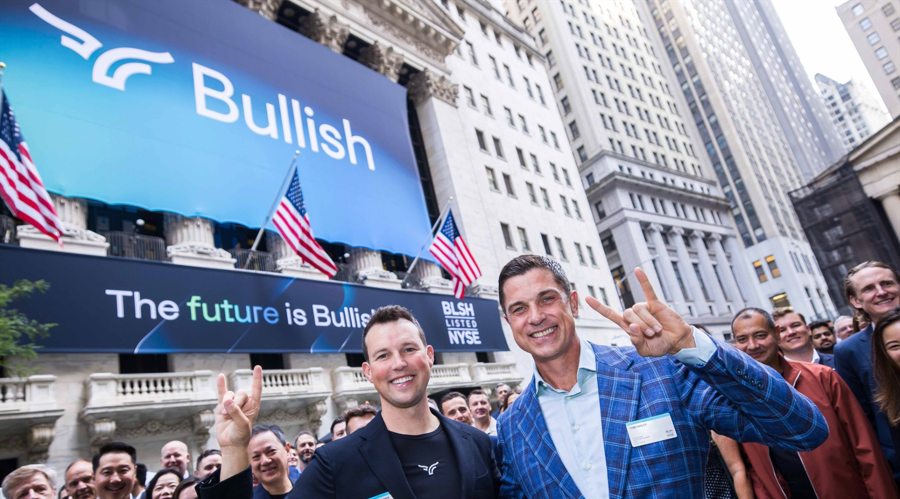
The platform soared 84% in its NYSE debut, minting two new crypto billionaires from the co-founders.
While eToro's May IPO raised $620 million with a solid 29% first-day gain, Bullish's institutional focus delivered nearly triple the performance.
Cryptocurrency exchange
Bullish made a stunning Wall Street debut yesterday (Wednesday), with
shares more than doubling to give the company a nearly $13.2
billion valuation and mint two new crypto billionaires in the
process.
Crypto
Exchange Bullish Soars in Blockbuster NYSE Debut
The
company's stock opened at $90 and climbed as high as $118 before
settling at $68 – an 84% gain from its $37 IPO price. The debut
marked one of the year's most successful public offerings and signals
growing mainstream acceptance of digital assets.
Bullish raised $1.1 billion in the offering after pricing shares above
its already-raised range of $32–$33. The company had initially targeted a
more conservative valuation but investor demand forced underwriters
to boost the price.
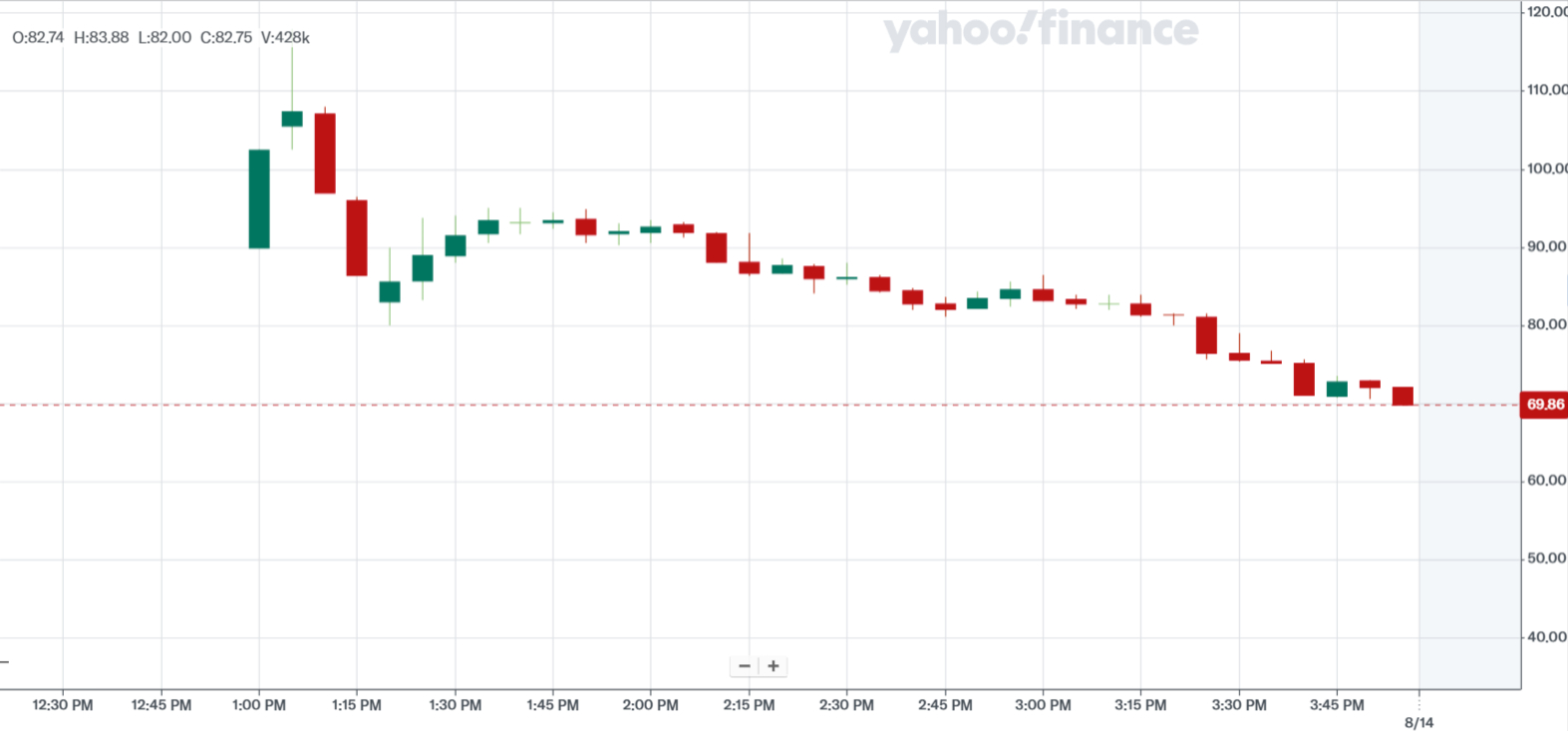
Bullish stock price after IPO. Source: Yahoo Finance
Bullish's
successful IPO adds to a growing wave
of retail trading companies going public. The company joins an increasingly
crowded field of recent debuts including eToro, the Israeli-founded fintech
that went public on Nasdaq in May. eToro raised approximately $620 million at a
$52 IPO price, giving it a valuation of about $4.2 billion.
Like
Bullish, eToro also saw strong first-day performance, opening
at $69.69 and closing at $67 – a 29% gain from its offering price. However,
unlike Bullish's institutional focus, eToro targets retail investors with its
social trading platform that allows users to copy strategies of successful
traders.
Founders Join
Billionaire Ranks
The
public listing catapulted co-founders Brendan
Blumer and Kokuei Yuan into the billionaire club.
Blumer, who serves as a board member, now holds a 30.1% stake
worth approximately $2.8 billion. Yuan, also a board member,
owns 26.7% valued at $2.5 billion.
Both men
previously struck gold in 2018 when their company Block.one
raised $4.2 billion through the largest initial coin offering in
crypto history. That venture, which created the EOS blockchain,
delivered early investors returns exceeding 6,500% before the
Securities and Exchange Commission later charged the company with
selling unregistered securities.
“We've
gone public today, and there's a slew of others that are going
to follow us, and I think that is net beneficial, because it
gives people more options in terms of how they access this asset
class,” Bullish President Chris Tyrer told Reuters.
Unlike
retail-focused rival Coinbase, Bullish targets institutional
clients – a strategy that analysts say positions the
company for steadier revenue streams. The exchange has processed $1.25
trillion in total transactions through March and offers spot, margin
and derivatives trading.
“A
pure institutional strategy positions Bullish for
more stable, recurring revenue than exchanges reliant on
retail volumes, which tend to be cyclical and sentiment-driven,”
said Michael Hall, co-chief investment officer at Nickel Digital
Asset Management.
Pedigreed Leadership
CEO Tom
Farley, the former New York Stock Exchange president,
brings Wall Street credibility that could prove crucial for
winning institutional mandates. His stake in the company is
now worth $355 million.
“For a
sector still overcoming reputational headwinds, that kind of
leadership experience can be a differentiator in securing
institutional mandates,” Hall noted.
The
company is also the parent of crypto news website
CoinDesk, which it acquired from Digital Currency Group
for $72.6 million in 2023.
Founded in
2021 with backing from Block.one, Bullish initially received
about $10 billion in seed assets including 164,000 Bitcoin. The
company still holds more than 24,000 Bitcoin worth over $1.7 billion
as of March.
Blumer, who
gave up his U.S. citizenship in 2020 and now lives in the Cayman
Islands, recently made headlines for purchasing a €170 million villa
in Sardinia – one of the largest residential deals in Italian
history.
The
successful debut provides a much-needed confidence boost for
crypto companies eyeing public markets after years of regulatory
uncertainty and market volatility.
Cryptocurrency exchange
Bullish made a stunning Wall Street debut yesterday (Wednesday), with
shares more than doubling to give the company a nearly $13.2
billion valuation and mint two new crypto billionaires in the
process.
Crypto
Exchange Bullish Soars in Blockbuster NYSE Debut
The
company's stock opened at $90 and climbed as high as $118 before
settling at $68 – an 84% gain from its $37 IPO price. The debut
marked one of the year's most successful public offerings and signals
growing mainstream acceptance of digital assets.
Bullish raised $1.1 billion in the offering after pricing shares above
its already-raised range of $32–$33. The company had initially targeted a
more conservative valuation but investor demand forced underwriters
to boost the price.
Bullish stock price after IPO. Source: Yahoo Finance
Bullish's
successful IPO adds to a growing wave
of retail trading companies going public. The company joins an increasingly
crowded field of recent debuts including eToro, the Israeli-founded fintech
that went public on Nasdaq in May. eToro raised approximately $620 million at a
$52 IPO price, giving it a valuation of about $4.2 billion.
Like
Bullish, eToro also saw strong first-day performance, opening
at $69.69 and closing at $67 – a 29% gain from its offering price. However,
unlike Bullish's institutional focus, eToro targets retail investors with its
social trading platform that allows users to copy strategies of successful
traders.
Founders Join
Billionaire Ranks
The
public listing catapulted co-founders Brendan
Blumer and Kokuei Yuan into the billionaire club.
Blumer, who serves as a board member, now holds a 30.1% stake
worth approximately $2.8 billion. Yuan, also a board member,
owns 26.7% valued at $2.5 billion.
Both men
previously struck gold in 2018 when their company Block.one
raised $4.2 billion through the largest initial coin offering in
crypto history. That venture, which created the EOS blockchain,
delivered early investors returns exceeding 6,500% before the
Securities and Exchange Commission later charged the company with
selling unregistered securities.
“We've
gone public today, and there's a slew of others that are going
to follow us, and I think that is net beneficial, because it
gives people more options in terms of how they access this asset
class,” Bullish President Chris Tyrer told Reuters.
Unlike
retail-focused rival Coinbase, Bullish targets institutional
clients – a strategy that analysts say positions the
company for steadier revenue streams. The exchange has processed $1.25
trillion in total transactions through March and offers spot, margin
and derivatives trading.
“A
pure institutional strategy positions Bullish for
more stable, recurring revenue than exchanges reliant on
retail volumes, which tend to be cyclical and sentiment-driven,”
said Michael Hall, co-chief investment officer at Nickel Digital
Asset Management.
Pedigreed Leadership
CEO Tom
Farley, the former New York Stock Exchange president,
brings Wall Street credibility that could prove crucial for
winning institutional mandates. His stake in the company is
now worth $355 million.
“For a
sector still overcoming reputational headwinds, that kind of
leadership experience can be a differentiator in securing
institutional mandates,” Hall noted.
The
company is also the parent of crypto news website
CoinDesk, which it acquired from Digital Currency Group
for $72.6 million in 2023.
Founded in
2021 with backing from Block.one, Bullish initially received
about $10 billion in seed assets including 164,000 Bitcoin. The
company still holds more than 24,000 Bitcoin worth over $1.7 billion
as of March.
Blumer, who
gave up his U.S. citizenship in 2020 and now lives in the Cayman
Islands, recently made headlines for purchasing a €170 million villa
in Sardinia – one of the largest residential deals in Italian
history.
The
successful debut provides a much-needed confidence boost for
crypto companies eyeing public markets after years of regulatory
uncertainty and market volatility.
Damian's adventure with financial markets began at the Cracow University of Economics, where he obtained his MA in finance and accounting. Starting from the retail trader perspective, he collaborated with brokerage houses and financial portals in Poland as an independent editor and content manager. His adventure with Finance Magnates began in 2016, where he is working as a business intelligence analyst.
From Chat to Stock: xStocks Puts Tokenized U.S. Equities Inside TON Wallet on Telegram
Featured Videos
Executive Interview | Charlotte Bullock | Chief Product Officer, Bank of London | FMLS:25
In this interview, we sat down with Charlotte Bullock, Head of Product at The Bank of London, previously at SAP and now shaping product at one of the sector’s most ambitious new banking players.
Charlotte reflects on the Summit so far and talks about the culture inside fintech banks today. We look at the pressures that come with scaling, and how firms can hold onto the nimble approach that made them stand out early on.
We also cover the state of payments ahead of her appearance on the payments roundtable: the blockages financial firms face, the areas that still need fixing, and what a realistic solution looks like in 2026.
In this interview, we sat down with Charlotte Bullock, Head of Product at The Bank of London, previously at SAP and now shaping product at one of the sector’s most ambitious new banking players.
Charlotte reflects on the Summit so far and talks about the culture inside fintech banks today. We look at the pressures that come with scaling, and how firms can hold onto the nimble approach that made them stand out early on.
We also cover the state of payments ahead of her appearance on the payments roundtable: the blockages financial firms face, the areas that still need fixing, and what a realistic solution looks like in 2026.
In this interview, we sat down with Charlotte Bullock, Head of Product at The Bank of London, previously at SAP and now shaping product at one of the sector’s most ambitious new banking players.
Charlotte reflects on the Summit so far and talks about the culture inside fintech banks today. We look at the pressures that come with scaling, and how firms can hold onto the nimble approach that made them stand out early on.
We also cover the state of payments ahead of her appearance on the payments roundtable: the blockages financial firms face, the areas that still need fixing, and what a realistic solution looks like in 2026.
In this interview, we sat down with Charlotte Bullock, Head of Product at The Bank of London, previously at SAP and now shaping product at one of the sector’s most ambitious new banking players.
Charlotte reflects on the Summit so far and talks about the culture inside fintech banks today. We look at the pressures that come with scaling, and how firms can hold onto the nimble approach that made them stand out early on.
We also cover the state of payments ahead of her appearance on the payments roundtable: the blockages financial firms face, the areas that still need fixing, and what a realistic solution looks like in 2026.
In this conversation, we sit down with Drew Niv, CSO at ATFX Connect and one of the most influential figures in modern FX.
We speak about market structure, the institutional view on liquidity, and the sharp rise of prop trading, a sector Drew has been commenting on in recent months. Drew explains why he once dismissed prop trading, why his view changed, and what he now thinks the model means for brokers, clients and risk managers.
We explore subscription-fee dependency, the high reneging rate, and the long-term challenge: how brokers can build a more stable and honest version of the model. Drew also talks about the traffic advantage standalone prop firms have built and why brokers may still win in the long run if they take the right approach.
In this conversation, we sit down with Drew Niv, CSO at ATFX Connect and one of the most influential figures in modern FX.
We speak about market structure, the institutional view on liquidity, and the sharp rise of prop trading, a sector Drew has been commenting on in recent months. Drew explains why he once dismissed prop trading, why his view changed, and what he now thinks the model means for brokers, clients and risk managers.
We explore subscription-fee dependency, the high reneging rate, and the long-term challenge: how brokers can build a more stable and honest version of the model. Drew also talks about the traffic advantage standalone prop firms have built and why brokers may still win in the long run if they take the right approach.
In this conversation, we sit down with Drew Niv, CSO at ATFX Connect and one of the most influential figures in modern FX.
We speak about market structure, the institutional view on liquidity, and the sharp rise of prop trading, a sector Drew has been commenting on in recent months. Drew explains why he once dismissed prop trading, why his view changed, and what he now thinks the model means for brokers, clients and risk managers.
We explore subscription-fee dependency, the high reneging rate, and the long-term challenge: how brokers can build a more stable and honest version of the model. Drew also talks about the traffic advantage standalone prop firms have built and why brokers may still win in the long run if they take the right approach.
In this conversation, we sit down with Drew Niv, CSO at ATFX Connect and one of the most influential figures in modern FX.
We speak about market structure, the institutional view on liquidity, and the sharp rise of prop trading, a sector Drew has been commenting on in recent months. Drew explains why he once dismissed prop trading, why his view changed, and what he now thinks the model means for brokers, clients and risk managers.
We explore subscription-fee dependency, the high reneging rate, and the long-term challenge: how brokers can build a more stable and honest version of the model. Drew also talks about the traffic advantage standalone prop firms have built and why brokers may still win in the long run if they take the right approach.
In this conversation, we sit down with Drew Niv, CSO at ATFX Connect and one of the most influential figures in modern FX.
We speak about market structure, the institutional view on liquidity, and the sharp rise of prop trading, a sector Drew has been commenting on in recent months. Drew explains why he once dismissed prop trading, why his view changed, and what he now thinks the model means for brokers, clients and risk managers.
We explore subscription-fee dependency, the high reneging rate, and the long-term challenge: how brokers can build a more stable and honest version of the model. Drew also talks about the traffic advantage standalone prop firms have built and why brokers may still win in the long run if they take the right approach.
In this conversation, we sit down with Drew Niv, CSO at ATFX Connect and one of the most influential figures in modern FX.
We speak about market structure, the institutional view on liquidity, and the sharp rise of prop trading, a sector Drew has been commenting on in recent months. Drew explains why he once dismissed prop trading, why his view changed, and what he now thinks the model means for brokers, clients and risk managers.
We explore subscription-fee dependency, the high reneging rate, and the long-term challenge: how brokers can build a more stable and honest version of the model. Drew also talks about the traffic advantage standalone prop firms have built and why brokers may still win in the long run if they take the right approach.
Executive Interview | Remonda Z. Kirketerp Møller| CEO & Founder Muinmos | FMLS:25
In this interview, Remonda Z. Kirketerp Møller, founder of Muinmos, breaks down the state of AI in regtech and what responsible adoption really looks like for brokers. We talk about rising fragmentation, the pressures around compliance accuracy, and why most firms are still in the early stages of AI maturity.
Ramanda also shares insights on regulator sandboxes, shifting expectations around accountability, and the current reality of MiCA licensing and passporting in Europe.
A concise look at where compliance, onboarding, and AI-driven processes are heading next.
In this interview, Remonda Z. Kirketerp Møller, founder of Muinmos, breaks down the state of AI in regtech and what responsible adoption really looks like for brokers. We talk about rising fragmentation, the pressures around compliance accuracy, and why most firms are still in the early stages of AI maturity.
Ramanda also shares insights on regulator sandboxes, shifting expectations around accountability, and the current reality of MiCA licensing and passporting in Europe.
A concise look at where compliance, onboarding, and AI-driven processes are heading next.
In this interview, Remonda Z. Kirketerp Møller, founder of Muinmos, breaks down the state of AI in regtech and what responsible adoption really looks like for brokers. We talk about rising fragmentation, the pressures around compliance accuracy, and why most firms are still in the early stages of AI maturity.
Ramanda also shares insights on regulator sandboxes, shifting expectations around accountability, and the current reality of MiCA licensing and passporting in Europe.
A concise look at where compliance, onboarding, and AI-driven processes are heading next.
In this interview, Remonda Z. Kirketerp Møller, founder of Muinmos, breaks down the state of AI in regtech and what responsible adoption really looks like for brokers. We talk about rising fragmentation, the pressures around compliance accuracy, and why most firms are still in the early stages of AI maturity.
Ramanda also shares insights on regulator sandboxes, shifting expectations around accountability, and the current reality of MiCA licensing and passporting in Europe.
A concise look at where compliance, onboarding, and AI-driven processes are heading next.
In this interview, Remonda Z. Kirketerp Møller, founder of Muinmos, breaks down the state of AI in regtech and what responsible adoption really looks like for brokers. We talk about rising fragmentation, the pressures around compliance accuracy, and why most firms are still in the early stages of AI maturity.
Ramanda also shares insights on regulator sandboxes, shifting expectations around accountability, and the current reality of MiCA licensing and passporting in Europe.
A concise look at where compliance, onboarding, and AI-driven processes are heading next.
In this interview, Remonda Z. Kirketerp Møller, founder of Muinmos, breaks down the state of AI in regtech and what responsible adoption really looks like for brokers. We talk about rising fragmentation, the pressures around compliance accuracy, and why most firms are still in the early stages of AI maturity.
Ramanda also shares insights on regulator sandboxes, shifting expectations around accountability, and the current reality of MiCA licensing and passporting in Europe.
A concise look at where compliance, onboarding, and AI-driven processes are heading next.
In this conversation, we speak with Aydin Bonabi, CEO and co-founder of Surveill, a firm focused on fraud detection and AI-driven compliance tools for financial institutions.
We start with Aydin’s view of the Summit and the challenges brokers face as fraud tactics grow more complex. He explains how firms can stay ahead through real-time signals, data patterns, and early-stage detection.
We also talk about AI training and why compliance teams often struggle to keep models accurate, fair, and aligned with regulatory expectations. Aydin breaks down what “good” AI training looks like inside a financial environment, including the importance of clean data, domain expertise, and human oversight.
He closes with a clear message: fraud is scaling, and so must the tools that stop it.
In this conversation, we speak with Aydin Bonabi, CEO and co-founder of Surveill, a firm focused on fraud detection and AI-driven compliance tools for financial institutions.
We start with Aydin’s view of the Summit and the challenges brokers face as fraud tactics grow more complex. He explains how firms can stay ahead through real-time signals, data patterns, and early-stage detection.
We also talk about AI training and why compliance teams often struggle to keep models accurate, fair, and aligned with regulatory expectations. Aydin breaks down what “good” AI training looks like inside a financial environment, including the importance of clean data, domain expertise, and human oversight.
He closes with a clear message: fraud is scaling, and so must the tools that stop it.
In this conversation, we speak with Aydin Bonabi, CEO and co-founder of Surveill, a firm focused on fraud detection and AI-driven compliance tools for financial institutions.
We start with Aydin’s view of the Summit and the challenges brokers face as fraud tactics grow more complex. He explains how firms can stay ahead through real-time signals, data patterns, and early-stage detection.
We also talk about AI training and why compliance teams often struggle to keep models accurate, fair, and aligned with regulatory expectations. Aydin breaks down what “good” AI training looks like inside a financial environment, including the importance of clean data, domain expertise, and human oversight.
He closes with a clear message: fraud is scaling, and so must the tools that stop it.
In this conversation, we speak with Aydin Bonabi, CEO and co-founder of Surveill, a firm focused on fraud detection and AI-driven compliance tools for financial institutions.
We start with Aydin’s view of the Summit and the challenges brokers face as fraud tactics grow more complex. He explains how firms can stay ahead through real-time signals, data patterns, and early-stage detection.
We also talk about AI training and why compliance teams often struggle to keep models accurate, fair, and aligned with regulatory expectations. Aydin breaks down what “good” AI training looks like inside a financial environment, including the importance of clean data, domain expertise, and human oversight.
He closes with a clear message: fraud is scaling, and so must the tools that stop it.
In this conversation, we speak with Aydin Bonabi, CEO and co-founder of Surveill, a firm focused on fraud detection and AI-driven compliance tools for financial institutions.
We start with Aydin’s view of the Summit and the challenges brokers face as fraud tactics grow more complex. He explains how firms can stay ahead through real-time signals, data patterns, and early-stage detection.
We also talk about AI training and why compliance teams often struggle to keep models accurate, fair, and aligned with regulatory expectations. Aydin breaks down what “good” AI training looks like inside a financial environment, including the importance of clean data, domain expertise, and human oversight.
He closes with a clear message: fraud is scaling, and so must the tools that stop it.
In this conversation, we speak with Aydin Bonabi, CEO and co-founder of Surveill, a firm focused on fraud detection and AI-driven compliance tools for financial institutions.
We start with Aydin’s view of the Summit and the challenges brokers face as fraud tactics grow more complex. He explains how firms can stay ahead through real-time signals, data patterns, and early-stage detection.
We also talk about AI training and why compliance teams often struggle to keep models accurate, fair, and aligned with regulatory expectations. Aydin breaks down what “good” AI training looks like inside a financial environment, including the importance of clean data, domain expertise, and human oversight.
He closes with a clear message: fraud is scaling, and so must the tools that stop it.
Exness expands its presence in Africa: Inside our interview with Paul Margarites in Cape Town
Finance Magnates met with Paul Margarites, Exness regional commercial director for Sub-Saharan Africa, during a visit to the firm’s office opening in Cape Town. In this talk, led by Andrea Badiola Mateos, Co-CEO at Finance Magnates, Paul shares views on the South African trading space, local user behavior, mobile trends, regulation, team growth, and how Exness plans to grow in more markets across the region. @Exness
Read the article at: https://www.financemagnates.com/thought-leadership/exness-expands-its-presence-in-africa-inside-our-interview-with-paul-margarites/
#exness #financemagnates #exnesstrading #CFDtrading #tradeonline #africanews #capetown
Finance Magnates met with Paul Margarites, Exness regional commercial director for Sub-Saharan Africa, during a visit to the firm’s office opening in Cape Town. In this talk, led by Andrea Badiola Mateos, Co-CEO at Finance Magnates, Paul shares views on the South African trading space, local user behavior, mobile trends, regulation, team growth, and how Exness plans to grow in more markets across the region. @Exness
Read the article at: https://www.financemagnates.com/thought-leadership/exness-expands-its-presence-in-africa-inside-our-interview-with-paul-margarites/
#exness #financemagnates #exnesstrading #CFDtrading #tradeonline #africanews #capetown
Finance Magnates met with Paul Margarites, Exness regional commercial director for Sub-Saharan Africa, during a visit to the firm’s office opening in Cape Town. In this talk, led by Andrea Badiola Mateos, Co-CEO at Finance Magnates, Paul shares views on the South African trading space, local user behavior, mobile trends, regulation, team growth, and how Exness plans to grow in more markets across the region. @Exness
Read the article at: https://www.financemagnates.com/thought-leadership/exness-expands-its-presence-in-africa-inside-our-interview-with-paul-margarites/
#exness #financemagnates #exnesstrading #CFDtrading #tradeonline #africanews #capetown
Finance Magnates met with Paul Margarites, Exness regional commercial director for Sub-Saharan Africa, during a visit to the firm’s office opening in Cape Town. In this talk, led by Andrea Badiola Mateos, Co-CEO at Finance Magnates, Paul shares views on the South African trading space, local user behavior, mobile trends, regulation, team growth, and how Exness plans to grow in more markets across the region. @Exness
Read the article at: https://www.financemagnates.com/thought-leadership/exness-expands-its-presence-in-africa-inside-our-interview-with-paul-margarites/
#exness #financemagnates #exnesstrading #CFDtrading #tradeonline #africanews #capetown
Finance Magnates met with Paul Margarites, Exness regional commercial director for Sub-Saharan Africa, during a visit to the firm’s office opening in Cape Town. In this talk, led by Andrea Badiola Mateos, Co-CEO at Finance Magnates, Paul shares views on the South African trading space, local user behavior, mobile trends, regulation, team growth, and how Exness plans to grow in more markets across the region. @Exness
Read the article at: https://www.financemagnates.com/thought-leadership/exness-expands-its-presence-in-africa-inside-our-interview-with-paul-margarites/
#exness #financemagnates #exnesstrading #CFDtrading #tradeonline #africanews #capetown
Finance Magnates met with Paul Margarites, Exness regional commercial director for Sub-Saharan Africa, during a visit to the firm’s office opening in Cape Town. In this talk, led by Andrea Badiola Mateos, Co-CEO at Finance Magnates, Paul shares views on the South African trading space, local user behavior, mobile trends, regulation, team growth, and how Exness plans to grow in more markets across the region. @Exness
Read the article at: https://www.financemagnates.com/thought-leadership/exness-expands-its-presence-in-africa-inside-our-interview-with-paul-margarites/
#exness #financemagnates #exnesstrading #CFDtrading #tradeonline #africanews #capetown